MEXC Restricted Countries List 2026: Bans, KYC & Alternatives
Find out where MEXC is unavailable in 2026, why the UK and Europe now sit in the firing line, what KYC limits apply, and which licensed exchanges to use instead.

Disclosure: Coinperps may earn a commission from partner links, at no extra cost to you. Reviews are based on independent testing, see how we test.
- MEXC now fully prohibits 11 jurisdictions, including the United States, Canada, the United Kingdom, Mainland China, Hong Kong, Singapore, and several sanctioned territories, with the UK added as a hard ban rather than just an app-store block.
- The platform stays unlicensed everywhere it operates, and Europe is the next pressure point as the MiCA transition deadline of 1 July 2026 forces unlicensed exchanges to either get authorised or offboard EU users.
- If MEXC is restricted in your region, regulated alternatives such as Kraken, Bybit, Coinbase, and CoinSpot offer comparable derivatives access with verified licensing and stronger consumer protection.

MEXC
MEXC is a centralized exchange launched in 2018, offering over 2,900 cryptocurrencies and high-leverage perpetual futures with more than $12 billion in daily trading volume.
Features
Fees
Regulation
Overall
Many traders only discover MEXC is off-limits at the moment they try to verify an account or open a futures position. The exchange runs from the Seychelles with no tier-one licence anywhere, so its access map shifts whenever a regulator pushes back or a new framework takes effect.
The list changed meaningfully over the past year. The United Kingdom moved from a partial block to a full prohibition, the restricted Ukrainian regions expanded, and the no-KYC withdrawal ceiling was cut sharply in most markets. Knowing exactly where you stand matters before you deposit funds or build a position.
Read below for the full breakdown of MEXC's country restrictions. ⬇️
List of MEXC Restricted Countries
MEXC blocks registration and trading in a defined set of jurisdictions to align with international sanctions and local licensing rules. The list below reflects the Prohibited Jurisdictions named in the MEXC User Agreement, last updated in April 2026.
Fully prohibited jurisdictions (no registration, login, or trading):
- North America: United States and Canada are barred entirely, with MEXC blocking IP addresses and refusing account creation for residents.
- Sanctioned states: North Korea, Iran, Cuba, and Sudan are cut off in line with international sanctions covering financial services.
- Asia and crypto-banned regions: Mainland China, Hong Kong, and Singapore are excluded due to national bans or strict licensing regimes.
- United Kingdom: Newly added as a hard ban after landing on the FCA Warning List, where it previously faced only app-store limits.
- Russian-controlled regions of Ukraine: Crimea, Donetsk, Luhansk, Zaporizhzhia, Kherson, and Sevastopol are restricted, with Zaporizhzhia and Kherson added in the latest update.
MEXC also limits app downloads in some markets even where trading itself is allowed. Per MEXC's official restricted-countries notice, the iOS app is unavailable in India, Japan, South Korea, and the United Kingdom, while the Android app is unavailable in India, Indonesia, Japan, South Korea, and the United Kingdom. Users in these regions can still reach supported services through the official website.
The Prohibited Jurisdictions list is non-exclusive and can change at any time at MEXC's discretion. Trying to bypass a restriction can lead to account closure and loss of access to funds, so confirm your status before signing up.

Countries and Currencies Supported by MEXC
MEXC remains available across most of Europe, Africa, Latin America, the Middle East, and the wider Asia-Pacific region, covering more than 170 countries in total. Fiat access depends heavily on region and on third-party payment providers rather than direct bank rails.
How fiat access works by region:
- Card payments: Credit and debit card purchases are handled through third-party gateways across most supported markets, typically in USD, EUR, and GBP equivalents.
- SEPA in the EEA: Euro deposits via SEPA are available to verified users in parts of the European Economic Area, though this access is now tied to the MiCA timeline discussed below.
- Local rails: Selected markets in Latin America, the Middle East, and Asia support regional card and local-currency on-ramps, subject to KYC.
- Crypto-only access: Many regions can trade and withdraw crypto while having little or no fiat support, which is common across Africa and parts of Asia.
Fiat fees vary by method and provider, and the supported-country picture moves often. Always confirm current availability for your specific country before depositing, since the platform adjusts coverage as regulations shift.

Does MEXC Require Mandatory KYC Verification?
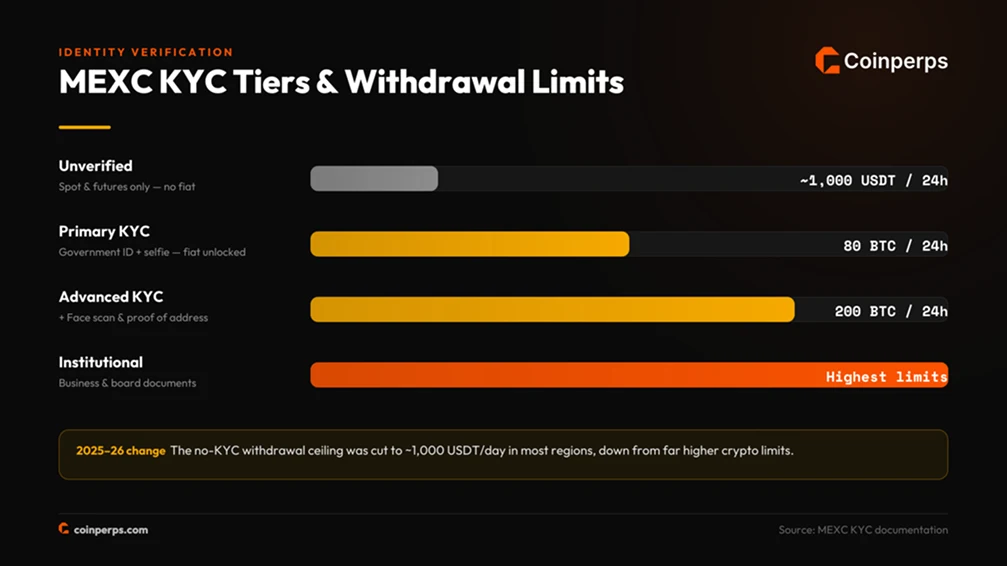
MEXC built its reputation as a no-KYC exchange, and basic spot and futures trading is still possible without identity documents. That freedom narrowed in 2025 and 2026, with the unverified withdrawal ceiling cut to roughly 1,000 USDT per 24 hours in most regions, down from the far higher crypto limits offered previously.
KYC tiers and what they unlock:
- Unverified (Tier 0): Trade spot and futures with no documents, but withdrawals are capped near 1,000 USDT per day in most markets and fiat services stay locked.
- Primary KYC (Tier 1): Submit a government-issued ID and selfie to raise the 24-hour withdrawal limit to 80 BTC and open fiat options in supported regions.
- Advanced KYC (Tier 2): Add facial recognition and proof of address to reach a 200 BTC daily limit and full feature access.
- Institutional KYC: Business accounts require company and board documentation and unlock the highest limits.
MEXC can also force verification based on location or account activity, and some users report being asked to verify after the fact. Each verified identity can be linked to a maximum of two MEXC accounts. Completing KYC improves account recovery options and is required for any fiat-related activity.
MEXC Derivatives Trading Restrictions
MEXC does not publish a separate restricted-countries list for derivatives. Access to futures follows the same Prohibited Jurisdictions rules in the User Agreement, so users in the US, Canada, the UK, China, Hong Kong, Singapore, and sanctioned territories are blocked from perpetuals along with everything else.
In supported regions, eligible users can trade USDT-margined, USDC-margined, and COIN-margined perpetual futures, with leverage reaching up to 500x on the most liquid pairs such as BTC and ETH. That cap is among the highest in the industry, and the elevated liquidation risk it carries is a key reason regulators in licensed markets restrict products like these.
The platform also offers leveraged ETF tokens, copy trading, and grid strategies. None of these change the underlying jurisdiction rules, so derivatives availability tracks the country list exactly.

Why is MEXC Banned in the US?
MEXC is banned in the United States because it holds no registration with US regulators such as the SEC, the CFTC, or FinCEN. Without those approvals it cannot legally offer crypto trading, derivatives, or fiat services to US residents, so it blocks US IP addresses and refuses sign-ups from the country.
US money-services law also requires strict identity verification, which sits at odds with MEXC's lighter no-KYC model in other regions. For a deeper look at access realities and the risks involved, see our guide on how to use MEXC in the USA.
Is MEXC Banned in the UK?
Yes. The United Kingdom is now listed as a fully prohibited jurisdiction, a step up from the earlier position where UK users faced only app-store download limits. MEXC blocks UK registration rather than pursue the authorisation needed to operate there.
The driver is the FCA financial promotions regime, in force since October 2023, which requires any firm marketing crypto to UK consumers to be authorised and to carry clear risk warnings. The FCA escalated enforcement in early 2026 by launching legal proceedings against another offshore exchange for breaching these rules, and MEXC Global Ltd already appears on the FCA Warning List. Pulling out of the UK entirely is the defensive response, and it leaves UK residents without recourse to protections such as the FSCS.
Will MEXC Be Available in Europe After MiCA?
Europe is the next major uncertainty. The EU's Markets in Crypto-Assets framework (MiCA) sets a transition ceiling of 1 July 2026, with some member states applying earlier cut-offs. The European regulator ESMA confirmed in April 2026 that after this date any firm serving EU clients without a MiCA licence is in breach of EU law and must stop offering services.
After that point, an exchange serving EEA users without a MiCA licence operates illegally, as does any licensed exchange that keeps routing European users through an unlicensed offshore entity. MEXC currently holds no MiCA authorisation in any member state, which places it in the same unlicensed bucket as several large platforms that national regulators have already flagged. Note too that MiCA-licensed venues in the EEA have already restricted non-compliant stablecoins such as USDT, which is central to MEXC's product set.
That leaves MEXC with a binary choice: secure a CASP licence or offboard EU users. European traders who want continuity should not assume current SEPA and EEA access will survive past mid-2026, and should plan around a MiCA-licensed alternative in advance.
Which Regulators Have Warned About MEXC?
MEXC operates without a tier-one licence in any major market, and a growing list of financial regulators has published consumer warnings about it providing services without authorisation.
Regulators that have warned about MEXC:
- Germany (BaFin): Warned consumers that MEXC offered financial services on mexc.com without the required authorisation.
- United Kingdom (FCA): Lists MEXC Global Ltd on its Warning List as an unauthorised firm that may be targeting people in the UK.
- Malaysia (SC): Added MEXC Global to the Investor Alert List for operating without registration.
- Other authorities: Austria's FMA, Belgium's FSMA, Cyprus's CySEC, Japan's FSA, Hong Kong's SFC, and Canada's British Columbia Securities Commission have each issued comparable alerts.
These warnings do not make MEXC illegal to use everywhere, but they signal that affected users trade without local consumer protection or a clear path to recover funds if something goes wrong. The 1/10 regulatory score on our MEXC exchange profile reflects exactly this gap.

Can You Access MEXC with a VPN?
A VPN can technically mask your location and reach the MEXC site from a restricted country, since the platform relies on IP-based blocking. That does not make it safe or advisable.
Using a VPN to bypass restrictions breaches MEXC's Terms of Use and can trigger account suspension, frozen assets, or forced verification. The platform monitors for VPN patterns and known VPN IP ranges, and users in restricted regions have reported being locked out with limited ability to recover funds. Circumventing a geo-block may also breach local law.
For US-based readers weighing the trade-offs, our how to use MEXC in the USA guide covers the specific risks in detail. In most cases a locally licensed exchange is the safer path.
Best Alternatives if MEXC is Unavailable in Your Country
If MEXC is restricted where you live, several regulated exchanges offer comparable derivatives and spot access with verified licensing and clearer consumer protection. The table below outlines leading options by regulatory standing.
Best MEXC Alternatives in Europe
Kraken is one of the most established options for European traders, combining deep liquidity, a broad asset list, and a MiCA licence held through its Central Bank of Ireland entity and passported across the EEA. Unlike MEXC, it offers regulatory assurance ahead of the July 2026 deadline alongside derivatives access for eligible users, and you can check its own regional limits in our Kraken restricted countries guide. Bitpanda suits beginners who want a fully MiCA-licensed, EUR-friendly home base. See our roundup of the best crypto futures platforms in Europe for more.
Best MEXC Alternatives in the United States and Canada
Coinbase leads the regulated US market with SEC, CFTC, and NYDFS oversight. Its derivatives arm is a CFTC-registered Designated Contract Market that began listing US perpetual futures in 2025, a regulated route MEXC cannot legally offer American users. The specifics are covered in our Coinbase Perpetuals restricted countries guide, and Canadian traders can compare locally compliant venues in our best crypto futures platforms in Canada guide.
Best MEXC Alternatives in Asia and the Middle East
Bybit is a strong derivatives venue with a MiCAR licence granted by Austria's FMA in May 2025, plus regional licences from VARA in Dubai and AFSA in Kazakhstan, offering high-leverage perpetuals under more transparent compliance than MEXC. Its own regional limits are detailed in our Bybit restricted countries guide. Gate appeals to traders who want an expansive asset list and a deep futures market while keeping VASP registrations in Lithuania and Malta.
Best MEXC Alternatives in Australia
CoinSpot is AUSTRAC-registered and widely trusted by Australian users, while a broader set of perpetuals-focused venues is covered in our best crypto futures platforms in Australia guide. Australian traders should note that local rules around crypto derivatives are stricter than MEXC's offshore model implies.
Before signing up anywhere, confirm the platform's licensing status for your specific country. You can compare verified venues side by side on our perpetual exchanges hub.

Bottom Line
MEXC offers some of the lowest fees and highest leverage in the market, but it pairs that with the thinnest regulatory standing of any major exchange. Its restriction list is widening rather than narrowing, with the UK now fully banned and Europe facing a hard MiCA reckoning by mid-2026.
For users in supported regions, the platform remains functional, though the tighter no-KYC limits and the absence of any tier-one licence mean weaker protection if a dispute or insolvency arises. Anyone trading sizeable balances should weigh that exposure carefully.
If MEXC is unavailable in your country, a licensed alternative that complies with your local laws is the safer route. Track regulatory updates closely, since the next framework deadline could shift access again with little notice.
Frequently asked questions
How do I know if my country is restricted by MEXC?
Check the Prohibited Jurisdictions section of the MEXC User Agreement, which is updated periodically based on legal and compliance changes. The current list includes the US, Canada, the UK, Mainland China, Hong Kong, Singapore, and several sanctioned territories. Always confirm your status before creating or funding an account.
Why was the UK added to MEXC's restricted list?
The UK's FCA financial promotions regime requires firms marketing crypto to UK consumers to be authorised. Rather than meet those requirements, MEXC moved the UK from a partial app-store block to a full prohibition. UK residents trading on the platform have no access to FSCS protection.
Can I still use MEXC in Europe after July 2026?
That depends on whether MEXC obtains a MiCA licence. The EU transition ceiling is 1 July 2026, with some member states applying earlier dates, and ESMA has confirmed that firms serving EU clients without authorisation must stop after the applicable deadline. MEXC currently holds no MiCA licence, so European access beyond mid-2026 is not guaranteed.
Can I use MEXC without completing KYC?
Basic spot and futures trading is available without KYC, but the unverified withdrawal limit is now capped near 1,000 USDT per day in most regions, and fiat services stay locked. Higher limits and full access require Primary or Advanced verification, and MEXC may request verification based on your location or activity.
Is it safe to access MEXC with a VPN?
No. Using a VPN to bypass a country restriction breaches MEXC's Terms of Use and can lead to account suspension, frozen funds, or forced verification. MEXC monitors for VPN use, and bypassing a geo-block may also breach local law. A locally licensed exchange is the safer option.