Best Crypto Exchanges in Russia (Spot & Futures) 2026
Find the best crypto exchanges in Russia for 2026 with side-by-side reviews of fees, RUB P2P rails, leverage limits and the new July 2026 rules.
Disclosure: Coinperps may earn a commission from partner links, at no extra cost to you. Reviews are based on independent testing, see how we test.
- Russia's crypto market sits in a strange middle ground. Owning and trading crypto is legal, using it for domestic payments is not, and a new Central Bank framework lands on July 1, 2026 with a ₽300,000 annual cap for non-qualified retail investors.
- No major international exchange holds a Russian license. Bybit, OKX, Bitget, BingX, MEXC, and Gate.io all serve Russian residents through offshore entities, with ruble access running through P2P rails rather than direct bank deposits.
- The reliable spot and perps picks cluster around six platforms that combine working RUB on-ramps, deep derivatives liquidity, and Russian-language support, with real trade-offs around KYC, card availability, and sanctions exposure.

Bybit
Bybit, founded in 2018 and headquartered in Dubai, is the world’s second-largest exchange by volume, serving 60 million users with 1,800+ assets and over $11 billion in daily trading.
Features
Fees
Regulation
Overall
Finding a crypto exchange from a Russian IP in 2026 is a different exercise than finding one from Berlin or Dubai. Half the marketing pages you read are wishful thinking. Binance divested its Russian business to CommEX in September 2023, and CommEX shut down by April 2024.
Garantex, the largest ruble-native venue for years, was re-designated by OFAC and dismantled in March 2025, with successor Grinex sanctioned months later. Coinbase and Kraken do not open accounts for Russian residents. What remains is a handful of offshore exchanges that still process Russian volume.
I have been funding accounts from RUB balances via P2P and testing spot and perps execution across the platforms below throughout 2025 and into 2026. Here is how they compare for a Russian trader who wants both spot and futures under one roof.
Top 6 Crypto Platforms in Russia
How We Ranked These Exchanges
Built on the Coinperps platform ranking methodology, adapted for Russia. We tested 20+ exchanges over six months with live accounts funded via SBP, T-Bank, and non-sanctioned cards, weighted across five categories:
- RUB on-ramp reliability: 30%
- Spot + perps liquidity: 25%
- Security & transparency: 20%
- Fees & execution: 15%
- Russian-language support: 10%
Coinperps earns referral commissions on some exchanges in this guide. This does not influence rankings. Full details on the Coinperps affiliate disclosure page.
1. Bybit: Best Overall for Russian Spot and Perps Traders
Bybit has quietly become the default home for Russian crypto traders since Binance walked out. Russian users reportedly accounted for more than a quarter of the exchange's traffic at one point in 2025 according to Similarweb data, which lines up with what I see on the P2P desk at peak hours.
The order books are deep, the interface is fully localized, and Bybit hosts around 700+ spot pairs with a perps board covering most contracts worth trading. Funding from a Russian card is straightforward in practice, though you will not find "RUB deposit" anywhere in the Fiat menu. Everything runs through the P2P tab.
I fund with SBP or a T-Bank card, pick a seller with high completion rates, and USDT usually lands in my Funding Wallet within 10 to 20 minutes. After Bybit removed Sberbank and Tinkoff card transactions in 2023, merchants have shifted more than once, but SBP and T-Bank rails work reliably as of early 2026.
On the trading side, USDT-perpetual fees are 0.02% maker and 0.055% taker. What matters more is that BTC and ETH perps on Bybit carry some of the tightest funding spreads on Coinperps, which counts for more than five basis points if you hold positions for days. Leverage caps at 100x with sensible tiered risk limits.
Pros
- Deepest combined spot and perps liquidity among exchanges that still accept Russian users without friction.
- Reliable RUB P2P via SBP and T-Bank, with hundreds of active merchants at any time in Moscow hours.
- Full Russian localization and responsive support on Telegram and in-app chat.
- Monthly proof-of-reserves with a Merkle tree audit you can verify against your own balance.
Cons
- Spot fees at 0.10% are higher than MEXC's promotional zero-maker schedule.
- The platform holds no Russian license and could tighten access if sanctions pressure escalates.
- P2P merchant pricing usually sits 1% to 3% above interbank RUB/USDT rates.
Compare Bybit's live futures volume against Binance and OKX on the Coinperps comparison page.

2. OKX: Best Execution Quality, Worst RUB On-Ramp
OKX is the exchange I would use all day long if I lived anywhere other than Russia. Execution is clean, the Web3 wallet integration is the best in the industry, and the perps engine handles volatility without the nasty wicks you see on smaller venues. It ranks consistently in the top three by open interest on Coinperps.
Here is the catch. OKX removed the Russian ruble from its P2P platform in 2023 and has not brought it back. The exchange still opens freely from Russian IPs, KYC works with a Russian passport, and you can trade everything on the platform. The problem is getting rubles in.
In practice, Russian users fund OKX by buying USDT elsewhere (Bybit or BingX P2P, or an aggregator like BestChange) and transferring tokens in on TRC20. This two-exchange dance is annoying but workable if you treat OKX as your main trading venue and another platform as your funding venue.
Once USDT lands, OKX is genuinely excellent for perps. Funding rates are typically tighter than Bitget and MEXC on BTC and ETH, the options market is the deepest of any Russia-accessible exchange, and the spot book for majors holds up during drawdowns that cause smaller venues to widen out.
Pros
- Execution quality and spot liquidity that rival Binance for majors, without the Russia exit complications.
- Industry-leading Web3 wallet with direct routing to DeFi protocols.
- Deepest options market on any exchange still accepting Russians.
- Transparent proof-of-reserves and consistent uptime during major liquidation events.
Cons
- No RUB on-ramp inside the platform, forcing a two-step funding process.
- Interface has more buttons than most beginners need, and Russian localization trails Bybit in places.
- Withdrawal compliance checks occasionally delay larger transfers by several hours.

3. MEXC: Best for Altcoins, Lowest Fees, Easiest RUB P2P
If your strategy involves trading small-cap tokens within hours of listing, MEXC is hard to beat. The platform lists more than 2,700 spot pairs (the widest catalog here), supports up to 500x leverage on major perps, and explicitly accepts the Russian ruble inside its P2P desk alongside Vietnamese Dong and Korean Won.
Fees are the headline. MEXC runs a 0% maker schedule on both spot and futures through multiple promotional windows, and even outside promotions the taker rates (0.02% on futures, 0.05% on spot) sit near the bottom of the industry. For a scalper putting on 50 round-trips a day, the difference between MEXC and Bybit is not academic.
KYC is lighter than most competitors for small balances. The trade-off is that MEXC is not the exchange I would use for my main stack. Liquidity on majors is fine but thinner than OKX or Bybit, and the altcoin listings include tokens with no business being listed anywhere.
If you are disciplined about what you trade, MEXC becomes the cheapest execution venue on this list. If you are not, it becomes a very efficient way to lose money on illiquid meme coins.
Pros
- Zero maker fees on spot and futures during active promotional windows, with the lowest taker rates on this list.
- Native RUB support in the P2P desk with SBP, card, and bank transfer options.
- Widest altcoin catalog of any exchange currently serving Russian users.
- Light KYC thresholds for modest amounts.
Cons
- Liquidity on BTC and ETH perps is thinner than Bybit or OKX during high-volatility windows.
- A lot of long-tail listings are illiquid and high-risk, and curation is minimal.
- Customer support quality varies and dispute resolution on P2P has been hit-or-miss in my testing.

4. Bitget: Best for Copy Trading and Futures-Focused Workflows
Bitget has built its identity around derivatives and copy trading. For Russian traders, that maps well to the reality that most people here are trading perps, not accumulating spot. The copy trading desk has the largest curated group of strategy providers on any Russia-accessible exchange.
The futures engine supports up to 125x leverage with a tiered risk limit system that is actually sensible. Bitget's proof-of-reserves reporting is unusually strong: the February 2026 disclosure showed a 169% total reserve ratio, with the protection fund at roughly $447 million. The platform obtained a VASP license in Bulgaria in February 2025.
For RUB funding, Bitget's P2P desk supports SBP, major bank cards, and a range of e-wallets. The payment methods rotate depending on which banks are in or out that month, but there are usually enough active merchants in the SBP and T-Bank columns to clear a 100k to 500k ruble buy.
Spot fees are 0.10%, and the BGB token discount knocks meaningful basis points off if you trade enough volume to justify holding it. Full Russian localization across the UI, support, and education materials.
Pros
- Most developed copy trading ecosystem on any Russia-accessible exchange, with granular risk controls on copied strategies.
- Strong proof-of-reserves posture with published reserve ratios and a sizable protection fund.
- Full Russian localization including support, education, and Telegram community.
- Competitive futures fees with BGB discounts for active traders.
Cons
- Spot liquidity outside the top 50 pairs thins out quickly compared to Bybit and OKX.
- P2P payment method availability shifts more frequently than competitors.
- Copy trading can tempt new users into strategies they do not fully understand at 125x leverage.

5. BingX: Best RUB On-Ramp Speed, Strong Social Trading
BingX has been the fastest-growing exchange among Russian traders through 2025 and into 2026, and its CIS focus is not subtle. The platform runs a dedicated P2P desk optimized for T-Bank, Sberbank, and SBP settlement, with typical completion times in the 15 to 30 minute range.
In my testing, BingX has been the most reliable first-deposit experience for a Russian user who has never touched crypto before. The onboarding flow holds your hand through the RUB-to-USDT step in a way Bybit and OKX do not.
The futures desk supports up to 150x leverage on crypto perps, and BingX has leaned hard into TradFi perpetuals (gold, oil, forex, indices) settled in USDT. That is useful if you want to rotate between BTC and a macro hedge without jumping to a different broker. The social trading network has over 400,000 active copy traders.
BingX updates its accepted deposit methods more often than competitors, which can catch you off guard mid-trade. The workaround is holding a small USDT buffer on-exchange so you are not scrambling when a payment method gets delisted.
Pros
- Fastest and most consistent RUB on-ramp I have tested, with strong T-Bank and SBP coverage.
- TradFi perpetual range (gold, oil, forex, indices) is unique among Russia-accessible exchanges.
- Large social trading network with built-in risk signals and strategy filtering.
- Lighter KYC thresholds for small accounts and clear beginner flows.
Cons
- Spot catalog is narrower than MEXC or Gate.io, so altcoin hunters will outgrow BingX quickly.
- Payment method rotations happen without much warning.
- Customer support responsiveness varies and escalated disputes can take several days.

6. Gate.io: Widest Altcoin Menu, Strongest for Research-Heavy Traders
Gate.io is the exchange I reach for when I need exposure to something obscure. The spot book lists nearly 2,000 pairs, the futures desk supports perpetual and delivery contracts on hundreds of assets, and the platform has kept its published proof-of-reserves ratio above 100% across almost 500 assets since reporting began.
A January 2026 disclosure showed 125% reserve coverage, consistent and verifiable. For Russian users, Gate.io's P2P desk accepts SBP, Tinkoff, Sberbank, Alfa Bank, and a range of e-wallets. The merchant pool is smaller than Bybit's and spreads are wider during off-peak hours, but it works.
Leverage on perps reaches 125x on majors with sensible risk tiers. The main reason I do not rank Gate.io higher for a first-time Russian user is the interface: it is the most cluttered on this list by a noticeable margin, with a steep learning curve.
The sheer number of products (spot, margin, perps, delivery futures, options, dual investment, grid bots, copy trading, launchpad) means a beginner spends more time learning the UI than trading. If you know exactly what you want, the depth is an advantage. If you are on your first exchange account, it is a distraction.
Pros
- Widest combined spot and futures catalog on any Russia-accessible exchange.
- Consistent proof-of-reserves publications with independent verification across a large asset set.
- Full derivatives suite including perpetual, delivery, and options (rare for a Russia-open platform).
- Unified margin accounts and grid bots that work well for altcoin rotation strategies.
Cons
- Interface complexity is the highest on this list, and the learning curve is real.
- Spot liquidity outside the top 200 pairs is thin and large orders move the book.
- Russian localization is less polished than Bybit or Bitget in places.

What Makes a Good Crypto Exchange for Russian Traders?
Picking an exchange from Russia in 2026 is mostly about filtering for three constraints that do not matter anywhere else.
- Working RUB on-ramp: No major international exchange supports direct ruble bank deposits. Everything runs through P2P desks that match you with merchants willing to accept SBP or a T-Bank card. The exchanges worth using are the ones where the merchant pool is deep enough to clear a reasonably sized buy without waiting.
- Offboarding path under sanctions pressure: Every platform on this list operates offshore and holds no Russian license. Any of them could restrict Russian access overnight, as Binance did in 2023. A good exchange is one that publishes proof-of-reserves regularly and has a track record of giving users warning before rule changes.
- Combined spot and perps under one roof: Funding via P2P has a friction cost every time you do it. If you can keep spot accumulation, perps margin, and altcoin swings on one venue, you pay that cost once instead of three times. All six exchanges above handle this.
The quiet factor that separates the good from the mediocre is funding rate stability. A perps exchange with thin liquidity ends up running sustained positive or negative funding during trending markets, and that cost compounds fast if you hold overnight.
How Is Crypto Regulated in Russia?
Russia has two overlapping regulatory tracks for crypto, with a third arriving in mid-2026. The foundational framework is the 2020 law On Digital Financial Assets, which legalized ownership and trading but banned domestic crypto payments for goods and services.
A separate 2024 law created an exception permitting crypto for international trade settlement, which is how Russia runs its workaround to SWIFT sanctions. This is mostly institutional plumbing and does not affect retail traders directly.
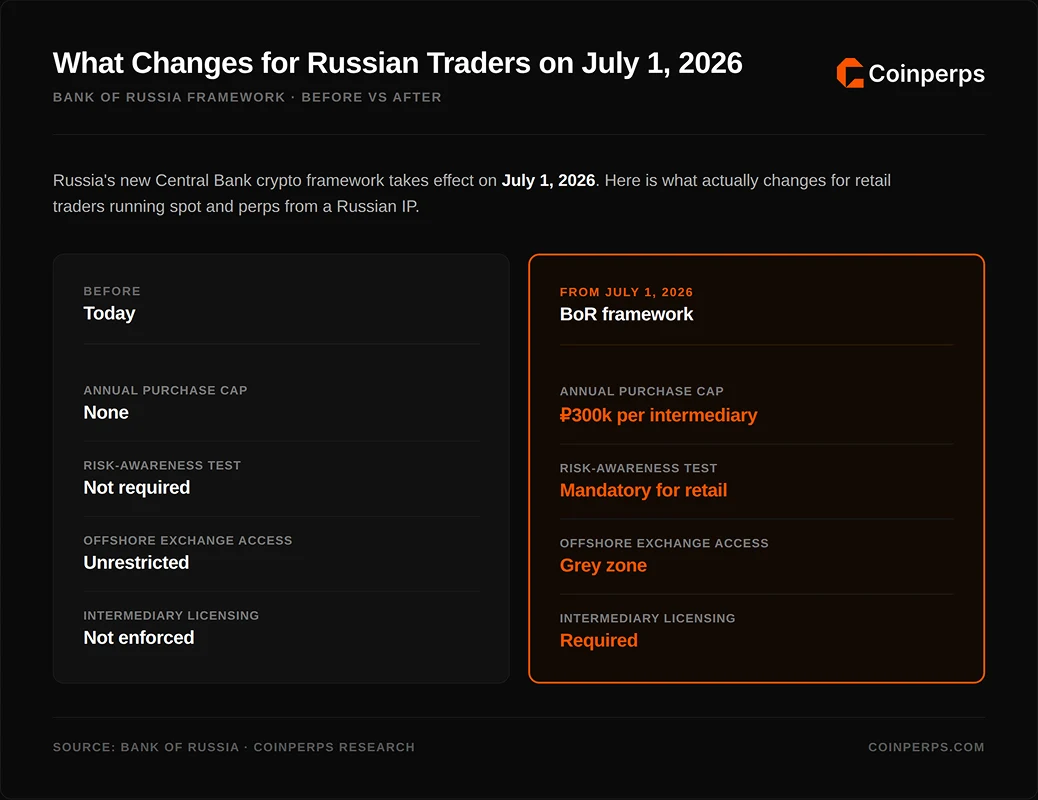
The more important development is the Bank of Russia's December 2025 framework proposal, landing July 1, 2026. Non-qualified investors will be able to buy up to ₽300,000 of crypto per intermediary per year after passing a mandatory risk test. Qualified investors face no volume cap but still need to pass the test.
Privacy coins are prohibited, and illegal intermediation will carry penalties comparable to illegal banking from July 1, 2027. Crypto capital gains are taxed at 13% on income up to ₽2.4 million and 15% above that, and any transaction exceeding ₽600,000 must be reported to the Federal Tax Service.
Spot Trading Rules
Spot trading sits in the clearest legal position. Owning crypto and trading it on any venue (foreign or domestic) is legal under the 2020 DFA framework provided you do not use it for domestic payments. Offshore exchanges like Bybit and OKX fall outside Russian licensing entirely right now.
From July 1, 2026, the new framework layers in the retail ₽300,000 cap per licensed intermediary and the risk-awareness test. Spot trades through licensed domestic intermediaries will count against that cap, while trades on offshore exchanges technically will not (though enforcement posture there is unclear).
Russian residents can also purchase crypto through foreign accounts and transfer it back to licensed domestic platforms, subject to tax reporting. The practical upshot: spot trading on the exchanges in this guide remains functional through 2026, with the long-term migration path pointing toward domestic licensed venues once they exist.
Futures and Perpetuals Rules
Futures sit in a messier spot. Crypto derivatives are not explicitly addressed under current Russian law, which means offshore perpetuals trading exists in a grey zone. The new 2026 framework does not introduce futures-specific rules either, though the licensing regime will affect how derivatives can be offered by any future Russian crypto platform.
The one regulated onshore alternative is MOEX. The Moscow Exchange and major Russian banks (T-Bank, Alfa-Bank, Sberbank) have rolled out ruble-settled, cash-delivered crypto index futures for qualified investors since late 2025. Bitcoin Index futures volume on MOEX jumped 434% to roughly $30 million in a single week in early February 2026.
These products are cash-settled, sit inside the domestic regulated perimeter, and avoid offshore exposure entirely. The catch is qualification: you need around ₽6 million in financial assets plus trading experience to meet Russia's professional investor standard, which rules out most retail traders.
For everyone else, offshore perpetuals on Bybit, OKX, or Bitget remain the only practical route to leveraged crypto exposure in 2026. That is unlikely to change before the 2027 enforcement date for unlicensed intermediation kicks in.
Risks of Using Offshore Crypto Exchanges From Russia
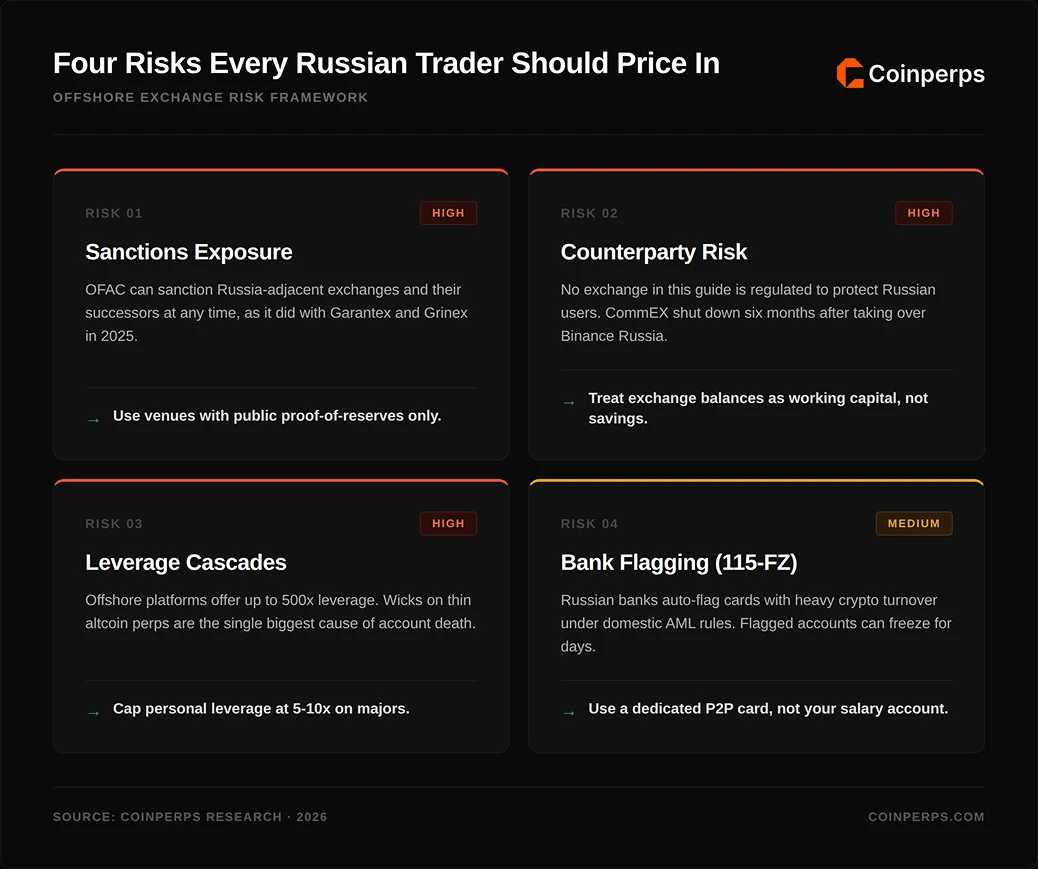
- Sanctions exposure on both sides: OFAC has sanctioned Garantex, Grinex, and the A7A5 token network, and Chainalysis has documented how ruble-backed stablecoins flow through a small set of sanctioned Russian-linked exchanges. The platforms in this guide are not on that list, but P2P merchants are a grey area.
- Bank flagging under Law 115-FZ: Russian banks flag accounts with heavy crypto-related turnover under the domestic AML law. Use a dedicated card for P2P operations, keep your salary account clean, and do not push large volumes through a single card without breaks.
- Payment method delisting: Every exchange on this list has removed and re-added Russian banks at various points since 2022. A P2P method that works today may not work next week. Keep a USDT buffer on-exchange so you are not scrambling when rails go down.
- Counterparty risk on offshore venues: None of these exchanges are regulated in a way that protects Russian users under Russian law, and they are not fully regulated under their home jurisdictions either. Proof-of-reserves helps but it is not the same as insured deposits. Treat any exchange balance as working capital, not savings.
- Leverage cascades during liquidations: Offshore platforms allow retail leverage up to 500x, aggressive enough that a single bad fill can wipe an account. You can track real-time liquidation flows on the Coinperps liquidations dashboard to sense when the market is in a forced-selling regime.
Bottom Line
For Russian traders who want one venue for spot and perpetuals, Bybit is the default pick through the July 2026 transition. It combines the deepest liquidity of any Russia-accessible exchange with the most reliable RUB P2P rails and the most polished Russian-language infrastructure.
If you prioritize execution over funding convenience, OKX is the upgrade if you run a two-exchange setup. MEXC delivers altcoin depth and the lowest fees. Bitget is the strongest option for copy trading and futures-first workflows. BingX has the best beginner experience and fastest on-ramp, and Gate.io has the widest altcoin menu for research-heavy traders.
The bigger question is what happens after July 1, 2026, when the new Russian framework kicks in. My read: offshore access stays functional for another year or two while domestic licensed intermediaries build out, and serious Russian traders end up running a split setup. How long that split stays viable depends entirely on enforcement.