









What Is the Solana Liquidation Heatmap?
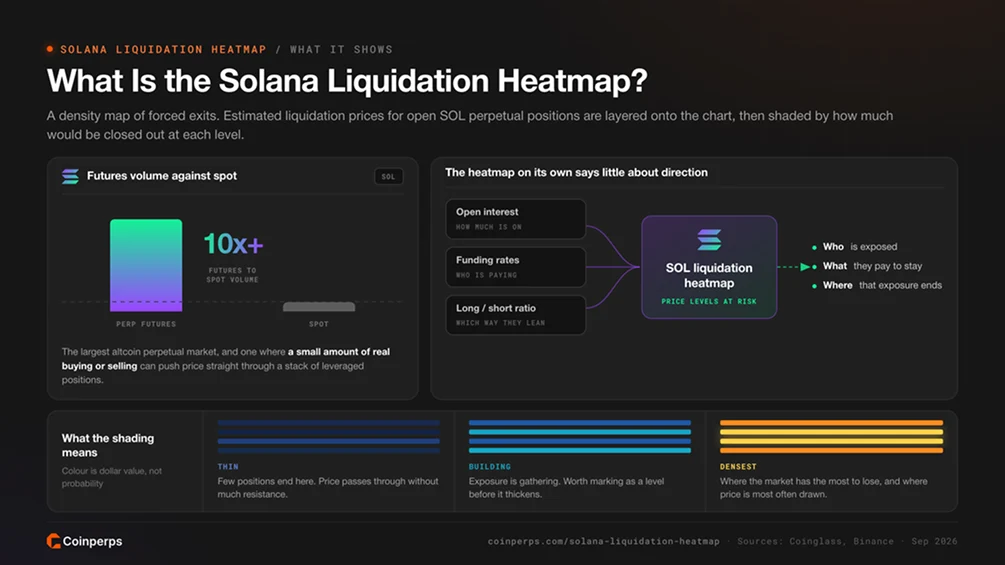
A Solana liquidation heatmap maps the estimated liquidation prices of open SOL perpetual positions onto the price chart. Each level is shaded according to the amount of exposure that would be closed if SOL reached it. The brightest, densest zones represent the largest concentrations of risk.
Solana is the largest altcoin perpetual market, and its trading behaviour reflects that scale. Futures volume regularly exceeds spot volume by more than ten times. As a result, relatively modest spot buying or selling can push price through a stack of leveraged positions. This imbalance also helps explain why SOL clusters clear faster than Bitcoin or Ethereum clusters of comparable size.
Position data alone provides little directional insight. Used alongside open interest, funding rates and the long/short ratio, the heatmap shows who is exposed and what they are paying to maintain that exposure. It also indicates where those positions may be forced to close.
How to Read the Solana Liquidation Heatmap
The table below explains each part of the chart and how traders can use it.
Why Solana Liquidates Differently
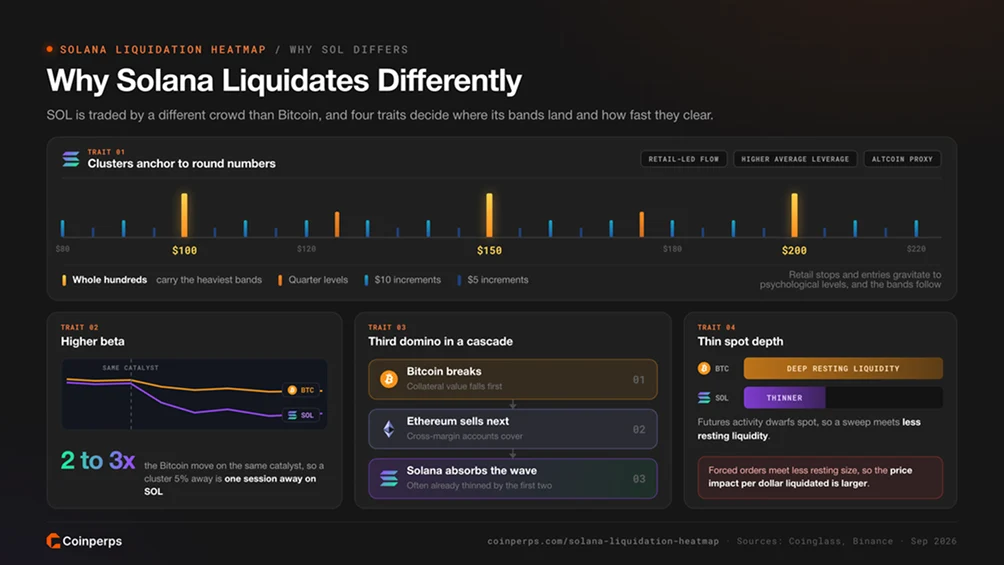
Solana’s liquidation profile reflects its trader base and market structure. Retail traders dominate SOL perpetual volume, average leverage is higher than on Bitcoin, and the token often trades as a proxy for the broader altcoin market.
- Round-number anchors: SOL clusters are usually heaviest around whole numbers such as $100, $150 and $200 because retail entries and stops gravitate towards psychological levels. Smaller bands often develop at $5 and $10 intervals within those zones.
- Higher beta: SOL typically moves further than Bitcoin in response to the same catalyst, sometimes by two or three times as much. A cluster 5% from the current price is therefore far more reachable on SOL within a single session.
- Third domino in a cascade: When Bitcoin falls, cross-margin accounts lose collateral before Ethereum begins to sell. SOL often absorbs the next wave, after its own clusters have already been weakened by the first two moves.
- Thin spot depth: Futures activity substantially exceeds spot trading. Forced orders from a liquidation sweep therefore encounter less resting liquidity than they would on Bitcoin, increasing the price impact of each dollar liquidated.
Coinperps’ Altcoin Season Index tracks the market rotation that drives SOL’s beta. The SOL perpetuals dashboard shows how its leverage is distributed across trading venues.
The Events That Shaped Solana Liquidation Behaviour
Several episodes since late 2025 continue to influence SOL’s liquidation profile.
- The October 10, 2025 cascade: A tariff shock triggered the largest deleveraging event on record. FTI Consulting’s post mortem estimated that more than $19 billion in positions were forcibly closed within roughly one day. SOL was among the hardest-hit major assets and briefly fell by more than 30% intraday. Binance’s staked SOL token, BNSOL, also dislocated on the exchange’s internal price feed during a 40-minute period that evening. The exchange later compensated affected users who had used it as collateral. Collateral pricing has remained central to discussions of SOL liquidation risk since the event.
- The 1 February long unwind: Almost $200 million in SOL positions were liquidated in one day while $2.58 billion was cleared across crypto. Long positions accounted for nearly all of the total. SOL lost the $100 level at around the same time and did not recover it until late August.
- The Drift exploit: On 1 April, Drift Protocol, the largest perpetual futures exchange on Solana, lost approximately $286 million in an attack that Elliptic assessed as consistent with North Korean operations. Its total value locked fell by half. Solana-native venues were left with a smaller share of SOL leverage, changing where liquidations appeared across the market.
- The late-August breakout: SOL escaped a multi-month range of roughly $60 to $100 that had held since June. The token climbed from the low $70s to above $100 in less than two weeks, clearing dense short clusters above the range ceiling. Fresh long exposure then accumulated below the new price.

Where Solana Leverage Sits Today
Solana’s derivatives market is crowded on the long side. At the beginning of September, SOL futures open interest was close to $7 billion. Funding was positive, meaning longs were paying shorts, while roughly two-thirds of accounts on major venues held long positions. The heaviest bands consequently sit below spot, making a long flush more likely than a short squeeze.
The $100 level is particularly important. It capped the range for two months and remains a major psychological price. It now separates the new long clusters formed during the breakout from older bands below. A daily close beneath $100 would expose those positions in sequence.
Spot demand provides a counterweight. Nine US spot Solana ETFs launched from October 2025 and have accumulated around $1.5 billion in assets. Bitwise’s staking fund alone holds more than 9 million SOL. Forward Industries, the largest Solana treasury company, reported holdings of 7.55 million SOL at the end of June. Because these holders buy without leverage, they can absorb a sweep that the heatmap suggested might cascade.
The next scheduled catalyst is the Alpenglow consensus upgrade, which targets finality of roughly 150 milliseconds and is planned for October. Speculative leverage often increases before upgrade windows, so clusters may grow on both sides of the market as the date approaches.

Trading With the Solana Liquidation Heatmap
The heatmap works best as a source of market context rather than a standalone trading signal. Traders commonly use it in the following ways.
- Target the magnet: Price often moves towards the largest untouched cluster. The pull is strongest when funding shows one side paying heavily to remain positioned. Identify the nearest major band above and below spot, then prepare for price to test it. Momentum usually weakens once the band has been cleared and forced orders subside, allowing a counter-move to begin.
- Keep stops out of bright bands: Placing a stop inside a dense cluster leaves it directly in the path of a potential sweep. Position the stop beyond the band or reduce the trade size to allow more room. This lowers the chance that the wick clearing the cluster also closes the trade.
- Size for the stack: Several bright bands concentrated within a narrow range can produce a cascade. On SOL, that may result in a 10% move within minutes. Reduce position sizes near stacked zones and compare each band with open interest to distinguish new leverage entering from older positions closing.
- Watch Bitcoin first: SOL often liquidates later in a cross-margin cascade. The Bitcoin liquidation heatmap and Ethereum liquidation heatmap may therefore reveal the trigger before it appears on the SOL chart. Traders using cross-margin exchanges have the strongest reason to monitor all three.
The Fear and Greed Index provides additional context on whether a sweep is more likely to reverse or continue. Coinperps’ guide to avoiding auto-deleveraging explains what happens when an insurance fund cannot cover liquidation losses.
Limitations of the Solana Liquidation Heatmap
Each band is an estimate rather than a directly observed liquidation level. Exchanges do not publish individual liquidation prices, so the model reconstructs them using open interest, trading volume and an assumed distribution of leverage. Under Binance’s liquidation protocols, positions are triggered by the mark price rather than the last traded price. Tiered maintenance margins also mean that large positions can liquidate after a smaller move than their headline leverage would suggest.
Changing the model’s leverage assumptions can shift the same cluster by several dollars. This is why competing heatmaps rarely identify the exact same SOL price.
Market coverage creates another limitation. The chart uses Binance’s SOL/USDT perpetual because it has the deepest SOL leverage, but it does not extend beyond that market. Positions held on Hyperliquid, Bybit or OKX are excluded. The same applies to Solana-native perp DEXs. Realised liquidations across these venues are instead recorded on the all-asset liquidations feed.
Timing also affects accuracy. During a cascade, the chart is updating against a moving market, and bands that were relevant five minutes earlier may already be gone. SOL can also move through ETF creations, treasury purchases or staking deposits without affecting the perpetual order book. This spot demand may weaken a cascade that the chart appeared to anticipate.
Frequently Asked Questions
What does a bright band on the Solana liquidation heatmap mean?
A bright band marks a price where the model estimates that a large amount of leveraged SOL would be forcibly closed. If price reaches that level, liquidated longs create automatic selling while liquidated shorts create buying. These forced orders allow bright bands to act as both price magnets and accelerants.
How accurate is the Solana liquidation heatmap?
The locations are more reliable than the estimated sizes. Bands are anchored to real open interest and previous liquidation activity, so the identified price levels tend to remain useful. Their size depends on the leverage distribution assumed by the model. Since SOL’s retail-heavy order book makes that mix less predictable than Bitcoin’s, the bands should be treated as risk zones with imprecise edges.
Why are SOL clusters swept more often than BTC or ETH clusters?
SOL responds more sharply to the same catalyst, while retail traders generally use higher leverage. Its spot depth is also thinner relative to futures volume. Positions therefore sit closer to liquidation, and the forced orders released during a sweep have a greater effect on price.
Which timeframe suits short-term SOL trading?
Day traders gain the most from the 12-hour and 24-hour windows, where newly formed clusters can reveal the next likely stop hunt. Position traders generally use the 7-day and 30-day views. Bands that remain visible across several sessions are more relevant to the broader trend.
Does the heatmap cover every exchange?
No. Coinperps’ chart only uses Binance’s SOL/USDT perpetual. Liquidations on Bybit, OKX, Hyperliquid and other venues are counted on the all-asset liquidations feed. The SOL perpetuals page shows how leverage is divided between exchanges.
Are liquidation heatmaps available for other assets?
Yes. Coinperps also provides live heatmaps for Bitcoin, Ethereum, XRP, BNB and HYPE. Each uses the same modelling basis as the Solana heatmap.