Best Crypto Futures Platforms in Australia 2026: Regulation, Fees & Access
Compare the best crypto futures platforms for Australians in 2026. Covers the new Digital Assets Framework Act, Coinbase's retail AFSL, wholesale rules, fees and tax.

Fact checked
Key Takeaways
- Coinbase holds Australia's first retail derivatives AFSL for a crypto exchange, while Kraken and OKX offer full perpetuals only to wholesale clients who pass Corporations Act asset or income tests.
- The Digital Assets Framework Act commences 9 April 2027, and ASIC's licence application deadline passed on 30 June 2026, with penalties of up to 10% of annual turnover for firms that missed it.
- Offshore venues like Bybit and onchain platforms like Hyperliquid give Australians the most access, with 100x and 40x leverage respectively, but carry no Australian consumer protections.

Bybit
Bybit, founded in 2018 and headquartered in Dubai, is the world’s second-largest exchange by volume, serving 60 million users with 1,800+ assets and over $11 billion in daily trading.
Features
Fees
Regulation
Overall Rating
Australia rewrote its crypto rulebook in 2026. The Digital Assets Framework Act passed on 1 April and pulls exchanges and custodians into the AFSL regime, and days later Coinbase became the first crypto exchange with a retail derivatives AFSL.
Access still splits three ways. Kraken and OKX reserve full perpetual suites for wholesale clients, Bybit serves Australians without a local licence, and Hyperliquid sits outside the perimeter entirely. ASIC has enforced hard: $8 million against Kraken's operator, $10 million against Binance's derivatives arm, and a public warning to Bitget over 125x products.
This guide ranks the best crypto futures platforms for Australians in mid-2026, who can legally access what, and the fees, leverage, and tax rules that matter. Rankings follow our methodology.
How Crypto Futures Are Regulated in Australia in 2026
Crypto derivatives have always been financial products under the Corporations Act 2001, so anyone issuing perpetuals, futures, or margin products to Australians needs an AFSL. The 2026 change widened the perimeter around everything else. The Digital Assets Framework Act creates two new financial products, Digital Asset Platforms (DAPs) and Tokenised Custody Platforms (TCPs), placing exchanges, brokers, and custodians under ASIC supervision even where the tokens they hold are not financial products.
The regime commences on 9 April 2027, but ASIC required licence applications by 30 June 2026. Past that date, its no-action position fell away and unlicensed firms face civil and criminal exposure of up to 10% of annual turnover.
Two settings define the futures market itself:
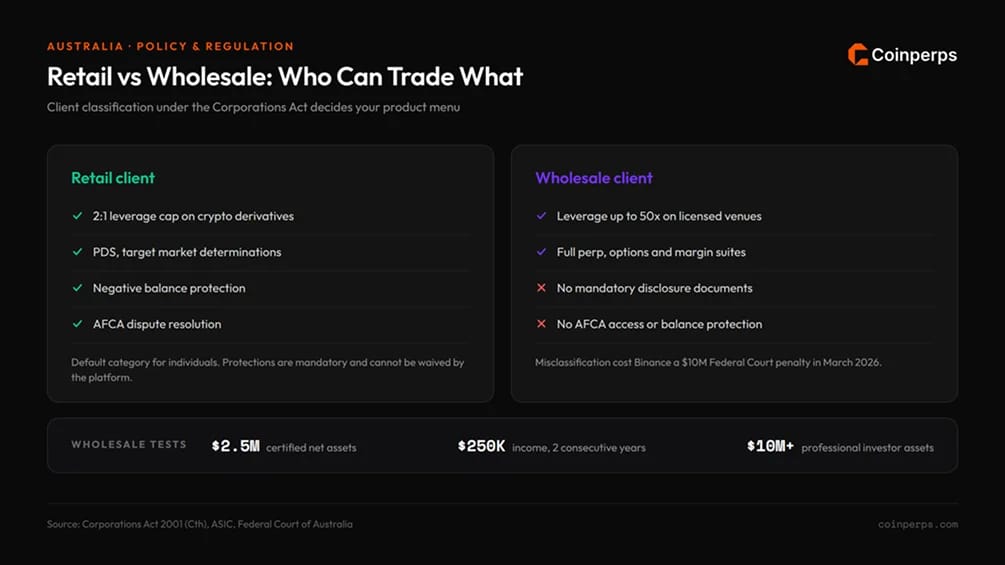
- 2:1 retail leverage cap. ASIC limits crypto derivatives offered to retail clients to 2:1 leverage under the same product intervention framework that governs CFDs.
- Retail vs wholesale classification. Licensed venues can offer high-leverage perpetuals only to clients certified as wholesale, creating a three-tier market: capped retail products, wholesale products up to 50x, and offshore or onchain venues with no Australian protections at all.
Demand keeps climbing regardless. Independent Reserve's Cryptocurrency Index put Australian crypto exposure at 33% in 2026, up from 31%, while global monthly perp volume hit $7.24 trillion in January 2026 per CoinGecko.
Best Crypto Futures Platforms in Australia Compared
Live funding, volume, and open interest for each venue updates continuously on our perpetual exchanges hub.
Top Crypto Futures Platforms for Australians Reviewed
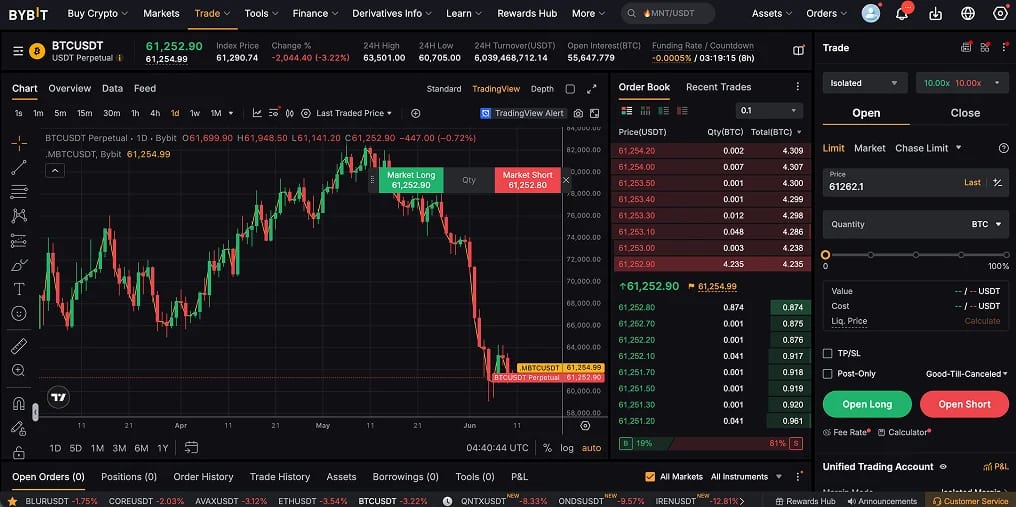
Bybit: Deepest Perp Access for Australian Retail Traders
Bybit is the default for Australians who want full perpetual access without wholesale certification. It lists 500+ USDT and inverse perp pairs, runs top-three global derivatives volume, and offers 100x leverage with maker fees from 0.02%. AUD on-ramps work through P2P and processors like Banxa, and its TradFi suite adds stock perps and MT5 CFDs, covered in our Bybit TradFi review.
The trade-off is regulatory. Bybit holds no AFSL and no AUSTRAC registration, so Australians get no local dispute resolution, no client money protections, and full offshore counterparty exposure. See our Bybit vs OKX comparison for how it stacks up against the licensed wholesale alternative.
Quick take: Best market depth and product range available to Australian retail traders. Zero local protection.
Coinbase: The Licensed Retail Option
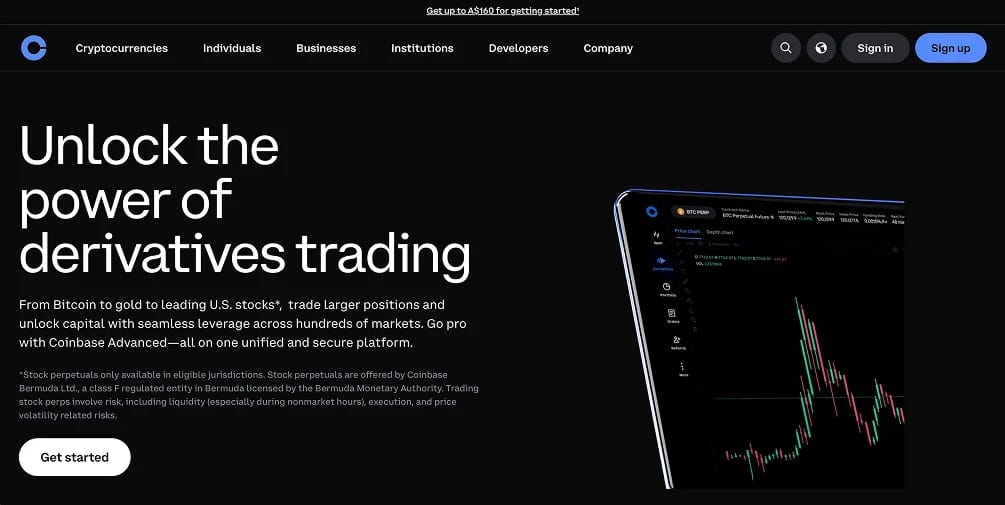
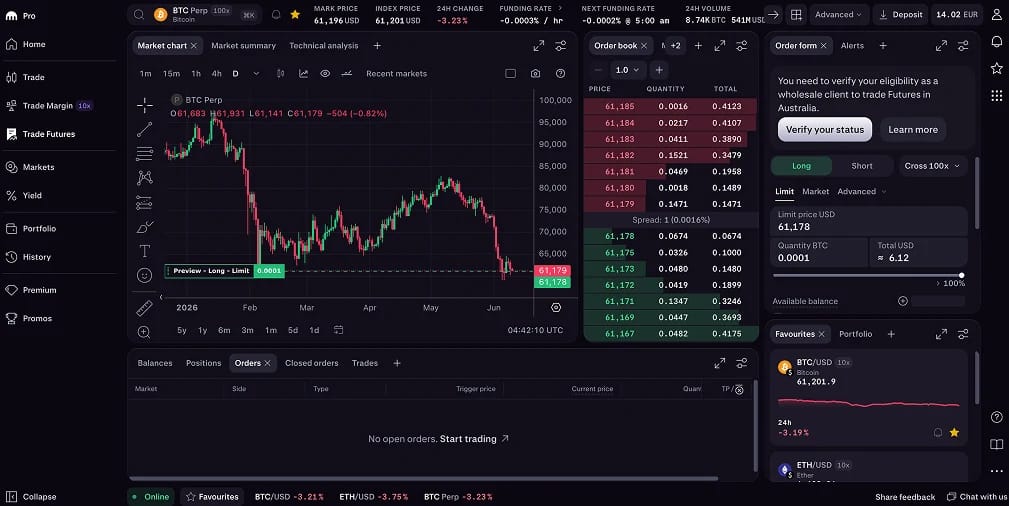
Coinbase Australia received the first retail derivatives AFSL granted to a crypto exchange in April 2026 and is rolling out crypto and equity perpetuals under it, with dated futures and options next. The licence imposes the same conduct, disclosure, and consumer protection standards as any Australian broker, including PDS documents, target market determinations, and external dispute resolution. PayID AUD rails and SMSF onboarding round out the regulated stack.
Expect tighter parameters than offshore. Coinbase's international perps cap crypto leverage around 20x and equity perps at 10x, and the Australian retail product operates within ASIC's intervention settings. It is the first genuine licensed leverage option and the safest entry point to perpetual futures markets.
Quick take: The only AFSL-covered retail perps in Australia. Lower leverage, full statutory protections.
Kraken: Best for Wholesale Clients
Kraken's Australian derivatives run through Beaufort Fiduciaries Pty Ltd under AFSL 545124, wholesale clients only. Qualify and you get 350+ perpetual contracts, 50x leverage, multi-collateral wallets, and taker fees from 0.05% that compress with volume, plus regular proof of reserves and an expanding shelf of FX and tokenized equity perps.
The history explains the structure. Kraken's local operator Bit Trade paid an $8 million penalty in December 2024 for offering a retail margin product without a target market determination. Today's wholesale-only setup is the direct result, and one of the most compliance-hardened in the country.
Quick take: Strongest licensed product for wholesale-qualified traders. Highest leverage of any AFSL venue.
OKX: Licensed Wholesale Alternative With AUD Rails
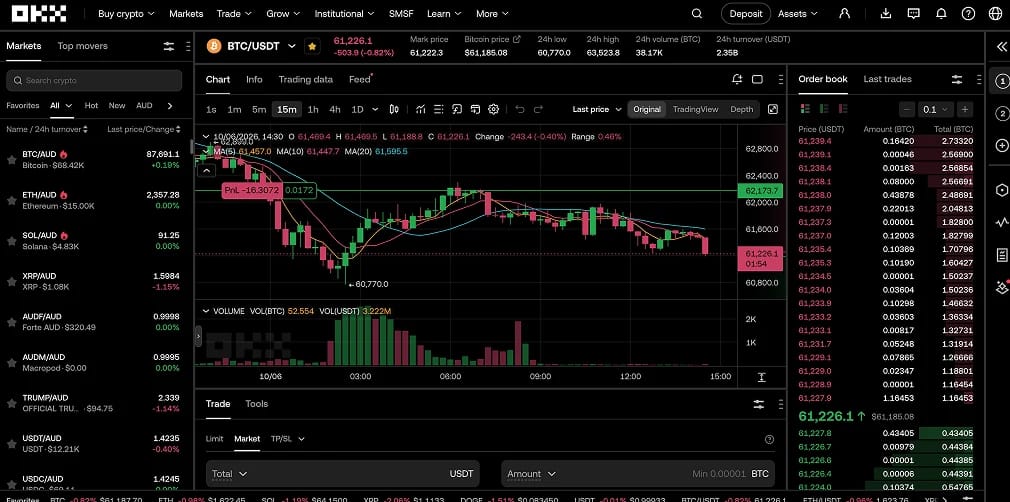
OKX splits its local business in two. OKX Australia Pty Ltd handles AUSTRAC-registered spot with direct AUD deposits and withdrawals through most Australian banks, while OKX Australia Financial Pty Ltd (AFSL 379035) offers futures, options, and perpetuals to verified wholesale clients at up to 20x across 100+ cryptocurrencies, backed by a Sydney office and local relationship managers.
That leverage cap sits below Kraken's 50x, but the AUD funding convenience is unmatched among licensed derivatives venues. Retail users stay limited to spot until product settings change under the new regime.
Quick take: Best AUD rails of any licensed venue. Wholesale-only derivatives at 20x.
Hyperliquid: The Onchain Path
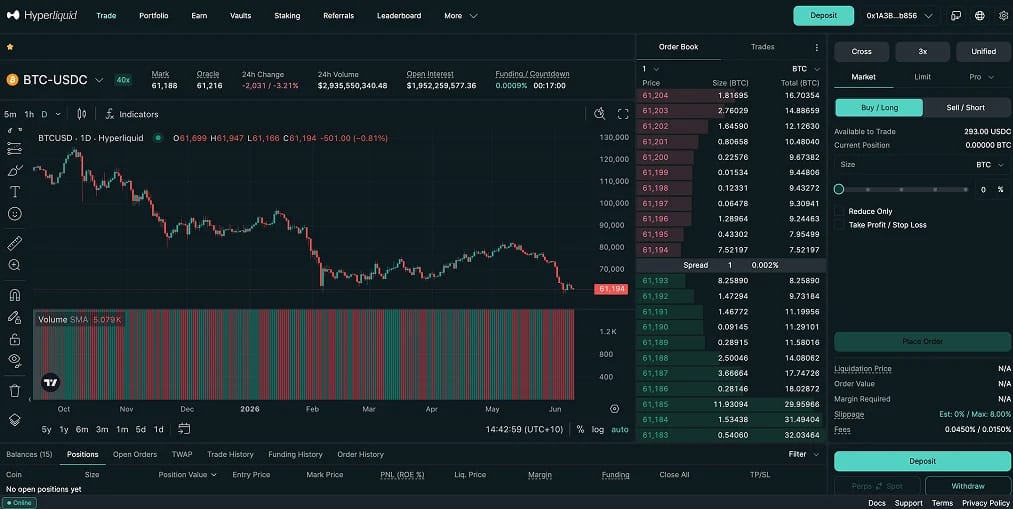
Hyperliquid requires no account application, no wholesale certificate, and no custodian. The leading perp DEX runs a fully onchain order book with one-block finality, 190+ markets at up to 40x leverage, and 0.045% base taker fees with maker rebates. DEXs grew from 2.0% to 10.2% of all perp volume between January 2024 and January 2026, and Hyperliquid alone cleared $1.59 trillion in the six months to January 2026, ranking it among the top ten perp venues globally including CEXs.
Australians can connect a wallet and trade in minutes, and self-custody removes exchange counterparty risk. Smart contract risk, bridge risk, and zero recourse replace it: no PDS, no AFCA, no entity to sue. Our decentralized perpetual exchange rankings compare Hyperliquid against Aster, Lighter, and the rest of the onchain field.
Quick take: Fastest access and self-custody. All risk sits onchain with no legal recourse.
Retail or Wholesale: Which Client Category Are You?
Licensed venues sort every applicant into one of two buckets, and the bucket decides your product menu. The main wholesale pathways under the Corporations Act:
- Individual wealth test. An accountant certifies net assets of $2.5 million+ or gross income of $250,000+ in each of the last two financial years.
- Sophisticated investor assessment. The licensee verifies sufficient experience, typically via a knowledge assessment plus documentation, as OKX runs for derivatives onboarding.
- Professional investor or large business tests. Holding an AFSL yourself, controlling $10 million+ in assets, or meeting company size thresholds.
Wholesale status means surrendering retail protections: no mandatory disclosure, no negative balance protection, no leverage caps, no automatic AFCA access. That trade is what the Binance case turned on. In March 2026 the Federal Court fined Binance Australia Derivatives $10 million for misclassifying 524 retail investors as wholesale, over 85% of its client base, after those traders lost $8.66 million and paid $3.89 million in fees on products they should never have accessed.
Binance handed back its derivatives AFSL in 2023, so Australians have had no local Binance futures since. Our Binance futures restricted countries guide tracks the wider picture.
ASIC Enforcement Is Reshaping the Platform List
Three actions define the current enforcement posture, and each removed or reshaped an option Australians once used:
ActionDateOutcomeBit Trade (Kraken) penaltyDec 2024$8M fine over retail margin product; derivatives now wholesale-onlyBinance Australia Derivatives penaltyMar 2026$10M fine for wholesale misclassification; AFSL surrendered in 2023Bitget investor alertJul 2025Public warning over unlicensed 125x futures offered to Australians
The Bitget alert is the template for what comes next. ASIC contrasted 125:1 leverage against the 2:1 retail cap and warned that users of unlicensed platforms lose statutory rights entirely. With the June 2026 deadline passed, the regulator has signalled the same scrutiny will reach any offshore venue marketing to Australians. None of this blocks Australians from opening offshore accounts, but it moves the risk from the regulator to the trader.
How the ATO Taxes Crypto Futures Profits
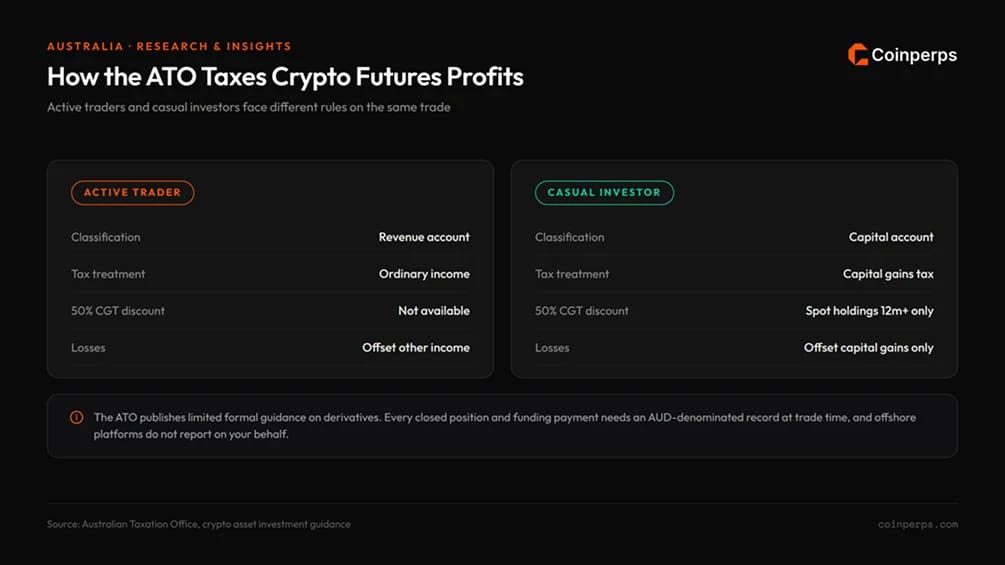
The ATO treats crypto assets as property, but perpetuals rarely involve holding the underlying asset, which changes the analysis. For most active futures traders, profits and losses fall on revenue account and are taxed as ordinary income, with no 50% CGT discount. Infrequent derivatives activity may instead fall under CGT rules, and formal ATO guidance on derivatives remains thin, making classification a genuine grey zone.
Three points hold either way:
- Records in AUD. Every closed position, including funding paid or received, needs a record at the time of the trade.
- No automatic reporting. Offshore platforms do not report to the ATO, but data-matching covers Australian exchanges and international reporting is tightening.
- Classification cuts both ways. Revenue losses offset other income; capital losses only offset capital gains.
Anyone trading size should engage a crypto-specialist accountant before lodging.
Bottom Line
The right platform in mid-2026 depends on your client category and risk tolerance. Bybit gives Australians the deepest unrestricted perp access with zero local protection. Coinbase is the only licensed retail derivatives option and the right start for anyone who values AFSL coverage over leverage. Kraken and OKX serve wholesale-qualified traders, Kraken winning on depth and leverage, OKX on AUD funding. Hyperliquid suits self-custody traders comfortable owning onchain risk.
Whichever venue you pick, the data layer is the same. Compare real-time funding rates before holding through funding windows, watch liquidation clusters around your entries, and keep leverage well below platform maximums. The October 2025 cascade that erased roughly $19 billion of positions in a single day proved that on any platform, in any jurisdiction, position sizing decides survival before regulation does.
Frequently Asked Questions
Is it illegal for Australians to trade on offshore futures exchanges?
No. Australian law targets the providers, not the traders. ASIC penalties and warnings apply to platforms offering financial products without a licence, while individuals who open offshore accounts break no law. The cost is protection: no AFCA dispute resolution, no client money rules, and no practical recourse if the platform freezes withdrawals or collapses.
Can I trade crypto futures through a regulated CFD broker instead?
Yes. ASIC-licensed CFD brokers offer Bitcoin and Ethereum CFDs to retail clients with negative balance protection, but the same 2:1 product intervention cap applies, and spreads typically run wider than perp exchange fees. CFDs suit small hedges inside a regulated account, while serious leverage requires either wholesale status or an offshore venue.
Can an SMSF trade crypto perpetual futures?
In practice, rarely. A self-managed super fund needs the activity to fit its investment strategy and sole purpose test, and most licensed venues only open derivatives to wholesale-certified entities. SMSF crypto support from Coinbase and OKX currently centers on spot holdings. Trustees considering leveraged derivatives should obtain professional advice first, since breaches risk the fund's compliance status.
Do I need a VPN to access crypto futures platforms from Australia?
No. Australia is not geoblocked by Bybit, Hyperliquid, or other major perp venues, so a VPN serves no access purpose. Using one to disguise your location can breach platform terms and void withdrawal rights, a worse position than trading openly. Traders prioritizing privacy over licensing can compare options in our no-KYC perpetual exchanges guide.