Best Crypto Futures Platforms in Canada
Learn the true state of crypto futures in Canada in 2025, find out why regulated exchanges deny leverage and how to safely access decentralized perpetuals.

Coinperps may earn a commission from partner links, at no cost to you; rankings follow our methodology. Not financial advice.
Key takeaways
- Only three CSA-registered platforms with global futures operations (Kraken, Coinbase, Crypto.com) serve Canadians, and domestic accounts remain spot-only.
- Canadian traders seeking leverage use DeFi perps like Hyperliquid, Lighter and Aster with self-custodied collateral, unregistered and without investor protection.
- For simple buying, 15 CSA-authorized platforms offer CAD Interac funding, while derivatives-focused Canadians instead trade CME Bitcoin and Ether futures.

- License (Canada)
- Restricted Dealer
- Futures access (CA)
- No retail access
- Max leverage
- 50x
- Maker / taker fee
- 0.02% / 0.05%
- Notable details
- ~20 contracts, strong BTC/ETH depth
Why it ranks #1 Partner link · How we rank
Kraken is a long-running centralized crypto exchange founded in 2011, now serving more than nine million clients across 190 countries through spot, staking and institutional products.
- Strong security track record, including regular proof-of-reserves attestations.
- Advanced order types and APIs suitable for algorithmic or institutional traders.
- Educational content tailored to Canadian investors navigating local crypto rules.
Coinperps may earn a commission if you sign up through this link, at no cost to you. Rankings follow our method, not partner deals.
On this page 8 sections
If you are an Australian trader exploring crypto futures, you want clear information before risking capital. You are comparing leverage, fees, platform safety, and local regulations, hoping to find trustworthy long-term partners, but you are hit with sudden feature restrictions and unclear rules.
If you are already trading spot crypto in Australia, futures introduce hedging tools, income strategies, and significantly higher risk. You might wonder which platforms accept Australians, handle AUD smoothly, and genuinely offer compliant, reliable derivatives access.
In the table below, we give and overview of top platforms:
Exchange | License (Canada) | Futures access (CA) | Max leverage | Maker fee | Taker fee | Notable details |
|---|---|---|---|---|---|---|
Restricted Dealer | No retail access | 50x | 0.02% | 0.05% | ~20 contracts, strong BTC/ETH depth | |
Restricted Dealer | No access | 20x | 0.00% | 0.03% | 90+ USDC perps offshore | |
Restricted Dealer | No access | 50x | 0.25% | 0.50% | 100+ perps overseas | |
Unregistered (DeFi) | Full access | 40x | 0.015% | 0.045% | 200+ perps, large DeFi OI | |
Unregistered (DeFi) | Full access | 50x | 0.00% | 0.00% | High volume, zk engine | |
Unregistered (DeFi) | Full access | 1001x | 0.01% | 0.035% | Multi-chain perps |
 Coinbase
 Crypto.com
 Hyperliquid
Best Crypto Futures Platforms in Canada
We meticulously reviewed over 25 distinct cryptocurrency exchanges to identify the most viable options for Canadian traders. Our rigorous methodology involved cross-referencing global derivative platforms against the official Canadian Securities Administrators registry to ensure strict regulatory accuracy.
To verify trading volumes and liquidity depth, we utilized leading data aggregators like DefiLlama and CoinGecko. This dual approach highlights the stark contrast between secure, licensed spot platforms and high-volume decentralized alternatives offering the futures products Canadians seek.
1. Kraken
- License (Canada)
- Restricted Dealer
- Futures access (CA)
- No retail access
- Max leverage
- 50x
- Maker / taker fee
- 0.02% / 0.05%
- Notable details
- ~20 contracts, strong BTC/ETH depth
Kraken is a long-running centralized crypto exchange founded in 2011, now serving more than nine million clients across 190 countries through spot, staking and institutional products. In Canada, clients contract with Payward Canada Inc., registered nationally as a Restricted Dealer marketplace.
Globally, Kraken offers regulated crypto futures via Kraken Derivatives US, including cash-settled CME contracts on Bitcoin, Ether and Solana, alongside Kraken Pro Futures for non-US users. Canadian residents are explicitly barred from margin and derivatives trading under Kraken’s Canada-specific restrictions.
Canadian users fund accounts in CAD through Interac e-Transfer rails powered by providers like Payper, plus cards, wire transfers and even in-person cash services at Canada Post locations. Today, Canadian accounts support spot crypto trading only, without leverage or futures exposure.
Pros
- Strong security track record, including regular proof-of-reserves attestations.
- Advanced order types and APIs suitable for algorithmic or institutional traders.
- Educational content tailored to Canadian investors navigating local crypto rules.
Cons
- Canadian onboarding requires full KYC plus periodic suitability questionnaires.
- Product lineup omits some altcoins available on domestic competitors.
- Fee tiers disadvantage low-volume traders placing many market orders.
2. Coinbase
- License (Canada)
- Restricted Dealer
- Futures access (CA)
- No access
- Max leverage
- 20x
- Maker / taker fee
- 0.00% / 0.03%
- Notable details
- 90+ USDC perps offshore
Coinbase is a publicly listed U.S. crypto exchange with over 110 million verified users worldwide, offering retail, institutional and developer products. In Canada, Coinbase Canada Inc. operates as a Restricted Dealer under CSA exemptive relief, with registration in all provinces and territories.
Globally, Coinbase Advanced and Coinbase International Exchange offer over 150 perpetual and futures contracts on crypto and commodities, settled in USDC. Perpetual futures are explicitly limited to eligible non-US jurisdictions and exclude retail customers located in Canada and the U.K.
Canadian clients can add CAD via Interac e-Transfer, Electronic Funds Transfer, bank wires, PayPal or supported cards, then trade 200-plus spot assets and staking products. Currently, Coinbase’s Canadian platform doesn’t provide leveraged derivatives, focusing instead on regulated cash markets.
Pros
- User interface feels familiar to Canadians used to mainstream fintech apps.
- Detailed tax reports integrate with common Canadian crypto tax software.
- Round-the-clock English and French support channels for account issues.
Cons
- Retail fee tiers remain relatively expensive for low-volume CAD traders.
- Limited altcoin derivatives access pushes expert traders toward offshore venues.
- Ongoing U.S. regulatory disputes may create headline risk for brand.
3. Crypto.com
- License (Canada)
- Restricted Dealer
- Futures access (CA)
- No access
- Max leverage
- 50x
- Maker / taker fee
- 0.25% / 0.50%
- Notable details
- 100+ perps overseas
Crypto.com is a Singapore-headquartered crypto platform with an all-in-one app, exchange and Visa card serving a large global user base. In Canada, Foris DAX Canada ULC operates Crypto.com as a Restricted Dealer marketplace under nationwide CSA exemptive relief granted in May 2025.
Globally, Crypto.com Exchange lists perpetual futures and margin products on major coins, but those features are walled behind strict geo-restrictions. Its official derivatives and margin geo-restriction list explicitly include Canada, so Canadian-resident accounts are limited to spot, card and yield products only.
Canadian users open a dedicated CAD Account and fund it via Interac Standard Transfer or Interac Request Money, routed through partners such as DC Bank and Payper. Funds then support spot trading, the prepaid Visa program and on-app earn tools.
Pros
- Deep integration with Cronos ecosystem appeals to DeFi-curious card users.
- Competitive CAD withdrawal fees, especially for high-tier Prime customers.
- In-app price alerts and automation simplify basic directional trading strategies.
Cons
- Mobile app can feel cluttered for traders needing clean depth views.
- Advanced API and desktop tooling still lag leading derivatives exchanges.
- Future Canadian regulatory changes could further constrain promotions or rewards.
4. Hyperliquid
- License (Canada)
- Unregistered (DeFi)
- Futures access (CA)
- Full access
- Max leverage
- 40x
- Maker / taker fee
- 0.015% / 0.045%
- Notable details
- 200+ perps, large DeFi OI
Hyperliquid is a decentralized perpetual futures exchange built directly on its own high-performance Layer-1 blockchain, using a fully on-chain orderbook. DefiLlama data shows roughly $6 billion in open interest and around $229 billion in thirty-day perpetual trading volume.
Currently, Hyperliquid does not require KYC, but its Terms of Service explicitly restrict users from Ontario, Canada. While not all of Canada is blocked, the regulatory risk remains high for Canadian users. The platform offers up to 50x leverage on a vast range of assets.
Hyperliquid has no Canadian legal entity, fiat rails or registration; users connect self-custodial wallets and post crypto collateral, typically USDC. Because it is absent from Canadian registered-platform lists, Canadians accessing it do so without investor protections, suitability reviews or standardized disclosure documents.
Pros
- Zero-gas trading experience on its custom chain improves cost predictability.
- Strong on-chain risk engine supports high-frequency liquidations transparently.
- Community-driven governance via HYPE token aligns incentives with active traders.
Cons
- Smart-contract and protocol risks are borne entirely by individual participants.
- Interface and order-book tools may overwhelm newcomers used to swap DEXs.
- Regulatory treatment of DeFi derivatives in Canada remains highly uncertain.
5. Lighter
 #5 of 6 in this guide
- License (Canada)
- Unregistered (DeFi)
- Futures access (CA)
- Full access
- Max leverage
- 50x
- Maker / taker fee
- 0.00% / 0.00%
- Notable details
- High volume, zk engine
Lighter is a decentralized perpetuals exchange that aggregates liquidity across multiple chains, built around an order-book model similar to centralized venues. DefiLlama estimates roughly $1.7 billion in open interest and nearly $288 billion thirty-day perp trading volume, despite launching recently.
The protocol lists dozens of perpetual markets on majors and long-tail altcoins, offering deep liquidity and high leverage compared with many on-chain rivals. Its architecture emphasizes low-latency matching and centralized-style risk controls while keeping collateral, order placement and liquidations settled on-chain.
Lighter provides no direct CAD on-ramps or Canadian entity; users must bridge stablecoins or crypto from elsewhere before trading. It does not appear on Canadian registered-platform lists, so Canadians accessing Lighter face derivatives risk without domestic regulatory oversight or complaints mechanisms.
Pros
- Integrates with popular noncustodial wallets, reducing friction for on-chain traders.
- Flexible margin modes support both isolated and cross-portfolio risk management.
- Trading incentives and point programs attract active derivatives volume and market makers.
Cons
- Relatively new protocol with limited long-term track record through full cycles.
- Concentrated liquidity on select pairs may increase slippage in stress events.
- Opaque governance structure makes it harder to evaluate accountability and decision-making.
6. Aster
 #6 of 6 in this guide
- License (Canada)
- Unregistered (DeFi)
- Futures access (CA)
- Full access
- Max leverage
- 1001x
- Maker / taker fee
- 0.01% / 0.035%
- Notable details
- Multi-chain perps
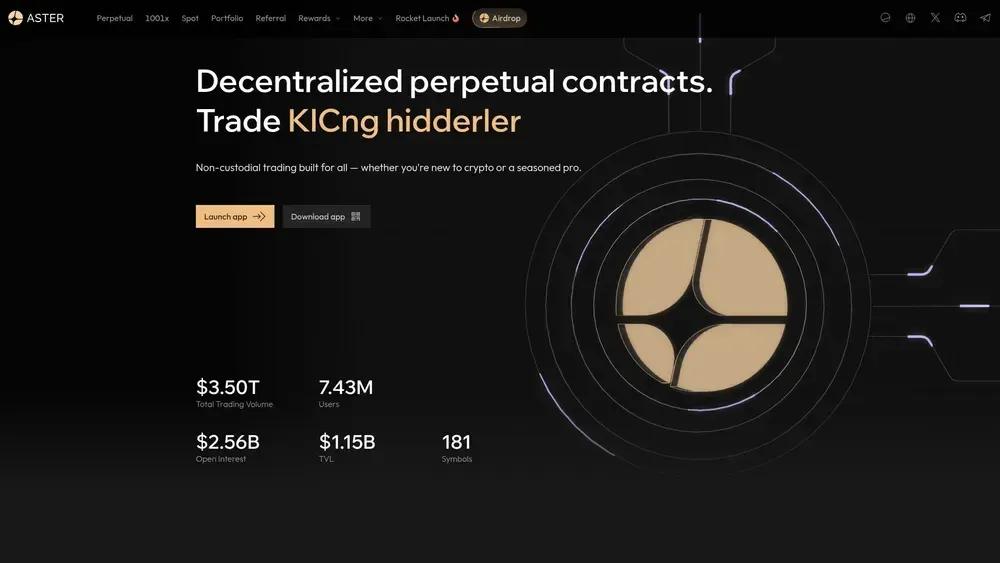
Aster is another derivatives-focused decentralized exchange specializing in crypto perpetual contracts, typically deployed across multiple high-throughput chains. On DefiLlama’s open-interest rankings it sits alongside Hyperliquid and Lighter, with roughly $2.6 billion in open interest and multibillion-dollar monthly perp volume.
The platform offers a broad slate of long and short perpetual markets on majors and niche tokens, with leverage tiers targeted at active derivatives traders. Its noncustodial design typically routes collateral through smart contracts, supporting cross-margin and liquidations driven by price-oracle feeds.
Like many DeFi derivatives venues, Aster lacks a Canadian corporate entity, fiat rails or securities registration, and doesn’t feature on CSA authorized platform lists. Open-interest statistics rely on third-party analytics, and some watchdogs have questioned data quality for certain emerging venues.
Pros
- Early-stage growth gives upside optionality if protocol sustains derivatives dominance.
- Multi-chain deployments can reduce congestion risks tied to any single network.
- Pseudo-anonymous access model may appeal to privacy-oriented users.
Cons
- Documentation and English-language disclosures remain thinner than leading perp DEX peers.
- Limited external audits or insurance funds may amplify smart-contract loss severity.
- Lack of Canadian legal presence complicates recourse if disputes ever arise.
What is a Crypto Futures Platform?
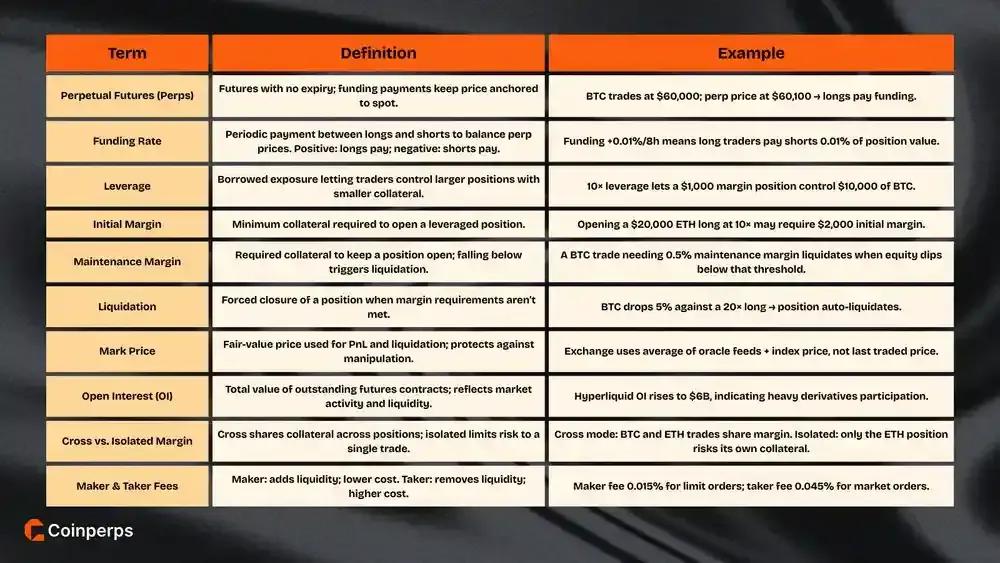
A crypto futures platform is a venue where traders enter contracts to buy or sell cryptocurrency at a later date at a set price, rather than exchanging immediately. These platforms can be centralized exchanges or decentralized, smart-contract-based protocols.
Key components typically include margin accounts, collateral management, matching engines for orders, risk controls like auto-deleveraging, and accurate oracle price feeds. Together, they let traders open long or short positions, use leverage, and manage downside with stop or take-profit orders..
Beyond speculation, these platforms provide crucial benefits like hedging against market volatility. Miners and institutions use futures to lock in prices and stabilize revenue. This liquidity depth ensures smoother market operations and allows for complex portfolio risk management strategies.
How Are Crypto Futures Regulated in Canada?
Crypto futures are tightly regulated in Canada, primarily by the provincial authorities under the Canadian Securities Administrators (CSA). The regulators classify any custodial crypto product, or "crypto contract," as a security or derivative, subjecting them to strict investor protection rules.
In 2022, the CSA prohibited registered ‘Restricted Dealers’, which includes most compliant Canadian platforms, from offering margin or leverage to retail users to protect investors from volatility. This is why CEXs like Kraken or Coinbase automatically disable futures interfaces for Canadian accounts.
Legal exposure to futures is currently limited to traditional financial avenues. Canadians can trade regulated ETF futures on the TSX or access CME Bitcoin futures through traditional brokers like Interactive Brokers. However, these options often require higher capital and lack the flexibility of direct crypto exchanges.
Alternative Crypto Exchanges to Buy Crypto in Canada
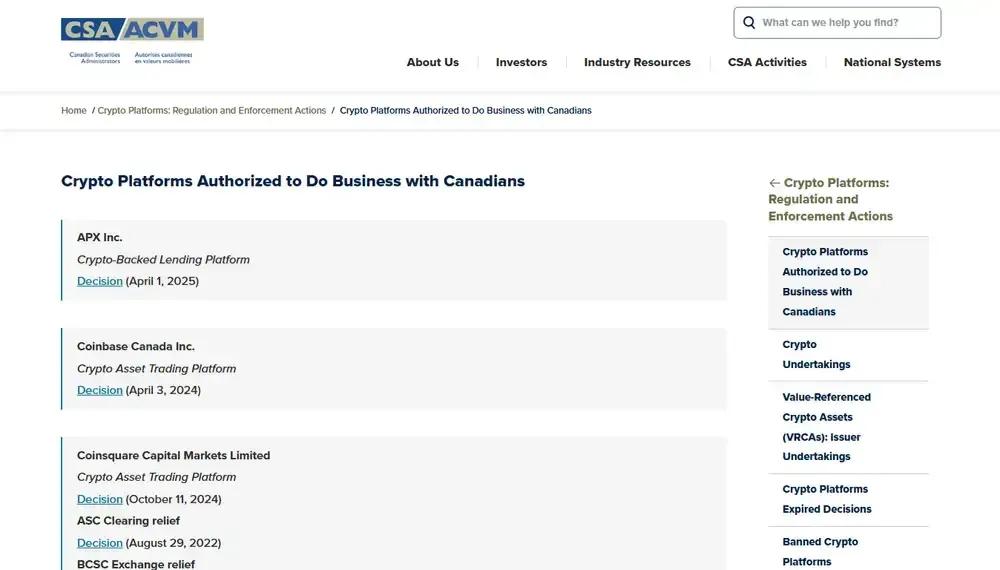
According to the official Canadian Securities Administrators (CSA) registry, there are exactly 15 authorized crypto trading platforms operating in Canada.
Here is the complete list of the remaining regulated options for spot trading:
- APX Inc: CSA-exempt crypto-backed lender offering Bitcoin and Ethereum collateral loans from $25,000 to over $10 million, via secured credit facilities.
- Coinsquare Capital Markets: IIROC-regulated marketplace supporting 60+ assets, free CAD Interac deposits, spread-based Quick Trade plus Pro maker-taker fees up to 0.50%.
- Cybrid Canada: Restricted Dealer platform for BTC, ETH and approved coins, funding via linked bank accounts with CAD deposits and withdrawals.
- Fidelity Digital Assets: Institutional-only crypto contracts and custody, routing Bitcoin exposure through CIRO-member brokerages, with digital assets held at Fidelity’s cold-storage infrastructure.
- Hibit Technology: Regional Restricted Dealer serving Western provinces, app-based crypto trading plus in-person support, CAD funding through bank transfers and withdrawals.
- NDAX Canada: Investment Dealer marketplace with flat 0.2% trading fee, free deposits, Interac e-Transfers and wires, CAD deposit limit $10 million.
- Netcoins: Restricted Dealer with 60+ assets, 0.5% trading fee, free funding, Interac e-Transfers and bank-wire deposits over $3,000.
- Newton Crypto: Zero-fee funding and withdrawals, competitive spreads on 70+ coins, Interac e-Transfer, wire and pre-authorized debit, $5 network-fee subsidy.
- Shakepay: Beginner-friendly BTC and ETH platform, commission-free trading with spread-based pricing, free Interac deposits from $5 to $10,000.
- VirgoCX: Spot-focused platform listing 90+ assets, trading fees roughly 0.95%-1.6%, free Interac deposits, e-Transfer send limits up to $15,000 daily.
- Wealthsimple Investments: Canada-only broker offering 100+ cryptocurrencies, crypto trading spreads 0.5%-2%, free funding via Interac e-Transfer and linked bank accounts.
How Are Crypto Futures Taxed in Canada?
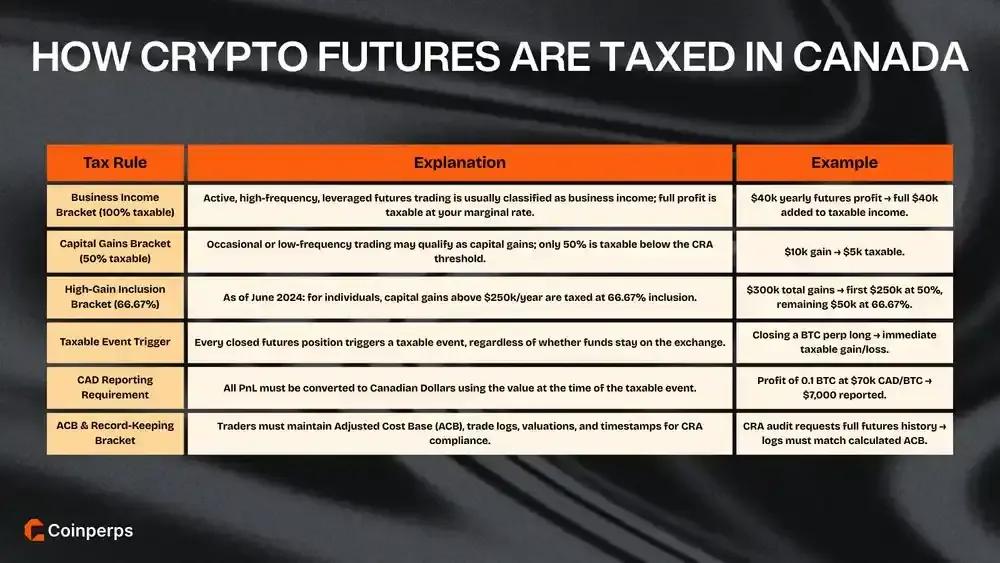
The Canada Revenue Agency (CRA) classifies cryptocurrency as a commodity, not currency. Consequently, your trading profits fall into one of two distinct tax categories: capital gains or business income, depending entirely on your trading frequency and intent.
Because crypto futures involve high-frequency speculation and leverage, the CRA often classifies this activity as business income. This means 100% of your profits are added to your taxable income and taxed at your marginal rate, unlike passive investments.
If your activity is infrequent enough to qualify as capital gains, only 50% of your profit is taxable. However, effective June 2024, the inclusion rate increases to 66.67% for any annual gains exceeding $250,000 for individuals.
Every closed position is a taxable event that must be reported in Canadian Dollars. You are required to track your Adjusted Cost Base (ACB) for every trade, making automated tax software essential for accurately calculating your final obligations.
Risks of Trading Crypto Futures
Trading crypto derivatives carries substantial financial risk due to extreme market volatility and the complex nature of leveraged products. Here are the critical risks that threaten your capital:
- Liquidation Cascades: High leverage triggers automatic closures; market crashes frequently see over $500 million in total trader liquidations within single hours.
- Smart Contract Exploits: Decentralized code often contains vulnerabilities; hackers stole approximately $1.7 billion from DeFi protocols across 2023 alone due to unpatched bugs.
- Platform Insolvency: Unregulated offshore exchanges lack insurance; the FTX collapse erased billions in customer deposits with absolutely no recovery for users.
- Regulatory Geoblocking: Access can vanish instantly; Ontario regulators forced Binance to exit the province, mandating the closure of all active accounts.
- Funding Fees: Perpetual contracts typically charge funding rates every eight hours; holding positions during strong trends can cost over 100% APR in fees.
- Execution Slippage: Thin liquidity creates price disparities; executing large market orders on altcoin futures often results in immediate 3-5% value loss.
- Extreme Volatility: Markets operate 24/7 without halts; Bitcoin has historically experienced single-day price crashes exceeding 40% during major cycle correction events.
Bottom Line
Canadian traders currently face a frustrating reality, with restrictive regulations blocking access to the most powerful global derivatives tools.
The safest current strategy involves buying your spot assets on a trusted, licensed platform like Kraken. From there, self-custody your funds and bridge to established decentralized exchanges like Lighter to access the futures market.
FAQs
Does Canada’s Superficial Loss Rule Apply to Realized Capital Losses on Crypto Assets?
Yes, the CRA’s superficial loss rule is critical for Canadian tax-loss harvesting. If you claim a capital loss on crypto and repurchase the identical property within the 61-day period (30 days before or after the sale date), the loss will be denied.
Can I Use My Crypto Trading Losses to Reduce Tax Owed on My Employment Income?
Only if the CRA classifies your crypto trading activity as a business; those losses can offset other forms of income (like employment). Capital losses, however, can only be used to offset taxable capital gains realized in the current or other tax years.
Do Regulated Bitcoin Futures Traded via CME or Other Exchanges Deliver Physical Cryptocurrency?
No. Regulated crypto futures and options traded on platforms like the CME are almost universally cash-settled or settled into a separate futures contract. These products do not involve the physical delivery of the underlying spot Bitcoin or Ethereum.
Besides DEXs, are there other Highly-Leveraged Regulated Alternatives for Canadians?
Some international, but regulated, CFD brokers offer high leverage (e.g., 1:200) on crypto products. However, these are complex instruments, often restricted in provinces like Ontario, and come with a mandatory high-risk disclosure warning.


