BloFin Restricted Countries List 2026: Bans, KYC Rules & Alternatives
BloFin is the largest no-KYC perpetuals exchange, but skipping licenses comes with a long blocklist. Over 40 jurisdictions are off-limits, US users have no path in, and Fireblocks plus Proof of Reserves carry the trust burden regulators normally would. Here is the 2026 list and working alternatives.

Coinperps may earn a commission from partner links, at no cost to you; rankings follow our methodology. Not financial advice.
Key takeaways
- BloFin restricts 40+ jurisdictions, including the US, Canada, Singapore, China, India, and the UAE, per Section 6 of its Terms of Use.
- KYC is optional, not mandatory. Unverified accounts trade spot and 150x perpetuals with a 20,000 USDT daily withdrawal cap, rising to 1M USDT (Level 1) and 2M USDT (Level 2).
- BloFin holds no Tier-1 financial licenses. It operates through BuildLight Future Limited in the Marshall Islands, leaning on ISO 27001, PCI DSS, Fireblocks, and bi-monthly Proof of Reserves for credibility.
On this page 9 sections
- Which Countries Does BloFin Restrict?
- Countries Supported by BloFin
- BloFin Derivatives Trading Restrictions
- Does BloFin Require Mandatory KYC Verification?
- Is BloFin Banned in the US?
- What Licenses Does BloFin Have?
- Can You Access BloFin with a VPN?
- Best Alternatives if BloFin is Unavailable in Your Country
- Bottom Line
Which Countries Does BloFin Restrict?
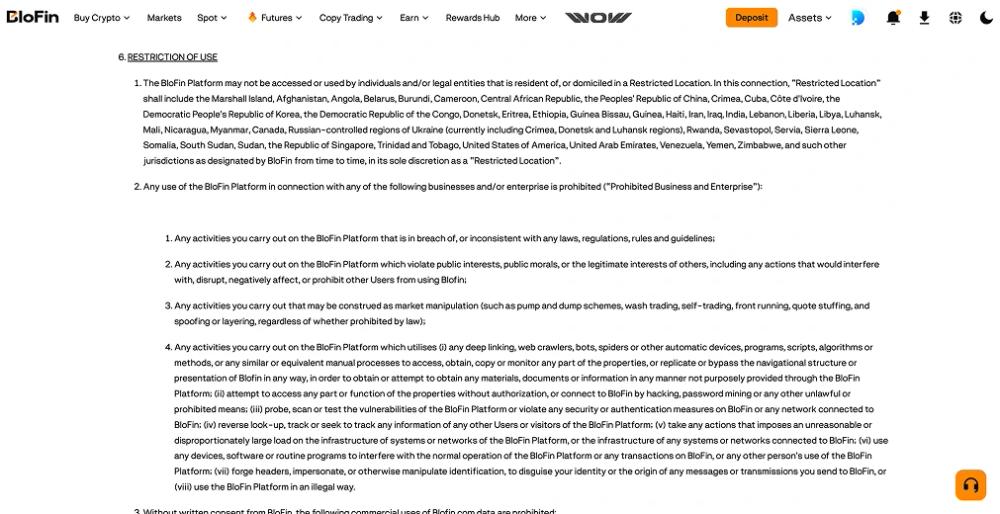
BloFin's Terms of Use designates 40+ jurisdictions as "Restricted Locations" where the platform will not onboard users. The list runs longer than most CEX competitors because BloFin has no local licenses to rely on, so any jurisdiction with active crypto enforcement gets excluded outright.
- Sanctions and high-risk states: Afghanistan, Belarus, Cuba, Iran, Iraq, Lebanon, Libya, Myanmar, Nicaragua, North Korea, Sudan, Syria, Venezuela, Yemen, plus the Russian-controlled regions of Ukraine (Crimea, Donetsk, Luhansk, Sevastopol).
- Africa (FATF and AML-related): Angola, Burundi, Cameroon, Central African Republic, Côte d'Ivoire, Democratic Republic of the Congo, Eritrea, Ethiopia, Guinea, Guinea-Bissau, Haiti, Liberia, Mali, Rwanda, Sierra Leone, Somalia, South Sudan, Zimbabwe.
- Licensing-led exclusions: United States (all states and territories), Canada, China, India, Singapore, United Arab Emirates, Trinidad and Tobago, Serbia, and the Marshall Islands (BloFin's own jurisdiction of incorporation).
Two entries stand out. The UAE is on the list despite running two of the world's friendliest crypto regimes through VARA and the FSRA, which reflects BloFin's absence of a local VASP license rather than a hostile UAE position. The Marshall Islands appears because BuildLight Future Limited is registered there and excludes domestic residents under local financial rules.
BloFin reserves the right to expand the list "from time to time, in its sole discretion." Confirm the current version in the Terms before signing up.
Countries Supported by BloFin
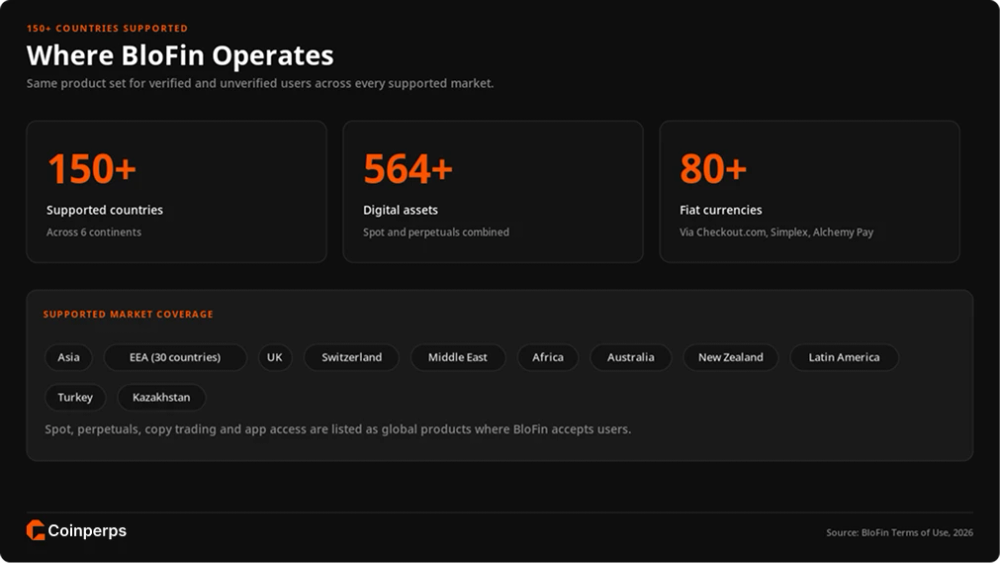
Outside the Restricted Locations, BloFin operates in 150+ countries and gives every verified or unverified user the same product set: spot, USDT-M perpetuals up to 150x leverage, copy trading, and fiat on-ramps. Major supported markets include:
- Asia: Japan, South Korea, Thailand, Indonesia, Vietnam, Philippines, Taiwan, Malaysia
- Europe and EEA: all 30 EEA members plus the United Kingdom, Switzerland, and Norway
- Middle East and Africa: Saudi Arabia, Qatar, Bahrain, Israel, South Africa, Egypt, Kenya, Morocco, Nigeria
- Oceania: Australia, New Zealand
- Latin America: Mexico, Argentina, Brazil, Colombia, Chile, Peru
- Other: Turkey, Kazakhstan, Ukraine (excluding occupied regions)
Fiat purchases run through Checkout.com, Simplex, and Alchemy Pay, supporting Apple Pay, Google Pay, SEPA transfers, and major cards across 80+ fiat currencies including USD, EUR, GBP, JPY, AUD, BRL, INR, and NGN.
BloFin Derivatives Trading Restrictions
BloFin runs one global derivatives product across every supported market. There is no separate list of countries restricted from futures while keeping spot access, which is a structural break from OKX, Coinbase, and Bybit. If you can access BloFin, you can trade the full 150x leverage stack.
The exceptions live in three product-specific carve-outs:
- xStocks tokenized equity derivatives: BloFin listed five xStocks pairs (METAX, GOOGLX, COINX, MCDX, AMZNX) in September 2025 under the Backed Finance framework. These are blocked for US and UK users on top of standard Restricted Locations, per the xStocks Risk Disclosure.
- High-leverage suitability reviews: Positions above certain thresholds may trigger risk-control reviews, with BloFin reserving the right to reduce or liquidate under its Risk Disclosure Statement.
- Jurisdictional product suspension: New perpetual contracts can be withheld from specific countries before rollout without notice, usually for regional compliance reasons.
Traders looking past BloFin for derivatives can compare options across the perpetual exchanges directory, the decentralized perpetuals list, and live funding rates.
Does BloFin Require Mandatory KYC Verification?
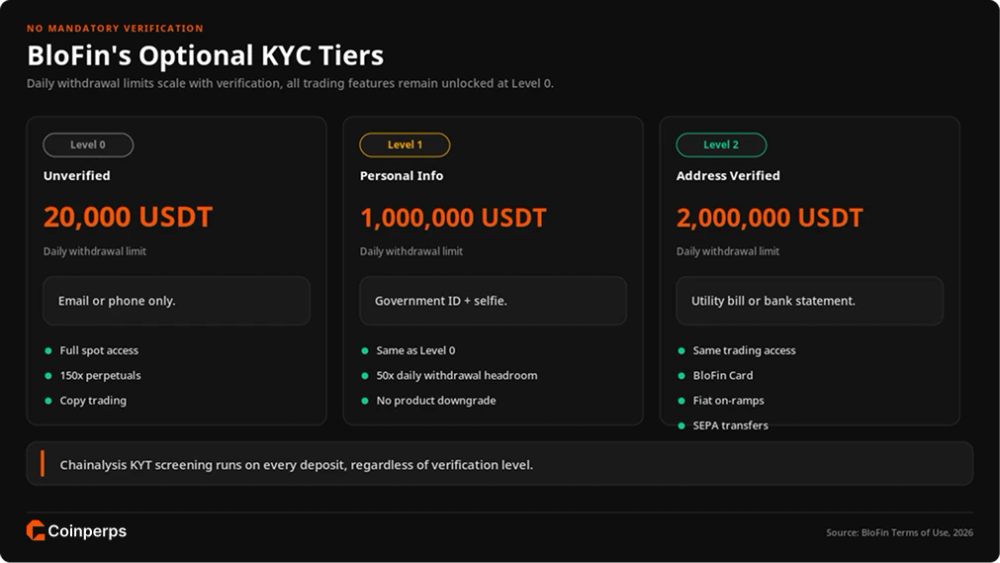
No. Optional KYC is BloFin's biggest competitive differentiator and the structural reason the platform ranks first in our best no-KYC perpetual futures exchanges guide. Users can sign up with an email, fund with crypto, and trade 150x perpetuals without uploading any ID.
The trade-off comes in withdrawal limits, which scale by verification tier:
- Unverified (Level 0): Email or phone only. 20,000 USDT per 24 hours. Full trading access.
- Personal Information Verified (Level 1): Government ID plus selfie. 1,000,000 USDT per 24 hours.
- Address Proof Verified (Level 2): Utility bill or bank statement. 2,000,000 USDT per 24 hours.
Verification typically clears within 24 hours per the BloFin identity verification guide. KYC is mandatory for the BloFin Card, fiat purchases through Checkout.com, and most SEPA bank transfers. Chainalysis-based KYT screening runs on every incoming deposit to flag wallets tied to sanctioned addresses, hacks, or mixers, regardless of verification status.
Is BloFin Banned in the US?
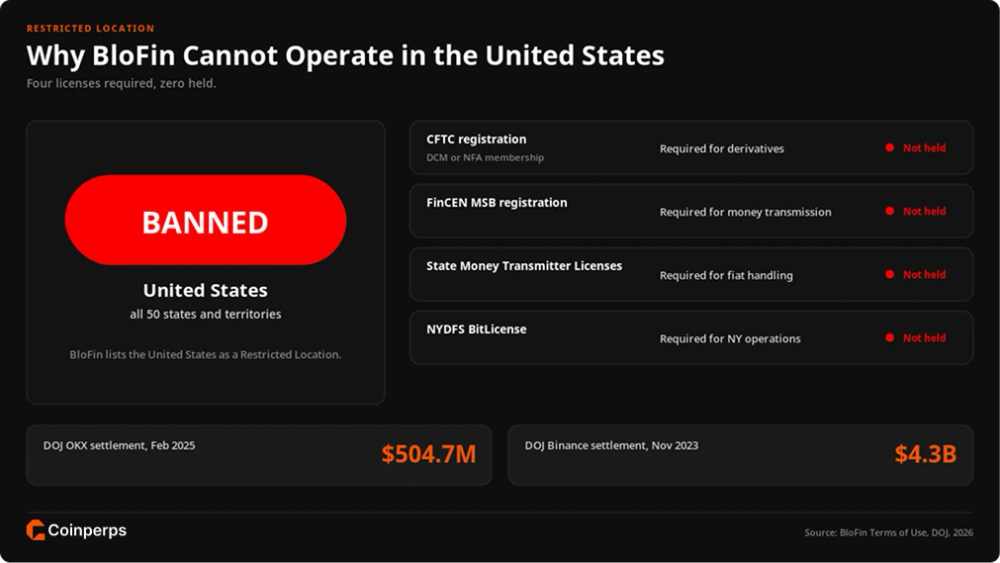
Yes. The United States is a Restricted Location across all 50 states and US territories, including Puerto Rico, Guam, American Samoa, the Northern Mariana Islands, and the US Virgin Islands.
The regulatory math is uncomplicated. Operating a crypto derivatives venue for US users requires CFTC registration as a Designated Contract Market or NFA membership, plus FinCEN MSB registration and state Money Transmitter licenses for fiat handling. BloFin holds none of these.
Onboarding US users without authorization would expose the platform to enforcement comparable to the DOJ's $504.7 million OKX settlement in February 2025 or the $4.3 billion Binance settlement in November 2023. US-based options are covered in the Coinbase Perpetuals restricted countries and Kraken restricted countries guides.
What Licenses Does BloFin Have?
None from Tier-1 regulators. BloFin holds no authorizations from the SEC, CFTC, FCA, MAS, ASIC, BaFin, or any equivalent body, and operates as an offshore venue through BuildLight Future Limited in the Marshall Islands. This is a meaningful gap against peers who licensed up aggressively in 2025 and 2026, including OKX (MiCA via Malta), Bybit (full VARA), and Kraken (MiCA via Ireland).
The substitutes are operational rather than regulatory:
- ISO 27001 certification for information security management
- PCI DSS certification (September 2025) for card data security
- Fireblocks custody for hot and cold wallet management with insurance coverage
- Chainalysis KYT screening for transaction monitoring and sanctions compliance
- Bi-monthly Proof of Reserves with Merkle Tree verification, listed on the Nansen dashboard, at a 1:1 ratio across BTC, ETH, and USDT
- Mastercard partnership for the BloFin Card (EEA only, virtual launch April 2025)
- Checkout.com partnership for fiat on-ramps with 3D Secure (October 2025)
Some review sites cite a "FinCEN MSB license" or "CIMA fund license" for BloFin, but neither shows on the FinCEN MSB registrant database or any equivalent registry. Treat BloFin as offshore-unregulated for investor-protection purposes, with the safeguards above as the only counterweight.
Can You Access BloFin with a VPN?
Technically possible, materially risky. Because BloFin does not enforce mandatory KYC, a VPN can put a Restricted Location user onto the platform and let them trade without ID upload. BloFin uses IP geolocation at signup but skips the multi-layer fingerprinting (bank residency, phone country codes, document cross-checks) that OKX, Kraken, and Coinbase deploy.
The downside is real and uninsured:
- Account freezing. BloFin can freeze any account later identified as a Restricted Location resident, with assets withheld pending review.
- No legal recourse. A US, Canadian, Singaporean, or UAE user who circumvents geoblocks has no consumer-protection claim if funds are lost or frozen.
- KYT screening on deposits. Funds from sanctioned wallets, mixers, or flagged exchanges are blocked at the protocol level regardless of VPN status.
- Tax exposure. Trading on an unauthorized offshore venue does not exempt residents from local capital gains or derivatives tax reporting.
A cleaner path for genuinely no-KYC perpetuals is on-chain. Both the best decentralized perpetual exchanges ranking and the Hyperliquid restricted countries guide cover platforms that sidestep the geoblocking question entirely.
Best Alternatives if BloFin is Unavailable in Your Country
Replacement depends on whether you need the offshore product (high leverage, optional KYC) or the onshore product (lower leverage, full compliance, fiat rails). Our regional picks for each scenario:
- United States: Coinbase (NYDFS, SEC, CFTC) and Kraken Futures USA (CFTC) cover CFTC-registered perpetuals.
- Canada: Bitbuy and Kraken Canada hold FINTRAC MSB registration with CAD rails via Interac e-Transfer. Derivatives are heavily restricted under Canadian Securities Administrators guidance.
- Singapore: Coinhako and Independent Reserve are the main MAS-licensed Major Payment Institutions for retail. Perpetuals are blocked for retail under MAS rules.
- European Union: Bybit EU (MiCA FN 636180i via FMA Austria), Kraken, and OKX Malta all operate under MiCA passporting before the July 1, 2026 transitional deadline.
- United Kingdom (derivatives): The FCA retail derivatives ban of January 2021 still applies. The legitimate routes are decentralized perpetuals on Hyperliquid or UK-listed crypto ETNs following the FCA's October 2025 rule change.
- High-leverage non-KYC: Hyperliquid, GMX, and dYdX lead the on-chain stack with no KYC and on-chain settlement.
- Cost-optimized: The lowest fee crypto perpetual exchanges guide ranks maker-taker rates across major venues.
Confirm local licensing before depositing. Compliant access protects both your funds and your tax position.
Bottom Line
BloFin's restricted-countries list is one of the longest in the industry, and the reason is structural rather than incidental. The platform chose to operate without major financial licenses, which keeps it fast, cheap, and 150x-capable with optional KYC.
The price is jurisdictional reach. Any country with active crypto enforcement gets blocked outright, and the Restricted Locations count keeps climbing as MiCA, the Australian Digital Assets Framework Bill, and similar regimes harden across 2026.
For traders in a supported country, BloFin remains a top-tier no-KYC perpetuals venue and our number-one pick in the best no-KYC perpetual futures exchanges ranking.
For traders in a Restricted Location, particularly the US, Canada, Singapore, or UAE, bypassing geofencing carries real downside with no legal recovery. The perpetual exchanges directory and live open interest and funding rates trackers cover the working alternatives in every major region.


