Crypto.com Restricted Countries List 2026 – Regions & Alternatives
Find out which Crypto.com products are blocked in 2026, including App access, spot trading, derivatives, staking, lending, and eight alternatives worldwide.

Coinperps may earn a commission from partner links, at no cost to you; rankings follow our methodology. Not financial advice.
Key takeaways
- Crypto.com blocks App access in 75 locations, including Afghanistan, China, Cuba, Iran, Russia, New York, Gaza Strip, West Bank, and five Ukrainian regions.
- The exchange separates App, spot trading, derivatives, Onchain Earn, Onchain Perpetuals, DeFi Lending, DeFi Staking, and staking into different eligibility lists.
- If Crypto.com is unavailable, U.S. users can compare Coinbase and Kraken, while Europe, Asia, and global users need eight region-specific alternatives.

- App blocked in
- 75 locations, including New York
- Derivatives
- Blocked in US, UK, Canada, much of Europe
- Countries served
- 90 countries
- EU licence
- Class 2 MiCA CASP
How we rate Crypto.com Partner link · How we rank
Crypto.com, founded in 2016 in Singapore, is a global exchange serving 80 million users with 400+ assets, Visa cards, DeFi tools, and $600M+ in daily trading volume.
Field average across 19 exchanges. Coinperps score 6.8/10, #13 of 19.
Coinperps may earn a commission if you sign up through this link, at no cost to you. Rankings follow our method, not partner deals.
On this page 9 sections
- List of Crypto.com Restricted Countries and Regions
- Countries and Currencies Supported by Crypto.com
- Does Crypto.com Require Mandatory KYC Verification?
- Does Crypto.com Restrict Derivatives Trading?
- Other Product-Specific Crypto.com Restrictions
- What Licenses Does Crypto.com Have?
- Best Alternatives if Crypto.com is Unavailable
- Bottom Line
- FAQs
Traders are usually looking for one clear answer: whether Crypto.com works in their country, which restrictions apply, and what to use instead.
This guide breaks down Crypto.com’s restricted countries, product-specific limits, KYC rules, derivatives access, licenses, supported regions, and practical exchange alternatives.
Start with the official restriction lists below. 🔽
List of Crypto.com Restricted Countries and Regions
Crypto.com’s official App Geo-Restrictions page lists 75 restricted countries, territories, regions, and one U.S. state for Crypto.com App access in 2026.
Restricted Crypto.com App locations include:
- Sanctioned or high-risk markets: Includes Afghanistan, Belarus, Cuba, Iran, North Korea, Russia, Sudan, Syria, Venezuela, Yemen, and Zimbabwe, reflecting sanctions exposure and compliance limitations.
- Africa restrictions: Includes Benin, Botswana, Burkina Faso, Burundi, CAR, Chad, both Congos, Djibouti, Eritrea, Ethiopia, Gabon, Gambia, Guinea, Mali, Niger, Somalia, Tanzania, and Togo.
- Middle East restrictions: Includes Iran, Iraq, Lebanon, Syria, Yemen, Gaza Strip, Palestine, and West Bank, where sanctions, conflict, and local legal barriers affect access.
- Asia restrictions: Includes Bangladesh, China, Myanmar, Kyrgyzstan, Macau, Nepal, Tajikistan, and North Korea, reflecting regulatory uncertainty and market-access limitations.
- Small island jurisdictions: Includes Cook Islands, Dominica, Kiribati, Marshall Islands, Micronesia, Nauru, Palau, Samoa, Tonga, Tuvalu, Montserrat, Saint Helena, and Wallis and Futuna.
- Latin America and Caribbean restrictions: Includes Bolivia, Cuba, Guyana, Haiti, Suriname, and Venezuela, mainly due to financial-risk, sanctions, or local compliance constraints.
- European and territorial restrictions: Includes Andorra, Mayotte, Western Sahara, and Russia, alongside territory-specific restrictions tied to sanctions and regional controls.
- Ukraine regional restrictions: Only Zaporizhzhia, Kherson, Crimea, Luhansk, and Donetsk are restricted, not all of Ukraine, according to Crypto.com’s official list.
- United States restriction: Crypto.com App access is broadly available across U.S. states, but New York appears as a restricted state on the App geo-restrictions list.
Countries and Currencies Supported by Crypto.com
Crypto.com serves users across 90 countries and reports 150 million users, with fiat access depending on jurisdiction, product, and local banking availability.
Key availability and fiat payment options include:
- Global app coverage: Crypto.com is available in many major markets, but onboarding remains subject to eligibility, residency, verification, and product-level restrictions.
- Cash account currencies: Supported App cash accounts include AUD, CAD, EUR, GBP, USD, BRL, TRY, SGD, and AED.
- Bank transfer support: Users may access local or regional rails such as SEPA, FPS, ACH, PayID, Interac, PIX, FAST, or AED transfers.
- Card purchases: Eligible users can buy crypto with credit or debit cards, although issuer rules, fees, and local restrictions may apply.
- Recurring Buy funding: Recurring Buy supports cards, selected crypto wallets, and fiat wallets, with availability varying by jurisdiction.
- Exchange fiat deposits: Crypto.com Exchange supports USD and EUR fiat deposits for retail users and institutions, subject to regional eligibility.
- USD SWIFT access: Eligible users in listed countries can open USD SWIFT accounts for deposits and withdrawals through Crypto.com.
- Product-specific coverage: Web, App, Exchange, Visa Card, Prime, Earn, derivatives, and Onchain services may each have separate country eligibility rules.
Note: Supported countries do not guarantee access to every Crypto.com feature. Users should check the App, Exchange, and product-specific help pages before depositing funds or trading.

Does Crypto.com Require Mandatory KYC Verification?
Yes. Crypto.com requires identity verification during account registration. Its KYC help page says users must provide their full legal name, a government-issued ID photo, and a selfie before accessing App services.
The process is mandatory because Crypto.com must verify customer identity, residency, and eligibility before enabling regulated services. Users should not email documents manually, because account opening and document submission are handled through the Crypto.com App.
For Crypto.com Exchange, verification can go beyond basic App onboarding. Crypto.com says it collects additional information so users can transact on the Exchange, on top of the general KYC verification process.
Existing users may also face updated verification requirements. Crypto.com previously required Exchange users to submit a valid identity document and photo for full access, with incomplete verification potentially causing access restrictions.
Does Crypto.com Restrict Derivatives Trading?
Yes. Crypto.com uses a separate derivatives geo-restrictions list, and it is broader than the general App restriction list. The official Exchange derivatives page says users from listed locations are restricted from trading derivatives, including futures and perpetual contracts.
Restricted Crypto.com derivatives locations include:
- United States and territories: Includes the United States, Puerto Rico, Guam, U.S. Virgin Islands, American Samoa, Northern Mariana Islands, and Minor Outlying Islands, meaning Exchange derivatives are not available to U.S. users.
- United Kingdom and major English-speaking markets: Includes the United Kingdom, Canada, Australia, Singapore, South Africa, and Hong Kong, showing derivatives access is much narrower than standard App availability.
- European Union and EEA markets: Includes Austria, Belgium, Bulgaria, Croatia, Cyprus, Czech Republic, Denmark, Estonia, Finland, France, Germany, Greece, Hungary, Ireland, Italy, Latvia, Lithuania, Luxembourg, Malta, Netherlands, Poland, Portugal, Romania, Slovakia, Slovenia, Spain, and Sweden.
- Other European restrictions: Includes Iceland, Liechtenstein, Norway, Switzerland, Vatican City, Russia, and the restricted Ukrainian regions of Crimea, Donetsk, Kherson, Luhansk/Lugansk, and Zaporizhzhia.
- Sanctioned or high-risk jurisdictions: Includes Afghanistan, Cuba, Iran, Iraq, Lebanon, Libya, Myanmar, North Korea, Sudan, Syria, Venezuela, Yemen, Zimbabwe, Somalia, and South Sudan.
- Africa restrictions: Includes Burundi, Central African Republic, Democratic Republic of Congo, Eritrea, Guinea, Guinea-Bissau, Mali, Namibia, Somalia, South Africa, South Sudan, and Sudan.
- Asia and Pacific restrictions: Includes Bangladesh, China, Japan, Kyrgyzstan, Nepal, Palau, Taiwan, French Polynesia, New Caledonia, and several U.S. linked Pacific territories.
- Latin America and Caribbean restrictions: Includes Bolivia, Brazil, Ecuador, Cuba, Martinique, Saint Martin, St. Lucia, Caribbean Netherlands, French Guiana, and Venezuela.
- Onchain Perpetuals use a different list: Crypto.com’s Onchain Wallet Perpetuals has its own restrictions, including the U.S., U.K., Canada, Australia, many EU markets, China, Hong Kong, and additional territories. It also notes that extra dYdX restrictions may apply.
In practice, Crypto.com derivatives restrictions are not the same as App restrictions. Some countries may access the Crypto.com App but still be blocked from derivatives, especially in the U.S., U.K., Canada, Australia, Singapore, Hong Kong, Japan, and much of Europe.
Other Product-Specific Crypto.com Restrictions
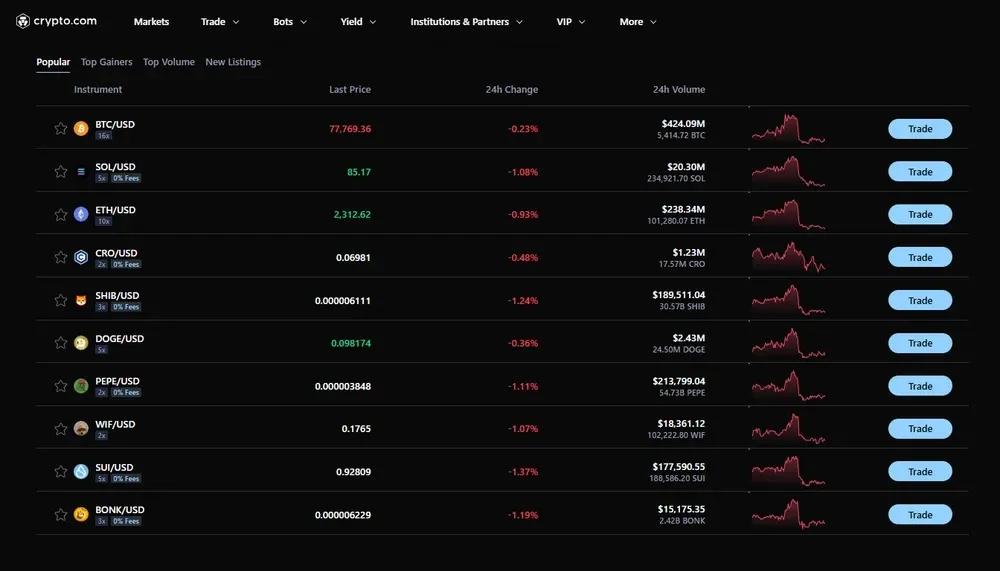
Crypto.com restrictions are not limited to the main App. The Exchange UI page says users must check separate geo-restrictions for spot trading, derivatives, margin trading, on-chain staking, and lending before using those products.
Spot trading has its own restricted list, including Afghanistan, Bangladesh, Bolivia, Burundi, Central African Republic, Democratic Republic of Congo, Cuba, Ecuador, Hong Kong, Iran, Iraq, North Korea, Libya, Mali, Russia, Somalia, Sudan, Syria, and others.
Yield and staking products also vary by location. On-chain staking excludes Hong Kong, Kazakhstan, Malta, Seychelles, Singapore, South Korea, Thailand, and selected U.S. states including New York, California, Maryland, New Jersey, and Wisconsin.
Crypto.com DeFi Lending and DeFi Staking are unavailable in Australia, Canada, Hong Kong SAR, Malta, Seychelles, South Korea, Thailand, and New York. Singapore is restricted too, except for verified accredited investors.
What Licenses Does Crypto.com Have?
Crypto.com presents itself as a multi-jurisdiction regulated platform, with licenses and registrations across the Americas, Europe, Asia-Pacific, the Middle East, and Africa. Its official licenses page lists authorisations covering money services, payments, crypto-asset services, derivatives, custody, and investment services.
Key Crypto.com licenses and registrations include:
- United States: Broker-dealer registration, DCO license, DCM license, MSB registration, money transmitter licenses, non-depository trust company charter, and conditional national trust bank charter approval.
- European Economic Area: Class 2 Crypto-Asset Service Provider license under MiCA, Electronic Money Institution license, MiFID investment firm license, and Limited Financial Institutions license.
- United Kingdom: Crypto-asset business registration and Electronic Money Institution license, supporting regulated access to certain crypto and payment-related services.
- Canada: Money-services business registration with FINTRAC and restricted dealer registration, reflecting its regulated presence in Canadian markets.
- Brazil: COAF registration and payment institution license, supporting compliance with local financial intelligence and payments rules.
- Asia-Pacific: Australia digital currency exchange registration and financial services license, Hong Kong VATP license status, Singapore Major Payment Institution license, and South Korean VASP-related registration.
- Middle East and Africa: ADGM Category 3A license in Abu Dhabi, payment service provider license in Bahrain, Dubai VASP license, and Mauritius investment dealer license.
- Cayman Islands: Conditional approval for a Virtual Asset Service Provider license, adding another offshore regulatory layer for Crypto.com group operations.
Best Alternatives if Crypto.com is Unavailable
If Crypto.com is unavailable, choose an exchange based on your region, local fiat rails, licensing posture, asset coverage, fees, and whether you need spot or advanced trading.
Top Crypto.com Alternatives
Recommended venues by jurisdiction and trading profile
United States
 Coinbase
Accessible interface with broad U.S. availability and integrated custody tools.
 Kraken
Advanced order types and Pro tools for active traders with deep spot liquidity.
Europe
 Bitstamp
High regulatory clarity with passported CASP and Payment licenses across the EU.
 Bitpanda
Simplified investment app with MiCA-authorized access to crypto and traditional assets.
Asia & Middle East
 OKX
OKX
Advanced product depth and Web3 tools with licensing in Singapore and Dubai.
 Binance
Global market depth and high-frequency features for large asset coverage.
Rest of the World
 Bybit
Bybit
Specialized trading-first experience with derivatives and copy trading tools.
 MEXC
MEXC
Extensive altcoin breadth and early listings for niche asset accessibility.
United States
Coinbase is the clearest U.S. alternative for beginners and compliance-focused users. Its main advantage is a highly accessible interface, broad U.S. availability, strong institutional brand recognition, and integrated custody, staking, card, and advanced trading tools.
Kraken is a stronger fit for active U.S. traders who value deeper order types, lower pro-style fees, and long operating history. Its strength is the combination of spot liquidity, Kraken Pro tools, security focus, and broad crypto asset support.
Europe
Bitstamp is a practical European alternative for users who want a long-running exchange with strong fiat support. Its strength is regulatory clarity: Bitstamp Europe says it has passported CASP and Payment Institution licenses across EU/EEA member states.
Bitpanda is better for European users seeking a simplified investment app rather than a pure trading venue. Its edge is multi-asset access, including crypto and traditional assets, plus MiCA authorization that supports regulated EU expansion.
Asia
OKX is a strong alternative in eligible Asian and Middle Eastern markets for users who want advanced trading, Web3 tools, and broader product depth. Its value proposition is its combined exchange, wallet, DeFi, and institutional infrastructure, with licensing activity in Singapore and Dubai.
Binance can suit eligible Asian users prioritizing liquidity, large asset coverage, and high-frequency trading features. Its differentiation is global market depth and broad product variety, although users must carefully check local licensing and access rules before onboarding.
Rest of the World
Bybit is often considered by eligible users outside heavily restricted markets who want derivatives, copy trading, and active-trader tools. Its advantage is a trading-first platform experience, but users should verify local access, licensing, and leverage rules before depositing funds.
MEXC is another option for eligible users seeking broad token availability and early listings. Its main feature is altcoin breadth, making it useful when Crypto.com lacks a market, though users should weigh liquidity, licensing, and regional restrictions carefully.
Bottom Line
Crypto.com is available in many major markets, but its restrictions are layered by country, region, and product. The App, Exchange, derivatives, staking, lending, and wallet features can each have different eligibility rules.
Before signing up or depositing funds, users should check Crypto.com’s official geo-restriction and product pages. If access is blocked, choose a regulated regional alternative with suitable fiat support.
FAQs
Can I use Crypto.com with a VPN from a restricted country?
No. A VPN does not change residency, identity, sanctions exposure, or KYC status. Crypto.com can still restrict accounts based on documents, phone number, address, device signals, funding source, or later compliance reviews.
Why is Crypto.com available in my country but one feature is missing?
Crypto.com separates product eligibility by service. Your country may support basic App access but not derivatives, staking, lending, cards, fiat transfers, Exchange access, or specific promotions because each feature faces different rules.
What happens if I move to another country after opening a Crypto.com account?
You may need to update your address and complete additional verification. Access can change if your new country is restricted, unsupported for certain products, or subject to different fiat and regulatory requirements.


