Funding Rate Arbitrage in Crypto Explained
Read our guide on funding rate arbitrage to master delta-neutral trading and start harvesting recurring 8-hour payments from market demand imbalances.

Disclosure: Coinperps may earn a commission from partner links, at no extra cost to you. Reviews are based on independent testing, see how we test.
- Funding rate arbitrage leverages 8-hour interest payments from perpetual markets to generate consistent yields exceeding 10% in average market conditions.
- Maintaining delta-neutral positions effectively hedges against price volatility while capturing premiums from high leverage demand during intense bullish market cycles.
- Precise execution across multiple trading venues requires factoring in 0.1% entry fees to ensure net profitability remains positive and sustainable.
In a volatile market, watching your portfolio fluctuate can be exhausting for any investor. You likely searched for a way to generate consistent income without predicting price movements, seeking a reliable method to profit from high leverage demand.
This detailed guide breaks down funding rate arbitrage, moving beyond basic concepts to advanced cross-exchange execution. You will gain concrete strategies to capture passive yield, calculate exact mathematical returns, and identify critical risks to protect your capital.
Read our expert guide to master this strategy. ⬇️
What is Funding Rate Arbitrage in Crypto?
Funding rate arbitrage is a delta-neutral strategy capturing interest payments from price imbalances between different trading venues. Traders exploit varying leverage costs across platforms, harvesting yield from speculators who pay to maintain their positions during periods of high demand.
This strategy extends beyond spot markets to include cross-exchange perpetual trades. An arbitrageur identifies a high funding rate on one platform and opens an offsetting position on another where the rate is significantly lower, pocketing the net difference.
By maintaining balanced exposure, participants neutralize market direction risks. Success involves monitoring spreads across dozens of venues, turning systemic inefficiencies into predictable income. This mechanism provides essential liquidity while aligning prices between decentralized and centralized perpetual futures.
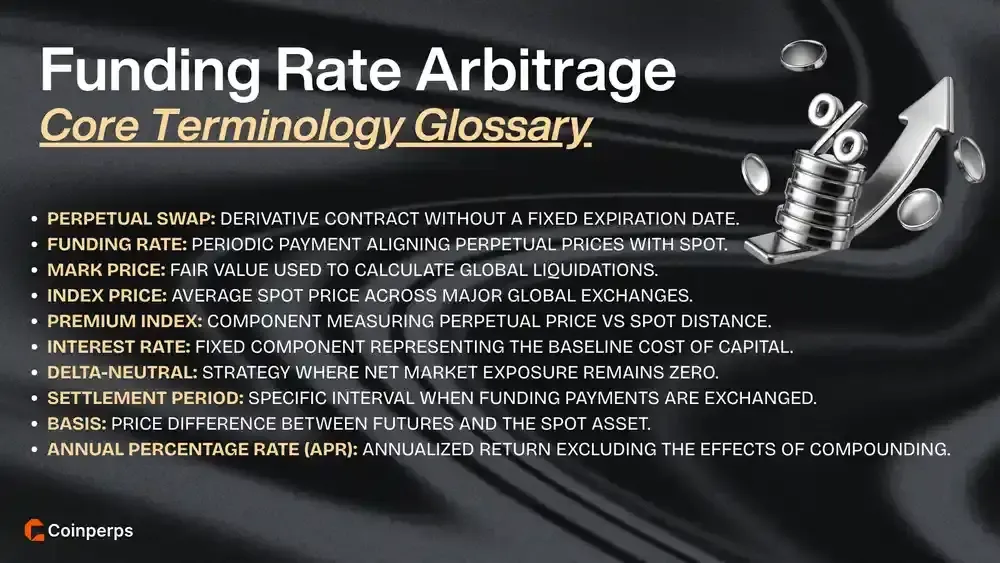
Funding Rate Arbitrage Methods
Diverse execution paths allow traders to harvest funding fees across various market conditions. These methods vary by capital efficiency, risk profile, and the specific instruments utilized.
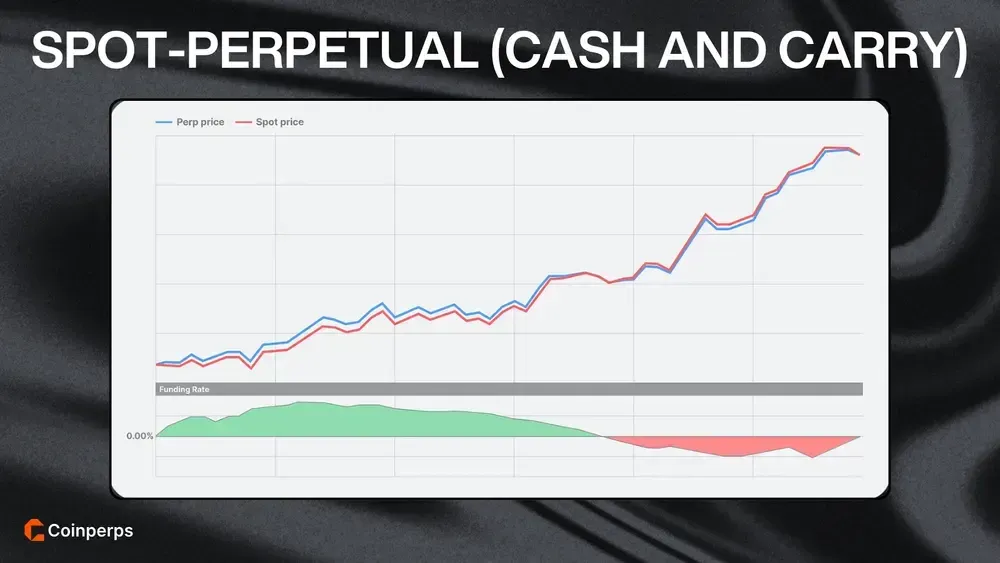
1. Spot-Perpetual (Cash and Carry)
Spot-perpetual arbitrage, known as cash-and-carry, utilizes the price basis between physical assets and derivative contracts. Traders maintain a delta-neutral stance by longing the underlying while shorting the equivalent perpetual, effectively harvesting recurring funding fees from over-leveraged long speculators.
- Identify an asset where the perpetual funding rate is consistently positive and exceeds trading fees.
- Purchase the asset on the spot market using quote currency (e.g. USDT).
- Simultaneously open a 1x short position on the perpetual contract for the same asset amount.
- Monitor the position and collect funding payments settled every 8 hours.
Example: Purchase 1 BTC at $95,000 on spot while shorting 1 BTC perp. Collect 0.01% funding every 8 hours, yielding roughly 11% annually risk-free.
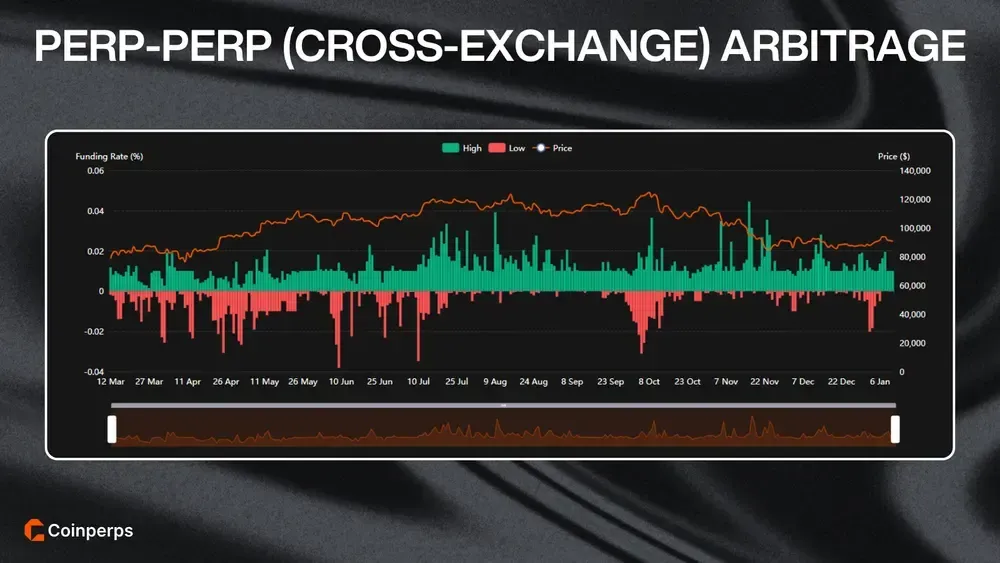
2. Perp-Perp (Cross-Exchange) Arbitrage
Cross-exchange arbitrage exploits funding rate differentials between 2 distinct trading platforms. By going long where funding is low (or negative) and short where it is high, traders pocket the spread between the 2 rates while remaining delta-neutral.
- Scan multiple exchanges to find a significant funding rate spread for a single asset.
- Open a long perpetual position on the exchange with the lower funding rate.
- Open an equal-sized short perpetual position on the exchange with the higher funding rate.
- Ensure both accounts are sufficiently collateralized to prevent liquidation during localized volatility.
Example: Long ETH on Bybit at 0.01% funding while shorting ETH on Binance at 0.03%. Earn the 0.02% net spread every settlement period.
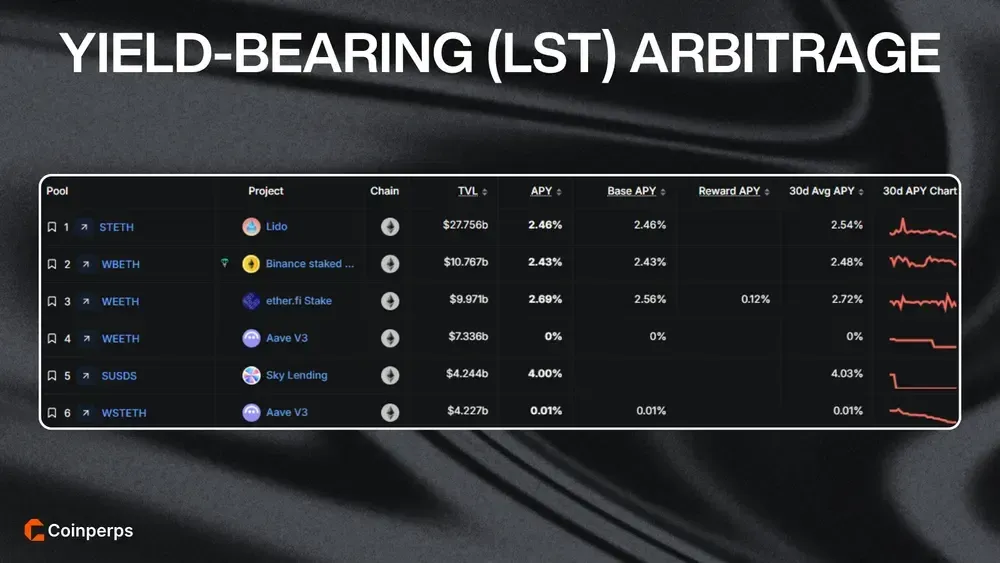
3. Yield-Bearing (LST) Arbitrage
This advanced method combines liquid staking yields with funding fee collection. By using yield-bearing tokens as collateral for a short position, traders "stack" the underlying staking rewards on top of the perpetual funding payments for enhanced total returns.
- Convert base assets (e.g., ETH) into liquid staking tokens like stETH or cbETH.
- Deposit the liquid staking tokens as collateral on a perpetual exchange that supports them.
- Open a short perpetual position against the underlying asset to neutralize price exposure.
- Collect both the 3-4% staking yield and the variable funding fees simultaneously.
Example: Hold 10 stETH as collateral and short 10 ETH perps. Combine 3.5% staking rewards with 12% funding for a 15.5% total annualized yield.
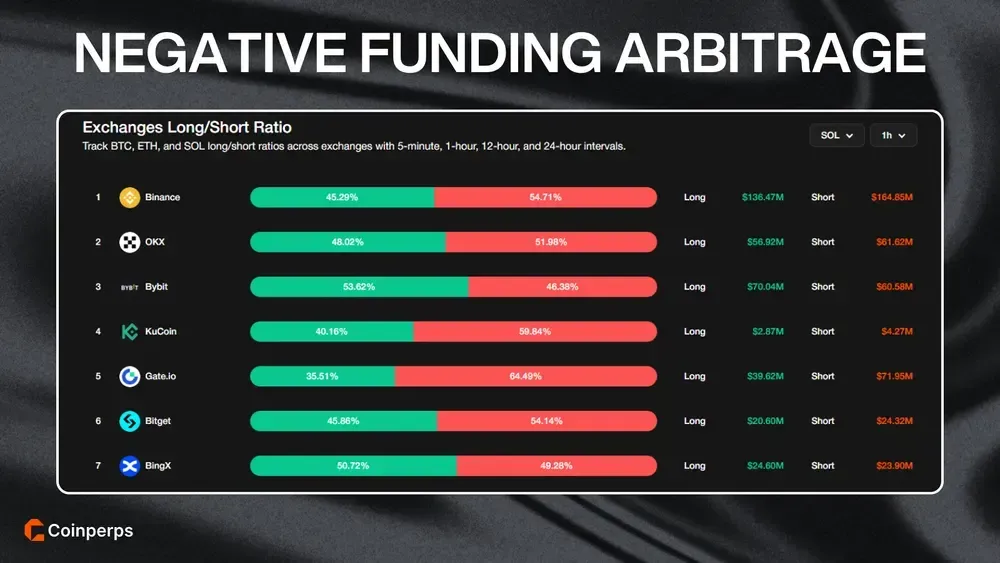
4. Negative Funding Arbitrage
Negative funding arbitrage reverses the standard setup to profit when shorts pay longs. This occurs during bearish regimes where the perpetual price trades below spot, allowing traders to earn yield by maintaining a long derivative position hedged by spot.
- Locate markets where the funding rate is negative, indicating a dominant short bias.
- Borrow the underlying asset via a margin or lending protocol to sell it on spot.
- Simultaneously open a long perpetual position of the same size to neutralize the short spot.
- Receive funding payments from short sellers while paying the lower margin borrowing interest.
Example: Short 100 SOL on margin at 2% interest while longing 100 SOL perps at -0.05% funding. Profit from the net interest surplus.
How Much Can You Earn With Funding Rate Arbitrage?
Earning potential in funding arbitrage scales with market volatility and the collective leverage of retail speculators. By analyzing a $10,000 portfolio, we can mathematically project how different sentiment regimes translate into specific daily and annual yield outcomes.
With a $10,000 portfolio, average returns typically mirror 10.95% annually. In sideways markets, a 0.01% funding rate every 8 hours generates $3.00 daily. After accounting for basic exchange fees, this conservative approach provides a consistent baseline for low-risk capital preservation.
Bullish volatility often triggers 0.05% funding spikes, potentially elevating annual yields toward 54.75%. In these aggressive scenarios, a $10,000 position could earn $15.00 per day. Such peaks occur when leverage demand explodes, offering sophisticated traders rapid, outsized compounding opportunities.
Losses occur if funding rates turn negative, forcing the arbitrageur to pay interest. To calculate net profit, subtract 0.10% total entry and exit fees from your gross yield, or utilize our interactive calculator below to model your specific portfolio outcomes.
Strategy for Disovering Funding Rate Arbitrage
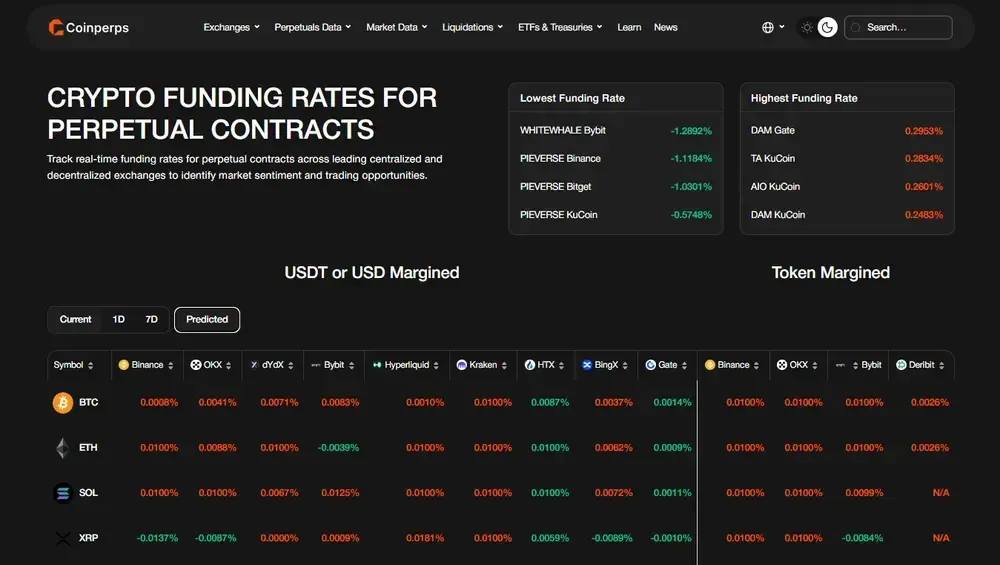
Successful arbitrage depends on locating massive imbalances across venues. Using the Coinperps dashboard on funding rates, traders can visualize cross-exchange disparities and predict future yield cycles effectively.
1. Analyzing Highest and Lowest Yields
The Coinperps dashboard highlights extreme funding rates, allowing traders to immediately spot assets with unsustainable leverage. By monitoring the highest and lowest lists, you can identify which tokens offer the most significant premiums for delta-neutral market participants.
Indicator: Filter the highest and lowest lists on Coinperps.
- Navigate to the Coinperps funding rates landing page.
- Scan the "Highest Funding Rate" and "Lowest Funding Rate" widgets.
- Select tokens with rates exceeding 0.05% per 8-hour period.
Tip: Avoid tokens with 24-hour volume under $1,000,000 to prevent slippage.
2. Cross-Exchange Disparity Mapping
Coinperps aggregates real-time data from Binance, Bybit, and OKX into a single interface for easy comparison. This visibility allows arbitrageurs to detect price-sync lags between exchanges, enabling them to capture the spread between different platform funding payments.
Indicator: Compare the current rates across the exchange columns.
- Use the Coinperps search bar to locate a specific asset.
- Compare the "Current" funding rate across the available exchange columns.
- Identify a spread of at least 0.02% between 2 platforms.
Tip: Ensure both chosen exchanges have sufficient liquidity for the asset.
3. Predictive Trend Confirmation
Utilizing the Predicted and 7D columns on Coinperps helps traders distinguish between temporary spikes and persistent yield opportunities. This historical context ensures that the arbitrage spread remains profitable long enough to cover the initial entry fees.
Indicator: Verify the predicted and 7D cumulative funding metrics.
- Check the "Predicted" column for the next settlement period.
- Review the "7D" cumulative rate to confirm trend stability.
- Enter positions only when the predicted rate remains favorable.
Tip: Higher 7D cumulative rates often signal more sustainable arbitrage opportunities.
Funding Rate Arbitrage Risks
Funding arbitrage involves technical and market dangers that can jeopardize capital. Understanding these risks is essential for maintaining a truly delta-neutral portfolio over time.
Several critical risk factors must be managed during execution:
- Liquidation Risk: Sudden price volatility can liquidate your leveraged perpetual position if collateral isn't rebalanced quickly, leading to significant net capital losses.
- Execution Lag: Delay between opening spot and perpetual legs causes price slippage, potentially resulting in a negative entry basis that destroys profit.
- Exchange Solvency: Holding funds on centralized platforms exposes capital to counterparty risks, including potential withdrawal freezes or exchange-wide insolvency during market crises.
- Negative Funding: Market regimes can shift rapidly, turning positive rates negative and forcing arbitrageurs to pay interest instead of collecting passive yield.
- Smart Contract: Decentralized protocols carry inherent coding vulnerabilities; a protocol exploit or bug could lead to the total loss of locked collateral.
- De-Pegging Risk: Using yield-bearing tokens like stETH introduces risk if the asset loses its peg to the underlying, breaking the delta-neutral hedge.
- Trading Fees: High transaction costs on both entry and exit can exceed the total funding earned, resulting in a net loss scenario.
- Auto-Deleveraging: During extreme market moves, exchanges may forcibly close profitable positions to maintain system stability, leaving your remaining spot leg unhedged.
Funding Arbitrage vs Other Crypto Arbitrage Strategies
Comparing funding arbitrage against other strategies highlights its unique profile. Use the table below to evaluate capital efficiency, risk, and technical difficulty.
Bottom Line
Funding rate arbitrage is still one of the best ways to get steady returns from the structural imbalances that exist in the global crypto derivative markets.
Utilizing specialized data tools like Coinperps allows traders to identify high-reward opportunities while maintaining the delta-neutral positioning required for capital safety.
Success requires diligent monitoring of exchange fees and liquidation levels to ensure that recurring funding payments effectively compound into long-term profits.