How to Avoid Auto-Deleveraging in Crypto
Learn how auto-deleveraging works in crypto, why exchanges trigger ADL, and practical ways traders can reduce forced position closures effectively.

Disclosure: Coinperps may earn a commission from partner links, at no extra cost to you. Reviews are based on independent testing, see how we test.
- Auto-Deleveraging (or simply ADL) is a mechanism that force-closes profitable positions to cover bankrupt accounts when insurance funds lack the capital to absorb losses.
- Exchanges like Bybit and Hyperliquid utilize ADL to protect solvency, close bankrupt positions cleanly, and prevent unpredictable loss socialization during extreme volatility.
- The best strategy to avoid ADL is lowering leverage and concentration, watching ADL indicators, and trading on venues with strong insurance and risk controls.
On October 10, 2025, a sudden tariff announcement triggered extreme volatility, causing roughly $19.3 billion in leveraged liquidations across 1.6 million accounts and forcing several crypto exchanges to activate auto-deleveraging mechanisms.
This black swan event caught the market by surprise, as thousands of profitable traders saw their positions closed without warning. Despite its critical role in platform solvency, data indicates that 80% of retail traders remain completely unaware of how these mechanisms function.
This guide will explain the technicalities of the ADL engine and how to protect your portfolio. ⬇️
What is Auto-Deleveraging (ADL) in Crypto?
Auto-Deleveraging (ADL) is a last-resort risk control on crypto perpetuals futures exchanges. Platforms like Binance and OKX trigger it only after normal liquidations and their insurance or security funds cannot absorb a bankrupt position’s loss, making ADL essentially the final step.
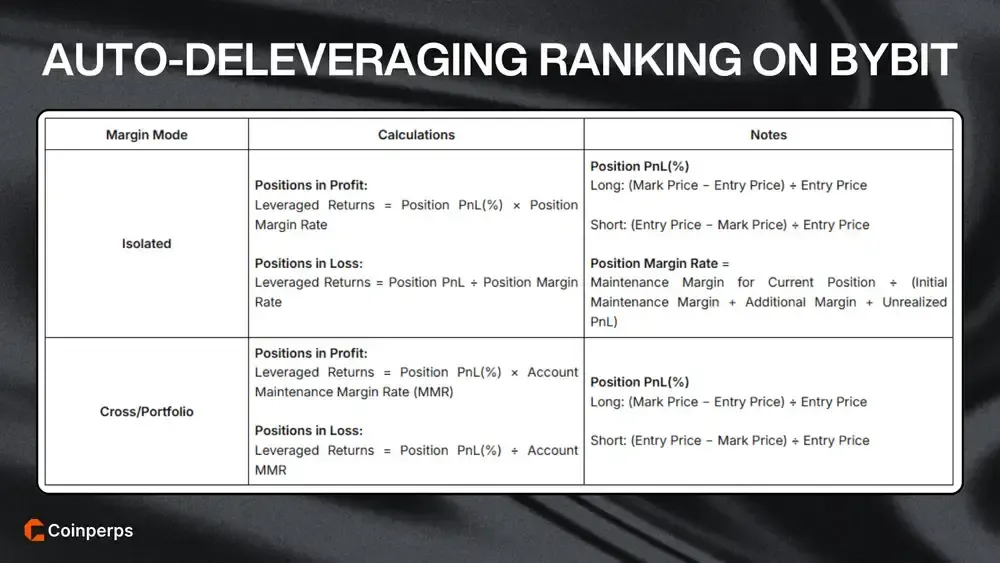
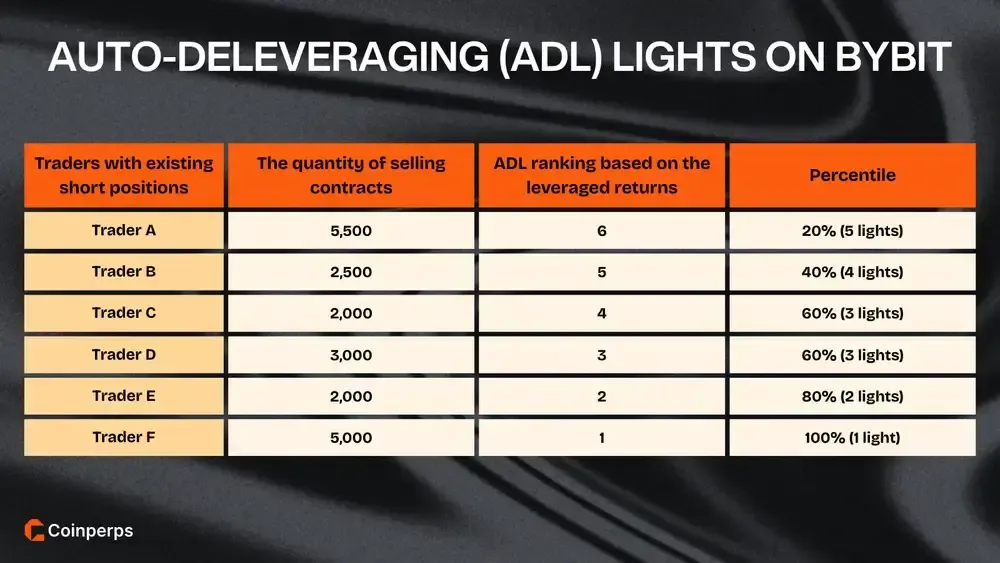
When ADL fires, the platform forcibly reduces or closes positions on the opposite side of the failed trade. Bybit and BitMEX describe selecting traders by an ADL ranking, typically prioritizing higher profit and higher leverage, then settling at the bankruptcy price.
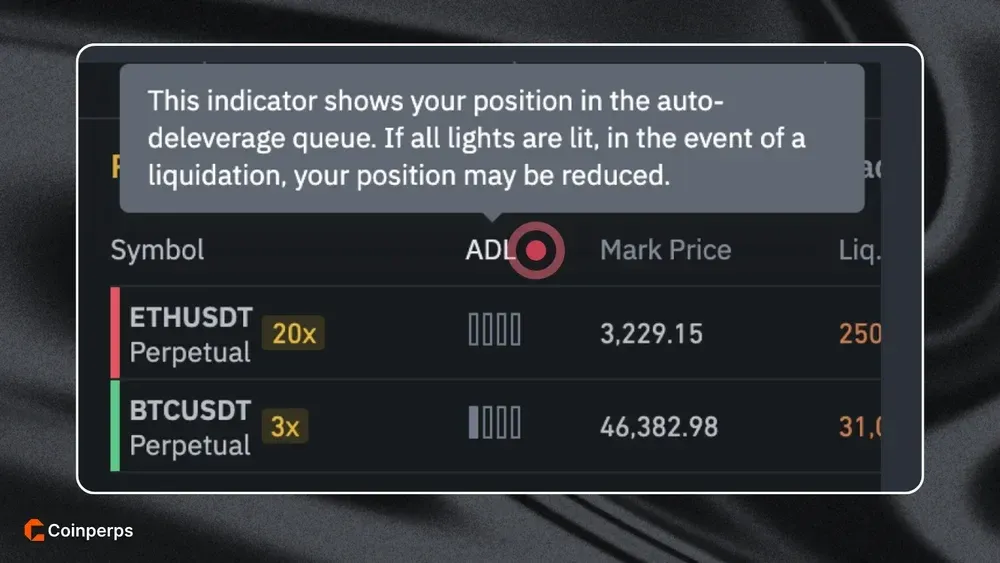
Ultimately, ADL exists to keep the exchange solvent and prevent losses from being spread unpredictably across users. It is most likely during extreme volatility or thin liquidity, and venues often show an ADL indicator, or priority lights, so traders can gauge exposure.
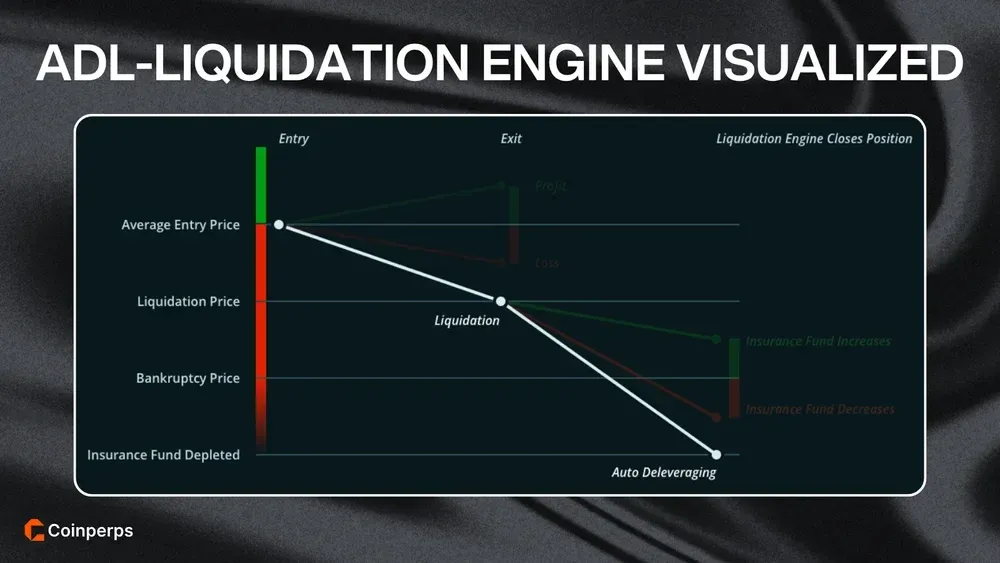
How Does Auto-Deleveraging Work?
Understanding how auto-deleveraging works requires analyzing how exchanges systematically rebalance market risk by matching bankrupt positions against the most profitable opposing traders.
The mechanical execution follows these specific steps:
- Systemic Trigger: Knowing how auto-deleveraging works starts when liquidations leave bad debt that the platform’s insurance fund cannot absorb.
- Queue Generation: To determine how auto-deleveraging works, exchanges like Binance rank winning traders by profit and effective leverage scores.
- Counterparty Selection: Understanding how auto-deleveraging works requires seeing how the system picks high-ranking accounts to cover the outstanding deficit.
- Direct Matching: A key part of how auto-deleveraging works is netting contracts directly against bankrupt positions without using order books.
- Price Settlement: Defining how auto-deleveraging works includes closing positions at the specific bankruptcy price dictated by exchange insolvency rules.
- Priority Monitoring: Users see how auto-deleveraging works through ranking indicators or "lights" that signal their proximity to the queue.
- Automated Reduction: Part of how auto-deleveraging works is the potential for partial position reduction to satisfy the remaining market debt.
- Instant Notification: Finally, how auto-deleveraging works concludes with the platform notifying affected traders that their active positions were force-closed.
Auto-Deleveraging (ADL) Examples
Real-world ADL examples usually hinge on two numbers: how much bad debt liquidations create, and how large the insurance fund is. Bybit defines a trigger tied to an eight-hour insurance-fund drawdown, while BitMEX has documented periods where ADL never fired.
Scenario 1: On an ETHUSDT contract, the insurance fund peaks at $25 million, then loses $25 million within eight hours. Under Bybit’s trigger rule, ADL activates, calculates a bankruptcy price, and force-reduces top-ranked profitable, high-leverage shorts until the deficit clears.
Scenario 2: A whale captures a 300% gain on a 5x BTC swing trade. Despite the safer leverage, their massive profit ratio pushes them up the priority queue. During the 2025 volatility spike, their position is reduced automatically, realizing profits earlier than planned.
Which Crypto Exchanges Support Auto-Deleveraging
Most major derivatives platforms implement auto-deleveraging as a final safeguard to protect their internal infrastructure from becoming insolvent during periods of extreme market volatility.
These following exchanges actively utilize ADL for risk management:
- Binance Futures: This global leader utilizes a 5-level indicator system to signal your ranking within their high-priority ADL queue.
- Bybit: Bybit utilizes specialized insurance pools for new listings and portfolios to reduce the frequency of triggered ADL events.
- Hyperliquid: This protocol utilizes a whale-priority ranking system to match bankrupt accounts against the most profitable opposing traders during crashes.
- BitMEX: As the perpetual swap pioneer, BitMEX determines rankings using a formula of PnL percentage multiplied by effective leverage.
- OKX: OKX employs a sophisticated risk-backstop mechanism that targets profitable counterparties when the insurance fund reaches a 0 balance.
- Kraken: This platform enforces auto-deleveraging rules to protect overall solvency if liquidation engines fail to clear bankrupt trading positions.
- Gate: Uses a transparent ranking system where profitable accounts are automatically deleveraged at the liquidated trader's bankruptcy price.
- MEXC: MEXC utilizes an extensive insurance fund to prevent ADL, yet activates the mechanism during extreme 2025 market volatility.
How to Avoid Auto-Deleveraging
Auto-deleveraging is the trader’s nightmare: you are profitable, yet the exchange force-closes or reduces your position because another account went bankrupt, often in fast markets. Bybit is the ideal answer to this industry-wide issue by offering a sophisticated "ADL Priority Lights" indicator.
Bybit positions its derivatives system to make that outcome rarer. Its insurance fund is built to cover losses that exceed a liquidated trader’s margin, using Bybit contributions and surplus margin from liquidations executed better than bankruptcy prices, reducing ADL likelihood.
Transparency matters when you are evaluating ADL risk. Bybit lets users monitor insurance fund balances, distinguishes shared versus isolated pools, and exposes insurance pool data via API. It also publishes clear 8 hour drawdown trigger and stop conditions for ADL.
Bybit also reduces the chance that a single oversized position creates the bad debt that triggers ADL. Its risk limit framework uses dynamic leverage: as position value rises, maximum leverage falls and initial margin requirements increase, limiting liquidation losses.
Risks of Auto-Deleveraging (ADL)
Derivatives traders face unique hazards when platforms execute auto-deleveraging protocols to prevent systemic insolvency during extreme market liquidation cascades and volatility.
Understanding these risks is essential for managing professional trading portfolios:
- Profit Realization: Forced exits crystallize unrealized gains at the bankruptcy price, potentially depriving traders of 20% or more in additional profits.
- Hedge Disruption: Closing a single leg of a delta-neutral strategy leaves the remaining side exposed to 100% of directional market risk.
- Tax Implications: Automatic position termination triggers immediate capital gains liabilities, forcing investors to settle tax obligations earlier than originally planned for 2025.
- Liquidity Removal: The mechanism bypasses traditional order books, removing significant buy or sell pressure exactly when the market requires the most support.
- Strategy Invalidation: Quantitative models and automated bots fail when positions are truncated without warning, leading to severe execution errors and portfolio imbalances.
- Monitoring Complexity: Traders must track opaque ranking indicators across multiple exchanges to assess their proximity to the front of the deleveraging queue.
- Opportunity Cost: Forced closures prevent accounts from participating in rapid price recoveries that often follow sharp, temporary liquidity-driven flash crash events.
- Unfair Selection: Prudent risk managers are penalized for their success, as high profit-to-leverage ratios prioritize their accounts for immediate system-wide debt matching.
Bottom Line
Exchanges use auto-deleveraging to keep derivatives markets solvent when liquidations and insurance funds cannot fully cover bankrupt positions during high volatility periods.
This guide helps you recognize ADL triggers, indicators, and ranking mechanics so you can reduce exposure and choose platforms with stronger backstops.
Perpetual traders should also master funding rates, mark price mechanics, liquidation thresholds, risk limits, and liquidity conditions that amplify sudden forced reductions.