How to Use Bitget in the USA: VPN Risks & Alternative CEXs
Explore Bitget’s US restrictions, VPN access risks, account-ban concerns, global licenses, and the best crypto exchange alternatives for American traders.

Disclosure: Coinperps may earn a commission from partner links, at no extra cost to you. Reviews are based on independent testing, see how we test.
- Bitget is not available in the United States because its official restricted-country list includes the US as a prohibited jurisdiction.
- US users should avoid VPN workarounds because Bitget monitors and restricts access from sanctioned or restricted regions.
- Coinbase, Kraken, and Crypto.com are safer choices for US traders because they operate under US-focused compliance frameworks.

Bitget
Bitget is a leading global exchange founded in 2018, serving more than 50 million users across 150 countries with over $5 billion in daily volume and extensive futures and copy trading features.
Features
Fees
Regulation
Overall
Bitget offers large crypto markets, copy trading, and futures products, but American users run into firm access restrictions, compliance checks, and account limitations.
This guide breaks down Bitget’s US availability, VPN concerns, account-access scenarios, regulatory status, and safer exchange alternatives for traders based in the United States.
Here are the main points to know first. 🔽
Is Bitget Available in the United States?
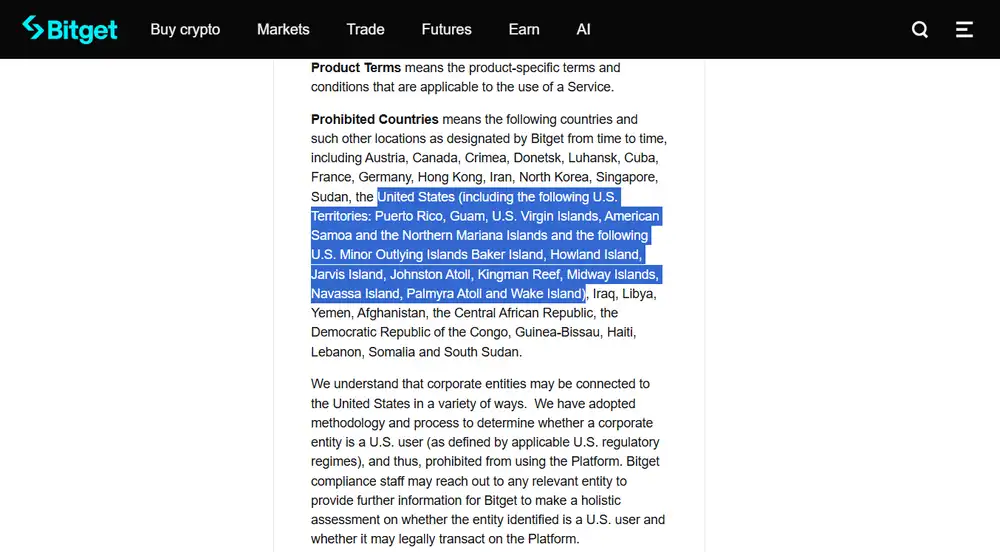
No. Bitget is not available in the United States. Its official Terms of Use classify the United States as a “Prohibited Country,” meaning US-based users are not allowed to access or use Bitget services.
Bitget also defines “Restricted Person” broadly, covering individuals or entities connected to prohibited jurisdictions. That means the restriction can apply based on residence, location, establishment, or other links to the United States, not just citizenship.
Bitget’s regulatory compliance page confirms that it restricts access from sanctioned or restricted regions and again lists “The United States” among prohibited countries. Therefore, US users should choose a compliant, US-available crypto exchange instead.
How to Use Bitget in the USA
Since Bitget blocks US users under its Terms of Use, there is no officially supported way to use the exchange from the United States. Still, some traders attempt access by masking their location, which may violate Bitget’s rules.
Common methods people try when attempting to access Bitget include:
- Choose a VPN: Some users pick services like Proton VPN, Mullvad, or CyberGhost to route their traffic through a country where Bitget is not restricted.
- Select a Supported Region: Instead of connecting from the US, they choose a server in a jurisdiction where Bitget services are normally available.
- Check the Connection First: Before opening Bitget, they confirm the VPN is active and that their browser or device is not leaking their real location.
- Create an Account by Email: Users typically attempt registration with an email address rather than a US phone number, since phone verification may expose their location.
- Avoid US Payment Rails: Because card purchases and bank transfers usually require identity checks, some users fund accounts through external crypto wallet transfers.
- Enable Security Tools: They add two-factor authentication, withdrawal whitelists, and anti-phishing codes before depositing funds, especially because account recovery may be harder.
- Keep the Same Access Pattern: Some users continue logging in through the same VPN region to reduce sudden location changes that may trigger Bitget’s compliance checks.
Risks of Using a VPN to Access Bitget
Using a VPN to access Bitget from the US can breach the platform’s rules because Bitget lists the United States as a prohibited country. If detected, users may face failed verification, account restrictions, trading limits, or blocked access.
The bigger risk is losing reliable control over funds during compliance reviews. Bitget says it monitors and restricts access from sanctioned or restricted regions, so location masking may trigger checks, withdrawals delays, or account freezes at inconvenient times.
Will My Bitget Account Be Banned if I Move to the US?
A move or visit to the US does not guarantee an instant ban, but it can make your Bitget account unusable, restricted, or subject to review.
1. Traveling to the US Temporarily
If you travel to the United States temporarily, Bitget may block access because its Terms say services can become unavailable when a user travels to a prohibited country, which includes the US and several territories there.
A short trip may not automatically close the account, but logging in from a US IP address can create a compliance signal. Trading, withdrawals, or open positions may be affected until access returns outside the country.
2. Moving to the US Permanently
If you permanently move to the United States, the issue is more serious because Bitget defines US-linked users as restricted. Continuing to trade from there may violate eligibility rules, even if the account was opened elsewhere.
In this scenario, a ban is possible, but restrictions are more likely to appear first. Bitget may request verification, limit account functions, or prevent access if your KYC documents, IP address, or activity show US residence clearly.
3. Passing Through While Logged In
Passing through the US while logged in is still risky because Bitget can detect location from IP data, device signals, or account behavior. Even airport Wi-Fi or roaming data may show prohibited-country access during transit sessions.
One accidental login probably does not mean instant closure, but it can create avoidable problems. Users with funds or open trades may prefer to stop logging in until they are back in an allowed region again.
Where is Bitget Regulated?
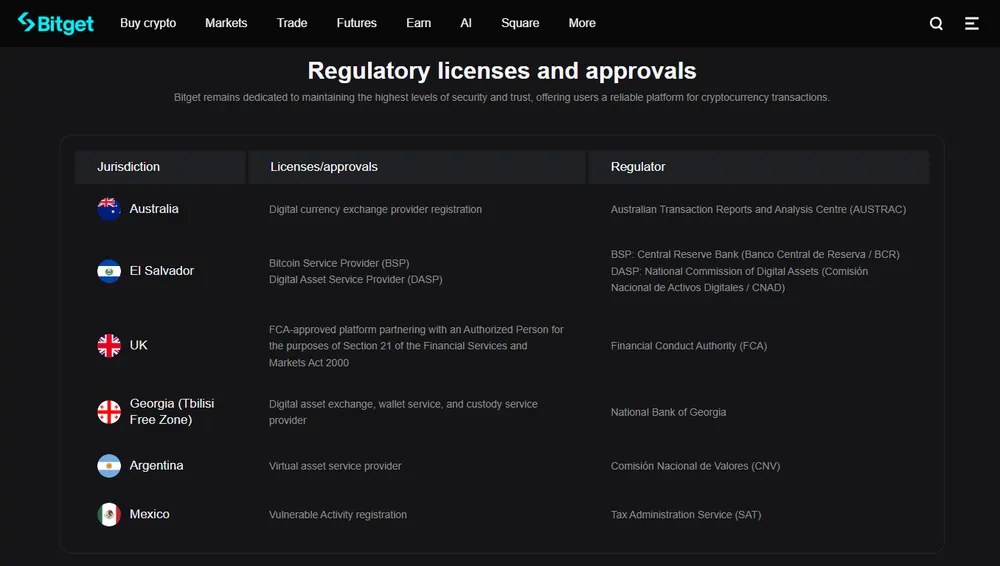
Bitget says it holds regulatory licenses and approvals across several jurisdictions, but these registrations do not make the platform available to US residents today.
Current licenses and approvals listed by Bitget include:
- Australia: Digital currency exchange provider registration with AUSTRAC, covering crypto exchange activity under Australia’s anti-money-laundering supervision framework for crypto services.
- El Salvador: Bitcoin Service Provider and Digital Asset Service Provider approvals through BCR and CNAD, supporting locally regulated digital asset services.
- United Kingdom: FCA-approved platform arrangement through an Authorized Person, structured for Section 21 financial promotions compliance under UK rules.
- Georgia: Digital asset exchange, wallet service, and custody service provider approval through the Tbilisi Free Zone framework.
- Argentina: Virtual asset service provider registration with CNV, allowing Bitget to operate under Argentina’s local crypto supervision framework.
- Mexico: Vulnerable Activity registration with SAT, reflecting compliance obligations for covered crypto-related activities in the Mexican market.
Best Bitget Alternatives for the United States
US traders should use regulated, locally available platforms instead of bypassing Bitget restrictions. Coinbase, Kraken, and Crypto.com are three practical options.


Kraken
Kraken is better suited to users who want a more exchange-style experience, with advanced order types, strong liquidity, crypto-to-crypto trading, and a long operating history. It is often a good fit for traders who outgrow basic brokerage-style apps.
Kraken’s disclosures say Payward Interactive is registered with FinCEN as a Money Services Business and holds licenses across multiple US jurisdictions. Kraken Financial is also connected to Wyoming’s SPDI banking framework, adding another US regulatory layer.
Coinbase
Coinbase is a strong Bitget alternative for beginners because it offers a simple interface, debit card and bank-transfer funding, recurring buys, staking where available, and a separate advanced trading experience for lower-fee limit orders and deeper charting tools.
From a compliance angle, Coinbase says its US entity is licensed to engage in money transmission in most US jurisdictions, while New York’s DFS approved Coinbase for both a virtual currency license and money transmitter license.
Crypto.com
Crypto.com is a useful alternative for users who want a mobile-first app, a broad list of supported tokens, card-linked features, wallet tools, and access to several crypto services from one account rather than only spot trading.
Crypto.com’s licenses page lists US Money Services Business registration, money transmitter licenses, broker-dealer registration, DCO and DCM licenses, and conditional approval for a national trust bank charter, although product availability still varies by state.
Bottom Line
Bitget is not available in the United States, and its Terms list the US as a prohibited country. Using a VPN may create account, withdrawal, and compliance risks.
For US users, the safer route is choosing regulated alternatives such as Coinbase, Kraken, or Crypto.com. Bitget may hold licenses elsewhere, but that does not override US access restrictions.