Hyperliquid HIP-3 Perpetuals Explained
Discover how Hyperliquid HIP-3 Perpetuals bring new crypto, commodity, and index exposures onchain & understand what traders should know before starting.

Coinperps may earn a commission from partner links, at no cost to you; rankings follow our methodology. Not financial advice.
Key takeaways
- HIP-3 turns perpetual listings into a permissionless builder activity, allowing Hyperliquid to expand beyond crypto-native markets and bring more TradFi-style exposures onchain.
- Unlike standard protocol-run listings, HIP-3 markets are operated by deployers who control specifications, collateral, and risk settings, creating more flexibility but also more responsibility.
- For traders, the opportunity is broader market access across assets like indices, commodities, and equities, but success still depends on liquidity, fees, and execution.

- HIP-3 markets
- Indices, commodities, equities, crypto
- HIP-3 fees
- 2x standard perp fees
- Deployer stake
- 500,000 HYPE
- Quote assets
- USDC, USDH or USDT
How we rate Hyperliquid Partner link · How we rank
Hyperliquid is the largest and most liquid decentralized perpetuals exchange, processing over $2 trillion in volume on a custom Layer-1 with sub-second finality.
Field average across 19 exchanges. Coinperps score 6.7/10, #14 of 19.
Coinperps may earn a commission if you sign up through this link, at no cost to you. Rankings follow our method, not partner deals.
On this page 9 sections
Hyperliquid HIP-3 Perpetuals mark a major shift in how new markets reach traders, moving perpetual listings toward a more open, builder-driven model inside the protocol’s familiar trading stack.
That means HIP-3 is not just another product update: it expands Hyperliquid’s contract universe into a broader onchain derivatives layer that can include crypto, commodities, indices, and single-stock style exposures.
Below, we break down what HIP-3 is, why it matters, how it works, and what traders should weigh before using these new markets. 🔽
What Are Hyperliquid HIP-3 Perpetuals?
Hyperliquid HIP-3 Perpetuals are permissionless builder-deployed perpetual markets that let qualified deployers launch their own perp DEXs on Hyperliquid, instead of waiting for validator-operated listings. Hyperliquid presents HIP-3 as a major decentralization milestone for the protocol’s perp listing process.
The concept matured through testnet rollout in 2025, then received a more formalized public mainnet spec update on March 25, 2026. A follow-up developer documentation update on April 9, 2026 clarified deployer actions, signaling a feature moving closer to production readiness.
What makes HIP-3 novel is that builders define and operate markets while still inheriting HyperCore’s high-performance order books, margining, and unified trading interfaces. In practice, that means custom perps can plug into familiar Hyperliquid infrastructure rather than launching as isolated, fragmented venues.
HIP-3 also introduces a new market-creation model with staking, validator oversight, shared auctions for additional assets, and configurable collateral choices. That mix aims to open perpetual listings permissionlessly while preserving platform neutrality, solvency safeguards, and operational standards as Hyperliquid scales.
Why HIP-3 Perps Matter For Crypto Traders?
Traditional derivatives still operate on a much bigger economic scale than crypto. BIS data showed $846 trillion in OTC derivatives outstanding at mid-2025, while OTC interest-rate derivatives alone averaged $7.9 trillion in daily turnover.
Crypto perps are expanding quickly, but they remain smaller by comparison. CoinGecko estimated $92.9 trillion in 2025 perp volume, meaning just a couple of weeks in OTC rate derivatives can approach an entire year of crypto perp trading.
That gap helps explain why HIP-3 matters: traditional derivatives are bigger partly because they offer broad exposure to stocks, indexes, commodities, and macro trades, and HIP-3 is starting to replicate that model onchain with markets like oil and the S&P 500.
Key trader benefits worth highlighting at this stage:
- Early Access: Traders can reach niche or time-sensitive perpetual markets sooner, without relying only on Hyperliquid’s validator-operated listing pipeline.
- Familiar Execution: HIP-3 perps inherit HyperCore order books and margining, keeping trading consistent instead of pushing users toward unfamiliar external venues.
- Better Choice: Independent deployers can compete on design and collateral choices, improving product variety, pricing quality, and overall market responsiveness.
- Faster Innovation: Builders can launch novel perp concepts and specialized strategies faster than centralized exchange-style listing committees usually permit.
- Lower Friction: Users get new instruments inside Hyperliquid’s unified stack, avoiding the hassle of learning completely separate exchange workflows.
- Stronger Accountability: Deployer staking, validator review, and slashing risk encourage accountable operators rather than careless short-term experimentation.
How Does HIP-3 Work?
HIP-3 lets qualified deployers launch perpetual markets on Hyperliquid while using shared core infrastructure, but with their own market definitions, risk settings, and operating responsibilities.
1. Market Deployment And Structure
HIP-3 starts with the idea that a deployer can launch one perp DEX once the mainnet staking threshold is met. Hyperliquid set that requirement at 500,000 staked HYPE, with expectations it may decline over time.
Each deployed DEX has independent margining, order books, and deployer settings, even though it still inherits the HyperCore stack. That gives builders room to launch differentiated markets without abandoning Hyperliquid’s unified trading environment, performance profile, and API conventions.
How Does HIP-3 Work?
Permissionless builder-deployed market framework
Anything Tradable
Pricing Data
User Interest
Entry Requirement
500,000 HYPE
Minimum staked for 30 days post-halt.
Market Capacity
1 Perp DEX
Independent margining & order books.
Bootstrap Speed
3 Instant Listings
Skip auctions for first 3 markets.
Growth Buffer
7 Reserve Slots
Bypass auction timer at prevailing price.
Validator Oversight & Neutrality
Risk Controls: Slashing protects protocol correctness. Validator reviews trigger automatically for manipulation risk (>50% price moves). Deployment remains neutral, separating technical violations from market outcomes.

Operational Standards dev update: 20 April 2026
2. Asset Listing And Market Expansion
HIP-3 also defines how new markets get added over time, balancing faster deployment with controlled expansion so builders can launch quickly without making permissionless listings totally unrestricted.
Main building blocks traders and builders should know:
- Staking: Mainnet deployers must keep 500,000 HYPE staked, and that requirement remains for 30 days after all deployed perps are halted.
- One DEX: Each qualifying deployer can initially launch one perp DEX, with separate margining, order books, and deployer-defined settings.
- Collateral Choice: Any eligible quote asset can serve as collateral, creating more flexibility in product design and fee positioning.
- First Listings: The first three assets on a perp DEX skip auction participation, helping new deployers bootstrap markets faster.
- Dutch Auctions: Additional listings enter a shared Dutch auction system, using hyperparameters aligned with the existing HIP-1 auction framework.
- Reserve Slots: Deployers receive seven reserve deployments that can bypass the auction timer at the prevailing auction price.
3. Risk Controls And Oversight
HIP-3 is permissionless in listing terms, but not lawless: deployers operate under validator oversight, slashing rules, and asset standards meant to protect protocol correctness.
Key safeguards built into the framework include:
- Slashing: Validators can slash a deployer’s stake for irregular actions that jeopardize correctness, uptime, or protocol performance.
- Neutrality: Hyperliquid explicitly separates technical violations from subjective disputes, preserving platform neutrality rather than policing every controversial market outcome.
- Settlement: Deployers can halt trading to cancel orders and settle positions at the current mark price when needed.
- Cross Margin: Cross-margin access is gated by validator-enforced eligibility standards around liquidity, oracle reliability, and manipulation resistance.
- Manipulation Reviews: Assets showing external price moves above 50% versus start-of-day levels trigger validator review for possible manipulation risk.
- Onchain Transparency: All deployer transactions are onchain, allowing independent monitoring and post-trade review by validators and market participants.
Types of HIP-3 Perpetual Contracts
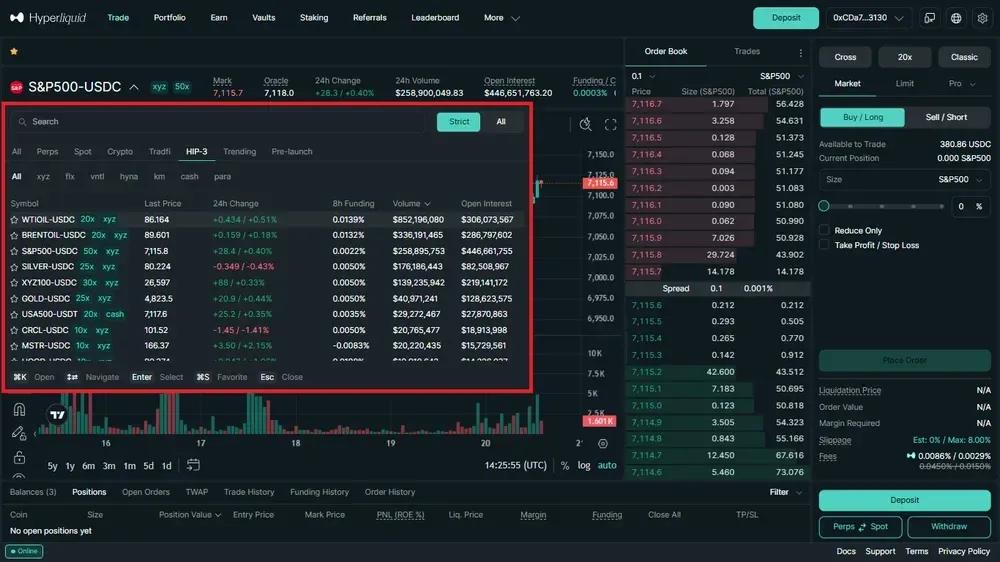
Latest HIP-3 market data shows the category has expanded beyond crypto-native pairs into a multi-asset lineup spanning indices, commodities, equities, and still core digital assets.
The current contract mix can be grouped into:
- Equity Indices: Contracts like SP500, USA500, and XYZ100 bring benchmark-style macro exposure onchain, letting traders express broad market views without picking individual stocks.
- Energy: CL and BrentOil show HIP-3 reaching commodity territory, giving users round-the-clock access to oil-linked perp trading beyond traditional exchange hours.
- Precious Metals: Gold and Silver contracts extend the product suite into classic defensive assets, useful for macro positioning, inflation trades, and risk-off narratives.
- Single Stocks: Names such as NVDA and TSLA show how HIP-3 can package high-interest equity stories into perpetual format for always-on speculation.
- Crypto Majors: BTC remains part of the lineup too, showing HIP-3 is expanding the menu rather than replacing crypto-native perpetual demand.
Types of HIP-3 Perpetual Contracts
Expanding multi-asset lineup beyond crypto-native pairs
| Category | Market Assets | Trading Role |
|---|---|---|
| Equity Indices |



|
Benchmark-style macro exposure. |
| Energy |


|
24/7 commodity perps. |
| Precious Metals |


|
Classic defensive positioning. |
| Single Stocks |


|
Always-on equity speculation. |
| Crypto Majors |

|
Expanding core demand. |
HIP-3 packages high-interest global stories into perpetual format for non-stop market access.
How to Trade Hyperliquid HIP-3 Perps
Trading HIP-3 perps follows the standard Hyperliquid flow: connect a wallet, fund the account with supported assets, choose a market, then open, manage, and close positions.
1. Connect Your Wallet And Enable Trading
Before trading any HIP-3 market, users first connect a wallet and activate permissions through Hyperliquid’s gas-less signature flow, which prepares the account for deposits and order entry.
- Connect: Click the wallet connection button, approve the request, and link your address so Hyperliquid can recognize the account in the trading interface.
- Enable Trading: Sign the gas-less authorization message, which turns on trading access without requiring a separate onchain gas payment.
- Confirm Access: Once enabled, the connected wallet becomes the account used for deposits, transfers, and signing trading actions inside Hyperliquid.
2. Fund The Account With Supported Assets
Funding is broader than just USDC, because Hyperliquid supports deposits from several native assets, though traders may still need the appropriate quote asset afterward.
- Choose Asset: Hyperliquid supports deposits using USDC on Arbitrum, plus native assets such as BTC, ETH, ENA, SOL, BONK, MON, and XPL.
- Match Collateral: After deposit, traders may need to sell the incoming asset for USDC, USDH, or USDT depending on the quote asset used.
- Check Balance: Confirm that collateral is visible in the relevant trading balance before selecting a HIP-3 market and entering a position.
- Understand Margin: In portfolio margin, eligible quote assets can interact with unified balances, and HIP-3 DEXs are included in that framework.
3. Open A HIP-3 Position
Once funded, opening a HIP-3 trade feels familiar because Hyperliquid uses the same general order-entry system, margin modes, and execution logic across perpetual products.
- Select Market: Choose the HIP-3 contract you want, then decide whether your thesis is bullish or bearish before entering size.
- Choose Margin Mode: Use cross margin for shared collateral efficiency or isolated-style exposure when you want tighter risk separation.
- Set Leverage: Pick leverage carefully, since required initial margin depends on position size, mark price, and selected leverage.
- Pick Order Type: Submit the trade with the appropriate order format, such as GTC, IOC, Post Only, or other supported instructions.
4. Manage And Close The Trade
After entry, the main tasks are controlling downside, monitoring funding and liquidation risk, and exiting cleanly without accidentally reversing the position.
- Use TP/SL: Take-profit and stop-loss orders can automate exits, and Hyperliquid says the mark price is used to trigger them.
- Watch Funding: Funding remains an important holding cost for perpetuals, especially when positions stay open across multiple intervals.
- Reduce Exposure: A reduce-only exit can trim or close the position without opening a new trade in the opposite direction.
- Close Before Liquidation: If equity falls too far, Hyperliquid can liquidate positions using mark-price based logic, so timely exits matter.
HIP-3 vs Other Hyperliquid Contracts
HIP-3 sits in a different lane from HIP-1 and HIP-2. HIP-1 is Hyperliquid’s permissionless native token standard for creating spot assets, while HIP-2 is the protocol’s onchain liquidity mechanism for HIP-1 spot pairs, currently against USDC.
HIP-3, by contrast, is about permissionless builder-deployed perpetuals. Instead of launching a token or auto-bootstrapping spot liquidity, a qualified deployer launches a dedicated perp DEX with its own order books, margining, settings, and market operations.
HIP-4 is the closest conceptual neighbor, but it targets a different contract type. Public 2026 materials describe HIP-4 as outcome trading: fully collateralized, expiry-based contracts for prediction-market style exposures rather than perpetual futures that rely on funding and liquidation mechanics.
The practical differences are easiest to scan side by side:
Risks to Consider
HIP-3 opens the door to more markets and faster listings, but that flexibility also introduces extra layers of market, operator, and product-specific risk.
The main risk factors traders should keep in mind are:
- Deployer Risk: Each HIP-3 market is operated by a deployer responsible for market definition, oracle inputs, leverage limits, and settlement decisions.
- Oracle Risk: HIP-3 supports general oracle design, so poorly chosen or manipulable reference data can create pricing distortions or unstable market behavior.
- Liquidity Risk: New or niche contracts may have thinner books than established markets, raising slippage and making larger positions harder to enter or exit.
- Higher Fees: Hyperliquid says user fees on HIP-3 markets are 2x the usual fees on validator-operated perp markets.
- Settlement Risk: Deployers can halt trading, cancel orders, and settle positions to the current mark price when necessary.
- Cross-Margin Limits: Cross margin is not universally available without conditions, and validator standards can restrict eligibility for more volatile assets.
- Manipulation Reviews: Assets with external price moves above 50% versus start-of-day levels can trigger validator review for possible manipulation.
- Slashing Events: While meant as a safety mechanism, deployer slashing highlights that HIP-3 markets carry operator-specific governance and compliance risk.
- Frontend Fragmentation: Public 2026 coverage notes HIP-3 markets may depend on third-party frontends, adding another layer of usability and trust considerations.
Bottom Line
HIP-3 is one of Hyperliquid’s most important expansions because it turns perpetual listings into a more permissionless builder activity instead of a tightly controlled protocol function.
That matters because the product set is already moving beyond crypto-native pairs and into equities, indices, and commodities, bringing more traditional-market style exposure onchain.
For traders, the appeal is broader opportunity and faster innovation; the trade-off is that market quality depends more heavily on deployers, collateral choices, liquidity depth, and risk controls.
FAQs
Does HIP-3 only support crypto perpetuals?
No. By 2026, HIP-3 usage had clearly expanded into TradFi-linked exposures, including tokenized stocks, equity-index style markets, and commodities, not just crypto-native pairs.
Do HIP-3 markets trade through the same Hyperliquid infrastructure?
Yes. Hyperliquid says HIP-3 inherits the HyperCore stack, including high-performance order books, margining, and unified trading APIs, even though the markets are builder-deployed.
Is HIP-4 basically the same thing as HIP-3?
No. HIP-3 is for perpetual futures, while public 2026 descriptions of HIP-4 frame it as outcome trading with fully collateralized, expiry-based contracts closer to prediction markets than standard perps.


