Kraken Restricted Countries List 2026 – Regions & Alternatives
Discover Kraken restricted countries in 2026, see which regions are blocked, understand why access is limited, and explore regulated exchange alternatives.

Disclosure: Coinperps may earn a commission from partner links, at no extra cost to you. Reviews are based on independent testing — see how we test.
- Kraken strictly prohibits users from sanctioned nations like North Korea and Iran, maintaining a zero-tolerance policy toward VPN usage for bypassing geographic blocks.
- The platform supports 190+ countries and offers diverse fiat access via SEPA, SWIFT, and FedWire, facilitating seamless entry for global traders.
- For users in restricted regions, utilizing licensed alternatives like Coinbase or local regulated providers ensures adherence to regional compliance and fund security.

Kraken
Kraken is the most trusted and well regulated perpetuals exchange across the US, Europe, Canada, and other key markets, offering 170+ contracts with deep liquidity and low fees.
Features
Fees
Regulation
Overall Rating
Kraken can be hard to assess in certain locations because eligibility depends on country, state, product, and verification status. Users who register from blocked territories risk account restrictions, failed deposits, and frozen access while compliance checks are carried out.
Jurisdiction also decides what KYC documents Kraken can request, whether fiat rails are available, and whether products like margin, rewards, or derivatives appear at all. That makes residency accuracy a core account-safety issue, not just a box-ticking exercise.
Learn where Kraken is actually supported today. ⬇️
List of Kraken Restricted Countries and Regions
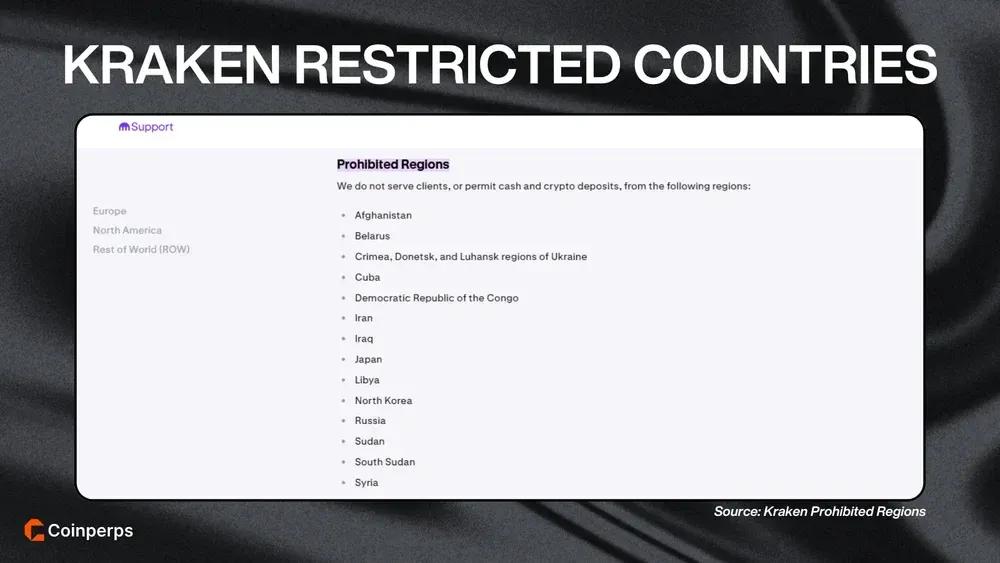
Kraken’s Terms of Service restrict sanctioned or embargoed jurisdictions and listed persons. As of early 2026, its support page identifies 14 prohibited countries and territories/regions where clients cannot access services or make cash and crypto deposits. Here are they:
- Eastern Europe: Includes Belarus, Russia, and Crimea, Donetsk, and Luhansk, reflecting sanctions exposure, territorial restrictions, and heightened cross-border compliance concerns.
- Middle East: Includes Iran, Iraq, and Syria, where sanctions risk and local legal barriers prevent onboarding, funding, trading, and account servicing.
- East Asia: Includes North Korea and Japan, combining sanctions-related prohibitions with jurisdiction-specific eligibility limits under Kraken’s current compliance framework.
- South Asia: Afghanistan is prohibited due to legal, sanctions, and compliance concerns that make account opening, deposits, and ongoing access unavailable.
- Caribbean: Cuba remains restricted because embargo controls and related sanctions obligations block lawful access to exchange services and payment channels.
- Central Africa: The Democratic Republic of the Congo is prohibited, reflecting elevated compliance risk and Kraken’s decision not to support local onboarding.
- North Africa: Libya is restricted under Kraken’s geographic controls, preventing residents from using exchange services or submitting fiat and crypto deposits.
- Sudan Region: Sudan and South Sudan are both prohibited, with restrictions covering registration, funding access, and continued account use.
Countries and Currencies Supported by Kraken
Kraken declares it serves more than 15 million clients in over 190 countries and offers its website in 13 languages. For buying, the platform supports a Quick Buy-style instant purchase flow, peer-to-peer transfers through Krak, and multiple on-ramp providers, but payment availability still changes by verified residency.
- USD (US Dollar): Available through ACH via Plaid, PayPal, debit card, FedWire, and SWIFT. ACH is near-instant for trading but carries a 7-day withdrawal hold.
- EUR (Euro): Fundable through SEPA, SEPA Instant via Plaid, Openpayd, Banking Circle, Ivy, plus Bank Frick and PayPal in eligible EEA settings. Processing is usually instant to 3 business days.
- CAD (Canadian Dollar): Canadian residents can use domestic wire transfer, e-Transfer, in-person cash or debit, Apaylo Bill Pay, and debit card, while SWIFT exists for broader access.
- GBP (Pound Sterling): Supported through FPS via Plaid, standard FPS, Openpayd, PayPal, debit card, and SWIFT. Most FPS routes clear in 0-1 business days.
- CHF (Swiss Franc): Swiss and Liechtenstein users can use SIC through Bank Frick, while broader users can fund CHF through SWIFT with Bank Frick.
- ARS (Argentine Peso): Argentina-based verified accounts get local bank transfer funding with near-instant processing, while some Pro personal and business setups are limited to SWIFT.
- BRL (Brazilian Real): Brazil-only BRL funding runs through PIX bank transfer, with a 50 BRL minimum and near-instant processing under Kraken’s published cash deposit page.
- MXN (Mexican Peso): Mexico-only funding is available through SPEI bank transfer, with a 150 MXN minimum, a 0.50% fee, and processing of up to 20 minutes.
Important: Kraken’s bank rails are often free or low-cost, but instant card and wallet purchases can be much higher than 1-2%, and slippage can still appear on fast buys. Processing ranges from near-instant for cards, PayPal, PIX, and SPEI to 1-5 business days for many wire and SWIFT methods.
Does Kraken Require Mandatory KYC Verification?
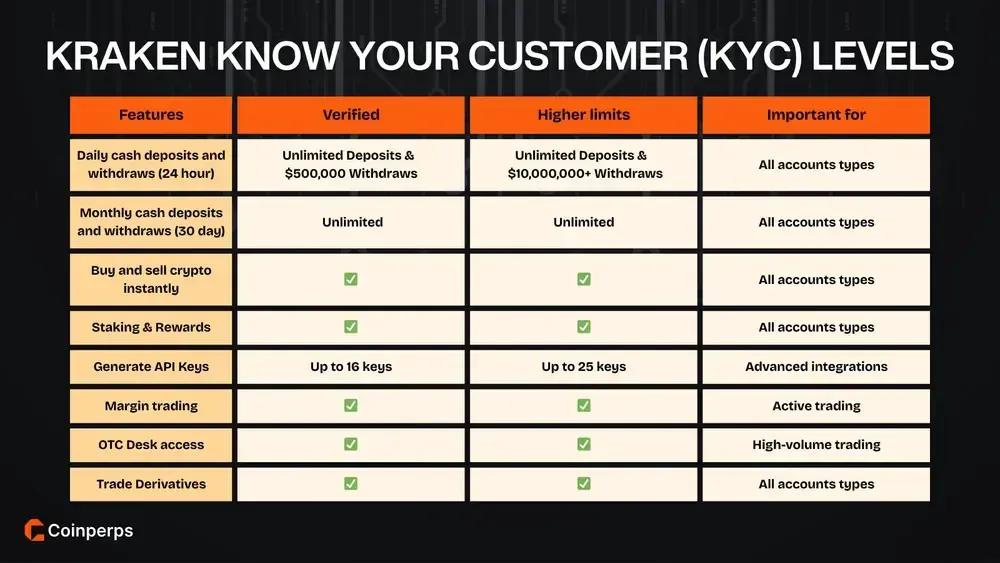
Kraken’s current KYC framework does not show a practical “unverified” retail tier with published funding rights. Its posted limits begin at Standard verification, where crypto withdrawals are capped at $500,000 per 24 hours, while cash withdrawals are capped at $100,000 per 24 hours and $500,000 per 30 days.
For the first usable retail tier, Kraken points users to Standard verification. Kraken says a verified individual account unlocks essential account functions, and its document list includes passport, driver’s license, or national identity card, alongside supported-area residency requirements.
For users seeking a Level 2-style upgrade, Kraken now uses a “personal account with higher limits” model rather than a simple Advanced label. That tier raises cash limits to $10,000,000+ per 24 hours and $100,000,000+ per 30 days, and Kraken may require proof of address and a face photo depending on residency and review outcome.
Kraken estimates Standard verification at instant to 45 minutes in many cases, while higher-limit reviews can take a few days. Fiat access is tied directly to verification because many deposit methods, instant buys, and local rails are only shown to verified users in supported jurisdictions.
Does Kraken Restrict Derivatives Trading?
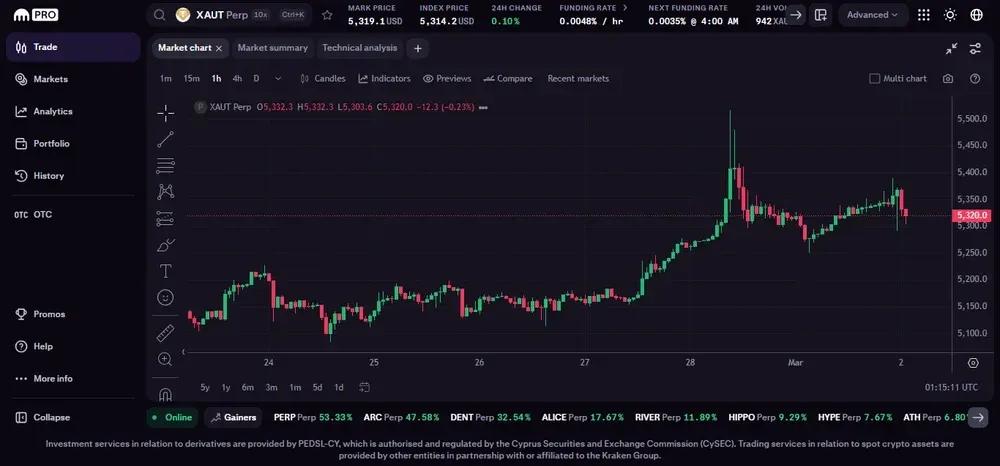
Yes. Kraken offers margin products, perpetual-style derivatives outside some regions, and a separate U.S. futures setup, but its support pages repeatedly point users to official risk disclosures, margin disclosures, geographic eligibility rules, and contract-specific limits before trading.
- Geographic gating: Kraken Derivatives is unavailable in many regions, while Kraken Derivatives U.S. is restricted to U.S. clients through a separate regulated futures setup.
- Leverage limitations: Single-collateral derivatives can reach up to 50x leverage, but margin requirements vary by contract and position size, increasing liquidation risk quickly.
- Forced liquidation authority: If collateral drops below requirements, Kraken may cancel open futures orders and liquidate some or all positions without advance notice.
- Position assignment: If normal liquidation fails because there is no opposing demand, Kraken may assign the remaining position to another participating client.
- Liquidity-pool intervention: For eligible contracts, Kraken may attempt covered liquidation and use its liquidity pool to absorb any remaining negative collateral balance.
- Position unwind power: If liquidation and assignment still fail, Kraken may unwind positions at a price it determines, and its calculations are binding and final.
- Trading suspension controls: Kraken may suspend trading, switch markets to cancel-only, post-only, or limit-only, and cancel orders for technical, legal, or market-integrity reasons.
Is Kraken Banned in the US?
No. Kraken is not banned in the United States. Its current regulatory page says Kraken serves U.S. clients through a FinCEN-registered MSB, a Wyoming-chartered SPDI for eligible custody clients, and registered broker-dealer and adviser entities for equities services.
But U.S. access is not universal. Kraken says residents of New York and Maine cannot use its services, U.S. users cannot deposit fiat currencies other than USD, and its main global derivatives product is not the same as the CFTC/NFA-regulated U.S. futures offering.
Kraken’s Terms also forbid accessing services unavailable in your location or giving misleading location information, so VPN workarounds are not a compliant option.
What Licenses Does Kraken Have?
Licenses matter because they shape AML controls, client onboarding, product scope, payments access, and the exchange’s ability to offer services in a given jurisdiction without triggering local enforcement.
Here is where Kraken holds key licenses:
- Cyprus / MiFID: Payward Europe Digital Solutions (CY) Limited is regulated by CySEC as an investment firm under licence number 342/17.
- Ireland / EMI + MiCA CASP: Kraken says Payward Ireland Limited holds CBI EMI registration C453020, while Payward Europe Solutions Limited and Payward Global Solutions Limited hold MiCA CASP registrations C468360 and C559106.
- United Kingdom / FCA: Kraken lists Payward Limited as an FCA-registered cryptoasset firm FRN 928768, Payward Services Limited as an EMI FRN 1010381, and Crypto Facilities Limited as an FCA authorised investment firm FRN 757895.
- Canada / MSB + Restricted Dealer: Payward Canada, Inc. is a FINTRAC money services business with registration M19343731, and Kraken says it operates as a Restricted Dealer across Canadian provinces and territories.
- United States / MSB + custody + securities: Payward Interactive, Inc. holds FinCEN MSB registration 31000270997766; Kraken also cites Kraken Financial’s Wyoming SPDI charter and Kraken Securities’ SEC/FINRA/SIPC status.
- Australia / AUSTRAC + AFSL, plus enforcement: Kraken says Bit Trade Pty Ltd is registered with AUSTRAC, while Beaufort Fiduciaries Pty Ltd uses AFSL 545124 for certain derivatives; separately, ASIC said Bit Trade was ordered to pay $8 million in 2024.
- Bermuda + U.S. SEC history: Payward Digital Solutions Ltd holds a Bermuda Class F Digital Asset Business licence, registration 202403268. In the U.S., Kraken paid $30 million in a 2023 SEC staking settlement, while the SEC later dismissed its separate 2023 exchange-case action with prejudice in 2025.
Kraken’s posture is current but mixed: it has real registrations across Europe, the UK, Canada, the U.S., Australia, Bermuda, and Argentina, yet it also operates with product-by-product limits, state carve-outs, and a record of enforcement friction that users should factor into platform risk.
Best Alternatives if Kraken is Unavailable
If Kraken is blocked in your jurisdiction, the safest path is to choose another exchange that is directly licensed or clearly permitted where you live, with local bank rails and published KYC rules.
Coinbase is a leading alternative for U.S. and European users seeking high reliability. Its USP over Kraken is its status as a publicly traded company on the NASDAQ, providing a level of financial transparency that few private exchanges can match.
Another great alternative for U.S. traders is Gemini as it offers a secure, regulated environment with a strong focus on institutional-grade custody. Its USP is its unique "SOC 2 Type 2" certification, making it a safer choice for users who prioritize the highest possible standards of technical security.
For EU-located users, Bitstamp and Bitvavo are practical choices. Bitstamp supports bank transfers and Instant SEPA in many European countries, while Bitvavo says it is authorized under MiCA by the Dutch AFM and supports European payment methods.
For Asia or broader global access, Bybit and Binance may fit some users, but only where their local entity is actually authorized. Bybit advertises licenses in Vienna, Cyprus, and Dubai and uses KYC, while Binance’s support page points to ADGM/FSRA-regulated entities and a Dubai VASP licence.
Bottom Line
Before opening a Kraken account, review both the global Terms of Service and the country-specific licensing page for your residence. On Kraken, product access is driven by where you live, what you verify, and which entity serves you.
Kraken’s current strategy is to keep adding licenses and regulated entities, especially across Europe and payments, while also separating products by jurisdiction and using different entities for spot, payments, custody, securities, and derivatives.
The safest operating approach is to monitor Kraken’s support pages for changes, avoid any VPN-based access, and keep more than one fully verified exchange account in case a regulator, payment partner, or local rule cuts off a route you rely on.
FAQs
