Pre-Market Perpetuals in Crypto Explained (Top Exchanges)
Read our guide on pre-market perpetuals to understand early token speculation and discover the best platforms for liquidity and secure trading in 2026.

Disclosure: Coinperps may earn a commission from partner links, at no extra cost to you. Reviews are based on independent testing, see how we test.
- Pre-market perpetuals in crypto are futures contracts allowing speculators to establish early price discovery for upcoming tokens before their official spot market debut.
- Our research identifies Bybit, Binance, MEXC, OKX, Hyperliquid, and Aster as top venues offering reliable liquidity and infrastructure for early token speculation.
- These instruments grant early project access and hedging capabilities but carry higher liquidation risks due to wider spreads and lower market depth.

Bybit
Bybit, founded in 2018 and headquartered in Dubai, is the world’s second-largest exchange by volume, serving 60 million users with 1,800+ assets and over $11 billion in daily trading.
Features
Fees
Regulation
Overall
Traders looking at pre-market perpetuals want to know where they can trade tokens before spot listings, with enough liquidity, leverage, and protection to price discovery without getting liquidated by thin books or opaque conversion mechanics.
A common misunderstanding is that pre-market perpetuals offer the same high leverage as standard futures. In practice, these synthetic markets usually cap leverage at 5x (on CEXs at least) to manage extreme volatility and prevent liquidations while a stable spot index is absent.
Quick comparison of leading pre-market perpetual exchanges:
Top Pre-Market Crypto Perpetual Exchanges in 2026
We evaluated 20+ crypto exchanges to find those hosting functional pre-market perpetual markets in 2026. Our approach focused on examining order book depth, collateral requirements, and the technical specificities of how each platform handles index price formation.
Our list prioritizes the balance between low maker costs and the presence of protective price caps. These 6 finalists represent the most efficient options for securing early exposure to unreleased tokens while minimizing typical slippage issues found in their competitors.
1. Bybit
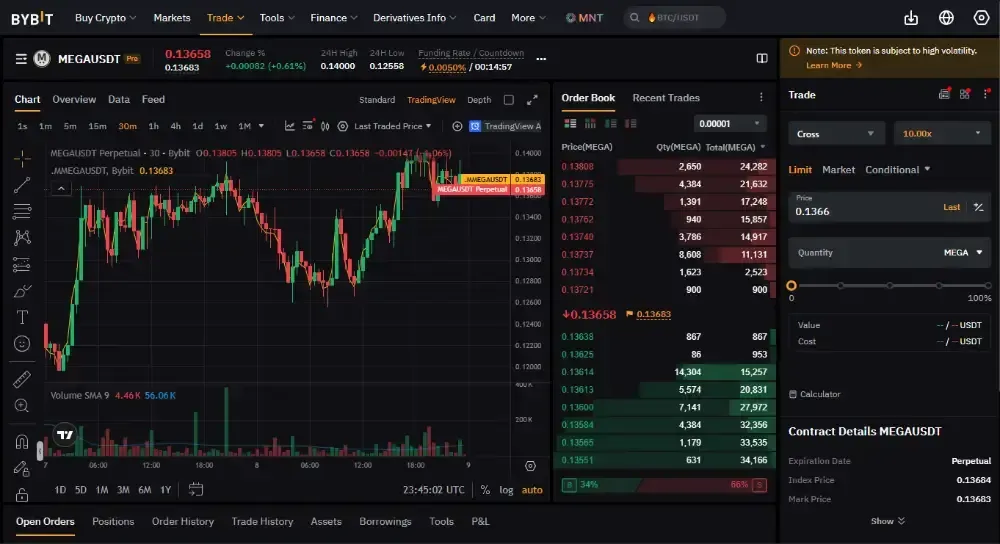
Bybit leads the market as the best overall platform for pre-market perpetuals, combining a call-auction launch with continuous trading for brand-new contracts, giving early price discovery before broad spot liquidity exists. Bybit transitions the contract once the token is listed on at least three CEX spot markets.
For VIP 0 accounts, Bybit lists maker fees at 0.0400% and taker fees at 0.1000% for Pre-Market Perpetuals. Call-auction matching is zero-fee, and during a continuous auction, Bybit stabilizes funding by setting the premium index to zero for traders.
Leverage is configured per trading pair, so risk limits feel closer to a “soft launch” than full-blown futures. One thing we appreciated is how conversion announcements (for example, INXUSDT’s January 2026 transition) keep positions intact while the contract becomes standard.
Pros
- Zero trading fees are applied during the initial call auction phase.
- Subaccounts supported under UTA for cleaner strategy segregation.
- Clear KYC requirement reduces low-quality, botted participation.
- Defined auction mechanics improve initial price discovery discipline.
Cons
- Continuous-auction fees can feel steep versus low-fee rivals.
- Minimum order depth requirements may cause an initial auction to fail.
- Cancellation rules tighten during auctions, limiting rapid adjustments.
- Pair-specific leverage and limits require manual sizing checks.
2. Binance
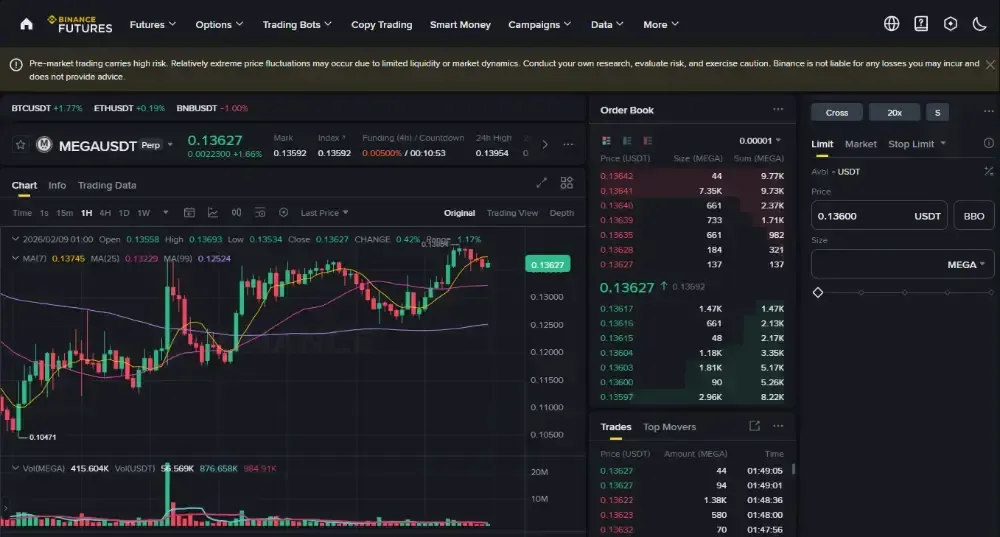
Next up, Binance Futures runs pre-market perpetual trading to surface a mark price before a reliable spot index exists, then converts to a standard perpetual once a stable index can be derived. During transition, Binance applies mark-price caps to dampen shocks.
Pre-market listings often start conservatively: Binance launched INITUSDT pre-market with up to 5x leverage, while futures can reach 125x on eligible pairs. After pre-market ends, funding follows standard rules with caps up to ±2%. Fee examples cite 0.02% maker and ~0.04%-0.05% taker.
In a LITUSDT conversion, Binance said positions and open orders remain active while the mark price gradually shifts toward the usual calculation, with a ±1% per-second cap during transition. From user feedback, this feels smooth, but order books can still be jumpy.
Pros
- Multi-asset mode allows participants to use BTC or BNB as collateral.
- Mature risk tooling: hedge mode, grids, and detailed tier limits.
- Large contract catalog makes relative-value trades easier to build.
- Frequent conversion notices help traders plan around index formation.
Cons
- Maximum leverage is typically capped at 5x for pre-market assets.
- Pre-market availability may vary by region and user eligibility.
- Fee visibility can require login, slowing quick due diligence.
- Early contracts may have thinner depth than headline liquidity suggests.
3. MEXC
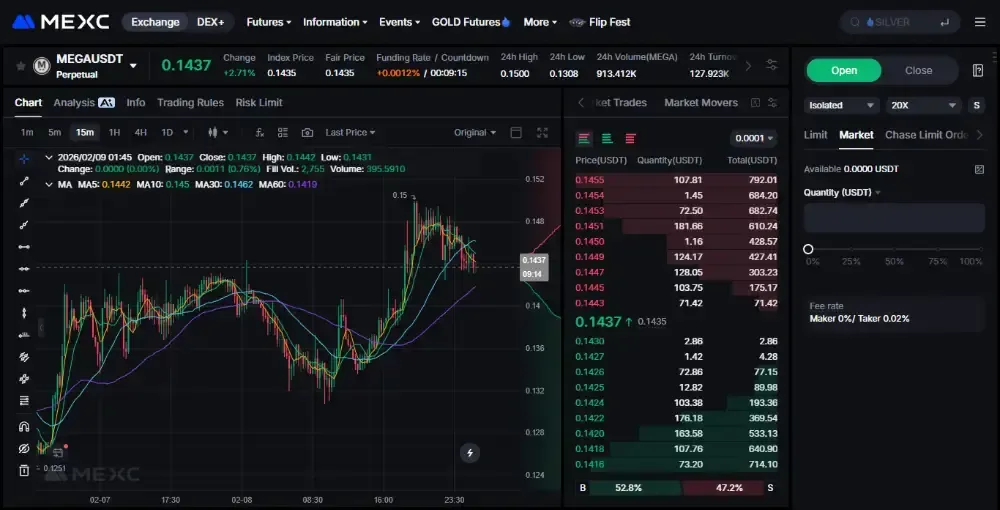
Great for fee-sensitive traders, MEXC frames pre-market perpetual futures as USDT-margined contracts that let you long or short a token before it officially launches. Once the project goes live, the pre-market contract transitions into a formal perpetual so positions don’t need migration.
MEXC’s fee guide lists futures pricing at 0.000% maker and 0.020% taker, and pre-market perpetuals inherit the same schedule. Holding MX can reduce fees further via discounts. In our checks, the near-zero maker cost makes passive liquidity provision attractive.
Recommended for new-pair discovery, MEXC lets you filter “Pre-Market” inside the futures interface and trade them like other USDT-M contracts. A recent SENTUSDT conversion notice listed adjustable 1-20x leverage. MEXC also has common pitfalls: thinner depth, wider spreads, and higher liquidation risk.
Pros
- MX-based discounts can materially reduce taker fees over time.
- Pre-market category is clearly labeled inside the futures selector.
- Zero maker fees are often available for limit orders on major pairs.
- Cross and isolated margin options support different risk profiles.
Cons
- Smaller symbols can suffer abrupt spread widening during volatility.
- Withdrawal issues have been reported by users in specific regional jurisdictions.
- Pre-market pairs may delist or convert on short notice.
- Tooling quality varies across web, app, and regional pages.
4. OKX
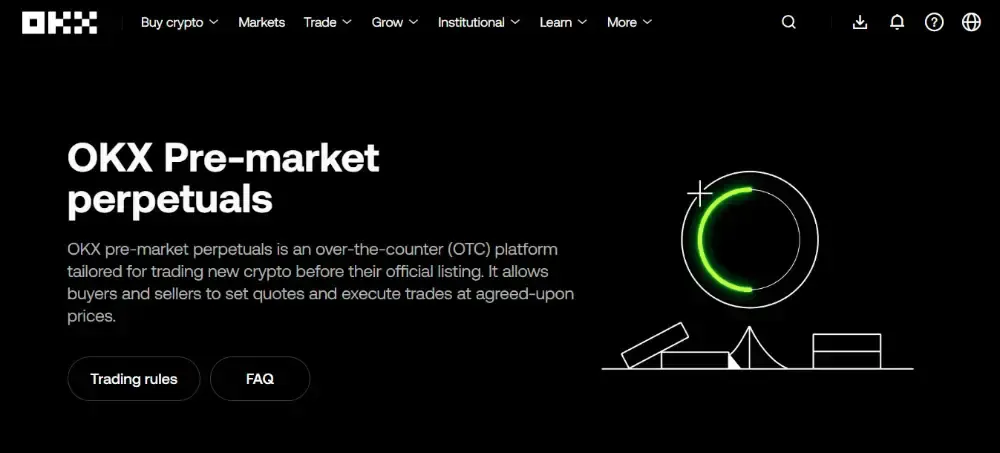
OKX suits structured launches: its pre-market perpetuals are USDT-margined contracts, offered via an OTC flow, that trade before a token lists. Before spot references exist, the index tracks the contract’s last price, and market orders are disabled for the first five minutes.
Funding is simplified in early trading: OKX sets the premium index to zero, producing a flat funding rate that settles every four hours. Trading fees match standard futures; OKX futures guides cite a lowest-tier 0.02% maker and 0.05% taker.
Leverage is contract-specific, ranging from modest to aggressive: OKX listed FOGO pre-market futures at 0.01-5x, while another pre-market spec sheet for SENT shows 0.01-50x. In our evaluation, the conversion process (positions and orders carry over) helps, but slippage can spike when books are thin.
Pros
- Early trading rules reduce “casino opens” and bad initial fills.
- Flat funding cadence is simple for basis and carry planning.
- Standard futures fee tiers apply immediately after conversion.
- Mechanisms from expiry futures provide a more stable and predictable environment.
Cons
- Leverage is generally limited to 2x for most pre-market futures.
- OTC-style workflow may feel slower than normal futures.
- Delisting risk exists if the underlying token launch changes.
- Users receive cash settlement rather than the actual underlying digital tokens.
5. Hyperliquid
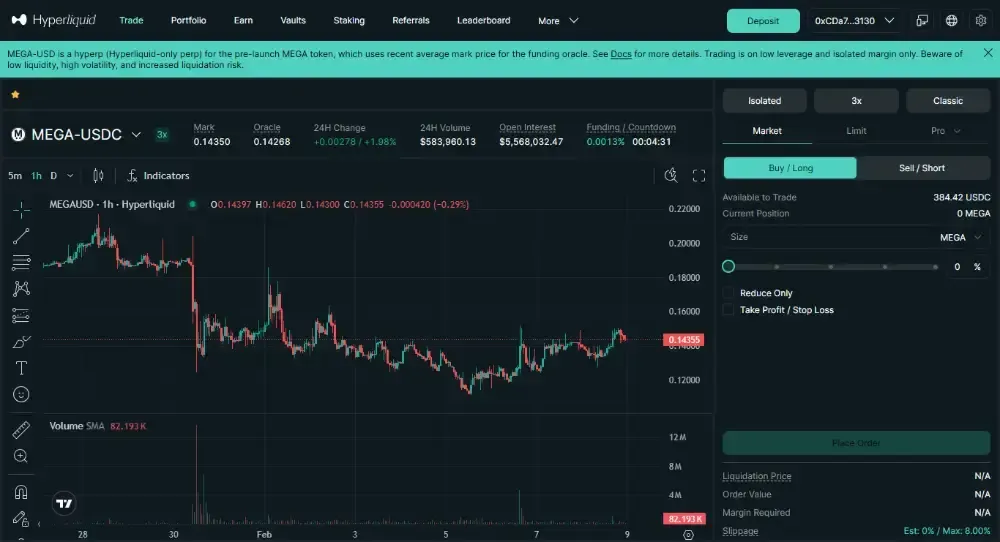
Great for onchain power users, Hyperliquid runs a fully onchain order book on its own Layer-1 and supports 100+ perpetual markets. For pre-market-style exposure, it introduces “hyperps” that let you long or short unlaunched tokens (like MON-USD) with up to 3x leverage.
Costs are transparent: Hyperliquid’s base perps fees are 0.045% taker and 0.015% maker, with tiers set by rolling 14-day weighted volume and updated daily. Maker rebates are paid continuously, and spot volume counts double toward your tier, rewarding active cross-product traders.
Hyperliquid perps have leverage caps ranging from 3x to 40x by asset, and you can select leverage up to each market’s maximum. In our usage, the interface feels CEX-like, but risk controls are strict: caps on unlaunched hyperps can limit hedging flexibility.
Pros
- Self-custody model reduces centralized exchange counterparty exposure.
- Fee tiers reward sustained volume with better rebates.
- Continuous maker rebates are paid directly to the trading wallet for liquidity.
- Onchain transparency helps verify markets and rule parameters.
Cons
- The protocol requires managing a decentralized wallet and associated private keys.
- Hyperps leverage is intentionally low versus some CEX launches.
- The mark price for Hyperps is capped to prevent extreme manipulation gains.
- Asset-specific leverage caps require frequent checks across markets.
6. Aster
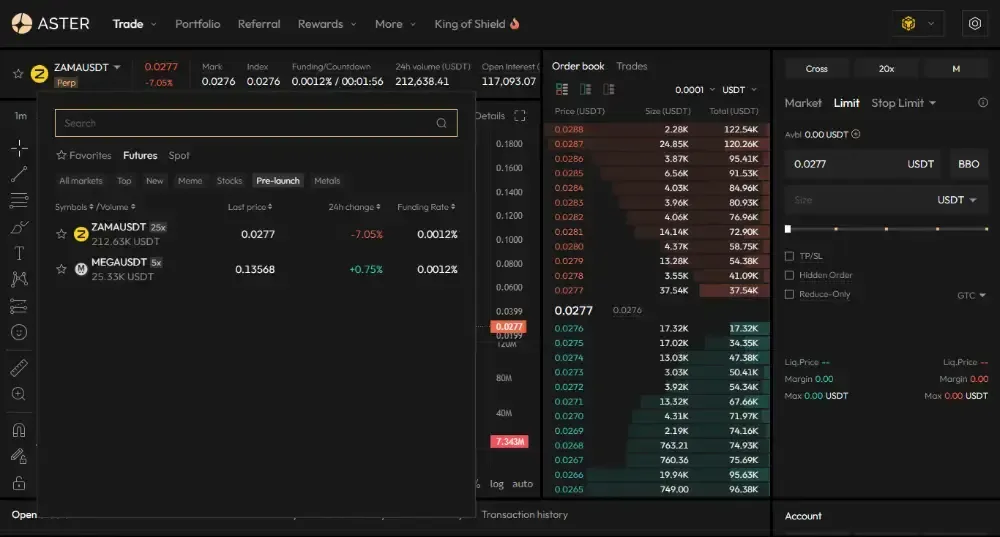
Aster is last on our list, yet it represents the vanguard of decentralized privacy and traditional asset integration through its purpose-built L1 chain. The platform offers "Hidden Orders" that allow users to execute large trades without tipping off competitors.
Aster’s Pro mode runs order-book perpetuals across several chains, and it also supports USDT-settled stock perpetuals with up to 10x leverage. On fees, Aster’s docs note a 5% discount when you pay perpetual trading fees using $ASTER held in your perp wallet.
For pure speculation, Aster’s 1001x Simple mode offers up to 1001x leverage on select pairs and is built to work without deposits. In our trial, the UX makes leverage selection too easy; positions are isolated, yet liquidation risk explodes on price moves.
Pros
- Pre-launch conversion preserves tickers and avoids manual contract rolls.
- Fee discount with $ASTER benefits frequent active traders.
- Broader offering includes crypto perps plus USDT-settled stock perps.
- Zero fees for stock perpetuals provide an attractive entry for equity traders
Cons
- Extreme leverage modes can amplify losses from tiny price moves.
- Network and product availability vary, requiring chain-by-chain checks.
- Documentation-heavy setup may slow first-time users onboarding.
- Mobile app functionality is currently limited compared to the web3 interface.
What are Pre-Market Perpetual Exchanges?
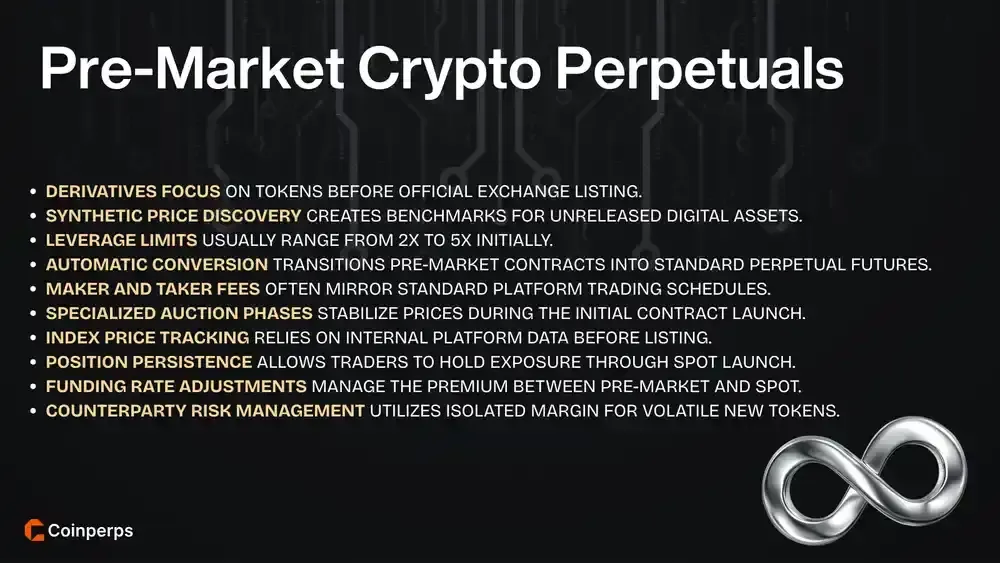
Pre-market perpetual exchanges provide specialized trading environments where investors speculate on the valuation of upcoming tokens before their official spot market debut. These platforms use synthetic contracts to mirror expected prices, enabling price discovery for anticipated projects.
Bybit and Binance for example utilize these derivative markets to establish early benchmarks for tokens like INIT or INX. Unlike standard futures, these contracts rely on internal liquidity and specialized index calculations until the underlying asset achieves sufficient distribution across major venues.
Trading these instruments allows for hedging or positioning before a token becomes widely available. Platforms often transition these pre-market pairs into standard perpetuals once listing occurs, ensuring that open positions and strategies remain active throughout the official launch.
How to Choose a Pre-Market Perps Exchange
Pre-market perps vary wildly in pricing, risk controls, and conversion rules. Use the checklist below to match your strategy, region, and risk tolerance.
Step 1: Verify conversion and settlement rules first
Before fees or leverage, confirm exactly how a pre-market contract becomes a standard perpetual, and whether positions and orders stay intact during transition.
- Find the conversion trigger (time-based vs criteria-based; “market stability” is common).
- Confirm positions + open orders persist through conversion (no forced close).
- Check whether conversion depends on external spot listings (e.g., “listed on eligible exchanges”).
- Look for explicit delist/termination language if the token launch is delayed or canceled.
- Note who controls timing: some venues keep conversion at their sole discretion.
Indicator to look for: Clear conversion trigger and carry-over guarantee.
Step 2: Compare fees and funding like a carry trader
Pre-market perps often use special fee schedules and simplified funding. Model your total carry cost assuming you’ll hold through multiple funding windows.
- Separate trading fees from funding; early markets can be cheap to trade but expensive to hold.
- Check if there’s a special pre-market fee table (Bybit’s pre-market maker/taker differs from standard).
- Confirm pre-market funding frequency (commonly every 4 hours) and whether it’s flat.
- Watch for funding caps after pre-market ends (Binance notes up to ±2% once standard rules apply).
- If you’re fee-sensitive, evaluate rebates/discounts (e.g., MEXC maker 0.000% and MX discounts).
- On DEX perps, confirm how tiers are computed (Hyperliquid uses 14-day weighted volume, assessed daily).
Indicator to look for: Published fees plus predictable funding cadence.
Step 3: Audit mark price and volatility guardrails
Because spot indices may not exist yet, exchanges add mark-price caps and auction mechanics. These rules directly affect liquidations and stop orders.
- Identify the pre-market mark price formula (trade averages vs order-book mid, clamped by limits).
- Prefer venues that publish explicit mark-price caps during launch and conversion (e.g., ±1% per second).
- Check order-type restrictions at launch (i.e. OKX disables market orders for the first five minutes).
- Review price limit rules (Bybit uses LTP ±5% in pre-market; OKX recalculates limits more frequently pre-conversion).
- If you trade stops, test how the venue handles thin books + fast marks (slippage can trigger unexpected liquidations).
Indicator to look for: Mark-price methodology and volatility clamps disclosed.
Step 4: Validate real liquidity, not just “launch hype”
Pre-market order books are thinner, so spreads and impact matter more than on mature perps. Choose venues with depth and controls early.
- Watch the top-of-book spread and depth at 0.5%-1% away from mid before sizing up.
- Use limit orders first, especially where the venue nudges orderly discovery (OKX’s initial restriction is a clue).
- Check whether the platform runs auctions (call/continuous) that can reduce chaotic first prints.
- Confirm whether the contract’s index is self-referential early (OKX uses last traded pre-market price pre-listing).
- Plan around conversion windows as liquidity can fluctuate abruptly as pricing starts aligning to external spot indices.
Indicator to look for: Consistent volume, tight spreads, resilient matching.
Step 5: Match leverage, margin mode, and liquidation behavior
Leverage caps, margin modes, and liquidation backstops differ in pre-market. Pick a platform whose risk limits match your sizing and hedging needs.
- Check whether pre-market supports cross vs isolated (Bybit supports both; some modes may be unavailable).
- Look for warnings on elevated slippage and liquidation risk due to limited depth (OKX states this explicitly).
- Prefer venues that disclose ADL/system liquidation mechanics for these contracts.
- On onchain perps, understand the maintenance margin + backstop design (Hyperliquid describes vault backstop liquidations).
- Treat extreme leverage products as a different category entirely and use smaller notional and tighter invalidation points.
Indicator to look for: Transparent tiered margin and ADL rules.
Step 6: Confirm access, account requirements, and custody model
Finally, confirm you can actually use the venue where you live, and decide whether you prefer a centralized account or onchain custody.
- Check regional availability disclaimers (Binance notes some products may be unavailable by region).
- Confirm required account type / setup (some features require a specific unified account structure).
- Decide custody: CEX-style balance vs wallet-based trading (Aster Pro requires wallet connection and transferring funds).
- If you need automation, verify API coverage and whether pre-market instruments expose the same endpoints/fields.
- Prioritize venues with clear risk disclosures on delisting, delivery price discretion, and launch uncertainty.
Indicator to look for: Eligibility, KYC, and wallet flow fit.
Pros and Cons of Pre-Market Perpetuals
Trading unlisted assets provides a unique edge for early discovery while introducing specific liquidity risks that can impact your overall portfolio performance.
Compare the advantages and risks of early perpetual trading in the following table:
Bottom Line
Pre-market perpetuals offer a sophisticated way to gain exposure to unreleased tokens, but success requires choosing platforms with deep liquidity and strong risk management.
Prioritize exchanges that offer transparent transition rules and protected fee structures to maximize your trading efficiency during volatile launch events.