Bybit vs Binance Perpetual Futures Fees: Full Comparison for 2026
Compare Bybit vs Binance perpetual futures fees in 2026, including maker-taker rates, VIP tier discounts, BNB savings, funding costs, and which platform is cheaper for your trading style.

Disclosure: Coinperps may earn a commission from partner links, at no extra cost to you. Reviews are based on independent testing, see how we test.
- Binance is cheaper for taker orders with a base rate of 0.05% versus Bybit's 0.055%, plus a 10% BNB discount that drops the effective rate to 0.045% on USDT-M perpetuals.
- Both exchanges charge identical maker fees at 0.02%, meaning limit-order traders pay the same on either platform at the base tier before VIP discounts.
- The cost difference compounds with leverage because fees are calculated on full notional value, not margin. A $10,000 position at 50x leverage costs $50 more per round trip on Bybit than Binance with BNB enabled.

Binance
Binance is the world’s largest exchange, founded in 2017, serving over 260 million users globally with more than $40 billion in daily trading volume across spot, futures, and options markets.
Features
Fees
Regulation
Overall
Quick Fee Comparison
Base Fee Breakdown by Contract Type
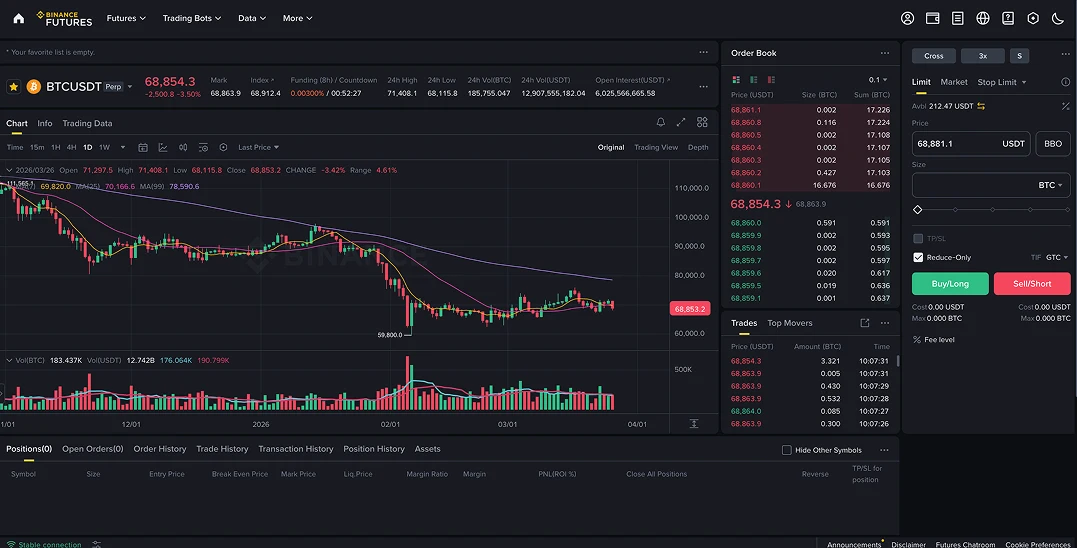
USDT-Margined Perpetuals
This is where most volume sits on both platforms. At the base tier (non-VIP), according to Binance's futures fee schedule and Bybit's fee structure:
- Binance: 0.02% maker / 0.05% taker
- Bybit: 0.02% maker / 0.055% taker
Maker rate is identical. The difference is on the taker side, where Binance is half a basis point cheaper. If you're placing market orders or using stop-losses (which almost always fill as taker), Binance has a structural cost advantage.
Binance also offers a 10% discount on USDT-M futures fees when you pay with BNB, dropping the effective taker to 0.045%. Bybit has no equivalent token discount for derivatives, which widens the gap for traders willing to hold some BNB.
USDC-Margined Perpetuals
This is where Binance pulls furthest ahead:
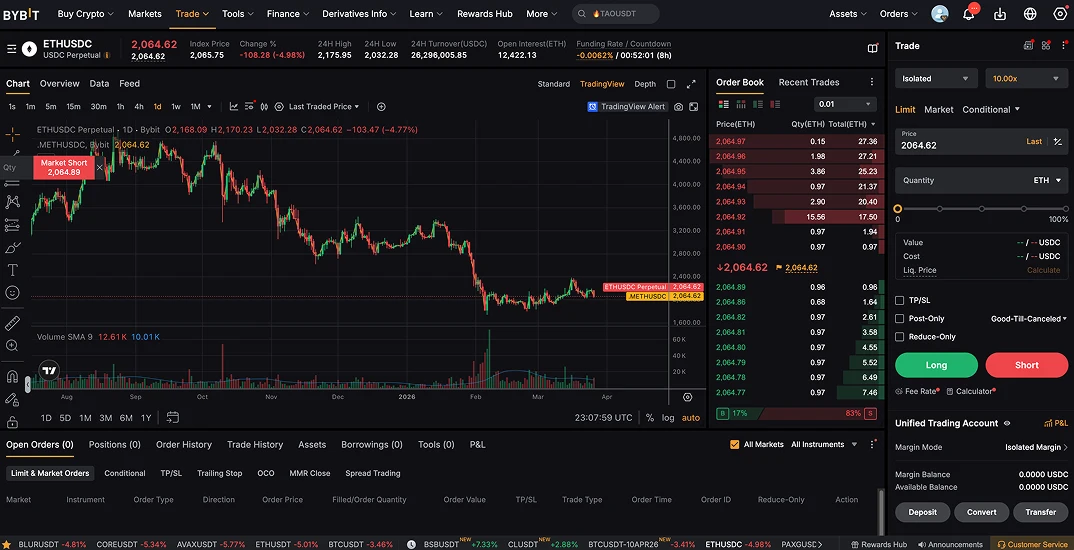
- Binance: 0.00% maker / 0.04% taker
- Bybit: 0.02% maker / 0.055% taker
Binance's USDC-M contracts are free for makers and 0.04% for takers. This is a deliberate pricing move to drive volume toward USDC settlement. If you're comfortable settling in USDC, these are among the cheapest perpetuals available from any major exchange. Bybit charges the same rates on USDC perpetuals as USDT perps, so there's no contract-type fee advantage on the Bybit side.
COIN-Margined (Inverse) Perpetuals
Same pattern: Binance at 0.02% / 0.05%, Bybit at 0.02% / 0.055%. Binance's BNB discount does not apply to COIN-M contracts, so the gap is slightly narrower here than on USDT-M with BNB active.
Bybit charges a 0.05% settlement fee on inverse expiry contracts if your position hits the settlement date without being manually closed. This doesn't apply to perpetuals (no expiry), but it's worth knowing if you trade expiry futures alongside perps.
How Fees Actually Hit Your PnL
The 0.005% difference means nothing in isolation. Here's how it plays out at different leverage levels on a $10,000 margin trade, assuming taker fills on both entry and exit.
Round-Trip Fee Comparison (Taker Both Sides)
A day trader running 5 round trips at 25x pays roughly $125 more per day on Bybit than Binance with BNB. That's about $3,750/month. For swing traders doing a few round trips per week, the difference is much smaller and may not outweigh other factors like Bybit's higher position limits or faster altcoin listings.
If you primarily use limit orders (maker fills), the gap disappears at the base tier since both charge 0.02%. The real question is what percentage of your fills actually execute as maker versus taker. Stop-losses almost always fill as taker.
VIP Tier Fee Comparison
Both exchanges offer progressively lower fees with volume. The key difference is in how you qualify and where the rates bottom out.
Binance USDT-M Futures VIP Tiers
Sourced from Binance's VIP program:
Bybit Perpetual & Futures VIP Tiers
Sourced from Bybit's VIP program:
Key differences: Binance requires both volume and BNB holdings to qualify. You need to meet both criteria. Bybit is more flexible, letting you qualify on either derivatives volume or asset balance, whichever is higher. This makes Bybit's VIP tiers more accessible for traders who hold significant capital but don't trade at extreme volumes.
At VIP 1-3, both platforms converge quickly on the taker side (0.032-0.04%). The base tier gap effectively disappears once you're trading any meaningful monthly volume. At the top end, Binance reaches 0.017% taker (VIP 9) versus Bybit's 0.03% (PRO 6), but those tiers require billions in monthly volume and are only relevant for institutional desks.
Funding Rates: The Cost Most Traders Underestimate
Trading fees are a known, fixed cost. Funding rates are the variable that quietly destroys leveraged positions held overnight or longer.
Both exchanges settle funding every 8 hours by default (00:00, 08:00, 16:00 UTC), with payments flowing between longs and shorts to keep perpetual prices anchored to spot. When the perp trades above spot, the rate is positive and longs pay shorts. When it trades below, the rate flips and shorts pay longs. Neither exchange profits from funding. It flows directly between traders.
Bybit has introduced variable funding intervals on certain contracts. Some pairs settle every 4 hours, 2 hours, or even hourly. More frequent settlements increase the total funding cost for position holders in trending markets where the rate stays consistently directional.
Why This Matters More Than Trading Fees for Some Strategies
A $500,000 long position held through two 0.01% funding settlements costs $100 in funding alone, often more than the trading fee to enter. In bullish markets where rates spike to 0.03-0.1% per settlement, holding a leveraged long for even 24 hours can cost more in funding than the round-trip trading fee.
Since rates are market-driven, they differ between Binance and Bybit on the same pair at the same time. This creates arbitrage opportunities: long on the exchange with lower funding, short on the higher one, and capture the spread every settlement.
Hidden Costs Worth Knowing
Liquidation
When a position hits its liquidation price, both exchanges close it automatically, but the cost mechanics differ.
Binance deducts a liquidation clearance fee (typically 0.5-1.5% of remaining position value) that goes into the Insurance Fund. This is a meaningful cost on top of losing your margin.
Bybit doesn't charge an explicit liquidation fee according to its fee overview, but liquidation triggers at a price worse than your bankruptcy price, with the difference feeding their insurance fund. The economic outcome is similar. You lose more than your margin in either case.
If you're trading at leverage where liquidation is a realistic risk, this matters more than the 0.005% taker fee difference. Track liquidation heatmaps to see where liquidation clusters are building on major pairs.
Slippage and Liquidity
Binance consistently has the deepest order book on major perps like BTCUSDT and ETHUSDT. You can place a $1M+ market order on Binance BTC perps with minimal price impact. On Bybit, the same order may move price slightly more during volatile sessions. This implicit cost doesn't show up in the fee schedule but affects your real execution cost.
For altcoin and newer token perpetuals, the liquidity picture flips. Bybit lists tokens on perps faster than Binance, and its pre-market perpetual product gives access to pairs that haven't launched elsewhere yet. Check open interest on both platforms before sizing into less liquid pairs.
Collateral Efficiency
Bybit's Unified Trading Account (UTA) lets you use multiple assets as cross-collateral without converting between them. Binance's Multi-Asset Mode serves a similar function but with a narrower asset list. Better capital efficiency can offset fee differences. If you don't have to convert USDT to USDC just to access cheaper contract pricing, you save the spread cost on conversion.
Which Exchange to Choose
Choose Binance if:
- You trade primarily with market orders or stop-losses. The 0.005% taker advantage and BNB discount compound meaningfully at volume.
- You're willing to settle in USDC. Binance's USDC-M contracts at 0.00% maker / 0.04% taker are the cheapest perps from any major exchange.
- You trade BTC/ETH perps at size. Deeper order books mean less slippage, an implicit fee saving.
- You're targeting VIP 4+. Binance's fee floor is significantly lower at the top tiers.
Choose Bybit if:
- You trade mostly with limit orders. Identical 0.02% maker rate, so the taker gap doesn't affect you.
- You want VIP access via asset balance. Bybit's flexible criteria make it easier to unlock discounts without extreme monthly volume.
- You need higher position limits. Bybit allows up to $2M notional at 100x versus Binance's $600K cap.
- You're trading newer or niche perpetual pairs. Bybit's pre-market perps and faster listing pace can matter more than a fee saving.
Use both if you run funding rate arbitrage, want Binance for majors and Bybit for altcoin perps, or want to split strategies by their cost profile.
How to Minimize Fees on Either Platform
- Use limit orders wherever possible. The 0.02% maker fee is less than half the taker fee on both platforms. Post-only mode ensures your order won't accidentally fill as a taker.
- Enable BNB fee payment on Binance. Transfer a small BNB balance to your futures wallet and enable BNB fee payment. The 10% USDT-M discount is free savings with no downside.
- Check funding rates before entering. The CoinPerps funding rate tracker shows predicted rates. Entering just before a high funding settlement is an avoidable cost that often exceeds the trading fee itself.
- Consolidate volume to hit VIP thresholds. Splitting volume across both platforms means hitting VIP 1 on neither. Pick one for primary volume and use the other selectively.
- Consider USDC-M on Binance. At 0.00% maker / 0.04% taker, these are the cheapest perpetual futures available from any major exchange. The saving over standard USDT-M contracts adds up quickly for active traders.