How to Use MEXC in the USA: Access, VPN Risks & Alternatives
Discover how MEXC works in the USA, why access is restricted, what risks users face, and which regulated crypto alternatives are safer for Americans.

Disclosure: Coinperps may earn a commission from partner links, at no extra cost to you. Reviews are based on independent testing, see how we test.
- MEXC is not available to US residents, and its terms list the United States among prohibited jurisdictions for registration and trading access.
- Using a VPN may create serious account risks, including restricted access, withdrawal reviews, account freezes, forced liquidation, or closure under MEXC policies.
- US traders wanting regulated derivatives should compare Coinbase, Kraken, and Crypto.com rather than relying on offshore exchange access or risky location workarounds.

MEXC
MEXC is a centralized exchange launched in 2018, offering over 2,900 cryptocurrencies and high-leverage perpetual futures with more than $12 billion in daily trading volume.
Features
Fees
Regulation
Overall
MEXC attracts crypto traders with deep altcoin markets and high-leverage futures, but US users face strict availability, licensing, tax, and account-access limits.
This guide explains MEXC’s US restrictions, regulatory footprint, safer account steps, and the best regulated alternatives for American traders seeking derivatives exposure online.
Start with the key points below now. 🔽
Is MEXC Available in the USA?
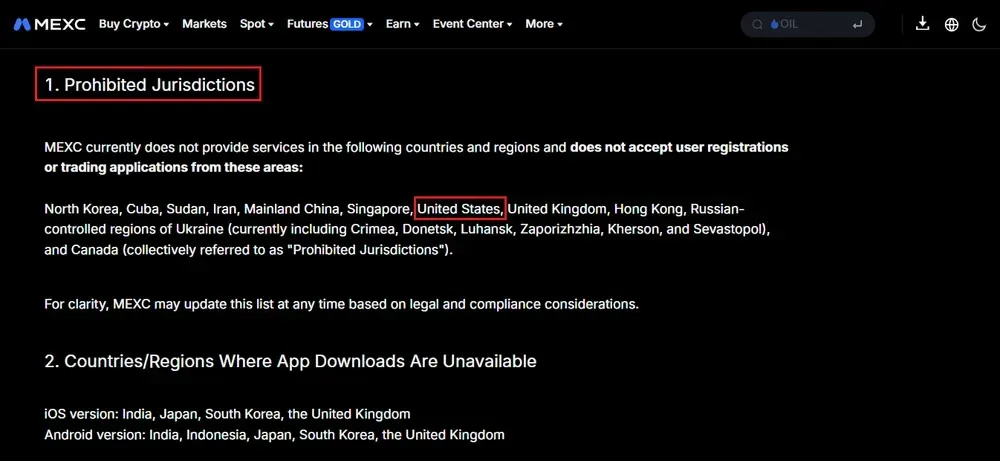
No. MEXC is not available in the USA. Its User Agreement lists the United States under “Prohibited Jurisdictions” and says MEXC does not provide services, accept registrations, or accept trading applications from users in those countries and regions.
The same section says users are responsible for ensuring they are not residents of a prohibited jurisdiction. It also notes that MEXC’s restricted list is non-exclusive and may change at the platform’s sole discretion for legal, regulatory, or compliance reasons.
In practical terms, US residents should not create, verify, deposit, or trade through MEXC. MEXC’s own support guidance also says it may refuse trading or registration applications from users in the United States and other prohibited jurisdictions.
How to Use MEXC in the USA
While MEXC officially bars residents from the United States, some traders bypass these restrictions by utilizing virtual private networks to mask their true locations.
Common methods for attempting to access the MEXC exchange:
- VPN Selection: Choose a service like NordVPN, ExpressVPN, or Surfshark to redirect your MEXC traffic through a server in a supported region.
- Server Choice: Connect your chosen software to a location where MEXC operates freely, such as Mexico, to bypass the platform's strict geographical blocks.
- Registration: Sign up for MEXC using an email address to avoid the phone verification process that would reveal your restricted domestic status.
- Account Security: Set up 2-factor authentication on MEXC using a mobile app to ensure your funds remain protected without needing a prohibited phone.
- Fund MEXC: Transfer cryptocurrency from an external wallet to MEXC because using bank cards requires identity checks that are unavailable to American residents.
- Start Trading: Access the various MEXC markets to begin your transactions, making sure your virtual connection is active before opening the platform's website.
Risks of Using a VPN to Access MEXC
Using a VPN may change your visible IP address, but it does not change your residence, legal status, or contractual eligibility. MEXC’s User Agreement says false representations of location or residence can lead to immediate account termination and liquidation of open positions.
MEXC’s Risk Control Guideline also lists possible enforcement measures, including access restrictions, trading limitations, withdrawal or deposit limitations, account closure, and asset forfeiture where legally permissible. That makes VPN-based access risky even before considering tax, compliance, or identity-verification issues.
Will My MEXC Account Be Banned if I Move to the US?
Moving to the United States is different from briefly travelling there. The main issue is whether you become a US resident or only access MEXC temporarily from US territory.
Scenario 1: If You Are Travelling to the US
Temporary travel can still create access problems because MEXC lists the United States as a prohibited jurisdiction. Its restricted-regions guidance says MEXC does not provide services, accept registrations, or accept trading applications from users in listed prohibited jurisdictions.
Before travelling, consider reducing open positions, saving account records, and checking withdrawal routes. Do not assume a VPN removes the issue, because account residence, KYC information, device signals, withdrawal reviews, and support checks may still expose restricted access.
Scenario 2: If You Are Moving to the US
If you move to the United States and become a resident, the risk becomes much higher. MEXC’s User Agreement says users must inform MEXC at the earliest opportunity if they become resident in a prohibited jurisdiction.
In that situation, the safest approach is to stop trading, contact support, withdraw eligible assets, export your records, and move to a US-available exchange. That reduces the chance of unexpected restrictions, frozen withdrawals, or forced account actions.
Where is MEXC Regulated?
MEXC’s public compliance page highlights one European virtual asset registration, while its broader global availability remains subject to local restrictions and eligibility rules.
Publicly disclosed MEXC licensing information includes:
- Estonia: MEXC says MEXC Estonia OÜ, registration number 14832615, is a licensed virtual asset service provider supervised by Estonia’s FIU.
This license gives MEXC a regulatory foothold while the exchange serves users across 170+ countries and regions, including Australia, Brazil, France, Germany, India, Italy, Japan, Mexico, South Korea, Spain, and Turkey.
Best MEXC Alternatives for the United States
For US traders replacing MEXC, the strongest alternatives are regulated platforms with domestic futures access and separate global perpetual products where legally available.
US Derivatives: Restricted vs. Regulated
Comparing the restricted MEXC baseline against verified domestic alternatives
 MEXC
MEXC
Officially bars residents from the United States. No domestic licensing or registered futures stack available for US residents.
 Coinbase
Coinbase Financial Markets offers regulated perpetual-style futures (up to 5 years) with clearinghouse margin for US users.
 Kraken
Kraken Derivatives US provides CME crypto futures access through a CFTC-registered FCM (NinjaTrader Clearing) and NFA framework.
 Crypto.com
Derivatives North America connects US traders to a CFTC-approved stack with specific domestic margined derivatives licenses.
Coinbase
Coinbase is the most direct US replacement for traders who want regulated perpetual-style exposure. Coinbase Financial Markets offers short-dated futures and long-dated perpetual-style futures in the United States, with clearinghouse-set margin and contracts lasting up to five years for eligible traders.
Globally, Coinbase also offers standard perpetual futures through Coinbase Bermuda Ltd., a Bermuda Monetary Authority-regulated entity, for eligible non-US jurisdictions. That separation matters: US users get regulated perpetual-style futures, while international users may access broader offshore perpetual markets through Coinbase Advanced.
Kraken
Kraken is another strong US alternative, especially for traders who want futures inside a regulated domestic framework. Kraken Derivatives US is available to verified US residents through NinjaTrader Clearing, a CFTC-registered futures commission merchant and NFA member for futures access.
For global users, Kraken’s non-US derivatives arm supports perpetual futures in eligible regions, but Kraken says Kraken Pro Futures is only for non-US users. US clients instead access CME crypto futures through Kraken Derivatives US, not offshore-style crypto perpetuals.
Crypto.com
Crypto.com is useful for US traders prioritizing a CFTC-regulated derivatives stack. Its US derivatives business connects eligible users to Crypto.com Derivatives North America, and the company says it has CFTC approvals covering margined derivatives licenses in the United States market.
Outside the US, Crypto.com Exchange supports spot, futures, and perpetual markets, including recently launched commodity and US index perpetual contracts. For Americans, however, the relevant distinction is regulated domestic derivatives access, not the full global perpetual menu available elsewhere internationally.
Bottom Line
MEXC remains attractive for altcoin and futures traders, but it is not a practical choice for US residents under its own restricted-jurisdiction rules and current service-availability language for compliant access.
If you are in the United States, prioritize withdrawal planning, record exports, and regulated alternatives with clearer domestic access to futures, perpetual-style products, compliance support, tax reporting tools, and customer protections.