Lowest Fee Crypto Perpetual Exchanges
We funded and traded seven venues to rank the lowest fee crypto perpetual exchanges of 2026, from MEXC and KCEX to zero-fee DEXs like Lighter.

Disclosure: Coinperps may earn a commission from partner links, at no extra cost to you. Reviews are based on independent testing, see how we test.
- The lowest all-in costs crypto perpetuals sit with MEXC, KCEX, and Lighter, which pair 0% maker fees with taker rates from zero to 0.02%.
- Your real bill is the taker fee plus 8-hour funding, not the 0% maker figure that dominates most exchange landing pages and promotional offers.
- Native tokens like MX, BNB, and ASTER trim a further 5% to 50%, but they ask you to hold a volatile asset to unlock the discount, which needs to be taken into account.

MEXC
MEXC is a centralized exchange launched in 2018, offering over 2,900 cryptocurrencies and high-leverage perpetual futures with more than $12 billion in daily trading volume.
Features
Fees
Regulation
Overall
The 7 Lowest Fee Crypto Perpetual Exchanges
Finding the cheapest perpetual venue takes more than reading a headline maker rate. We funded each platform, opened and closed real positions on major and mid-cap pairs, and tracked every cost that left the account, from the taker fee to the funding payment to the slippage on a thin book.
We ranked for a cost-focused perp trader, weighting the taker rate most heavily, then funding behavior, native-token discounts, and liquidity depth, since slippage is a fee in all but name. Rates were verified against each exchange's own fee schedule in mid-2026.
The table below summarizes the fee structure and standout trait for each of our seven picks:
1. MEXC
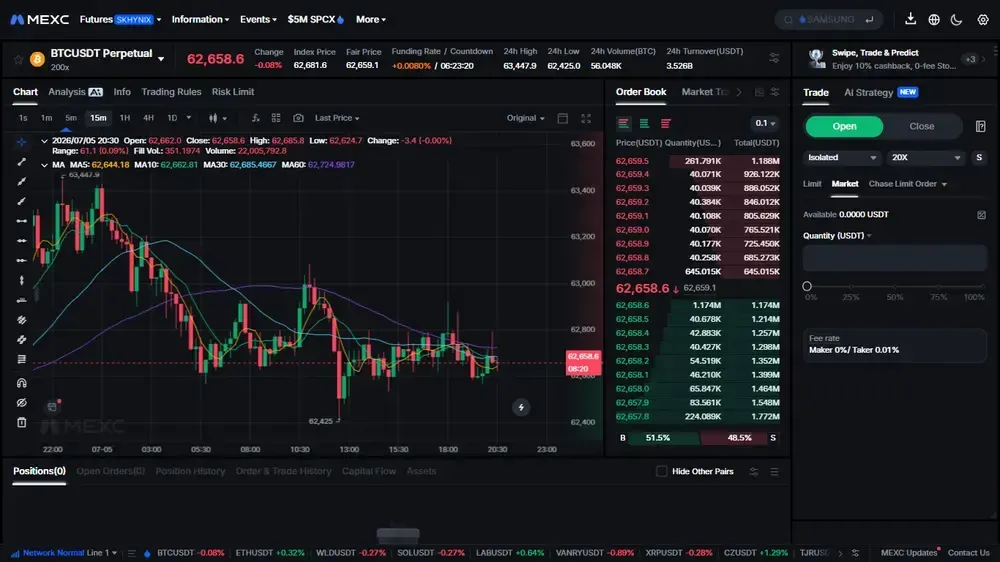
MEXC tops this list because it pairs the cheapest realistic cost profile of any large centralized exchange with liquidity you can actually trade against. Its perpetual schedule runs 0% maker and 0.02% taker, and MEXC publishes that more than 140 futures pairs trade at zero on both sides during its recurring fee events, verifiable on its official fee page.
Funding confirmed the pitch when we tested it. We opened a BTC-USDT long and closed it as a taker, and the only charges were the 0.02% taker fee and the standard 8-hour funding payment. That funding is exchanged peer-to-peer between traders rather than skimmed by MEXC itself.
Holding an MX balance cuts fees a further 50%, so an effective taker rate near 0.01% is reachable without a whale-sized position. The catch is offshore licensing without the tier-one recourse of a regulated platform, plus restricted access in several countries tracked in our MEXC restricted countries guide. For a cost-first trader who accepts that tradeoff, nothing else centralized matches it.
Pros
- Zero maker fee and a 0.02% taker rate across the perpetual board.
- Over 140 pairs run genuinely zero-fee during frequent, well-advertised events.
- MX holdings cut fees up to 50% without a large balance.
Cons
- Offshore licensing means weaker recourse than a regulated platform.
- Restricted in several jurisdictions, so access is not universal.
- Crypto-only funding in practice, with no meaningful fiat rails.
2. KCEX
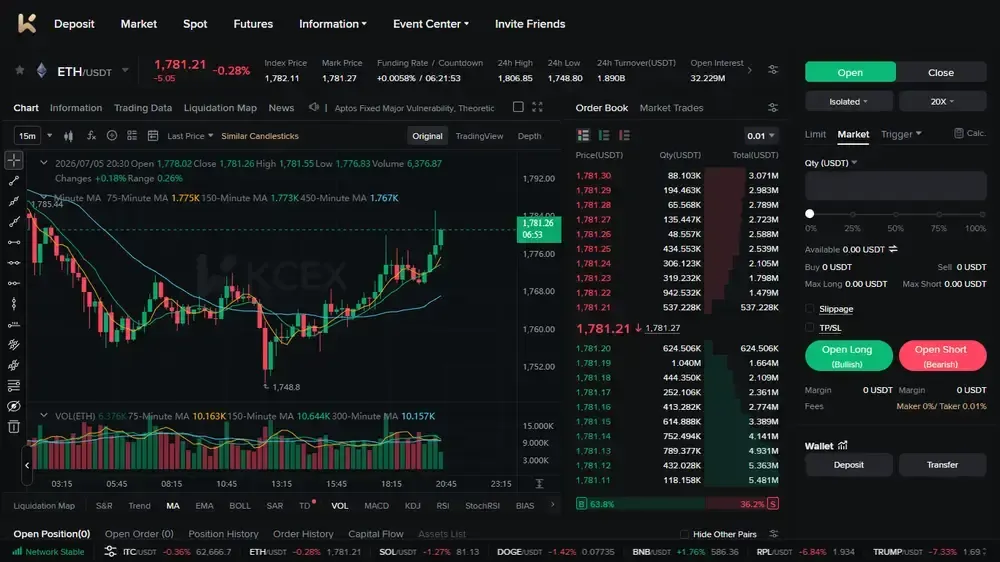
KCEX posts the lowest standard taker fee of any centralized exchange we tested, a flat 0% maker and 0.01% taker. There are no volume tiers to climb and no native token to hold, so that half-of-MEXC taker rate applies from your very first trade rather than at a distant VIP threshold.
The account experience matched the pitch. KCEX is Seychelles-based and runs no mandatory KYC below a 15 BTC daily withdrawal ceiling, so a test deposit and first perp position took minutes. Funding on majors sat around 0.01% every eight hours, in line with the wider market.
Selected promotional pairs like DOGE-USDC waived fees entirely, though there is no fiat on-ramp, so you arrive already holding crypto. Independent reviews note the absence of full Merkle-tree proof of reserves, and mid-cap books run shallower than MEXC or Binance. As a lean, low-friction perp terminal for cost-conscious traders, it earns second place.
Pros
- Flat 0.01% taker fee, among the lowest on any centralized exchange.
- No mandatory KYC for standard withdrawal limits, so onboarding is fast.
- Recurring zero-fee promotional pairs and free withdrawals on many assets.
Cons
- No full proof-of-reserves disclosure, unlike larger exchanges.
- Crypto-only, with no fiat deposit or withdrawal route.
- Mid-cap liquidity is thinner, so larger orders can slip.
3. Lighter
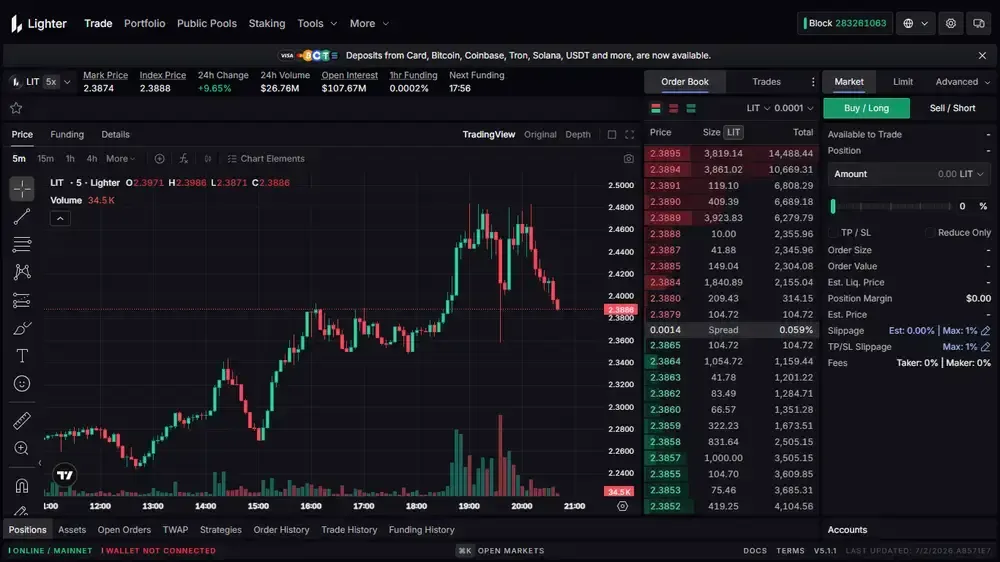
Lighter is the cleanest zero on this list, charging retail accounts nothing on maker or taker across every perpetual market, confirmed in its own fee documentation. It runs an application-specific zero-knowledge rollup anchored to Ethereum, so every match, funding calculation, and liquidation is proven correct on-chain before settlement, giving order-book trading with self-custody.
Trading it felt like a centralized exchange with the custody risk removed. You bridge USDC as collateral, connect a wallet, and trade a true central limit order book rather than an AMM, with funding sampled hourly instead of every eight hours. Because retail pays literally zero, the only holding cost is that hourly funding.
Our testing found that funding tracked spot closely, thanks to a mark price blended from several exchanges. Zero retail fees mean Lighter monetizes through premium high-frequency accounts and a Circle USDC revenue-share deal, not your trades. It is not authorized in the EEA or most regulated markets, but on pure cost, nothing beats zero.
Pros
- Genuinely zero maker and taker fees for all standard retail accounts.
- Self-custody with a ZK-verified order book anchored to Ethereum.
- Hourly funding on a multi-exchange mark price keeps holding costs honest.
Cons
- Not authorized in the EEA or most regulated jurisdictions.
- Collateral is USDC-only, bridged on-chain with no fiat route.
- Alt-pair depth still trails the largest centralized order books.
4. Aster
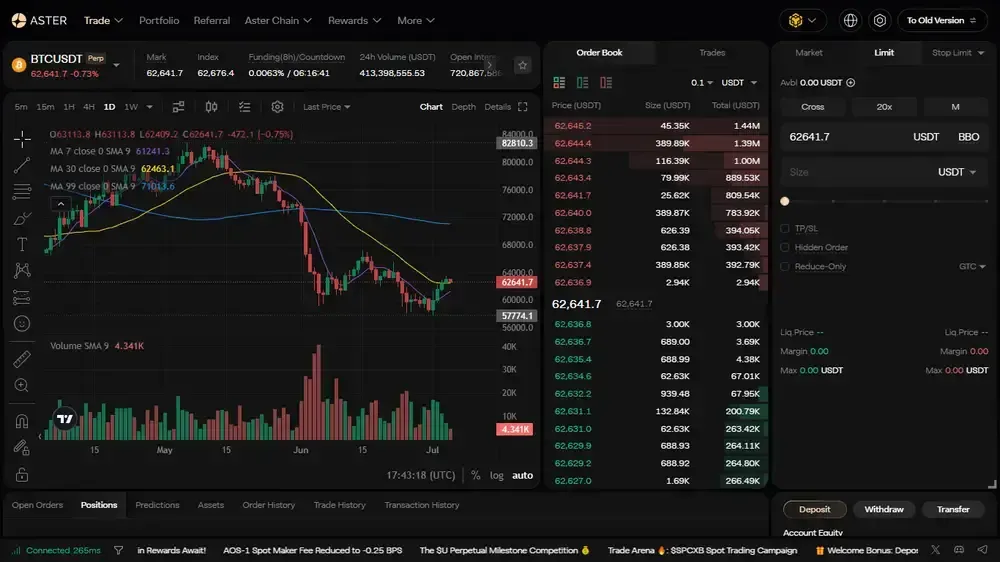
Aster delivers the cheapest headline rate of any multi-chain DEX we used, 0.01% maker and 0.035% taker on its Pro perpetual engine, undercutting Binance on the same order types. Backed by YZi Labs and positioned as a Hyperliquid rival, it settles trades on-chain without KYC while running an off-chain order book for speed, detailed in its fee documentation.
The standout for cost-hunters is its equity lineup. Aster runs stock perpetuals on names like Nvidia, Tesla, and Apple at 0% maker and 0% taker, letting you take leveraged, custody-free equity exposure around the clock with no trading fee at all. Paying fees in the ASTER token trims a further 5% on crypto perps.
We found funding on major pairs displayed transparently on the dashboard before entry, and bridge-free collateral across BNB Chain, Ethereum, and Solana removed the usual friction. The caveats are youth and 1001x leverage, which carries real liquidation danger a clean fee table can distract from. It remains the strongest multi-chain pick, and our Aster trading guide walks through the setup.
Pros
- Low 0.01% maker and 0.035% taker on the Pro perpetual engine.
- Zero-fee stock perpetuals give custody-free, round-the-clock equity exposure.
- Multi-chain, bridge-free collateral plus a 5% ASTER fee discount.
Cons
- Live only since late 2025, so long-run stability is untested.
- 1001x leverage mode creates severe liquidation risk for retail.
- Non-custodial flow demands comfort with on-chain trading.
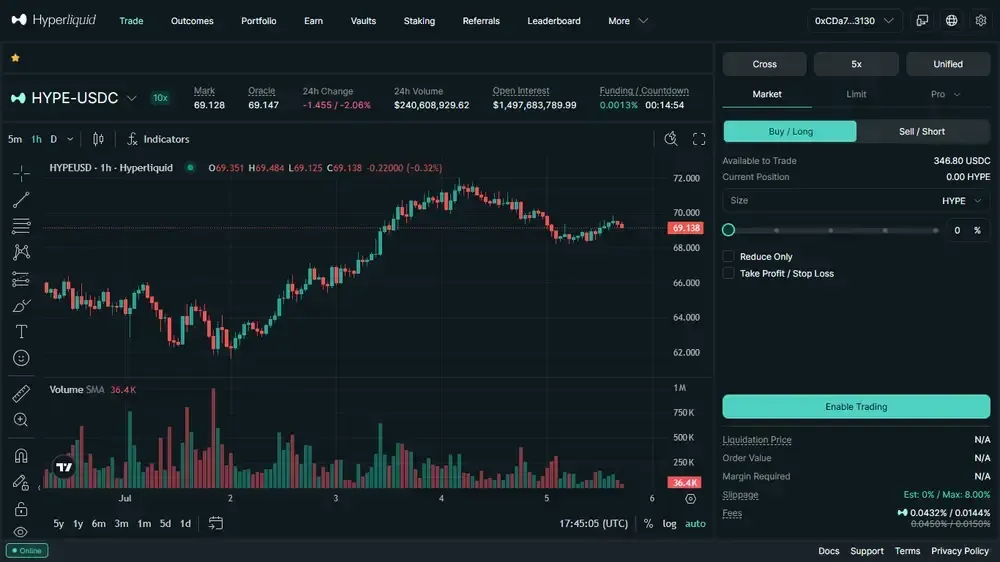
5. Hyperliquid
Hyperliquid earns its place by delivering the deepest on-chain liquidity anywhere at fees that stay competitive, 0.015% maker and 0.045% taker at the base tier, all verifiable on its own Layer-1. For a trader moving real size, the tightest book often beats the lowest headline rate, since slippage costs more than a few basis points.
The self-custody flow is frictionless once you learn it. You bridge USDC as margin, connect a wallet with no KYC or account signup, and trade against a liquidity pool and order book that centralized desks now benchmark against. Staking HYPE steps fees down through tier discounts, and our Hyperliquid fees guide shows how the referral path shaves a further 4%.
Funding runs hourly and, as we saw during a volatile session, can spike hard when the book leans one way. It is not the absolute cheapest here, and it is not authorized in regulated markets, so you carry the reporting burden. For execution quality alongside cost, its depth is unmatched among DEXs, with live liquidity in our perp DEX rankings.
Pros
- Deepest on-chain liquidity, so real size trades with minimal slippage.
- Competitive base fees with HYPE-staking discounts and a referral cut.
- Full self-custody, no KYC, and transparent on-chain funding and fills.
Cons
- Base taker fee sits above MEXC, KCEX, and the zero-fee DEXs.
- Not licensed in regulated markets, leaving compliance to the user.
- Funding can spike sharply during one-sided volatility.
6. Binance
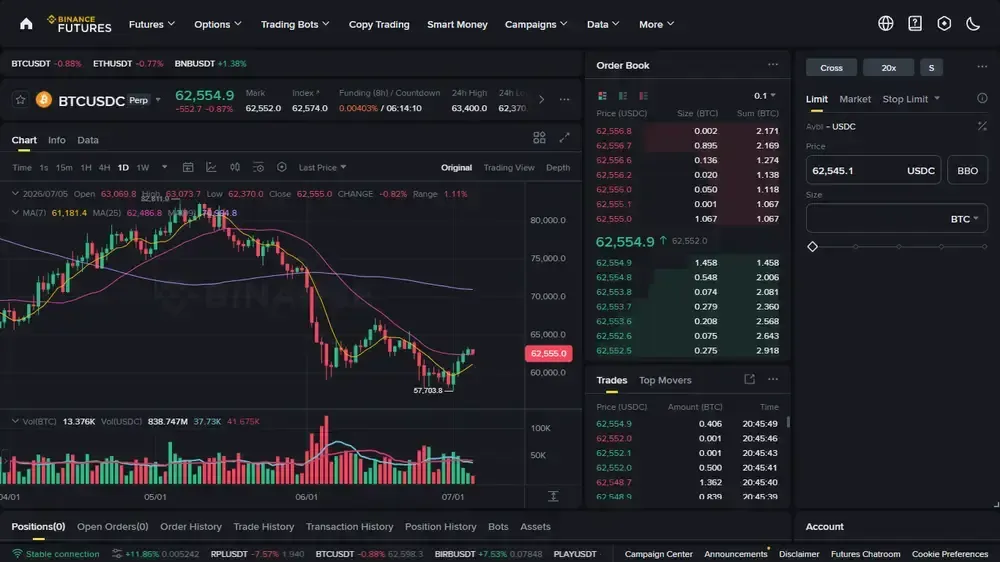
Binance is the cheapest way to trade the deepest order book in crypto, provided you use its USDC-margined contracts. Those run a promotional schedule at 0% maker and 0.04% taker, below the standard USDT-M rates, and paying fees in BNB cuts a further 10%, which its USDC-margined fee notice sets out.
The appeal is low cost meeting unbeatable depth. On BTC and ETH perps, the spread and slippage on Binance are as tight as anywhere, so the effective all-in cost of a large taker order can beat a nominally cheaper platform with a thinner book. We funded via SEPA and the reduced rate applied automatically.
Recurring zero-fee USDC promotion windows appear regularly, so it is worth watching the announcements tab before you trade. The friction is regulatory, since Binance is restructuring access in several regions, including its EU exit, and perp availability varies sharply by jurisdiction, tracked in our Binance futures restricted countries guide. Where you can reach the USDC-M board, it is the lowest-cost deep-book route.
Pros
- USDC-margined perps run 0% maker and 0.04% taker, below standard rates.
- BNB fee payment trims a further 10% on eligible contracts.
- Deepest book in crypto, so large orders slip the least.
Cons
- The cheapest rate applies only to USDC-margined contracts, not USDT-M.
- Access is shrinking and varies sharply by jurisdiction.
- Mandatory KYC and a complex VIP system add onboarding friction.
7. Gate
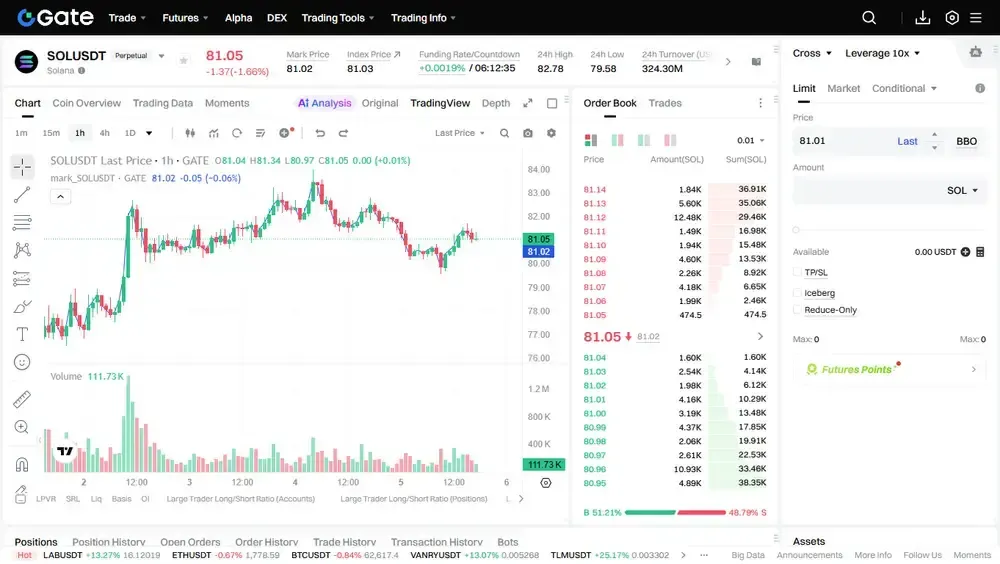
Gate closes the list as a credible, long-running exchange where the maker side is genuinely cheap. Its BTC perpetual maker fee starts at 0.015%, below the base maker rate on Binance and Bybit, with a 0.05% taker fee that falls through a 17-level VIP ladder, per its published fee schedule. Operating since 2013, it brings a real track record.
For a resting-liquidity strategy, that maker rate matters. We tested limit-heavy flow on major pairs and found the maker cost genuinely low once GT-token discounts and VIP tiers applied. Liquidity on BTC, ETH, and the larger alts held up well through a volatile session, with funding at the standard 8-hour cadence.
Our sampled slippage on a mid-size BTC taker order stayed under a basis point during a liquid window, and the 3,800-plus asset menu makes it a home for cheap perps on names others do not list. The honest read is that Gate rewards patient makers, since its 0.05% base taker rate trails MEXC and KCEX, and its coverage sits in our Gate restricted countries guide.
Pros
- BTC-perp maker fee from 0.015%, below Binance and Bybit base rates.
- GT holdings and a deep VIP ladder push maker costs toward zero.
- Huge asset menu means cheap perps on hard-to-find pairs.
Cons
- The 0.05% base taker fee trails MEXC and KCEX.
- Lowest costs depend on volume tiers and GT holdings.
- Mandatory KYC before withdrawal, with mixed support reviews.
What is a Crypto Perpetual Exchange?
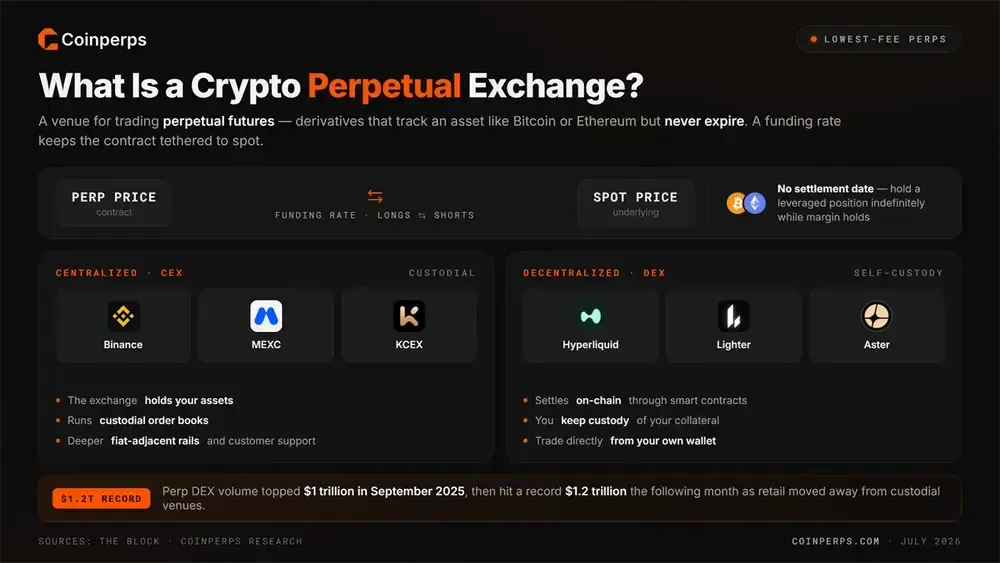
A crypto perpetual exchange is a platform for trading perpetual futures, derivative contracts that track an asset like Bitcoin or Ethereum but never expire. Instead of a settlement date, a funding rate exchanged between longs and shorts keeps the contract price tethered to spot, letting you hold a leveraged position indefinitely as long as your margin holds.
These venues split into two models with very different cost and custody profiles. Centralized exchanges like MEXC, KCEX, and Binance hold your assets, run custodial order books, and offer deeper fiat-adjacent rails and support. Decentralized exchanges like Lighter, Aster, and Hyperliquid settle on-chain through smart contracts, so you keep custody of your collateral and trade directly from a wallet.
The onchain side has scaled fast. The Block reported perpetual DEX volume topping $1 trillion in September 2025 before hitting a record $1.2 trillion the following month, driven by incentive programs, liquidation flows, and heavier retail participation moving away from custodial venues.
How Do Fees Work in Crypto Perpetual Exchanges?
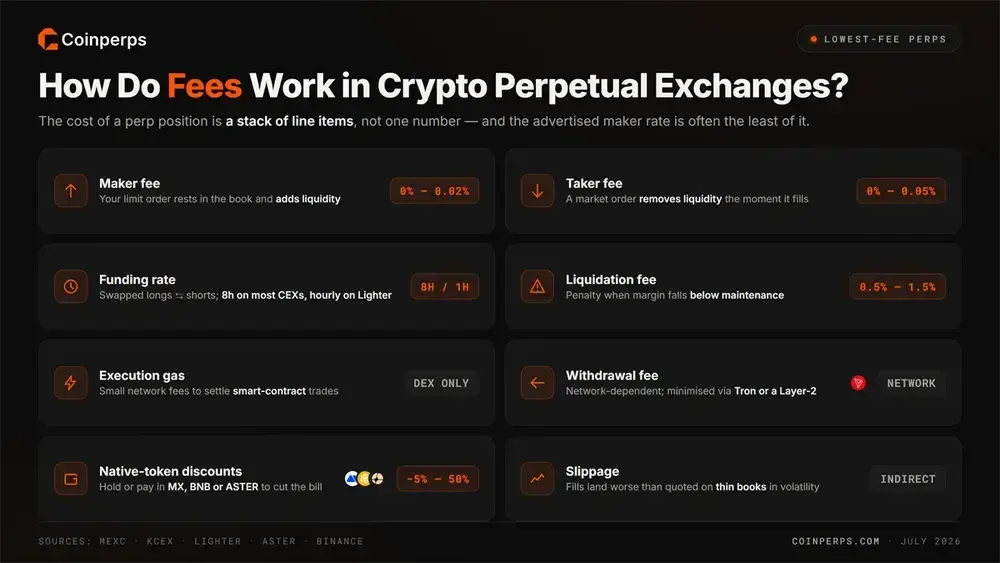
The cost of a perpetual position is not one number but a stack of them, and the advertised maker rate is often the least of it. Before you judge a venue on its landing-page figure, it helps to see every line item that can leave your account across the life of a trade.
The core costs to weigh before trading:
- Maker fees: Charged at 0% to 0.02% here when your limit order rests in the book and adds liquidity rather than filling instantly.
- Taker fees: Range from 0% to 0.05% and apply the moment a market order removes existing liquidity from the order book.
- Funding rates: Periodic payments swapped between longs and shorts, every eight hours on most CEXs or hourly on venues like Lighter.
- Liquidation fees: Penalty charges near 0.5% to 1.5% applied when a position's margin falls below the maintenance requirement.
- Execution gas: Small network fees on decentralized venues to settle smart-contract transactions on the underlying chain.
- Withdrawal fees: Network-dependent costs when moving assets off the exchange, minimised by routing over Tron or a Layer-2.
- Native-token discounts: Reductions of 5% to 50% for holding or paying in tokens like MX, BNB, or ASTER.
- Slippage: The indirect cost of a fill landing worse than expected, which widens sharply on thin books during volatility.
CEX vs DEX: Which Offers Lower Perpetual Fees?
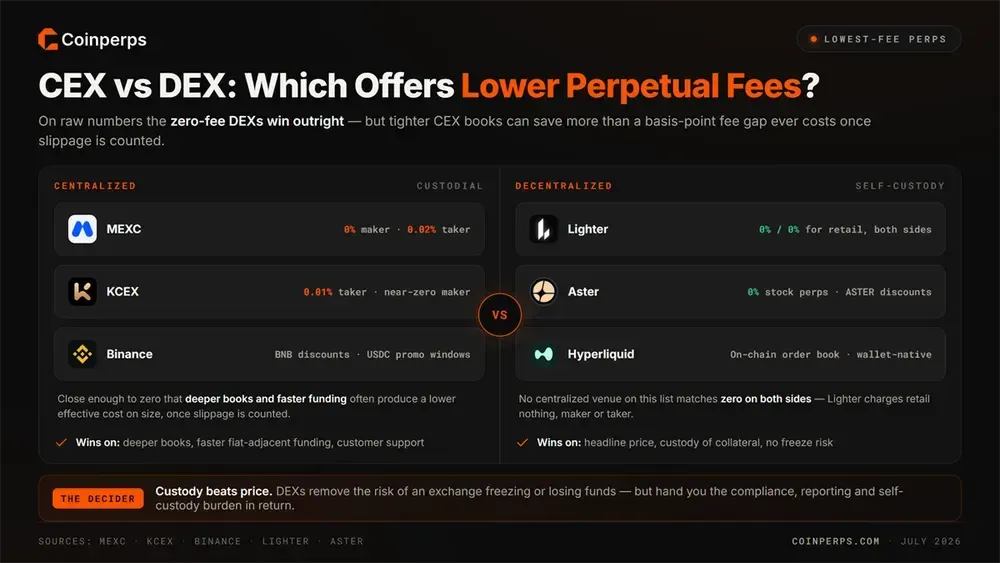
The cheapest venues split cleanly along the custody line, and the answer to which is cheaper depends on how you weigh cost against control. On raw numbers, the zero-fee DEXs win outright, since Lighter charges retail nothing on either side and Aster runs 0% stock perps, something no centralized venue on this list matches.
Centralized exchanges fight back on liquidity and access rather than headline price. MEXC at 0% maker and 0.02% taker and KCEX at 0.01% taker are close enough to zero that their deeper books, faster fiat-adjacent funding, and customer support often produce a lower effective cost on size, once slippage is counted. That is the real tradeoff, because a tighter book can save more than a basis-point fee gap ever costs.
Custody is the deciding factor beyond price. DEXs remove the risk of an exchange freezing or losing your funds, but hand you the compliance, reporting, and self-custody burden in return. Our perp DEX versus CEX comparison breaks down where each model earns its keep for different trader profiles.
How to Save on Fees When Trading Crypto Perps
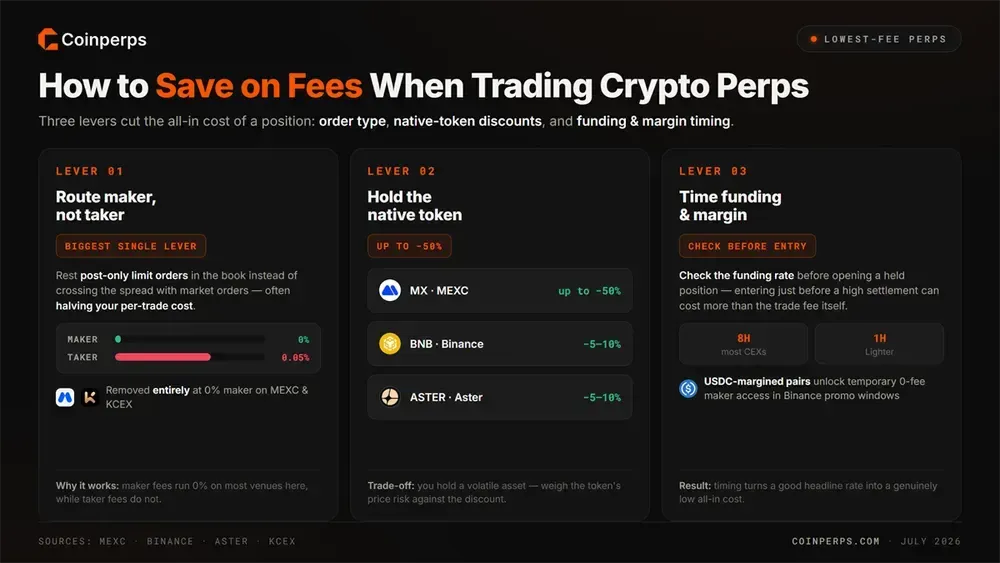
Cutting your perp costs starts with order type. Because the maker fee is zero or near-zero on most venues here while the taker fee is not, routing limit orders with a post-only flag instead of crossing the spread with market orders is the single biggest lever, often halving your per-trade cost or removing it entirely on MEXC and KCEX.
Native tokens are the second lever. Holding MX on MEXC unlocks up to a 50% cut, while paying fees in BNB on Binance or ASTER on Aster trims 5% to 10%. The saving is real, but it asks you to hold a volatile asset, so weigh the token's price risk against the discount before buying in purely to chase a lower rate.
Funding and margin choices finish the job. Always check the funding rate before opening a long-held position, since entering just before a high settlement can cost more than the trade fee itself, and switching to USDC-margined pairs during Binance promotion windows opens temporary zero-fee maker access. Timing these details turns a good headline rate into a genuinely low all-in cost.
Risks of Using Low-Fee Crypto Perpetual Exchanges
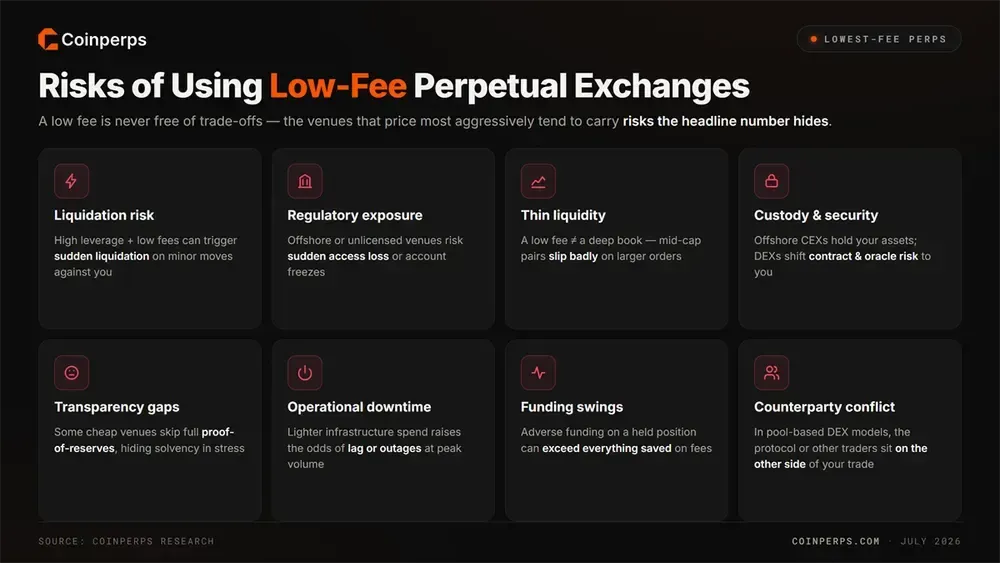
A low fee is never free of trade-offs, and the venues that price most aggressively tend to carry risks the headline number hides. Before you move size onto any of them, it is worth understanding where the savings can quietly cost you more than you saved.
The dangers to weigh before depositing:
- Liquidation risk: High leverage paired with low fees can trigger sudden liquidation on even minor price moves against you.
- Regulatory exposure: Many low-fee venues are offshore or unlicensed, risking sudden access loss, account freezes, or jurisdictional carve-outs.
- Thin liquidity: A low fee does not guarantee a deep book, so mid-cap pairs can slip badly on larger orders.
- Custody and security: Offshore CEXs hold your assets, while DEXs shift smart-contract and oracle risk onto you instead.
- Transparency gaps: Some cheap venues skip full proof-of-reserves, leaving you less visibility into solvency during stress.
- Operational downtime: Aggressive fee pricing can mean lighter infrastructure spend, raising the odds of lag or outages at peak volume.
- Funding swings: An adverse funding rate on a held position can quietly exceed everything you saved on trading fees.
- Counterparty conflict: In pool-based DEX models, the protocol or other traders sit on the other side of your position.
How to Verify a Low-Fee Exchange Before You Deposit
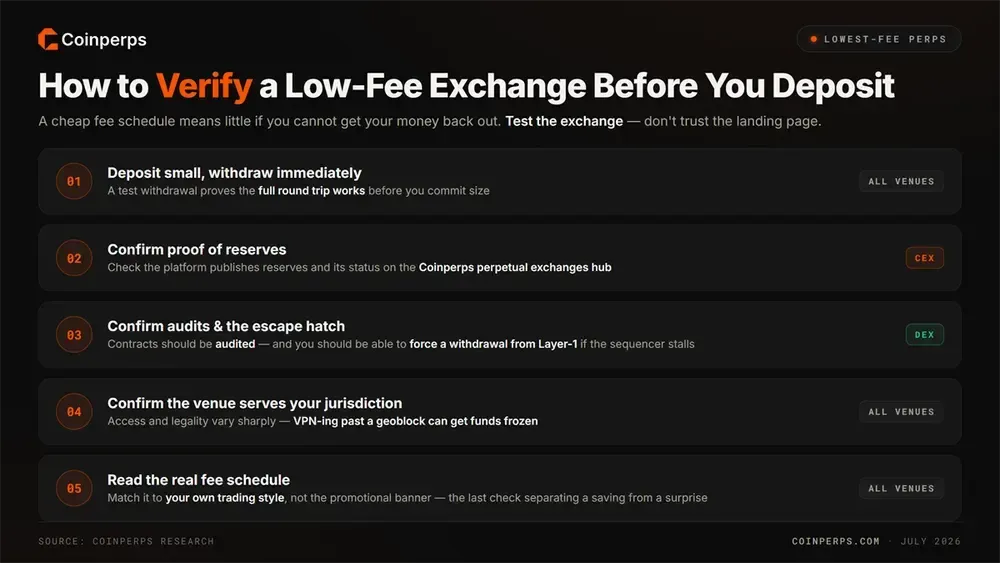
A cheap fee schedule means little if you cannot get your money back out, so a few minutes of checks protects your capital before you fund anything. Test the exchange rather than trusting the landing page, because the venues on this list vary widely in transparency and recourse.
Start with a small deposit and an immediate test withdrawal, which proves the full round trip works before you commit size. On a centralized venue, confirm the platform publishes proof of reserves and check its status on our perpetual exchanges hub; on a DEX, confirm the contracts are audited and that you can force a withdrawal from Layer-1 if the sequencer stalls.
Finally, confirm the venue actually serves your jurisdiction before depositing, since access and legality vary sharply and using a VPN to bypass a geoblock can get funds frozen. Reading the real fee schedule rather than the promotional banner, and matching it to your own trading style, is the last check that separates a genuine saving from a costly surprise.
Bottom Line
The cheapest perp venue depends on how you trade. For a market-taking trader who wants low cost with real depth on a centralized platform, MEXC leads at 0% maker and 0.02% taker, with KCEX undercutting it on the taker side at 0.01% if you accept a thinner transparency layer.
For traders comfortable with self-custody, Lighter is the only true zero on both sides, while Aster adds zero-fee equity perps and Hyperliquid wins on liquidity depth. Binance is the cheapest route into the deepest book through its USDC-margined contracts, and Gate rewards patient makers with a low base maker rate and a vast asset menu.
Remember that the lowest number rarely tells the whole story. Fund consistently, weigh funding and slippage alongside the taker rate, and confirm a venue serves your jurisdiction before you deposit.