Oil Perpetual Contracts Explained (Futures on Hyperliquid)
Explore oil perpetual contracts on Hyperliquid and see how crypto traders can access crude markets through familiar perp mechanics, funding, and leverage.

Disclosure: Coinperps may earn a commission from partner links, at no extra cost to you. Reviews are based on independent testing, see how we test.
- Oil perpetuals let crypto traders access WTI and Brent price exposure through familiar perp mechanics, without using a traditional broker or handling physical delivery.
- On Hyperliquid, oil markets are crypto-native in execution and collateral, but they still follow futures-style trading hours, roll schedules, and event-driven macro volatility.
- For crypto investors, oil perps matter because they open direct access to a major global macro market that was previously difficult to trade natively.

Hyperliquid
Hyperliquid is the largest and most liquid decentralized perpetuals exchange, processing over $2 trillion in volume on a custom Layer-1 with sub-second finality.
Features
Fees
Regulation
Overall
Oil has become one of 2026’s most volatile macro markets, as the Iran war and Strait of Hormuz disruption sent crude sharply higher and forced traders to react to geopolitical risk.
That same shock helped push oil perps into crypto’s mainstream: Hyperliquid’s oil volumes surged after late-February escalation, giving traders direct access to WTI and Brent through a crypto-native interface built for speed, leverage, and familiar execution.
Here is what crypto traders should know before getting started. ⬇️
What Are Oil Perpetual Contracts?
Oil perpetual contracts are crypto-native derivatives that give traders synthetic exposure to crude prices without touching physical oil. Instead of expiring each month like classic futures, they stay open indefinitely and are kept near reference prices through recurring funding payments.
Those reference prices usually come from the oil market’s main benchmarks: WTI and Brent. WTI means West Texas Intermediate, the flagship U.S. light sweet crude grade behind NYMEX WTI futures at CME Group, while Brent futures are traded on ICE.
For a crypto audience, the key distinction is settlement and market structure. On Hyperliquid, perpetuals are margined with stablecoins rather than barrels, and pricing, funding, and liquidations rely on oracle-linked derivatives logic instead of physical delivery logistics.
In practice, an oil perp behaves more like an onchain price-exposure instrument than an old-school commodity contract. Hyperliquid’s model uses a linear perpetual design and hourly funding, allowing traders to express macro oil views with crypto-native collateral and execution.
Why Oil Perps Matter For Crypto Traders?
Middle East conflict has turned oil into one of 2026’s most volatile macro markets, driven by supply disruptions and excessive uncertainty.
That matters because crude is no longer just a TradFi narrative. On Hyperliquid, oil-linked perpetual volume jumped from about $21 million before the Iran shock to more than $1.2 billion in 24 hours, showing that crypto traders now have direct, always-on access.
Oil’s move is critical for crypto investors because energy shocks spill into inflation, interest rates, dollar strength, and overall risk appetite. Reuters reported Brent near $109.76 and WTI near $111.28 on April 6, following some of the biggest daily jumps since 2020.
Key benefits of trading oil perps include:
- Extended market access: Traders can react to overnight headlines, military escalation, and shipping disruptions without waiting for traditional market hours.
- Direct expression of a macro view: Instead of using BTC, energy stocks, or the dollar as imperfect proxies, traders can take a cleaner position on crude itself.
- Better portfolio hedging: Oil spikes can reinforce inflation fears and pressure broader risk assets, so oil perps can help hedge a crypto portfolio during geopolitical stress.
- Crypto-native execution: Stablecoin margin, perpetual structure, and continuous trading make the instrument feel familiar to perps traders even though the underlying theme is global energy.
In other words, oil perps matter because they bring one of the world’s most important macro markets into the native workflow of crypto traders.
Where Can You Trade Them?
Crypto traders can access oil markets across both centralized exchanges and perpetual DEXs, giving them multiple ways to trade WTI and Brent exposure without using a traditional commodities broker. As of April 2026, the strongest verified lineup includes the following platforms:
How to Trade Oil Futures on Hyperliquid
Trading oil on Hyperliquid is simpler than it sounds. Once the account is funded and the market is selected, the process looks familiar to any crypto trader: choose exposure, set leverage, place the order, and manage the position like any other perp.
1. Register and connect to Hyperliquid
Getting started begins with access.
- Connect a wallet to the Hyperliquid app.
- Approve the gasless trading signature.
- Open the trading interface.
- Prepare the account for deposits and execution.
For most crypto users, wallet connection is the most natural route because it keeps the onboarding process close to a standard onchain trading flow.
2. Fund the account
Hyperliquid supports more than one way to bring funds onto the platform. While USDC remains the core collateral for perp trading, the onboarding flow now supports deposits across multiple ecosystems, including BTC on Bitcoin, ETH and ENA on Ethereum, SOL, BONK, PUMP, SPX, FARTCOIN, and other assets on Solana, as well as selected assets on Monad and Plasma.
That said, not every deposited asset is immediately ready for use as trading collateral. In many cases, traders may need to convert deposited assets into USDC, USDH, or USDT, depending on the quote asset used by the market they want to trade.
3. Move funds into the right account
Depositing funds is only part of the process. On Hyperliquid, balances can sit in different parts of the system, so traders need to make sure capital is available in the correct trading bucket before opening a position.
A simple framework helps:
- Keep funds in the perp account for derivatives trading.
- Use the spot account for holding or converting assets.
- Use the staking account only for HYPE staking activity.
4. Choose the oil market
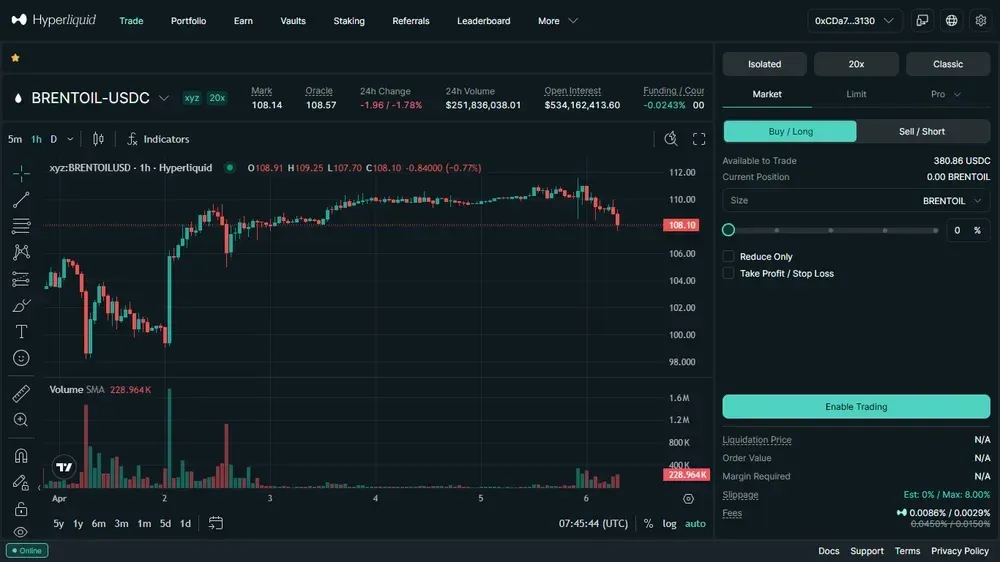
For direct crude exposure, Hyperliquid offers two main oil contracts:
- WTIOIL: Tracks 1 barrel of WTI crude oil
- BRENTOIL: Tracks 1 barrel of Brent crude oil
Both contracts are structured for traders who want oil exposure without dealing with the mechanics of traditional commodity brokerage accounts or physical delivery.
Current specifications also show:
- Up to 20x leverage
- Normal isolated margin
- Trading aligned with futures market hours
- Daily maintenance windows during the trading week
- Published roll schedules tied to underlying futures references
5. Look beyond crude if needed
Oil does not trade in isolation. Many traders approach energy through a wider macro lens, and Hyperliquid’s broader market lineup makes that easier.
Alongside oil, the platform’s expanded market set includes products tied to:
- Natural gas
- Gold and silver
- Copper and other metals
- FX pairs
- Equity-index style markets
That is important because some traders are not just expressing a view on crude itself. They may be positioning around inflation, dollar strength, commodities, or broader risk sentiment.
6. Place the trade
Once the market is selected, execution is straightforward.
- Pick WTIOIL or BRENTOIL.
- Choose whether to go long or short.
- Enter position size and leverage.
- Select the order type.
- Confirm the trade.
At this stage, the trade behaves much like any other perpetual contract. The key difference is that the position is tied to a macro asset that can react sharply to geopolitical headlines, inventory data, OPEC commentary, and global growth expectations.
7. Use the right order types
Execution quality matters, especially in a fast-moving market like oil.
- Limit orders: Help control entry price.
- Market orders: Prioritize immediate execution.
- Take-profit and stop-loss orders: Help automate exits.
- Reduce-only orders: Help trim or close a position without accidentally reversing it.
For many traders, the safest approach is to define risk controls before the position is opened rather than trying to manage everything after volatility arrives.
8. Monitor the position
Opening the trade is only the beginning. Oil can move quickly, and position management matters just as much as entry.
Key metrics to watch include:
- Mark price
- Unrealized PnL
- Funding payments
- Distance to liquidation
Funding is especially important for positions held beyond short intraday windows. On Hyperliquid, funding is paid hourly, so carrying a position over time comes with ongoing cost or yield depending on market positioning.
9. Manage leverage carefully
Oil contracts on Hyperliquid can be traded with meaningful leverage, but that should not be confused with low risk. Crude is a macro asset, and it can reprice aggressively when supply disruptions, military escalation, sanctions, or inventory surprises hit the market.
For that reason, traders should think in terms of controlled exposure, not just maximum allowable leverage. A smaller position with more room to breathe is often more durable than a larger one built around a tight liquidation threshold.
11. Close the trade
Exits can be handled in several ways:
- Close the full position manually.
- Scale out in smaller pieces.
- Use take-profit or stop-loss orders to automate the exit.
For most traders, the best process is to plan the exit before the entry. Oil perps may look familiar on the screen, but they still demand the discipline of a macro trade.
Unique Risks to Consider
Oil perps can unlock macro opportunity, but they also carry risks that differ from standard crypto pairs and demand tighter trade management.
The main risks traders should watch closely include:
- Funding drag: Holding positions through crowded conditions can get expensive because Hyperliquid charges funding every hour, with a cap looser than some CEXs.
- Liquidation risk: Oil can reprice sharply on headlines, and because liquidations use mark price, positions can be closed before last-trade moves look extreme.
- Leverage risk: Oil already reacts violently to war, sanctions, and inventories, so 20x leverage can shrink margin for error extremely quickly.
- Trigger risk: Stops use mark price rather than last trade, so exits can trigger during oracle-led repricing before the visible tape catches up.
- Gap risk: Unlike BTC or ETH, oil follows futures hours, daily maintenance windows, and holiday closures that can create reopening gap risk.
- Roll risk: WTI and Brent references roll across futures months, which can shift pricing during transition windows even without a new macro catalyst.
- ADL risk: During severe volatility, profitable opposing positions can be auto-deleveraged if liquidations cannot fully absorb losses across the market.
- Slippage risk: Oil order books can thin during geopolitical shocks, and Hyperliquid TP/SL market orders allow up to 10% slippage tolerance.
- Basis risk: These contracts follow futures-linked benchmarks and validator inputs, so temporary divergence from headline spot prices is possible during fast conditions.
- Event risk: Inventory reports, OPEC signals, sanctions, and military escalation can reprice crude instantly, turning an ordinary position into a crisis.
Bottom Line
Oil perpetuals give crypto traders a direct way to access one of the world’s most important macro markets without leaving the perpetual trading framework they already know.
On Hyperliquid, that access feels native to crypto, but the underlying asset still follows oil’s distinct fundamentals, trading hours, volatility, and event-driven risks.