Best Crypto Exchange VIP Programs (Bybit, Binance & More)
Read our 2026 guide to the best crypto exchange VIP programs, comparing Bybit, Binance, Kraken, Gate, OKX, and Hyperliquid tiers, fees, and perks.

Disclosure: Coinperps may earn a commission from partner links, at no extra cost to you. Reviews are based on independent testing, see how we test.
- Crypto exchange VIP programs are essential for high-volume traders to minimize execution costs and access 1:1 professional account management and API perks.
- The six best programs for 2026 include Bybit, Binance, Kraken, Gate, OKX, and Hyperliquid, each accommodating different trading styles and capital requirements.
- Traders can utilize "Status Match" programs to immediately port their fee discounts to a new exchange, bypassing the standard 30-day volume wait.

Bybit
Bybit, founded in 2018 and headquartered in Dubai, is the world’s second-largest exchange by volume, serving 60 million users with 1,800+ assets and over $11 billion in daily trading.
Features
Fees
Regulation
Overall
Seasoned crypto traders often find that their biggest expense isn't market volatility, but the hidden drain of execution fees and slippage on every position. If you are generating millions in volume, you are likely looking for a way to turn those costs back into profit.
You need a platform that treats your capital with the priority it deserves, offering institutional-grade tools and high fee rebates. This guide breaks down the most efficient VIP programs for 2026 to ensure you are trading on the most cost-effective terms possible.
Check the table below to compare our top exchanges:
Top Crypto Exchange VIP Programs in 2026
Crypto exchange VIP programs in 2026 look less like simple fee discounts and more like full “pro trader” memberships: deeper maker rebates, higher API limits, faster support, maker-taker spreads, and faster onboarding for market makers across spot and derivatives.
To build this list, we audited each exchange’s official fee schedules and VIP pages, then compared tier counts, qualification rules, and real fee deltas from entry level to top tier. We prioritized transparent tables, achievable thresholds, and perks that matter.
1. Bybit
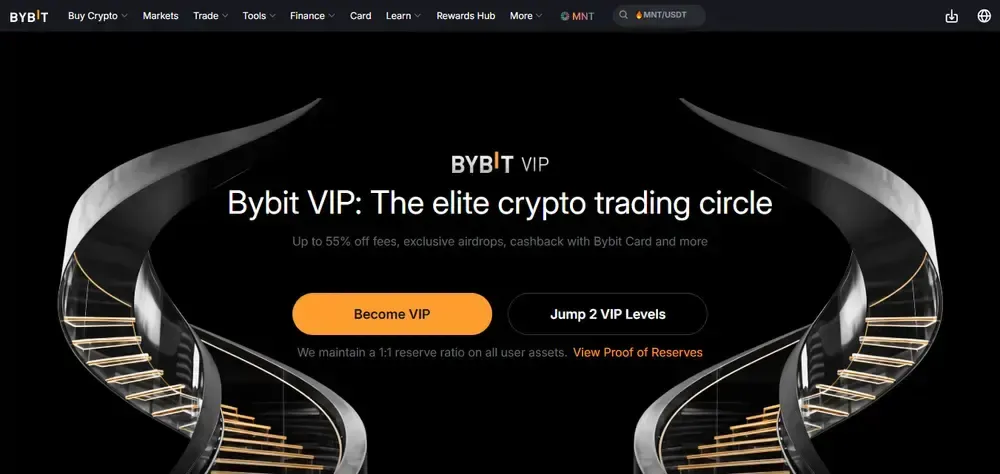
Bybit’s VIP program balances clear fee ladders with strong “white-glove” perks, so high-volume traders get savings without guesswork. The program utilizes six primary levels, starting from VIP 1 and culminating in the "Supreme VIP" tier for the highest-volume market participants.
Standard users pay 0.0550% in taker fees, but VIP 1 status (requiring a $100,000 balance) immediately drops this to 0.0400%. In our experience, the Supreme VIP level is the most competitive for market makers, offering a 0.0000% maker fee and 0.0300% taker fee on all derivatives.
The "Mantle Multiplier" is a unique 2026 feature where holding MNT tokens can boost your qualifying asset balance by up to 1.5x, accelerating your path to higher tiers. This capital efficiency allows traders to reach VIP 3 status with less native collateral than on competing exchanges.
Pros
- Zero maker fees available for Supreme VIP derivatives accounts.
- Asset balance boost for users holding native Mantle tokens.
- Higher daily withdrawal limits reaching up to $60 million.
Cons
- API volume limits are strictly enforced for lower VIP tiers.
- Supreme VIP status requires an immense $500 million volume.
- Fiat-to-crypto spot pairs have a much higher base fee.
2. Binance
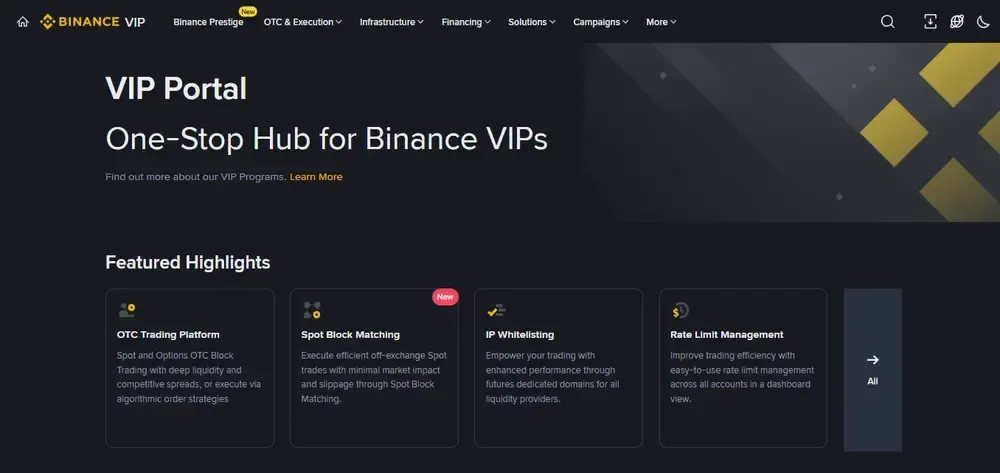
Binance dominates the high-volume sector by offering an nine-tier system that integrates spot, futures, and even mining pool activity into one cohesive status. To qualify for VIP 1, traders need a $1 million spot volume and a minimum holding of 25 BNB.
Base taker fees of 0.1000% can be reduced by 25% simply by paying in BNB, with further tier-based discounts reaching up to 80%. Based on user reviews, the 2026 "Holder VIP" track is excellent for those with $500,000 in assets who prefer not to trade frequently.
The platform's 2026 updates have also integrated "Investor VIP" status, where locked Simple Earn subscriptions of $250,000 can bypass traditional trading volume requirements. This makes Binance the most versatile option for users who combine active trading with long-term passive yield strategies.
Pros
- Unmatched liquidity for multi-million dollar institutional spot orders.
- Versatile qualification tracks including EARN and mining activity.
- Seamless sub-account management with shared VIP status benefits.
Cons
- Mandatory BNB holdings are required for most VIP tracks.
- Regulatory restrictions vary greatly by geographic user location.
- Lower tiers offer less personalized support than boutique exchanges.
3. Kraken
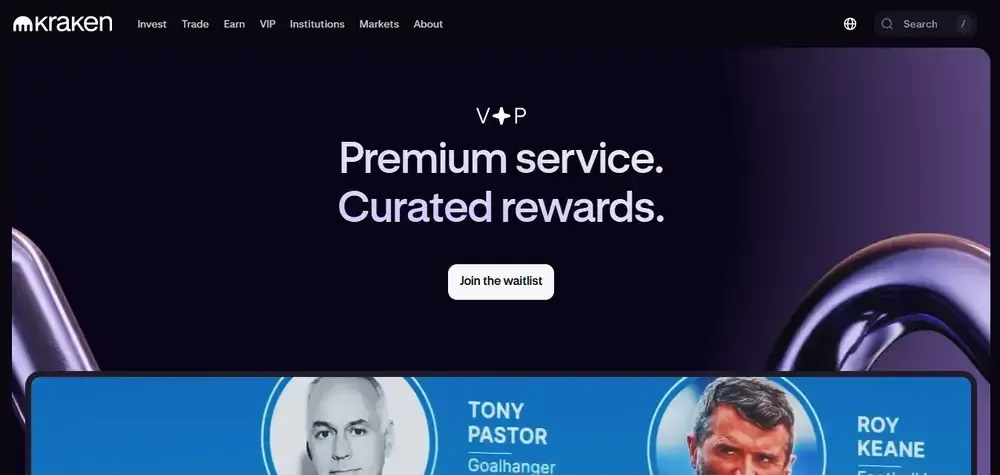
Kraken is next on the list, targeting high-net-worth individuals and professional firms who prioritize security and high-touch customer support. Their VIP structure is less about "gamified" levels and more about tailored institutional-grade fee schedules and bespoke funding.
Entry for their VIP fee tier upgrade typically requires a 30-day volume of $5 million for spot or $10 million for futures. In our experience, Kraken provides the fastest 1:1 onboarding process, with dedicated account managers assisting with complex tax reporting and API integrations.
The Kraken Pro VIP upgrade is particularly useful for traders migrating from other platforms, as they will match your existing volume-based tier for 60 days. This allows for an immediate taker fee reduction from the standard 0.26% down to professional institutional rates.
Pros
- Industry-leading security protocols with audited proof of reserves.
- 60-day fee tier matching for traders moving from competitors.
- Personalized white-glove service for high-net-worth individual accounts.
Cons
- Higher volume requirements for initial VIP qualification than others.
- Lack of a native token means fewer extra discounts.
- Interface is optimized for professionals rather than casual traders.
4. Gate
Gate provides the most flexible progression path in the industry, featuring 16 distinct VIP levels that cater to every stage of a trader's growth. This system ensures that even minor increases in 30-day volume or GT token holdings result in immediate fee adjustments.
Standard maker fees are 0.1000%, but reaching VIP 10 or higher completely eliminates maker costs, setting them to 0%. Our research indicates that Gate is one of the few platforms where VIP status is "relegation-proof" if you hold a specific threshold of native GT tokens.
The 2026 "Gate VISA" integration further rewards VIPs with up to 1% daily cashback on real-world purchases, bridging the gap between digital assets and fiat spending. This makes it an ideal ecosystem for users who want their trading activity to fund their daily expenses.
Pros
- 16 incremental levels provide constant feedback and reward progression.
- Relegation-proof VIP status for long-term native GT token holders.
- Zero maker fees are accessible at the mid-to-high tiers.
Cons
- Taker fees remain relatively high until reaching VIP 12+.
- The platform's massive altcoin list can lead to slippage.
- Navigation through 16 different tier requirements is often confusing.

5. OKX
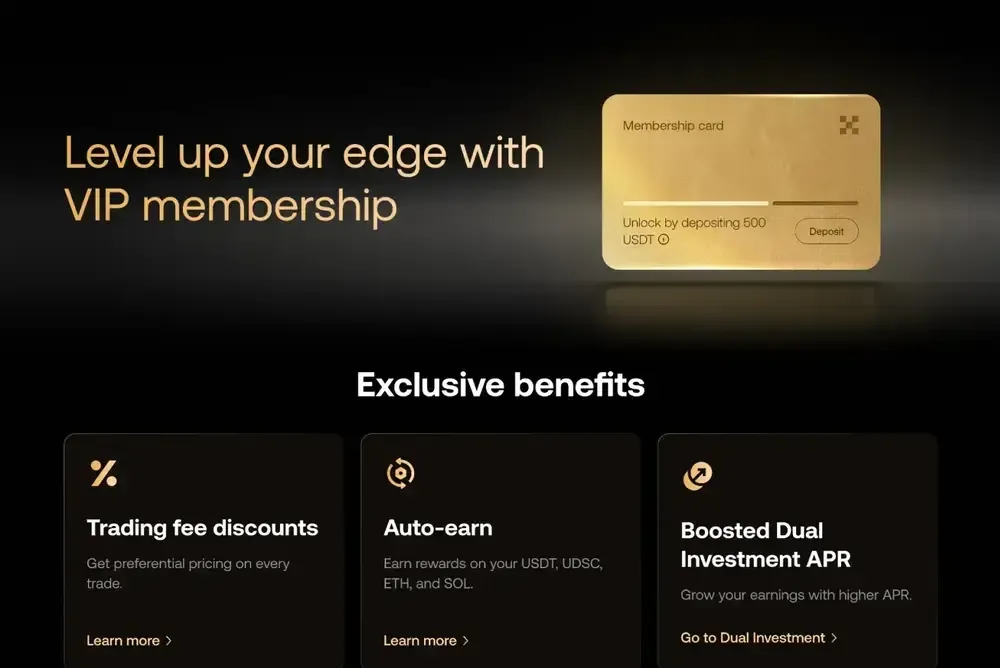
OKX has recently overhauled its 2026 EEA fee framework to provide more transparency for professional traders operating within European jurisdictions. The new system utilizes nine professional tiers, focusing on a balance of AUM and 30-day trading volume.
The update heavily reduced taker fees across all VIP levels, with some professional accounts seeing rates as low as 0.055%. In our observation, the OKX "Unified Account" mode is the most economical way to manage cross-margin positions for VIP users.
Top-tier VIP 9 users on OKX benefit from a massive $80 million daily crypto withdrawal limit, which is essential for arbitrageurs and hedge funds. The platform also offers negative maker fees (rebates) for the highest-tier market makers, essentially paying you to trade.
Pros
- Negative maker fees (rebates) for top-tier professional market makers.
- Optimized Unified Account structure for superior capital margin efficiency.
- High daily withdrawal limits suitable for large institutional funds.
Cons
- Fee structures are strictly segmented by geographic user regions.
- VIP benefits are heavily skewed toward professional-tier volumes.
- Lower-tier maker fees were recently increased for some regions.
6. Hyperliquid
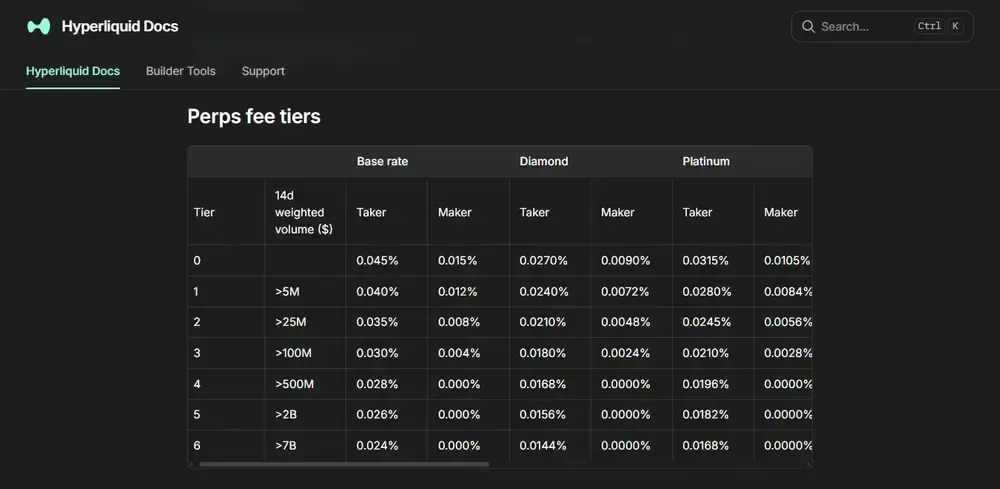
Hyperliquid is the only decentralized perpetual exchange on our list, offering a high-performance Layer 1 experience that rivals centralized counterparts. Its VIP program is governed by the native HYPE token and transparent onchain trading metrics.
Instead of a hidden corporate ladder, Hyperliquid uses "Staking Tiers" where staking HYPE tokens directly reduces your execution costs. Even without staking, the base fees are often lower than many CEX VIP 1 levels due to the protocol's low overhead.
Our research shows that Hyperliquid is the top choice for privacy-conscious whales who require deep liquidity without the traditional KYC hurdles. The 2026 roadmap includes protocol revenue sharing for HYPE stakers, adding a layer of passive income to the fee-saving benefits.
Pros
- Full onchain transparency for all trades, liquidations, and fees.
- No KYC requirements for accessing professional-grade perpetual markets.
- Direct participation in protocol governance for HYPE token stakers.
Cons
- Self-custody carries higher personal security risks for large portfolios.
- No fiat on-ramps compared to centralized exchange VIP programs.
- Fee rebates are paid in native HYPE tokens only.
What are Crypto Exchange VIP Programs?
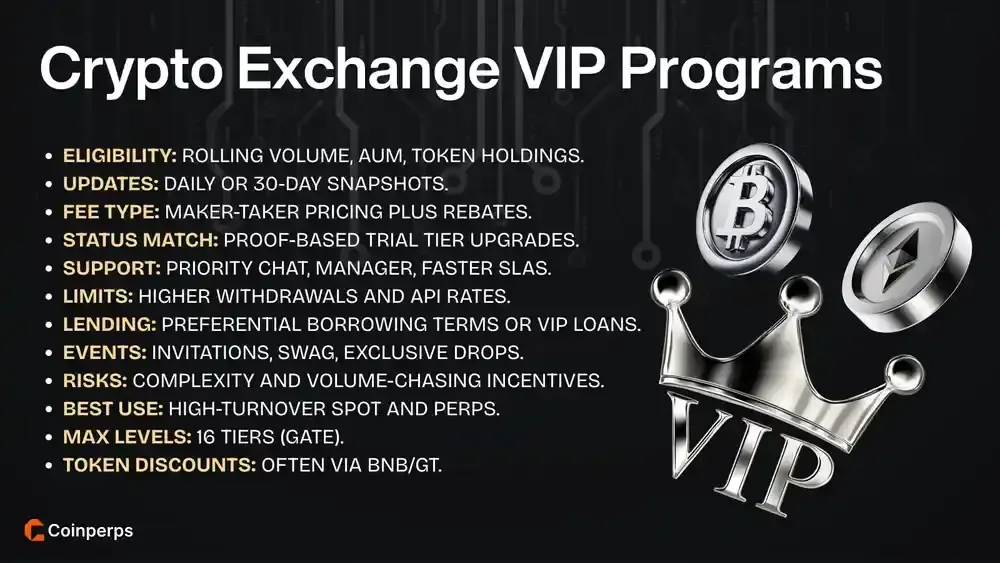
Crypto exchange VIP programs are tiered memberships that reward high-value users with lower trading fees and operational perks. They usually track rolling volume, assets under management, or token holdings, then apply a better maker/taker schedule across spot and derivatives.
Most programs also bundle non-fee advantages: higher withdrawal limits, priority support, dedicated account managers, faster OTC onboarding, and early access to launches or events. Some platforms add “status match” trials, letting you prove volume elsewhere and receive temporary higher tiers.
The practical goal is simple: reduce friction for professionals who trade frequently, route via API, or provide liquidity. If you’re mainly a buy-and-hold investor, VIP won’t move the needle; but for million-dollar notional, basis points translate into real money.
How to Choose a Crypto VIP Program
Choosing the right VIP program is a math-and-operations exercise: model your fees, then pick the venue whose perks match how you actually trade.
Step 1: Define your product mix and order style
If you trade mostly perps with market orders, taker fees will dominate your costs; if you run maker strategies, rebates and maker tiers matter more. Write down your expected monthly notional split across spot, perps, options, and OTC.
Also consider operational needs: API rate limits, sub-accounts, and margin features can be worth more than a tiny fee delta. For instance, Hyperliquid shares tiers across sub-accounts, while Binance notes VIP benefits apply across its product suite.
Step 2: Calculate the fee path you can realistically reach
Don’t compare only the “top tier.” Compare the tier you’ll hit in 30-60 days realistically, then the next one after that.
Quick checklist for modeling your fee trajectory:
- Pull your last 30-day notional from your current exchange.
- Separate maker versus taker; your mix changes effective rate.
- Add token-holding discounts only if you’ll maintain them.
- Include withdrawals and funding, not just trading fees.
Step 3: Compare non-fee perks that move the needle
Look for perks that reduce downtime: priority support SLAs, a named account manager, and faster KYC or institutional onboarding. Bybit and Gate explicitly market VIP concierge-style support, while Binance highlights VIP communities, events, and useful insights.
Also check limits and borrowing terms. Gate lists customized borrowing rate plans as a VIP perk, and OKX offers VIP products like VIP Loan. If you move capital often, higher withdrawal limits and fewer operational holds can outweigh basis points.
Step 4: Use status matching if you’re switching venues
If you already trade size elsewhere, apply for a tier match or trial card so you don’t pay “beginner” fees during migration.
Common match programs to look for:
- Bybit offers VIP+2 status matching with proof of VIP.
- Binance Invitation Program recognizes verified external 30-day volume.
- Kraken Pro can match your fee tier for 60 days.
- OKX trial cards can grant higher tiers up to VIP 6.
Can You Match or Transfer VIP Status Between Exchanges?
Yes, most venues now offer “VIP matching” rather than literal transfers. You don’t carry a badge across platforms automatically; instead, you submit proof of assets or 30-day volume and receive a temporary or boosted tier to ease switching costs.
Bybit offers VIP+2 status matching for users from other exchanges, and Binance runs an Invitation Program where applicants can qualify by submitting 30-day volume from another venue. Gate says approved applicants can “jump 2 VIP levels” with proof.
Kraken’s docs spell out a fee tier upgrade that matches your spot or derivatives tier to your volume elsewhere for 60 days. OKX offers trial cards and fast-tracking to a matching tier, often capped at a maximum like VIP 6.
How Much Can You Save With Crypto VIP Programs?
Reducing your crypto costs by just a few basis points can be the difference between a profitable month and a losing one when trading with leverage.
Example A: A trader on Bybit with a $10,000 portfolio using 20x leverage on perpetuals could generate $5 million in monthly volume. By qualifying for VIP 2, their taker fee drops from 0.0550% to 0.0375%, saving them $875 in monthly overhead.
Example B: A professional firm on OKX doing $20 million in monthly volume would pay $60,000 in taker fees as a standard user. At the VIP 7 tier, that cost drops to 0.150% (or lower), saving them $30,000 every single month on execution alone.
Pros and Cons of Crypto VIP Programs
VIP programs can meaningfully reduce costs for active traders, but they add complexity and can nudge you into overtrading just to “keep status”. Look at the table below for benefits and drawbacks:
Bottom Line
Selecting the right VIP program in 2026 requires a deep understanding of your own trading volume and the specific fee tiers of each platform.
Bybit and Binance remain the leaders for sheer liquidity and versatile qualification tracks, while Kraken excels in personalized service for high-net-worth accounts.
If you are a DeFi-native trader, Hyperliquid offers the best onchain alternative without the need for centralized KYC. Always consider the "all-in" cost of a program, including the potential volatility of any tokens you are required to hold for status.