

Bybit vs Bitget: How the Two Exchanges Compare in 2026
Bybit and Bitget are both major centralised derivatives venues, but they pull in different directions. Bybit is built around deep liquidity and a wide product stack, while Bitget has made copy trading its signature. The live data at the top of this page tracks their volume, open interest, funding, and fees minute to minute; the analysis below explains what those numbers mean for the way you trade.
Liquidity, Volume and Open Interest
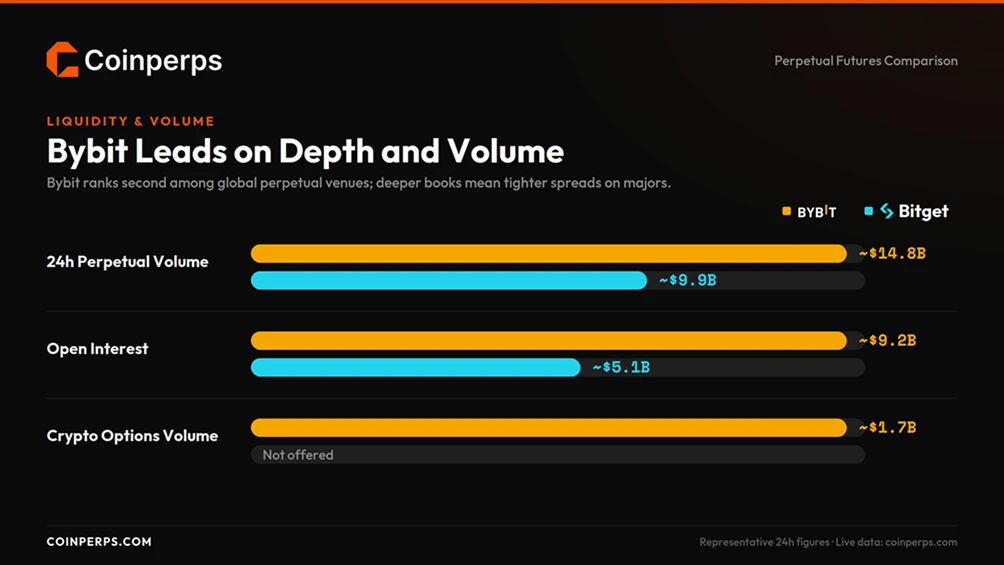
On raw throughput, Bybit is the larger venue by a clear margin. It ranks second worldwide among perpetual exchanges, and its 24-hour perpetual volume and open interest both run well ahead of Bitget's, as the open interest figures above confirm. Depth counts for most on majors like BTC and ETH, where it keeps spreads tight and lowers the cost of moving size.
Bitget holds respectable liquidity and fills well on popular contracts, but its books thin out faster once you move down the cap table. That gap tends to surface first in funding, which you can monitor on the live funding rates page.
Trading Fees and Costs
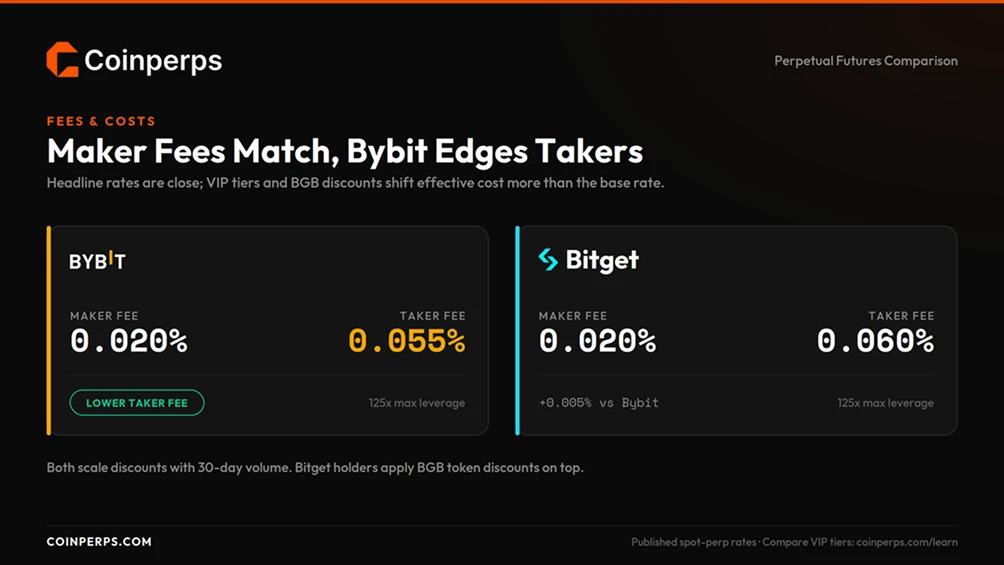
On headline rates, Bybit is the marginally cheaper venue for takers, at 0.055% against Bitget's 0.06%, while both hold maker fees at 0.02%. The spread is slim, and your tier ends up mattering more than the public rate: each exchange lowers fees as 30-day volume rises, and Bitget layers BGB token discounts on top.
If you trade often enough for tiers to bite, weigh where each platform's VIP thresholds fall before you commit, using our breakdown of exchange VIP programs.
Copy Trading and Product Range
This is Bitget's standout. The exchange pioneered exchange-native copy trading and now runs one of the largest social-trading ecosystems in crypto, with well over 100,000 lead traders that followers can mirror across spot, futures, and bot strategies. Profit-share is capped at a flat 10% on spot copying and scales up to 20% on futures for top-ranked traders, and the old requirement to lock BGB to participate has been removed. For traders who would rather follow proven strategies than trade by hand, that selection is difficult to rival.
Bybit answers with breadth in other areas. It lists a wider spot catalogue, settles perpetuals in both USDT and USDC, and runs an active crypto options desk that Bitget does not offer. Bitget matches Bybit on dual-currency settlement and 125x leverage, so the real divide is product focus: Bitget for copy and automated strategies, Bybit for options and a fuller derivatives suite.
Security and Proof of Reserves
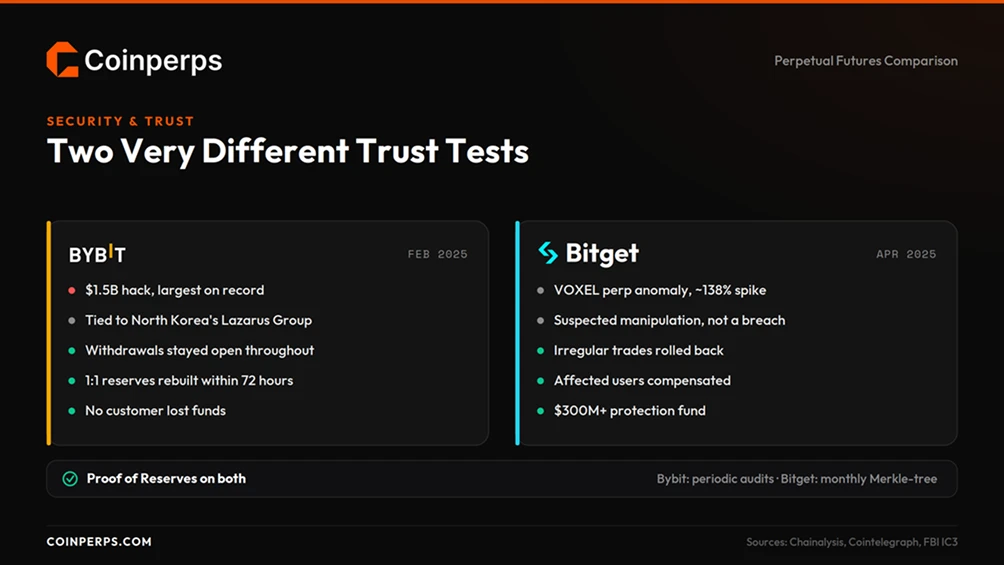
Neither exchange has had a spotless run, and their incidents are very different in kind. Bybit absorbed the largest theft in crypto history in February 2025, when attackers manipulated a third-party multisig signing interface and drained roughly $1.5 billion in Ethereum from a cold wallet; Chainalysis and US investigators tied the operation to North Korea's Lazarus Group. The response is the part that matters for depositors: Bybit kept withdrawals open, sourced replacement ETH through loans and OTC desks, and rebuilt one-to-one reserve backing inside three days, with no customer left short.
Bitget's test came in April 2025, when its VOXEL/USDT perpetual spiked around 138% and briefly traded more volume than Bitcoin, behaviour the exchange, under CEO Gracy Chen, put down to suspected manipulation rather than a system breach. Bitget froze the accounts involved, rolled back the irregular trades and compensated affected users from a protection fund that holds well over $300 million. Both platforms publish Proof of Reserves today, Bybit through periodic audits and Bitget on a monthly Merkle-tree basis.
Regulation and Availability
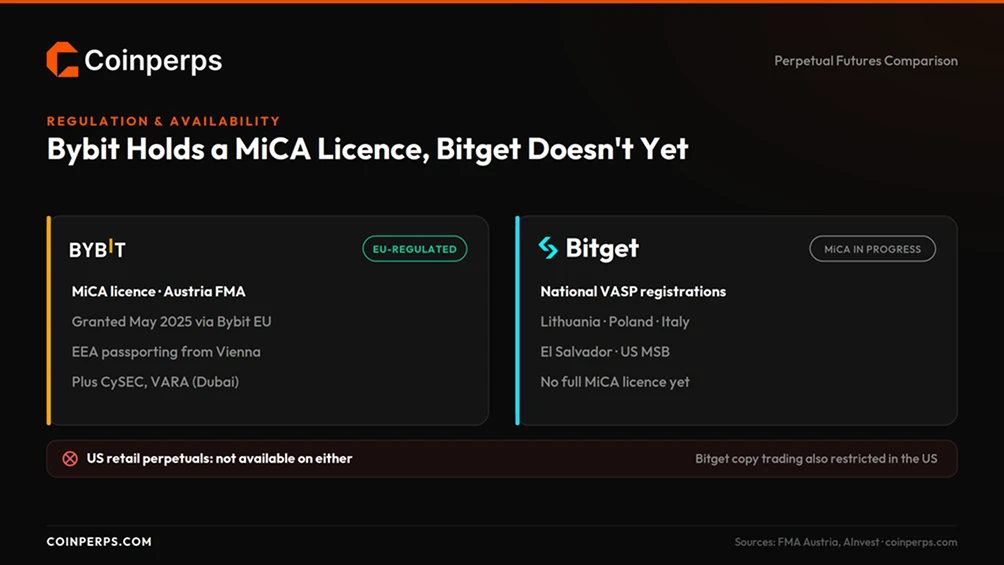
The sharpest regulatory difference sits in Europe. Bybit cleared a key hurdle in May 2025, when its Bybit EU arm was granted a MiCA licence by Austria's Financial Market Authority, opening passported access across the EEA from a Vienna headquarters. Bitget was still operating on national VASP registrations rather than a full MiCA authorisation heading into 2026, with approvals in markets such as Lithuania, Poland, Italy, and El Salvador, plus an MSB registration in the United States.
Neither platform offers perpetual futures to US retail traders, and Bitget's copy trading is unavailable there as well. Both restrict derivatives access in line with their licensing.
Which Should You Choose?
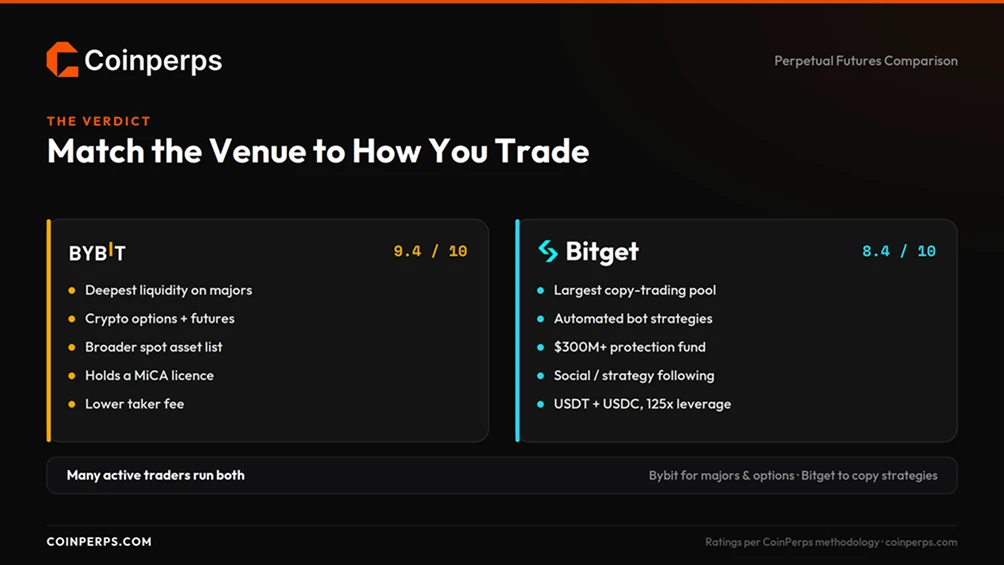
For most leverage traders in this pairing, Bybit is the stronger default: it leads on liquidity, carries options and a broader asset list, holds a MiCA licence, and edges Bitget on taker fees. Bitget earns its place when copy trading or automated strategies are the point, since nothing else in this comparison comes close to its lead-trader pool and bot tooling. Plenty of traders simply run both, keeping majors and options on Bybit while mirroring strategies on Bitget. If self-custody outweighs either for you, on-chain venues are worth a look too, and you can size them up on our perp DEX rankings.
Each platform's full scorecard, including how we weight liquidity, fees, security, and features, sits on the Bybit review and Bitget review pages, scored against our published ranking methodology.
Frequently Asked Questions
Is Bitget or Bybit better for copy trading?
Bitget. It pioneered exchange-based copy trading and runs the larger ecosystem, with well over 100,000 lead traders to mirror across spot, futures, and bots, plus a flat 10% profit-share cap on spot copying. Bybit offers copy trading too, but Bitget's selection and tooling go deeper.
Which is safer, Bybit or Bitget?
Both publish Proof of Reserves and hold user-protection funds. Bybit was hacked for about $1.5 billion in 2025 yet covered every account and restored full reserves within three days. Bitget has avoided a comparable breach; its main test was a 2025 trading anomaly it settled with rollbacks and compensation. Everyday custody risk on both is low.
Which has lower fees, Bybit or Bitget?
Bybit is slightly cheaper for takers at 0.055% versus Bitget's 0.06%, and the two are level on maker fees at 0.02%. VIP tiers and Bitget's BGB discounts move your real cost more than the headline rate, so check the rate at your own volume tier.
Does Bybit or Bitget list more coins?
Bybit carries the wider spot selection of the two and adds a crypto options market. Bitget's edge is the breadth of its copy-trading and bot markets rather than raw spot listings.
Are Bybit and Bitget available in the United States?
Neither offers perpetual futures to US retail traders, and Bitget's copy trading is also closed to US users. Both limit derivatives access in line with their licensing.
Can I use Bybit and Bitget together?
Yes. A common setup is trading liquid majors and options on Bybit while using Bitget to copy lead traders or run bots. Both secure funds with cold storage and multi-signature custody and publish Proof of Reserves.