Dark Pools in Crypto Explained: Institutional Stealth Trading
Learn why institutions use dark pools to swap Bitcoin and Ethereum discretely and how these private platforms differ from standard public crypto exchanges.

Not financial advice.
Key takeaways
- Dark pools in crypto are private trading platforms that hide large digital asset orders from the public to prevent slippage and front-running bots.
- Major platforms like Kraken and Enclave Markets support these pools, while prime brokers like sFOX provide access to various private liquidity sources.
- Hidden orders on Aster Pro offer an alternative to dark pools, allowing any trader to achieve stealth execution without needing a massive institutional bankroll.
On this page 10 sections
If you need to execute large trades without alerting the market or suffering from slippage, dark pools are the key. You likely want to know how whales move $10 million without crashing prices or facing front-running bots.
As a trader seeking privacy, you are searching for venues that offer stealth execution and asset security. This guide explains how these private exchanges function in 2026 and how you can access similar benefits through hidden orders.
Explore the mechanics and risks of private liquidity below. ⬇️
What are Dark Pools in Crypto?
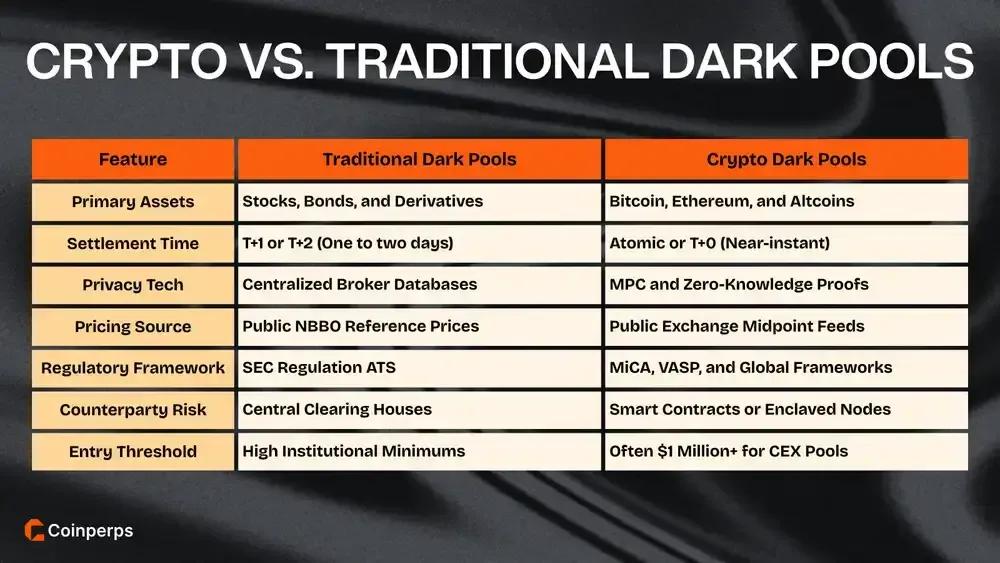
Dark pools in crypto are private exchanges for executing large digital asset trades without publicizing order book data. These platforms allow whales to swap $10 million or $50 million in assets while avoiding the price slippage seen on transparent exchanges.
Technically, crypto dark pools utilize multiparty computation (MPC) and zero-knowledge proofs (ZKPs) to match buy and sell orders. This cryptographic approach hides trade details from both the public and the platform operator until the final execution settles on the blockchain.
Unlike public decentralized exchanges, these systems prevent front-running by hiding transaction intent. While traditional dark pools report to consolidated tapes, crypto versions often use atomic swaps to ensure immediate settlement while maintaining 100% privacy for high-volume institutional investors.
How Do Crypto Dark Pools Work?
Dark pools work by decoupling order matching from public ledgers. Cryptographic protocols facilitate trade discovery while ensuring that sensitive transaction data remains encrypted.
Dark pools operate using the following technical workflow:
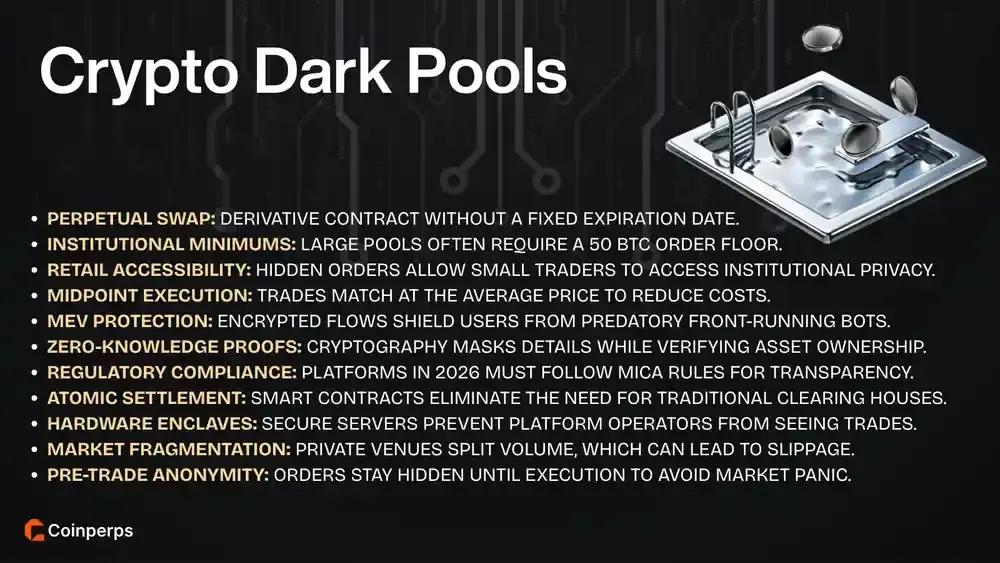
- Hidden Submission: Institutional traders submit encrypted order parameters to the matching engine to prevent public disclosure of their current market intent.
- Cryptographic Verification: Zero-knowledge proofs confirm the participant owns the necessary $50 million in assets without revealing their entire on-chain wallet history.
- Multiparty Computation: This protocol splits order processing among several independent nodes so that no single entity can view the trade details.
- Midpoint Matching: Dark pools execute trades at the midpoint of the public bid-ask spread to ensure fair pricing for all involved participants.
- Atomic Settlement: Smart contracts facilitate a simultaneous exchange of assets between blockchains, ensuring the swap fails unless both parties fulfill obligations.
- Order Fragmentation: High-volume blocks are divided into smaller pieces across multiple liquidity sources to mask the total size of the position.
- Post-Trade Reporting: Details of the executed transaction are broadcast to the ledger only after the trade completes, maintaining pre-trade privacy for whales.
- Homomorphic Encryption: Platforms process trades directly on encrypted data, allowing for complex matching logic without ever decrypting the sensitive inputs.
Which Crypto Exchanges Support Dark Pools?
Dark pools in crypto operate across specialized institutional exchanges and decentralized protocols to offer discreet execution for trades exceeding $1 million in value.
The following table lists a few platforms that support crypto dark pools in 2026:
Platform | Market type | Operating model | Target audience |
|---|---|---|---|
Trustless CEX | Encrypted matching through secure hardware enclaves to protect trade intent. | Institutional | |
Aggregator | Smart routing that scans multiple private and public liquidity sources simultaneously. | Professional | |
Regulated | Dedicated dark book matching for large Bitcoin and Ethereum institutional orders. | High-Volume | |
Prime Broker | Unified access to global OTC liquidity and private institutional matching engines. | Institutional | |
Institutional | Cross-platform liquidity aggregation providing deep books with minimal price impact. | Professional |
 Enclave Markets
 sFOX
sFOX Kraken MTF
 FalconX
 WOO X
WOO XDark Pool Fees
Dark pools replace standard maker-taker fee schedules with streamlined commission models designed for institutional users. Platforms like Kraken historically applied a 0.10% premium atop basic taker rates for private execution. This transparency allows traders to forecast costs before submitting block trades.
Prime brokers like sFOX provide dark pool access at no additional cost beyond their standard brokerage fees. By aggregating private liquidity, these venues offer execution for $10 million orders without the high slippage costs found on transparent and public exchanges.
The primary financial benefit is midpoint matching, which captures the average of the bid-ask spread. For a $50 million Bitcoin position, this mechanism can save traders $250,000 in spread costs alone without slippage. These savings outweigh official platform commissions.
Pros & Cons of Dark Pools
Dark pools provide institutional participants with specialized environments to execute massive trades. These venues balance privacy and price protection against risks of fragmentation and oversight.
Example Crypto Trade Using Dark Pools
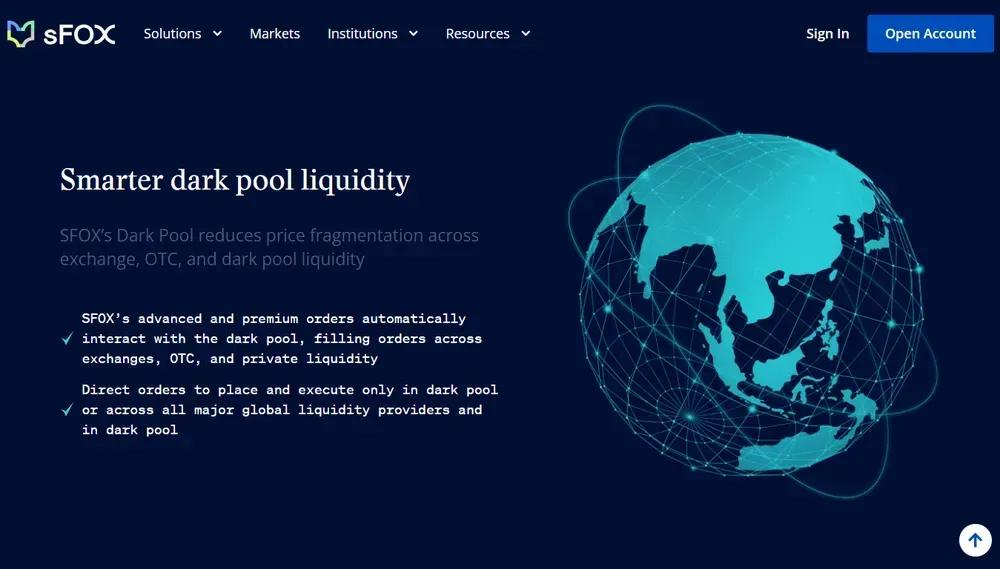
sFOX provides a strong environment for executing high-volume private trades. In 2026, its dark pool service is one of the leading solutions for institutions and professional traders who want to move large positions without exposing their intentions to the public market.
Step 1: Account Verification and Requirements
Before you can use the sFOX dark pool, you must complete institutional or professional onboarding and verification. These checks ensure that only qualified participants can access deeply hidden liquidity.
Requirements typically include:
- Institutional or pro account verification with full identity documentation.
- Completion of KYC and AML checks as required by regulators.
- Connectivity setup such as API access or FIX protocol integration.
- Eligibility for dark pool trading based on account size and use case.
Completing this setup ensures your account is ready to handle large, private execution workflows and integrated liquidity routing.
Step 2: Navigating to the Dark Trading Environment
After your account is approved, you will access the sFOX trading platform where dark pool functionality is available alongside advanced order types. Instead of entering orders on a public order book, you will use an option that directs orders into a hidden execution layer that other market participants cannot see.
Key features in this interface include:
- Hidden liquidity routing options for dark execution or mixed routing.
- Advanced execution algorithms for professional order strategies.
- API access for automated executions and connection with prime brokers.
- Performance analytics tools for execution quality tracking.
This trading environment gives you a dedicated space to specify how and where your order should be executed without public visibility.
Step 3: Executing the Private Order
Once your trade parameters are set, including asset type, size, and execution preferences, sFOX’s dark pool will attempt to match your order privately. Orders submitted this way are not visible on major exchange order books until after execution or final settlement.
Execution options include:
- Dark pool only routing to keep the entire order confidential.
- Smart routing that checks dark pool, OTC and public liquidity for best execution.
- Zero slippage setting to protect price and minimize market impact.
- Price protection controls to set limits or midpoint execution preferences.
When your order is matched with another counterparty, the transaction completes without public exposure of your intent. This gives you the privacy needed to manage very large trades without moving the market.
Step 4: Settlement and Reporting
After execution, settlement procedures ensure asset transfer and compliance reporting are completed. Although the trade was private before execution, necessary trade details are shared after the fact with regulators or authorized reporting systems as required by law.
This practice keeps your strategy private during execution while still meeting audit and regulatory standards.
Dark Pools vs. Hidden Orders
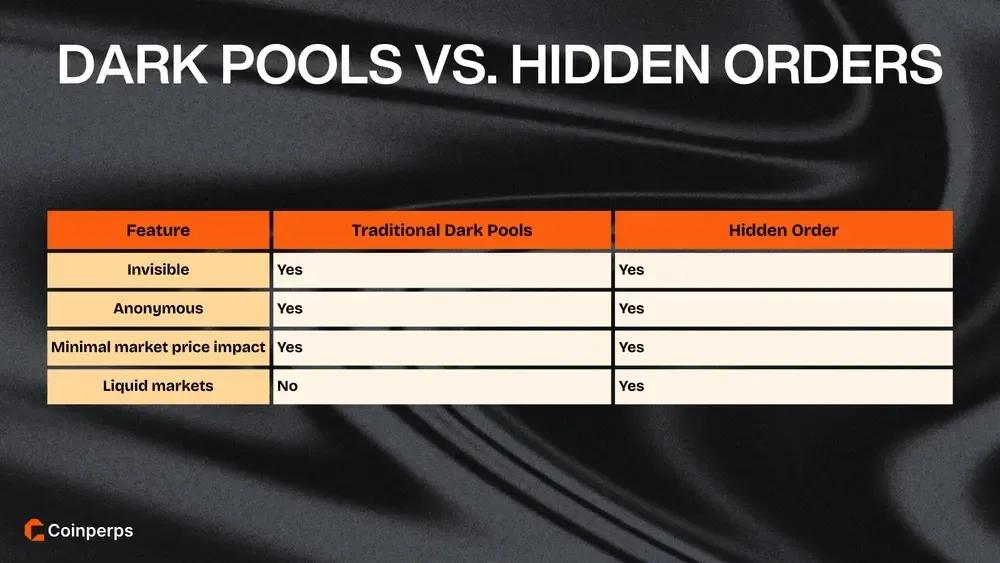
For users who would love the same privacy and protection as whales but do not manage $10 million+ in capital, hidden orders provide a much more accessible alternative. While traditional dark pools like Kraken are exclusive places often requiring a minimum order of 50 BTC, hidden orders allow anyone to trade with total discretion regardless of their account size.
Aster removes these steep barriers by allowing you to toggle the hidden order setting on any trade. This ensures your limit order stays completely off the public books, which prevents bots from seeing your entry price or size. It offers the same core benefit of a dark pool, stealth execution, but integrates it directly into the public market's deep liquidity for faster fills.
The difference comes down to gatekeeping versus professional tools. Dark pools are restricted silos for institutional block trades, whereas Aster’s hidden orders democratize that same privacy for every participant. You get the professional advantage of zero pre-trade exposure without needing the massive bankroll of an institutional fund.
Are Dark Pools Safe For Crypto Trading?
Safety in crypto dark pools depends on the platform regulatory status and technical architecture. In 2026, many venues operate as registered entities under MiCA or ATS frameworks, offering institutional traders a layer of legal and operational security.
Technological safeguards like secure hardware enclaves and multiparty computation protect trade data from leaks. These tools ensure that even the platform operator cannot view order details, which prevents internal front-running and maintains high levels of transaction integrity.
Risks of Dark Pools
While these venues offer privacy, they also introduce unique challenges that differ from the transparent environment of standard lit crypto exchanges today.
- Transparency Gaps: Limited pre-trade data makes it difficult to verify if execution occurred at the best possible price on public markets.
- Counterparty Risks: Users rely on the platform operator to facilitate settlements, creating a central point of failure for institutional asset custody.
- Information Asymmetry: Large players with access to various private pools may exploit data gaps to trade against less informed market participants.
- Regulatory Uncertainty: Changing global frameworks in 2026 could lead to sudden platform closures or restricted access for certain regional jurisdictions.
- Conflict of Interest: Operators might prioritize their own proprietary trading desks over client orders, leading to unfair execution within private systems.
- Liquidity Fragmentation: Dividing volume across multiple dark venues can result in incomplete fills for massive positions.
Bottom Line
Dark pools provide essential privacy for institutions managing large positions, ensuring that massive trades do not trigger immediate and volatile price swings.
Aster Pro democratizes this level of discretion for everyone by offering hidden orders that provide professional stealth execution without requiring a massive bankroll.
Choosing between these options depends on your total capital and the need for either exclusive private books or integrated public market liquidity.
FAQs
Are dark pool trades reported to tax authorities in 2026?
Yes, under the new Cryptoasset Reporting Framework, exchanges must report transaction data to global tax authorities starting in 2026. While your order stays hidden from the public during execution, the final settlement is recorded for annual tax compliance.
What is a pinging attack within a crypto dark pool?
A pinging attack occurs when high-frequency bots send tiny orders to detect large hidden positions. If an order executes, the bot confirms a whale is present and can front-run the remaining volume on public exchanges to profit.
How do dark pools affect price discovery for retail traders?
Since dark pools hide massive trades from the public order book, the visible price on standard exchanges might not reflect true market demand. This delay can lead to sudden price shifts once these large private transactions finally settle on-chain.
Can a dark pool prevent a market-wide flash crash?
Dark pools help prevent flash crashes by allowing whales to exit large positions without triggering a domino effect of liquidations. By keeping these massive sell orders off the public books, they maintain stability and prevent retail panic selling.


