Perp DEX vs CEXs Compared: What Traders Should Know
Read about perpetuals in crypto and learn how decentralized and centralized exchanges stack up in execution quality, fees, safety & regional regulations.

Coinperps may earn a commission from partner links, at no cost to you; rankings follow our methodology. Not financial advice.
Key takeaways
- Perpetuals trading in crypto allows users to speculate on price movements with leverage using contracts that never expire or require scheduled settlement.
- The two main ways to trade perpetuals are centralized exchanges with custodial accounts and decentralized platforms where users interact directly from personal wallets.
- Their similarities include leverage, funding payments, and liquidation mechanics, while differences involve custody, regulation, trading tools, asset availability, and overall services.
On this page 10 sections
- Perp DEX vs CEXs in Crypto Overview
- What are Perpetual Centralized Exchanges (Perp CEXs)?
- What are Perpetual Decentralized Exchanges (Perp DEXs)?
- Trading Features and Tools in Perp DEXs vs CEXs
- Perp DEX vs CEXs Statistics in 2025
- What Are The Fees in Crypto Perpetual Exchanges?
- How Are Perp DEX and CEXs Regulated?
- Risks of Trading Crypto Perpetuals
- Bottom Line
- FAQs
Some traders in 2025 moved parts of their futures activity to Hyperliquid after seeing million-dollar positions executed smoothly on-chain. You may be exploring whether similar performance advantages apply to your own leveraged strategies and trading habits.
Others have improved risk management by combining CEX liquidity with DEX transparency during volatile periods or regulatory shifts. You might be deciding where your positions gain the best balance of safety, execution quality, and platform flexibility.
Continue reading to understand which approach fits your trading goals. ⬇️
Perp DEX vs CEXs in Crypto Overview
Perpetual futures can be traded on two types of platforms, and the key difference is how each one handles user funds. A decentralized exchange for perpetual futures, also called a perp DEX, uses blockchain smart contracts so traders keep control of their own wallet.
A centralized exchange, also called a CEX, is a company that holds user funds and processes all trades on its own servers, similar to an online brokerage. These different designs affect transparency, speed, identity rules, and overall risk, which is why traders often compare both before choosing where to trade.
The table below summarizes the main differences:
Feature | Perp DEXs | Perp CEXs |
|---|---|---|
Fund Control | User keeps wallet control | Exchange holds funds |
Trade Processing | Done on blockchain | Done on company servers |
Data Visibility | Public on chain records | Private internal records |
Identity Rules | No identity verification needed | Identity (KYC) checks required |
Speed | Sub second execution | Millisecond execution |
Liquidity | Incentive driven depth | Deep unified liquidity |
Regulation | Limited direct oversight | Licensed and supervised |
Market Variety | Mostly perpetual futures | Spot, futures, options |
Main Risks | Smart contract failures | Custodial loss events |
What are Perpetual Centralized Exchanges (Perp CEXs)?
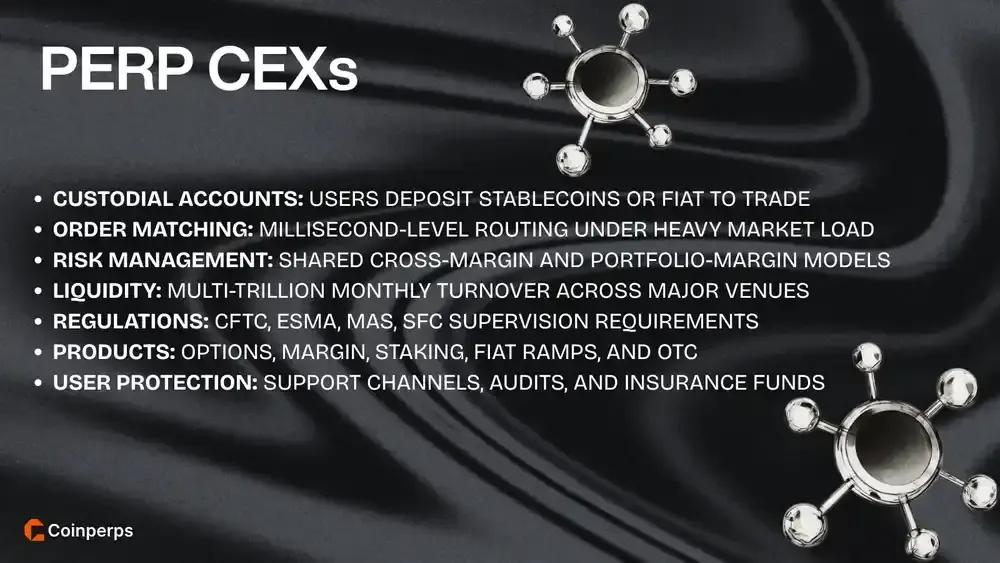
Perpetual centralized exchanges are company-operated trading platforms that offer perpetual futures through custodial user accounts. These platforms manage all trade processing, risk controls, and margin systems internally, giving traders fast execution and deep liquidity.
Below are the main characteristics of perpetual centralized exchanges:
- Custodial account structure: Users deposit funds into exchange-controlled wallets, enabling unified margin systems across spot, futures, and options markets.
- High-speed matching engines: Orders are processed on dedicated servers with millisecond latency, supporting large trade sizes without noticeable slippage.
- Regulated trading environment: Most leading platforms require identity verification and comply with regional rules that govern derivatives and leverage.
- Deep and consistent liquidity: Centralized books pool market makers, institutions, and retail flow in one venue, producing strong depth during volatile periods.
- Unified risk engine: Exchanges monitor leverage, liquidations, and insurance funds centrally, reducing fragmentation and improving system-wide stability.
- Wide product selection: Beyond perpetual futures, users typically access spot markets, margin trading, options, structured products, and staking.
- Integrated fiat access: Bank transfers and card payments allow straightforward deposits and withdrawals, making entry to trading significantly easier for beginners.
Examples: Major perpetual centralized exchanges in 2025 include Bybit, OKX, Binance, Bitget, and Gate, all handling multi-trillion monthly derivatives volumes. These platforms dominate institutional flow and remain the largest venues for high-leverage Bitcoin and Ethereum futures trading.
What are Perpetual Decentralized Exchanges (Perp DEXs)?
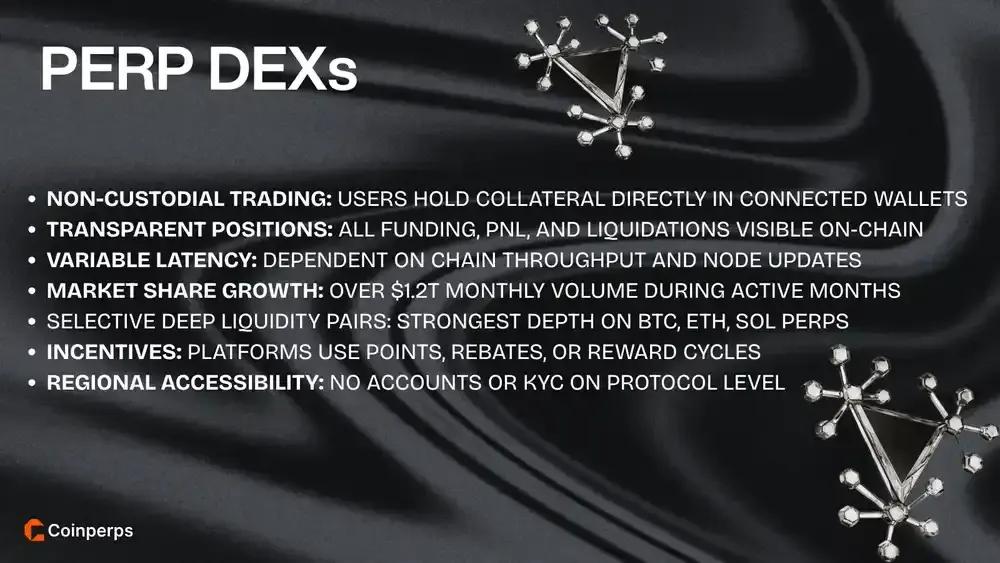
Perpetual decentralized exchanges are on-chain trading platforms that let users trade perpetual futures directly from their own wallet. These exchanges run through smart contracts instead of company servers, removing custodial control and account-based trading.
Below are the main characteristics of perpetual decentralized exchanges:
- Self-custody trading model: Users keep full control of funds in their wallet and interact with smart contracts for margin and settlement.
- On chain transparency: Positions, funding rates, fees, and liquidations are visible on public blockchains, allowing independent verification of system health.
- Blockchain execution: Trades settle on high-speed chains like Solana, Arbitrum, and Hyperliquid L1, giving sub-second confirmations without relying on centralized servers.
- Permissionless global access: No account creation or identity checks are required, allowing anyone with a crypto wallet to trade instantly.
- Distributed risk handling: Liquidations, collateral updates, and price feeds are managed by code and oracles rather than a single centralized risk engine.
- Incentive-driven liquidity: Market depth often grows through reward programs, points systems for future airdrops, and competitive funding mechanisms that attract active traders.
- Specialized product focus: Most platforms concentrate on perpetual futures rather than offering broad financial services like fiat support or options.
Examples: Leading perpetual DEXs in 2025 include Hyperliquid, Aster, Lighter, edgeX, and ApeX, each contributing to more than one trillion dollars in combined monthly on-chain derivatives volume. These platforms now rival mid-tier centralized exchanges in speed, depth, and open interest.
Trading Features and Tools in Perp DEXs vs CEXs
Centralized exchanges provide a full set of trading controls that manage entries, exits, and risk inside a single interface. Their platforms offer market orders, limit orders, stop losses, take profit levels, and multi-condition bracket structures commonly used by active traders.
Perpetual decentralized exchanges provide the same essential tools, but execution quality depends heavily on the platform and asset. Hyperliquid and Aster produce steady fills on liquid pairs such as BTC and ETH, while smaller markets on EdgeX or Jupiter can show wider spreads during elevated volatility.
These differences are most visible when stop losses and take profit triggers interact with rapid price movements during high-volume periods. Traders evaluate venue suitability by comparing fill accuracy, slippage ranges, trigger timing, and the stability of each platform’s liquidation behavior.
How Trading Tools Differ on Perp DEXs and Perp CEXs
Centralized exchanges such as Binance, Bybit, and OKX use unified price feeds that support highly accurate conditional order triggers. Their cross-margin and isolated margin systems recalculate exposure instantly, which maintains reliable protection during periods of heavy derivatives activity.
Perpetual decentralized exchanges handle conditional orders reliably on liquid pairs, especially on Hyperliquid and Lighter, where execution queues are optimized. Some platforms, such as Aster, also offer hidden orders, giving traders invisible liquidity that reduces front running and improves fill quality.
Perp DEX vs CEXs Statistics in 2025
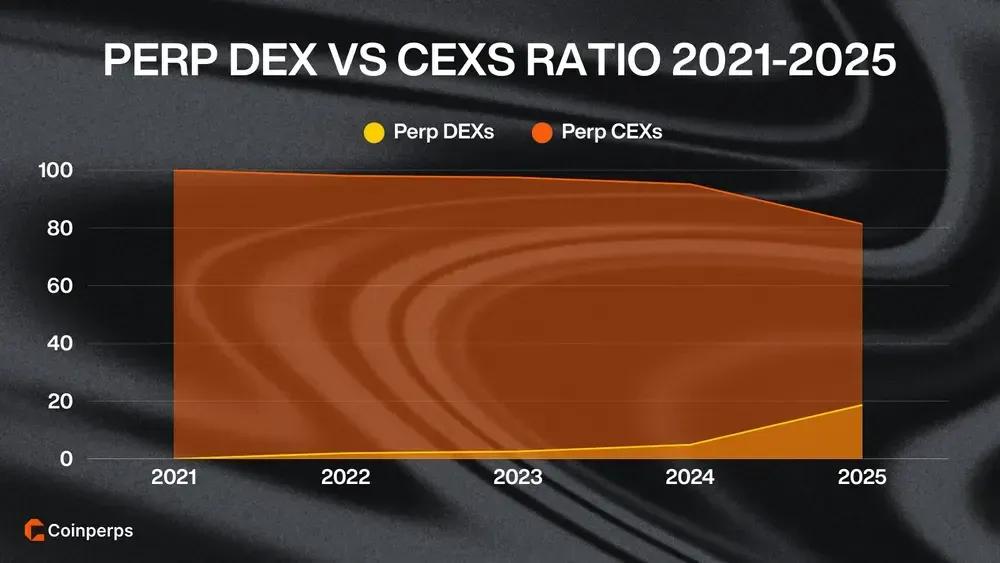
Perpetual trading activity in 2025 shows a clear redistribution of volume as decentralized platforms capture a measurable share from established centralized platforms.
Below are the most important statistics from 2025:
- DEX spot volumes: Decentralized spot exchanges reached approximately $568.4 billion in October 2025, setting an all-time high across every decentralized venue.
- CEX spot volumes: Centralized exchanges processed around $2.70 trillion in October, with Binance alone contributing over $810 billion in activity.
- Perp DEX monthly volume: On-chain perpetual platforms generated between $1.3 trillion and $1.4 trillion in October, nearly doubling their September totals.
- CEX derivatives dominance: Centralized derivatives markets recorded more than $7 trillion in monthly activity, maintaining the strongest liquidity concentration globally.
- Perp DEX market share: Decentralized perpetual futures reached roughly 20% of centralized derivatives volume, rising sharply from 6% in early January.
- DEX to CEX spot ratio: Decentralized spot activity represented 19%-24% of centralized exchanges, depending on the specific month and market conditions.
- Leading DEX performers: Aster, Hyperliquid, and Lighter frequently posted daily perpetual volumes exceeding $10 billion, with several spikes significantly higher.
- Open interest distribution: Hyperliquid maintained more than $6 billion in open interest, holding a clear lead ahead of Aster, Lighter, and edgeX.
What Are The Fees in Crypto Perpetual Exchanges?
Perpetual exchanges charge maker and taker fees on every position, with maker costs usually between 0.00% and 0.03% and taker costs between 0.01% and 0.05%, creating meaningful differences in overall trading efficiency for active or high-leverage participants to manage risk.
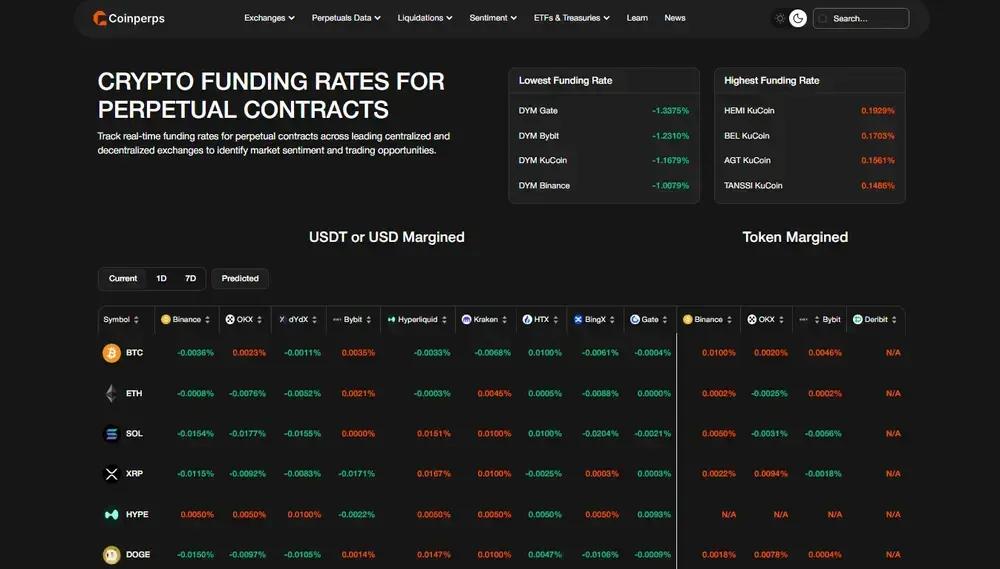
Funding rates shift value between long and short traders to keep perpetual prices aligned with underlying spot markets. Funding typically ranges between 0.01% and 0.05%, but rates can exceed 0.10% during heightened volatility or when market positioning becomes imbalanced during spikes.
Additional costs differ by platform type and can influence trade outcomes when conditions shift quickly. CEX users may pay withdrawal, conversion, and settlement fees, while DEX users encounter gas costs, liquidation penalties, slippage when liquidity drops during heavy congestion periods.
How Are Perp DEX and CEXs Regulated?
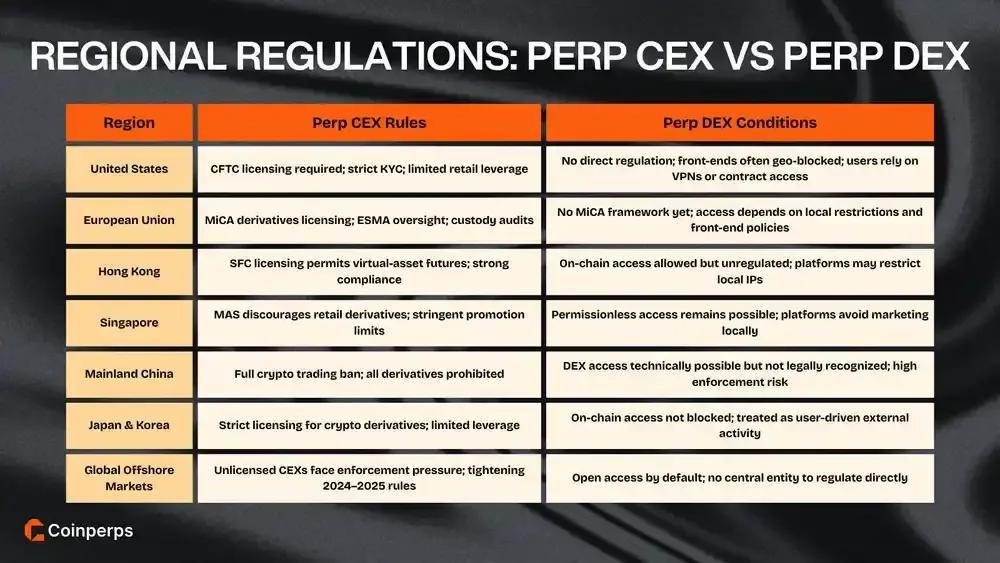
Regulation for perpetual futures depends on whether a platform is operated by a company or deployed as autonomous blockchain software. This difference determines how jurisdictions apply licensing, identity checks, reporting rules, and leverage restrictions.
CEXs follow oversight from agencies like the CFTC in the United States, ESMA under MiCA in the European Union, and HKMA or the Hong Kong SFC in Asia. These regulators impose KYC verification, derivatives registration, custodial audits, leverage caps, and stricter user-protection standards.
The United States and European Union allow perpetual futures only through licensed venues, which limits retail access to compliant platforms. Many users historically turned to offshore exchanges for higher leverage, though 2024-2025 rules increased penalties against unregistered derivatives access.
Asia shows mixed treatment, because Hong Kong permits licensed virtual-asset futures while Singapore restricts retail derivatives promotion. Mainland China bans crypto trading entirely, which pushes interested traders toward offshore platforms or permissionless perp DEXs.
Risks of Trading Crypto Perpetuals
Whether you trade on a centralized exchange or a decentralized perpetual platform, these instruments carry structural risks that can quickly amplify losses.
Key risks traders should evaluate before opening any position:
- High leverage exposure: Using leverage multiplies both profits and losses, allowing small price moves to trigger rapid liquidation events during volatile market swings.
- Liquidation and margin risk: Positions are closed automatically (liquidated) when collateral falls below required maintenance levels, often causing irreversible losses during sudden market drops.
- Funding rate costs: Perpetual contracts charge periodic funding payments, which can accumulate significantly when open interest becomes unbalanced between long and short traders.
- Exchange reliability risk: Centralized platforms can suffer outages or overloaded engines, leaving traders unable to adjust positions during critical price movements.
- Smart contract exposure: Decentralized platforms rely on code that may contain vulnerabilities, causing potential user losses through bugs, oracle errors, or economic exploits.
- Slippage and liquidity gaps: Large orders can move prices when market depth is thin, especially on smaller pairs where liquidity providers adjust quotes slowly.
- Regulatory uncertainty: Jurisdictional restrictions can change unexpectedly, limiting platform access or forcing traders to close futures positions under new compliance rules.
Bottom Line
Perpetual futures are the most actively used trading product in crypto, sustaining strong demand across the last five years across multiple market cycles and fluctuating liquidity conditions.
Their presence on decentralized exchanges expanded significantly during the last year, supported by platforms like Hyperliquid, Aster, Lighter, and other high-throughput venues.
New entrants in on-chain derivatives target the leading position in decentralized trading while also challenging the long-established dominance held by major centralized exchanges.
FAQs
What collateral is typically used for perpetual futures?
Most perpetual platforms use stablecoins like USDT or USDC as the main collateral asset because they simplify margin calculations. Some exchanges also allow BTC, ETH, or platform tokens, but stablecoin collateral remains the safest and most predictable option for managing leverage.
How do funding payments work during extreme volatility?
Funding rates can spike sharply when one side of the market becomes crowded, especially during aggressive long-only or short-only periods. Traders holding positions through these moments may pay unusually high hourly funding, which can significantly reduce net returns even without liquidation.
Can traders hedge spot holdings with perpetual futures?
Yes, perpetual contracts are commonly used for hedging, especially by long-term holders wanting temporary downside protection. A simple method is opening a short perp position equal to the value of held spot assets, offsetting near-term price risk without selling the underlying tokens.
What happens to a perps trade if an exchange lists the asset late or never lists it?
Perpetual futures rely on price indexes sourced from multiple venues, so an asset does not need a CEX listing to support a perp market. Many on-chain platforms launch perpetuals before major listings, but traders should verify index sources to avoid relying on illiquid or low-quality price feeds.


