What Is the Clarity Act? The US Crypto Bill Explained
The Clarity Act is the US crypto market structure bill that would hand spot trading in digital commodities to the CFTC and leave token fundraising with the SEC. It passed the House, fell 11 votes short in the Senate and expires in January, while regulators write parts of it as rules.

Не является финансовой рекомендацией.
Основные выводы
- The Clarity Act is a US crypto market structure bill that is not law: it passed the House 294 to 134 on 17 July 2025, failed a Senate vote 49 to 50 on 15 September 2026 and expires on 3 January 2027.
- It would split crypto between two regulators: the CFTC would supervise spot trading in digital commodities such as Bitcoin, while the SEC would keep token fundraising, capped at $50 million a year under a lighter disclosure regime.
- Perpetual futures are not in the bill: the CFTC approved the first true US perpetual on 29 May 2026 under existing law, with leverage of about 6x on Kalshi against 100x or more offshore.
- Regulators have delivered parts of it anyway: the SEC and CFTC named 16 tokens as examples of digital commodities in March 2026, but agency rules can be reversed, and a new bill must restart in a Democratic Congress in 2027.
На этой странице 10 разделов
- What Is the Clarity Act?
- How the Clarity Act Splits Crypto Between the SEC and the CFTC
- What the Clarity Act Would Change for Exchanges and Traders
- Clarity Act Rules for DeFi and Stablecoin Rewards
- Does the Clarity Act Cover Perpetual Futures?
- Clarity Act Timeline and Why It Stalled in the Senate
- What Regulators Have Done Without the Clarity Act
- How Markets Reacted and What Happens Next
- Итог
- Часто задаваемые вопросы
The Clarity Act is a United States bill that would decide which crypto tokens the SEC regulates and which fall to the CFTC. It would also create the first federal licence for spot crypto exchanges. It is not law.
In July 2025 the House passed it, but a Senate vote on 15 September 2026 left it 11 short of the 60 it needed. The bill expires when the current Congress ends on 3 January 2027, and regulators have begun writing parts of it as agency rules.
This guide explains what the bill says, why it stalled and what changes for traders anyway. We read the House and Senate bill texts and checked each date against congressional and regulator records on 24 November 2026.
What Is the Clarity Act?
The Clarity Act is the short name for the Digital Asset Market Clarity Act of 2025, numbered H.R. 3633. A market structure bill sets out who supervises crypto trading and under what rules. Congress styles the name in capitals as the CLARITY Act.
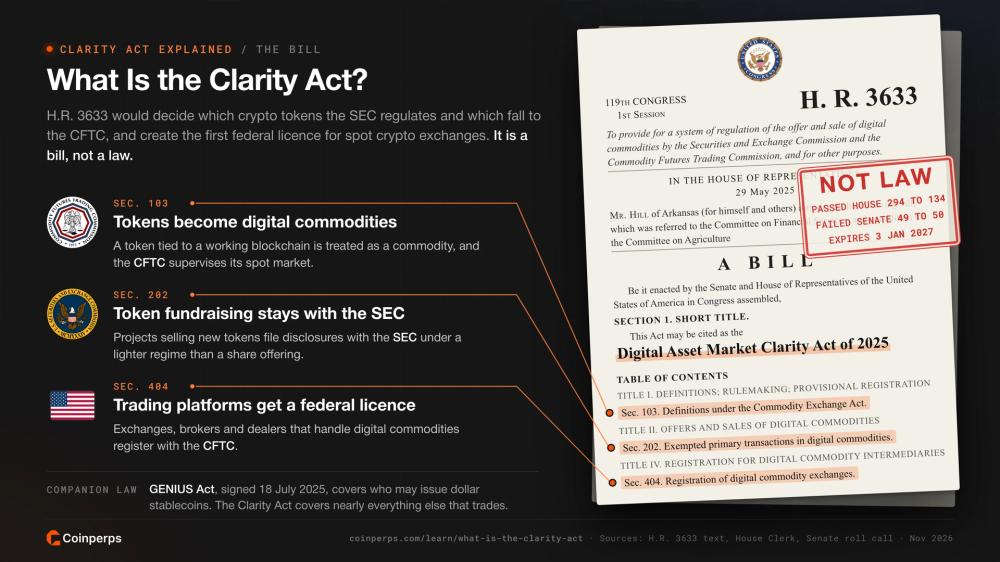
Representative French Hill of Arkansas, who chairs the House Financial Services Committee, introduced the bill on 29 May 2025. It builds on FIT21, a similar bill that passed the House in May 2024 and never received a Senate vote.
US law never said whether a crypto token is a security, like a share, or a commodity, like gold. The Securities and Exchange Commission (SEC) and the Commodity Futures Trading Commission (CFTC) each claimed parts of the market. Where the line sat, exchanges mostly learned through lawsuits.
Its answer runs as follows.
- Tokens become digital commodities: a token tied to a working blockchain is treated as a commodity, and the CFTC supervises its spot market.
- Fundraising stays with the SEC: a project selling new tokens to raise money files disclosures with the SEC under a lighter regime than a share offering.
- Trading platforms get a federal licence: exchanges, brokers and dealers that handle digital commodities register with the CFTC.
It is a companion to the GENIUS Act, the stablecoin law signed on 18 July 2025. GENIUS covers who may issue dollar stablecoins. The Clarity Act covers nearly everything else that trades.
How the Clarity Act Splits Crypto Between the SEC and the CFTC
Under the bill, the token you trade and the deal that first sold it are treated separately. The fundraising can be a securities offering that the SEC polices. Once the token changes hands between ordinary users, it is a commodity and the CFTC takes over.
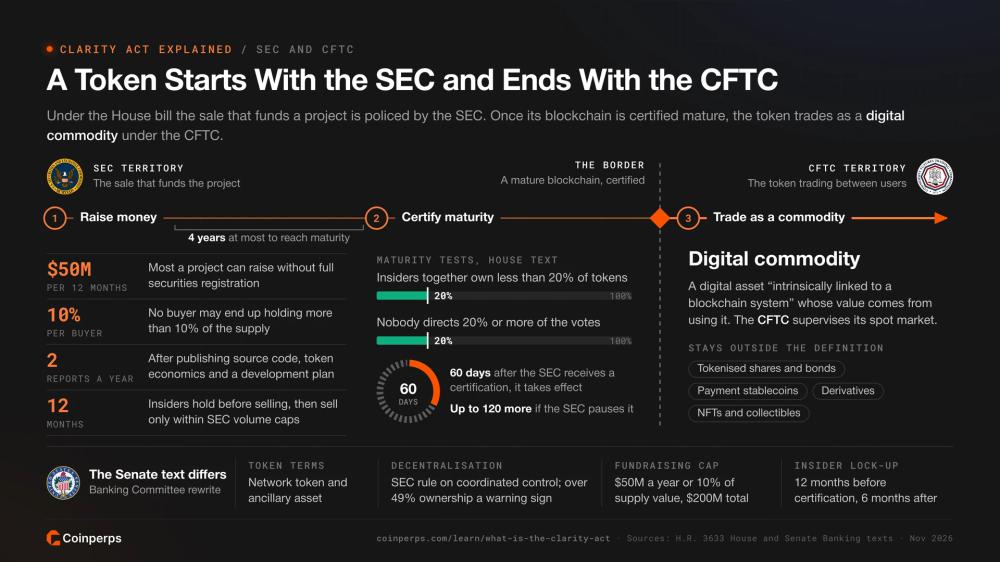
A digital commodity, in the House text, is a digital asset "intrinsically linked to a blockchain system" whose value comes from the use of that system. Tokenised shares and bonds stay securities. Payment stablecoins, derivatives and collectibles such as NFTs are carved out too.
Decentralisation decides when the SEC's role ends. The House version calls this a mature blockchain system, meaning one that no person or group controls. Among other tests, insiders together must own less than 20% of the tokens and nobody may direct 20% or more of the voting power.
Maturity is certified to the SEC by the project itself. Unless the agency pauses it, the certification takes effect after 60 days, and a pause can last up to 120 more days. Projects that raise money under the bill must plan to reach maturity within four years.
That fundraising exemption lets a project sell up to $50 million of tokens in any 12 months without full securities registration. Many summaries still quote $75 million, the figure in earlier drafts. No buyer may end up with more than 10% of the supply, and the issuer must publish its source code, token economics and development plan, then report twice a year.
Before a blockchain is certified mature, founders and large early holders must hold their tokens for at least 12 months and can sell only within volume caps set by the SEC.
The Senate's Banking Committee text drops the mature blockchain test in favour of two new terms, network token and ancillary asset. Decentralisation is left to an SEC rule on coordinated control, and ownership above 49% is one warning sign.
**Issue** | **House bill** | **Senate banking text** |
|---|---|---|
Token label | Digital commodity | Network token; ancillary asset |
Decentralisation test | Mature blockchain; 20% thresholds | Coordinated control; SEC rule |
Fundraising cap | $50 million per 12 months | $50 million a year or 10% of supply value; $200 million total |
Insider lock-up | 12 months before maturity | 12 months before; 6 months after |
DeFi front ends | Excluded by statute | Left to SEC rulemaking |
Stablecoin rewards | Not addressed | Holding-based yield banned |
What the Clarity Act Would Change for Exchanges and Traders
For anyone trading on a US platform, the bill would replace a patchwork of state licences with one federal rulebook. A spot exchange would register with the CFTC as a digital commodity exchange, and the agency would have exclusive jurisdiction over its registered activity. US platforms such as Kraken and Coinbase run their spot exchanges today mainly under state money transmitter licences.
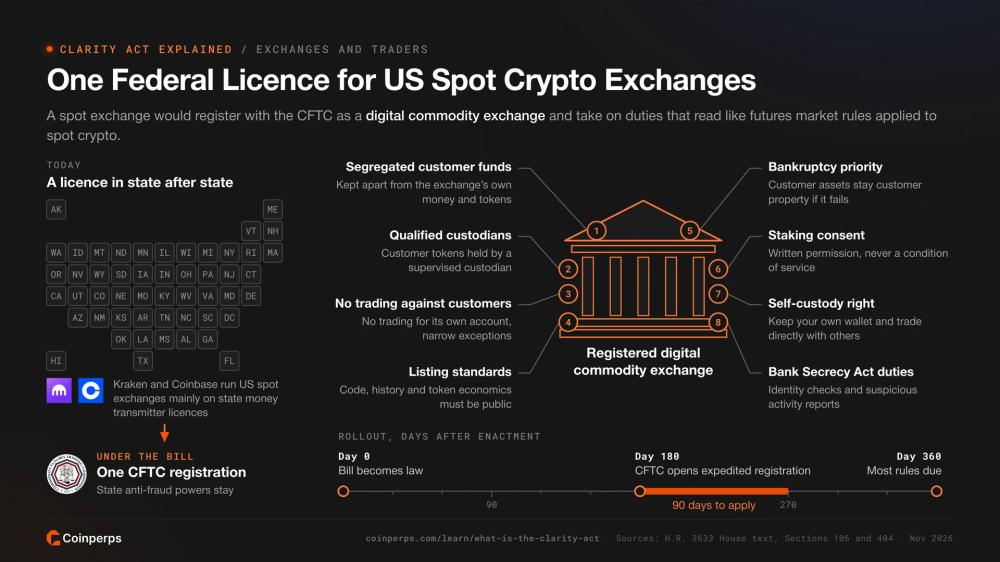
The duties that come with registration read like futures market rules applied to spot crypto.
- Segregated customer funds: customer money and tokens must be accounted for separately and never mixed with the exchange's own assets.
- Qualified custodians: customer tokens must sit with a custodian supervised by a state or federal banking regulator, the SEC, the CFTC or a comparable foreign authority.
- No trading against customers: an exchange and its affiliates may not trade on their own venue for their own account, with narrow exceptions.
- Listing standards: a token can be listed only if its source code, transaction history and token economics are public and accurate.
- Bankruptcy priority: customer assets count as customer property if the exchange fails, the same protection futures customers have.
- Staking consent: an exchange may stake customer coins only with written permission and cannot make it a condition of service.
Self-custody is protected. Under the House bill a US individual keeps the right to hold digital assets in a hardware or software wallet and to transact directly with other people. Registered firms also become financial institutions under the Bank Secrecy Act, which brings identity checks and suspicious activity reports.
None of this would have arrived overnight. The CFTC had 180 days to open an expedited registration process, and platforms then had 90 days to apply. Provisionally registered firms could keep operating while the agency wrote the full rules, most of which were due within 360 days of enactment.
State regulators lose ground, because digital commodities are treated as covered securities. That label removes state registration requirements while leaving state anti-fraud powers in place.
The North American Securities Administrators Association urged Congress to vote no on the House bill in July 2025. Our guide to the best crypto exchanges in the USA covers how platforms are licensed today.
Clarity Act Rules for DeFi and Stablecoin Rewards
Decentralised finance and stablecoin rewards were the hardest parts of the bill to agree, and both affect what you can do with coins outside a centralised exchange. The House and Senate texts differ sharply on each.
DeFi Developers and Front Ends
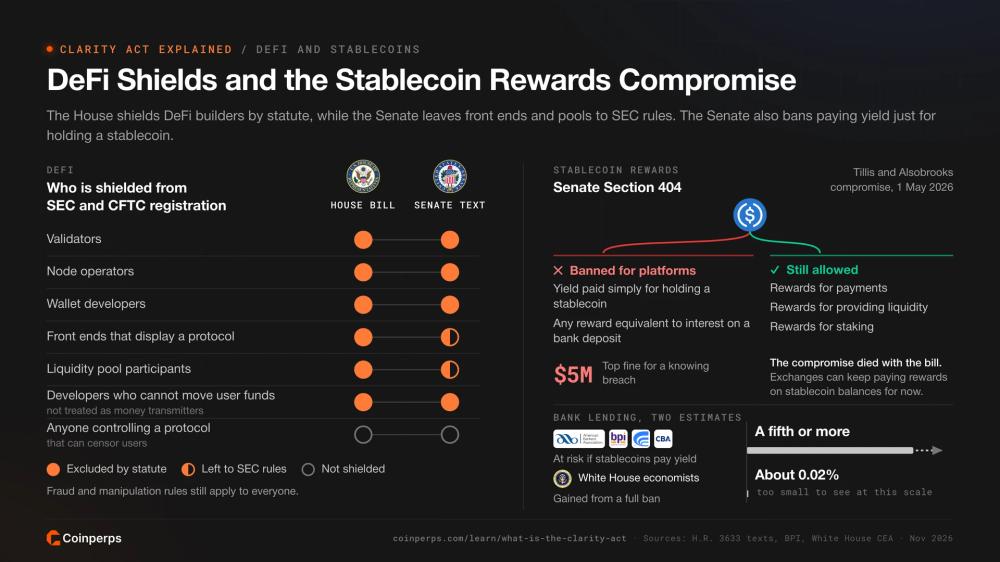
The House bill shields people who build or run decentralised infrastructure without holding user funds. Validators, node operators, wallet developers, liquidity pool participants and the websites that display a protocol are excluded from SEC and CFTC registration. Fraud and manipulation rules still apply to them.
A developer who cannot move users' assets is not a money transmitter, under a section known as the Blockchain Regulatory Certainty Act. Both chambers kept that language.
Everything else was narrowed in the Senate. Its Banking text protects validators and wallet developers outright but leaves front ends and liquidity pools to future SEC rules. It also brings in anyone who controls a protocol that can censor users or that does not run purely on code.
CFTC Chairman Michael Selig said on 19 November 2026 that onchain venues offering derivatives to US retail traders must register or partner with a registered exchange. Hyperliquid still blocks US users, as our guide to using Hyperliquid in the USA explains.
Stablecoin Rewards
The GENIUS Act bars stablecoin issuers from paying interest but says nothing about exchanges that pass rewards to customers. Banks wanted the Clarity Act to close that gap. The House bill is silent on it.
Senators Thom Tillis and Angela Alsobrooks reached a compromise on 1 May 2026 that became Section 404 of the Senate text. Platforms could not pay yield simply for holding a stablecoin, or in any form equivalent to interest on a bank deposit. Rewards tied to real activity such as payments, providing liquidity or staking stayed legal. A knowing breach carried a fine of up to $5 million.
Five bank trade groups said the text fell short and cited research suggesting yield-bearing stablecoins could cut consumer and small business lending by a fifth or more. A White House Council of Economic Advisers analysis in April 2026 found a full ban would raise bank lending by about 0.02%.
When the bill failed, the compromise went with it. Exchanges can keep paying rewards on stablecoin balances for now. The GENIUS ban on issuers is the only limit written into statute.
Does the Clarity Act Cover Perpetual Futures?
Perpetual futures traders gain nothing directly from the Clarity Act, because it is a spot market bill. We searched the House text, the Senate Banking text and the Senate Agriculture bill, and the word perpetual appears in none of them.
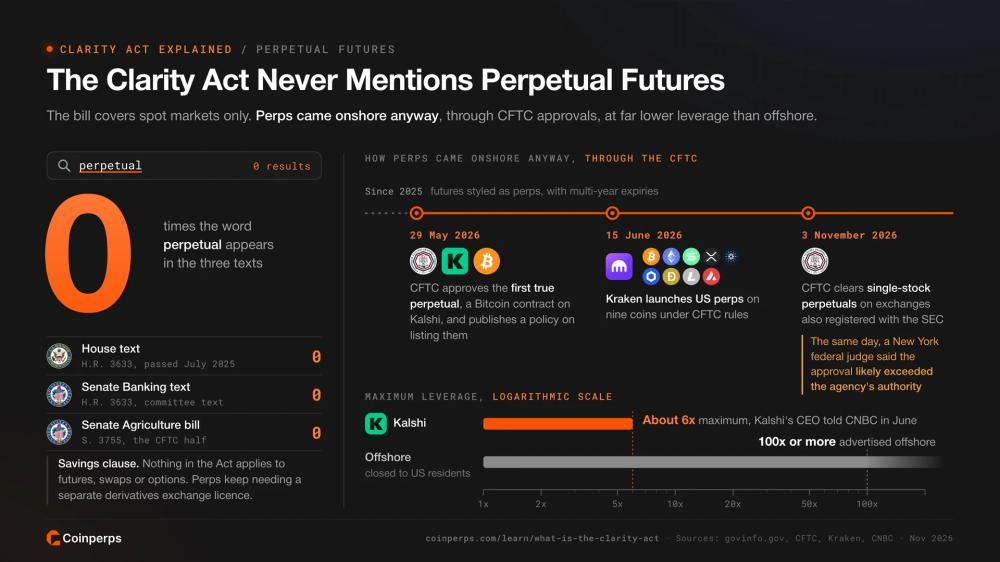
A savings clause says nothing in the Act applies to futures, swaps or options. Holding a digital commodity exchange licence gives no authority to offer them. Perpetual futures, or perps, are leveraged contracts that track a price and never expire. They stay under the existing Commodity Exchange Act and need a separate derivatives exchange licence.
The one overlap is leverage on spot trades, where a registered broker could offer margin financing as long as the purchased coins are delivered to the customer's account. The Senate Agriculture bill went further and ordered the CFTC to write leverage limits for spot crypto.
Onshore perps arrived through the CFTC instead. Futures styled as perpetuals with multi-year expiries had traded since 2025. On 29 May 2026 the agency approved the first true perpetual, a Bitcoin contract on Kalshi's exchange, and published a policy statement on listing perpetual contracts.
Kraken launched US perps on nine coins on 15 June. On 3 November the CFTC cleared single-stock perpetuals on exchanges that are also registered with the SEC. A New York federal judge said the same day that the approval likely exceeded the agency's authority.
By crypto standards the leverage is modest. Kalshi's chief executive told CNBC in June that its maximum was about 6x. Offshore venues advertise 100x or more. Our Kalshi perpetuals review covers the product, and the stock perps page tracks equity contracts.
For perp traders the bill still matters. Spot markets supply the index price that a perp follows and the collateral that backs it. A federally supervised spot market would make both more reliable. Country by country rules are in our guide to crypto perpetual futures regulation.
Clarity Act Timeline and Why It Stalled in the Senate
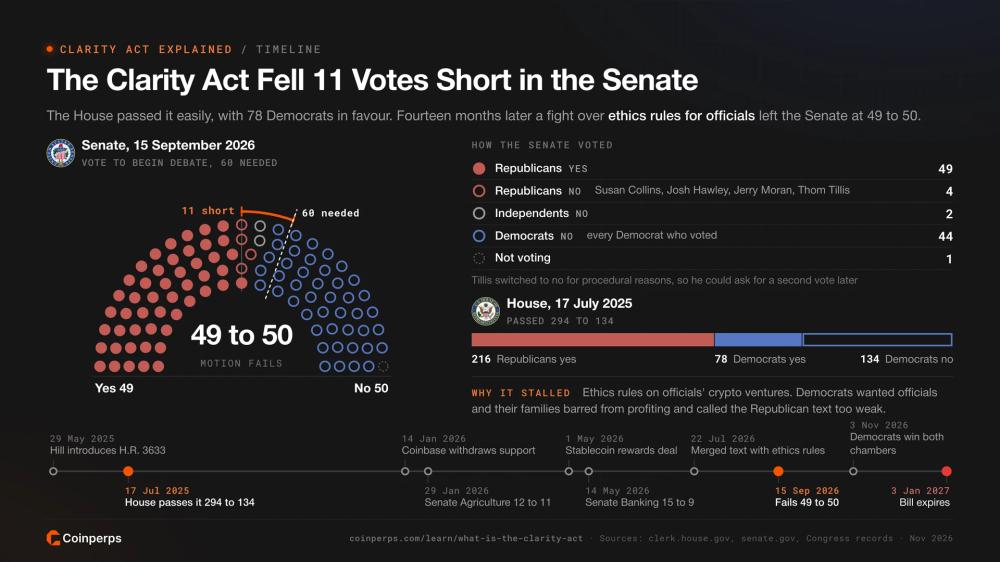
The Clarity Act cleared the House easily and then spent 14 months failing to find 60 votes in the Senate. Knowing where it broke down shows what any future bill must fix.
**Date** | **Event** |
|---|---|
29 May 2025 | French Hill introduces H.R. 3633 in the House |
17 July 2025 | House passes the bill 294 to 134; 78 Democrats vote yes |
14 January 2026 | Coinbase withdraws support; Senate Banking postpones its vote |
29 января 2026 года | Senate Agriculture advances its CFTC bill 12 to 11 |
1 May 2026 | Tillis and Alsobrooks agree the stablecoin rewards compromise |
14 мая 2026 года | Senate Banking advances its text 15 to 9 |
22 July 2026 | Republicans release a merged Senate text with ethics rules |
15 September 2026 | Senate motion to advance the bill fails 49 to 50 |
3 ноября 2026 года | Democrats win the House and the Senate in the midterms |
3 January 2027 | The 119th Congress ends and the bill expires |
On 17 July 2025 the House vote was 294 to 134. In the Senate, the Agriculture Committee wrote the CFTC half and the Banking Committee wrote the SEC half. Banking's vote slipped in January 2026 when Coinbase objected to how the draft treated tokenised shares, DeFi and stablecoin rewards.
Banking approved its text 15 to 9 in May with two Democrats, Ruben Gallego and Angela Alsobrooks, in favour. Both later opposed the bill on the floor.
The deal broke on ethics. With President Trump's family businesses in mind, Democrats wanted a ban on senior officials and their families profiting from crypto ventures while in office. The Republican text barred officials from issuing or sponsoring new tokens and left enforcement to the Justice Department, which Democrats called too weak.
On 15 September 2026 the Senate voted on whether to begin debate, a step that needs 60 votes. It failed 49 to 50. Every Democrat who voted was opposed, joined by Republicans Susan Collins, Josh Hawley and Jerry Moran. Thom Tillis switched to no so that he could ask for a second vote later.
Outside Congress the objections were different. In July 2025 Americans for Financial Reform and 81 allied groups wrote that the bill creates a weak structure that deregulates much of the sector.
Former CFTC chair Timothy Massad told the House that the decentralisation test would confuse more than it settled. Others doubted the CFTC's capacity, since it has fewer than 600 staff against more than 4,000 at the SEC.
What Regulators Have Done Without the Clarity Act
Much of what the bill promised is arriving through agency action, which means US traders already see some of the changes. Agency rules, however, can be reversed by a later administration or struck down in court.
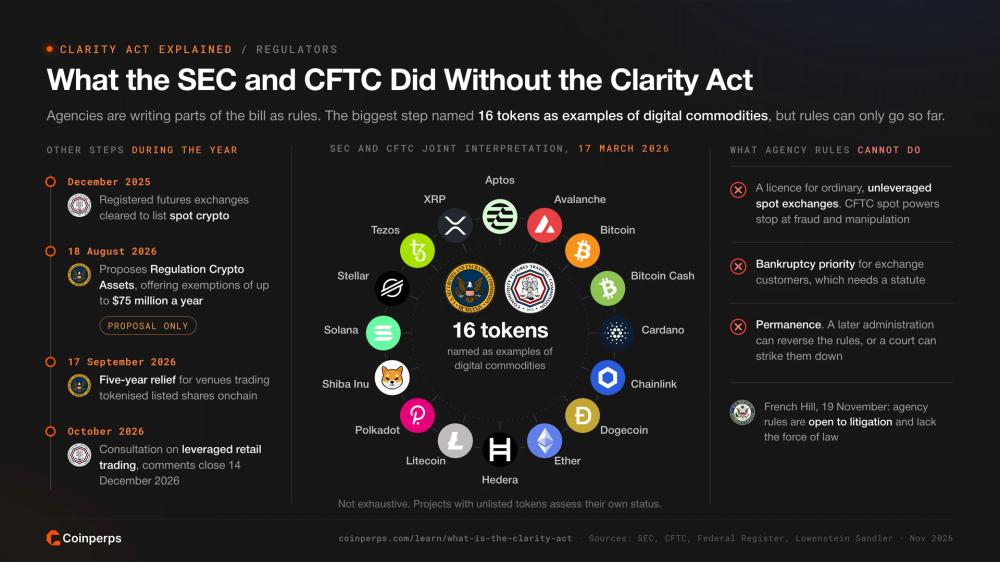
The biggest step came on 17 March 2026, when the SEC and CFTC issued a joint interpretation sorting crypto into five categories. Only digital securities, meaning tokenised versions of traditional securities, are securities outright. Mining, protocol staking and free airdrops generally fall outside securities registration.
It named 16 tokens as examples of digital commodities, listed in a Lowenstein Sandler summary. The list includes Bitcoin, Ether, Solana, XRP, Cardano, Dogecoin, Avalanche and Chainlink. It is not exhaustive, and projects with unlisted tokens must assess their own status.
More agency action followed after March.
- Token fundraising: on 18 August 2026 the SEC proposed Regulation Crypto Assets, with offering exemptions of up to $75 million a year. No final rule has been adopted.
- Tokenised stocks: on 17 September 2026 the SEC granted five-year conditional relief to venues trading tokenised listed shares onchain.
- Spot crypto on futures exchanges: the CFTC cleared its registered exchanges to list spot crypto in December 2025.
- Leveraged retail trading: in October 2026 the CFTC opened consultation on a new crypto asset market category for margined and financed trades. Comments close on 14 December 2026.
Rulemaking only goes so far. Without Congress the CFTC cannot create a licence for ordinary, unleveraged spot exchanges, and its spot powers stop at fraud and manipulation. Bankruptcy priority for exchange customers needs a statute as well. French Hill said on 19 November that agency rules are open to litigation and lack the force of law.
Elsewhere the statutes already exist. The European Union's MiCA regime has applied in full since 30 December 2024 and issues one licence for all 27 member states. The United Kingdom's crypto regime is due to take effect on 25 October 2027. Both authorise firms by activity, while the US approach divides oversight by asset type.
How Markets Reacted and What Happens Next
Clarity Act headlines have moved crypto shares and a handful of altcoins far more than Bitcoin, which shows where the regulatory risk sits. The bill's prospects now depend on a new Congress.
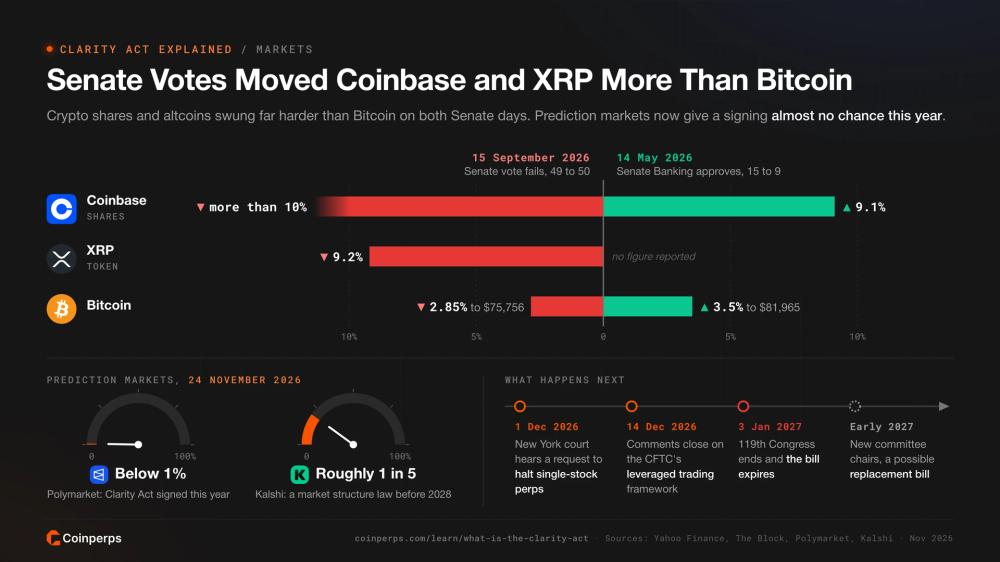
When Senate Banking approved the bill on 14 May 2026, Coinbase shares rose 9.1% and Bitcoin gained 3.5% to $81,965. The failed vote on 15 September reversed that. Coinbase fell more than 10% and XRP dropped 9.2%, while Bitcoin slipped 2.85% to $75,756, according to The Block.
Then came the midterm elections of 3 November 2026. Democrats won both chambers of Congress and take control in January. Asked on 19 November what could pass in the remaining weeks of the session, Republican Senator Bernie Moreno answered "Zero. Zero."
H.R. 3633 lapses on 3 January 2027, so any market structure bill in the next Congress needs a new number, new committee votes and 60 Senate votes. House Democrats are reported to be drafting a bill with a larger SEC role. The President would then have to sign it.
On 24 November 2026 Polymarket priced a signing this year below 1%. Kalshi put a market structure law before 2028 at roughly one in five.
Traders have these dates to watch.
- 1 December 2026: a New York federal court hears a request to halt single-stock perpetuals.
- 14 December 2026: comments close on the CFTC's leveraged crypto trading framework.
- 3 January 2027: the 119th Congress ends and the Clarity Act expires.
- Early 2027: new committee chairs take over and a replacement bill may be introduced.
- Pending: a Washington federal court is weighing CME Group's lawsuit arguing that perpetuals are swaps, which could unsettle current US listings.
Итог
The Clarity Act would have given US crypto a statutory map. The CFTC would oversee spot trading in digital commodities, the SEC would keep fundraising and exchanges would hold a federal licence. It passed the House 294 to 134 and fell 11 votes short of the 60 needed to start debate in the Senate.
Regulators have delivered a large share of it regardless. The SEC and CFTC have named which major tokens are commodities, and perpetual futures now trade on US exchanges at low leverage. Those changes rest on agency decisions that a court or a future administration can undo.
For traders, the practical position is unchanged from before the vote. Offshore exchanges remain closed to US residents while onshore products expand rule by rule. A durable framework waits on the next Congress.
Часто задаваемые вопросы
Is the Clarity Act the same as the GENIUS Act?
No. The GENIUS Act is the US stablecoin law signed on 18 July 2025, and it sets out who may issue dollar stablecoins and how they must be backed. The Clarity Act is a separate bill covering the wider crypto market, including which regulator supervises tokens and exchanges. GENIUS is in force as law, while the Clarity Act never passed the Senate.
Does the Clarity Act ban a US central bank digital currency?
The House version does. Title VI of the bill the House passed is the Anti-CBDC Surveillance State Act, which bars the Federal Reserve from issuing a central bank digital currency to individuals, directly or through banks. It also stops the Fed from testing or developing one. Because the Clarity Act stalled, that ban is not law either.
Are meme coins and NFTs covered by the Clarity Act?
Meme coins are covered in the Senate Agriculture version, which says a digital commodity includes a meme coin and would place its spot trading under the CFTC. NFTs are treated differently. The House bill excludes collectibles from the digital commodity definition and orders a study of non-fungible tokens instead of regulating them.
Does the Clarity Act change how crypto is taxed in the US?
No. The House-passed text contains no tax provisions and does not amend the Internal Revenue Code. Crypto remains property for US tax purposes under existing IRS guidance, so selling, swapping or spending it can still trigger capital gains. Any change to crypto tax rules would need separate legislation or Treasury action.
Would the Clarity Act let offshore exchanges such as Binance serve US customers?
Only if they register or qualify for an exemption. Under the House bill, any platform acting as a digital commodity exchange for US customers must register with the CFTC. The agency may exempt a foreign exchange that it finds is subject to comparable, comprehensive supervision in its home country. The bill also orders a study of offshore platforms that serve US persons.


