Best Crypto Exchanges in Kazakhstan (2026)
Find the best crypto exchanges in Kazakhstan for 2026, with side-by-side reviews covering AFSA licensing, KZT on-ramps, fees, leverage and the rules introduced on 1 May 2026.
Disclosure: Coinperps may earn a commission from partner links, at no extra cost to you. Reviews are based on independent testing, see how we test.
- The regulator names names here: The AFSA identified OKX, HTX, Bitget and MEXC as unlicensed in April 2026. Since 1 May 2026, the National Bank has also licensed platforms outside the AIFC. Bybit and Binance are the only global exchanges serving Kazakh residents through AFSA-licensed local entities.
- The tax break only works on licensed venues: A presidential decree gives individuals a three-year personal income tax exemption on crypto gains. Profits from unlicensed services are excluded, making licence status essential when choosing a main trading account.
- KZT funding is split in two: Licensed platforms offer direct bank rails through Bank CenterCredit and Freedom Bank, plus regulated P2P with licensed institutions as counterparties. Offshore exchanges rely on conventional P2P transfers through Kaspi Gold and Halyk, where account freezes are more likely.

Bybit
Bybit, founded in 2018 and headquartered in Dubai, is the world’s second-largest exchange by volume, serving 60 million users with 1,800+ assets and over $11 billion in daily trading.
Features
Fees
Regulation
Overall
Choosing a crypto exchange from Almaty or Astana now means checking whether the platform is licensed before you check its fees. Kazakhstan has never banned crypto, but it has ruled that exchange activity is legal only on a licensed platform, and it enforces that. The Agency for Financial Monitoring shut down 22 unlicensed exchanges and blocked more than 1,100 illegal crypto sites in 2025, and froze roughly 20,000 bank cards in the process.
Then in April 2026 the Astana Financial Services Authority, the regulator inside the AIFC, put out a warning that named OKX, HTX, Bitget and MEXC as platforms promoting services to Kazakh citizens without authorisation. MEXC has since added Kazakhstan to the prohibited jurisdictions list in its own user agreement. Offshore exchanges still open from a Kazakh IP, but the legal, tax and banking consequences now depend on which platform you pick.
I have funded accounts from Halyk, Kaspi and Freedom Bank cards and tested spot and perpetuals execution across every platform below. The comparison assumes you want spot and futures in one place and would rather not have a Kaspi account frozen.
Top 6 Crypto Platforms in Kazakhstan
How We Ranked These Exchanges
Over a few months, we tested more than 15 exchanges using live accounts funded through Halyk, Kaspi, Freedom Bank and Bank CenterCredit. Each platform was scored under the Coinperps platform ranking methodology, using five weighted categories:
- Legal standing in Kazakhstan: 30%
- KZT on-ramp reliability: 25%
- Spot + perps liquidity: 20%
- Fees & execution: 15%
- Kazakh and Russian language support: 10%
Legal standing receives the greatest weight because it determines whether gains qualify for the tax exemption and whether a bank is likely to process your transfers. It also affects your options if withdrawals stall. Coinperps earns referral commissions from some exchanges covered in this guide, but these arrangements do not influence the rankings. Full details are available on the Coinperps affiliate disclosure page.
1. Bybit
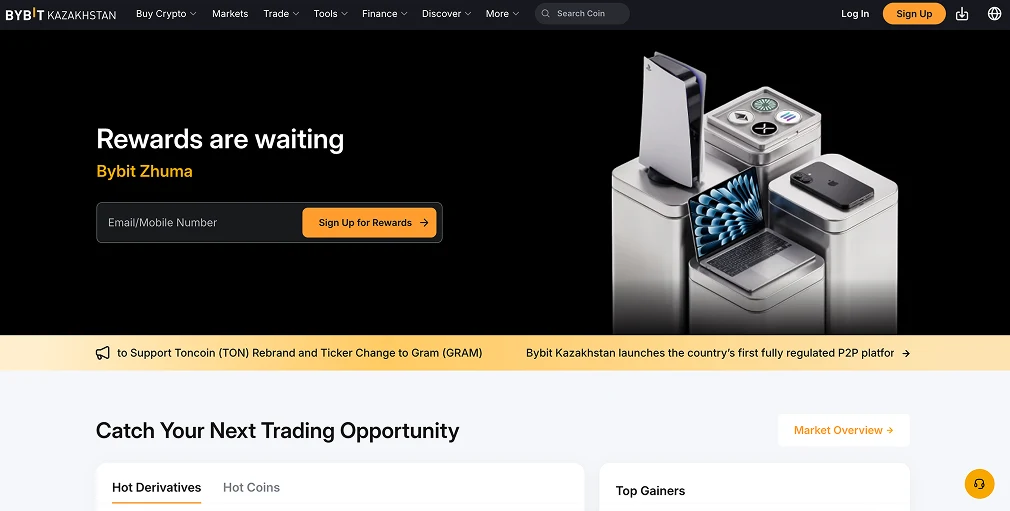
Bybit is the only exchange reviewed here where the entire process, from depositing tenge to opening a leveraged position, operates under a Kazakh licence. Bybit Kazakhstan received full AFSA authorisation in September 2024. The licence covers operating a digital asset trading facility, custody, managing investments and dealing in investments as both principal and agent. Its local platform runs at bybit.kz, with support in Kazakh, Russian and English. Registration requires a Kazakh ID and IIN.
Its funding system is the main point of difference. Bybit Kazakhstan launched what it describes as the country's first fully regulated P2P platform in November 2025. It works much like standard P2P, but the Maker is an AFSA-licensed financial institution. Your KZT goes to the institution's corporate account instead of an individual's Kaspi Gold account.
The rail accepts verified Halyk Bank cards and charges no P2P commission. Each transaction is capped at 2.5 million KZT, with a daily limit of 5 million KZT. I have used the service since December. USDT typically reaches my funding wallet within minutes, with pricing inside 1% of the Kaspi mid-rate.
Bybit also introduced a direct fiat channel with Bank CenterCredit in June 2025. BCC customers can deposit and withdraw tenge directly through their accounts. Customers of other banks can use regulated P2P instead.
Fees match global Bybit at 0.10% for spot trading and 0.02% maker / 0.055% taker on USDT perpetuals. BTC and ETH perps have some of the tightest funding spreads on Coinperps. For overnight positions, funding costs can matter more than a few basis points in trading fees. Major contracts offer leverage up to 100x. Check the risk-limit tier on the bybit.kz contract page, as a regulated entity can change these limits without notice.
Pros
- A full AFSA licence covering spot, derivatives and custody. This is the only setup where the new three-year tax exemption clearly applies.
- Regulated P2P with a licensed institution as the counterparty, plus a direct Bank CenterCredit rail. This removes stranger card details and name-mismatch disputes.
- Deep liquidity across spot and perpetuals, with full Kazakh and Russian localisation and a local support team.
- Monthly proof-of-reserves using a Merkle tree that customers can verify against their balances.
Cons
- Regulated P2P currently supports Halyk cards only. Kaspi-only users need either a Halyk card or a BCC account.
- The 0.10% spot fee is higher than promotional rates offered by some offshore platforms.
- P2P transaction and daily limits may be restrictive for larger accounts.
2. Binance
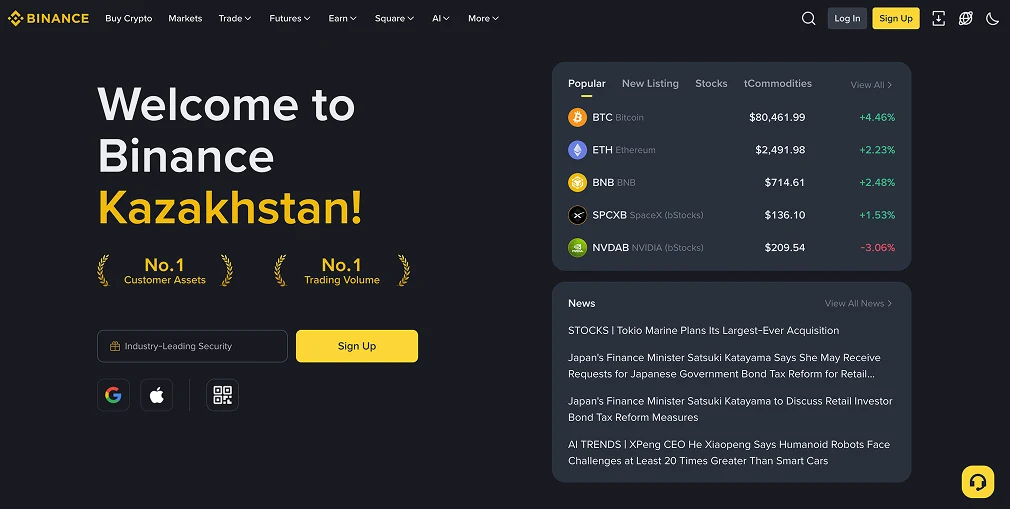
Binance became the first global exchange to secure an AFSA licence when it received permanent authorisation in October 2022. It later joined the five exchanges in the AIFC's pilot project with Kazakh banks, which helped shape the current regulatory framework. Binance Kazakhstan introduced futures in January 2025, followed by options, futures copy trading and BFUSD in March 2025. The local entity is no longer limited to spot trading.
Its selection of tenge funding methods is unmatched. Binance Kazakhstan provides direct online banking deposits and withdrawals through Freedom Bank. The IIN attached to your Binance KYC must match the one registered with Freedom. Anyone verified using a document without an IIN must reset and complete KYC again. That process took me two days. Card deposits and an active P2P market covering Kaspi, Halyk, Jusan and Forte provide other options.
Binance is also worth keeping for its liquidity, even if Bybit remains your main account. It ranks first on the Coinperps open interest rankings for most major perpetuals. Its BTC, ETH and SOL spot books can absorb orders that would move prices on smaller exchanges. Trading costs are 0.10% on spot and 0.02% maker / 0.05% taker for USDⓈ-M futures. Holding BNB provides a fee discount.
The state-backed Alem Crypto Fund made BNB its first purchase in September 2025, executing the transaction through Binance Kazakhstan. This suggests that Binance's local licence is likely to remain secure for the foreseeable future.
Pros
- An AFSA-licensed local entity offering spot, futures, options and copy trading.
- Direct online banking through Freedom Bank, alongside cards and the largest KZT P2P merchant pool.
- The strongest liquidity on this list for major assets, with tight spreads during volatile periods.
- A complete Kazakh and Russian interface, local support and a large community in Almaty.
Cons
- Freedom Bank's IIN matching requirement can catch out users who completed verification with a foreign passport.
- The range of products makes the interface more complex than Bybit for beginners.
- Global Binance has exited other markets before. The local licence reduces this risk but does not eliminate it.
3. OKX
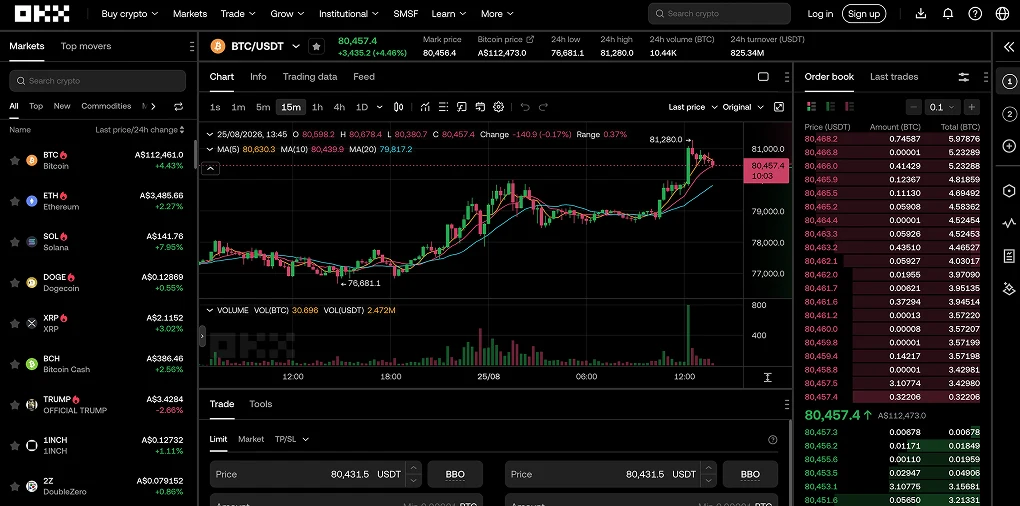
OKX provides the best perpetuals execution available from Kazakhstan. The platform remains accessible from a Kazakh IP and accepts a Kazakh passport for KYC. It was also the first exchange identified in the AFSA's April 2026 warning. Kazakhstan has not been added to OKX's own restricted countries disclosure, leaving the service accessible despite operating outside the local licensing framework.
The personal income tax exemption applies only to activity conducted through Kazakhstan's regulated infrastructure, so gains made on OKX do not qualify. Funding relies on conventional P2P merchants using Kaspi Gold, Halyk and Freedom. These are the transaction patterns monitored by the AFM and bank compliance teams.
My approach is to buy USDT through Bybit Kazakhstan's regulated P2P market, then send it to OKX using TRC20 or Arbitrum. This keeps my Kaspi card separate from offshore P2P trading.
Execution is where OKX performs best. Its perpetuals engine remains stable during volatile periods and avoids many of the price wicks seen on smaller platforms. The exchange also has an industry-leading Web3 wallet and the deepest options market accessible to Kazakh traders. Spot fees are 0.10%, while perpetuals cost 0.02% maker / 0.05% taker. Leverage reaches 100x on major contracts.
Pros
- Spot liquidity and execution that compete with Binance on major assets.
- An industry-leading Web3 wallet and the deepest options order book included in this guide.
- Transparent proof-of-reserves and reliable performance during major liquidation events.
Cons
- The AFSA explicitly named OKX as unlicensed in April 2026, leaving users without consumer protection in Kazakhstan.
- Gains realised on the platform do not qualify for the tax exemption.
- The Kazakh interface trails Bybit and Binance, while Russian localisation remains incomplete.
4. Gate.io
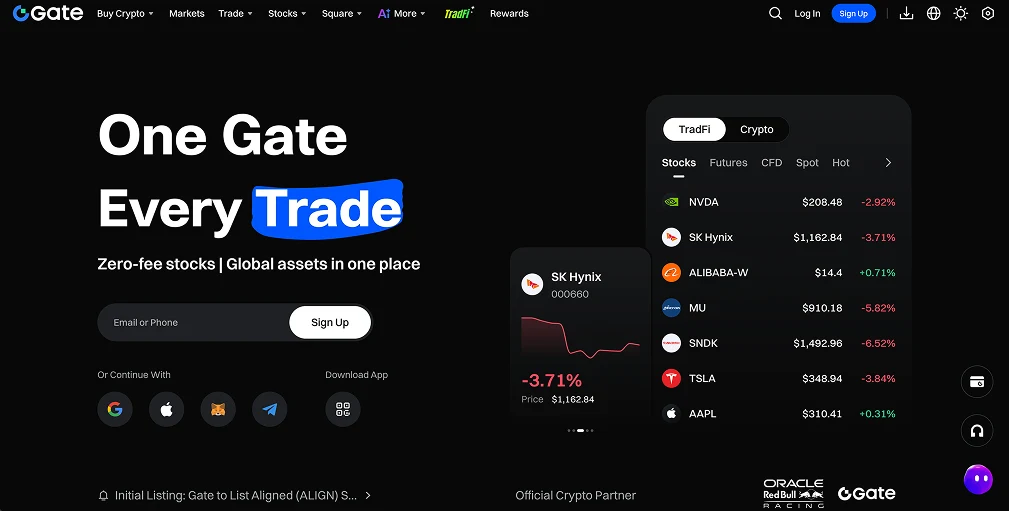
Gate.io was not included in the AFSA warning and does not identify Kazakhstan as a restricted market in its restricted countries policy. It is accessible and unlicensed, but regulators have not singled it out. Gate.io holds a MiCA CASP licence in Malta and other authorisations discussed in our MiCA licensed exchanges guide. Those approvals have no standing in Kazakhstan, where only an AFSA or National Bank licence is relevant.
Its main advantage is range. Gate.io offers nearly 2,000 spot pairs, perpetuals and delivery futures across hundreds of assets. The platform has reported a proof-of-reserves ratio above 100% since disclosures began. Newly listed tokens often appear here before reaching other large exchanges.
Its P2P market supports Kaspi and Halyk, although there are fewer merchants than on Binance. Spreads also widen after 22:00 Astana time.
Leverage reaches 125x on major perpetuals and follows tiered risk limits. Gate.io has the most crowded interface in this comparison. The number of products, including spot, margin, perpetuals, delivery futures, options, grid bots, dual investment and a launchpad, creates a steeper learning curve for beginners.
Pros
- The widest combined spot and futures selection among exchanges accessible from Kazakhstan.
- Regular proof-of-reserves reporting with independent verification across a broad asset base.
- Gate.io was not named in the AFSA warning and does not restrict Kazakhstan in its terms.
Cons
- It remains unlicensed in Kazakhstan, so users do not receive the tax exemption or local consumer protection.
- The interface is complex, and liquidity becomes thin outside the top 200 pairs.
- Kazakh localisation is limited, while Russian support is slower than Bybit's.
5. Bitget
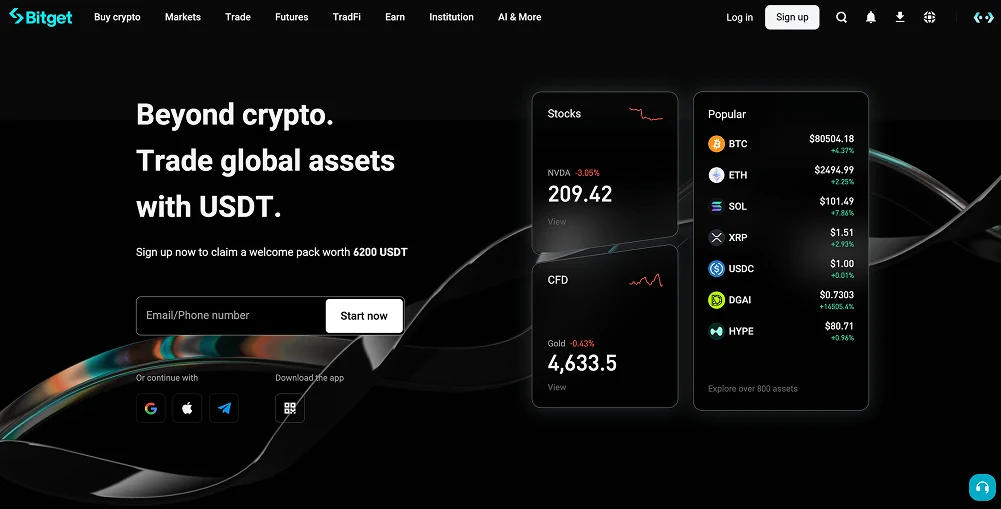
Bitget has retained a following in Kazakhstan largely because of its copy trading service. It offers the biggest curated selection of strategy providers among platforms that still accept Kazakh users. Its futures engine supports leverage up to 125x under a tiered risk framework that operates sensibly during liquidation cascades. A January 2026 proof-of-reserves report showed a total reserve ratio above 160%.
The AFSA named Bitget in its warning alongside OKX. Kazakhstan is not included on Bitget's restricted countries list, so the platform remains available. However, it operates without a local licence, and the regulator has formally confirmed that status.
KZT funding is available through cards or P2P merchants accepting Kaspi, Halyk and Jusan. Card purchases generally carry a spread of 2% to 3% over the interbank rate, while Kaspi transactions are frequently declined.
Bitget charges 0.10% on spot trades and 0.02% maker / 0.06% taker on futures. Active users can reduce costs by holding BGB. The interface is busy, and there is no Kazakh-language option.
Pros
- The most developed copy trading system available to Kazakh users.
- Detailed reserve disclosures supported by a sizeable protection fund.
- Competitive futures pricing, with further discounts for BGB holders.
Cons
- Formally identified as unlicensed by the AFSA in April 2026.
- Wide card purchase spreads and frequent Kaspi declines.
- No Kazakh interface, with support available only in Russian.
6. KuCoin
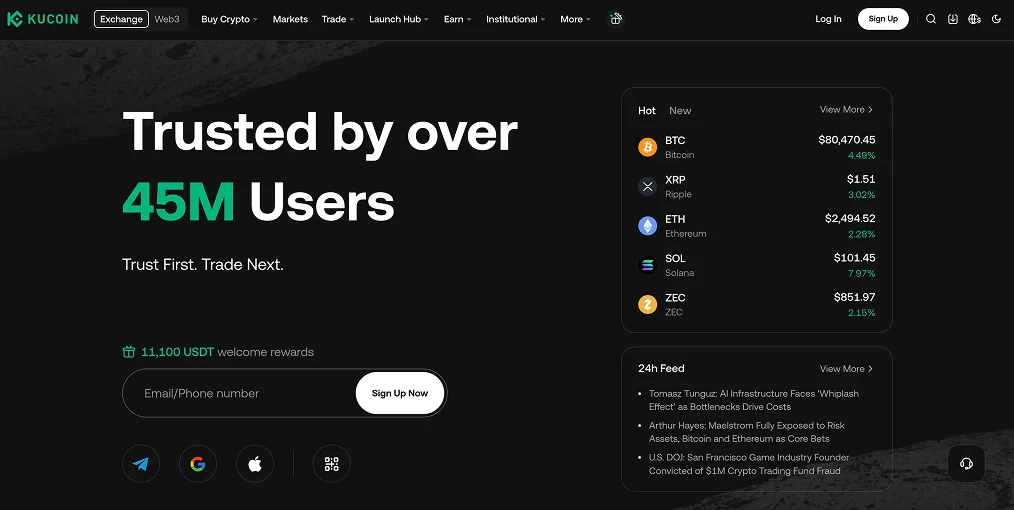
KuCoin is better suited to users who value staking and earn products alongside trading. It was not identified by the AFSA, and Kazakhstan remains absent from its terms, as detailed in our KuCoin restricted countries guide. KuCoin lists one of the industry's largest altcoin catalogues, provides futures leverage up to 100x and has a broader earn suite than Bybit.
Instead of a direct Kazakh bank rail, KuCoin accepts tenge through the Volet e-wallet. It also operates a modest P2P market. Volet is functional but adds an extra step and another fee. Funding it with a Kaspi card can also be difficult. For deposits above a few hundred thousand tenge, purchasing USDT elsewhere and transferring it to KuCoin is simpler.
Trading fees are 0.10% for spot and 0.02% maker / 0.06% taker on futures. Liquidity for major contracts falls behind the top four exchanges during volatile periods. P2P disputes were also resolved slowly in my testing.
Pros
- A broad selection of earn and staking products, supported by an extensive altcoin catalogue.
- KuCoin was not listed in the AFSA warning, and its restricted markets do not include Kazakhstan.
- Volet provides a non-bank KZT route that does not expose a Kaspi card to P2P trades.
Cons
- The exchange is unlicensed in Kazakhstan, excluding users from local tax benefits and consumer protections.
- Volet adds cost and friction, while KuCoin's KZT P2P market has relatively few merchants.
- Perpetuals liquidity is thinner than on Bybit, Binance or OKX.
What Makes a Good Crypto Exchange for Kazakh Traders?
In Kazakhstan, three constraints should shape your shortlist before trading fees enter the comparison.
- A licence you can verify: The AFSA maintains a public register rather than a blacklist. Since 1 May 2026, the National Bank has also maintained a register of licensed exchange operators. If the entity serving you appears on neither register, you are outside the regulated perimeter. That affects tax treatment and how banks handle your transactions, as well as your recourse when problems occur.
- A KZT rail that does not put your main card at risk: Kaspi handles much of the country's everyday banking and is also among the most active banks in freezing accounts tied to crypto P2P inflows. This included a wave of freezes initiated by prosecutors in early 2025. A reliable exchange should provide a funding route that does not require transfers to an individual's Kaspi Gold account.
- Spot and perps under one roof: Every fiat conversion adds time and spread. Keeping spot purchases, perpetuals margin and altcoin trades on the same venue means paying that cost once. All six exchanges offer both markets, but only two provide them under a Kazakh licence.
Funding rate stability is another important difference between exchanges. Thin liquidity can lead to extended periods of positive or negative funding during trending markets. The cost compounds quickly when positions remain open overnight. Our guide to positive vs negative funding fees explains how to interpret these rates.
How Is Crypto Regulated in Kazakhstan?
Kazakhstan has two licensing tracks. The one used by your exchange determines its legal standing, your available recourse and how gains are taxed.
The original regime operates through the Astana International Financial Centre, a jurisdiction in the capital based on English common law and regulated by the AFSA. The Law on Digital Assets came into force in April 2023 and restricted the circulation of unbacked digital assets to platforms licensed within the AIFC. Through 2025, every licensed exchange serving Kazakh residents held an AFSA licence. This group includes Bybit Kazakhstan, Binance Kazakhstan, ATAIX Eurasia and Intebix.
Licensed platforms processed $6.8 billion in trading between January and September 2025. Around 30 licensed digital asset firms now operate from the AIFC.
A second track began on 1 May 2026. Amendments to the Law on Digital Assets established a national framework and gave the National Bank of Kazakhstan authority to license and supervise digital asset service providers outside the AIFC. The amended law recognises unsecured digital assets, money-backed stablecoins, tokenised real assets and financial instruments.
The National Bank supervises stablecoins. Other digital financial assets fall under the Agency for Regulation and Development of the Financial Market. A newly established local firm received the first National Bank exchange operator licence in July 2026, showing that the onshore framework is operational but still at an early stage.
Both regimes are supported by enforcement. In 2025, the AFM closed 22 exchangers, blocked 1,100 websites and froze 20,000 cards. The AFSA followed in April 2026 by warning that OKX, HTX, Bitget and MEXC were operating without authorisation. It also cautioned users about bonus and referral campaigns run by unlicensed platforms, stating that global scale does not replace a local licence.
Kazakhstan is developing a state-backed presence in the sector as well. The Alem Crypto Fund, a government-supported digital asset reserve, launched in September 2025. Intebix and Eurasian Bank have also introduced a tenge-backed stablecoin called Evo, with the ticker KZTE. It operates on Solana inside the National Bank's regulatory sandbox alongside Mastercard.
Tax treatment became more favourable in August 2026. President Tokayev signed a decree granting individuals a three-year personal income tax exemption on digital asset gains earned through Kazakhstan's regulated infrastructure. Residents ordinarily pay a rate of 10%.
The exemption excludes gains connected to unlicensed services. Kazakhstan is also implementing the OECD Crypto-Asset Reporting Framework ahead of its first automatic data exchanges in 2027. As a result, offshore activity will eventually reach the tax authority regardless of whether a user reports it voluntarily.
%201.webp)
Spot Trading Rules
Individuals may legally trade spot crypto through licensed platforms. Article 11(5) of the Law on Digital Assets prohibits organising the circulation of digital assets without a licence issued under AIFC law or, from May 2026, national law.
The legal obligation falls on the platform rather than the individual trader. Users still face consequences when choosing an unlicensed exchange. Their gains do not qualify for the tax exemption, and banks classify P2P inflows associated with offshore services as high risk.
Licensed exchanges also follow approved-asset rules. Fully licensed platforms can admit assets under AFSA listing requirements, except for stablecoins issued outside the AIFC. The National Bank maintains a separate list of authorised unsecured digital assets for its onshore regime.
This makes the selection on Bybit Kazakhstan and Binance Kazakhstan smaller than on their global platforms. Some long-tail tokens are unavailable. Both licensed exchanges list USDT, and since September 2025 the AFSA has allowed it to be used for regulatory fee payments.
%201.webp)
Futures and Perpetuals Rules
Kazakhstan is unusual in allowing high-leverage perpetual futures through locally licensed platforms. Bybit Kazakhstan's authorisation covers managing investments and dealing in investments as both principal and agent. The platform launched with spot and derivatives. Binance Kazakhstan introduced futures in January 2025, followed by options in March.
Few jurisdictions permit regulated local platforms to offer leverage without a fixed ceiling. European platforms cannot do so because MiFID imposes a 10x limit.
As of August 2026, Kazakhstan has no separate leverage cap for retail traders. The licensed platforms follow their global leverage schedules, although both use tiered risk limits and may tighten them. Offshore perpetuals trading is not illegal for the user. However, the platform remains unlicensed, gains are excluded from the tax exemption and no local complaints process is available. Our guide to crypto perpetual futures regulation compares Kazakhstan with other markets.
%201.webp)
Risks of Using Crypto Exchanges From Kazakhstan
- Bank freezes from P2P activity: This is the most immediate risk for Kazakh traders. The AFM froze around 20,000 cards in 2025, while Kaspi restricts accounts that receive repeated transfers from unrelated individuals. Keep your salary account separate and use a dedicated card for P2P. Where possible, choose Bybit Kazakhstan's regulated P2P service or the direct bank rails offered by licensed platforms.
- Losing the tax exemption: The three-year personal income tax holiday covers only gains earned through licensed infrastructure. Using OKX, Bitget or Gate.io means paying the standard 10% and maintaining your own records. CARF reporting from 2027 will disclose this activity to the tax authority.
- Platform exit risk on unlicensed venues: MEXC added Kazakhstan to its prohibited jurisdictions after the AFSA warning. Other unlicensed exchanges could take similar action with little notice, blocking new registrations and requiring existing users to withdraw. Keep only working capital offshore.
- Narrower asset menus on licensed venues: Approved-asset requirements reduce the number of tokens available through Bybit Kazakhstan and Binance Kazakhstan. Strategies that depend on trading assets within hours of listing may require an offshore account, along with its associated risks.
- Leverage cascades: Both licensed exchanges offer leverage of at least 100x on major contracts. One poor fill can wipe out an account at those levels. Monitor the Coinperps liquidations dashboard for forced-selling conditions and read our guide on how to avoid auto-deleveraging before increasing position sizes.
- Tenge volatility: The tenge has traded above 500 to the dollar for most of the past two years, while the National Bank's base rate remains in the high teens. USDT may appeal as a dollar proxy, but the KZT value of a position changes with both the currency and the underlying crypto market.
Best KZT Deposit Methods for Crypto
Your choice of tenge funding method can cost more than the exchange's trading fees. It also affects whether a bank flags the account.
- Regulated P2P (Bybit Kazakhstan): This is the cleanest option I tested. After choosing an offer, you transfer KZT from a verified Halyk Bank card to the corporate account of an AFSA-licensed Maker. The Maker then releases USDT to your wallet. The card details, IIN and name are verified on both sides. Transactions are limited to 2.5 million KZT, with a daily cap of 5 million KZT, and no commission is charged. Selling follows the same process in reverse, with KZT returned to your verified card. Since the counterparty is an institution, there is no name-mismatch risk or chance of receiving tainted funds.
- Direct bank rails (Bank CenterCredit, Freedom Bank): Bybit Kazakhstan supports tenge deposits and withdrawals from Bank CenterCredit accounts. Binance Kazakhstan provides the same service through Freedom Bank online banking. Freedom's crypto-friendly approach predates much of the current framework. Both integrations require the IIN registered with the bank to match the exchange account. I use these routes for larger deposits because neither has the P2P transaction cap.
- Card purchases: Binance Kazakhstan, Bitget and Gate.io support crypto purchases by card. The total spread is usually 2% to 3% above the interbank rate. Offshore platforms frequently decline Kaspi cards, while Halyk and Freedom cards have better acceptance rates. Card payments are best treated as a backup option.
- Classic P2P (Kaspi Gold, Halyk, Jusan, Forte): This remains the standard funding method on OKX, Gate.io, Bitget and the offshore version of Binance. Kaspi transfers made by phone number usually settle within seconds. The same activity pattern can also lead to an account freeze. Choose merchants with at least 500 completed orders and a completion rate above 98%. Never accept money from someone whose name does not match the order. Keep every receipt inside the platform and avoid using the account where your salary is deposited.
- Volet e-wallet (KuCoin): Volet provides a non-bank route that keeps your Kaspi card away from P2P trading. You fund the wallet in KZT and then deposit to KuCoin. The additional fee and extra step make it more suitable for a small initial deposit than a large transfer.
- The two-exchange workaround: To fund an offshore exchange, buy USDT on Bybit Kazakhstan using regulated P2P or a direct bank rail. Transfer the tokens over TRC20 or Arbitrum afterward. This method involves one network fee and avoids exposing a personal card to offshore P2P merchants. It is the setup I use for OKX.
%201.webp)
Bottom Line
Bybit is the default choice for Kazakh traders who want spot and perpetuals on one platform. The full process, from depositing with a Halyk card through a regulated P2P Maker to opening a 100x perpetual, operates under an AFSA licence. That structure keeps eligible gains within the three-year tax exemption and reduces banking risk.
Binance is the natural second licensed account because it provides greater liquidity and a direct Freedom Bank rail. OKX offers the best execution if you are prepared to trade outside the local licensing framework and fund the account through the two-exchange method.
Gate.io provides the widest selection of altcoins. Bitget is strongest for copy trading, while KuCoin suits users focused on yield products. None holds a Kazakh licence, and regulators have specifically named two of them.
The development of the National Bank's onshore framework will shape the market over the next two years. I expect the two AFSA-licensed global exchanges to retain their lead through 2027. Local platforms such as ATAIX and Intebix should expand around KZTE and crypto cards, while unlicensed exchanges will either seek authorisation or leave the market as MEXC did.