Gate Restricted Countries List 2026: Bans, Licenses & Alternatives
Gate.io is now just Gate. The exchange rebranded in May 2025, moved to Gate.com, and reshaped which countries it serves through which licensed arm. The restricted list still names more than 30 jurisdictions. Here is the 2026 picture and your alternatives.

Disclosure: Coinperps may earn a commission from partner links, at no extra cost to you. Reviews are based on independent testing, see how we test.
- Gate restricts 30+ named jurisdictions in 2026, including the US, Canada, Chinese Mainland, Singapore, the UK, and most of Western Europe, per Section 2.5 of the Gate User Agreement (last updated 15 April 2026).
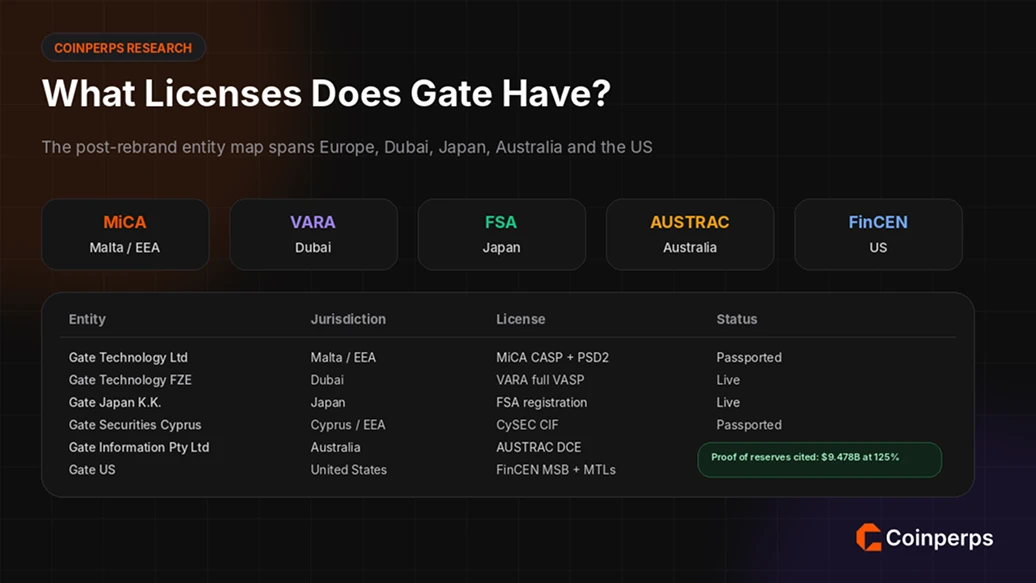
- The brand and structure both changed. Gate.io became Gate (Gate.com) in May 2025, now operating through region-specific entities: Gate US (spot in 30 states), Gate Malta (MiCA), Gate Dubai (VARA), and Gate Japan (FSA).
- KYC is mandatory. Gate's help center confirms verification is required before depositing and withdrawing, closing the VPN loophole older guides described.

Gate.io
Gate.io, founded in 2013 and based in the Cayman Islands, is a global exchange with 22 million users, 3,800+ assets, 560 perpetual pairs, and over $9 billion in daily volume.
Features
Fees
Regulation
Overall
Which Countries Does Gate Restrict?
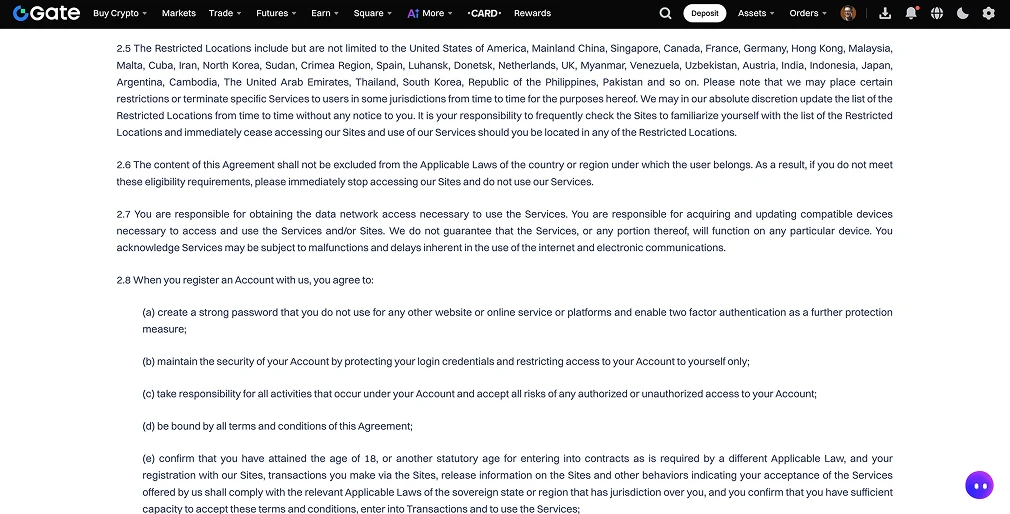
Gate's Restricted Locations sit in Section 2.5 of its User Agreement, which names more than 30 jurisdictions where the global platform refuses account creation. The agreement uses "include but are not limited to" wording, so the list is not exhaustive and Gate can update it without notice.
Fully restricted as of 2026:
- North America: United States, Canada
- Greater China: Chinese Mainland, Hong Kong
- Western Europe: United Kingdom, France, Germany, Spain, Netherlands, Austria, Malta
- Asia-Pacific: Singapore, Malaysia, India, Indonesia, Japan, Thailand, South Korea, Philippines, Cambodia, Myanmar, Pakistan, Uzbekistan
- Middle East: United Arab Emirates, Iran, Sudan
- Latin America: Cuba, Venezuela, Argentina
- Ukraine (occupied regions): Crimea, Donetsk, Luhansk
One irony stands out. Gate holds active licenses in several countries on this list, including Malta, the UAE, Japan, and Hong Kong, yet Gate.com still blocks residents there. Access in those markets runs through a separately licensed local entity instead. The restriction is structural, the same model OKX and Bybit adopted, not an exit.
Gate updates the list "in its absolute discretion." Confirm your status in the User Agreement before signing up.
Countries Supported by Gate
Outside the Restricted Locations, Gate operates in 180+ countries, blending the global platform with locally-licensed entities. Major regions include:
- Latin America: Brazil, Mexico, Peru, Chile, Colombia, Ecuador
- Europe (non-restricted): Italy, Portugal, Switzerland, Poland, Sweden, Czech Republic, Belgium, Finland, Norway, Ireland
- Africa: South Africa, Nigeria, Kenya, Morocco, Zambia, Ghana
- Asia and Middle East: Vietnam, Saudi Arabia, Israel, Bahrain, Qatar
- Oceania: Australia, New Zealand (AUSTRAC-registered)
Access can vary by product within a country. In Nigeria, users reach Gate through the app while the website stays blocked. Supported users get spot, perpetuals up to 125x leverage, copy trading, and fiat rails in 65+ currencies.
Gate Derivatives Trading Restrictions
Gate runs one global derivatives product across nearly every supported market. Perpetuals and futures are available wherever the platform is, with no separate spot-only country list.
Older guides, including the previous version of this page, claimed Gate derivatives were freely accessible in markets like Australia despite local rules, citing the absence of geoblocking. That no longer holds in 2026:
- Mandatory KYC closed the enforcement gap. Gate verifies identity and residence before any deposit or withdrawal, so trading from a restricted jurisdiction is now detectable.
- Local licensing changed the posture. With AUSTRAC registration in Australia and VARA authorization in Dubai, Gate now carries direct regulatory obligations where it once operated at arm's length.
For traders comparing venues, the perpetual exchanges directory, the Binance vs Bybit comparison, and live funding rates cover the options by region.

Does Gate Require Mandatory KYC Verification?
Yes, and this is the key correction to older Gate guides. Gate's official KYC documentation states verification is required before both depositing and withdrawing. No usable unverified tier exists in 2026.
Verification runs in two levels:
- KYC Level 1 (identity): Government photo ID (passport, driver's license, or national ID) plus facial recognition. Unlocks deposits, trading, and standard withdrawals.
- KYC Level 2 (address): Residential address on top of Level 1. Raises withdrawal limits and clears transactions flagged "KYC Required" by Gate's risk engine.
Verification completes within 30 minutes to 12 hours per Gate's help center. An automated risk system can flag any withdrawal for manual review, forcing Level 2 regardless of prior status.
Is Gate Banned in the US?
The global Gate.com platform is banned in the US, but Gate US is not. This is the biggest change since the last version of this article.
Gate US launched spot trading on August 1, 2025 as a separate entity registered with FinCEN as a Money Services Business, holding state Money Transmitter Licenses. By early 2026 it covered crypto-to-crypto spot trading in roughly 30 states, with fiat on-ramps and custodial wallets planned and no derivatives yet.
The pattern mirrors OKX US and the 2025 wave of offshore exchanges building compliant US arms after the GENIUS Act and CLARITY Act improved regulatory clarity. Gate US is a legitimate route in supported states. For derivatives, our Coinbase Perpetuals and Kraken restricted countries guides cover CFTC-registered options.
What Licenses Does Gate Have?
Gate runs a regulation-first multi-entity structure that expanded sharply after the rebrand across Europe, the Middle East, Asia-Pacific, and North America.
The MiCA license from Malta's MFSA in October 2025 matters most, granting passporting across all 30 EEA states, with a PSD2 Payment Institution license following in February 2026. Gate also publishes monthly Proof of Reserves, most recently showing $9.478 billion at a 125% coverage ratio.
Holding a license in a country and serving it on the global platform are different things. Gate's EEA licensing routes European users to the local entity, which is why France, Germany, Spain, and the Netherlands stay on the global restricted list despite the passport.
Can You Access Gate with a VPN?
No, not safely. Mandatory KYC makes VPN access impractical in 2026. A VPN masks your IP at signup, but verification ties your account to a government ID and declared residence, which Gate cross-checks against your access patterns.
Section 2.5 of the User Agreement requires users in Restricted Locations to "immediately cease" using the platform, and Gate can freeze accounts and force position closures once such a user is identified. Because verification gates both deposits and withdrawals, anyone who clears KYC with restricted-country documents cannot fund or exit the account.
The genuinely no-KYC path is on-chain. The best decentralized perpetual exchanges guide and the Hyperliquid restricted countries breakdown cover non-custodial venues. For optional-KYC centralized trading, see our BloFin restricted countries guide.
Best Alternatives if Gate is Unavailable in Your Country
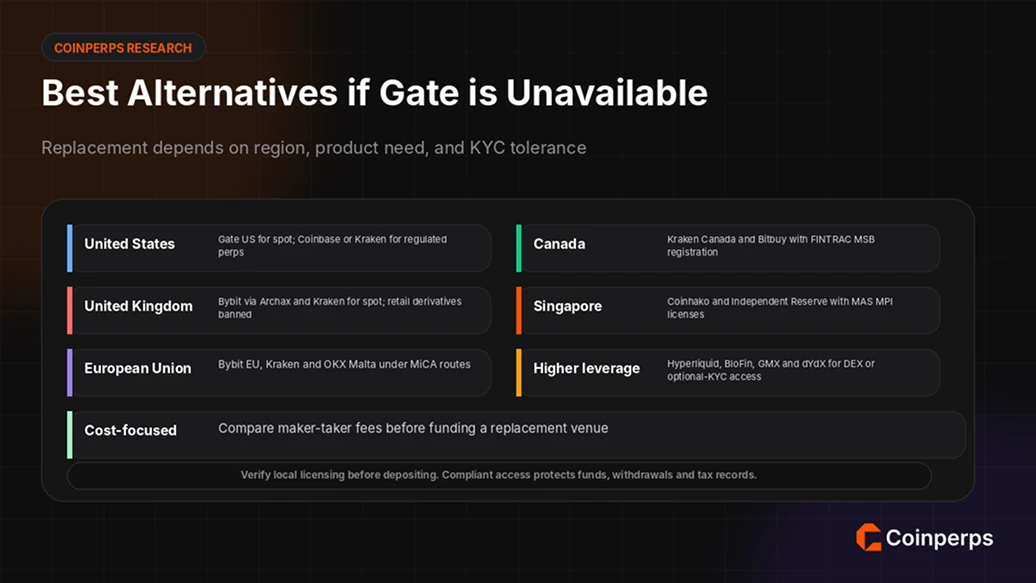
Replacement depends on whether you need the global derivatives product, a local licensed entity, or non-custodial perpetuals. Our regional picks:
- United States: Gate US covers spot in ~30 states. For derivatives, Coinbase (NYDFS, SEC, CFTC) and Kraken (FinCEN, state MTLs) offer CFTC-registered perpetuals.
- Canada: Kraken Canada and Bitbuy hold FINTRAC MSB registration with CAD rails via Interac e-Transfer.
- United Kingdom: Bybit (via Archax) and Kraken serve UK spot users. Retail derivatives stay banned under the FCA.
- Singapore: Coinhako and Independent Reserve are the main MAS-licensed Major Payment Institutions.
- European Union: Bybit EU (MiCA FN 636180i), Kraken, and OKX Malta all hold MiCA passporting.
- Higher-leverage no-KYC: Hyperliquid, BloFin, GMX, and dYdX lead on optional or non-existent KYC at high leverage.
- Cost-optimized: The lowest fee crypto perpetual exchanges guide ranks venues by maker-taker rates.
Verify local licensing before depositing. Compliant access protects both your funds and your tax position.
Bottom Line
Gate spent 2025 doing what the other survivors of the cycle did. It picked a clearer name, built licensed local entities, and stopped pretending one global platform could serve everyone. The rebrand was the visible part. The MiCA license, VARA authorization, FSA entity, and US spot launch were the substance.
The restricted list still reads long at 30+ named jurisdictions, but the meaning has shifted. Several now have a licensed Gate entity operating locally, so "restricted on Gate.com" increasingly means "served by a different Gate arm" rather than blocked outright.
For traders in a supported country, Gate offers deep liquidity, perpetuals up to 125x, and a 125% reserve ratio. The trade-off is mandatory KYC and an entity map that decides which products you actually get.
For traders in a Restricted Location, the alternatives above are the cleanest path. The perpetual exchanges directory and live open interest and funding rates trackers cover every restricted market.