OKX Restricted Countries List 2026: Bans, Limits & Alternatives
Trying to access OKX? Some countries are still blocked, others now run through a separately licensed local entity, and a handful have lost derivatives access while keeping spot. Here is the updated list, with the latest regulatory shifts and the best alternatives by region.
Disclosure: Coinperps may earn a commission from partner links, at no extra cost to you. Reviews are based on independent testing, see how we test.
- OKX restricts the global platform in around twenty jurisdictions, including the US, Canada, India, Japan, Hong Kong, and all major sanctions targets, per Section 3 of its Risk and Compliance Disclosure.
- OKX now runs seven separately licensed local entities (US, EU, Japan, Singapore, UAE, Australia, Bahamas) following the $505 million DOJ settlement in February 2025 and the MiCA license issued in January 2025.
- Perpetual futures remain blocked for retail in Australia, Brazil, South Korea, and the UK, even where spot access is allowed. KYC is mandatory across all entities, and VPN circumvention violates the terms of service.

OKX
OKX is a global crypto exchange founded in 2017, serving users in over 180 countries with more than $13 billion in daily trading volume across spot, futures, and Web3 products.
Features
Fees
Regulation
Overall
Which Countries Does OKX Restrict?
OKX restricts access in roughly twenty jurisdictions, set out in Section 3 of its Risk and Compliance Disclosure (last updated 21 March 2026). As of 2026, the following users are prohibited from accessing the global OKX platform:
- North America: United States (all states blocked on the global platform; users must use OKX US instead), Canada
- Asia-Pacific: Hong Kong, India, Japan, Malaysia, Nepal, Uzbekistan
- Middle East and Africa: Afghanistan, Algeria, Bangladesh, Iran, Nigeria, North Korea, Syria
- Latin America: Cuba
- Europe and Ukraine: Crimea, Donetsk, and Luhansk regions
- US territories: Puerto Rico, American Samoa, Guam, the Northern Mariana Islands, and the US Virgin Islands
A few notable changes from earlier 2025 lists: France has been removed following OKX's consolidation of EU operations under its Malta MiCA license in July 2025, and Bolivia and El Salvador no longer appear after Bolivia lifted its crypto ban in June 2024 and OKX launched a local El Salvador entity in February 2026.
OKX also imposes partial restrictions in several markets where the platform itself remains accessible: Australia (derivatives and certain CeFi products), Bahamas (retail products), Brazil (derivatives and P2P), Eritrea (P2P), Russia (fiat payment services), South Korea (derivatives and P2P), and the United Kingdom (derivatives, CeFi, and P2P).
Regulatory policies change frequently. Always confirm the current list directly through OKX's official channels before signing up.

Countries Supported by OKX
OKX provides services to more than 100 countries, with the platform's Similarweb traffic data showing Japan (14.2%), the United States (13.9%), Brazil (6.2%), Mexico (5.7%), and Vietnam (5.3%) as the top markets. Supported jurisdictions include:
- Asia: Singapore, Indonesia, Vietnam, Thailand, Philippines, Taiwan, South Korea (spot only), Japan (via OKX Japan)
- Europe: All 30 EEA member states (Austria, Belgium, France, Germany, Italy, Netherlands, Portugal, Spain, Switzerland and others) via MiCA passporting from Malta
- Middle East: UAE (via OKX Middle East), Saudi Arabia, Qatar, Israel, Bahrain
- Africa: South Africa, Egypt, Kenya, Morocco
- Oceania: Australia (spot retail, derivatives wholesale only), New Zealand
- Latin America: Mexico, Argentina, Brazil (spot only), Colombia, Chile, Peru
- United States: Available via the separately licensed OKX US platform since April 2025
Supported users get access to 240+ cryptocurrencies, 300+ trading pairs, and 900+ local payment methods, with direct fiat rails for USD, EUR, GBP, BRL, MXN, AUD, AED, SGD, and JPY.
OKX Derivatives Trading Restrictions
Perpetual futures, expiry futures, and options are OKX's most heavily regulated products, and the country list for derivatives looks very different from the list for platform access. The following markets allow spot trading but restrict or fully prohibit retail derivatives:
- Australia: Retail clients can access USDT-margined perpetuals at a maximum of 2x leverage through OKX Australia Financial Pty Ltd (AFSL 379035), subject to a suitability assessment. Wholesale clients (those meeting the Corporations Act 2001 definition) can access standard leverage. The new Corporations Amendment (Digital Assets Framework) Bill 2025, which passed in April 2026, will require all crypto platforms to hold an AFSL within 12 months.
- Brazil: All derivatives blocked. Spot, convert, and limited P2P remain available with BRL rails. Brazil's CVM supervises crypto-asset providers under Law 14.478 of December 2022.
- South Korea: Derivatives and P2P both blocked. Spot trading available subject to local AML requirements.
- United Kingdom: Retail crypto derivatives have been banned since January 2021 under FCA rules. The FCA lifted its retail ETN ban on 8 October 2025, but the derivatives prohibition remains in force. OKX UK customers can use spot and convert only.
Traders blocked from OKX derivatives can compare working alternatives across our perpetual exchanges and decentralized perpetual exchanges directories, along with live funding rates and open interest data.

How OKX Operates Through Licensed Local Entities
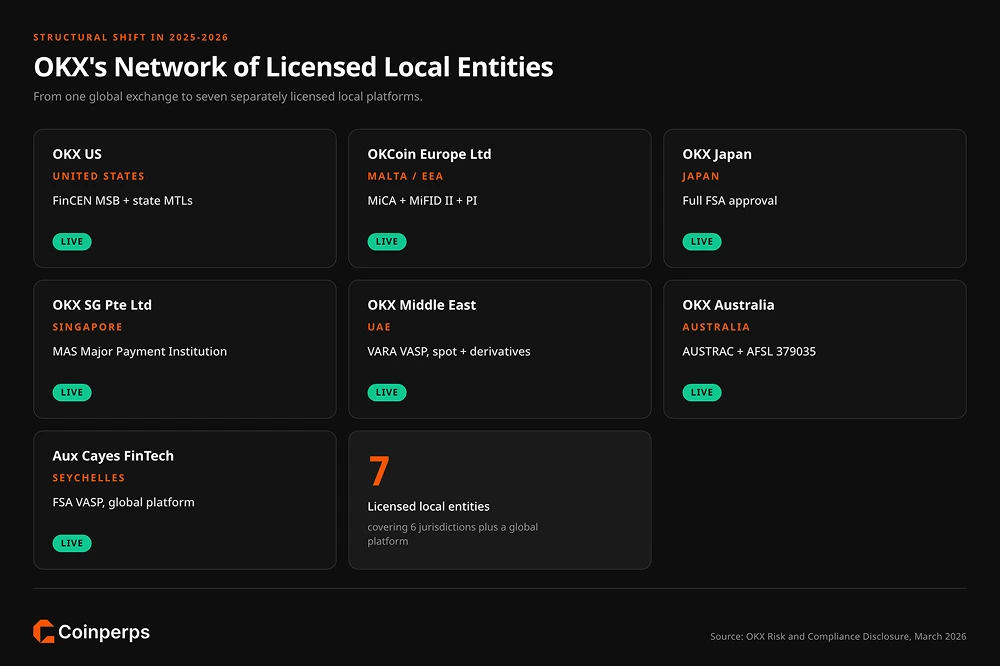
The most significant structural change at OKX over the past 18 months is the move from a single global platform to a network of separately licensed local entities. A country can appear on the restricted list (meaning the global platform is unavailable) while still having a fully functional local OKX entity operating under a domestic license.
The current licensed entities are:
- OKX US (OKcoin USA Inc.): Live since April 2025, registered with FinCEN and licensed as a Money Transmitter in most states. Led by US CEO Roshan Robert, headquartered in San Jose. Kentucky, New York, Texas, and all US territories remain excluded.
- OKCoin Europe Ltd (Malta): MiCA-licensed by the MFSA in January 2025, also holds a MiFID II license for derivatives (March 2025) and a Payment Institution license (February 2026). Passported across all 30 EEA states.
- OKX Japan: Holds full FSA approval following OKX's acquisition of BitTrade, ranking among the top three Japanese exchanges.
- OKX SG Pte Ltd: Holds a Major Payment Institution (MPI) license from the Monetary Authority of Singapore since September 2024, led by former MAS official Gracie Lin.
- OKX Middle East Fintech FZE: Holds a full VARA VASP license from Dubai's Virtual Assets Regulatory Authority, covering spot and derivatives for qualified retail and institutional clients.
- OKX Australia Pty Ltd: AUSTRAC-registered for spot, with derivatives offered through OKX Australia Financial Pty Ltd under AFSL 379035.
- Aux Cayes FinTech Co. Ltd: Seychelles-licensed entity that operates the global OKX platform for jurisdictions without a local entity.
The takeaway is that "restricted" in OKX terms increasingly means "use the local entity instead," not "go away." US, Japanese, Singaporean, Emirati, and Australian users sign up directly with the relevant local platform. EU users sign up through the MiCA-passported Maltese entity. The full MiCA transitional period ends on 1 July 2026 with no extensions, after which any exchange serving EU residents without a MiCA license is operating illegally.
If you need a side-by-side comparison against the other major derivatives venues, our Binance vs OKX and Bybit vs OKX breakdowns cover fees, leverage, liquidity, and licensing in detail.
Does OKX Require Mandatory KYC Verification?
Yes. OKX requires full KYC verification across every entity, with no anonymous tier on any of its CEX products. The standard process is reviewed within 24 hours and requires:
- A government-issued photo ID (passport, driver's license, or national ID card)
- A live selfie or video verification
- Proof of address for higher trading and withdrawal limits (utility bill, bank statement, or government correspondence)
Each local entity layers on additional country-specific checks tied to its license: AUSTRAC requirements in Australia, MAS rules in Singapore, FSA rules in Japan, and FinCEN plus state-level checks in the US. Detailed instructions are available on the OKX verification page.
EEA users are also subject to the EU's Transfer of Funds Regulation (the Travel Rule), enforceable since 30 December 2024. Transfers above EUR 1,000 to or from a self-hosted wallet typically require proof of wallet ownership through a Satoshi test or signed message.
Can You Access OKX with a VPN?
No, not in any reliable way. OKX uses device fingerprinting, IP geolocation, phone country codes, bank account residency, and KYC document checks to detect location mismatches. A US bank deposit paired with a German IP address will get flagged automatically and can result in permanent account closure with frozen funds.
A VPN may let an existing, fully verified user access their account temporarily while travelling, but it will not get a new user through KYC in a restricted country. Attempting to bypass restrictions violates the OKX Terms of Service, and the platform has closed tens of thousands of accounts caught through these checks. Users genuinely needing a no-KYC venue should look at Hyperliquid or other decentralized perpetual exchanges rather than relying on a VPN.
Best Alternatives if OKX is Unavailable in Your Country
If OKX is blocked in your region (or only available on spot), the right replacement depends on what you need to trade and what is licensed locally. Our region-specific picks:
- United States: Kraken is the most trusted spot option, registered with FinCEN and licensed in most states. For derivatives, Coinbase Perpetuals offers CFTC-regulated nano BTC and ETH contracts.
- Canada: Bitbuy and Kraken Canada both hold FINTRAC registration as Money Services Businesses, with CAD rails through Interac e-Transfer. Full Kraken restrictions breakdown here.
- Japan: OKX Japan itself is the answer (top-three FSA-approved exchange), with bitFlyer and Bitbank as the next-largest local alternatives.
- India: WazirX, CoinDCX, and Mudrex are the dominant FIU-IND registered exchanges, subject to the flat 30% capital gains tax and 1% TDS on all sales.
- Hong Kong: OSL and HashKey are the only two retail-licensed SFC platforms in the city.
- United Kingdom (derivatives): Retail crypto perpetuals remain banned. The legitimate options are decentralized perpetuals on Hyperliquid or UK-listed crypto ETNs following the October 2025 FCA rule change.
- Australia (higher-leverage derivatives): Bybit and Binance both operate locally and offer retail derivatives subject to ASIC product-intervention orders. Compare them directly on our exchanges directory.
- Brazil (derivatives): Bybit and Binance remain the deepest derivatives venues for Brazilian users, alongside on-chain alternatives like Hyperliquid.
- European Union: OKX's own MiCA-licensed Maltese entity covers all 30 EEA states. Alternatives include Bybit EU (FN 636180i, FMA Austria), Kraken, and Coinbase, all now operating under MiCA.
For traders specifically focused on non-custodial venues, the Hyperliquid restricted countries guide covers what is and is not accessible there, and the How to Use Hyperliquid in the USA walkthrough covers the workaround path for US-based users.
Always confirm local licensing before depositing. Compliant access protects both your funds and your tax position.

Bottom Line
OKX's restricted-countries list looks similar to what it did a year ago, but the meaning has changed. The platform has moved from one global exchange with a long block-list to a network of separately licensed local entities that absorb users who would previously have been excluded.
France leaving the restricted list, the relaunch of OKX US after the DOJ settlement, the consolidation of EU operations into a single Maltese MiCA entity, and the addition of Japan, Singapore, UAE, and Australia as fully licensed markets all point in the same direction.
For traders, the practical takeaway is to check both lists before assuming OKX is off the table: the global platform's restricted-locations list, and the availability of a local OKX entity in your country.
If neither works, our full perpetual exchanges directory and live funding rates tracker cover the working alternatives in every major region.