Best Crypto Exchanges in Mexico Ranked (2026)
Compare the best crypto exchanges in Mexico, from Binance and Bitso to Bybit, by local authorisation, SPEI funding, measured peso costs, tax rules and safety.

Coinperps may earn a commission from partner links, at no cost to you; rankings follow our methodology. Not financial advice.
Key takeaways
- Binance is the best crypto exchange in Mexico: it scores 9.3 with Coinperps, holds pesos through Medá, a payments institution authorised by the CNBV, and had the lowest cost in our samples. Bitso, the Mexican exchange with the deepest peso books, and Bybit, at 9.5, follow.
- The same MX$10,000 Bitcoin buy cost MX$14 or MX$81: our 27 November 2026 samples put Binance at about 0.14% all in and Bitso at about 0.81%, nearly all of it Bitso's 0.78% entry taker fee. Bitso's BTC/MXN book was more than four times deeper.
- Mexico has no crypto exchange licence: "regulated" means a peso payments affiliate authorised by the CNBV, an anti-money-laundering registration with the SAT, or both. New rules for crypto platforms apply from 30 November 2026.
- Dollar stablecoins trade at the bank rate: USDT changed hands within 0.2% of the mid-market rate on Bitso and Binance, while the best P2P adverts on Binance, Bybit, Bitget and OKX asked 0.5% to 0.9% more. Crypto tax rules are unsettled, and no deposit insurance covers coins on an exchange.
- Coinperps score
- 9.3
- Mexican status
- Medá, a CNBV-authorised payments institution
- Peso funding
- SPEI through Medá; P2P
- Entry spot fee (Maker / taker)
- 0.10% / 0.10%
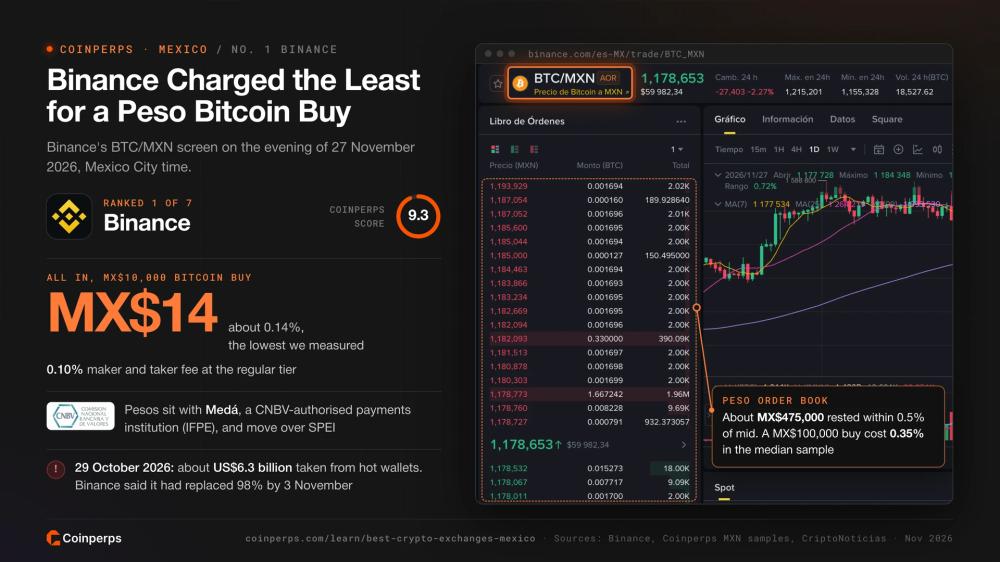
Binance is the best crypto exchange in Mexico for most buyers because it pairs a regulated peso channel with the lowest costs we measured.
Why it ranks #1 Checked Nov 28, 2026 · Partner link · Binance referral code · How we rank
- A Coinperps score of 9.3 and a CNBV-authorised payments arm, Medá, for pesos.
- The lowest cost in our samples, at about MX$14 on a MX$10,000 Bitcoin buy.
- Direct peso books for BTC, ETH, USDT, USDC and SOL, plus the largest peso P2P market.
Coinperps may earn a commission if you sign up through this link, at no cost to you. Rankings follow our method, not partner deals.
On this page 10 sections
The best crypto exchange in Mexico is Binance, followed by Bitso and Bybit. Our list of the best crypto exchanges in Mexico weighs each platform's place in our exchange rankings against its local status and the cost of a real purchase in pesos.
Mexico issues no crypto exchange licence. The strongest local status available is a payments affiliate authorised by the banking regulator, the CNBV, to hold customers' pesos. Binance and Bitso each have one.
We sampled Mexican peso (MXN) order books and peer-to-peer adverts on the evening of 27 November 2026, Mexico City time. Buying MX$10,000 of Bitcoin cost about MX$14 on Binance and about MX$81 on Bitso.
Spot trading comes first in this guide, and perpetual futures count as a bonus. Nothing here is legal, tax or investment advice.
Top 7 Crypto Exchanges in Mexico
Each of the seven exchanges below serves Mexican residents and takes pesos over SPEI, the instant interbank transfer system run by the central bank.
Exchange | Coinperps score | Mexican status | Peso funding | Entry spot fee (Maker / taker) | Best for | Visit |
|---|---|---|---|---|---|---|
9.3 | Medá, a CNBV-authorised payments institution | SPEI through Medá; P2P | 0.10% / 0.10% | Lowest measured peso cost | Visit Binance | |
None | Nvio Pagos México, a CNBV-authorised payments institution | Free SPEI | 0.60% / 0.78% | Large peso orders | Visit Bitso | |
9.5 | None found | SPEI; P2P; Mastercard | 0.10% / 0.10% | P2P and a local card | Visit Bybit | |
8.4 | SAT and UIF registration, self-reported | SPEI; OXXO Pay cash; P2P | 0.10% / 0.10% | Cash deposits at OXXO | Visit Bitget | |
5  OKX | 8.6 | None confirmed | SPEI to buy; P2P to sell | 0.08% / 0.10%Lowest | Low fees and published reserves | Visit OKX |
8.0 | None found | SPEI; pesos convert to US dollars | 0.40% / 0.80% | Buyers who hold dollars | Visit Kraken | |
7.3 | None found | SPEI at 0.116% plus MX$9.28 | 0.10% / 0.10% | Clear SPEI terms | Visit BingX |
 Kraken
 BingX
- Coinperps score
- 9.3
- Mexican status
- Medá, a CNBV-authorised payments institution
- Peso funding
- SPEI through Medá; P2P
- Entry spot fee (Maker / taker)
- 0.10% / 0.10%
Binance is the best crypto exchange in Mexico for most buyers because it pairs a regulated peso channel with the lowest costs we measured. It scores 9.3 in our rankings and is the only global exchange we found whose Mexican payments arm is authorised by the CNBV.
That arm is Medá, an Institución de Fondos de Pago Electrónico (IFPE), a company authorised to hold customers' pesos as electronic money and move them over SPEI. Binance presented Medá on 1 September 2025 and pledged more than MX$1 billion to Mexico over four years. Medá's authorisation dates from May 2022 and covers pesos only.
Deposits go by SPEI to a personal Medá account inside the Binance app and are credited within 30 minutes. You first verify your CURP, the 18-character national identity code. Withdrawals go to a CLABE, the 18-digit number of a Mexican bank account, in your own name and take one to three business days.
Neither page states a SPEI fee, and we could not confirm one. Monthly bank transfer limits start at the peso equivalent of US$5,000 in and US$10,000 out.
Binance is one of two exchanges with live peso order books in our check. Its API showed BTC, ETH, USDT, USDC and SOL trading against the peso, and its fee schedule charges 0.10% for makers and takers at the regular tier. A MX$10,000 Bitcoin buy cost about 0.14% all in, or about MX$14.
The peso books are thinner than Bitso's. About MX$475,000 of orders rested within 0.5% of the BTC/MXN mid price, and a MX$100,000 buy cost 0.35% in the median sample and 1.41% in the worst.
Attackers took about US$6.3 billion from Binance hot wallets, the online wallets used for withdrawals, on 29 October 2026. Binance paused withdrawals, reopened them in phases from 1 November and said in a 3 November report that it had replaced 98% of the missing assets. We could not confirm whether Medá peso withdrawals stopped during the pause.
Mexico News Daily reported on 1 September 2025 that the CNBV had opened an inquiry into irregular fundraising by Binance about five weeks earlier. We found no public outcome.
Binance's futures platform is reachable from Mexico, and we could not confirm the leverage limit applied to Mexican accounts. Sign up through Binance.
Pros
- A Coinperps score of 9.3 and a CNBV-authorised payments arm, Medá, for pesos.
- The lowest cost in our samples, at about MX$14 on a MX$10,000 Bitcoin buy.
- Direct peso books for BTC, ETH, USDT, USDC and SOL, plus the largest peso P2P market.
Cons
- A US$6.3 billion hot-wallet theft in October 2026.
- Thin BTC/MXN and ETH/MXN books for orders near MX$100,000.
- Peso withdrawals that take one to three business days.
- Coinperps score
- None
- Mexican status
- Nvio Pagos México, a CNBV-authorised payments institution
- Peso funding
- Free SPEI
- Entry spot fee (Maker / taker)
- 0.60% / 0.78%
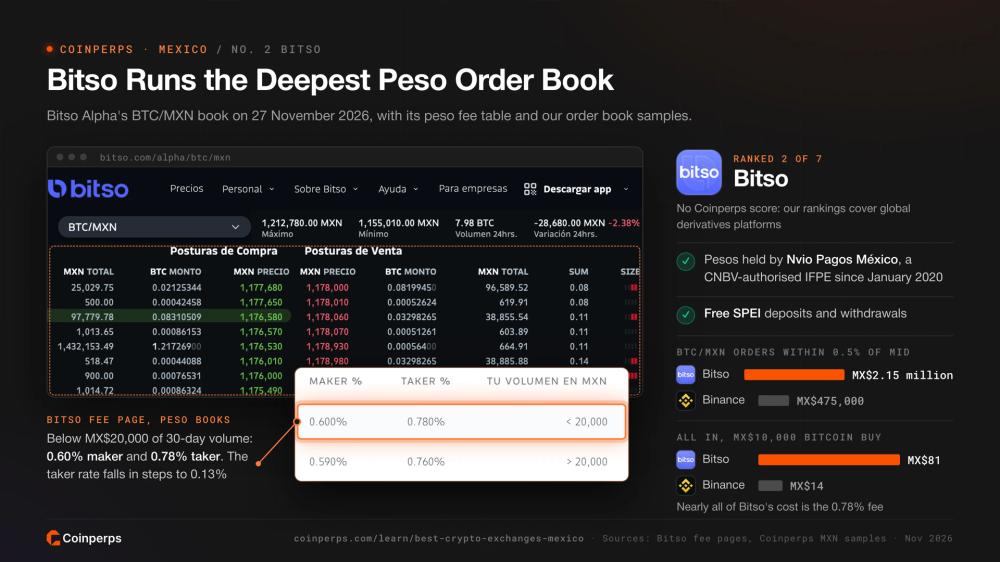
Bitso is the best Mexican exchange and the stronger choice for large peso orders. It was founded in Mexico in 2014 and had the deepest peso order books in our samples. It has no Coinperps score, because our rankings cover global derivatives platforms.
Bitso's peso wallet is run by Nvio Pagos México, the first company authorised under the Ley Fintech, Mexico's 2018 financial technology law. The CNBV authorised Nvio as an IFPE in January 2020. Bitso's safety page places crypto trading under a Gibraltar licence held by a group company.
Bitso's blog says it "holds registration with the CNBV". That describes its affiliates, and the exchange itself holds no Mexican authorisation.
SPEI deposits and withdrawals are free, according to Bitso's transaction fee page, and the page lists no OXXO or other cash deposit. Bitcoin withdrawals are free over the Lightning Network. Third-party guides say an account needs an INE voter card or a passport.
The order book, called Bitso Alpha, listed 11 peso books in our check, among them BTC, ETH, USDT, SOL and XRP. Bitso's fee page charges 0.60% for makers and 0.78% for takers on peso books below MX$20,000 of 30-day volume. The taker rate falls in steps to 0.13% at the top tier.
A MX$10,000 Bitcoin buy cost about 0.81% all in, or about MX$81, and nearly all of it was the fee. About MX$2.15 million of orders rested within 0.5% of the BTC/MXN mid price, and a MX$100,000 buy moved the price by 0.03%.
The app's simple buy screen charges no commission and builds its cost into a spread shown before you confirm. Third-party guides put that spread at 1% to 2%, and we could not measure it. The order book API listed 32 coins, against more than 200 claimed for the app.
Bitso denied a breach of its systems in March 2025 after a database of alleged customer details circulated on forums, according to Publimetro. Its status page logged at least eight incidents in November 2026, among them SPEI delays and a peso outage on 10 November.
Bitso added perpetual futures on 9 November 2026 through Hyperliquid, a decentralised exchange, at up to 50x. Its pages do not say whether Mexican residents are eligible. Open an account at Bitso.
Pros
- The deepest peso books in our samples, at MX$2.15 million within 0.5% of the BTC/MXN mid price.
- Free SPEI deposits and withdrawals through a CNBV-authorised payments institution.
- Eleven direct peso books.
Cons
- A 0.78% entry taker fee, about MX$81 on a MX$10,000 Bitcoin buy.
- No Coinperps score, and a proof of solvency that Bitso says covers Bitcoin and Ether only.
- Repeated SPEI incidents on its status page in November 2026.
- Coinperps score
- 9.5
- Mexican status
- None found
- Peso funding
- SPEI; P2P; Mastercard
- Entry spot fee (Maker / taker)
- 0.10% / 0.10%
Bybit holds our top score, 9.5, and suits Mexicans who want a large global exchange with P2P trading and a local card. It ranks third because we found no Mexican registration and no peso order book.
Bybit's own SPEI guide confirms peso purchases by SPEI and shows fees and limits only inside each order. Third-party guides add SPEI withdrawals since late 2024, no deposit fee, a peso balance and sign-up with an INE or passport plus CURP.
Bybit's spot API listed 494 pairs in our check and none against the peso. Pesos are swapped for USDT on a convert screen or through P2P, where the price carries a spread.
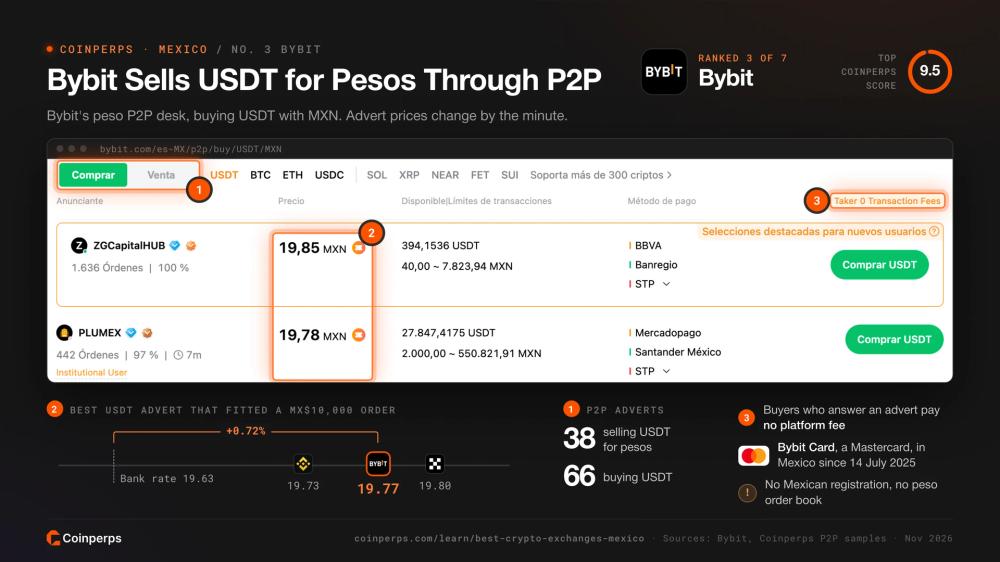
It had the second-highest count of adverts selling USDT for pesos, at 38, and 66 adverts buying it. The best advert that fitted a MX$10,000 order priced USDT at MX$19.77, 0.72% above the bank rate.
Spot trades cost 0.10% for makers and takers at the entry tier once you hold USDT. The Bybit Card reached Mexico on 14 July 2025 as a Mastercard at no annual fee.
Bybit lost about US$1.5 billion to a hack in February 2025 and said it covered the loss in full. It reports US$17.3 billion of assets in its 41st proof of reserves, a check that customer balances are backed by coins the exchange holds.
Perpetual futures on Bybit cost 0.02% for makers and 0.055% for takers. Sign up through Bybit.
Pros
- The top Coinperps score, 9.5.
- The second-highest count of adverts selling USDT for pesos in our samples, plus a Mastercard for Mexico.
- A 0.10% entry spot fee.
Cons
- No Mexican entity or registration found.
- No peso order book, so pesos convert at a quoted price or through P2P.
- SPEI fees and limits that we could not confirm on Bybit's own pages.
- Coinperps score
- 8.4
- Mexican status
- SAT and UIF registration, self-reported
- Peso funding
- SPEI; OXXO Pay cash; P2P
- Entry spot fee (Maker / taker)
- 0.10% / 0.10%
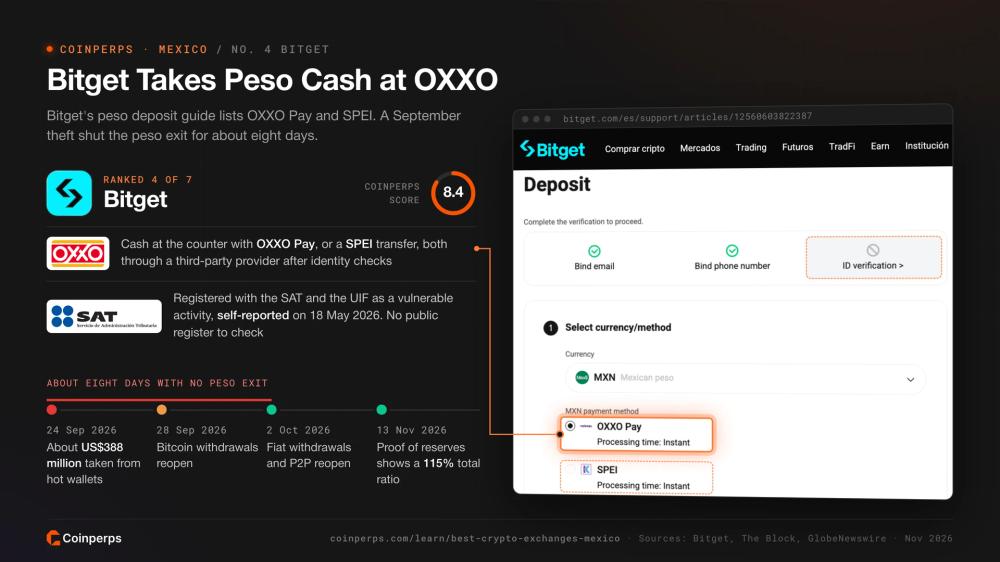
Bitget is the best choice for Mexicans who want to fund an account in cash. It accepts OXXO Pay, which lets you pay at the counter of an OXXO convenience store, alongside SPEI. Its Coinperps score is 8.4.
Bitget announced on 18 May 2026 that it had registered as a "vulnerable activity" with the tax authority, the SAT, and with the UIF, the finance ministry's financial intelligence unit. That is an anti-money-laundering registration and carries no licence. Bitget did not name the registered company, and we found no public register to check the claim.
Bitget's deposit guide lists OXXO Pay and SPEI, both through a third-party provider and after identity verification. Third-party comparisons quote MX$5 per SPEI transfer and 4% for OXXO Pay, and we could not confirm either fee on a Bitget page.
Bitget turns USDT or USDC into pesos and pays them to accounts at more than 35 Mexican institutions through partner firms, according to CriptoNoticias. Its spot API listed no peso pairs, and its P2P market showed 12 adverts selling USDT.
Attackers took about US$388 million from Bitget hot wallets on 24 September 2026 through a flaw in a third-party security product. Bitget reopened Bitcoin withdrawals on 28 September and fiat withdrawals and P2P on 2 October. Mexican users had no peso exit for about eight days.
Bitget said its Protection Fund covered the loss. Its latest proof of reserves, dated 13 November 2026 and so after the hack, shows a total ratio of 115%. Spot trades cost 0.10% for makers and takers at the entry tier.
Bitget also lists perpetual futures, which sit outside any Mexican supervision. Sign up through Bitget.
Pros
- Cash funding through OXXO Pay, plus SPEI.
- A Coinperps score of 8.4 and a 0.10% entry spot fee.
- Peso payouts to more than 35 Mexican institutions.
Cons
- A US$388 million theft in September 2026 that froze fiat withdrawals and P2P for about eight days.
- A Mexican registration that is self-reported and cannot be checked publicly.
- No peso order book, and funding fees we could not confirm.
- Coinperps score
- 8.6
- Mexican status
- None confirmed
- Peso funding
- SPEI to buy; P2P to sell
- Entry spot fee (Maker / taker)
- 0.08% / 0.10%
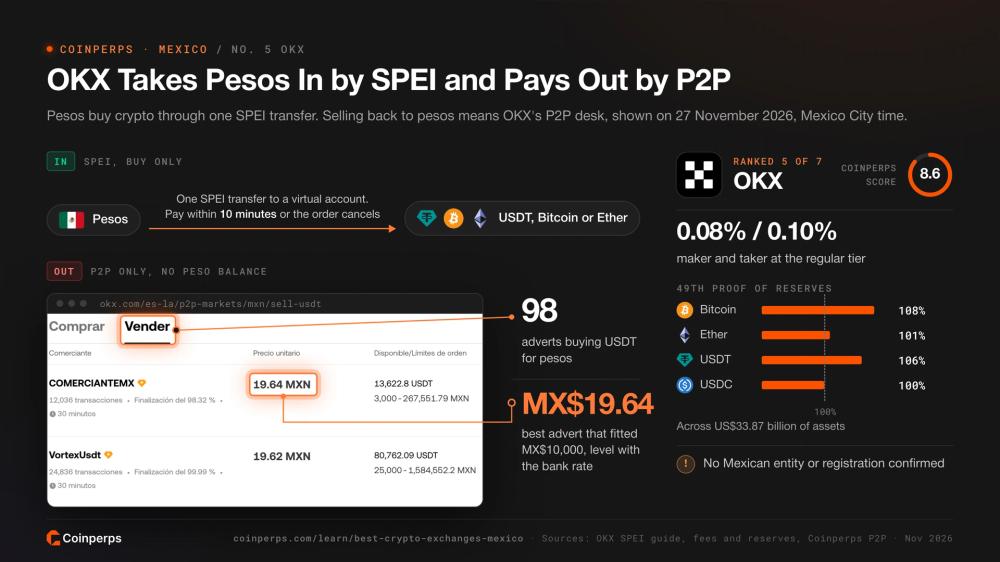
OKX works best for Mexicans who buy with pesos once and then trade at low fees on a global order book. It scores 8.6 with us and publishes a detailed proof of reserves. It ranks fifth because pesos enter through a buy-only screen and leave only through P2P.
OKX's SPEI guide describes one transfer to a virtual account that converts pesos straight into USDT, Bitcoin or Ether. You must pay within 10 minutes or the order cancels, and a purchase cap over each 30-day period applies. A third party provides the service, OKX says it may not be open to every customer, and the page states no fee.
OKX holds no peso balance. Its spot API listed 1,250 pairs and none against the peso, and we found no SPEI withdrawal on its pages. Selling for pesos means P2P, where OKX showed 98 adverts buying USDT. The best one that fitted a MX$10,000 order paid MX$19.64, level with the bank rate.
OKX's fee page puts the regular tier at 0.08% for makers and 0.10% for takers. It adds that fees vary by region, and we could not confirm a schedule for Mexico.
Its 49th proof of reserves showed Bitcoin backed at 108%, Ether at 101%, USDT at 106% and USDC at 100%, across US$33.87 billion of assets. We found no Mexican entity or registration for OKX and no security incident in 2026.
OKX runs one of the larger perpetual markets in our rankings. Its pages did not tell us which derivatives Mexican accounts can open. Sign up through OKX.
Pros
- A Coinperps score of 8.6 and a 0.10% taker fee at the global regular tier.
- Reserves of 100% or more on Bitcoin, Ether, USDT and USDC in its 49th report.
- The second-largest pool of P2P buyers for USDT in our samples.
Cons
- SPEI works for buying only, and no peso balance is held.
- No peso order book, so the only exit is P2P.
- No Mexican registration confirmed, and no fee stated for the SPEI service.
- Coinperps score
- 8.0
- Mexican status
- None found
- Peso funding
- SPEI; pesos convert to US dollars
- Entry spot fee (Maker / taker)
- 0.40% / 0.80%
Kraken suits cautious buyers who are content to hold US dollars. Its peso terms are published in full, and we found no security incident there in 2026. Its Coinperps score is 8.0.
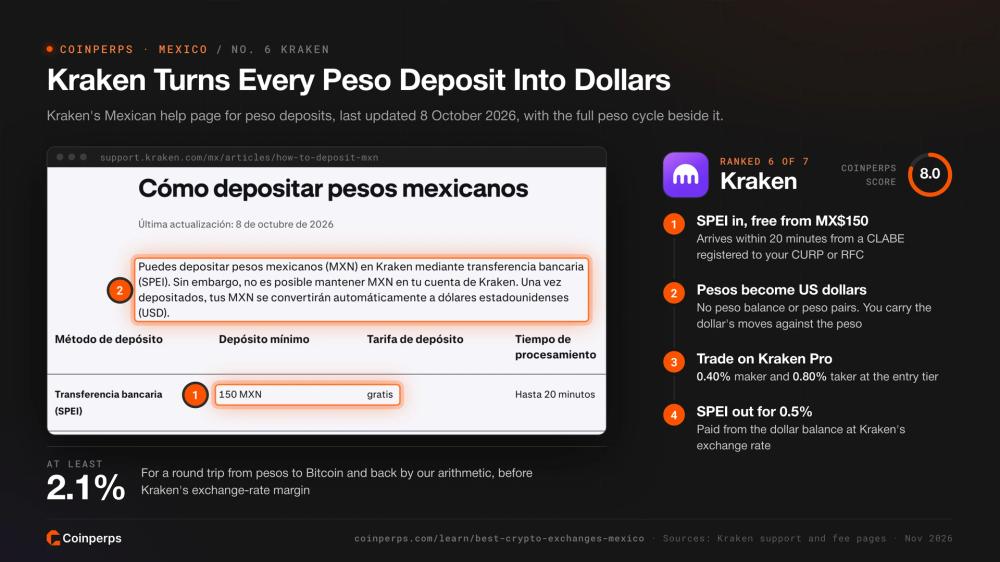
Kraken added local funding for Mexico on 10 July 2025. SPEI deposits are free from MX$150 and arrive within 20 minutes. They must come from a CLABE registered to your CURP or your RFC, the taxpayer number. The Spanish version agrees, but snippets of other versions show 0.5%, so confirm in the app.
A peso deposit converts to US dollars on arrival, and a SPEI withdrawal is paid from the dollar balance at Kraken's exchange rate for a 0.5% fee. You carry the dollar's moves against the peso in between.
Kraken's API listed no peso trading pairs, and it has no P2P market.
Kraken Pro charges 0.40% for makers and 0.80% for takers at the entry tier, and the instant buy screen costs 1% plus a spread. A round trip from pesos to Bitcoin and back costs at least 2.1% by our arithmetic, before Kraken's exchange-rate margin.
Kraken lists more than 350 assets. It runs a derivatives platform outside the United States, and its eligibility page does not exclude Mexico. Sign up through Kraken.
Pros
- Free SPEI deposits from MX$150, on terms published in full.
- No security incident found in 2026, and a Coinperps score of 8.0.
- More than 350 assets.
Cons
- Pesos convert to US dollars on arrival, and no peso pairs exist.
- A 0.80% entry taker fee on Kraken Pro and 0.5% on peso withdrawals.
- No Mexican registration found, and no P2P market.
- Coinperps score
- 7.3
- Mexican status
- None found
- Peso funding
- SPEI at 0.116% plus MX$9.28
- Entry spot fee (Maker / taker)
- 0.10% / 0.10%
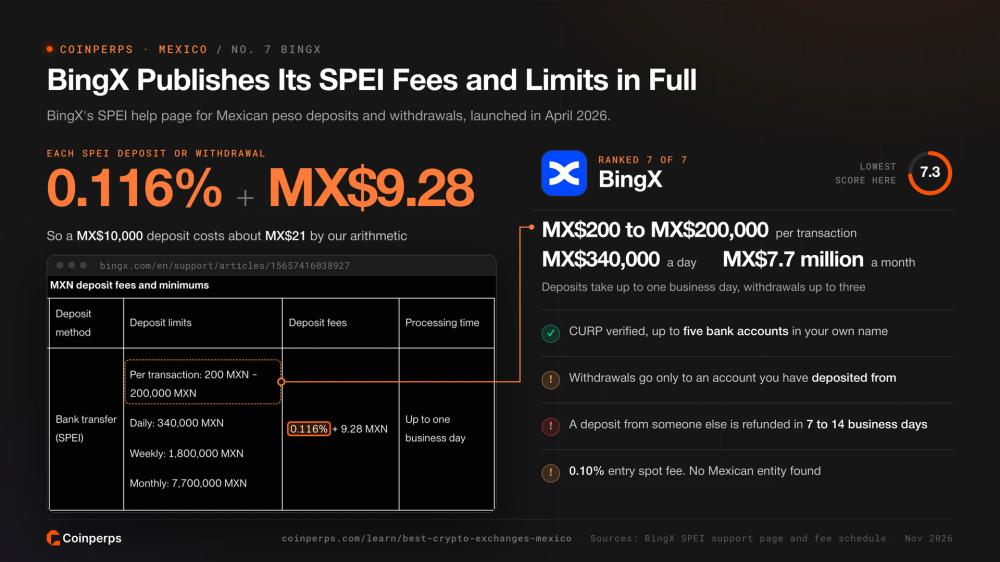
BingX publishes the clearest SPEI terms of any global exchange we checked. It scores 7.3 with us, the lowest on this list, and launched peso transfers in April 2026.
Its SPEI page sets deposits and withdrawals at MX$200 to MX$200,000 per transaction, up to MX$340,000 a day and MX$7.7 million a month. Each transfer costs 0.116% plus MX$9.28, so a MX$10,000 deposit costs about MX$21 by our arithmetic. Deposits can take up to one business day and withdrawals up to three.
You verify your CURP, link at most five bank accounts in your own name and withdraw only to an account you have already deposited from. A deposit from an account in another name is refunded in 7 to 14 business days.
BingX's fee schedule sets the entry spot fee at 0.10% for makers and takers. We found no Mexican entity, and BingX was outside our order book and P2P samples.
Perpetual futures are the product behind BingX's place in our rankings. Sign up through BingX.
Pros
- Published SPEI limits and a stated fee of 0.116% plus MX$9.28 each way.
- Deposits and withdrawals in pesos, up to MX$7.7 million a month.
- A Coinperps score of 7.3.
Cons
- The lowest score on this list, and no Mexican entity found.
- No peso pairs or P2P market confirmed.
- Withdrawals only to a bank account you have deposited from.
How We Ranked These Exchanges
We ranked the best crypto exchanges in Mexico on our global scores, on local authorisation, on peso funding and on the costs we measured. Bybit scores 9.5 and still sits third, below two exchanges that hold pesos through a CNBV-authorised institution and run peso order books.
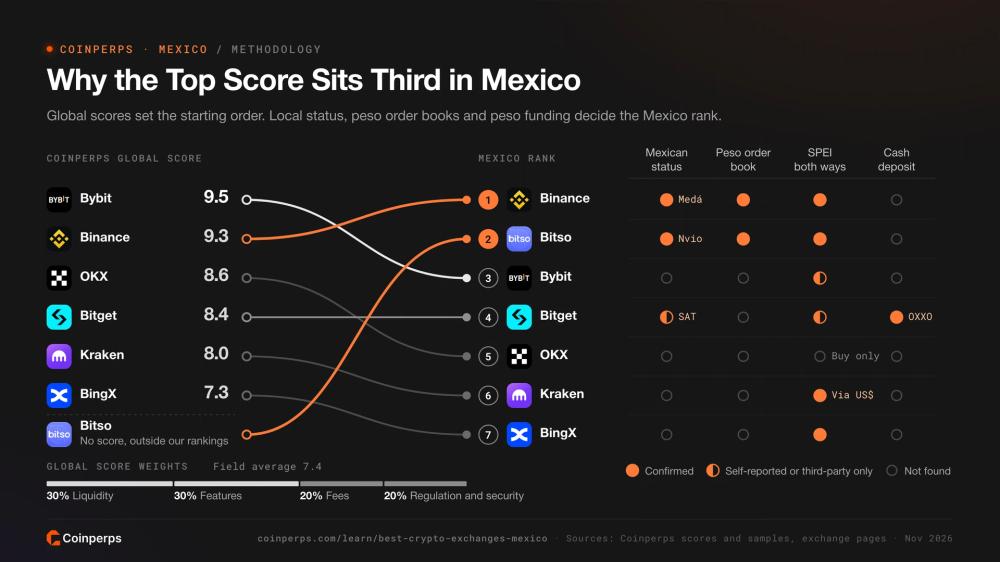
- Coinperps scores: our ranking methodology weights liquidity 30%, features 30%, fees 20% and regulation and security 20%. The field average is 7.4.
- Mexican authorisation or registration: a CNBV-authorised payments institution counts for most, and a self-reported SAT registration for less.
- Peso funding: we checked SPEI in both directions, cash options and published fees.
- Measured cost: we priced MX$10,000 and MX$100,000 purchases on peso order books and P2P adverts.
- Track record: we checked thefts, outages, regulator inquiries and proof of reserves.
Binance takes first place because it combines the second-highest score with an authorised peso arm, direct peso books and the lowest cost in our samples. Its October theft is the main argument against it.
Bitso has no Coinperps score and still ranks second. Its BTC/MXN book was more than four times deeper than Binance's, and SPEI is free both ways. Its 0.78% entry fee keeps it behind Binance.
Bitget ranks above OKX despite a lower score and its September theft, because it takes cash and reports a Mexican registration.
Exchanges That Missed the List
- MEXC: MEXC scores 7.3 and advertises SPEI. Its "MXN" market priced USDT 4.3% below the bank rate in our samples, so that balance does not behave like bank pesos. Dubai's regulator fined its operator in June 2026.
- KuCoin: it scores 8.2 and pays pesos out through KuCoin Pay. We found no SPEI deposit, and its P2P market had five adverts selling USDT.
- Gate: Gate scores 8.8, third in our rankings. We found no SPEI funding and no peso pairs.
- Coinbase: its exchange API listed no peso pairs, and third-party guides report no SPEI funding.
- Crypto.com: it scores 6.8, and a November 2026 review found no peso support.
- Mercado Pago: the wallet app sells Bitcoin and Ether at a reported 1.5% per trade. We could not confirm withdrawals to an outside wallet.
- TruBit: the former Mexo is live but small, and we could not confirm any Mexican authorisation.
- Volabit and Tauros: Volabit closed in 2023, and Tauros's site did not respond on 28 November 2026. Some guides still list both.
Is Crypto Legal in Mexico
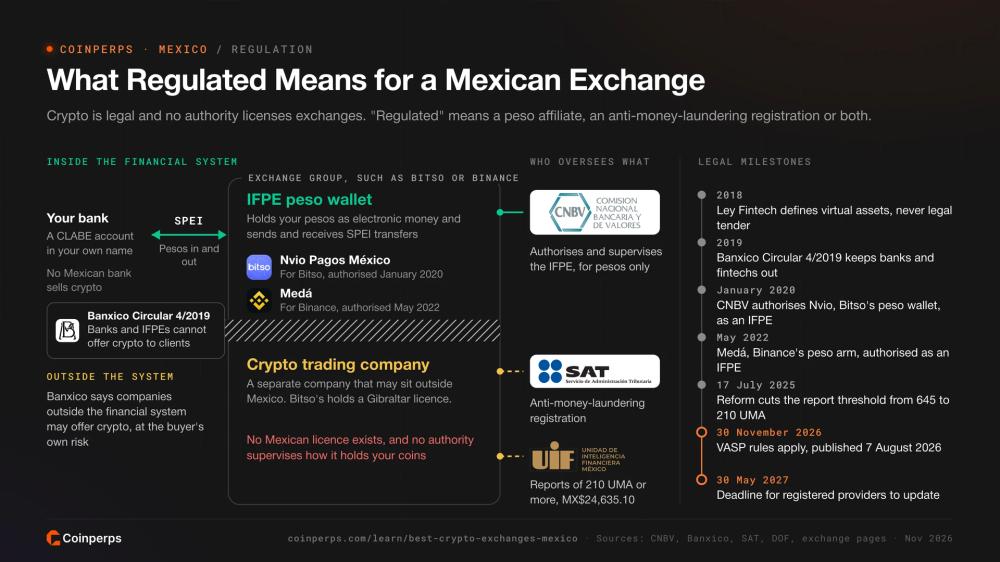
Buying, selling and holding crypto is legal in Mexico, and no authority issues a crypto exchange licence. An exchange that calls itself regulated in Mexico is describing an anti-money-laundering registration, a payments affiliate, or both. Neither one supervises how the exchange holds your coins.
What the Ley Fintech and the Banxico Circular Say
The Ley Fintech of 2018 defines virtual assets and states that they are never legal tender. The central bank, Banxico, followed with Circular 4/2019, which limits banks and fintech institutions to internal uses of virtual assets and only with its prior authorisation. They cannot offer exchange, transfer or custody of crypto to clients.
Banxico's own explainer says companies outside the financial system may offer virtual asset services, at the buyer's own risk. No Banxico authorisation for a virtual asset operation is publicly known, which is why no Mexican bank sells crypto.
What an IFPE Covers
An IFPE authorisation covers pesos. The institution can hold your balance as electronic money and send and receive SPEI transfers. Circular 4/2019 bars it from selling or holding crypto for the public.
At Bitso and Binance alike the crypto side sits in a separate company. "CNBV-authorised" therefore describes the peso wallet and says nothing about custody of your coins.
The Anti-Money-Laundering Registration
Mexico's anti-money-laundering law, known by its initials LFPIORPI, treats a crypto platform as a "vulnerable activity". The platform must register with the SAT, identify every user, keep each file for 10 years and report large operations.
The reporting threshold is 210 UMA per operation, as the SAT's 2026 guidance confirms. The UMA is an official unit that rises with inflation each year and stands at MX$117.31 a day in 2026, which puts the threshold at MX$24,635.10.
A reform in force since 17 July 2025 lowered that threshold from 645 UMA. It also extended the law to operations carried out with Mexican citizens from another jurisdiction, in the words of the reform decree. Offshore exchanges are covered on paper, and we found no account of how Mexico enforces this abroad.
The VASP Rules in Force From 30 November
Amended general rules tighten the registration chapter for virtual asset service providers (VASPs), the standard term for crypto platforms. They were published on 7 August 2026 and apply from 30 November 2026, under the official text. Providers that are already registered have six months, until 30 May 2027, to update their registration.
The rules require platforms to record the sender and recipient of each transfer, keep the data for 10 years and report suspicious activity within 24 hours. Expect more identity checks and source-of-funds questions on peso withdrawals.
How to Check an Exchange
- Find the company that holds your pesos in the app's terms, such as Nvio Pagos México for Bitso or Medá for Binance.
- Search for that company in the CNBV's Padrón de Entidades Supervisadas, its register of supervised entities.
- Treat a claimed SAT registration as self-reported. We found no public search of the SAT's vulnerable-activity register.
- Read which company contracts with you for crypto. It may sit outside Mexico, as Bitso's Gibraltar entity does.
What It Costs to Buy Crypto With Pesos
The cost of buying crypto with pesos is the trading fee, plus the spread, plus any gap between the exchange's price and the bank exchange rate. In our 27 November 2026 samples a MX$10,000 Bitcoin buy cost about MX$14 on Binance and about MX$81 on Bitso, the only two exchanges with peso order books.
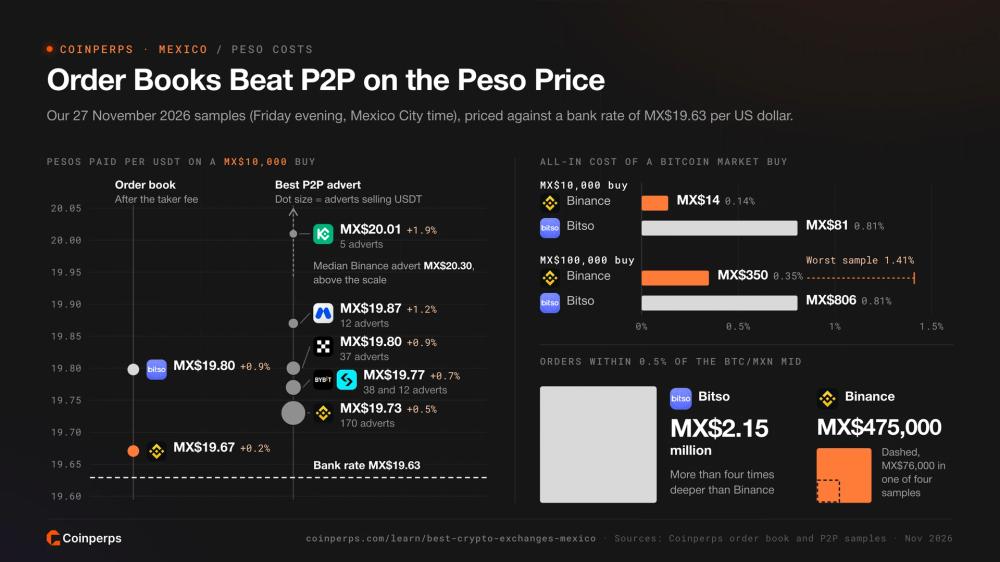
We sampled each public order book four times between 21:30 and 21:41 on Friday 27 November 2026, Mexico City time, and used the median. The reference was Coinbase's US dollar Bitcoin price converted at a mid-market bank rate of MX$19.63 per dollar, about MX$1,175,500 per Bitcoin. A Friday evening is a quiet hour, so read the figures as one snapshot.
We also asked the public APIs of 15 platforms for peso markets. OKX, Bybit, Bitget, KuCoin, Kraken, Gate, Coinbase and Crypto.com listed no BTC/MXN or USDT/MXN pair.
What a Bitcoin Buy Costs on Peso Order Books
Exchange | Taker fee used | MX$10,000 buy | In pesos | MX$100,000 buy | In pesos | Visit |
|---|---|---|---|---|---|---|
1  BinanceBest overall | 0.10%Lowest | About 0.14% | About MX$14 | About 0.35% | About MX$350 | Visit Binance |
2  Bitso | 0.78% | About 0.81% | About MX$81 | About 0.81% | About MX$806 | Visit Bitso |
All-in cost adds the entry-level taker fee to the price impact of a market buy and excludes deposit and withdrawal fees. Binance's MX$100,000 figure ranged from 0.34% to 1.41% across the four samples because its book is thin.
An investor who buys MX$10,000 of Bitcoin a month would pay about MX$800 more a year on Bitso's order book than on Binance's. A limit order that rests on Bitso's book pays the 0.60% maker rate, and our explainer on maker and taker fees shows how that works.
Peso Order Book Depth
Depth shows how much you can trade before the price moves. The mid price is the midpoint between the best buy and sell orders, and the spread is the gap between them.
Order book | Spread | Orders within 0.1% of mid | Orders within 0.5% of mid | Price impact of a MX$100,000 buy |
|---|---|---|---|---|
| Bitso BTC/MXN | 0.05% | MX$287,000 | MX$2,154,000 | 0.03% |
| Binance BTC/MXN | 0.07% | MX$35,000 | MX$475,000 | 0.25% |
| Bitso ETH/MXN | 0.11% | MX$397,000 | MX$1,988,000 | 0.05% |
| Binance ETH/MXN | 0.23% | None in three of four samples | MX$71,000 | About 15% |
Binance's BTC/MXN depth within 0.5% fell to MX$76,000 in one of four samples.
A MX$100,000 market order on Binance's ETH/MXN book would have moved the price by about 15%. Use a limit order there, or buy USDT with pesos first and then trade ETH/USDT.
Do Mexicans Pay a Premium for USDT
Mexicans pay no premium for dollar stablecoins on the order books. USDT and USDC traded within 0.2% of the mid-market bank rate on Bitso and Binance in our samples.
Order book | Spread | Mid price | Mid vs bank rate | Orders within 0.5% of mid | All-in cost of MX$10,000 | Pesos paid per dollar token |
|---|---|---|---|---|---|---|
| Binance USDT/MXN | 0.005% | MX$19.650 | +0.11% | MX$19.9 million | 0.10% | MX$19.67 |
| Binance USDC/MXN | 0.05% | MX$19.666 | +0.19% | MX$1.46 million | 0.13% | MX$19.69 |
| Bitso USDT/MXN | 0.005% | MX$19.643 | +0.07% | MX$7.59 million | 0.79% | MX$19.80 |
| Bitso USD/MXN | 0.013% | MX$19.662 | +0.17% | MX$25.3 million | 0.79% | MX$19.82 |
After fees a buyer paid about 0.2% over the bank rate for USDT on Binance and about 0.9% over on Bitso. Bitso's USD/MXN book is its USDC market. One large sell order of about MX$17 million made up most of Binance's USDT depth.
Our two bank rate sources differed by 0.60% because the peso weakened during Friday, and we used the later one.
P2P Prices and Advert Counts
Peer-to-peer (P2P) trading means you pay another user by bank transfer while the platform holds the USDT in escrow until the seller confirms the pesos. Buyers who respond to an advert pay no platform fee, and the advertiser sets the price.
Platform | Adverts selling USDT | Best buy price | Buy vs bank rate | Adverts buying USDT | Best sell price | Sell vs bank rate | Visit |
|---|---|---|---|---|---|---|---|
1 BinanceBest overall | 170 | MX$19.73 | +0.51% | 151 | MX$19.70 | +0.36% | Visit Binance |
3  Bybit | 38 | MX$19.77 | +0.72% | 66 | MX$19.68 | +0.26% | Visit Bybit |
5 OKX | 37 | MX$19.80 | +0.87% | 98 | MX$19.64 | +0.06% | Visit OKX |
4  Bitget | 12 | MX$19.77 | +0.72% | 17 | MX$19.57 | -0.30% | Visit Bitget |
 MEXC | 12 | MX$19.87 | +1.23% | 14 | MX$19.54 | -0.45% | |
 KuCoin | 5 | MX$20.01 | +1.94% | 21 | MX$19.30 | -1.68% |
Best prices are per USDT, from the best advert that accepted a MX$10,000 order. P2P cost more than the order book for a small purchase. Binance's own USDT/MXN book delivered USDT at MX$19.67 after fees, cheaper than every advert we saw. Sellers fared better, and the best adverts on Binance and Bybit paid slightly above the bank rate.
The median advert selling USDT on Binance asked MX$20.30, which is 3.4% above the bank rate, so sort by price and check each advert's limits. Our list of the best P2P crypto exchanges compares the platforms.
SPEI, OXXO and Cash Funding
SPEI is free at Bitso and on Kraken deposits, costs 0.116% plus MX$9.28 at BingX and 0.5% on Kraken withdrawals. Binance states no fee. For cash, Bitget takes OXXO Pay at a fee we could not confirm, and OXXO appeared on 33 of Binance's 170 P2P adverts selling USDT, 7-Eleven on 20 and Mercado Pago on 45.
Crypto Tax in Mexico
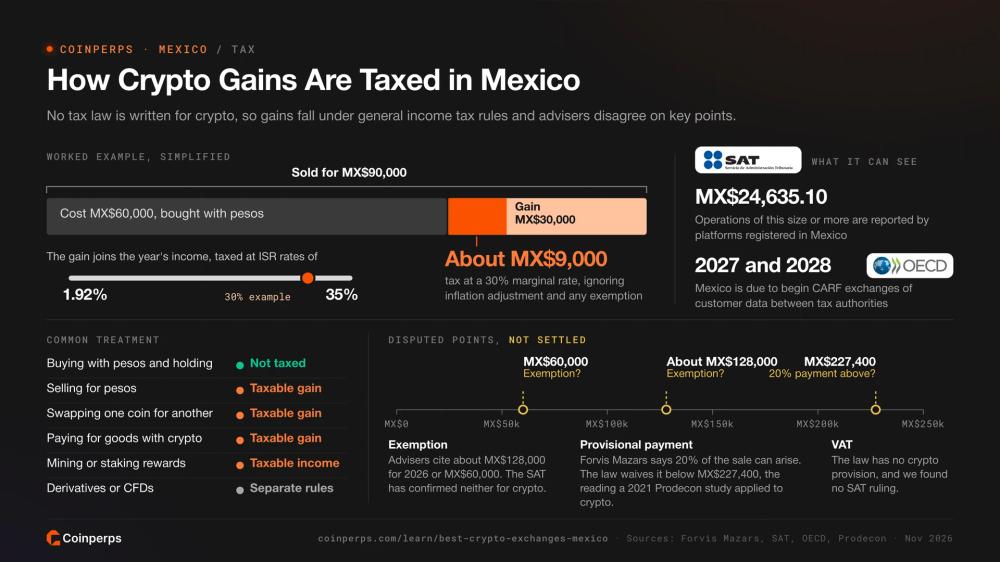
Mexico has no tax law written for crypto, so gains are taxed under general income tax rules and advisers disagree on key questions. The table below gives the common reading, and a Mexican accountant should confirm how it applies to you before you file.
Event | Common treatment |
|---|---|
Buying crypto with pesos and holding it | Not taxed |
Selling crypto for pesos | Taxable gain |
Swapping one coin for another | Taxable gain |
Paying for goods with crypto | Taxable gain |
Mining or staking rewards | Taxable income |
Trading derivatives or CFDs | Separate derivatives rules |
Gains made by individuals are generally treated as a sale of goods under the income tax, the ISR, according to Forvis Mazars. The gain is the sale price minus the cost, adjusted for inflation. It joins your other income for the year and is taxed at progressive rates of 1.92% to 35%, on a return due by 30 April.
Take a buyer who pays MX$60,000 for Bitcoin and sells it for MX$90,000. The MX$30,000 gain joins the year's income, and at a 30% marginal rate the tax would be about MX$9,000. This example ignores the inflation adjustment and any exemption.
Points That Advisers Dispute
- Exemption: some advisers cite the income tax law's exemption for movable goods, about MX$128,000 for 2026, and others cite MX$60,000. The SAT has not confirmed that either covers crypto, so do not plan around one.
- Provisional payment: Forvis Mazars says a provisional payment of 20% of the sale amount can arise. The income tax law waives it for sales of movable goods below MX$227,400, the reading a 2021 Prodecon study applied to crypto.
- VAT: the value added tax law has no crypto provision, and we found no SAT ruling on it.
What the SAT Can See
Platforms registered in Mexico report operations of MX$24,635.10 or more, and the rules in force from 30 November add sender and recipient data. Mexico has also committed to the Crypto-Asset Reporting Framework (CARF), under which exchanges report customer data that tax authorities share. The OECD lists Mexico among the countries due to begin exchanges in 2027 and 2028.
We found no Mexican rule that implements CARF yet. Some tax blogs date exchange reporting to the SAT from 1 April 2026. That date appears to match a separate rule on digital platforms, and no source we read confirms it covers exchanges.
Foreign exchanges issue no CFDI, the electronic tax invoice used in Mexico, so proof of cost is your job. Keep statements that show the date, peso value and fee of every trade. Penalties for omitted tax run from 55% to 75% of the amount, according to El Contribuyente.
Perpetual Futures and Leverage in Mexico
Perpetual futures are contracts with no expiry date that track a coin's price, and Mexicans can reach them only on platforms outside local supervision. We found no Mexican rule that bans an individual from trading them and none that authorises it. Treat them as an extra to a spot account.
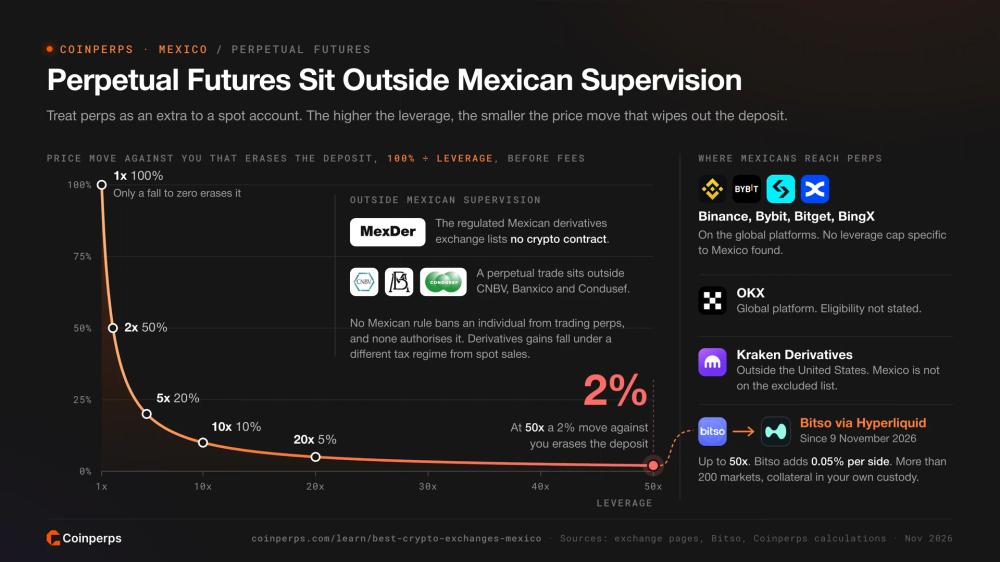
MexDer, the regulated Mexican derivatives exchange, lists no crypto contract that we found, so a perpetual trade sits outside the CNBV, Banxico and Condusef.
Exchange | Perpetuals | What we could confirm for Mexico |
|---|---|---|
Binance, Bybit, Bitget, BingX | Offered on the global platform | No leverage cap specific to Mexico found |
OKX | Offered on the global platform | Eligibility not stated on the pages we read |
Kraken | Kraken Derivatives outside the United States | Mexico is not on Kraken's list of excluded regions |
Bitso | Through Hyperliquid since 9 November 2026 | Up to 50x; Bitso adds 0.05% per side; eligibility not stated |
Bitso's product sends orders to Hyperliquid from inside Bitso Alpha. It covers more than 200 markets, including the S&P 500 and gold, and keeps collateral in the user's own custody.
At 50x a move of 2% against you erases the deposit. Our explainer on perps versus spot trading covers the mechanics, and derivatives gains fall under a different tax regime from spot sales.
Safety, Scams and What Protects You
No government scheme protects crypto held on an exchange in Mexico. The deposit insurance institute, IPAB, covers bank deposits only, and Banxico's explainer says virtual assets are bought at the user's own risk. Your protection is the exchange's solvency and your ability to withdraw.
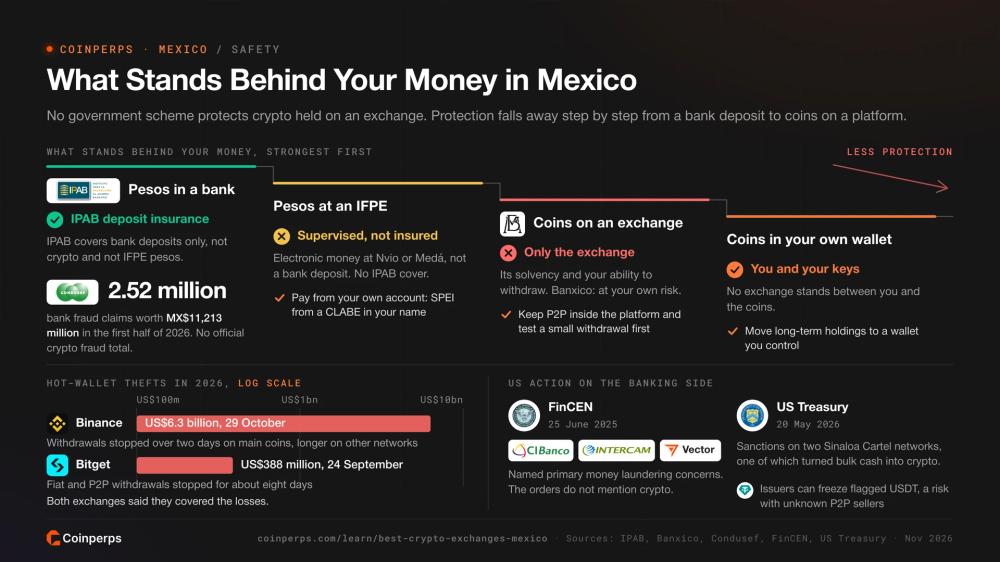
Pesos held at an IFPE such as Nvio or Medá are electronic money at a supervised institution. They are not bank deposits under the Ley Fintech and carry no IPAB cover.
Exchange Hacks and Outages
Binance and Bitget both suffered hot-wallet thefts in 2026. Binance lost about US$6.3 billion on 29 October and Bitget about US$388 million on 24 September, and each said it covered the losses. Withdrawals still stopped, for more than two days on Binance's main coins and longer on other networks, and for about eight days on Bitget's fiat and P2P services.
We found no hack or failure of a Mexican exchange between 2024 and 2026. Bitso's status page shows repeated SPEI delays, so a peso withdrawal can be slow even when the exchange is sound.
Bank Sanctions and Tainted Funds
Every peso deposit depends on a Mexican bank or payment partner. The US Treasury's FinCEN named three Mexican institutions, CIBanco, Intercam Banco and Vector Casa de Bolsa, as primary money laundering concerns on 25 June 2025. The orders do not mention crypto, and we found no documented effect on exchange customers.
The US Treasury also sanctioned more than a dozen people and entities in two Sinaloa Cartel networks on 20 May 2026, one of which turned bulk cash into cryptocurrency. Stablecoin issuers can freeze flagged addresses, so USDT bought from an unknown P2P seller carries a risk that an order book purchase does not.
Scams and Basic Precautions
Bank customers filed 2.52 million fraud claims worth MX$11,213 million in the first half of 2026, according to Condusef data reported by Expansión. The figure covers all bank fraud, and we found no official total for crypto fraud.
- Pay from your own account: SPEI deposits must come from a CLABE in your name.
- Keep P2P inside the platform: release coins only after the pesos arrive in your bank, and refuse payments from third parties.
- Test a withdrawal: send a small amount out before you build a balance.
- Hold your own keys: move long-term holdings to a wallet you control. Our list of the best USDT wallets covers the options.
How the Mexican Crypto Market Is Changing
Remittances and dollar stablecoins are the clearest drivers of Mexico's crypto market. Mexico received US$77.6 billion of crypto in the 12 months to 30 June 2026, up 25.5%, according to Chainalysis data reported by CriptoNoticias. That placed it third in Latin America.
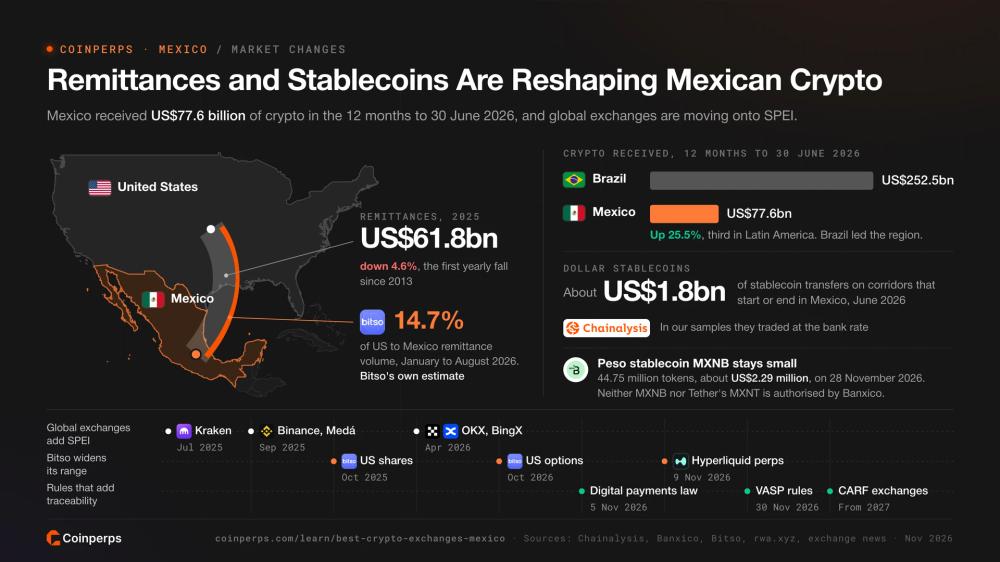
Brazil led the region at US$252.5 billion, and our guide to the best crypto exchanges in Brazil covers that market.
Remittances and Dollar Stablecoins
Mexico received US$61.8 billion of remittances in 2025, down 4.6% and the first yearly fall since 2013, on Banxico figures reported by El Financiero. Bitso says it processed 14.7% of remittance volume from the United States to Mexico between January and August 2026, according to Expansión.
That share is Bitso's own estimate. It counts Bitso as infrastructure for remittance companies and does not mean users sent the money through the Bitso app. Chainalysis put stablecoin transfers on corridors that start or end in Mexico at about US$1.8 billion in June 2026.
Dollar stablecoins traded at the bank rate in our samples, so we saw no sign of a rush out of the peso.
Peso Stablecoins Remain Small
Bitso's peso stablecoin, MXNB, had 44.75 million tokens in circulation on 28 November 2026, worth about US$2.29 million, according to rwa.xyz. Neither MXNB nor Tether's MXNT is authorised by Banxico.
A senator filed a bill in May 2026 to create peso stablecoins backed 1:1 by liquid reserves, Expansión reported. We found no committee vote. Banxico said in December 2025 that it would keep a "healthy distance" between digital assets and the financial system.
Global Exchanges Are Adding SPEI
Kraken added SPEI in July 2025, Binance presented Medá that September, and OKX and BingX followed in April 2026.
Bitso has answered by widening its range. It added US shares in October 2025, US options in October 2026 and Hyperliquid perpetuals in November 2026.
More Traceable Payments
A new digital payments law took effect on 5 November 2026. It introduces a digital CURP for opening accounts and lets the finance ministry require digital payment in named sectors, according to Greenberg Traurig. The law does not mention crypto.
Add the VASP rules of 30 November and the CARF exchanges due from 2027, and crypto transfers in Mexico are becoming easier for the authorities to trace.
Bottom Line
Binance is the best crypto exchange in Mexico for most buyers. It combines a Coinperps score of 9.3, a CNBV-authorised peso arm and the lowest cost in our samples, at about MX$14 on a MX$10,000 Bitcoin buy. The October 2026 theft and its thin peso books for large orders are the reasons to hesitate.
Bitso is the better choice for large peso orders and for anyone who wants a Mexican company and free SPEI. Bybit carries our top score and a strong P2P market but no local status. Bitget takes cash at OXXO, and OKX, Kraken and BingX suit narrower needs.
Whichever of the best crypto exchanges in Mexico you choose, no licence or insurance scheme stands behind your coins. Use an order book for purchases, keep records in pesos for the SAT, and move long-term holdings to a wallet you control.
FAQs
Is Binance legal in Mexico?
Yes. No Mexican law bans Binance, and Mexico issues no crypto exchange licence that it could hold or lack. Pesos move through Medá, a payments institution that the CNBV authorised in May 2022, and that authorisation covers pesos only. Since July 2025 the anti-money-laundering law has also covered foreign platforms that serve Mexicans, and we could not confirm a SAT registration for Binance. A CNBV inquiry reported in September 2025 has no public outcome. Our Binance review covers the global platform.
Can I buy Bitcoin with cash at OXXO?
Yes, in two ways. Bitget accepts OXXO Pay deposits after identity verification, at a fee we could not confirm on its own pages. P2P sellers also take OXXO cash payments, and in our 27 November 2026 samples OXXO appeared on 33 of 170 Binance adverts selling USDT, 12 of 37 on OKX and 10 of 38 on Bybit. 7-Eleven appeared on 20 of the Binance adverts. P2P delivers USDT, which you then swap for Bitcoin on the same exchange. Bitso's fee page lists no cash deposit.
Does the SAT know about my crypto?
Often, yes. A platform registered in Mexico must identify every user, keep the file for 10 years and report any operation of MX$24,635.10 or more to the authorities. Rules in force from 30 November 2026 add the sender and recipient of each transfer. Mexico has also committed to exchange crypto account data with other tax authorities from 2027. A report is not a tax bill, and holding crypto is not taxed. Gains from selling or swapping are generally declared in the annual return due by 30 April.
What is the cheapest way to buy USDT with Mexican pesos?
The Binance USDT/MXN order book was the cheapest option in our 27 November 2026 samples. A MX$10,000 purchase cost about 0.10% all in, or MX$19.67 per USDT against a bank rate of MX$19.63, and a MX$100,000 purchase cost about 0.11%. Bitso's book cost about 0.79% at either size because of its entry taker fee. The best P2P advert asked MX$19.73 on Binance and MX$19.77 on Bybit. Our list of the best USDT exchanges compares platforms worldwide.
Is Bitso safe and regulated in Mexico?
Partly. Bitso's peso wallet sits with Nvio Pagos México, a payments institution authorised by the CNBV in January 2020, and its investment arm, Nvierto, is a CNBV-registered adviser. Crypto trading falls under a Gibraltar licence granted in 2019, because Mexico has no crypto licence. Bitso says it publishes a monthly proof of solvency for Bitcoin and Ether, which excludes balances in its yield product. It denied a breach in 2025 and has acknowledged one from 2016. No deposit insurance covers crypto or peso balances there.


