Best Crypto Exchanges in India Ranked (2026)
Compare the best crypto exchanges in India, from Bybit and Binance to CoinDCX, by FIU-IND registration, rupee costs, TDS handling, withdrawals and tax rules.

Coinperps may earn a commission from partner links, at no cost to you; rankings follow our methodology. Not financial advice.
Key takeaways
- Bybit is the best crypto exchange in India: it holds the top Coinperps score of 9.5, registered with FIU-IND after a ₹9.27 crore fine and deducts the 1% TDS on crypto sales. Binance, at 9.3, and CoinDCX follow.
- Rupee buyers pay about 13% extra: USDT cost ₹104.58 to ₹107 on 25 November 2026 against a bank rate near ₹93. A ₹10,000 order bought 94.5 USDT on Binance P2P, where the bank rate implies 107.6.
- Registration is no licence: FIU-IND registration covers anti-money-laundering checks only, and crypto remains unregulated. OKX, MEXC and Bitget are closed to new Indian users.
- Tax is 30% plus 1% TDS: gains are taxed at a flat 30% with a 4% cess and no loss set-off. Bybit, KuCoin and the Indian exchanges deduct the 1% TDS, while KoinX reports that Binance leaves it to the buyer.

- FIU-IND status
- Registered, fined ₹9.27 crore
- Rupee funding
- UPI or bank via Onmeta; P2P
- Entry maker / taker
- 0.10% / 0.10%
- TDS handling
- Deducted by Bybit
- Crypto withdrawals
- Yes
Bybit is the best crypto exchange in India for buyers who want a global coin list and a clean tax record.
Why it ranks #1 Checked Nov 25, 2026 · Partner link · How we rank
- The highest Coinperps score, at 9.5.
- TDS deducted by the exchange on crypto sales and crypto-to-crypto trades.
- UPI and bank purchases through Onmeta, plus 55 rupee P2P adverts in our snapshot.
Coinperps may earn a commission if you sign up through this link, at no cost to you. Rankings follow our method, not partner deals.
On this page 10 sections
The best crypto exchange in India is Bybit, followed by Binance and CoinDCX. Our list of the best crypto exchanges in India only includes platforms registered with FIU-IND, the Financial Intelligence Unit that enforces anti-money-laundering rules.
Rupee buyers paid about 13% above the bank exchange rate for USDT and Bitcoin in our 25 November 2026 samples. India also taxes gains at 30% and requires 1% of most sales to be withheld as tax deducted at source (TDS), so your choice of exchange shapes your paperwork.
We sampled rupee order books and peer-to-peer (P2P) adverts on 25 November 2026. Fees, funding and tax handling were checked on each exchange's own pages where possible and against named sources elsewhere.
Those checks are weighed with our exchange rankings, which score liquidity, features, fees and regulation.
Spot trading comes first in this guide. India has no crypto licence, so registration proves an anti-money-laundering check and nothing more. Nothing here is legal, tax or investment advice.
Top 7 Crypto Exchanges in India
Exchange | FIU-IND status | Rupee funding | Entry maker / taker | TDS handling | Crypto withdrawals | Key nuance | Visit |
|---|---|---|---|---|---|---|---|
Registered, fined ₹9.27 crore | UPI or bank via Onmeta; P2P | 0.10% / 0.10% | Deducted by Bybit | Yes | Top Coinperps score of 9.5 | Visit Bybit | |
Registered, fined ₹18.82 crore | P2P only | 0.10% / 0.10% | Not deducted; you file | Yes, reopening after theft | 202 USDT adverts, the most we counted | Visit Binance | |
Registered | Bank transfer | 0.50% / 0.50% | Deducted | Yes | Deeper rupee books than WazirX in our samples | Visit CoinDCX | |
Registered, fined ₹34.5 lakh | P2P only | 0.10% / 0.10% | Deducted on sells | Yes | 16 adverts at a 15.1% premium | Visit KuCoin | |
Registered | UPI, IMPS, NEFT | 0% / 0.10% on PROLowest | Deducted | No | Publishes proof of reserves | Visit CoinSwitch | |
Registered | UPI in; IMPS in and out | 0.40% / 0.60% | Deducted | Off once a bank is linked | Rupee withdrawals halted on 9 November | Visit Coinbase Futures | |
Registered | UPI, bank transfer | 0.45% / 0.45% | Deducted | Off once UPI is enabled | Withdrawal delays in November | Visit ZebPay |
 Binance
 CoinDCX
 KuCoin
 CoinSwitch
 Coinbase
 ZebPay
- FIU-IND status
- Registered, fined ₹9.27 crore
- Rupee funding
- UPI or bank via Onmeta; P2P
- Entry maker / taker
- 0.10% / 0.10%
- TDS handling
- Deducted by Bybit
- Crypto withdrawals
- Yes
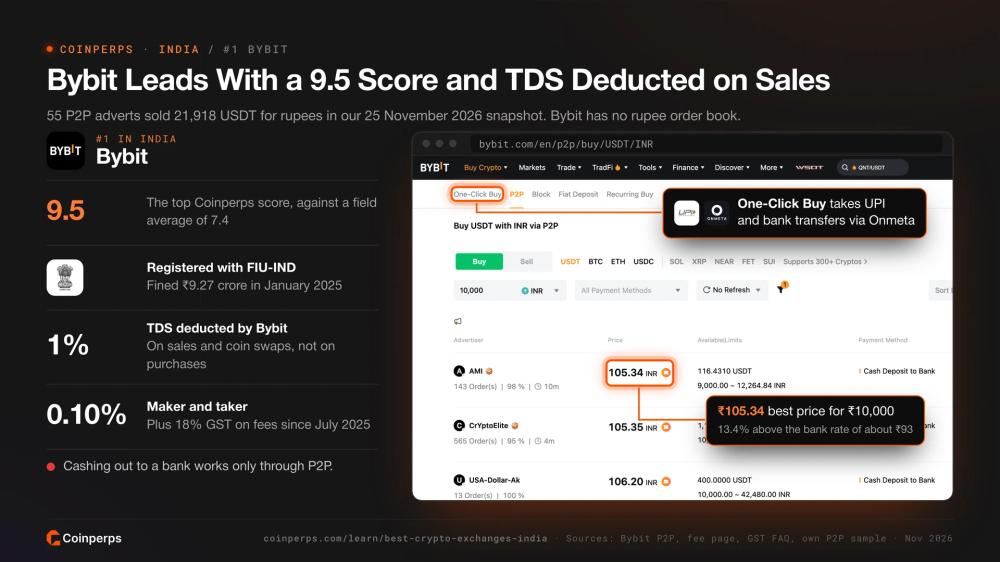
Bybit is the best crypto exchange in India for buyers who want a global coin list and a clean tax record. It holds the top Coinperps score of 9.5, is registered with FIU-IND and deducts TDS for you.
FIU-IND fined Bybit ₹9.27 crore, about $1 million at today's rate, in January 2025 under the Prevention of Money Laundering Act. Bybit announced its registration on 6 February 2025. It restored full access, including its app, on 8 September 2025.
One-Click Buy hands your rupee order to Onmeta, an outside payment provider that accepts UPI and bank transfers from verified Indian accounts. The provider sets fees and limits and shows them before you pay. P2P is the other way in, and the only way to cash out to a bank.
Our 25 November 2026 snapshot found 55 P2P adverts selling 21,918 USDT for rupees on Bybit. The best price for a ₹10,000 order was ₹105.34, about 13.4% above the bank rate.
Spot trades cost 0.10% for makers and takers at the entry tier. Bybit has added 18% GST to trading, conversion and withdrawal fees for Indian users since 7 July 2025.
Its GST and TDS FAQ sets TDS at 1%. Bybit deducts it from the assets you receive when you sell crypto for fiat or trade one coin for another, and takes nothing when you buy crypto with fiat. The FAQ does not cover P2P sales.
Bybit lost about $1.5 billion in February 2025 in a theft the FBI attributed to North Korea, and it covered the loss. Its 41st proof of reserves, a check that customer balances are backed by coins the exchange holds, showed $17.3 billion across 50 assets on 27 October 2026.
Indian accounts have no Bybit Card, trading bots or crypto loans. Perpetual contracts, expiry contracts and options are available, and Bybit's FAQ lists the GST charged on each. Our Bybit restricted countries guide tracks its access rules. Sign up through Bybit.
Pros
- The highest Coinperps score, at 9.5.
- TDS deducted by the exchange on crypto sales and crypto-to-crypto trades.
- UPI and bank purchases through Onmeta, plus 55 rupee P2P adverts in our snapshot.
Cons
- No rupee order book, and cashing out works only through P2P.
- Onmeta fees and limits appear only at checkout.
- No card, bots or loans for Indian accounts.
- FIU-IND status
- Registered, fined ₹18.82 crore
- Rupee funding
- P2P only
- Entry maker / taker
- 0.10% / 0.10%
- TDS handling
- Not deducted; you file
- Crypto withdrawals
- Yes, reopening after theft
Binance is the best choice for Indians who buy and sell USDT through P2P and want the most counterparties. It scores 9.3 with us, leaves the 1% TDS to you and is still recovering from a record theft.
FIU-IND fined Binance ₹18.82 crore, about $2 million at today's rate, on 19 June 2024, and the exchange returned in August 2024 after a seven-month block. Every Indian user has had to re-verify with a PAN, the tax department's ten-character ID, since April 2025.
Rupees move through P2P only. Binance has no rupee bank deposit and no rupee order book, so you pay a seller by UPI or bank transfer and Binance releases the USDT from escrow.
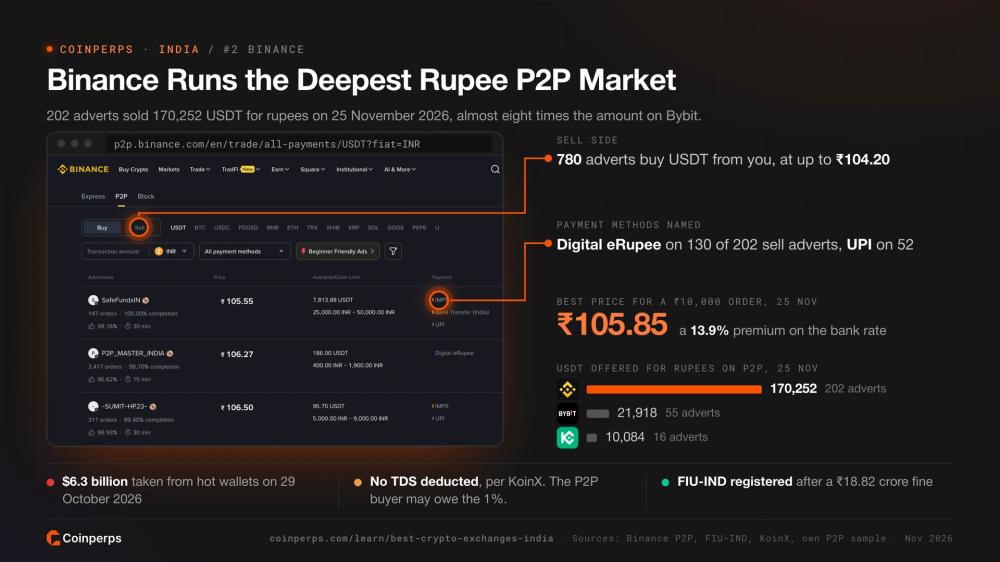
Its rupee P2P market was the deepest in our snapshot. We counted 202 adverts selling 170,252 USDT, almost eight times the amount on Bybit. The best price for ₹10,000 was ₹105.85, a 13.9% premium. Another 780 adverts wanted to buy USDT from users, at up to ₹104.20.
KoinX, an Indian crypto tax firm, reports that Binance does not deduct TDS on spot or P2P trades, and we found no Binance statement on it. In a P2P deal the law then puts the 1% deduction on the buyer. The 30% tax on gains is owed either way.
Attackers took about $6.3 billion from Binance hot wallets, the online wallets used for withdrawals, on 29 October 2026. Binance said the company would bear the loss and later said it had set aside more than the stolen amount.
Withdrawals reopened in phases from 1 November. Binance said on 14 November that 87 networks had reopened that week and that it aimed to reopen the rest by the end of the following week. We could not confirm that every network was open on 25 November, so test a small withdrawal first.
Nor could we confirm whether Binance Futures is open to Indian accounts. Our Binance Futures restricted countries guide lists where it operates. Sign up through Binance.
Pros
- 202 rupee adverts selling USDT, the most on any exchange we sampled.
- A Coinperps score of 9.3 and an entry spot fee of 0.10%.
- Registered with FIU-IND since 2024.
Cons
- A $6.3 billion theft in October 2026, with withdrawals reopened in stages.
- No TDS deducted according to KoinX, so the duty to deduct can fall on the P2P buyer.
- No rupee order book or bank deposit.
- FIU-IND status
- Registered
- Rupee funding
- Bank transfer
- Entry maker / taker
- 0.50% / 0.50%
- TDS handling
- Deducted
- Crypto withdrawals
- Yes
CoinDCX is the best Indian exchange for buying coins from a bank account on a real rupee order book. Its rupee books were far deeper than WazirX's, the only other books we could measure, and Coinbase is a shareholder. Coinperps has no score for Indian exchanges, so CoinDCX ranks on local evidence alone.
CoinDCX was founded in 2018 and states that it is registered with FIU-IND. Coinbase invested in October 2025 at a valuation of $2.45 billion.
Deposits arrive by bank transfer over IMPS, NEFT or RTGS, the standard Indian interbank systems. CoinDCX's help centre lists no deposit or withdrawal fee, a ₹500 minimum deposit and a ₹100 minimum withdrawal. Several 2026 guides also list UPI, but a CoinDCX help article says UPI apps do not work for bank-transfer deposits, so check in the app.
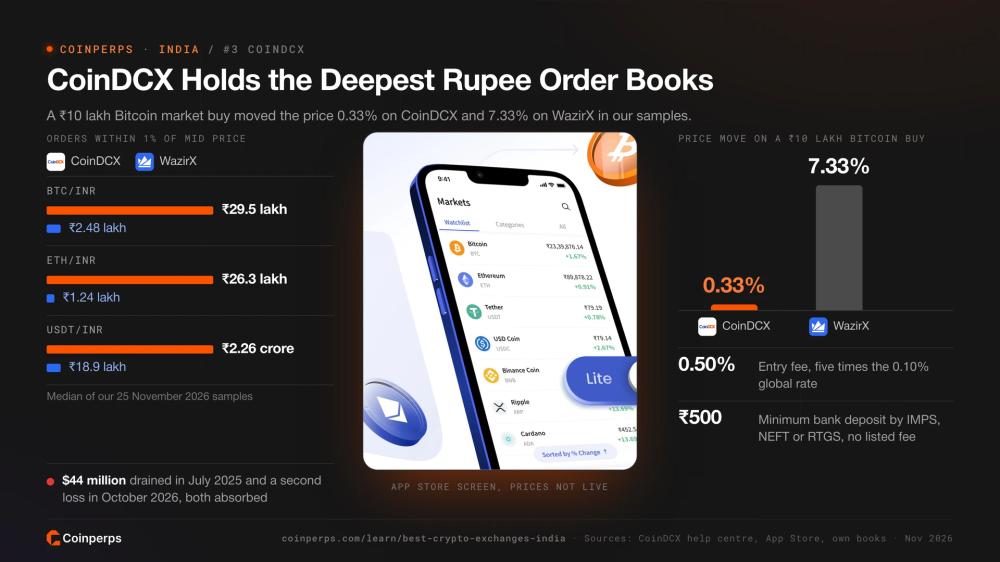
Its BTC/INR book held ₹14.2 lakh of orders within 0.5% of the mid price in our samples, and USDT/INR held ₹64.2 lakh. A ₹10 lakh market buy of Bitcoin, about $10,750, moved the price by 0.33%.
Analytics Insight lists rupee spot trades at 0.50% below ₹2 lakh of 30-day volume and 0.42% up to ₹5 lakh. That entry rate is five times the 0.10% on global exchanges. CoinDCX deducts 1% TDS on sales and reports the total in its monthly transparency report.
About $44 million was drained from an internal operational account in July 2025, and the company covered it from its treasury. A second loss followed. On 21 October 2026 an analyst flagged about 16 million USDT leaving addresses labelled as CoinDCX.
Co-founder Sumit Gupta first denied a breach. CoinDCX then said an internal sweeping process had failed, that it had absorbed the losses and that customer deposits were credited. It did not state the amount.
Its September 2026 transparency report put its investor protection fund at ₹57.07 crore, about $6 million. We found no reserve ratio or auditor name. The help centre lists crypto withdrawals.
Pros
- The deepest rupee order books we measured, with a 0.28% spread on USDT/INR.
- Bank deposits and withdrawals with no listed fee.
- Backed by Coinbase, with monthly transparency reports.
Cons
- A reported 0.50% entry fee, five times the global rate.
- Two loss events 15 months apart, the second with no loss figure.
- No Coinperps score, and no auditor named for its reserves.
- FIU-IND status
- Registered, fined ₹34.5 lakh
- Rupee funding
- P2P only
- Entry maker / taker
- 0.10% / 0.10%
- TDS handling
- Deducted on sells
- Crypto withdrawals
- Yes
KuCoin suits altcoin buyers who want a registered global exchange that deducts TDS. It scores 8.2 with us. Its rupee market is P2P only and thinner than those on Binance and Bybit.
KuCoin was the first offshore exchange to register with FIU-IND, in March 2024, after paying a ₹34.5 lakh penalty.
Its India FAQ confirms rupee P2P and says direct rupee deposits are not yet available. In its December 2025 update it also said the app's return to Indian app stores was still under discussion.
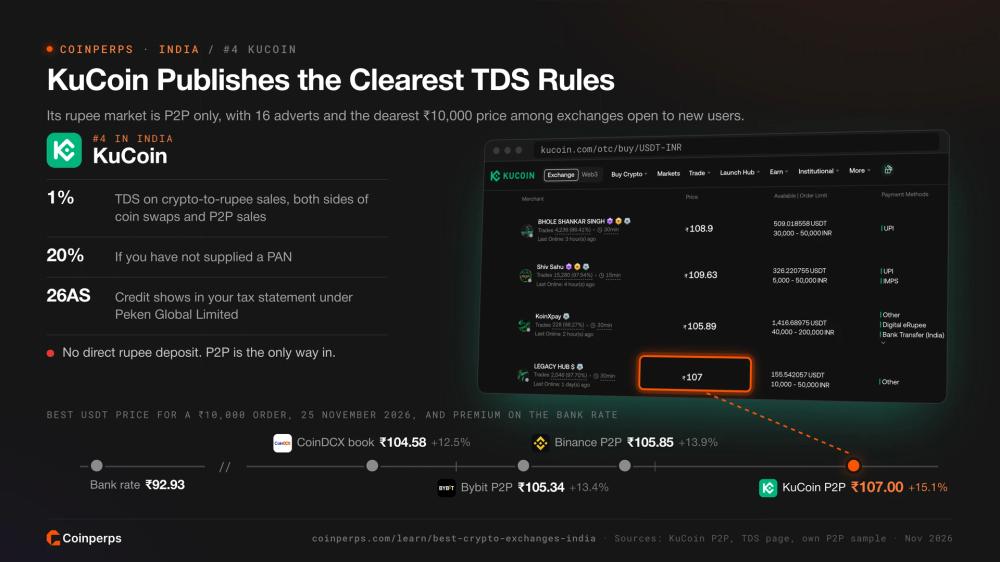
We counted 16 adverts selling 10,084 USDT on 25 November 2026. The best price for a ₹10,000 order was ₹107.00, a 15.1% premium and the highest among the exchanges open to new Indian users. Selling was easier, with 113 adverts buying USDT at up to ₹104.30.
KuCoin's TDS page is the clearest of the global platforms. It deducts 1% on crypto-to-rupee sales, on both sides of crypto-to-crypto trades and on P2P sales, and nothing on purchases. The rate is 20% if you have not supplied a PAN. The credit appears in Form 26AS, your annual tax credit statement, under the name Peken Global Limited.
Third-party checks list the entry spot fee at 0.10% and the coin count near 800. KuCoin's proof of reserves page shows Bitcoin backed at 107% and USDT at 111% for 31 August 2026. We found no security incident this year. Our KuCoin restricted countries guide covers its regional limits. Sign up through KuCoin.
Pros
- TDS rules published in detail, with credit visible in Form 26AS.
- Registered with FIU-IND since March 2024.
- A wide coin list and a 0.10% entry fee.
Cons
- Only 16 rupee adverts selling USDT, at a 15.1% premium.
- No direct rupee deposit.
- App store status in India not confirmed.
- FIU-IND status
- Registered
- Rupee funding
- UPI, IMPS, NEFT
- Entry maker / taker
- 0% / 0.10% on PRO
- TDS handling
- Deducted
- Crypto withdrawals
- No
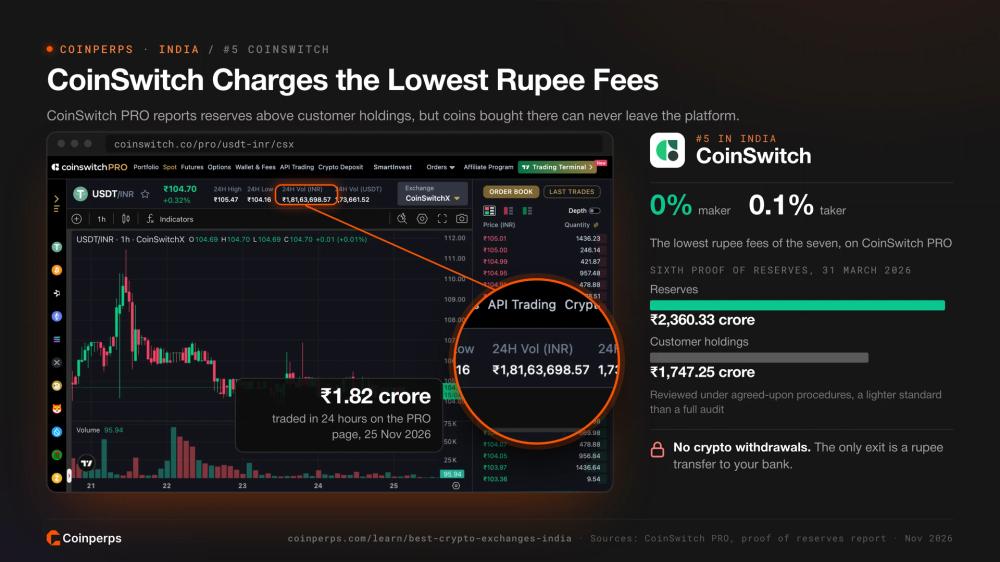
CoinSwitch has the lowest rupee trading fees of the seven exchanges here, and it suits investors who never plan to move coins off the platform. CoinSwitch PRO charges makers nothing and takers 0.1%. Crypto cannot be withdrawn.
Bitcipher Labs LLP operates the exchange and displays an FIU-IND registration badge. CoinSwitch claims more than 2 crore users, or 20 million, and over 400 coins.
Deposits come in by UPI, IMPS or NEFT. Its October 2026 blog sets rupee withdrawals at ₹100 to ₹5 lakh a day. The PRO page showed USDT/INR at ₹104.69 with a 0.45% spread and ₹1.82 crore of 24-hour volume on 25 November 2026. Its API is closed to outsiders, which leaves its depth unmeasured.
CoinSwitch is the only Indian exchange here with a detailed reserves report. Its sixth proof of reserves showed ₹2,360.33 crore of reserves against ₹1,747.25 crore of customer holdings at 31 March 2026. An outside firm reviewed it under agreed-upon procedures, a lighter standard than a full audit.
The PRO deposit page states that crypto withdrawals are not supported. You can deposit coins and sell them, and the only exit is a rupee transfer to your bank. You cannot hold your own keys, so a platform failure would leave you with a claim on the company.
CoinSwitch says it applies TDS where the law requires and also runs rupee-margined futures.
Pros
- 0% maker and 0.1% taker fees on CoinSwitch PRO.
- Reserves of ₹2,360 crore against ₹1,747 crore owed to customers.
- UPI deposits and rupee withdrawals of up to ₹5 lakh a day.
Cons
- No crypto withdrawals, so no self-custody.
- Order book depth cannot be checked from outside.
- No Coinperps score.
- FIU-IND status
- Registered
- Rupee funding
- UPI in; IMPS in and out
- Entry maker / taker
- 0.40% / 0.60%
- TDS handling
- Deducted
- Crypto withdrawals
- Off once a bank is linked
Coinbase suits buyers who want a US-listed company and a simple app, and who accept that their coins may never leave it. It is registered with FIU-IND and has taken rupees directly since June 2026. Its derivatives arm scores 6.8 in our Coinbase Futures review.
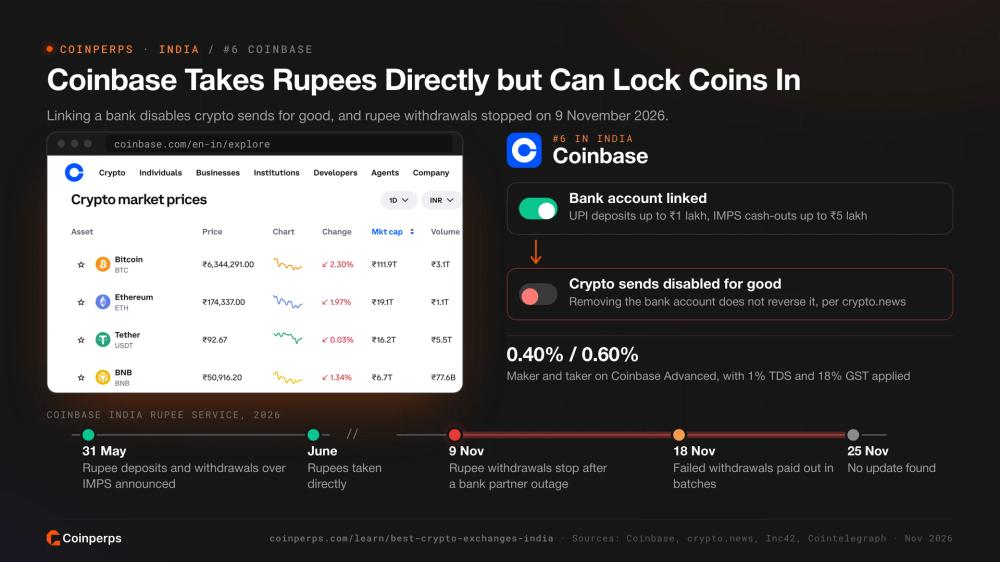
Coinbase announced direct rupee deposits and withdrawals on 31 May 2026 over IMPS, alongside rupee order books and perpetual futures. UPI is now listed for deposits of up to ₹1 lakh, and IMPS cash-outs run to ₹5 lakh per transaction, according to crypto.news.
Coinbase's India help page says that adding a bank account disables sending crypto to other wallets and exchanges for good, and removing the account does not reverse it, according to crypto.news.
Rupee withdrawals then stopped on 9 November 2026 after an outage at a banking partner. Coinbase India began processing failed withdrawals in batches on 18 November, and in-app rupee withdrawals were still unavailable that day.
Customers with a linked bank account could neither send coins out nor withdraw rupees for more than a week. We found no update by 25 November.
Third-party checks list Coinbase Advanced at 0.40% for makers and 0.60% for takers, four to six times the global rate. Coinbase applies 1% TDS to qualifying sales and conversions and 18% GST to fees. Sign up through Coinbase, and see our Coinbase perpetuals restricted countries guide for futures access.
Pros
- Direct rupee deposits by UPI and IMPS, with no deposit fee reported.
- A listed parent company with audited accounts.
- TDS and GST applied by the platform.
Cons
- Linking a bank account permanently disables crypto sends.
- Rupee withdrawals halted from 9 November 2026.
- Entry fees of 0.40% and 0.60%, and no proof of reserves.
- FIU-IND status
- Registered
- Rupee funding
- UPI, bank transfer
- Entry maker / taker
- 0.45% / 0.45%
- TDS handling
- Deducted
- Crypto withdrawals
- Off once UPI is enabled
ZebPay is one of India's longest-running exchange brands, founded in 2014, and it suits small UPI buyers. It ranks last because one funding choice locks your coins in and withdrawals were delayed this month.
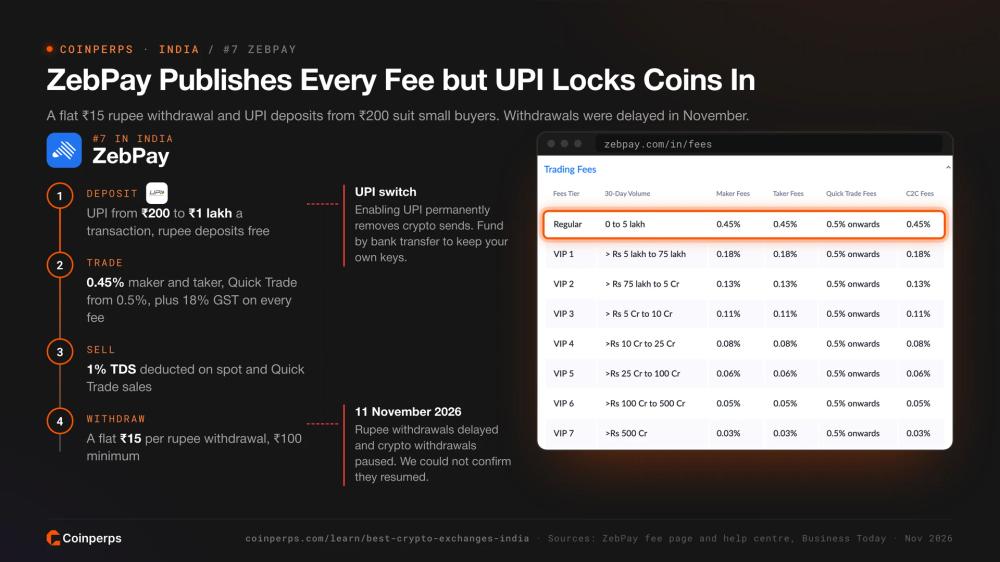
Its fee page listed 0.45% for makers and takers on 25 November 2026, for accounts trading up to ₹5 lakh in 30 days. Quick Trade starts at 0.5%. Rupee deposits are free, a rupee withdrawal costs ₹15 with a ₹100 minimum, and 18% GST is added to every fee. ZebPay deducts 1% TDS on spot and Quick Trade sales.
UPI deposits run from ₹200 to ₹1 lakh per transaction. ZebPay's help article warns that enabling UPI permanently removes the ability to send crypto out of the account. Fund by bank transfer if you ever want to hold your own keys.
On 11 November 2026 ZebPay told users that rupee withdrawals were delayed by problems at its banking partner. It also paused crypto withdrawals and targeted 17 November to resume them. We could not confirm that they resumed.
ZebPay reports more than 6 million registered users and offers perpetual futures with up to 75x leverage. We found no proof of reserves.
Pros
- Founded in 2014, with fees published in full.
- UPI deposits from ₹200.
- A flat ₹15 fee on rupee withdrawals.
Cons
- Enabling UPI permanently disables crypto withdrawals.
- Rupee and crypto withdrawal delays in November 2026.
- A 0.45% entry fee and no proof of reserves.
How We Ranked These Exchanges
We ranked the best crypto exchanges in India on what a spot buyer can check and use. FIU-IND registration was the entry test, and our global scores, rupee access and tax handling set the order.
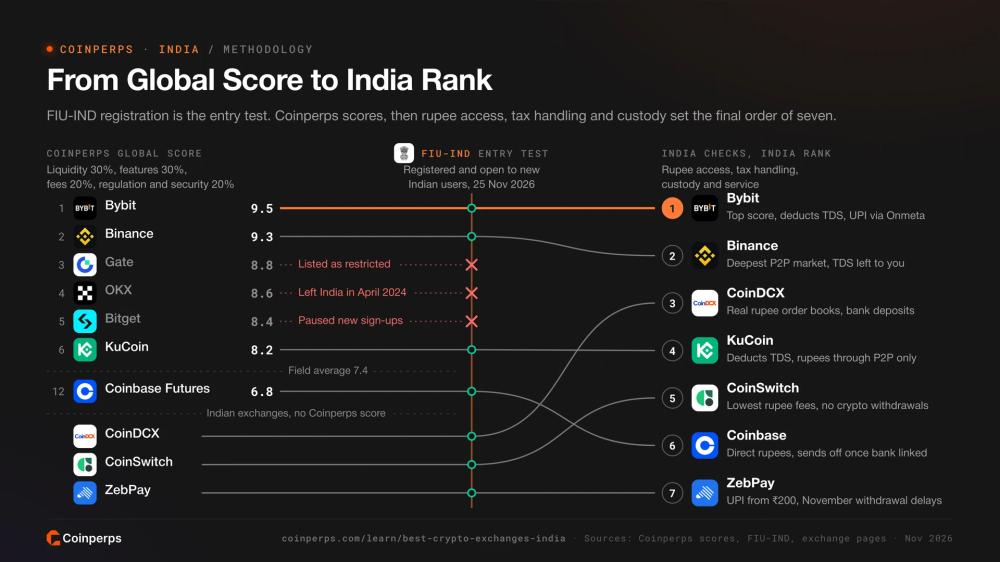
- FIU-IND registration: every platform had to be registered and open to new Indian users on 25 November 2026.
- Coinperps scores: our ranking methodology weights liquidity 30%, features 30%, fees 20% and regulation and security 20%. Bybit scores 9.5, Binance 9.3 and KuCoin 8.2 against a field average of 7.4.
- Rupee access: we sampled CoinDCX and WazirX order books and the USDT P2P adverts on six exchanges, then priced a ₹10,000 purchase.
- Tax handling: an exchange that deducts TDS and charges GST leaves a record that matches your tax return.
- Custody and service: we checked whether coins can leave for your own wallet, plus breach history, proof of reserves and recent withdrawal outages.
Bybit takes first place because it deducts TDS and offers a UPI purchase alongside P2P. Binance has the larger rupee market, yet it leaves the tax deduction to the user and suffered the October theft.
Indian exchanges have no Coinperps score, because our rankings cover global derivatives platforms. CoinDCX still places third on real rupee order books and bank deposits, which KuCoin lacks. Gate, OKX and Bitget outscore KuCoin globally, but OKX has left India, Bitget has paused new sign-ups and Gate is listed as restricted.
Indian Exchanges That Missed the List
WazirX reopened in October 2025 after its 2024 hack, and its books were thin in our samples. Mudrex charges 0.45% on spot and 2% to withdraw crypto. Giottus shows three different fee schedules on its own pages, so its true cost is unclear.
Is Crypto Legal in India
Buying, selling and holding crypto is legal in India, and it is taxed. It is also unregulated, so no licence exists and no regulator vets an exchange before it takes your money.
The finance ministry told the Lok Sabha in February 2026 that crypto assets are not regulated in India and fall only under anti-money-laundering oversight. The Supreme Court struck down the central bank's banking ban in 2020.
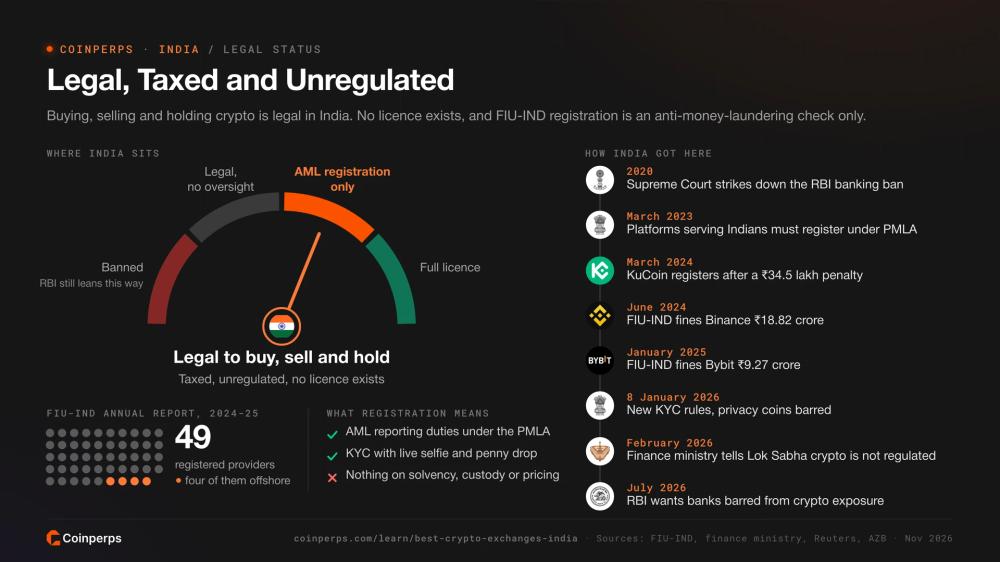
The Reserve Bank of India remains opposed. Reuters reported in July 2026 that it wants banks barred from crypto exposure and still leans towards prohibition.
What FIU-IND Registration Means
FIU-IND registration is an anti-money-laundering check. Since March 2023, any platform serving Indians, including one based abroad, must register as a reporting entity under the Prevention of Money Laundering Act.
Registration says nothing about solvency, custody or fair pricing. The fines paid by Binance, Bybit and KuCoin were penalties under the Prevention of Money Laundering Act, linked to the period when they served Indians without complying with it.
FIU-IND's annual report for 2024-25 counted 49 registered providers, four of them offshore. A March 2026 parliamentary reply put the number at 54, according to CryptoSlate.
The January KYC Rules
FIU-IND issued new guidelines on 8 January 2026, and they changed how you open an account. A law firm summary by AZB & Partners lists the main requirements.
- Live selfie: onboarding needs a selfie with liveness detection, plus the location, time and IP address of your device.
- Bank check: the exchange verifies your bank account with a small test deposit, known as a penny drop.
- Privacy coins: exchanges must not facilitate anonymity coins or mixers.
How to Check an Exchange
FIU-IND does not appear to publish a register of crypto platforms, so you cannot look a name up on one official page. Run these checks before you deposit.
- Look for a registration number in the site footer, such as VA00041101 on Delta Exchange India.
- Search FIU-IND's published penalty orders for the exchange's name.
- Compare the name with the notice lists in the exits section below.
- Confirm that the platform collects your PAN, and check whether it deducts TDS or leaves that to you.
Indians living abroad face different rules. Our guides to the best crypto exchanges in the UAE, Pakistan, Bangladesh and Sri Lanka cover those markets.
How to Buy Crypto With Rupees
You can fund an Indian account by bank transfer, by UPI or through a P2P seller, each with a different cost and risk. The price you pay per coin matters more than the trading fee, because rupee prices sit far above the global rate.
Bank Transfer, UPI and P2P
- Bank transfer: IMPS and NEFT deposits, plus RTGS on CoinDCX, go straight to an Indian exchange such as CoinDCX, CoinSwitch or ZebPay. You pay a registered company, which makes it safer for your bank account than paying a stranger through P2P.
- UPI: India's instant payment system works on CoinSwitch, ZebPay, Mudrex and Coinbase, and on Bybit through Onmeta. Limits are low and terms differ by platform.
- P2P: you pay another user directly and the exchange holds the seller's coins in escrow until payment is confirmed. Our guide to the best P2P crypto exchanges compares the global options.
The 13% Rupee Premium
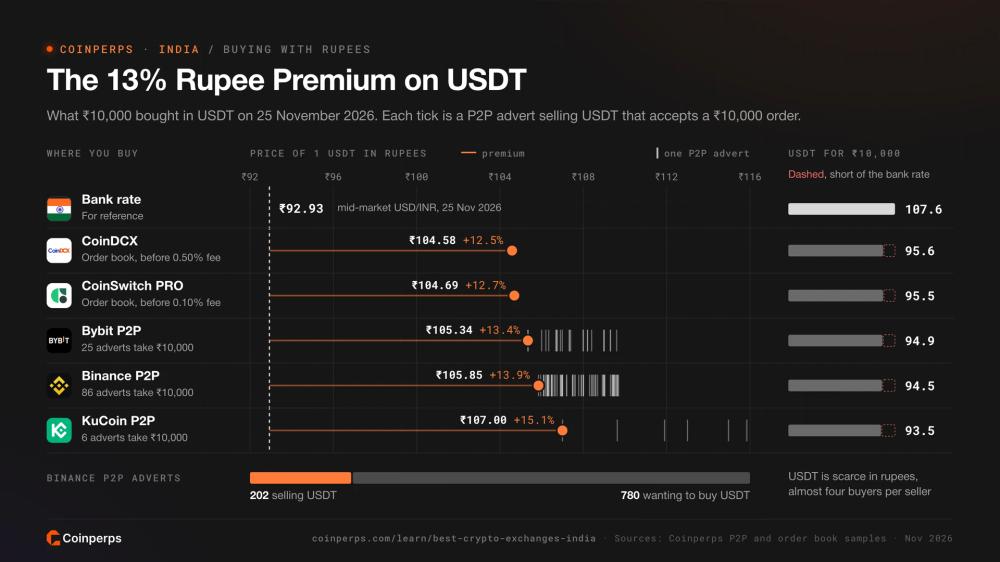
USDT and Bitcoin both cost about 13% more in rupees than their global price in our 25 November 2026 samples. The bank rate was about ₹93 to the dollar. USDT traded at ₹104.58 on CoinDCX and from ₹105.34 on Bybit P2P.
Bitcoin carried the same gap. BTC/INR stood at ₹63.16 lakh on CoinDCX while Bitcoin traded near $60,018 on Delta Exchange India, which converts to ₹55.8 lakh at the bank rate. The premium sits in the rupee price of Bitcoin as well as USDT, and most likely in other coins too.
All USDT in India has to be brought in from abroad. In June 2026 the Enforcement Directorate searched five crypto payment firms in Bengaluru, market makers cut their imports and the premium rose above 8.5% from a usual 3% to 4%. On Binance, adverts wanting to buy USDT outnumbered adverts selling it by almost four to one.
You get most of the premium back if you sell while it is still 13%, less the gap between P2P buying and selling prices. If it falls to 3% while you hold, your coins lose about 9% in rupees even if the dollar price does not move.
What ₹10,000 Buys
We priced a ₹10,000 USDT purchase at the best price open to that order size on 25 November 2026.
Where you buy | Price per USDT | USDT received | Premium over bank rate |
|---|---|---|---|
Bank rate, for reference | ₹92.93 | 107.6 | None |
CoinDCX order book | ₹104.58 | 95.6 before the 0.50% fee | 12.5% |
CoinSwitch PRO | ₹104.69 | 95.5 before the 0.10% fee | 12.7% |
Bybit P2P | ₹105.34 | 94.9 | 13.4% |
Binance P2P | ₹105.85 | 94.5 | 13.9% |
KuCoin P2P | ₹107.00 | 93.5 | 15.1% |
A buyer on Binance P2P received 13.1 fewer USDT than the bank rate implies, a shortfall of about 12%. The trading fee is small beside that gap. Our explainer on maker and taker fees shows how a limit order lowers the fee.
Rupee Order Book Depth
Depth shows how much you can trade before the price moves. We summed the orders within 1% of the mid price, the midpoint between the best bid and offer, and took the median of two samples taken minutes apart on 25 November.
Rupee market | CoinDCX spread | CoinDCX depth within 1% | WazirX spread | WazirX depth within 1% |
|---|---|---|---|---|
BTC/INR | 0.52% | ₹29.5 lakh | 0.79% | ₹2.48 lakh |
ETH/INR | 0.43% | ₹26.3 lakh | 1.68% | ₹1.24 lakh |
USDT/INR | 0.28% | ₹2.26 crore | 0.04% | ₹18.9 lakh |
SOL/INR | 0.63% | ₹20.4 lakh | 6.4% | None |
CoinDCX held about twelve times the Bitcoin depth of WazirX. A ₹10 lakh market buy moved the Bitcoin price by 0.33% on CoinDCX and by 7.33% on WazirX. ZebPay, Giottus, CoinSwitch and Mudrex do not open their APIs to us.
P2P and Frozen Bank Accounts
P2P carries a risk that bank deposits avoid. If a buyer pays you with money stolen in a fraud, police cyber-crime cells trace it through UPI and ask banks to freeze every account it touched, including yours.
Crypto Times reported in October 2026 that one Binance P2P seller had ₹4.5 lakh frozen after a single 1,000 USDT sale.
- Use verified merchants: trade with advertisers who have long histories and high completion rates.
- Match the name: accept payment only from an account in the buyer's verified name, and pay only from your own.
- Keep records: save the order page, chat and bank reference for every trade.
Crypto Tax in India
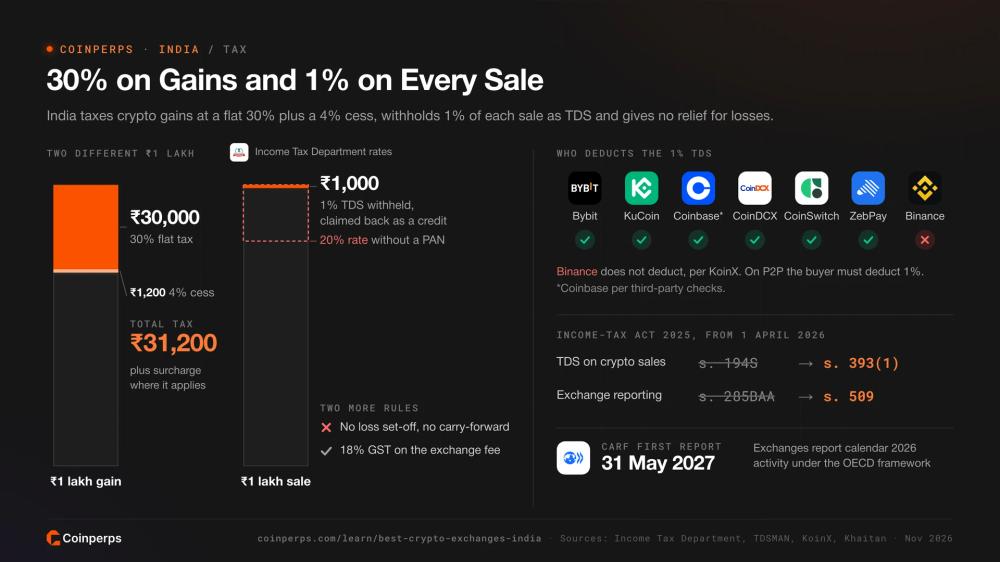
India taxes crypto more heavily than shares, and the rules apply on every exchange, Indian or foreign. Expect 30% on gains, 1% withheld on each sale and no relief for losses.
Rule | What it means |
|---|---|
Tax on gains | 30% flat, plus surcharge where it applies and a 4% cess |
Deductions | Purchase cost only; no fees or mining costs |
Losses | No set-off against other coins or other income; no carry-forward |
TDS | 1% of the sale value on each transfer; 20% without a PAN |
GST | 18% of the exchange's fee only |
The Income Tax Department's explainer on virtual digital assets sets out the 30% rate. A gain of ₹1 lakh costs ₹30,000 in tax plus a ₹1,200 cess, or ₹31,200 by our arithmetic. A loss on one coin cannot reduce the gain on another.
TDS is a prepayment. On a ₹1 lakh sale the exchange withholds ₹1,000 and pays it to the government against your PAN, and you claim it as a credit when you file. The law exempts small yearly totals, ₹50,000 for most individuals and ₹10,000 for others, according to TDSMAN's guide.
New Section Numbers
The Income-tax Act, 2025 replaced the 1961 Act on 1 April 2026. Rates stayed the same and section numbers changed. TDS moved from section 194S to section 393(1), and exchange reporting moved from section 285BAA to section 509.
Who Deducts TDS
Exchange | Deducts TDS | Detail |
|---|---|---|
Bybit | Yes | Crypto sold for fiat and crypto-to-crypto trades; P2P sales not covered by its FAQ |
Binance | No, per KoinX | The P2P buyer must deduct 1% once yearly trades pass the legal threshold |
KuCoin | Yes | Sales, both sides of crypto swaps and P2P sales |
Coinbase | Yes, per third-party checks | Qualifying sales and conversions |
CoinDCX, CoinSwitch, ZebPay | Yes | Deducted on each sale |
Chainalysis data reported by Coin Edition shows domestic exchanges' share of Indian volume falling from about 7% to 0.7% after TDS began in 2022. Using an exchange that skips TDS does not remove your duty to report.
What the Tax Department Sees
Every sale goes in Schedule VDA of your tax return. The department sent 44,057 messages to people who traded crypto and left that schedule blank, and searches found ₹888.82 crore of undisclosed crypto income.
India adopted the OECD's Crypto-Asset Reporting Framework, under which exchanges report calendar 2026 activity by 31 May 2027, as a Khaitan & Co briefing sets out. India has committed to exchanging data with other countries under the framework from April 2027, and the accounts reported are those of non-residents.
Perpetual Futures and Leverage in India
Indians can trade perpetual futures, contracts with no expiry date that track a coin's price, on registered Indian platforms in rupees. No Indian regulator supervises these products, and their tax treatment is disputed.
Rupee-Settled Futures
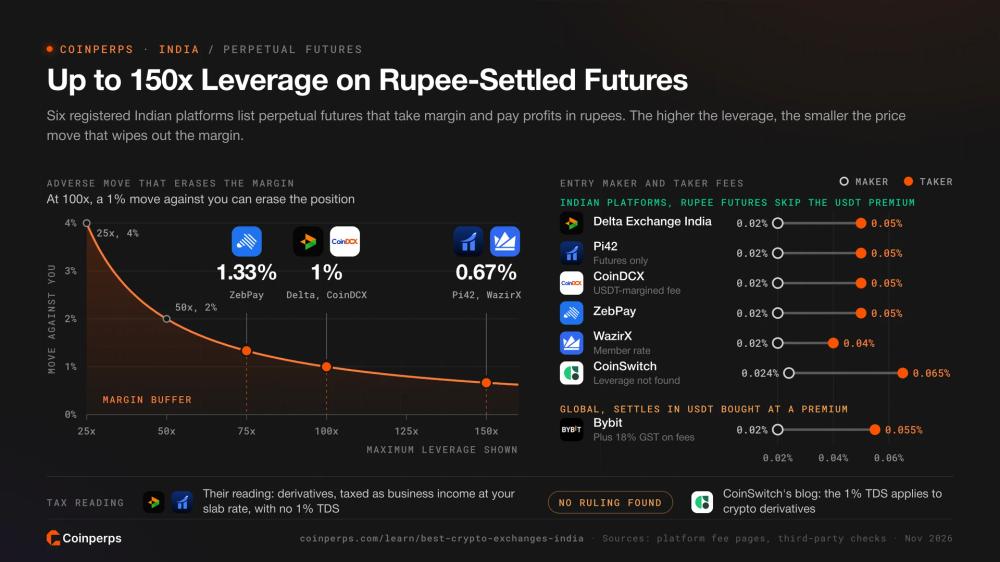
Rupee-settled futures take margin and pay profits in rupees, so you never hold the coin and avoid the USDT premium.
Platform | Entry maker / taker | Leverage shown |
|---|---|---|
0.02% / 0.05% | 100x | |
0.02% / 0.05% | 150x | |
CoinDCX, per third parties | 0.02% / 0.05% on USDT-margined contracts | 100x on rupee-margined contracts |
CoinSwitch | 0.024% / 0.065% | Not found |
WazirX, launched May 2026 | 0.02% / 0.04% for members | 150x |
ZebPay | 0.02% / 0.05% | 75x |
Pi42 offers futures only and does not allow crypto withdrawals by design. Leverage of 100x means a 1% move against you can erase the position. Our liquidations page shows how often that happens, and the funding rates page tracks the fee that long and short traders pay each other.
Global Perpetuals
Bybit offers Indian accounts perpetual and expiry contracts and options, charges 0.02% for makers and 0.055% for takers at the entry tier and adds 18% GST to those fees.
Coinbase launched perpetuals with its rupee service in 2026. We could not confirm futures access on Binance or KuCoin, or an India-specific leverage cap on any of them.
Global contracts settle in USDT, so you pay the rupee premium to fund the account. Our explainer on perps versus spot trading covers the mechanics.
The Contested Tax Position
Delta Exchange India and Pi42 both market rupee-settled futures as free of the 1% TDS and the 30% flat tax. Their reading is that these contracts are derivatives, taxed as business income at your slab rate with losses allowed.
CoinSwitch's own blog argues the opposite, that TDS applies to crypto derivatives. We found no circular or ruling from the tax authorities on the question. Treat the favourable reading as the platforms' own and take advice before you rely on it. Our guide to perpetual futures regulation covers other countries.
Which Exchanges Left or Were Blocked
Several well-known exchanges no longer serve Indians, so older rankings are out of date. A guide that still recommends OKX, MEXC or Bitget to a new Indian user predates these changes.
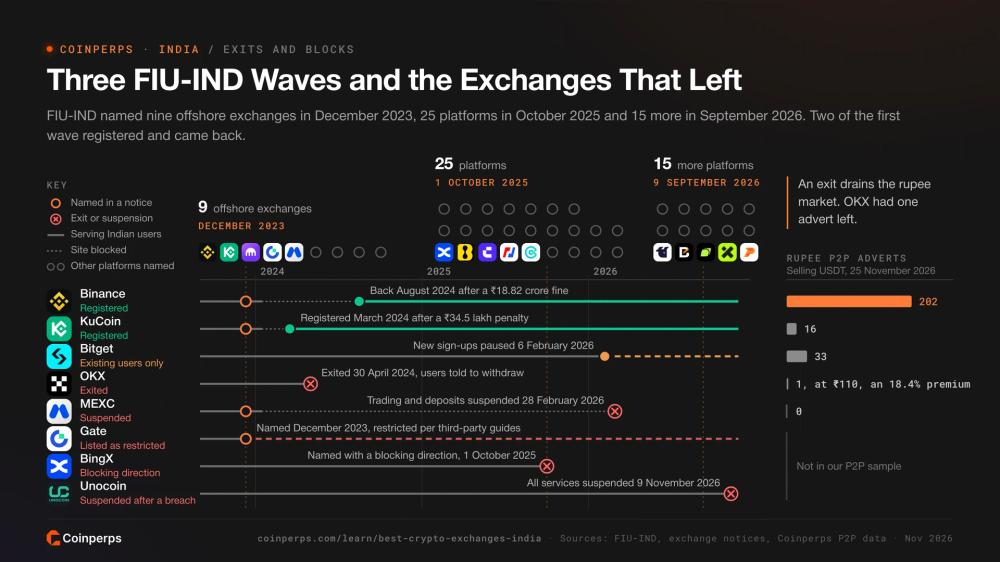
Platform | Status for Indian users | Key date |
|---|---|---|
 OKX | Exited; users told to withdraw | 30 April 2024 |
 MEXC | Trading and deposits suspended while it seeks registration | 28 February 2026 |
 Bitget | New sign-ups paused; existing users only | 6 February 2026 |
 Gate | Named in the 2023 notices; India listed as restricted by third-party guides | December 2023 |
 BingX | Named in the 2025 notices, with a blocking direction | 1 October 2025 |
 Unocoin | All services suspended after a breach | 9 November 2026 |
FIU-IND sent notices to nine offshore exchanges in December 2023, including Binance, KuCoin, Kraken, Gate and MEXC, and their sites were blocked the next month.
A second wave hit 25 platforms on 1 October 2025, among them BingX, LBank, CoinW, BitMEX and CoinEx. A third, on 9 September 2026, named 15 more, including WhiteBIT, Blofin, Bitunix, XT.com and Pionex.
An exit drains the rupee market. OKX had one rupee advert left in our snapshot, priced at ₹110 per USDT, an 18.4% premium. Bitget still showed 33 adverts for existing users.
We found no FIU-IND registration for Kraken or Crypto.com, so neither is recommended here. Our restricted country guides for OKX, MEXC, Bitget, Gate and BingX track each platform's own rules.
Indian Platforms to Treat With Caution
WazirX was hacked for about $230 million in July 2024 and froze for 15 months. A Singapore court approved its restructuring in October 2025, and trading restarted that month. About 15% of balances came back as recovery tokens that cannot be traded or withdrawn.
Unocoin suspended every service on 9 November 2026 after unauthorised transfers. Its 14 November statement put the loss at about $200,000 and promised to fund it. It had published no restart date by 25 November.
We do not recommend Bitbns. Users have reported restricted withdrawals since a 2022 cyberattack, and the Delhi High Court dismissed their petitions as a private dispute. Its public ticker quoted Bitcoin below ₹30 lakh on 25 November, less than half the real price, on 0.013 BTC of daily volume.
Risks, Hacks and Customer Protection
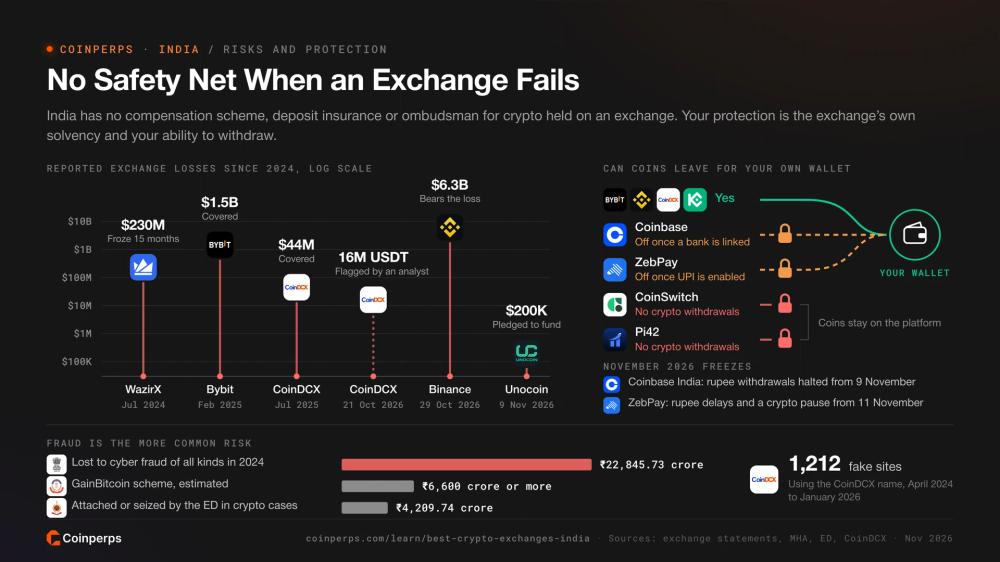
No compensation scheme covers crypto held on an exchange in India. We found no deposit insurance, statutory investor protection fund or ombudsman that applies, so your protection is the exchange's own solvency and your ability to withdraw.
Hacks and Withdrawal Freezes
Three of the seven exchanges on this list have been hacked since the start of 2025. Binance lost about $6.3 billion, Bybit about $1.5 billion and CoinDCX about $44 million, and each says it covered the loss. Coinbase India halted rupee withdrawals in November 2026 after a banking partner outage, and ZebPay delayed rupee withdrawals and paused crypto withdrawals in the same month.
Moving long-term holdings to your own wallet removes exchange risk. The option is closed on CoinSwitch and Pi42, on Coinbase once a bank is linked and on ZebPay once UPI is enabled. Our list of the best USDT wallets covers the options.
Scams and Fake Platforms
Fraud is a more common risk than a hack. Indians lost ₹22,845.73 crore to cyber fraud of all kinds in 2024, the home ministry told Parliament. The Enforcement Directorate has attached or seized ₹4,209.74 crore in crypto cases.
The GainBitcoin scheme is estimated at ₹6,600 crore or more. The Central Bureau of Investigation arrested a co-founder of Darwin Labs, a firm named in the case, in March 2026. Impersonation is also common, and CoinDCX says it reported 1,212 fake sites using its name between April 2024 and January 2026.
- Check registration: use the steps in the legal section before you deposit.
- Refuse fixed returns: no legitimate exchange guarantees a monthly yield on Bitcoin.
- Verify the payee: a bank or UPI deposit should go to the exchange's company name.
- Test withdrawals: send a small amount out before you build a large balance.
Bottom Line
Bybit is the best crypto exchange in India for most spot buyers. It pairs the top Coinperps score with FIU-IND registration, a UPI purchase option and TDS deducted on your sales.
Binance has the deepest rupee P2P market and suits experienced users who will handle their own TDS and accept the risk shown by its October theft. CoinDCX is the strongest Indian exchange, with real rupee order books and bank deposits at a higher fee.
KuCoin, CoinSwitch, Coinbase and ZebPay each fit a narrower need. Check the withdrawal rules first, because three of them can lock coins inside the platform.
Whichever of the best crypto exchanges in India you choose, the 13% rupee premium and the 30% tax will cost more than any trading fee. Buy in small steps, keep your TDS records and move long-term holdings to a wallet you control.
FAQs
Is Binance legal in India?
Indians can use Binance, which has stated since 2024 that it is registered with FIU-IND. The agency fined it ₹18.82 crore in June 2024 under the anti-money-laundering law, and its app and website reopened in August 2024. Registration covers anti-money-laundering duties only and is no licence. Indian users trade rupees through P2P and must verify with a PAN. They remain responsible for the 30% tax on gains and for the 1% TDS, which Binance is reported to leave to the user.
Do I need a PAN or Aadhaar to open a crypto exchange account in India?
You need a PAN on every registered exchange, because the 1% TDS is recorded against it and the rate rises to 20% without one. FIU-IND rules in force since January 2026 also require a live selfie, your device location and a small test deposit that confirms your bank account. Exchanges commonly accept Aadhaar as proof of identity and address. ZebPay charges ₹590 for its enhanced verification tier.
Can I use UPI to buy crypto in India?
Yes, on some platforms. CoinSwitch, ZebPay and Mudrex accept UPI deposits, Coinbase lists UPI for deposits of up to ₹1 lakh, and Bybit offers it through the payment provider Onmeta. Many P2P sellers on Binance and Bybit also take UPI. Read the terms first, because enabling UPI on ZebPay permanently disables crypto withdrawals. Pay only from an account in your own name, which is what the bank verification rules expect.
Can I withdraw crypto to my own wallet from an Indian exchange?
It depends on the platform. Bybit, Binance, KuCoin and CoinDCX support withdrawals to a private wallet, and Binance asks Indian users for recipient details on each transfer. CoinSwitch and Pi42 do not allow crypto withdrawals at all. Coinbase is reported to disable sends permanently once you link a bank account, and ZebPay's help page says the same happens once you enable UPI. Mudrex charges 2% to withdraw. Check the rule before you fund the account, because some of these choices cannot be reversed.
What happens if I do not report crypto in my tax return?
The tax department can match your trades to your PAN. Exchanges that deduct TDS deposit it against that number, the credit appears in your Form 26AS, and a return with an empty Schedule VDA then shows a mismatch. The department sent 44,057 messages to such taxpayers, and its searches uncovered ₹888.82 crore of undisclosed crypto income. Cross-border data sharing under an OECD framework begins in April 2027. A tax professional can help you correct an earlier return.


