Bybit TradFi Review: Trade Stocks, ETFs & Commodities
Everything traders need on Bybit TradFi, including how to trade stocks and ETFs with USDT, the leverage on offer, fees and who can use it.

Coinperps may earn a commission from partner links, at no cost to you; rankings follow our methodology. Not financial advice.
Key takeaways
- "Bybit TradFi" is two products, not one. A MetaTrader 5 CFD brokerage covering 100+ forex, metals, oil, index and US-stock contracts at up to 500x, plus separate TradFi Perpetual Contracts: USDT-settled perps that track stocks, ETFs and commodities at up to 10x.
- It is an offshore derivatives product. Bybit TradFi runs through Infra Capital, licensed by the Mauritius Financial Services Commission, and is closed to residents of the European Economic Area among other regions. You never own the share, so no voting and no dividends.
- The story in 2026 is convergence. Bybit is one of the few venues running CFDs, USDT perps and tokenized equities at once, putting it against OKX, Binance, Bitget and on-chain rivals like Hyperliquid's HIP-3 markets.

- Max leverage
- 500x on MT5, 10x on TradFi perps
- MT5 markets
- 100+ FX, index, metal, oil, stock CFDs
- Licence
- Infra Capital, Mauritius FSC
- EEA access
- Not available
How we rate Bybit Partner link · How we rank
Bybit, founded in 2018 and headquartered in Dubai, is the world’s second-largest exchange by volume, serving 60 million users with 1,800+ assets and over $11 billion in daily trading.
Field average across 19 exchanges. Coinperps score 9.5/10, #1 of 19.
Coinperps may earn a commission if you sign up through this link, at no cost to you. Rankings follow our method, not partner deals.
On this page 10 sections
Crypto exchanges spent 2026 racing to put Wall Street on-chain, and Bybit moved on every front at once. Under one "TradFi" banner it now runs a CFD broker, a set of 24/7 perpetuals on US equities, and tokenized stocks beside its spot book. That breadth is the appeal, and the reason most explanations get it wrong.
This review breaks down what Bybit TradFi is, how its two trading engines differ, what they cost, who can use them, and how it compares to the wider 24/7 stock-trading wave. If you only trade crypto perps today, you can now take a view on Nvidia or gold without leaving your Bybit account. The rails you use change the rules.
What Is Bybit TradFi?
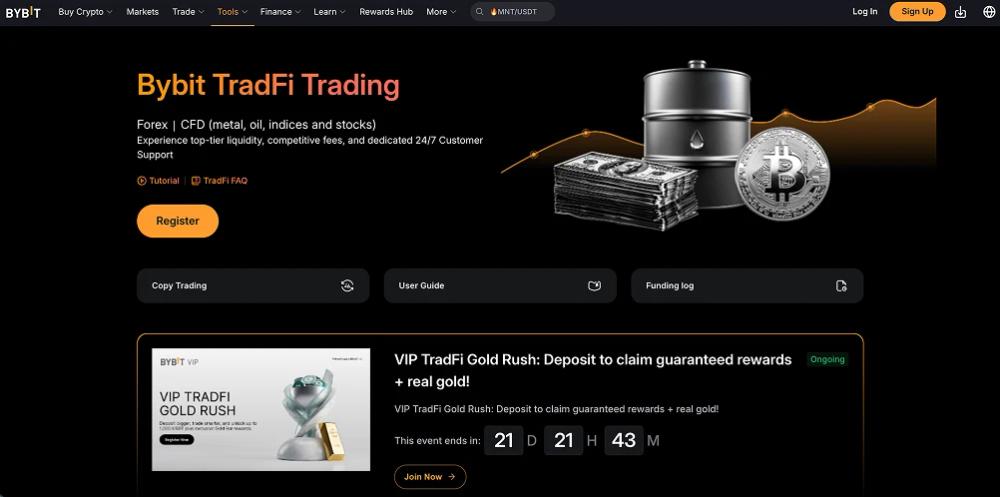
Bybit TradFi is the exchange's brand for trading traditional financial assets, including equities, ETFs, forex, indices, metals and commodities, using USDT as collateral. It has three parts:
- The MT5 CFD platform. The flagship "Bybit TradFi" is a contract-for-difference broker built on MetaTrader 5, the terminal MetaQuotes released in 2010 that dominates retail forex. It debuted in 2025 and scaled fast through early 2026.
- TradFi Perpetual Contracts. Launched in April 2026, these USDT-settled perps track US stocks, ETFs and commodities. They trade on the same order book and account as Bybit's crypto futures.
- Tokenized assets. Bybit also lists tokenized equities via xStocks and gold tokens (XAUT, PAXG) across Spot, Futures and Earn, giving spot RWA exposure with no leverage or funding.
The whole stack runs through Infra Capital Limited, licensed by the Mauritius Financial Services Commission. Bybit frames these products as complements to its crypto business. One rule matters before you start: Bybit TradFi is closed to residents of the European Economic Area and other restricted regions, tracking the platform rules in our Bybit restricted countries guide.
Bybit TradFi (MT5) vs TradFi Perpetual Contracts
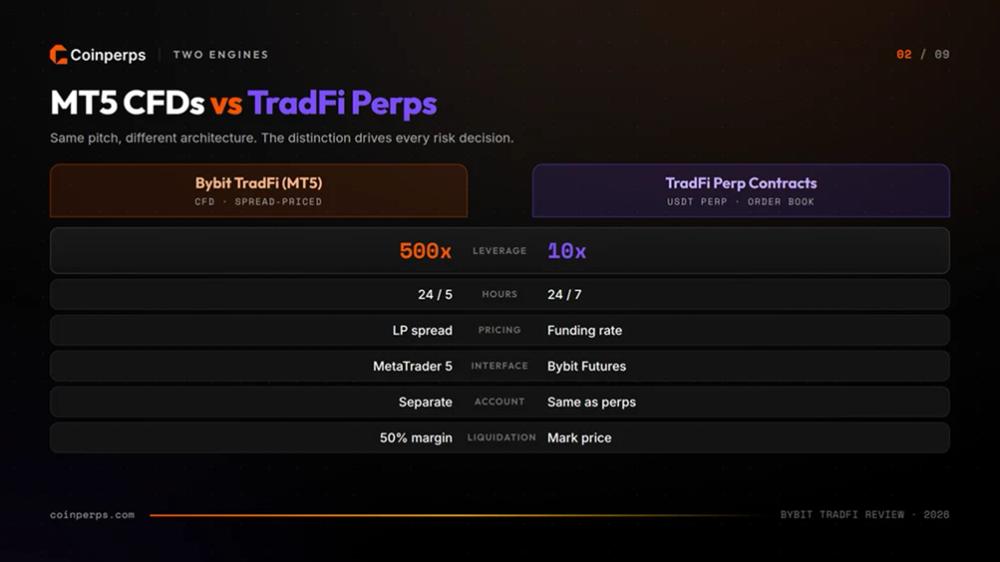
Most coverage blurs these two. On a marketing page both read as "trade stocks with USDT," but they are different products with different risk. The CFD platform runs the forex-broker model: a liquidity provider sets the price, cost sits in the spread, and you trade through MT5. The perpetuals run the model crypto traders know: an order book sets the price, a funding rate recalculates regularly, and everything sits in the standard Bybit derivatives interface.
Feature | Bybit tradFi (MT5) | TradFi perpetual contracts |
|---|---|---|
Model | CFD (contract for difference) | USDT perpetual futures |
Pricing | Liquidity-provider spread | Order book plus funding rate |
Interface | MetaTrader 5 (web, iOS, Android) | Native Bybit Futures page |
Account | Separate TradFi sub-account | Same account as crypto perps |
Max leverage | Up to 500x (fixed per symbol) | Up to 10x |
Trading hours | 24/5 (Mon to Fri) | 24/7 |
Instruments | 100+ FX, indices, metals, oil, stock CFDs | ~26 US stocks, 3 ETFs, 3 commodities |
Collateral | USDT | USDT |
Liquidation | Margin-level trigger at 50% (bid/ask) | Mark-price liquidation, as crypto perps |
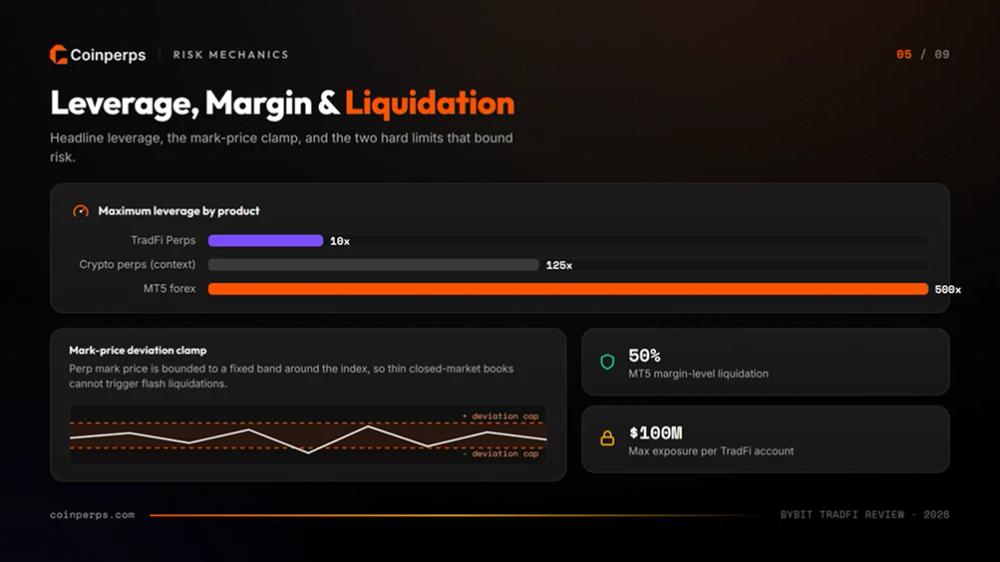
The leverage gap is the headline. MT5 advertises up to 500x on select symbols; the perpetuals cap at 10x. That is a deliberate guardrail, not caution. Crypto perps reach 125x because crypto trades nonstop, but a stock that opens 8% lower on Monday is a different liquidation problem.
What You Can Trade on Bybit TradFi
Coverage depends on the engine. MT5 is the broad one, built like a multi-asset CFD broker. Per Bybit's MT5 contract specifications, it carries 60+ forex pairs, 20+ indices, 150+ US stock CFDs, six gold and silver contracts, two oil contracts and a range of other commodities, with new tickers added weekly.
Asset class | MT5 CFD platform | TradFi perpetual contracts |
|---|---|---|
Forex | 60+ pairs | n/a |
Indices | 20+ contracts | n/a |
US stocks | 150+ CFDs | 20 perpetuals |
ETFs | Via index and stock CFDs | QQQ, EWJ, EWY |
Metals | 6 (gold & silver) | Gold, silver |
Oil & commodities | 2 oil plus 13 commodities | Crude oil |
On the perpetuals side, the equities cluster around names crypto traders already follow. The line-up covers semiconductors (TSM, NVDA, MU), big tech (TSLA, META, GOOGL, MSFT, ORCL, AAPL, INTC), crypto-adjacent stocks (MSTR, COIN, CRCL), and fintech (HOOD). The ETF perps, Nasdaq-heavy QQQ plus Japan (EWJ) and South Korea (EWY) iShares funds, let you take a one-click regional or broad-market view that is harder to build cheaply in spot.
Note: Bybit TradFi instruments are derivatives, not shares. A CFD or TradFi perpetual gives no ownership, no voting rights, no dividends and no physical delivery. You trade the price only.
Fees and Account Modes for Bybit TradFi
The two engines price differently, and the CFD side surprises crypto traders. On the perpetuals, fees follow Bybit's standard USDT-perp maker/taker schedule with the usual VIP discounts. On MT5, fees are mostly spreads, split across two account modes Bybit added in early 2026:
Mode | How you pay | Best for |
|---|---|---|
Zero-Fee | All-in spread, no separate commission (STP model). Default mode. | Beginners and lower-frequency traders |
Tight-Spread | Raw liquidity-provider spread plus fixed per-lot commission (ECN model). Requires US$3,000 minimum deposit. | Active and high-frequency traders |
Per Bybit's account-mode documentation, Zero-Fee buries all cost in the quoted spread, while Tight-Spread shows the raw spread and adds a fixed commission, starting near $3 per lot on forex and CFDs. A third cost matters for holders: a daily swap fee, calculated as lot size x market price x (swap rate / 365). On the perpetuals, the carry cost is the funding rate, which you can track against crypto on the Coinperps funding rates page.
Leverage, Margin and Liquidation
On MT5, leverage is fixed per symbol, not user-adjustable. Forex majors reach 500:1, while individual stock CFDs sit far lower. Margin works like cross margin: your full TradFi balance backs open positions, with tiered requirements that rise as exposure grows. Liquidation triggers at a 50% margin level, settled on bid/ask. A hard ceiling also applies: a US$100 million maximum exposure per TradFi account, with tighter caps on thinner index contracts.
The perpetuals inherit Bybit's crypto-futures plumbing with two changes for traditional assets. First, the mark price is clamped to the index: the system takes a median of several prices, then bounds it within a fixed band of the index to stop the contract drifting from real-world value. Second, a tiered risk-limit system mirrors the standard USDT-perp structure but with tighter leverage, and higher institutional tiers on request.
Note: That deviation clamp is the mechanic to understand. When US markets close, a TradFi perp still trades, but its mark price cannot stray past a set percentage from the last index reference. This stops thin weekend books triggering flash liquidations, but it also means your perp price and the Monday open can diverge.
Bybit TradFi and the 2026 Tokenization Race
Bybit TradFi only makes sense against the wider push to trade equities on crypto rails. The tokenized-equity market grew from about $2 million in mid-2025 to nearly $487 million by the end of March 2026, per the CoinGecko RWA report, with Circle (CRCL) the largest tokenized stock. Regulation tightened too: a January 2026 SEC staff statement confirmed securities laws apply to tokenized stocks whether ownership sits onchain or offchain.
Exchanges split into three camps, and Bybit straddles all of them. The CFD-via-MT5 route (Bybit, Bitget) offers the widest menu but runs through offshore, Mauritius-licensed entities. The USDT-perp route (Binance, OKX, Phemex) keeps everything in one order-book account. The on-chain route, led by Hyperliquid, Lighter, and tokenized-spot venues, drops centralized custody entirely.
Venue | TradFi model | Notable detail |
|---|---|---|
CFD plus USDT perps plus tokenized | Only major CEX running all three, MT5 up to 500x | |
USDT perps plus tokenized | ICE tie-up targets tokenized NYSE access | |
USDT perps plus tokenized | Re-entered tokenized equities in 2026 | |
 Bitget Bitget | CFD plus perps plus tokenized | RWA Index Perpetuals via Ondo Finance |
On-chain perps (HIP-3) | Builder-deployed stock perps, rising share of volume |
 OKX
OKX Binance
 Hyperliquid
The closest rival to Bybit's perpetuals is the on-chain wave in our Hyperliquid HIP-3 explainer, where builders deploy 24/7 markets for names like Tesla, Apple and Nvidia. For the centralized side, the Bybit vs OKX and Binance vs Bybit breakdowns cover liquidity and fees, and the perpetual exchanges directory tracks live activity across venues.
How to Trade on Bybit TradFi
The perpetuals are the simpler entry, since they live in the account you already have. MT5 needs a one-time TradFi account activation.
- Verify and fund USDT. Standard KYC unlocks the platform. Deposit USDT, since both engines use it as collateral.
- For perpetuals: open the Futures page, use the symbol dropdown and go to Perpetual > USDT > Stock / Commodity to find listed TradFi perps.
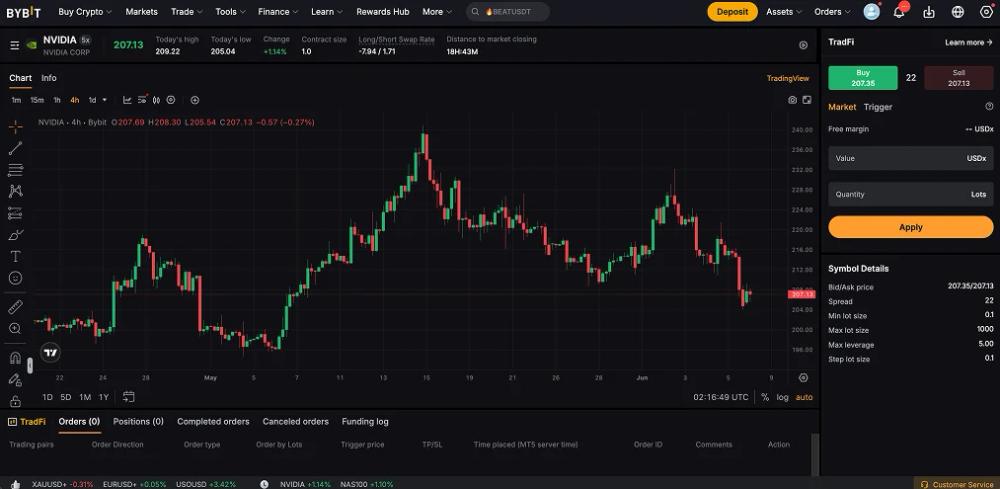
- For MT5: activate a Bybit TradFi account, then trade FX, metals, indices and stock CFDs in-app or via the MetaTrader 5 terminal. No separate login once active.
- Pick your mode. On MT5, start in Zero-Fee. Switch to Tight-Spread only when volume makes the raw-spread saving worth it, and close open positions first.
- Set risk first. Use take-profit and stop-loss orders, size for the gap risk of a closed market, and watch funding (perps) or swap fees (MT5) on overnight positions.
Risks to Consider
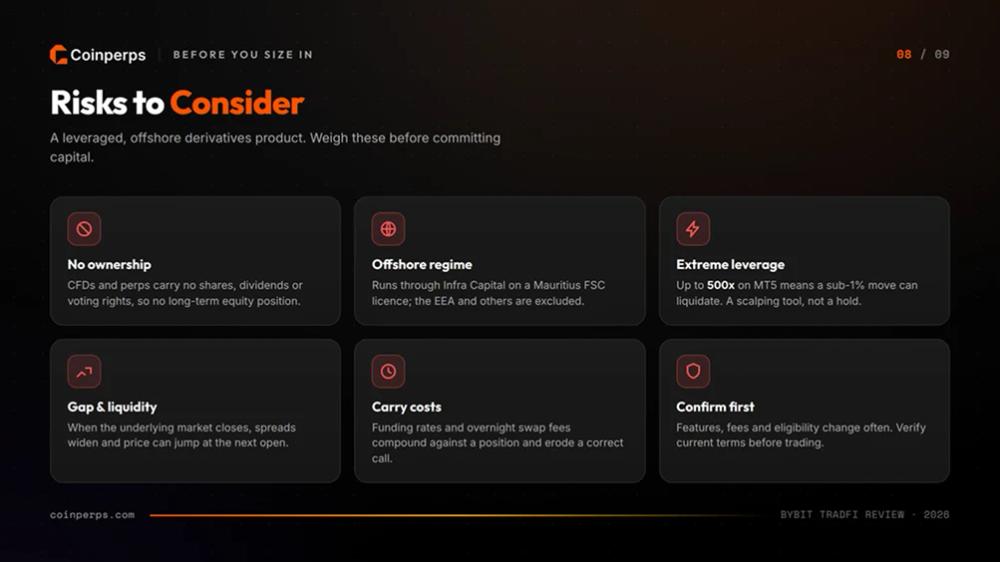
Bybit TradFi is a useful bridge, but it is a leveraged, offshore derivatives product. Weigh these before sizing in:
- No ownership: CFDs and TradFi perps carry no shares, dividends or voting rights, so they cannot build a long-term equity position.
- Offshore regulation: The product runs through Infra Capital on a Mauritius FSC licence, not an onshore broker regime. Protections differ from a domestic stockbroker, and the EEA and other regions are excluded.
- Extreme leverage: Up to 500x on MT5 means a sub-1% move can liquidate you. Leverage this high is a scalping tool, not a hold.
- Gap and liquidity risk: When the underlying market closes, spreads widen, liquidity thins, and the price can jump at the next open despite the clamp.
- Carry costs: Funding rates (perps) and overnight swap fees (MT5) compound against positions over time and can erode a correct call.
Bottom Line
Bybit TradFi is one of the most complete TradFi-on-crypto offerings any centralized exchange has built. MT5 brings forex-style breadth and high leverage, the perpetuals bring 24/7 stock and ETF exposure inside the order book you already use, and tokenized assets cover the spot side.
The trap is treating one name as one product. Run the 500x MT5 CFDs and the 10x USDT perps as separate tools, respect the offshore-derivative nature of both, and remember you trade price, not ownership.
For traders already on Bybit who want to react to a Nvidia print or a 3am gold spike, it earns its place, used with the leverage discipline these markets demand. Compare live options in the perpetual exchanges directory before committing capital.
Frequently asked questions
Is Bybit TradFi the same as Bybit's crypto perpetuals?
No. Crypto perpetuals track digital assets like BTC and ETH at up to 125x. Bybit TradFi covers traditional assets, either as MT5 CFDs (up to 500x) or USDT-settled TradFi Perpetual Contracts (up to 10x).
Do I own the stock when I trade a Bybit TradFi contract?
No. The MT5 CFDs and the TradFi perpetuals are derivatives that track price only. They carry no shares, dividends, voting rights or physical delivery.
What does it cost to trade?
On MT5, cost sits in the spread. Zero-Fee bundles everything into the spread, while Tight-Spread shows a raw spread plus a fixed per-lot commission (from about $3) and needs a $3,000 minimum deposit. Overnight swap fees apply. The perpetuals use standard USDT-perp maker/taker fees plus a funding rate.
Why is leverage 10x on the perpetuals but 500x on MT5?
The perpetuals use tighter, tiered leverage and a mark-price deviation clamp because stocks gap when their market is closed. The 10x cap and index-bounded mark price cut the risk of weekend flash liquidations, while the MT5 CFD product offers higher headline leverage on select symbols.


