Best USDT Wallets Ranked (2026)
MetaMask, Trezor and Ledger lead our ranking of USDT wallets for network coverage, security record and fees. See what a USDT transfer costs on ten networks, which wallets take fees in USDT and how to avoid freezes and address poisoning.

Coinperps may earn a commission from partner links, at no cost to you; rankings follow our methodology. Not financial advice.
Key takeaways
- MetaMask is the best USDT wallet for most people: it holds USDT on TRON, Ethereum and the main EVM networks in one free app, and it takes network fees in USDT on six of them.
- Network coverage matters most: TRON carries 52.4% of Tether-issued USDT and Ethereum 45.5%, so a wallet without both misses about 98% of the supply.
- TRON is now the dearest network to send on: our 18 November 2026 measurement put a TRC-20 transfer at $2.09 to $4.13, against about two cents on Ethereum.
- Self-custody does not stop a freeze: Tether has frozen more than 7 billion USDT at the contract level, and address poisoning cost one trader 49,999,950 USDT in a single transfer.

- USDT networks
- TRON, Ethereum, Solana, BNB Chain, Layer 2s
- Fees in USDT
- Gas Station on 6 EVM networks
- Price
- Free
- Swap fee
- 0.875%
On this page 9 sections
- Best USDT Wallets Compared
- Which USDT Network Should You Hold On?
- Is a Hot Wallet or a Hardware Wallet Better for USDT?
- Can You Pay Network Fees in USDT?
- Can USDT Be Frozen in a Self-Custody Wallet?
- What Do MiCA and the GENIUS Act Mean for USDT Holders?
- Which Scams Target USDT Wallets?
- How to Move USDT From an Exchange to Your Wallet
- Bottom Line
The best USDT wallets today are MetaMask and Trezor. MetaMask holds USDT on both TRON and Ethereum in one free app and takes network fees in USDT on six EVM networks. Trezor is the safest place for a large balance, kept offline.
Ledger, Trust Wallet, Bitget Wallet, Tangem, Keeper and Tether's own tether.wallet complete the list. USDT (Tether) is a dollar-pegged stablecoin, and in a self-custody wallet you hold the keys yourself.
Over 18 and 19 November 2026 we compared 21 wallets and measured what a USDT transfer costs on ten networks. This guide is general information and not personalised financial advice.
Best USDT Wallets Compared
Wallet | Type | USDT networks | Fees payable in USDT | Price | Key nuance |
|---|---|---|---|---|---|
Software, seed phrase | Ethereum and EVM networks, Solana, TRON | Yes, on 6 EVM networks | Free | TRON added January 2026; 0.875% swap fee | |
Hardware, open source | TRON, Ethereum, Solana, BNB Chain and EVM networks | No | $59 to $249 | TRON on desktop app; mobile still experimental | |
Hardware, secure element | Ethereum, TRON, Polygon and others | No | $59 to $399 | Buy direct; tampered reseller units found in October 2026 | |
Software, seed phrase | TRON, Ethereum, BNB Chain, Solana, TON and more | Yes, on 5 EVM networks | Free | Browser extension compromised in December 2025; victims repaid | |
Software, seed phrase | TRON, Ethereum, TON, Solana and more | Yes, including TRON | Free | Separate product from the Bitget exchange | |
Hardware, NFC card | TRON, Ethereum, BNB Chain, TON and more | Yes, on Ethereum, Polygon, Arbitrum | From $54.90 | No screen to check the address on | |
Software, seed phrase | TON, TRON, Ethereum, BNB Chain, Arbitrum, Base | Yes, on TON | Free | Formerly Tonkeeper; new operator since August 2026 | |
Software, seed phrase | Ethereum, Polygon, Plasma, Arbitrum | Yes, on every transfer | Free | Issuer's own app; TRON support not confirmed by Tether |
 Bitget Wallet
Prices are the makers' own store prices in US dollars on 19 November 2026. User counts quoted below are company figures.
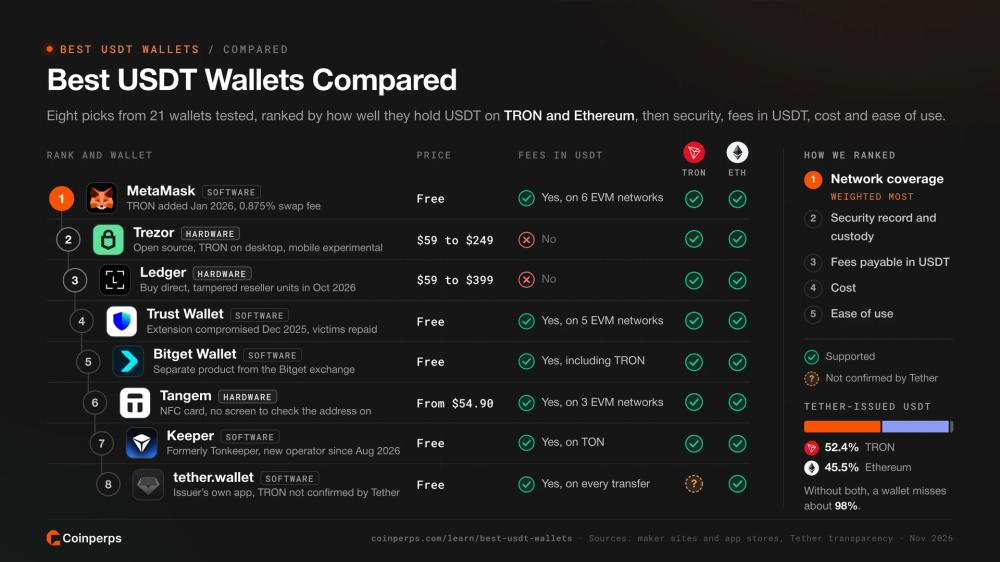
Network coverage carried the most weight in our ranking. TRON holds 52.4% of Tether-issued USDT and Ethereum 45.5%, so a wallet without both misses about 98% of the supply. Security record and custody model came second, then paying fees in USDT, cost and ease of use.
1. MetaMask
Best forTRON added January 2026; 0.875% swap fee- Type
- Software, seed phrase
- USDT networks
- Ethereum and EVM networks, Solana, TRON
- Fees payable in USDT
- Yes, on 6 EVM networks
- Price
- Free
MetaMask is the best USDT wallet for most holders. It leads on Ethereum and its layer 2 networks and has supported TRON since January 2026, so the two networks holding about 98% of USDT share one app. Consensys builds it as a free browser extension and mobile app.
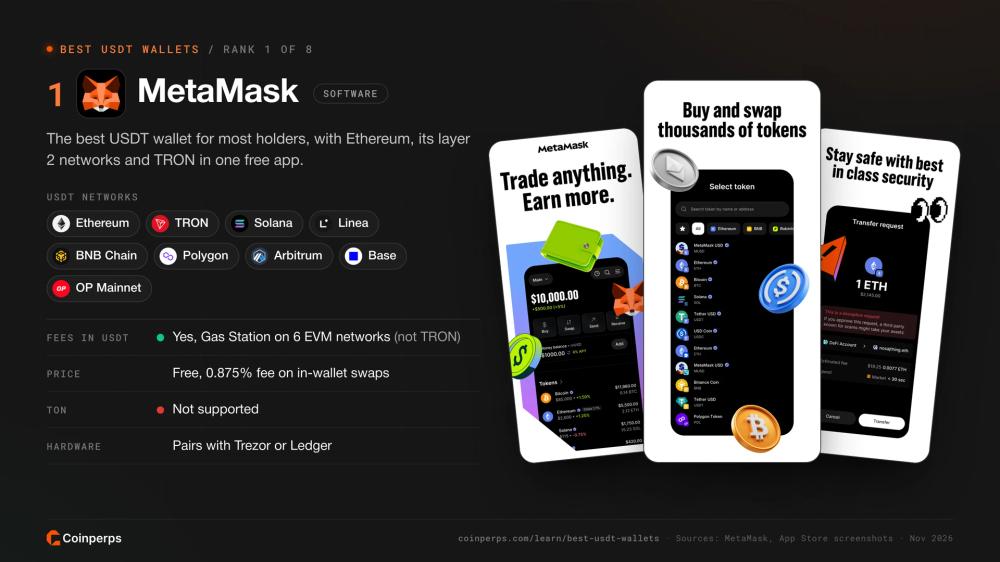
Sending and receiving TRC-20 USDT works, according to MetaMask's TRON support page, though connecting to TRON apps is still marked as coming soon. The wallet also covers Solana, Linea, BNB Chain, Polygon, Arbitrum, Base and OP Mainnet.
The Gas Station feature lets you pay the network fee in USDT on Ethereum, BNB Smart Chain, Polygon, Arbitrum, Linea and Base. The quote includes a small MetaMask fee, and TRON is not covered. Swaps inside the wallet carry a 0.875% MetaMask fee.
Pair it with a Trezor or Ledger and you keep the MetaMask interface while the keys move offline. It also accepts custom EVM networks, as our guide to connecting HyperEVM to MetaMask shows. Consensys has confirmed a planned MASK token, but none had launched when we checked, so treat any claim page as a scam.
Pros
- Best EVM support: works with almost every Ethereum app and layer 2 network.
- TRON included: TRC-20 USDT has been supported since January 2026.
- Fees in USDT: Gas Station covers six EVM networks.
Cons
- No TON: USDT on TON needs another wallet.
- Swap fee: 0.875% is high for stablecoin swaps.
- Frequent phishing target: fake MetaMask sites, emails and token claims are common.
2. Trezor
 Best forTRON on desktop app; mobile still experimental
- Type
- Hardware, open source
- USDT networks
- TRON, Ethereum, Solana, BNB Chain and EVM networks
- Fees payable in USDT
- No
- Price
- $59 to $249
Our top hardware pick is Trezor. A hardware wallet is a small device that stores your keys offline and signs each transfer on its own screen. Trezor publishes its firmware and hardware designs as open source, and no device exploit surfaced in 2026.
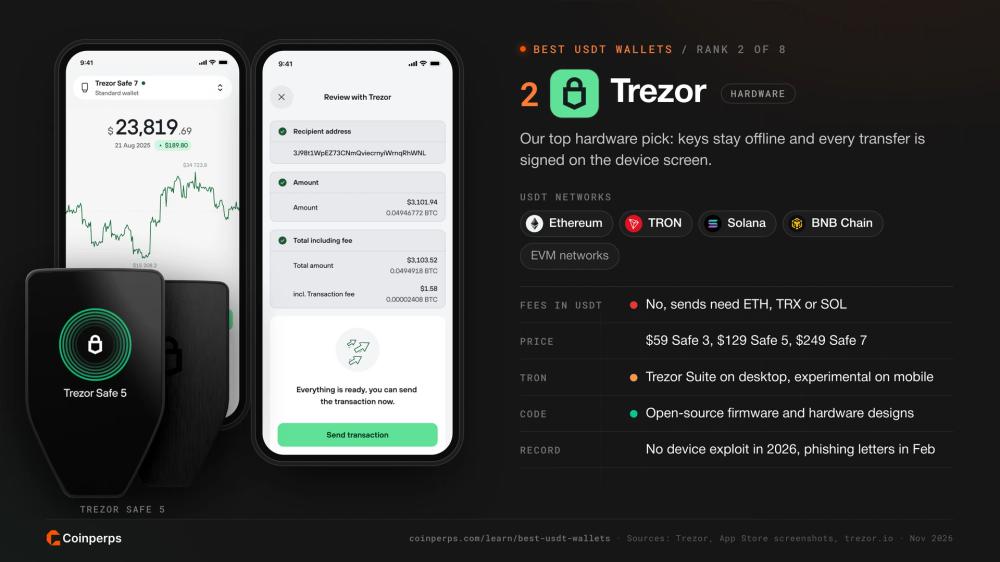
Prices run from $59 for the Safe 3 to $129 for the Safe 5 and $249 for the Safe 7, which adds Bluetooth and a second, openly auditable secure chip. Each model holds USDT on Ethereum, TRON, Solana, BNB Smart Chain and the main EVM networks.
Trezor's guide says its Trezor Suite app supports all TRC-20 tokens on the Safe 3, Safe 5, Safe 7 and Model T. On mobile, TRON is still an experimental setting. There is no built-in way to stake TRX for energy yet, which means each TRC-20 transfer burns TRX.
No Trezor wallet pays fees in USDT, so you need ETH, TRX or SOL beside the stablecoin. Trezor owners have been targeted by posted letters carrying QR codes that lead to seed-stealing sites, a campaign reported in February 2026. Trezor never asks for a recovery phrase.
Pros
- Open source: firmware and hardware designs are public and independently reviewed.
- Native TRON and Ethereum: both major USDT networks work in Trezor Suite without a third-party app.
- Low entry price: the Safe 3 costs $59, the same as the cheapest Ledger.
Cons
- No fees in USDT: every transfer needs the network's own coin.
- TRON on mobile is experimental: desktop is the dependable option for TRC-20 today.
- Phishing by post: older customer data leaks feed letters and emails that imitate Trezor.
3. Ledger
 Best forBuy direct; tampered reseller units found in October 2026
- Type
- Hardware, secure element
- USDT networks
- Ethereum, TRON, Polygon and others
- Fees payable in USDT
- No
- Price
- $59 to $399
Ledger sells the widest hardware range, five devices from $59 to $399. Its companion app, Ledger Wallet (formerly Ledger Live), manages USDT on Ethereum, TRON, Polygon and other major networks.
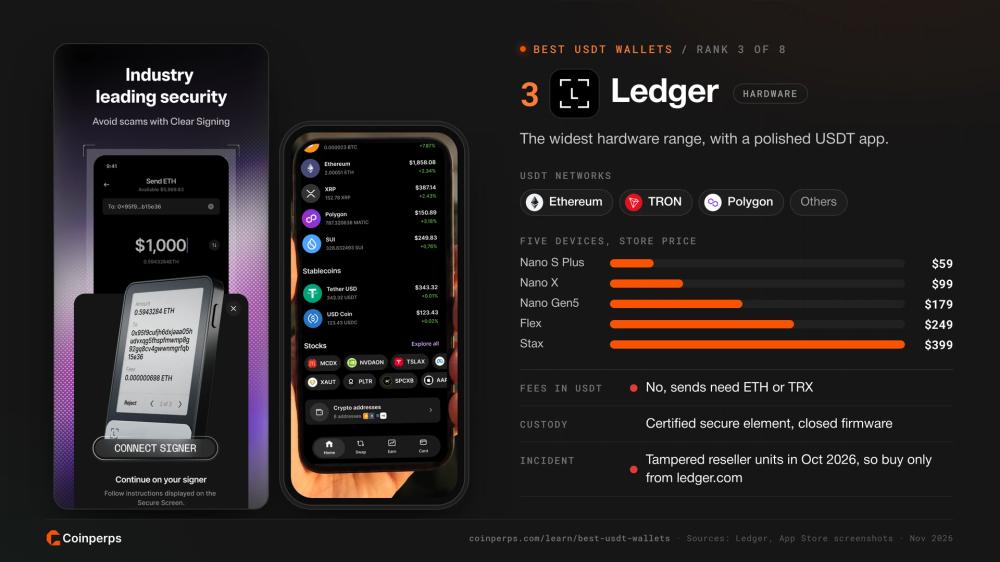
The Nano S Plus costs $59, the Nano X $99, the Nano Gen5 $179, the Flex $249 and the Stax $399. Keys stay inside a certified secure element chip. The Nano S Plus has no Bluetooth, so phone users should start at the Nano X.
Its record is why Ledger sits below Trezor. In October 2026 devices sold through an authorised Asian reseller, CryptoBilis, were found to carry hidden implants. Ledger confirmed tampering in at least one victim's device and paused the reseller. One onchain analyst puts linked thefts above $86 million. Ledger has not confirmed that figure.
Ledger says its own systems were not breached, so buy only from ledger.com. Earlier incidents include the Connect Kit library attack of December 2023, which cost users about $600,000 that Ledger reimbursed. Criticism also followed Ledger Recover in 2023, an optional backup service that splits an encrypted seed among third parties.
Pros
- Polished app: Ledger Wallet handles USDT on Ethereum, TRON and Polygon with built-in swaps.
- Range of devices: five models, with Bluetooth from $99.
- Secure element: keys are held in a certified chip and never leave the device.
Cons
- Reseller tampering: the October 2026 case makes buying direct essential.
- Closed firmware: the secure element code cannot be fully audited by outsiders.
- No fees in USDT: ordinary sends still need ETH or TRX.
4. Trust Wallet
 Best forBrowser extension compromised in December 2025; victims repaid
- Type
- Software, seed phrase
- USDT networks
- TRON, Ethereum, BNB Chain, Solana, TON and more
- Fees payable in USDT
- Yes, on 5 EVM networks
- Price
- Free
Trust Wallet supports USDT on nearly every network where the token circulates. TRON (TRC-20), Ethereum (ERC-20), BNB Chain, Solana, TON and the main Ethereum layer 2 networks all sit in one app. Its security record keeps it below MetaMask and the two hardware picks.
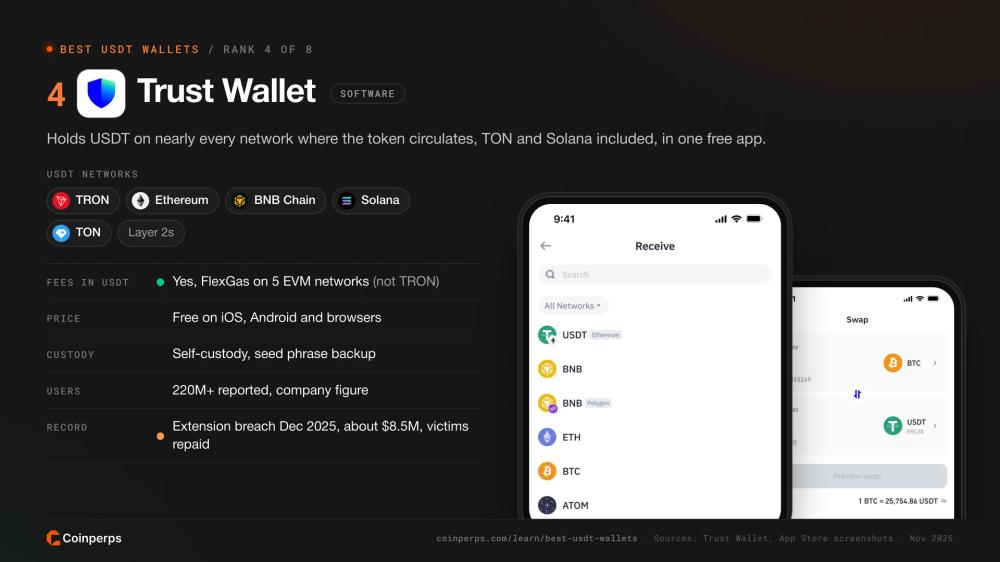
The free self-custody app runs on iOS, Android and desktop browsers. Binance acquired it in 2018, and it reports more than 220 million users. Backup works through a seed phrase. This list of 12 or 24 words restores the wallet on any device and gives full control to whoever holds it.
Its FlexGas feature lets you pay network fees in USDT, USDC or TWT on Ethereum, BNB Smart Chain, Arbitrum, OP Mainnet and Base. TRON is left out, so a TRC-20 transfer still needs TRX in the wallet.
A malicious version of the Chrome extension was published on 24 December 2025 and stayed live for two days. Losses came to about $8.5 million across roughly 2,520 addresses in Trust Wallet's own review. The company compensated the victims, and the mobile app was never affected.
A separate wave hit phones. Bitquery's analysts traced at least $5.42 million of USDT drained from 454 TRON wallets in October and November 2026. The suspected cause is iPhone malware that steals seed phrases from several wallet apps. No flaw in Trust Wallet itself has been shown. Keeping iOS updated is the defence.
Pros
- Widest USDT coverage: TRON, Ethereum, BNB Chain, Solana, TON and layer 2 networks in one app.
- Fees in USDT: FlexGas removes the need for ETH or BNB on five EVM networks.
- Free and familiar: a setup most beginners finish in minutes.
Cons
- Extension breach: the December 2025 compromise cost users about $8.5 million before compensation.
- TRX still needed: FlexGas does not work on TRON, the largest USDT network.
- Hot wallet: keys sit on an internet-connected phone or browser.
5. Bitget Wallet
- Type
- Software, seed phrase
- USDT networks
- TRON, Ethereum, TON, Solana and more
- Fees payable in USDT
- Yes, including TRON
- Price
- Free
If you want to pay TRON fees in USDT, no software wallet does it better than Bitget Wallet. This free self-custody app runs on a seed phrase, sits apart from the Bitget exchange and reports more than 80 million users.
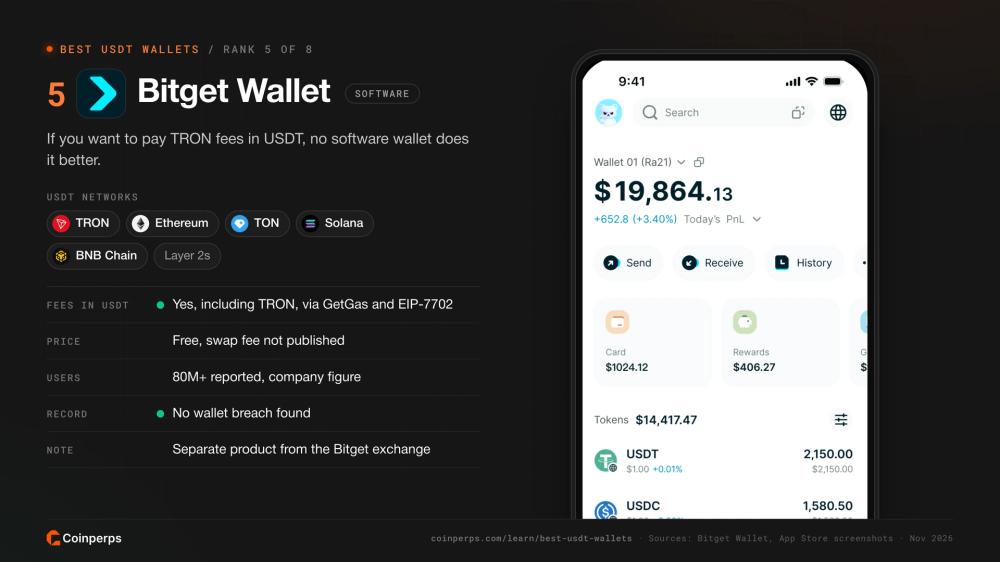
Its GetGas feature, launched on nine networks including TRON, TON, Solana, Ethereum and BNB Chain, lets you prepay network fees with USDT, USDC, ETH or BGB. In July 2025 Bitget Wallet said the first TRON USDT transfer would be free and later ones half price. Check the current offer in the app.
Since October 2025 the wallet has used EIP-7702, an Ethereum upgrade that lets an ordinary account borrow smart-contract features. Bitget Wallet relies on it to take gas directly in stablecoins with no prepaid balance, on eight networks that include TRON.
The wallet itself has no recorded breach. Its sister exchange runs on a different system and lost more than $350 million from its own wallets in September 2026, a loss covered by its protection fund. Bitget Wallet does not publish a standard swap fee, so compare the quote before you confirm.
Pros
- Fees in USDT on TRON: one of the few wallets that removes the need for TRX.
- Broad coverage: USDT on TRON, Ethereum, TON, Solana, BNB Chain and layer 2 networks.
- No recorded wallet breach: we found no compromise of the app itself.
Cons
- Unpublished swap fee: costs appear only in the quote.
- Exchange brand risk: the sister exchange was hacked in September 2026.
- Busy interface: trading and earn features crowd a simple send and receive task.
6. Tangem
 Best forNo screen to check the address on
- Type
- Hardware, NFC card
- USDT networks
- TRON, Ethereum, BNB Chain, TON and more
- Fees payable in USDT
- Yes, on Ethereum, Polygon, Arbitrum
- Price
- From $54.90
On a budget, Tangem is the hardware wallet to buy. It looks like a bank card and signs transfers when you tap it against a phone. A two-card set costs $54.90, and three cards cost $69.90.
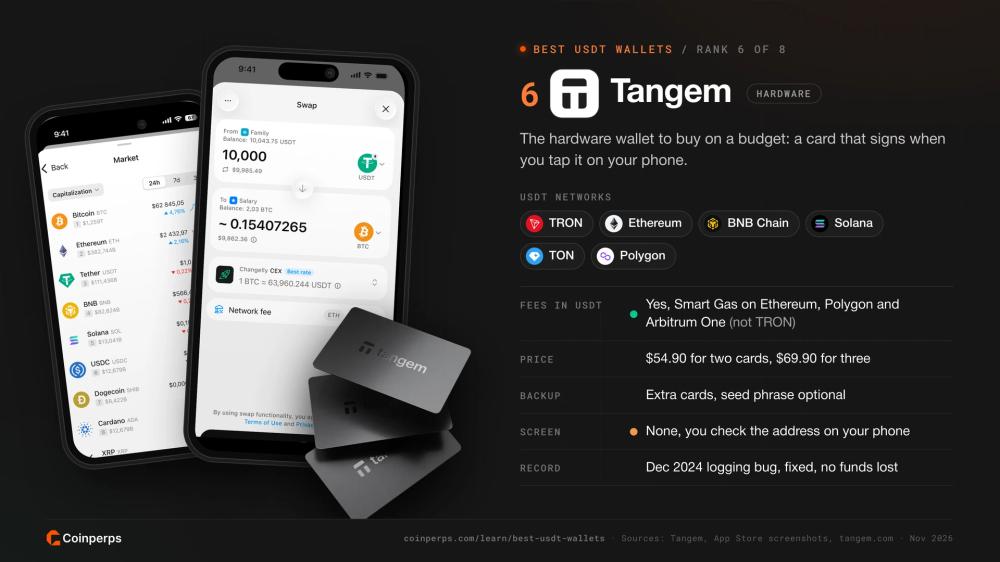
The key is generated inside the card's chip, the extra cards are the backup, and a seed phrase is optional. Tangem supports USDT on TRON, Ethereum, BNB Chain, Solana, TON and Polygon through its mobile app.
Smart Gas, added in February 2026, lets you pay fees in USDT on Ethereum and in USDT0 on Polygon and Arbitrum One. In Tangem's own example a 50 USDT transfer carries a fee of about $0.80, more than paying in ETH would cost. TRON is not included.
With no screen on the card, you confirm the address on your phone and give up the independent check a Trezor or Ledger display offers. In December 2024 an app bug wrote private keys to support logs for some users who set up with a seed phrase and then contacted support. Tangem fixed it and said no funds were lost.
Pros
- Cheapest hardware pick: $54.90 for two cards.
- No seed phrase required: backup cards replace the written phrase.
- Fees in USDT: Smart Gas works on Ethereum, Polygon and Arbitrum One.
Cons
- No screen: the phone is the only display, so malware on it is harder to catch.
- No Smart Gas on TRON: TRC-20 transfers need TRX.
- Past logging bug: the December 2024 issue exposed keys of some seed-phrase users to support logs.
7. Keeper
 Best forFormerly Tonkeeper; new operator since August 2026
- Type
- Software, seed phrase
- USDT networks
- TON, TRON, Ethereum, BNB Chain, Arbitrum, Base
- Fees payable in USDT
- Yes, on TON
- Price
- Free
TON holders should look at Keeper first. It was called Tonkeeper until 15 September 2026, when it relaunched with seven networks, covering TON, Bitcoin, Ethereum, TRON, BNB Smart Chain, Arbitrum and Base.
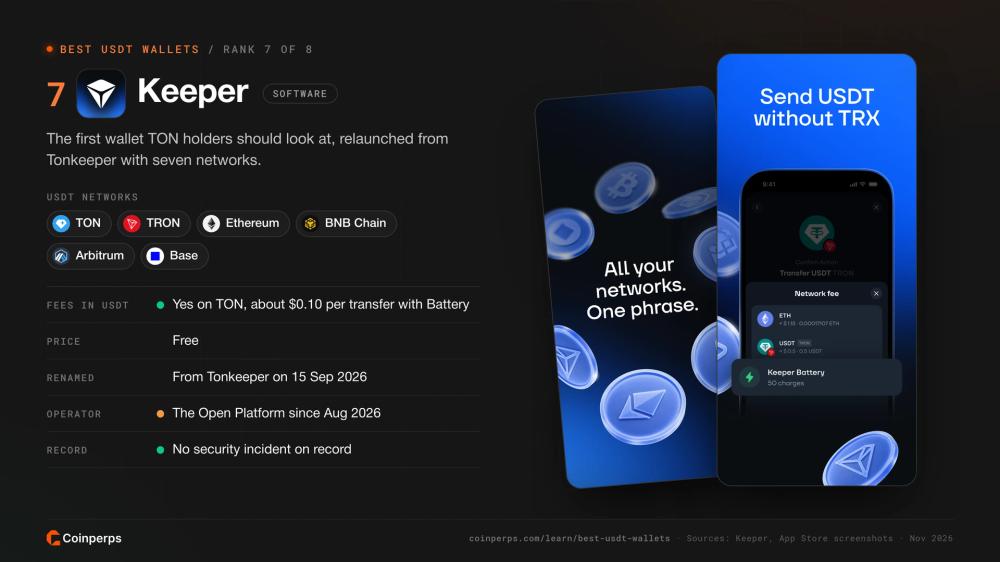
At the last step of a TON send, you can pay the fee in USDT. Battery, a prepaid credit, does the same job for less. Keeper's own figures put a USDT transfer at about $0.10 with Battery and $0.14 with the gasless option. The company says it plans to extend Battery to every supported network.
The Open Platform took over operational leadership in August 2026, and it also builds Walt, the wallet inside Telegram that was renamed from Wallet in Telegram on 28 September. Walt's main account is custodial, meaning the company holds the keys. Telegram's new self-custody Gram wallet is still in limited release.
Keeper reports more than 77 million registered accounts and has no security incident on record. The rename arrives as an update to the existing app, so ignore any site or message that asks for your recovery phrase to migrate.
Pros
- Fees in USDT on TON: no need to hold the network's own coin for token transfers.
- TRON and Ethereum added: the September relaunch covers both major USDT networks.
- Clean record: no incident found.
Cons
- New operator: the company behind Telegram's custodial wallet now runs it.
- Multichain support is young: TRON and Ethereum have been live for only two months.
- Rebrand phishing: lookalike domains imitate the old and new names.
8. tether.wallet
 Best forIssuer's own app; TRON support not confirmed by Tether
- Type
- Software, seed phrase
- USDT networks
- Ethereum, Polygon, Plasma, Arbitrum
- Fees payable in USDT
- Yes, on every transfer
- Price
- Free
Sending USDT without a gas token is simplest in tether.wallet, the issuer's own app. Tether launched it on 14 April 2026 for iOS and Android. Tether says keys and recovery phrases stay with the user.
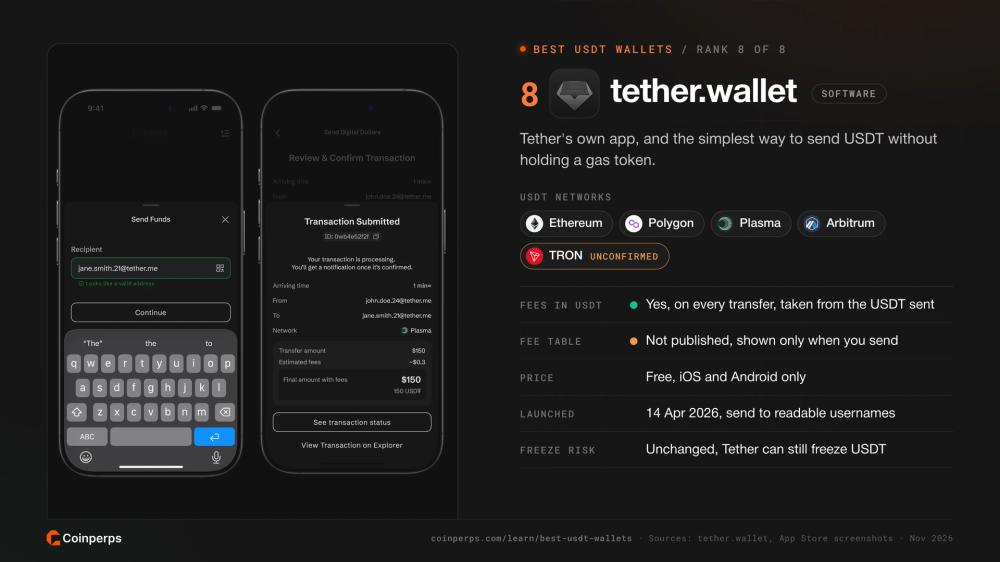
Fees come out of the asset you send, so a USDT transfer never needs ETH or another coin. No fee schedule has been published. You can send to a readable username in place of a long address, and an optional cloud backup protects the key.
At launch the wallet held USDT on Ethereum, Polygon, Plasma and Arbitrum, plus Bitcoin, Tether Gold and the US-regulated USAT. Secondary outlets reported TRON support in June 2026, but we found no Tether announcement confirming it. Check the network list in the app before you send TRC-20 USDT.
Tether's own app does not change freeze risk, and its usernames add a central directory to an otherwise self-custodial product.
Pros
- No gas token: fees come out of the USDT you send.
- Made by the issuer: built on Tether's open-source wallet kit.
- Readable usernames: fewer chances to paste a wrong address.
Cons
- Narrow network list: four USDT networks at launch, with TRON unconfirmed.
- No published fees: the cost appears only at the point of sending.
- Mobile only: no desktop app or browser extension.
Wallets That Missed the List
Without TRON support, Phantom and Coinbase Wallet cannot serve as a main USDT wallet. Exodus covers TRON and Ethereum but needs the native coin for fees on most networks. TronLink covers TRON only. SafePal disclosed in August 2026 that order records of 39,798 hardware customers were exposed, though keys were not.
Best Wallet is excluded because the UK's Financial Conduct Authority lists it as an unauthorised firm. Atomic Wallet stays out too. Its 2023 hack cost about $100 million, and the cause was never fully explained.
Which USDT Network Should You Hold On?
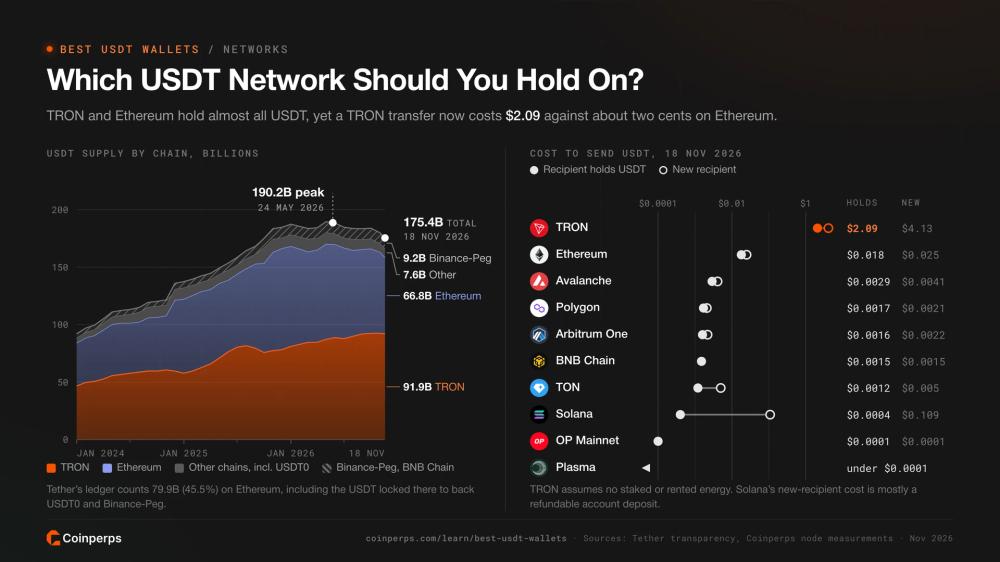
Hold USDT on the network your counterparties use, and for most people that is TRON or Ethereum. Tether's transparency data for 18 November 2026 shows 175.4 billion USDT in circulation. TRON carries 91.9 billion (52.4%) and Ethereum 79.9 billion (45.5%). Solana holds 2.0 billion and TON 0.5 billion.
TRC-20 and ERC-20 are the token standards for USDT on TRON and Ethereum. A wallet can receive either only if it supports that network, and USDT sent on the wrong network is often lost.
What a USDT Transfer Costs on Each Network
Using each chain's public nodes, we estimated the fee for a real USDT transfer on ten networks at 19:38 UTC on 18 November 2026. Sending 100 USDT costs the same as sending 100,000.
Network | Token standard | Recipient already holds USDT | New recipient | Fee paid in |
|---|---|---|---|---|
TRON | TRC-20 | $2.09 | $4.13 | TRX |
Ethereum | ERC-20 | $0.018 | $0.025 | ETH |
Avalanche C-Chain | ERC-20 | $0.0029 | $0.0041 | AVAX |
Polygon | USDT0 | $0.0017 | $0.0021 | POL |
Arbitrum One | USDT0 | $0.0016 | $0.0022 | ETH |
BNB Chain | BEP-20 (Binance-Peg) | $0.0015 | $0.0015 | BNB |
TON | Jetton | $0.0012 | $0.005 | Toncoin (now Gram) |
Solana | SPL | $0.0004 | $0.109 | SOL |
OP Mainnet | USDT0 | $0.0001 | $0.0001 | ETH |
Plasma | USDT0 | Under $0.0001 | Under $0.0001 | XPL |
TRON figures assume no staked or rented energy. Solana's new-recipient cost is mostly a refundable account deposit.
Most people use TRON for USDT, yet it is now the dearest network to send on. A transfer burns about 6.8 TRX, and about 13.4 TRX when the recipient has never held USDT. That is after TRON cut its energy price from 210 to 100 sun per unit in August 2025. Staking TRX or renting energy lowers the cost sharply.
Ethereum went the other way. Gas sat near 0.2 gwei at our snapshot, so an ERC-20 USDT transfer cost about two cents, against several dollars in earlier years. Fees rise quickly when the network is busy, so check the quote before sending.
USDT0, Binance-Peg and Legacy Versions
Tether issues USDT directly on TRON, Ethereum, Solana, TON, Aptos, Avalanche and a few smaller chains. On Arbitrum, Polygon, OP Mainnet and Plasma, the token your wallet labels USDT is USDT0. This version is backed one for one by USDT locked on Ethereum, is live on 24 networks and needs no swap.
On BNB Chain the token is Binance-Peg USDT, issued by Binance against USDT it holds. Tether's ledger shows no supply of its own there. It trades at par, but the redemption claim runs through Binance.
Tether no longer issues or redeems USDT on Omni, EOS, Algorand, Kusama and Bitcoin Cash SLP. Official support ended in 2025, although Tether dropped its plan to freeze them. A balance still showing on one of those chains should move to a supported network through an exchange that accepts it.
Is a Hot Wallet or a Hardware Wallet Better for USDT?
A hot wallet is better for small amounts you move often, and a hardware wallet is better for savings. A hot wallet is a free, quick app on a phone or browser, so its keys live on a device that is online. Its weak point is the device and the software supply chain, as the Trust Wallet extension case showed.
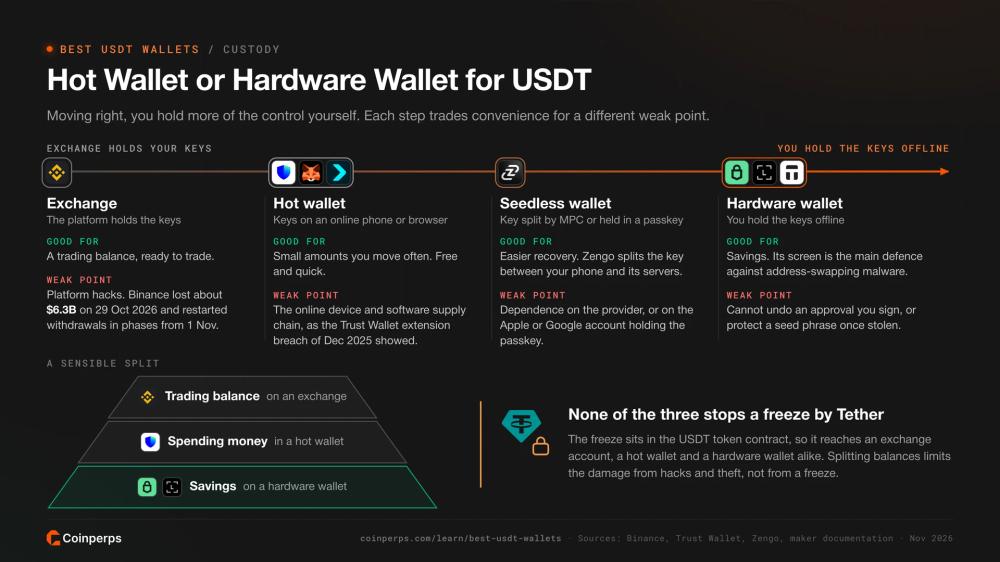
Hardware keeps keys offline and shows each transfer on its own screen, the main defence against malware that swaps addresses on your computer. It cannot undo a token approval you sign, and it offers no protection if someone obtains your seed phrase.
Seedless wallets take a third approach. Zengo splits the key between your phone and its servers using multi-party computation, and other apps tie the key to a passkey stored with Apple or Google. Recovery gets easier, at the cost of depending on the provider or cloud account. eToro agreed to buy Zengo in April 2026.
Leaving USDT on an exchange carries its own risk. Hackers took about $6.3 billion from Binance on 29 October 2026, and withdrawals restarted in phases from 1 November. Binance says it has replenished about 95% of the stolen assets. Our perp DEX vs CEX comparison sets out the custody trade-off for traders.
A sensible split is a trading balance on an exchange, spending money in a hot wallet and savings on a hardware wallet. None of the three protects against a freeze by Tether.
Can You Pay Network Fees in USDT?
A growing number of wallets let you, though TRON remains the hardest network for it. Normally a transfer needs the network's own coin, so a wallet holding only USDT cannot send it. Gasless features have a relayer pay the network and take its fee in USDT.
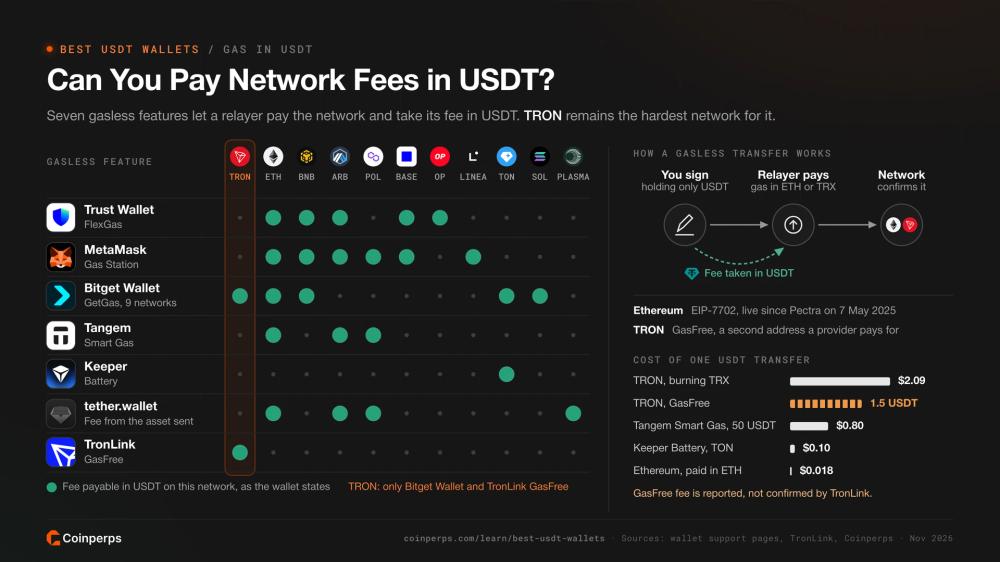
Wallet or feature | Networks covered | How the fee is charged |
|---|---|---|
| Trust Wallet FlexGas | Ethereum, BNB Smart Chain, Arbitrum, OP Mainnet, Base | In USDT, USDC or TWT at the time of sending |
| MetaMask Gas Station | Ethereum, BNB Smart Chain, Polygon, Arbitrum, Linea, Base | In USDT, with a small MetaMask fee included |
 Bitget Wallet GetGas | TRON, TON, Solana, Ethereum and others | From a prepaid balance or directly in stablecoins |
| Tangem Smart Gas | Ethereum, Polygon, Arbitrum One | In USDT or USDT0; about $0.80 in Tangem's example |
| Keeper Battery | TON | About $0.10 per USDT transfer with Battery |
| tether.wallet | Ethereum, Polygon, Plasma, Arbitrum | In the asset sent; no schedule published |
 TronLink GasFree | TRON | A flat USDT fee from a separate GasFree address |
On Ethereum, most of these features rely on EIP-7702. It went live with the Pectra upgrade on 7 May 2025 and lets a standard account hand fee payment to a smart contract. On TRON, GasFree gives each user a second address whose transfers a provider pays for.
Recent reports put the GasFree charge at about 1.5 USDT per transfer, which we could not confirm against TronLink's own guide. Burning TRX costs about $2.09, so GasFree would be cheaper, and staking TRX cheaper again. A relayed transfer on Ethereum can cost many times the two-cent native fee.
Occasional senders and new users who hold no other coin gain most from paying in USDT. Frequent TRON senders save more by staking TRX for energy. Plasma, a network built around USDT, charged almost nothing for a standard transfer in our test.
Can USDT Be Frozen in a Self-Custody Wallet?
Yes. Tether can freeze USDT at any address because the freeze sits in the token contract, whatever wallet you use. Once an address is frozen it cannot send USDT. Tether can then destroy the tokens and reissue them to a victim or to a government. By 2 November 2026 Tether said it had frozen more than 7 billion USDT.
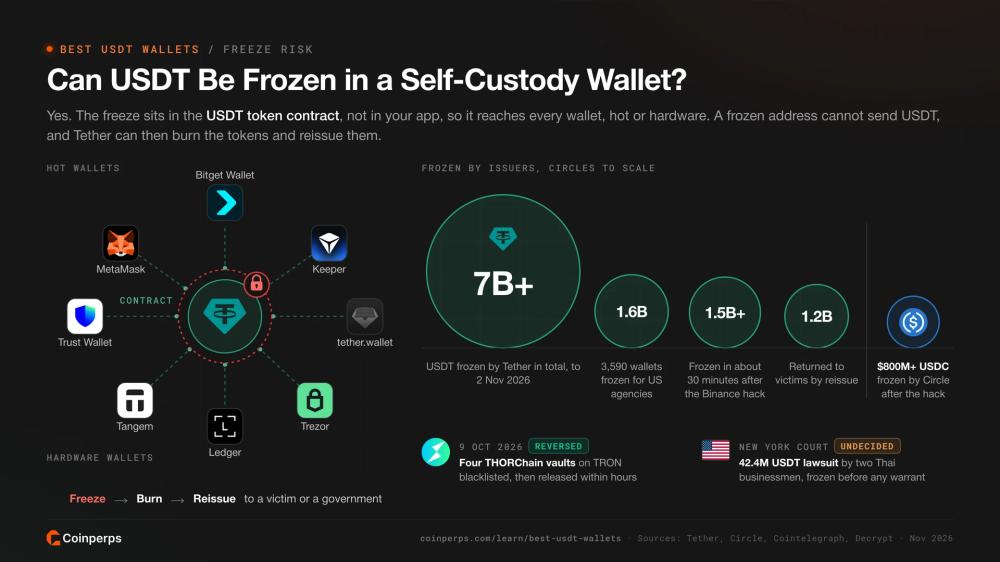
That statement also counts 3,590 wallets holding about 1.6 billion USDT frozen for US agencies, and about 1.2 billion returned to victims. When Binance was hacked, Tether froze more than 1.5 billion USDT within roughly 30 minutes. That power helps theft victims, and bitcoin or ether holders have no equivalent.
On 9 October 2026 Tether blacklisted four THORChain vaults on TRON and reversed the action within hours. Two Thai businessmen are suing Tether in New York over 42.4 million USDT, which they say was frozen on an agent's informal request before any warrant. No ruling has been made.
Ordinary holders are rarely frozen, and the usual cause is receiving USDT from a flagged address, often in a peer-to-peer or cash trade. Vetted counterparties lower that risk. Our guide to the best P2P crypto exchanges compares platforms with escrow and merchant checks.
How USAT and USDC Compare
Rival dollar stablecoins can be frozen too. Circle froze more than $800 million of USDC after the Binance hack. USDC has about $69 billion in circulation against USDT's 175 billion, and many onchain venues settle in it, as our list of USDC-margined perpetual exchanges shows.
For the United States, Tether launched a separate token, USAT, on 27 January 2026, issued by Anchorage Digital Bank. Its supply is a tiny fraction of USDT's, and so far only tether.wallet among our picks advertises support.
What Do MiCA and the GENIUS Act Mean for USDT Holders?
Neither law stops you holding USDT in your own wallet, because both regulate issuers and service providers. Tether never applied for authorisation under the EU's Markets in Crypto-Assets Regulation (MiCA), so USDT is not authorised there. Large exchanges removed USDT trading for European customers in late 2024 and early 2025.
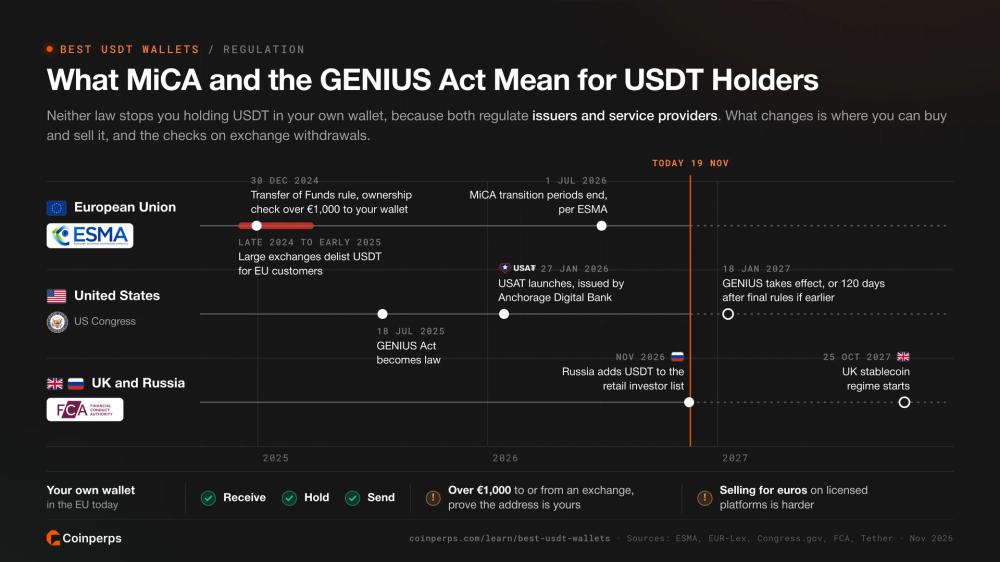
The last national grace periods for crypto firms ended on 1 July 2026, according to the EU markets regulator ESMA. Only MiCA-authorised firms may serve EU clients now, and the large ones no longer list USDT for trading. Our list of MiCA-licensed exchanges shows who holds a licence.
European residents can still receive, hold and send USDT from a self-custody wallet. Selling it for euros on a licensed platform is harder, so many EU holders convert to USDC before cashing out.
Under the EU Transfer of Funds Regulation, a crypto firm must verify that its customer controls a self-hosted address when a transfer to or from it exceeds €1,000. You may be asked to sign a message from your wallet or make a small test transfer, and every wallet in our list can do one or the other.
The US GENIUS Act became law on 18 July 2025. It takes effect on 18 January 2027 or 120 days after final rules, whichever is earlier. Issuers must be able to freeze tokens on a lawful order. Foreign issuers such as Tether face extra conditions to keep serving US platforms, which explains USAT.
Russia added USDT to the assets ordinary investors may buy in November 2026, as our guide to buying USDT in Russia explains. The UK's stablecoin regime is due to start on 25 October 2027.
Which Scams Target USDT Wallets?
Address poisoning is the scam most specific to USDT. The attacker generates an address sharing the first and last characters of one you use, then sends you a tiny transfer from it. The fake then sits in your history, waiting to be copied, and the victim sends the money with no key stolen.
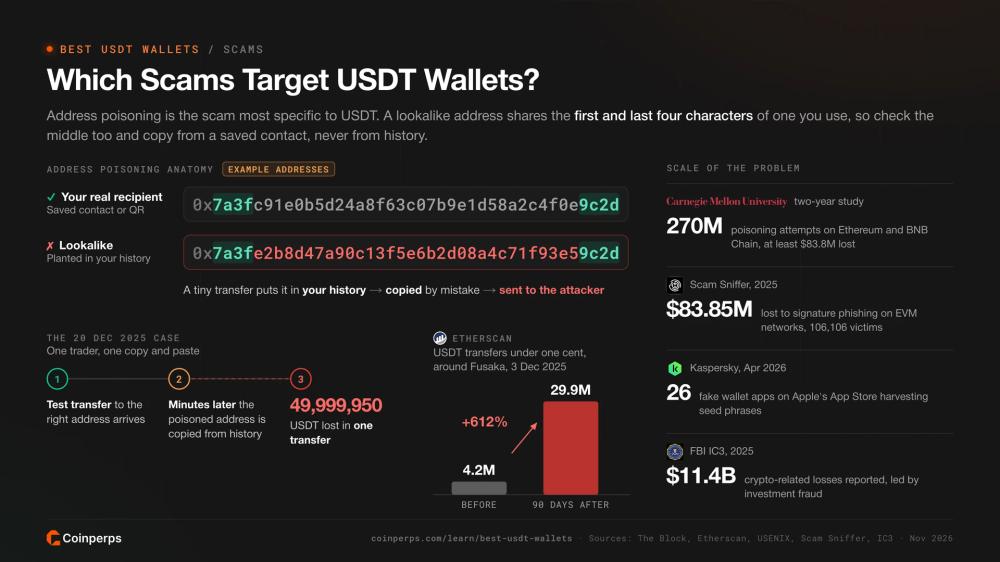
On 20 December 2025 a trader sent a test transfer to the right address. Minutes later they copied a poisoned address from history and sent 49,999,950 USDT to the attacker. Across two years, Carnegie Mellon University researchers counted about 270 million poisoning attempts on Ethereum and BNB Chain, with at least $83.8 million lost.
Cheaper fees made it worse. Etherscan found that USDT transfers worth under one cent on Ethereum rose 612%, from 4.2 million to 29.9 million, in the 90 days after the Fusaka upgrade of 3 December 2025. Some of those transfers are legitimate, Etherscan notes.
Drainers and Malicious Approvals
A drainer is a fake site that asks your wallet to sign an approval, which lets a contract spend your tokens. Scam Sniffer counted $83.85 million lost to signature phishing on EVM networks in 2025, across 106,106 victims.
Old approvals can be reviewed with Etherscan's approval checker or Revoke.cash. Cancel any you no longer need. TRON has a related trick that gets you to sign a permission update that makes the scammer an owner of your account. Check the Owner and Active permissions of your address on TronScan.
Fake Apps and Physical Threats
In April 2026 Kaspersky found 26 fake wallet apps on Apple's App Store that harvested seed phrases. Only install a wallet from a link on the maker's own website. Never type a seed phrase into a website, and never store it as a photo or in cloud notes.
Violent robbery is rarer, though it is growing, with more than $30 million stolen in physical attacks on crypto holders in the first half of 2026 by Chainalysis's count. Keep your holdings private.
Most losses still come from persuasion. The FBI's internet crime unit, IC3, recorded about $11.4 billion of crypto-related losses in 2025, led by investment fraud. No wallet protects a user who sends USDT to a scammer willingly.
USDT Wallet Safety Checklist
- Copy addresses from the source: use a saved contact or the recipient's QR code, never your transaction history.
- Check every character: scammers match the first and last four, so read the middle too.
- Confirm on the device screen: with a hardware wallet, the address on its display is the one that counts.
- Keep the seed phrase offline: write it on paper or metal, and give it to nobody who asks.
- Buy hardware direct: order from the maker's own store and reject a device that arrives already set up.
- Revoke stale approvals: review them every few months and after using any new app.
- Update the phone and the wallet: install system updates promptly and get wallet updates only from official stores.
- Split balances: keep spending money in a hot wallet and savings on hardware.
How to Move USDT From an Exchange to Your Wallet
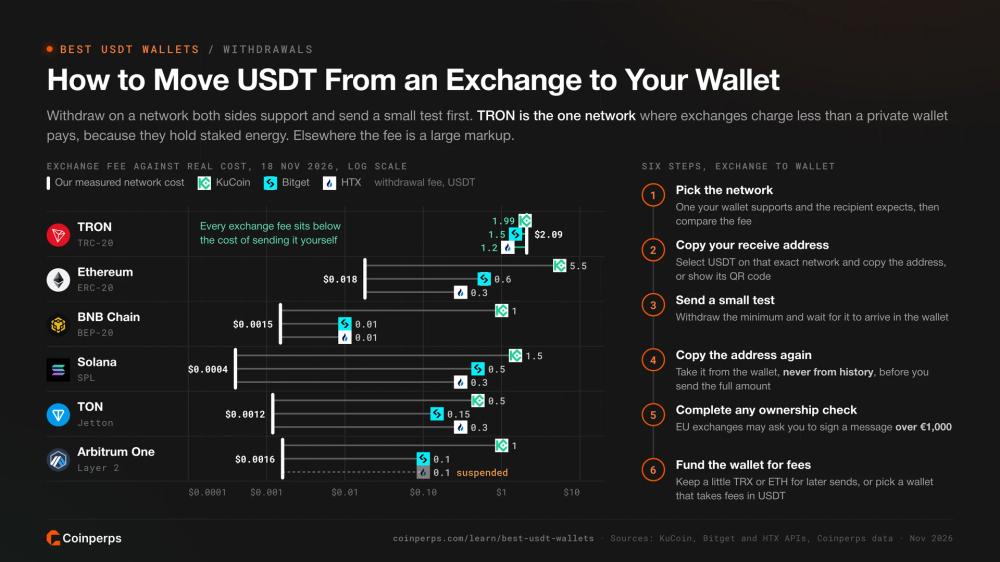
Withdraw on a network that both the exchange and your wallet support, and send a small test first. Exchange withdrawal fees differ sharply by network. We pulled the figures below from the public APIs of KuCoin, Bitget and HTX on 18 November 2026.
Network | KuCoin fee (USDT) | Bitget fee (USDT) | HTX fee (USDT) | Our measured network cost |
|---|---|---|---|---|
TRON (TRC-20) | 1.99 | 1.5 | 1.2 | $2.09 |
Ethereum (ERC-20) | 5.5 | 0.6 | 0.3 | $0.018 |
BNB Chain (BEP-20) | 1 | 0.01 | 0.01 | $0.0015 |
Solana | 1.5 | 0.5 | 0.3 | $0.0004 |
TON | 0.5 | 0.15 | 0.3 | $0.0012 |
Arbitrum One | 1 | 0.1 | 0.1 | $0.0016 |
Exchanges hold staked energy, so TRON is the one network where they charge less than a private wallet pays. Elsewhere the exchange fee is a large markup on the real cost. HTX had Arbitrum withdrawals suspended when we checked.
- Pick the network: choose one your wallet supports and the recipient expects, then compare the exchange's fee for each.
- Copy your receive address: open the wallet, select USDT on that exact network and copy the address or show its QR code.
- Send a small test: withdraw the minimum and wait for it to arrive in the wallet.
- Copy the address again from the wallet: do not reuse the entry in your exchange or wallet history for the full amount.
- Complete any ownership check: EU exchanges may ask you to sign a message for withdrawals above €1,000.
- Fund the wallet for fees: keep a little TRX or ETH for later sends, or use a wallet that takes fees in USDT.
Planning to trade onchain? Check which stablecoin the venue uses first. Hyperliquid and most of the top decentralised perpetual exchanges take USDC as collateral, and our guide to depositing USDC on Hyperliquid covers the conversion.
Bottom Line
MetaMask is the best USDT wallet for most people, holding the token on TRON, Ethereum and the main EVM networks in one free app. For savings, pick Trezor, with open-source hardware from $59 and native TRON support.
Ledger is a strong alternative if you buy direct, and Trust Wallet has the widest network list, TON included. Bitget Wallet is the easiest way to pay TRON fees in USDT, and Tangem is the cheapest hardware option. On TON, Keeper leads. tether.wallet is simple but narrow.
Whichever wallet you choose, match the network before every transfer, copy addresses from the source and remember that Tether can freeze USDT anywhere. Exchange comparisons for buying USDT are on our perpetual exchanges hub.


