Best Crypto Exchanges in Switzerland for 2026
Compare the best crypto exchanges in Switzerland, from Kraken's free SIC deposits to FINMA-licensed Swissquote and PostFinance, with Swiss wealth tax, leverage and safety rules.

Coinperps may earn a commission from partner links, at no cost to you; rankings follow our methodology. Not financial advice.
Key takeaways
- Kraken is the best crypto exchange in Switzerland: it takes Swiss francs free through SIC, runs BTC/CHF and ETH/CHF order books and offers perpetual futures to Swiss residents.
- Swissquote is the strongest FINMA-licensed choice: the Swiss bank sells 55 coins, lets you withdraw to your own wallet and charges 1% at its Standard tier.
- Foreign exchanges serve Switzerland without a Swiss licence: EU MiCA rules do not reach Switzerland, so Kraken, Bybit and OKX sign Swiss users to entities outside Europe.
- Private crypto gains are tax-free: Swiss investors pay cantonal wealth tax on the 31 December value instead, unless the tax office classes them as professional traders.

- Swiss status
- Cross-border (BVI entity), Swiss site
- Spot fees
- 0.40% / 0.80% maker / taker
- CHF funding
- Free SIC deposits
- Perps for swiss residents
- Yes
Why it ranks #1 Partner link · How we rank
Kraken is the best crypto exchange in Switzerland because it is the only major exchange with free Swiss franc deposits through SIC, the Swiss interbank payment system, and Bitcoin order books priced in francs.
- Free same-day CHF deposits through SIC and CHF 1 withdrawals.
- BTC/CHF and ETH/CHF order books, so no currency conversion.
- Spot, perpetual futures and tokenised stocks in one account.
Coinperps may earn a commission if you sign up through this link, at no cost to you. Rankings follow our method, not partner deals.
On this page 9 sections
Swiss residents can buy crypto legally from Swiss banks, Swiss brokers and foreign exchanges, but only Swiss banks and securities firms hold a full licence from the Swiss Financial Market Supervisory Authority (FINMA).
Swiss banks such as Swissquote and PostFinance give you FINMA supervision and higher fees. Foreign exchanges such as Kraken, Bybit and OKX give you lower fees and futures, usually through an entity outside Switzerland and outside the EU.
Around 18% of Swiss adults hold crypto, according to a 2026 Lucerne University of Applied Sciences survey, and capital gains on private crypto stay tax-free.
We checked every provider against the FINMA register of authorised institutions and the FINMA warning list, compared Swiss franc deposits and spot fees, and weighed the results against our exchange rankings.
This guide to the best crypto exchanges in Switzerland puts spot trading first and treats futures as a bonus. It is not tax or legal advice.
Top 7 Crypto Exchanges in Switzerland
Exchange | Swiss status | Spot fees | CHF funding | Perps for swiss residents | Key nuance |
|---|---|---|---|---|---|
Cross-border (BVI entity), Swiss site | 0.40% / 0.80% maker / taker | Free SIC deposits | Yes | Seven CHF pairs including BTC/CHF | |
FINMA bank | 1% / 1%, falling with volume | Swiss bank account | No | 55 coins with withdrawals to your own wallet | |
Cross-border (global platform) | 0.15% / 0.20% on fiat pairs | SWIFT or Zen.com | Yes | Top Coinperps global ranking | |
Cross-border (Seychelles entity) | 0.08% / 0.10% | No CHF deposits found | Yes | German, French and Italian website | |
EU MiCA licence (Austria) | Built into price; Fusion 0.25% | CHF wallet, PayPal at 1.49% | No | 650+ cryptos beside stocks and ETFs | |
FINMA bank, state-owned | 0.95% per trade | PostFinance account | No | 22 coins in your banking app | |
VQF member (anti-money laundering) | 1% plus spread | Bank transfer, card | No | Bitcoin only, straight to your own wallet |
 Bybit
 OKX
1. Kraken
- Swiss status
- Cross-border (BVI entity), Swiss site
- Spot fees
- 0.40% / 0.80% maker / taker
- CHF funding
- Free SIC deposits
- Perps for swiss residents
- Yes
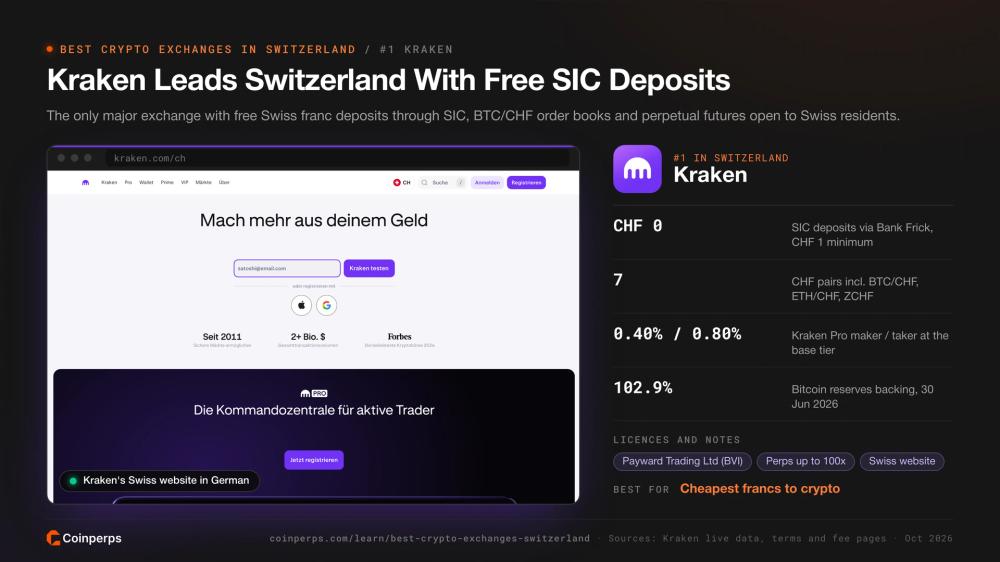
Kraken is the best crypto exchange in Switzerland because it is the only major exchange with free Swiss franc deposits through SIC, the Swiss interbank payment system, and Bitcoin order books priced in francs.
Kraken runs a Swiss website with no Swiss licence behind it. Under its Global Terms, updated on 19 October 2026, Swiss residents contract with Payward Trading Ltd in the British Virgin Islands, because Switzerland is outside the European Economic Area that Kraken's Irish MiCA entity serves.
SIC deposits through Kraken's partner Bank Frick are free with a CHF 1 minimum and usually arrive the same day, and SIC withdrawals cost CHF 1. Kraken lists seven CHF pairs, among them BTC/CHF, ETH/CHF and the Swiss franc stablecoin ZCHF.
Kraken Pro charges 0.40% for makers and 0.80% for takers at the lowest tier of its fee schedule, under new tiers in force since 9 July 2026. Switzerland is absent from the Kraken derivatives restricted list, and BTC and ETH perpetuals reach 100x leverage in eligible regions outside the EU and US.
Kraken's proof of reserves for 30 June 2026 shows 102.9% Bitcoin backing. In December 2025 it agreed to buy Zug-based Backed Finance, the issuer of xStocks tokenised shares. Our Kraken restricted countries guide covers regional access, or open an account through Kraken.
Pros
- Free same-day CHF deposits through SIC and CHF 1 withdrawals.
- BTC/CHF and ETH/CHF order books, so no currency conversion.
- Spot, perpetual futures and tokenised stocks in one account.
Cons
- No Swiss licence, and Swiss accounts sit with a British Virgin Islands entity.
- Base Kraken Pro fees rose to 0.40% / 0.80% in July.
- Instant buys in the app add a 1% fee plus a spread.
2. Swissquote
 Best for55 coins with withdrawals to your own wallet
- Swiss status
- FINMA bank
- Spot fees
- 1% / 1%, falling with volume
- CHF funding
- Swiss bank account
- Perps for swiss residents
- No
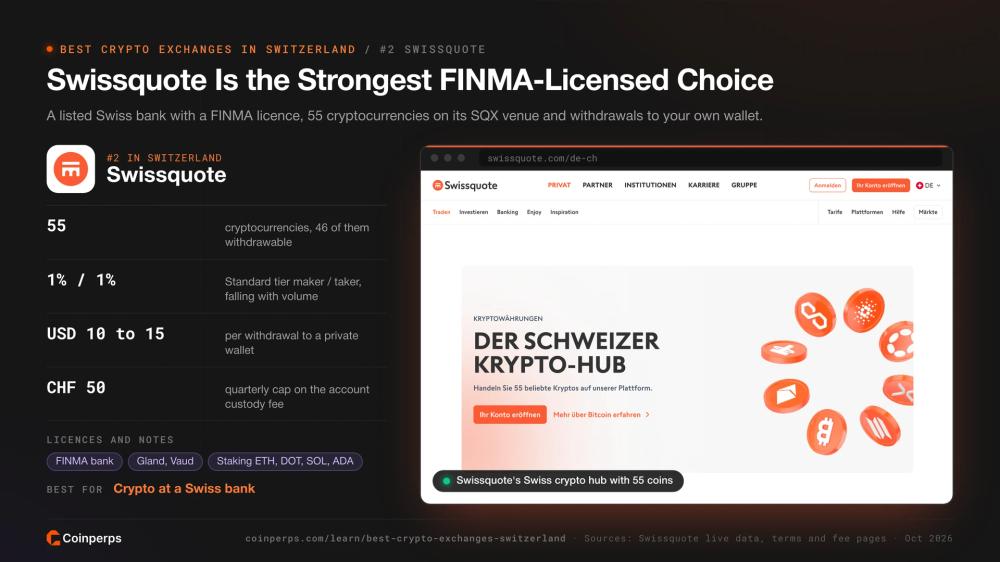
Swissquote is the best Swiss-regulated choice, because it combines a FINMA banking licence with the widest coin range of any Swiss bank and the right to move coins to your own wallet.
Swissquote Bank SA, based in Gland, appears on FINMA's list of authorised banks. It offers 55 cryptocurrencies through SQX, its in-house venue that pools liquidity from several exchanges, in the same account as shares, ETFs and crypto ETPs.
The crypto price list now uses maker and taker fees based on your 30-day volume. The Standard tier pays 1% either way, and fees fall to 0.08% / 0.18% for the largest traders. There is no separate crypto custody fee beyond the account fee, which is capped at CHF 50 a quarter.
Withdrawals to a private wallet cost USD 10 to 15 depending on the coin, and incoming crypto transfers are free from USD 500. Swissquote also stakes ETH, DOT, SOL and ADA for a 20% share of the rewards.
Swissquote owns the Yuh app, which sells 50 tokens at a flat 1% but does not allow transfers to outside wallets.
Pros
- A FINMA-licensed Swiss bank holds your crypto.
- 55 coins, staking and withdrawals to your own wallet.
- Crypto, shares and ETPs on one Swiss tax statement.
Cons
- A 1% fee at the Standard tier, more than double a Kraken maker order.
- Withdrawals cost USD 10 to 15 per transfer.
- No perpetual futures.
3. Bybit
- Swiss status
- Cross-border (global platform)
- Spot fees
- 0.15% / 0.20% on fiat pairs
- CHF funding
- SWIFT or Zen.com
- Perps for swiss residents
- Yes
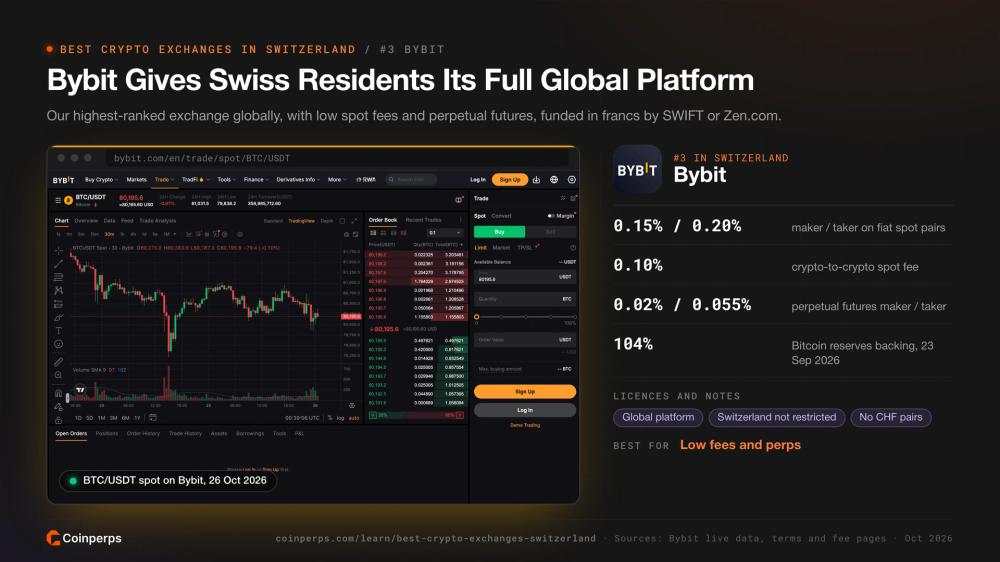
Bybit tops our global exchange rankings, and Swiss residents get its full global platform with spot and perpetual futures.
Switzerland is not on Bybit's list of restricted countries, updated on 16 October 2026. Bybit EU, the Austrian MiCA entity, serves only the European Economic Area, so Swiss users sign up with the global exchange.
Swiss francs arrive by SWIFT transfer or Zen.com. Bybit has no CHF order books. Its fee page lists 0.10% for crypto-to-crypto spot trades and 0.15% / 0.20% on fiat pairs, while perpetuals cost 0.02% for makers and 0.055% for takers.
Bybit's proof of reserves for 23 September 2026 shows 104% Bitcoin backing. In February 2025 it lost about $1.5 billion in ETH to a North Korean hack and replenished its reserves in full. Compare it in our Bybit vs Kraken guide, or sign up through Bybit.
Pros
- Our highest-ranked exchange for liquidity and features.
- Low spot fees and perpetual futures for Swiss residents.
- Published proof of reserves above 100%.
Cons
- No SIC deposits or CHF pairs.
- A French site but no German or Italian version.
- The 2025 hack, though clients lost nothing.
4. OKX
- Swiss status
- Cross-border (Seychelles entity)
- Spot fees
- 0.08% / 0.10%
- CHF funding
- No CHF deposits found
- Perps for swiss residents
- Yes
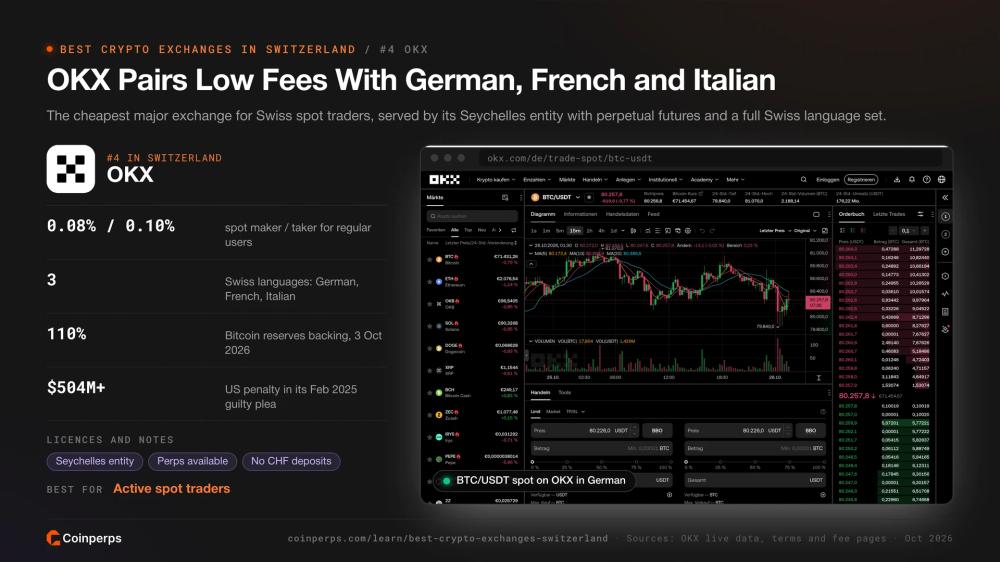
OKX is the cheapest major exchange for Swiss spot traders and the only one here with complete German, French and Italian websites alongside perpetual futures.
Its terms of service, updated on 22 October 2026, assign users outside the regions with a local OKX entity to Aux Cayes FinTech Co. Ltd in the Seychelles. The same company offers OKX futures, options and margin, and its terms do not exclude Switzerland.
OKX's fee schedule charges regular users 0.08% for makers and 0.10% for takers on spot. We found no CHF bank deposit option, so Swiss users usually fund OKX with crypto bought elsewhere.
The proof of reserves dated 3 October 2026 shows 110% Bitcoin backing. In February 2025 Aux Cayes pleaded guilty in the US to unlicensed money transmission and agreed to pay more than $504 million. See our OKX vs Kraken comparison.
Pros
- Spot fees of 0.08% / 0.10% for regular users.
- German, French and Italian website and app.
- 110% Bitcoin reserves backing in its latest report.
Cons
- A Seychelles contracting entity.
- No CHF deposits or CHF trading pairs.
- A 2025 US guilty plea by the company serving Swiss users.
5. Bitpanda
 Best for650+ cryptos beside stocks and ETFs
- Swiss status
- EU MiCA licence (Austria)
- Spot fees
- Built into price; Fusion 0.25%
- CHF funding
- CHF wallet, PayPal at 1.49%
- Perps for swiss residents
- No
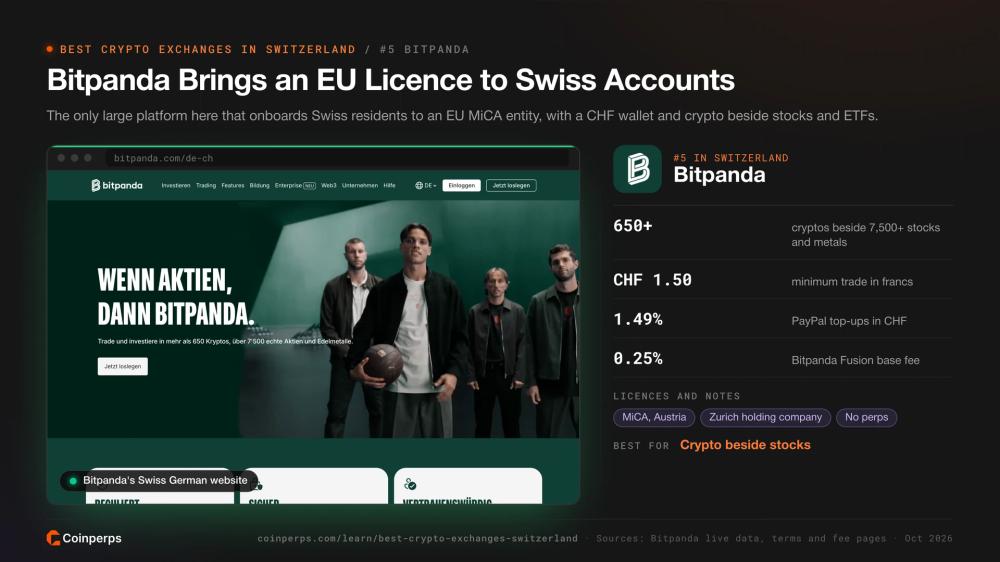
Bitpanda is the only large platform here that onboards Swiss residents to an EU-licensed entity, and it suits investors who want crypto, stocks and ETFs in one app.
Bitpanda's help centre says Swiss residents join Bitpanda GmbH, which Austria's FMA authorised under MiCA. The group's holding company, Bitpanda Group AG, is registered in Zurich, and a Swiss German website prices its offer in francs.
CHF is one of Bitpanda's ten trading currencies, with a CHF 1.50 minimum trade, and Swiss residents can top up in francs through PayPal for 1.49%. The broker app builds its fee into the price, while Bitpanda Fusion, its order-book platform, charges 0.25% at the base level.
In August the FMA fined Bitpanda GmbH €70,000 for MiCA breaches in its marketing. Bitpanda offers no perpetual futures.
Pros
- An EU MiCA licence covers Swiss accounts.
- More than 650 cryptos beside stocks, ETFs and metals.
- A CHF wallet and a Swiss German website.
Cons
- Broker prices include a spread that costs more than an order book.
- PayPal deposits cost 1.49%.
- No futures and no Swiss licence.
6. PostFinance
 Best for22 coins in your banking app
- Swiss status
- FINMA bank, state-owned
- Spot fees
- 0.95% per trade
- CHF funding
- PostFinance account
- Perps for swiss residents
- No
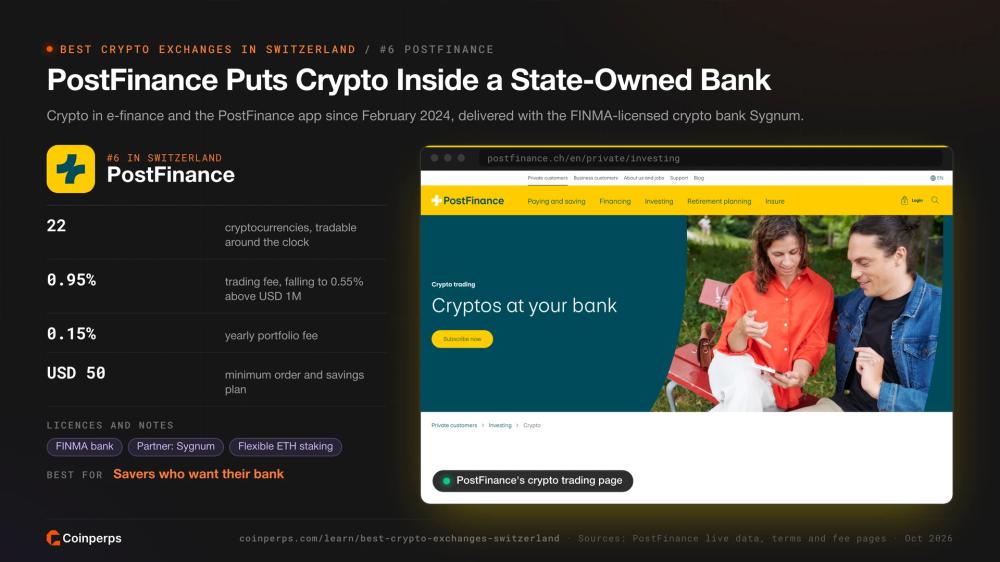
PostFinance is the easiest choice for Swiss savers who want crypto inside the bank account they already use.
PostFinance holds a FINMA banking licence and launched crypto trading with Sygnum, a FINMA-licensed crypto bank, in February 2024. After adding six coins in February 2026, it offers 22 cryptocurrencies around the clock in e-finance and its app.
Trading costs 0.95%, falling to 0.75% above USD 250,000 and 0.55% above USD 1 million, plus a yearly portfolio fee of 0.15%. Orders and savings plans start at USD 50, and since August PostFinance has offered flexible ETH staking with no lock-up.
PostFinance's crypto pages do not mention transfers to a private wallet, so treat it as an investment account. It also runs the first Swiss retail mandate with a 5% crypto allocation.
Pros
- Crypto inside a FINMA-licensed, state-owned Swiss bank.
- Savings plans from USD 50 and flexible ETH staking.
- No new account or exchange login.
Cons
- A 0.95% trading fee plus 0.15% a year.
- Prices and thresholds in US dollars.
- No transfers to your own wallet advertised.
7. Relai
 Best forBitcoin only, straight to your own wallet
- Swiss status
- VQF member (anti-money laundering)
- Spot fees
- 1% plus spread
- CHF funding
- Bank transfer, card
- Perps for swiss residents
- No
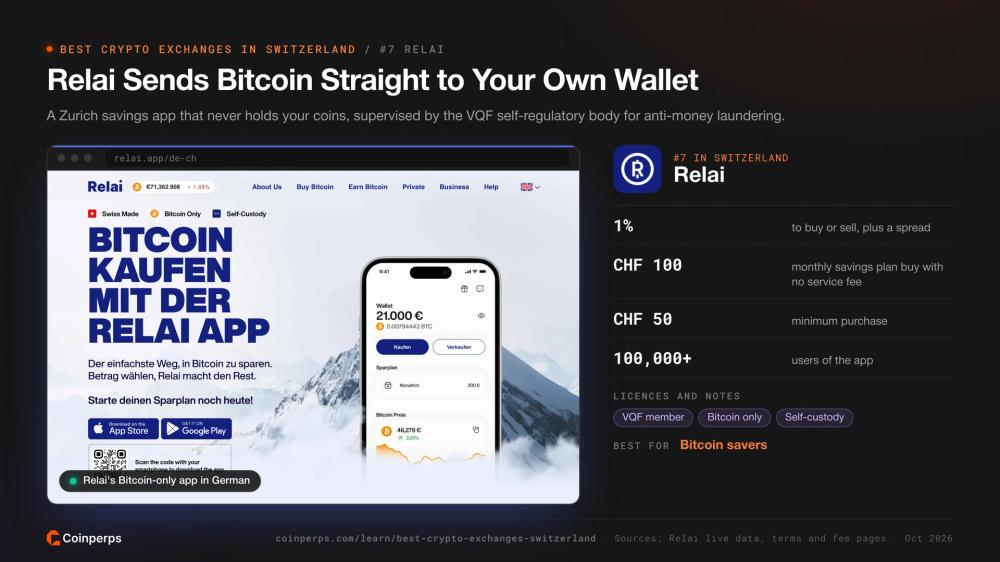
Relai is a Zurich app for Bitcoin savers who want their coins in their own wallet from the first purchase.
Relai AG is a member of VQF, a self-regulatory organisation that supervises Swiss financial intermediaries for anti-money laundering compliance. Its EU arm won a MiCA licence from France's AMF in October 2025.
The Swiss pricing policy charges 1% to buy or sell plus a spread, with a CHF 50 minimum, and one CHF 100 savings plan purchase each month carries no service fee. Card payments add 3%, so a monthly bank transfer costs least.
Relai never holds your Bitcoin. That removes exchange custody risk, but a lost recovery phrase means lost coins.
Pros
- Self-custody from the first purchase.
- Swiss company with a German, French and Italian website.
- A free service fee on one CHF 100 savings plan buy a month.
Cons
- Bitcoin only.
- A 1% fee plus spread, and 3% more by card.
- No FINMA licence, only SRO membership.
How We Ranked These Exchanges
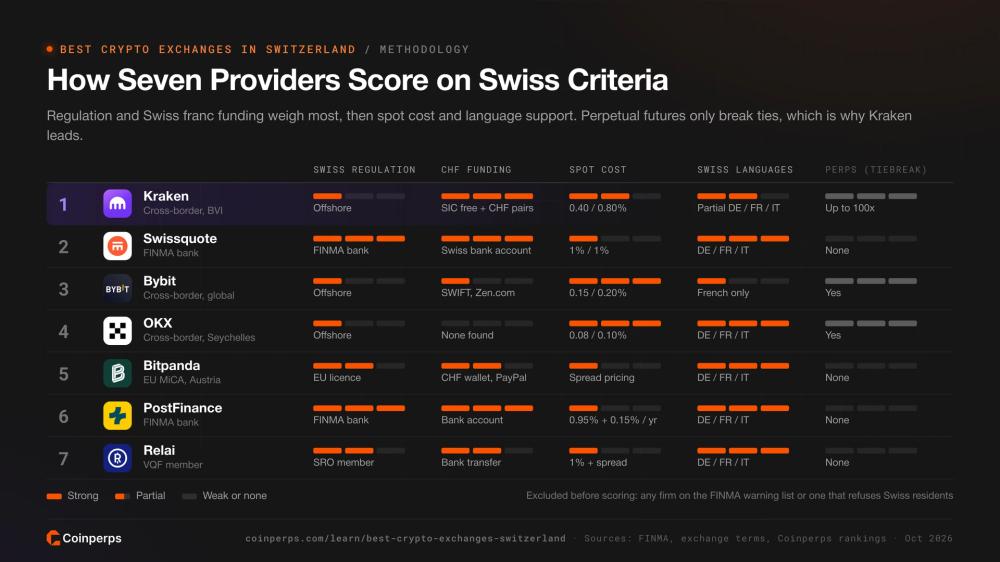
We ranked providers on Swiss regulatory status, Swiss franc deposits, spot costs, local language support and platform strength, following our ranking methodology.
Regulatory status came from FINMA's register, downloaded on 26 October 2026, and from each exchange's terms for Swiss residents. Fees came from published price lists. Any provider on the FINMA warning list, or one that excludes Swiss residents, could not make the list.
Our exchange rankings of liquidity, fees, regulation and features set the order among foreign exchanges. Bybit and OKX rank highest globally, but Kraken takes first place in Switzerland because only Kraken offers free SIC deposits and CHF order books.
Swissquote ranks second as the strongest FINMA-licensed platform, and PostFinance and Relai cover savers who value a Swiss bank or self-custody over price. Futures counted only as a tiebreaker.
Is Crypto Legal in Switzerland?
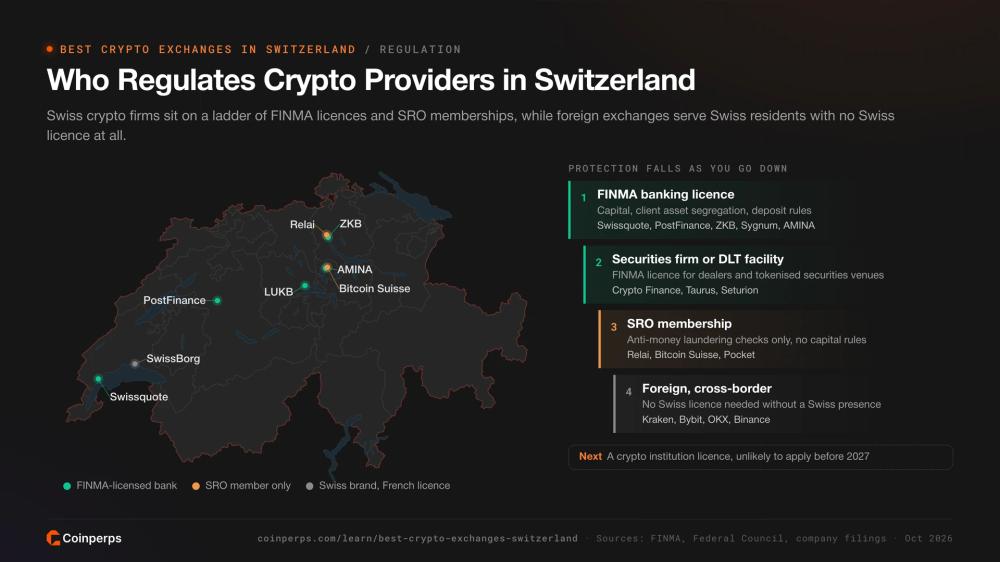
Buying, holding and selling crypto is legal in Switzerland. There is no single crypto exchange licence, so each firm is regulated by what it does.
FINMA Licences and SRO Membership
FINMA's overview of crypto services assigns each activity to an existing law. Banks such as Swissquote, PostFinance, Sygnum and AMINA need a banking licence, and venues for tokenised securities need a DLT trading facility licence, first granted to BX Digital in March 2025.
Brokers, exchange offices and custodial wallet apps that are not banks count as financial intermediaries under the Anti-Money Laundering Act. They must join a FINMA-recognised self-regulatory organisation (SRO) such as VQF, PolyReg or SO-FIT. SRO membership checks money laundering controls only, so it carries no capital or client asset rules.
Bitcoin Suisse, Relai and Pocket are SRO members with no FINMA licence. Bitcoin Suisse applied for a banking licence in 2019 that was never granted, and in June 2026 it took a MiCA licence in Liechtenstein for its European business.
Foreign Exchanges Serving Swiss Residents
Switzerland is outside the EU and the European Economic Area, so MiCA licences do not apply there. Kraken, Bybit, OKX and Binance serve Swiss residents from global entities, and only Bitpanda onboards them to an EU-licensed company.
Swiss anti-money laundering law generally covers only firms with a physical presence in Switzerland, according to law firm Lenz & Staehelin. A foreign exchange serving Swiss clients purely online therefore needs no Swiss licence, and Swiss supervisors cannot protect you if it fails.
None of the exchanges in our ranking appears on the FINMA warning list. Binance holds an Abu Dhabi licence for its global platform and keeps a Zug company, Binance (Switzerland) AG, that has no visible retail business. Our Binance restricted countries guide tracks its status.
How to Check a Provider
Search the FINMA register for banks and securities firms, then the warning list for firms suspected of unauthorised activity. FINMA made more than 300 warning list entries in 2025, a record, according to its annual report.
Check the contracting entity in a foreign exchange's terms, because the website and the company holding your money often differ.
The Planned Crypto Institution Licence
The Federal Council proposed two new licences in October 2025. A crypto institution licence would cover custody, staking and trading for clients, and a payment instrument institution licence would cover stablecoin issuers.
The consultation closed on 6 February. The government's fact sheet expects a bill for Parliament in the second half of 2026 at the earliest, so the new licences are unlikely to apply before 2027.
Travel Rule and Private Wallets
FINMA's guidance on blockchain payments requires Swiss providers to send sender and recipient details with every crypto transfer, with no minimum amount. A Swiss provider may send coins to an outside wallet only after confirming that the wallet belongs to you.
Exchange offices must also verify your identity for crypto trades above CHF 1,000, counting linked trades within 30 days.
Swiss Banks and Brokers That Sell Crypto
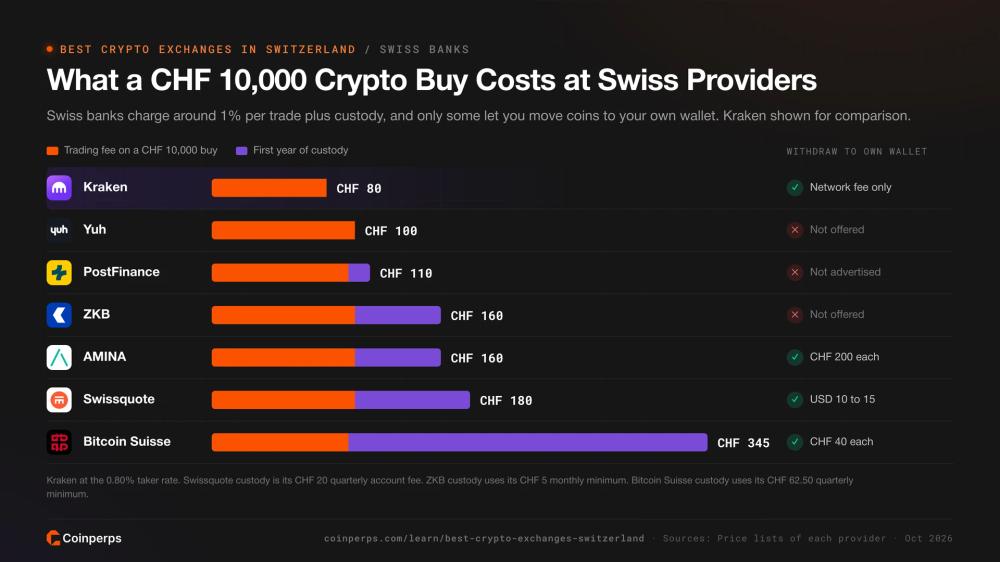
A growing number of Swiss banks sell crypto, charging more than exchanges for Swiss supervision and a familiar app.
Bank Apps With Direct Crypto
Zürcher Kantonalbank, the largest cantonal bank, opened Bitcoin and Ether trading in September 2024 and now also lists Solana and Chainlink. Its price list charges 1% per digital trade up to CHF 250,000 and 0.50% a year for custody, with no transfers in or out.
Luzerner Kantonalbank allows Bitcoin and Ether transfers to outside wallets and in September 2025 became the first Swiss universal bank to offer Lombard loans against crypto. Zuger Kantonalbank, PostFinance and St. Galler Kantonalbank buy their crypto services from the specialist banks Sygnum and AMINA.
Crypto Banks and Private Brokers
Sygnum and AMINA (formerly SEBA) are FINMA-licensed crypto banks. Sygnum reached a valuation above $1 billion in January 2025 and serves mainly qualified investors, while AMINA's Silver package charges individuals 1% per trade, 0.60% a year for custody and CHF 200 per crypto withdrawal.
Bitcoin Suisse in Zug serves wealthier private clients. Its fee schedule sets 0.95% per trade with a CHF 50 minimum, 0.45% a year for custody and CHF 40 per crypto withdrawal.
Crypto ETPs and the First Swiss Bitcoin ETF
Exchange-traded products hold crypto in a normal securities account. SIX Swiss Exchange listed 455 crypto products in September 2026, among them 210 ETPs from issuers such as 21Shares, WisdomTree, CoinShares and Bitwise.
On 20 October 2026 FINMA approved the first Swiss Bitcoin ETF for retail investors that holds Bitcoin directly. FINMA said other providers have applied and warned that Bitcoin stays highly risky even inside a fund. Track fund demand on our Bitcoin ETF tracker, and read our UBS crypto policy guide if you bank with UBS.
How to Buy Crypto With Swiss Francs
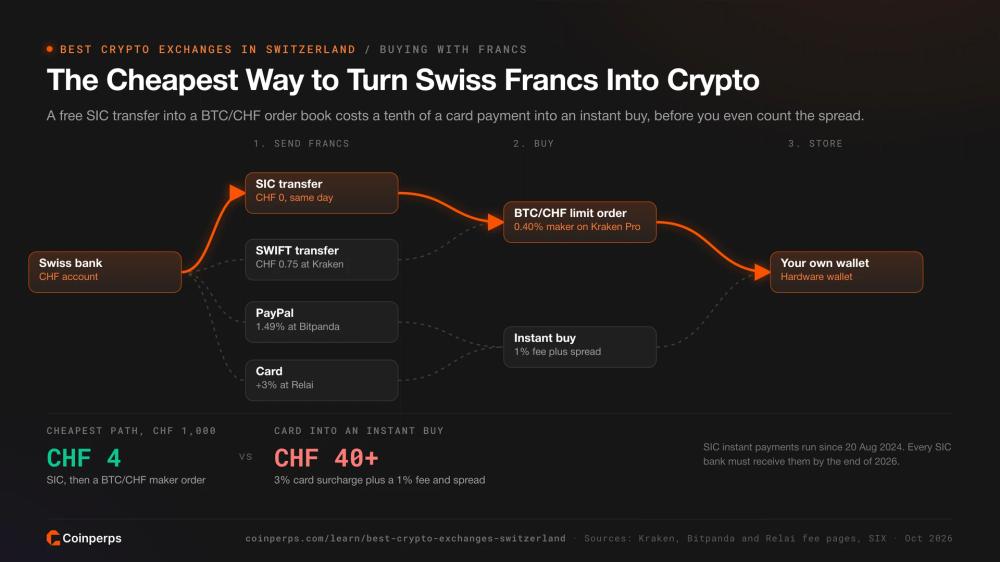
The cheapest way to buy crypto in Switzerland is a free SIC bank transfer in francs to Kraken, followed by a limit order on its BTC/CHF or ETH/CHF order book.
- Choose a provider and verify your identity with a Swiss ID card or passport and proof of address.
- Send francs by SIC from your Swiss bank account. Instant payments have run on SIC since 20 August 2024, and every bank on SIC must be able to receive them by the end of 2026.
- Avoid SWIFT and cards where you can. Kraken charges CHF 0.75 per SWIFT deposit, Relai adds 3% for cards and Bitpanda charges 1.49% through PayPal.
- Trade in francs where you can. A BTC/CHF limit order on Kraken Pro skips the currency conversion that USD-priced banks and USDT pairs add.
- Withdraw long-term holdings to a hardware wallet and keep a record of the 31 December value for your tax return.
Use the same legal name on your bank and exchange accounts, because Swiss banks screen payments to crypto providers under anti-money laundering rules.
TWINT, the Swiss mobile payment app, sells no crypto. It has announced plans to support regulated Swiss franc stablecoins and tokenised deposits, with no launch date.
Swiss franc stablecoins remain small. UBS, PostFinance, Sygnum, Raiffeisen, Zürcher Kantonalbank and Banque Cantonale Vaudoise started a CHF stablecoin sandbox in April 2026, while Germany's AllUnity issued a MiCA-compliant franc stablecoin in February.
Crypto Futures and Leverage Rules in Switzerland
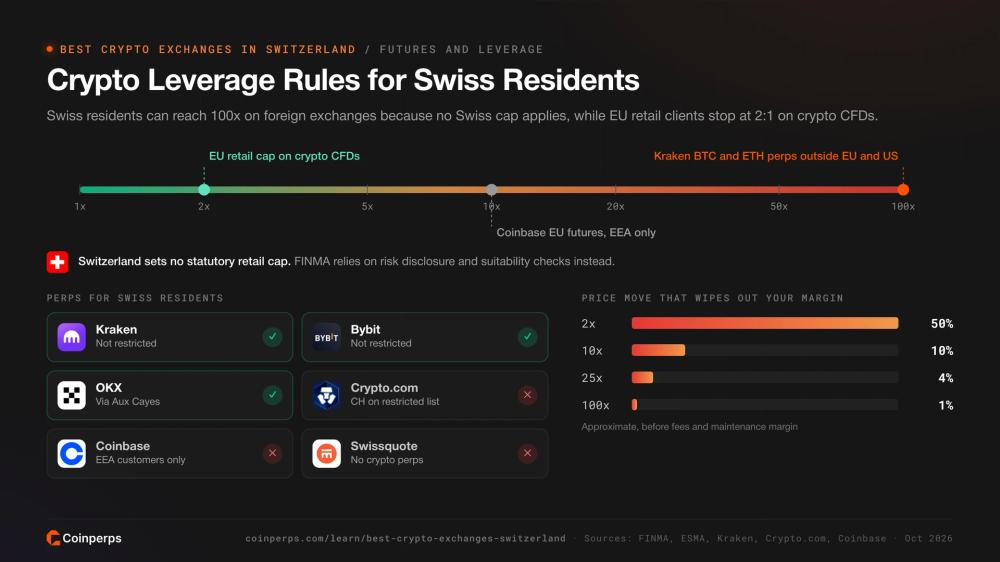
Swiss residents can trade crypto perpetual futures on foreign exchanges, and Switzerland sets no fixed leverage cap for retail clients like the 2:1 limit that applies across the EU.
Swiss law treats Bitcoin and other payment tokens as assets outside the Financial Services Act, while crypto derivatives count as financial instruments. Swiss providers selling derivatives to retail clients must classify clients, check suitability and supply a key information document, and FINMA relies on risk disclosure instead of statutory leverage limits.
No Swiss bank in our ranking sells crypto perpetuals. Kraken, Bybit and OKX offer them to Swiss residents from their global entities, while Crypto.com restricts derivatives in Switzerland and Coinbase's European futures serve only EEA customers.
FINMA has issued no guidance on perpetual futures. When it approved the first Bitcoin ETF it asked for suitability checks especially on the amount invested, and that warning applies doubly to 100x contracts.
Leverage can also change your tax position, since derivatives used beyond hedging fail one test of the professional trader rules. Read our guides to crypto perps vs spot trading, perpetual futures regulation and the Bitcoin liquidation heatmap before opening a position.
Crypto Taxes in Switzerland
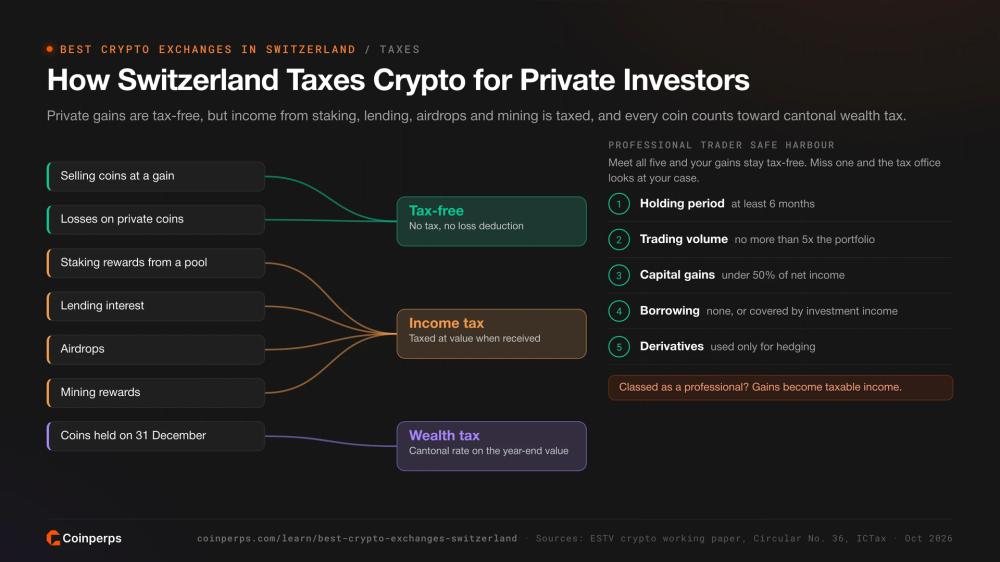
Most Swiss private investors pay no tax on crypto gains but owe cantonal wealth tax on their holdings each year.
Tax-Free Gains on Private Wealth
The Federal Tax Administration (ESTV) treats gains on crypto held as private wealth as tax-free capital gains, and losses are not deductible. Gains become taxable income only if the tax office classifies you as a professional trader.
Wealth Tax on the 31 December Value
Crypto counts as taxable wealth at its market value on 31 December. The ESTV publishes year-end values for major coins in its ICTax price list, and the purchase price applies to coins without a listed rate.
Rates depend on your canton and commune, as Switzerland has had no federal wealth tax since 1959. The ESTV wealth tax dossier shows the city of Zug among the lowest burdens and Geneva among the highest.
Staking, Airdrops and Mining
Staking rewards from a pool, lending interest and airdrops are taxable income at their value when received. Mining rewards are income too, and large operations may count as self-employment.
The Professional Trader Test
The ESTV's Circular No. 36 sets a safe harbour for private investors, and its crypto working paper applies it to crypto by analogy.
Safe harbour criterion | Threshold |
|---|---|
Holding period | At least 6 months |
Trading volume | No more than 5 times the portfolio value at the start of the year |
Capital gains | Under 50% of net income for the year |
Borrowing | No debt financing, or investment income above interest costs |
Derivatives | Used only for hedging |
Missing one criterion does not automatically make you a professional, as the VZ VermögensZentrum guide explains, but frequent leveraged trading puts tax-free status at risk.
Crypto Reporting Under CARF
Switzerland adopted the OECD's Crypto-Asset Reporting Framework, but the Federal Council switched off the crypto rules for 2026. On 28 September 2026 the National Council refused to debate the list of 74 partner states, so the planned start on 1 January 2027 is now uncertain.
Risks and Scams to Watch
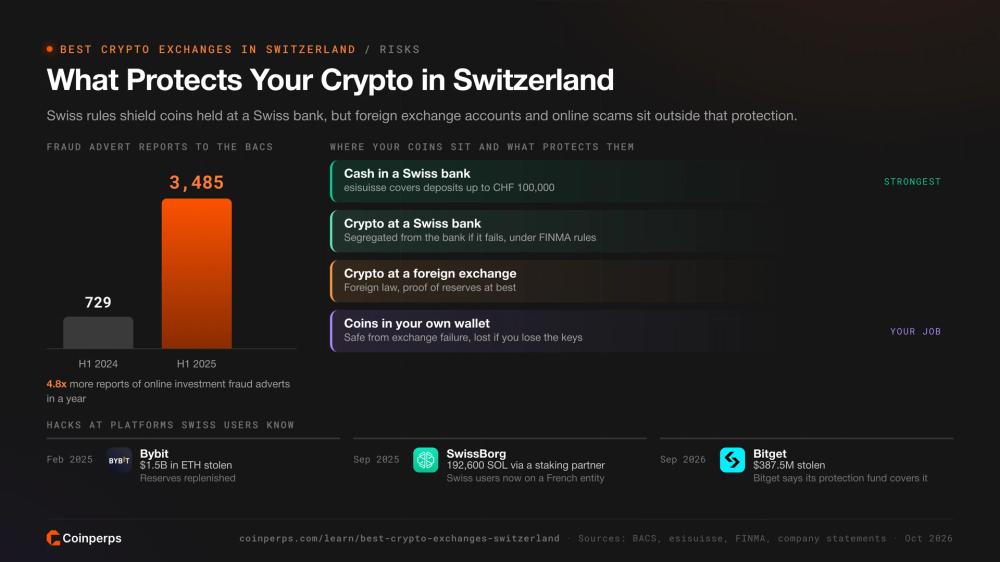
Swiss crypto rules protect coins held at a Swiss bank, but they do little for coins held at a foreign exchange or lost to a scam.
No Deposit Insurance for Crypto
The Swiss deposit guarantee scheme, esisuisse, protects bank deposits up to CHF 100,000 per client, and crypto is not a deposit. Coins held at a Swiss bank are instead separated from the bank's own assets if it fails, under the Banking Act and FINMA's custody guidance of January 2026.
That protection does not reach Kraken, Bybit or OKX accounts, which sit under foreign law. Keep only trading balances on any exchange and move long-term holdings to a wallet you control.
Exchange Hacks and Offshore Platforms
Bitget lost $387.5 million in September 2026, and Lausanne-founded SwissBorg lost about 192,600 SOL from a staking product through a partner's compromised API in September 2025.
SwissBorg moved its Swiss users to a French entity in June 2026, a reminder that a Swiss brand does not guarantee a Swiss regulator.
Scams and Fake FINMA Messages
The Federal Office for Cybersecurity received 3,485 reports of online investment fraud adverts in the first half of 2025, nearly five times the year before. Its latest half-year report describes crypto theft through fake job and investment offers on LinkedIn.
Fraudsters also send emails in FINMA's name and offer to recover past losses for a fee. FINMA does not email private individuals or take part in loss recovery, so treat any such message as a scam and check the warning list first.
Bottom Line
Kraken is the best crypto exchange in Switzerland for most buyers. Free SIC deposits and BTC/CHF order books make it the cheapest way to turn francs into crypto, and perpetual futures are there if you want them.
Choose Swissquote or PostFinance if you want a FINMA-licensed Swiss bank to hold your coins and can accept fees near 1%. Choose Relai if you only want Bitcoin in your own wallet. Whichever you pick, record your 31 December balance for wealth tax and keep long-term coins off exchanges.


