Uniswap Statistics and What the Fee Switch Changed
Uniswap has processed more than $4.5 trillion. See its volume, market share, chain split, fees, UNI burns, supply and derivatives data, with on-chain figures.

Not financial advice.
Key takeaways
- Uniswap still leads spot DEX trading: it has processed more than $4.5 trillion since 2018 and took 41.2% of top-10 spot DEX volume in the second quarter of 2026, more than double PancakeSwap.
- Robinhood Chain and v4 now carry the volume: over the four weeks to 24 October 2026, Robinhood Chain handled 42.8% of Uniswap volume and v4 pools 52.3%, while Unichain fell to 0.4%.
- The fee switch is burning UNI: about 113.2 million UNI sits at the burn address, including 100 million from the treasury in December 2025 and about 13.2 million funded by fees since then.
- UNI trades on burn news: UNI rose from $2.32 in June 2026 to $10.94 in September as burns hit a record, and perp open interest peaked at $1.06 billion on the same day.
On this page 9 sections
Uniswap is the largest decentralised exchange (DEX) by spot volume, and since December 2025 part of its fees has funded UNI token burns. These Uniswap statistics cover volume, market share, chains, fees, UNI supply, derivatives and risks as of 25 October 2026.
Most numbers come from Uniswap Labs, the Uniswap governance portal and Ethereum itself. On top of those we pulled Uniswap's public explore data for the chain and version split, read the UNI contract on-chain and added Coinperps perpetual futures data for UNI.
Our crypto exchange volume statistics put these numbers in the wider market. Anyone trading UNI with leverage can follow funding, open interest and volume across exchanges on the live UNI perpetuals page.
Uniswap Statistics at a Glance
These are the core Uniswap figures as of 25 October 2026. Rows marked Coinperps data come from our own pulls, and other rows are sourced further down the page.
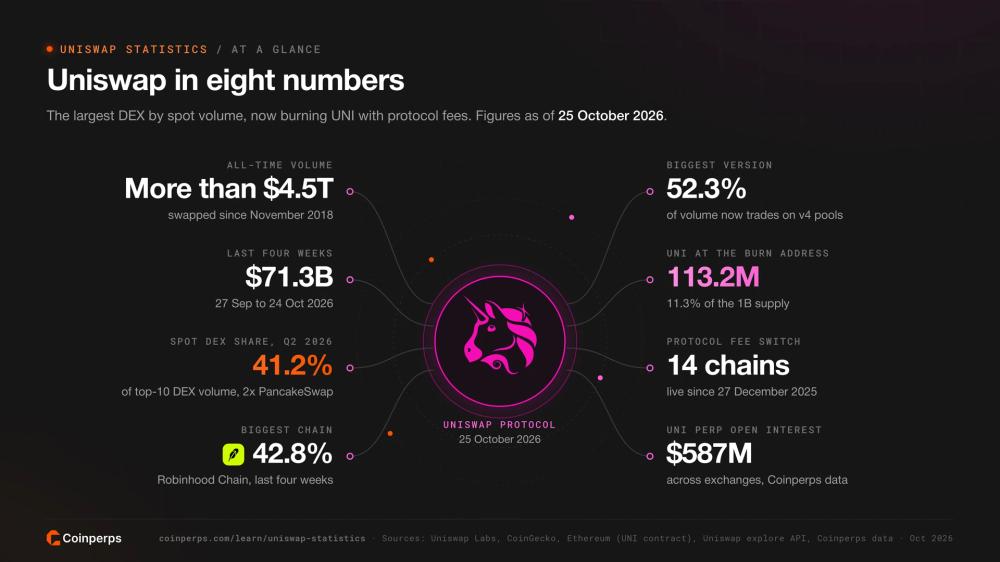
Metric | Value | Source |
|---|---|---|
All-time trading volume | More than $4.5 trillion | Uniswap Labs |
Volume, 27 September to 24 October 2026 | About $71.3 billion | Coinperps data |
Share of top-10 spot DEX volume, Q2 2026 | 41.2% | CoinGecko |
Largest chain, last four weeks | Robinhood Chain, 42.8% of volume | Coinperps data |
Largest version, last four weeks | v4, 52.3% of volume | Coinperps data |
Fees paid by traders, January to July 2026 | $297.9 million | Token Terminal |
Protocol fee switch | Live since 27 December 2025, now on 14 chains | Uniswap governance |
UNI sent to the burn address | 113.2 million (11.3% of supply) | Ethereum |
Fee-funded burns since activation | About 13.2 million UNI | Ethereum |
UNI price and market cap | $6.82 and $4.26 billion | CoinGecko |
UNI perpetual futures open interest | $587 million | Coinperps data |
UNI holders on Ethereum | 390,093 addresses | Etherscan |
The four-week volume figure adds up weekly protocol volume for every chain and version in Uniswap's explore API. One Robinhood Chain v4 week came in at 30 times its usual size. We swapped it for that series' 12-week median, which makes the total a conservative estimate.
Uniswap Trading Volume
Uniswap has processed more than $4.5 trillion in swaps since its November 2018 launch, Uniswap Labs said in its aggregator hooks announcement on 22 October 2026. Volume grew fastest in 2025 and has slowed this year.
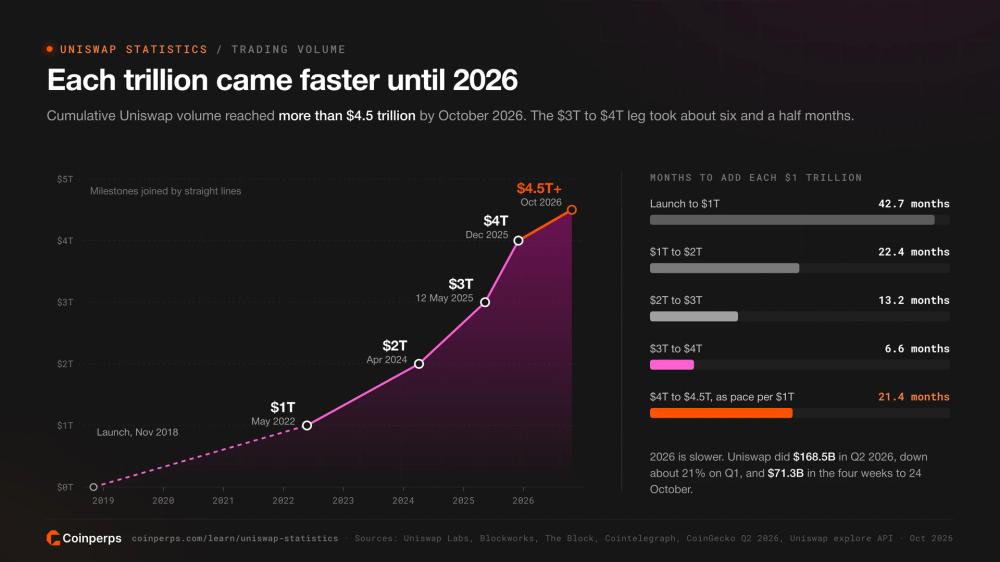
Each trillion came faster until 2026.
Milestone | Date reached | Time since previous milestone |
|---|---|---|
$1 trillion | 2022 | About 4 years from launch |
$2 trillion | April 2024 | About 2 years |
$3 trillion | 12 May 2025 | About 13 months |
$4 trillion | Around 1 December 2025 | About 6.5 months |
$4.5 trillion | By October 2026 | About 10 months |
Blockworks covered the first $1 trillion and The Block the $2 trillion mark. When the $3 trillion mark fell, daily volume stood at $3.3 billion, according to Cointelegraph. By 10 November 2025, the UNIfication proposal from Uniswap Labs put lifetime volume at about $4 trillion.
That jump from $3 trillion to $4 trillion packed roughly $1 trillion of trading into under seven months of 2025. Memecoin cycles, Unichain incentives and a record third quarter all fed it. The next $500 billion needed about ten months.
In the second quarter of 2026 Uniswap handled $168.5 billion, about 21% less than in the first. Top-10 spot DEX volume fell harder over the same period, down 26.5% in the CoinGecko Q2 2026 report.
The base has held up in recent weeks. Our pull of Uniswap's explore data shows about $71.3 billion over the four weeks to 24 October, close to $2.5 billion a day. Much of it now comes from Robinhood Chain, a network that did not exist before July 2026.
Uniswap Market Share Among DEXs
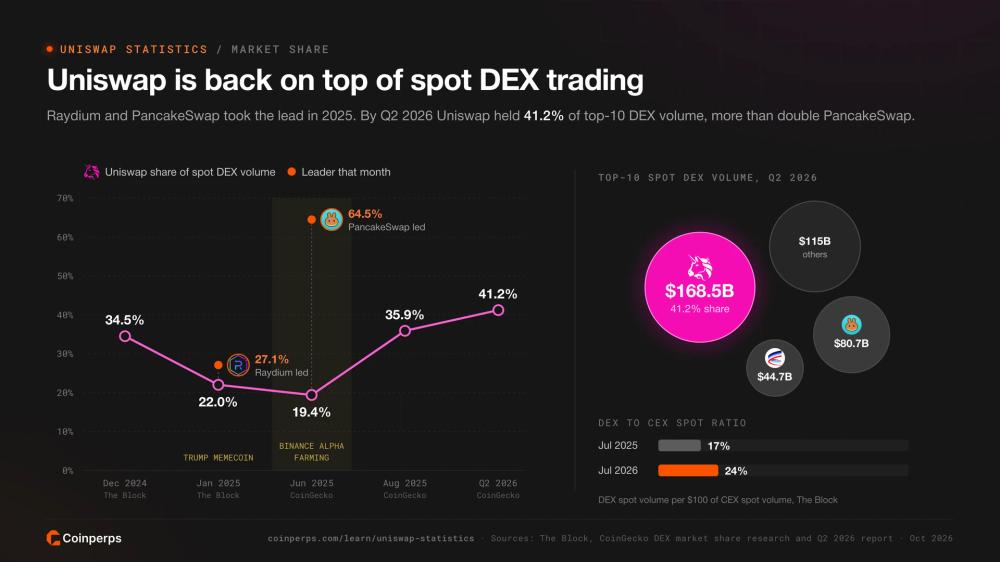
Uniswap is back on top of spot DEX trading after losing first place for much of 2025. Data providers measure share differently, so every figure below carries its source.
Period | Uniswap share | Leader that period | Source |
|---|---|---|---|
December 2024 | 34.5% | Uniswap | The Block |
January 2025 | 22.0% | Raydium (27.1%) | The Block |
June 2025 | 19.4% | PancakeSwap (64.5%) | CoinGecko |
August 2025 | 35.9% | Uniswap | CoinGecko |
Q2 2026 | 41.2% | Uniswap | CoinGecko |
Each dip had a single cause. The TRUMP memecoin pulled Solana traders onto Raydium in January 2025. Then, from April to July, Binance Alpha points farming pushed heavy trading through PancakeSwap on BNB Chain, which reached 64.5% of DEX volume in June, according to CoinGecko's DEX market share research.
By August 2025 the lead was Uniswap's again, on $111.8 billion of volume. PancakeSwap did $92.0 billion that month and Aerodrome $22.9 billion. The gap was wider still in the second quarter of 2026, when Uniswap's $168.5 billion more than doubled PancakeSwap's $80.7 billion.
On single chains its lead is wider. Blockworks estimated in August 2026 that Uniswap handled about 60% of Ethereum DEX volume, up from about 40% at the start of the year. It put Base at about 50%, Arbitrum at about 70% and Robinhood Chain at about 95%.
Centralised exchanges are also losing spot trading to DEXs in general. In July 2026 the DEX-to-CEX spot volume ratio reached 24%, up from 17% a year earlier, The Block reported, though weak exchange volumes explain much of the rise. For the same shift in derivatives, see our perp DEX vs CEX comparison.
Uniswap Volume by Chain, Version and Unichain
Two chains now dominate. Robinhood Chain and Ethereum carry about 72% of Uniswap volume between them, and v4 has passed v3 as the most used version.
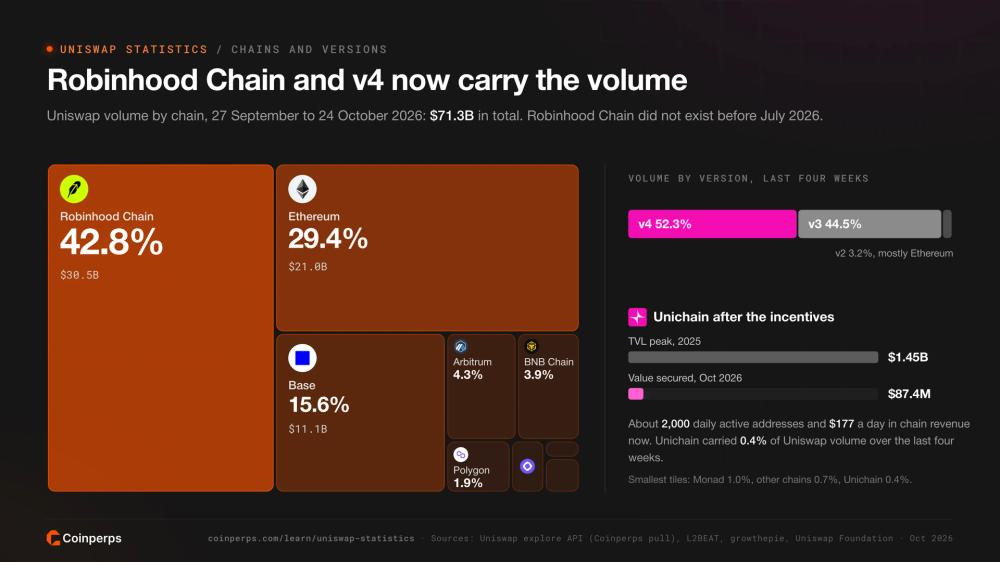
Our split covers the four weeks from 27 September to 24 October 2026.
Chain | Volume | Share |
|---|---|---|
Robinhood Chain | $30.5B | 42.8% |
Ethereum | $21.0B | 29.4% |
Base | $11.1B | 15.6% |
Arbitrum | $3.1B | 4.3% |
BNB Chain | $2.8B | 3.9% |
Polygon | $1.4B | 1.9% |
Monad | $0.7B | 1.0% |
Unichain | $0.25B | 0.4% |
Other chains | $0.5B | 0.7% |
Split by version, v4 took 52.3% of that volume and v3 took 44.5%. Only 3.2% went through v2, most of it on Ethereum.
- Robinhood Chain: Uniswap was live with v2, v3, v4 and UniswapX when the chain's mainnet opened on 1 July 2026, per Uniswap Labs. The Block counted more than $6 billion of volume there inside ten days, mostly from memecoins.
- Uniswap v4: launched on 30 and 31 January 2025 across 12 chains. Its headline feature is hooks, small contracts that bolt custom logic such as dynamic fees or auctions onto a pool. The Uniswap Foundation counted $190 billion of v4 volume and 5,000 initialised hooks by 30 September 2025. In October 2026 Uniswap Labs turned v4 into an aggregator by wrapping seven outside liquidity sources as hooks, covering more than 90% of DEX activity on Ethereum, Base and Robinhood Chain.
- Unichain: Uniswap's own layer 2 network went live on 11 February 2025 with 1-second blocks, and 200-millisecond Flashblocks followed in August 2025. Incentives lifted its total value locked to a peak of $1.45 billion in 2025, and cumulative DEX volume passed $62 billion by 30 September that year. Once the incentives stopped, activity drained away. L2BEAT now shows $87.4 million secured, while growthepie records about 2,000 daily active addresses and $177 a day in chain revenue.
Uniswap Fees, Revenue and the Fee Switch
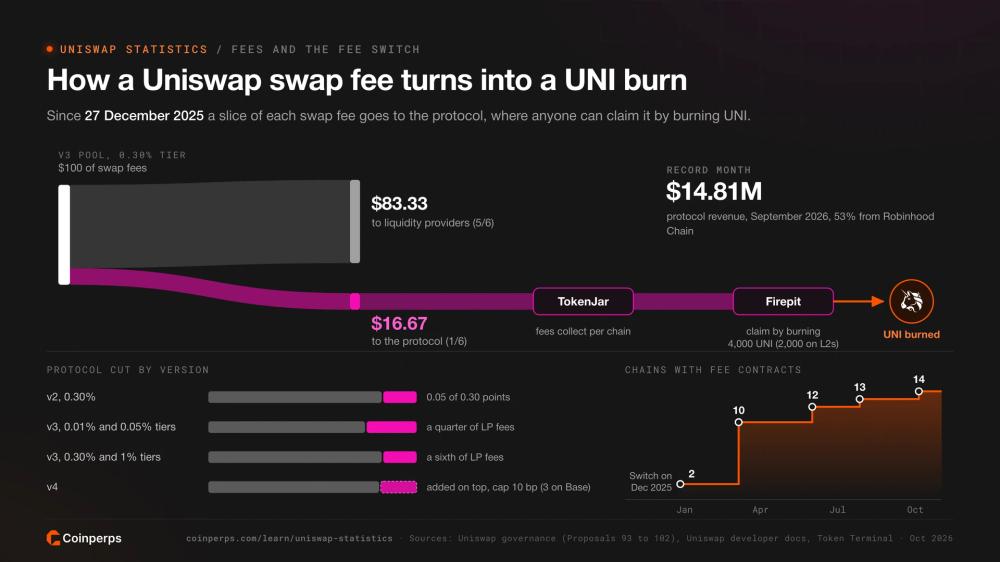
Every Uniswap trade pays a swap fee, and most of it goes to liquidity providers (LPs), the users who deposit tokens into pools. Since 27 December 2025 the protocol has also taken a slice, which pays for UNI burns.
Period | Fees paid by traders | Source |
|---|---|---|
January to October 2025 | More than $985 million | The Block |
October 2025 | More than $132 million | The Block |
January to July 2026 | $297.9 million, of which $28.2 million to the protocol | Token Terminal |
30 days to 12 August 2026 | $44 million to LPs and $3.64 million to the protocol (v2 and v3) | Blockworks |
September 2026 | $14.81 million to the protocol, a record month | Token Terminal |
In 2025, fees topped $985 million by the end of October, about $93 million a month, by The Block's count. Token Terminal puts lifetime fees at about $5.1 billion by August 2026. September's record protocol revenue leaned on Robinhood Chain, which supplied 53% of it, compared with 20% in July.
Governance sets the protocol's cut separately for each version.
- Uniswap v2: 0.05 percentage points of the 0.30% swap fee go to the protocol, so LPs keep 0.25%.
- Uniswap v3: the protocol takes a quarter of LP fees in the 0.01% and 0.05% fee tiers and a sixth in the 0.30% and 1% tiers.
- Uniswap v4: a separate fee is added on top of the LP fee and set by rules per group of pools, capped at 10 basis points on most chains, 3 on Base and 250 on aggregator hook pools.
The switch first came on in December 2025 through Proposal 93, which covered Ethereum v2 and selected v3 pools, as the Uniswap governance portal records. Later votes brought in every v3 pool on Ethereum, then Base, Arbitrum, OP Mainnet, Celo, Soneium, World Chain, X Layer, Zora, BNB Chain, Polygon and Robinhood Chain.
v4 fees started on seven chains on 27 July 2026. Circle's Arc joined in October, bringing the number of chains with fee contracts to 14.
On the day the protocol fee went live, Uniswap Labs scrapped its own interface fee. It had charged 0.15% from October 2023 and 0.25% from April 2024, earning more than $50 million by August 2024, The Block reported. Our guide to maker vs taker fees shows how these costs compare with order book exchanges.
UNI Token Supply and Burn Statistics
About 113.2 million UNI, or 11.3% of the original 1 billion supply, now sits at Ethereum's dead address and can never be spent. Because a burn is only a transfer to that address, the UNI contract still reports a total supply of exactly 1 billion.
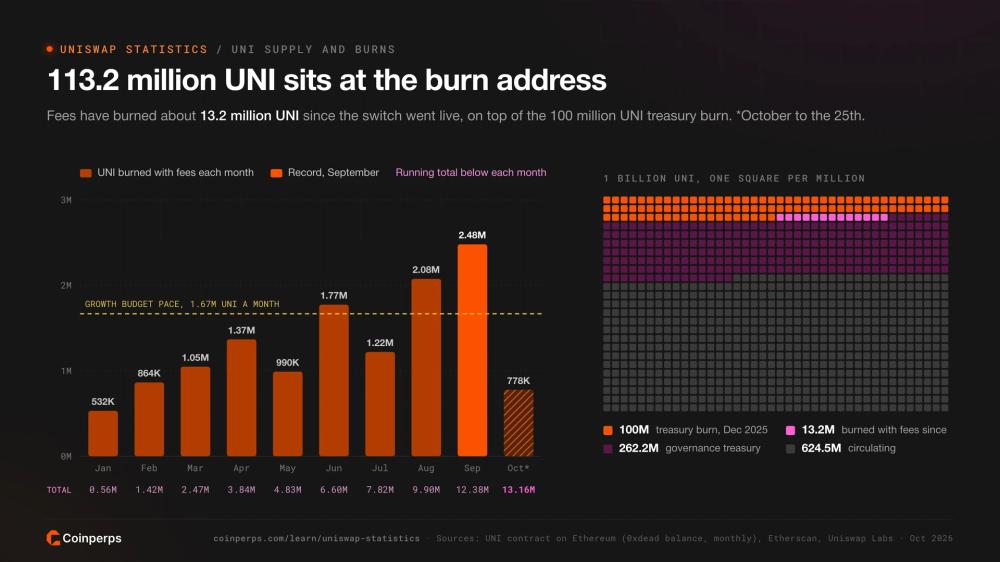
Most of that came in one transaction. On 27 December 2025, the UNIfication execution transaction moved 100 million UNI, worth about $596 million, from the governance treasury to the burn address. The figure was an estimate of what fees would have burned had the switch been on since the token's 2020 launch.
Fees have paid for every burn since. They build up on each chain in a contract called the TokenJar. Anyone can claim them by burning a fixed amount of UNI through a contract called the Firepit, as Uniswap's developer docs explain, with a threshold of 4,000 UNI on Ethereum and 2,000 UNI on layer 2 networks.
Our monthly reading of the burn address shows the pace.
Month | UNI burned with fees | Running total |
|---|---|---|
January 2026 | 532,000 | 560,003 |
February 2026 | 864,000 | 1.42 million |
March 2026 | 1.05 million | 2.47 million |
April 2026 | 1.37 million | 3.84 million |
May 2026 | 990,000 | 4.83 million |
June 2026 | 1.77 million | 6.60 million |
July 2026 | 1.22 million | 7.82 million |
August 2026 | 2.08 million | 9.90 million |
September 2026 | 2.48 million | 12.38 million |
1 to 25 October 2026 | 778,000 | 13.16 million |
September set the record at an annual pace of about 29.8 million UNI. So far October is running at about 11.7 million a year.
Supply also goes the other way. UNIfication created a growth budget of 20 million UNI a year, paid quarterly from the treasury from 1 January 2026. Only in the third quarter did fee burns beat that budget, so in every other quarter more UNI left the treasury than was burned.
Supply measure | Value on 25 october 2026 |
|---|---|
Contract total supply | 1,000,000,000 UNI |
Supply excluding the burn address | 886.8 million UNI |
Circulating supply | 624.5 million UNI |
Governance treasury | 262.2 million UNI (about $1.79 billion) |
Holders on Ethereum | 390,093 |
Governance delegates | About 52,900 |
Circulating supply and holder numbers are from Etherscan, and Tally supplies the delegate count. Governance has been allowed to mint up to 2% of supply a year since 1 January 2024, yet it has never done so.
UNI Price and Derivatives Data
UNI trades at $6.82 with a market cap of $4.26 billion, ranked 26th by CoinGecko. Today's price is about 85% below its all-time high of $44.92, set on 2 May 2021.
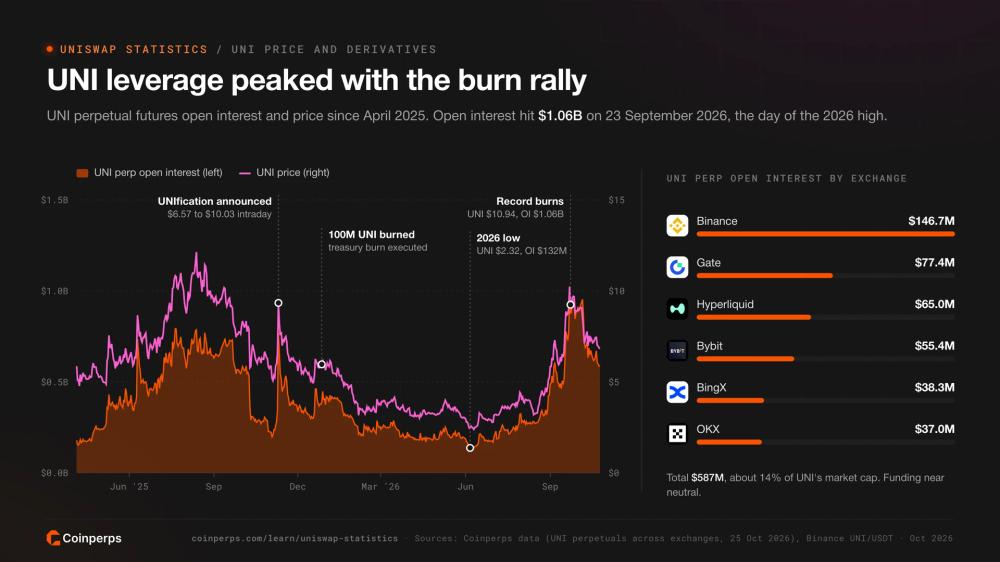
Binance's UNI/USDT market shows the past year's swings.
Date | Event | UNI price |
|---|---|---|
10 November 2025 | UNIfication announced | $6.57 to a $10.03 intraday high |
31 December 2025 | Year end, after the 100 million UNI burn | $5.64 |
6 June 2026 | 2026 low | $2.32 |
23 September 2026 | 2026 high, during record burns | $10.94 |
24 October 2026 | Latest close | $6.87 |
Burn rates and Robinhood Chain fees both peaked during the September rally. UNI more than doubled from its August level and has since dropped about 37% from the top.
Leveraged positions tracked the price. In Coinperps data, UNI perpetual futures open interest, the value of open positions, bottomed at $132 million on 6 June and hit $1.06 billion on 23 September, the day of the price high. Today it is $587 million, about 14% of UNI's market cap.
Exchange | UNI perp open interest | 24h volume |
|---|---|---|
 Binance (UNI/USDT) | $146.7M | $137.6M |
 Gate | $77.4M | $13.9M |
 Hyperliquid | $65.0M | $13.6M |
 Bybit | $55.4M | $24.1M |
 BingX | $38.3M | $45.0M |
 OKX | $37.0M | $66.0M |
Funding is close to neutral, at an open interest weighted average of about 0.003%. Our funding rates and open interest dashboards carry the latest readings, and the Uniswap liquidation heatmap shows where leveraged positions cluster.
Uniswap Risks, Security and Legal Status
The main risks for Uniswap users now sit outside its core contracts, in hooks, liquidity provider economics and regulation. Uniswap Labs says the protocol has processed more than $4.5 trillion with zero hacks.
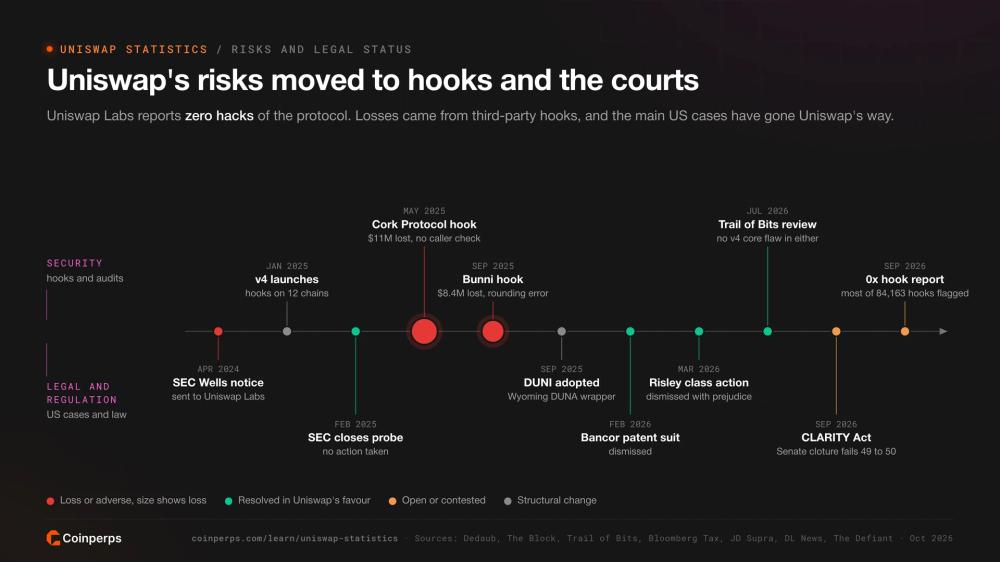
- Hook exploits: two projects built on v4 lost funds through their own code. Cork Protocol lost about $11 million on 28 May 2025 because its hook never checked who was calling it, Dedaub found. A rounding error cost Bunni about $8.4 million on 2 September 2025, according to The Block, and Bunni shut down in October 2025. Trail of Bits concluded that neither case involved a flaw in v4's core contracts.
- Malicious hooks: anyone can deploy a hook, so traders who swap outside the Uniswap interface can meet pools that charge hidden fees. A September 2026 report by 0x labelled most of the 84,163 hooks it reviewed as malicious or likely malicious. Hayden Adams answered that the Uniswap API only sends trades to reviewed hooks.
- LP returns: loss-versus-rebalancing, the cost LPs pay when arbitrageurs trade against stale pool prices, can outweigh fee income. In many of the largest Uniswap pools, arbitrage losses exceeded fees in a 2024 study. Milionis and co-authors formalised the concept in 2022.
- Unichain centralisation: L2BEAT rates Unichain a Stage 1 rollup with permissionless fault proofs, but one operator still runs its sequencer. The Unichain Validation Network, which would let UNI holders stake, has not launched on mainnet.
- Legal status: the SEC sent Uniswap Labs a Wells notice in April 2024 and closed its investigation without action on 25 February 2025, Bloomberg Tax reported. All remaining claims in the Risley class action over scam tokens were dismissed with prejudice on 2 March 2026. In a separate case covered by DL News, a judge threw out Bancor's patent suit on 10 February 2026. Uniswap governance also adopted a Wyoming DUNA legal wrapper called DUNI in September 2025.
- US market structure law: the CLARITY Act, which would set protections for DeFi developers, failed a Senate cloture vote 49 to 50 on 15 September 2026, The Defiant reported. US rules for DeFi front ends remain unsettled.
How derivatives venues are treated country by country is covered in our guide to crypto perpetual futures regulation.
Bottom Line
Uniswap has processed more than $4.5 trillion and still leads spot DEX trading, with 41.2% of top-10 DEX volume in the second quarter of 2026. Its mix has shifted quickly. Robinhood Chain and v4 now carry most of the volume, while Unichain has faded.
Fee-funded burns have removed about 13.2 million UNI, on top of the 100 million UNI treasury burn. Whether they keep pace with the 20 million UNI growth budget depends on volume holding up. Before you trade, check live UNI positioning, funding and liquidation levels on the UNI perpetuals page.


