What Is Pearl (PRL)? Proof of Useful Work Explained
Pearl (PRL) is a proof-of-work blockchain whose miners secure the network with the matrix multiplication AI models run on, with supply capped at 2.1 billion coins. This guide covers how it works, mining returns, tokenomics, the usefulness debate and where PRL trades.

Not financial advice.
Key takeaways
- Pearl (PRL) is a proof-of-work blockchain secured by AI-style matrix multiplication: it launched on 27 April 2026 on a fork of Bitcoin node software, and miners earn PRL for GPU work that can also serve an AI model.
- Supply is capped at 2.1 billion PRL with no premine: about 391.25 million coins, or 18.6%, were mined by 26 November 2026, and roughly 121.7 million of those came in the first six days.
- Most mining so far does no useful AI work: a June 2026 arXiv study found miners feeding in random matrices, and the FP8 upgrade meant to fix the incentive has no mainnet date.
- PRL usually means Perle on large exchanges: Pearl trades as PEARL on Coinbase, Kraken and Gate, and its perpetuals are on Ourbit, Deribit, a Hyperliquid HIP-3 market, Lighter and Aster.
On this page 10 sections
- What Is Pearl (PRL)?
- How Proof of Useful Work Secures Pearl
- Is Pearl Mining Useful AI Work?
- How Pearl Mining Works and What It Pays
- PRL Tokenomics and Supply
- How Pearl Compares With Bittensor and Other AI Compute Networks
- Where PRL Trades and the Perle Ticker Trap
- Risks of Holding and Trading PRL
- Bottom Line
- FAQs
Pearl (PRL) is a proof-of-work blockchain that pays miners for the matrix multiplication behind AI models in place of the hash puzzles Bitcoin uses. Its coin, PRL, has a hard cap of 2.1 billion and launched with no premine.
The network went live on 27 April 2026. Seven months later PRL is listed on Coinbase and Kraken with a market value near $766 million, yet an academic study argues that most of its mining does no useful AI work.
Below we explain how Pearl works and who mines it, then cover supply and the venues where it trades. Our figures come from Pearl's code and papers plus chain and exchange data pulled on 26 November 2026.
What Is Pearl (PRL)?
Pearl is a layer 1 proof-of-work blockchain in which miners secure the network by running matrix multiplication, the core arithmetic of AI models, on GPUs. PRL is the native coin, used for block rewards and transaction fees. Its developer, Pearl Research Labs, calls the design proof of useful work because one GPU pass can serve an AI model and enter the block lottery at once.
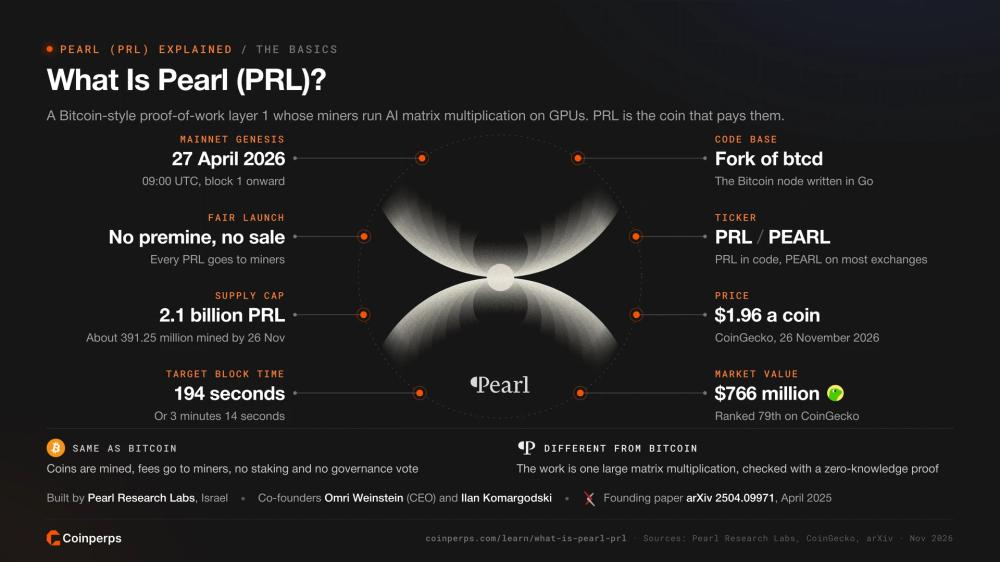
Under the hood sits a fork of btcd, a Bitcoin node written in Go. As on Bitcoin, coins are mined and fees go to miners, and there is no staking or governance vote. What changes is the work itself, which the INT whitepaper defines as one large matrix multiplication checked with a zero-knowledge proof.
- Launch: mainnet genesis on 27 April 2026 at 09:00 UTC, with no premine and no token sale.
- Supply: 2.1 billion PRL maximum; about 391.25 million mined by 26 November.
- Block time: a 194-second target, or 3 minutes 14 seconds.
- Ticker: PRL in Pearl's code and most of its documents, and PEARL on most exchanges.
- Market value: about $1.96 a coin and $766 million in total on 26 November 2026, ranked 79th on CoinGecko.
Who Built Pearl
Pearl Research Labs is based in Israel, and its terms of service give the legal entity as Pearl Research Ltd. Chief executive and co-founder Omri Weinstein is a theoretical computer scientist and former assistant professor at Columbia University. Fellow co-founder Ilan Komargodski is a cryptographer and associate professor at the Hebrew University of Jerusalem.
A year before the chain started, the pair published the founding paper, Proofs of Useful Work from Arbitrary Matrix Multiplication, in April 2025.
Israeli outlet TheMarker reported on 25 October 2026 that the company had raised about $130 million from Lightspeed, Ribbit Capital and Square Peg. According to that report, $55 million was equity and roughly $75 million sat in a vehicle for buying GPUs. Pearl has not confirmed the raise.
How Proof of Useful Work Secures Pearl
Proof of useful work lets a GPU that already serves an AI model earn block rewards from the same computation. Bitcoin miners burn electricity on hashes with no use outside the network. Pearl miners do matrix multiplication instead, the operation at the centre of how a large language model answers a prompt.
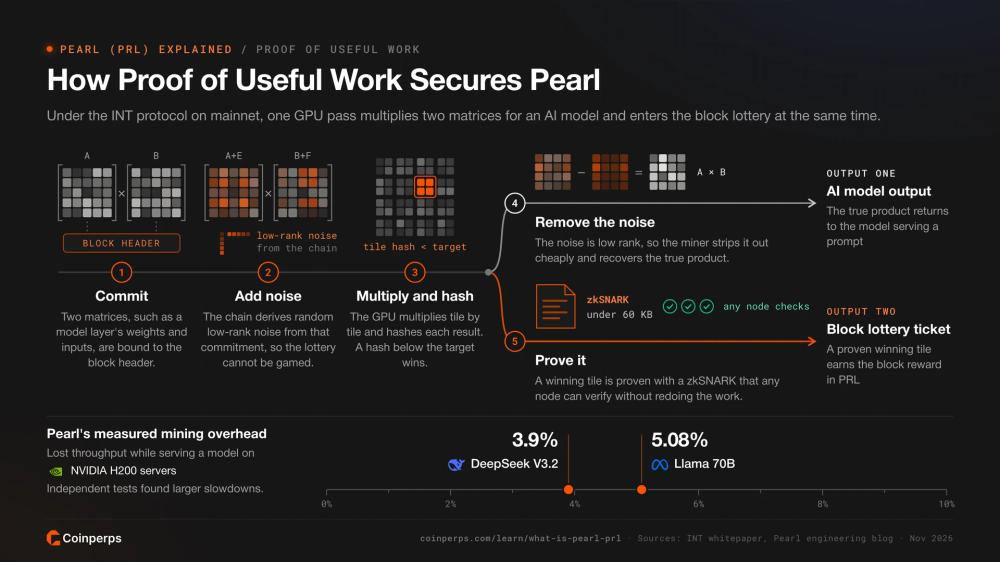
These steps follow the INT protocol that runs on mainnet.
- Commit: the miner commits to two matrices, such as a model layer's weights and its inputs, and binds them to the block header.
- Add noise: the chain derives random low-rank noise from that commitment, so the miner cannot pick inputs that make the lottery easier.
- Multiply and hash: the GPU multiplies the noised matrices tile by tile and hashes the intermediate results. A tile hash below the difficulty target wins the block.
- Remove the noise: the noise is low rank, so the miner strips it out cheaply and recovers the true product for the AI model.
- Prove it: a winning tile is proven with a zkSNARK, a compact proof under 60 KB that any node can check without redoing the work.
Pearl's engineering blog measured the slowdown from mining while serving a model at 5.08% on Llama 70B and 3.9% on DeepSeek V3.2, both on NVIDIA H200 servers. Independent tests found larger slowdowns.
A moving average with a one-week time constant resets difficulty after every block and keeps blocks near the 194-second target. On 26 November the chain stood at block 148,881, with blocks arriving about every 185 seconds by our reading of Pearl's block explorer. Outputs must use Taproot or the newer Pay-to-Merkle-Root (P2MR) format, and addresses begin with prl1.
Cryptography is only half of the security case, and the other half is economic. In The Economics of Proof-of-Useful-Work, cryptographer Rafael Pass argues that the cost of a majority attack stays tied to the block reward even when the work has outside value. The paper says he wrote it while consulting for Pearl Research Labs, and Pearl cites it in its own FAQ.
Is Pearl Mining Useful AI Work?
Most Pearl mining to date appears to serve no AI customer. What the protocol proves is narrow. A matrix multiplication was computed correctly, but nothing shows the matrices came from a real model or that anyone wanted the result.
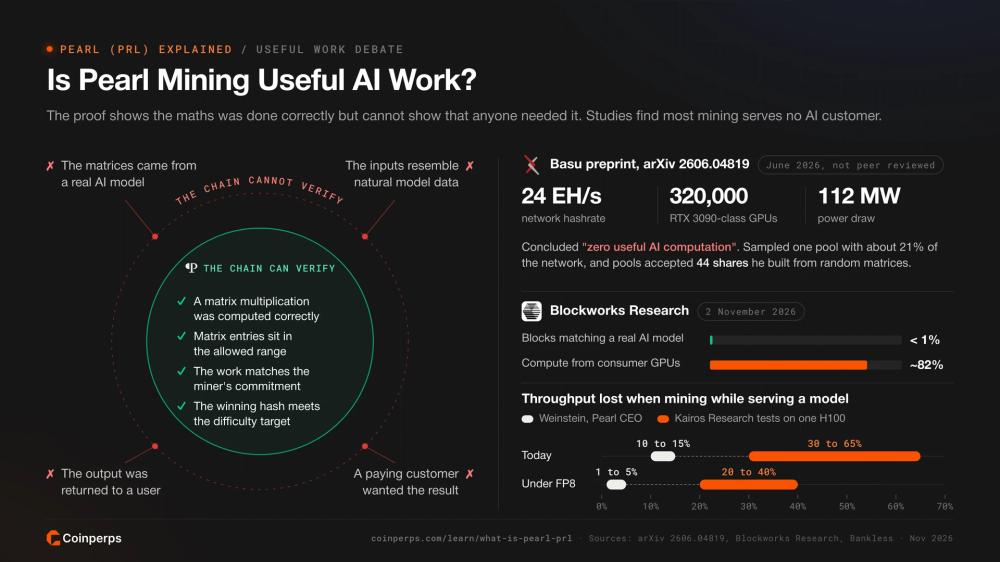
Abhinaba Basu, a researcher at India's NIELIT and IIIT Allahabad with no stated link to Pearl, tested this in a June 2026 preprint, The Usefulness Gap in Proof-of-Useful-Work. He estimated the network's hashrate at about 24 EH/s, equal to roughly 320,000 RTX 3090-class GPUs drawing 112 MW, and concluded that it produced "zero useful AI computation".
He found no AI model code in the dominant mining software of the time. Pools also accepted 44 shares from a miner he wrote to feed in random matrices, on both NVIDIA and AMD hardware. The paper has limits. It has not been peer reviewed, and its sample came from one pool holding about 21% of the network. Hashrate has also grown a great deal since.
The chain can verify | The chain cannot verify |
|---|---|
A matrix multiplication was computed correctly | The matrices came from a real AI model |
Matrix entries sit within the allowed range | The inputs resemble natural model data |
The work matches the miner's commitment | The output was returned to a user |
The winning hash meets the difficulty target | A paying customer wanted the result |
A 2 November Blockworks Research report points the same way. It estimated that fewer than 1% of Pearl blocks matched a real AI model and that consumer graphics cards supplied about 82% of the compute, according to crypto.news.
Weinstein has said on X that mining with random inputs will always be possible. Bankless reported in November that Pearl aims to remove the economic reason for it with FP8, a new mining format covered in the mining section below.
Kairos Research, which holds PRL, ran useful mining on one rented H100 and found the incentive gap still wide. Its current build served 30% to 65% fewer tokens than a normal server. The FP8 test build narrowed that to a loss of about 20% to 40%.
Weinstein puts that loss at 10% to 15% today and 1% to 5% under FP8. On the Kairos numbers, a GPU that only mines earns more PRL than one that mines while serving paid inference.
How Pearl Mining Works and What It Pays
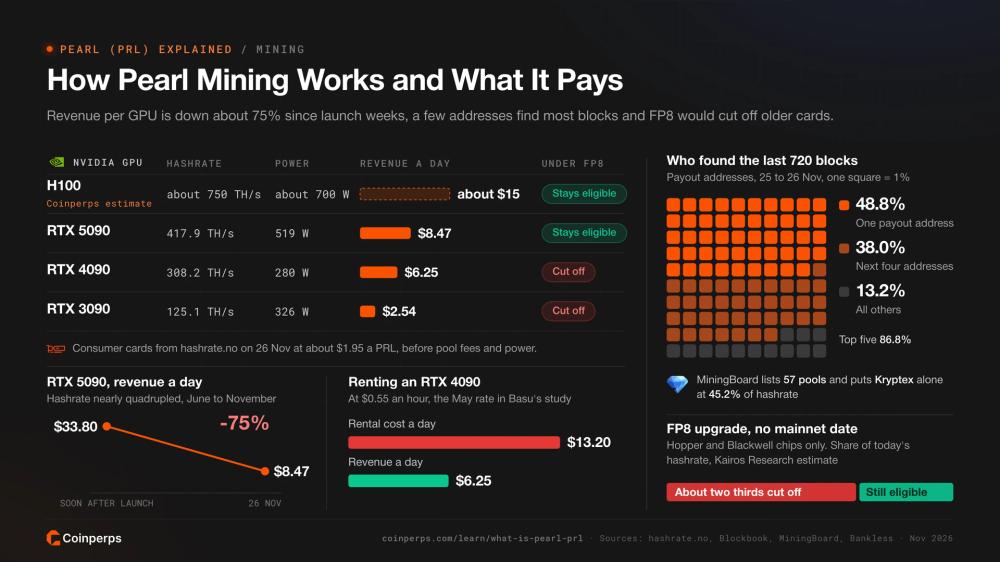
Anyone with a suitable GPU can mine PRL, but returns have fallen sharply since launch and a pending upgrade would cut off older consumer cards.
The official miner is a plugin for vLLM, an open-source model server, and its documentation supports only NVIDIA H100 and H200 cards. Mining happens as a side effect while it serves a Pearl-certified model such as Llama 3.3 70B. Most hashrate comes from community-built miners instead, which run on consumer cards like the RTX 4090 and multiply random matrices without loading any model.
GPU | Hashrate | Power | PRL per day | Revenue per day | Key nuance |
|---|---|---|---|---|---|
RTX 5090 | 417.9 TH/s | 519 W | 4.27 | $8.47 | About $33.80 a day soon after launch |
RTX 4090 | 308.2 TH/s | 280 W | 3.15 | $6.25 | Most efficient per watt of the three |
RTX 3090 | 125.1 TH/s | 326 W | 1.28 | $2.54 | Lowest return |
H100 | About 750 TH/s | About 700 W | About 7.7 | About $15 | Our estimate from study ratios |
Figures for consumer cards are from the tracker hashrate.no on 26 November, at a PRL price near $1.95 and before pool fees and electricity. Revenue per GPU has dropped about 75% since the weeks after launch, a slide Tom's Hardware first reported in May, mainly because network hashrate nearly quadrupled between June and November.
For someone who owns the card, power is cheap. We estimate about $0.21 per PRL on an RTX 4090 at $0.10 per kWh. Rented hardware loses money, since a 4090 at the $0.55 hourly rate in Basu's study costs $13.20 a day and earns $6.25.
Mining Pools
A handful of pools control most of the hashrate. MiningBoard listed 57 pools on 26 November and put Kryptex alone at 45.2%. Our own count of the last 720 blocks found one payout address collecting 48.8% of them and the top five collecting 86.8%.
Pearl also sells prepaid cloud mining through Pearl Compute. Its terms make payments non-refundable, give no guarantee that capacity will be available and let the company keep PRL mined with excess compute. Package prices sit behind a login.
The FP8 Upgrade
FP8 changes the unit of work from integer matrices to 8-bit floating point, a format AI providers already use in production. It activated on Pearl's test network on 17 November 2026 at block 67,415, and Pearl's node code sets no date for mainnet.
The FP8 specification is written for NVIDIA's Hopper and Blackwell chips. Kairos Research estimates that about two thirds of current hashrate would no longer qualify. The pool operator HeroMiners lists GeForce RTX 50 cards, including the RTX 5090, among the Blackwell chips that would stay eligible.
PRL Tokenomics and Supply
Most PRL does not exist yet. The maximum is fixed at 2.1 billion coins, all of them issued to miners over time. About 391.25 million PRL existed at block 148,881 on 26 November 2026, or 18.6% of the cap. Because so much is still to come, the fully diluted value of about $4.1 billion is more than five times the market cap.
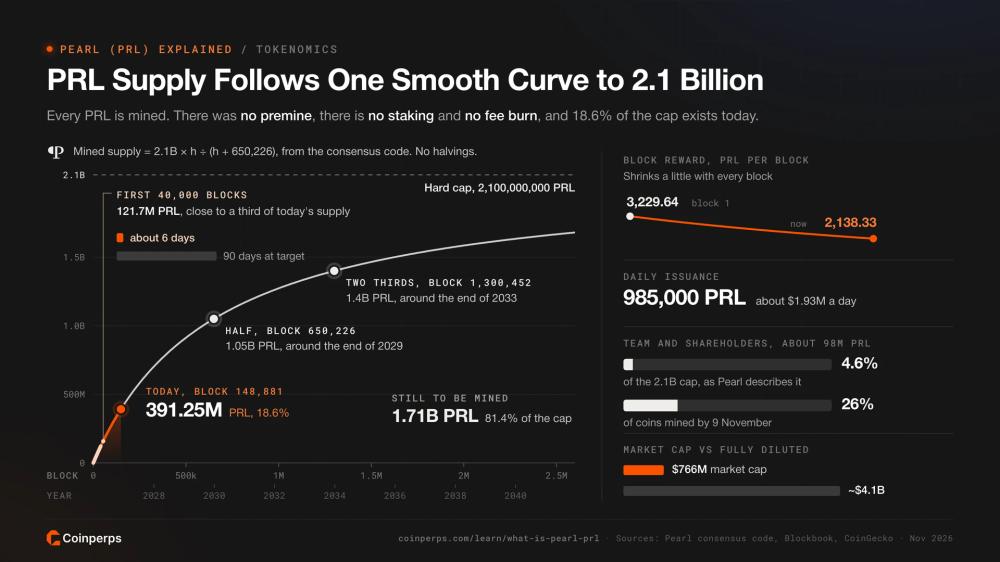
There are no halvings. The consensus code releases supply along a smooth curve in which the share mined after block h equals h divided by h plus 650,226. Half the supply is due by block 650,226.
The curve was sized to take four years at the 194-second target, but fast early blocks put the chain about 54,000 blocks ahead of schedule. At the target pace from here, half arrives around the end of 2029 and two thirds around the end of 2033.
Metric | Value |
|---|---|
Maximum supply | 2,100,000,000 PRL |
Mined by 26 November 2026 | 391.25 million PRL; 18.6% of the cap |
Block reward at block 1 | 3,229.64 PRL |
Block reward at block 148,881 | 2,138.33 PRL |
Daily issuance | About 985,000 PRL; roughly $1.93 million |
Premine or token sale | None |
Staking or fee burn | None |
Team and shareholder holdings | About 98 million PRL on 9 November 2026 |
Fair Launch and Early Mining
The genesis block paid out nothing, so there was no premine, and Pearl has held no token sale. Early issuance was still fast. With difficulty starting low, the first 40,000 blocks arrived in about six days, a stretch that would take roughly 90 days at the target pace. Those blocks emitted about 121.7 million PRL, close to a third of today's supply.
The INT whitepaper says the low starting difficulty was partly meant to give the core team resources. Pearl's network FAQ discloses that the company, its team and its shareholders held about 98 million PRL on 9 November 2026. Pearl puts that at 4.6% of total supply, a share of the 2.1 billion cap. Against the coins mined by that date it was about 26%.
Pearl Research and its team have pledged to lock at least half of their holdings for six months from that date. The pledge does not mention the roughly 26 million PRL held directly by shareholders, and the FAQ does not describe an on-chain lock.
What Gives PRL Value
Holders get no staking yield, no fee burn and no claim on company revenue. Demand rests on miners and investors who choose to keep the coin, plus transaction fees on the chain.
Even Pearl's own inference platform leaves the coin out. Its platform documentation says customers buy prepaid USD credits through Stripe, from $5 a top-up, and there is no option to pay in PRL.
A partnership with Together AI is the clearest link between AI revenue and the coin, announced on 15 May 2026. Together prices a Pearl-mined Gemma model more than 25% below standard and counts on the expected value of mined PRL to cover the discount. On 26 November Pearl's site called the endpoint live, while Together's model page showed a waitlist marked as launching soon.
How Pearl Compares With Bittensor and Other AI Compute Networks
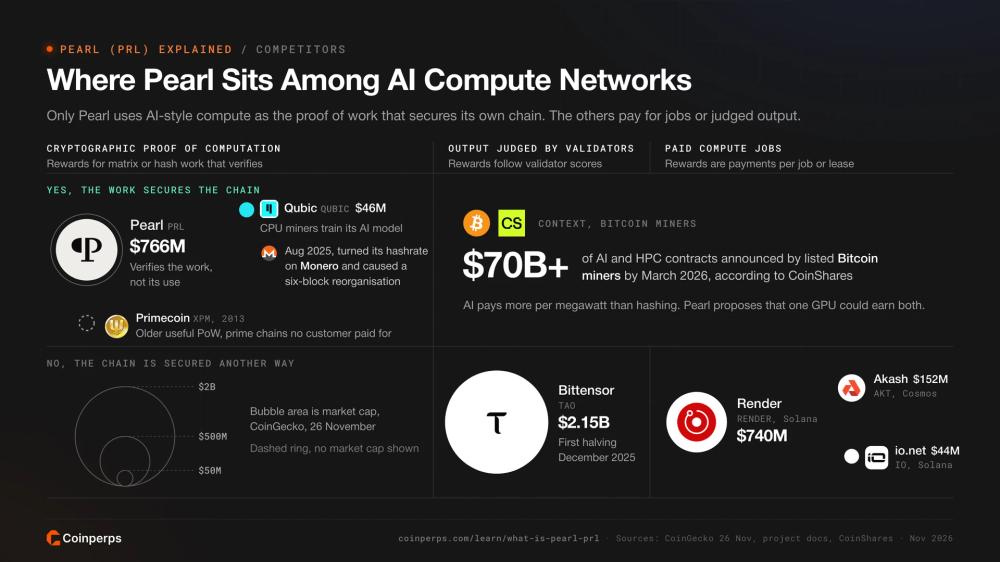
Of the networks below, only Pearl uses AI-style compute as the proof of work that secures a Bitcoin-like chain. In the others a token pays for jobs, or for output that validators judge.
Network | Token | What it is | How rewards are earned | Market cap | Key nuance |
|---|---|---|---|---|---|
Pearl | PRL | Proof-of-work layer 1 | Mining matrix multiplications | $766M | Verifies the work but not its use |
TAO | Network of AI subnets | Validators score miners' AI output | $2.15B | First halving in December 2025 | |
Render | RENDER | GPU marketplace on Solana | Operators are paid per job | $740M | Work does not secure a chain |
Akash | AKT | Compute marketplace on Cosmos | Providers are paid for leases | $152M | Proof-of-stake chain |
io.net | IO | GPU cloud on Solana | Suppliers are paid for compute | $44M | Revenue is self-reported |
Qubic | QUBIC | Useful proof-of-work network | CPU miners train its AI model | $46M | Turned its hashrate on Monero in 2025 |
Market caps are CoinGecko figures from 26 November. Bittensor is the largest of the group and the closest rival for attention. Its validators score the quality of miners' AI output, so rewards track usefulness as they judge it. Pearl checks the computation with cryptography and cannot judge usefulness at all.
For the security risk a small proof-of-work chain faces, look at Qubic. In August 2025 its miners turned their hashrate on Monero and caused a six-block reorganisation of that chain. An older caution comes from Primecoin, launched in 2013, whose miners searched for chains of prime numbers that no customer paid for, and the coin now has almost no trading market.
The wider industry is moving the same direction. By March 2026 listed Bitcoin miners had announced more than $70 billion of AI and high-performance computing contracts, according to CoinShares, because AI pays more per megawatt than hashing. Pearl's bet is that one GPU could earn both. We found no public Bitcoin miner or data centre operator that has announced it is mining Pearl.
Where PRL Trades and the Perle Ticker Trap
Pearl trades as PEARL on most centralised exchanges and as PRL on a few derivatives venues, and that split causes costly mistakes. On Coinbase, Binance, Bybit and most other large exchanges, the ticker PRL belongs to Perle, an unrelated Solana token priced near $0.067 on 26 November 2026. At about $1.96 that day, Pearl cost roughly 29 times as much, so check the price before any order.
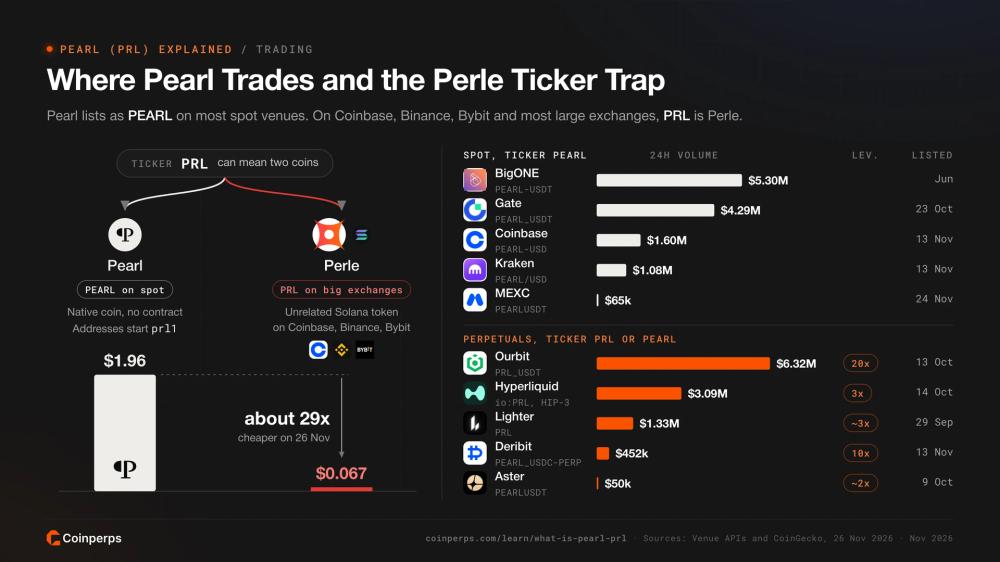
Spot trading began on smaller venues such as SafeTrade and BigONE. Gate added PEARL on 23 October, Coinbase and Kraken opened USD pairs on 13 November, and MEXC followed on 24 November. Binance, OKX and Bybit had not listed Pearl by 26 November.
Venue | Market | Ticker | Max leverage | 24h volume | Key nuance |
|---|---|---|---|---|---|
BigONE | Spot | PEARL-USDT | None | $5.3M | Longest price history, from June |
Spot | PEARL_USDT | None | $4.29M | Its PRL_USDT perp is Perle | |
Coinbase | Spot | PEARL-USD | None | $1.6M | PRL-USD and PRL-PERP-INTX are Perle |
Spot | PEARL/USD | None | $1.08M | Availability varies by region | |
Spot | PEARLUSDT | None | $65k | Thin order book | |
Ourbit | Perpetual | PRL_USDT | 20x | $6.32M | Highest leverage on offer |
Perpetual | io:PRL | 3x | $3.09M | HIP-3 market; isolated margin only | |
Lighter | Perpetual | PRL | About 3x | $1.33M | Listed 29 September |
Aster | Perpetual | PEARLUSDT | About 2x | $50k | Its PRLUSDT perp is Perle |
Perpetual | PEARL_USDC-PERPETUAL | 10x | $452k | Listed 13 November; its PRL_USDC perp is Perle |
Volumes are 24-hour figures from each venue's public data on 26 November.
Pearl Perpetual Futures
Five venues list a Pearl perpetual, a leveraged contract that tracks the price and never expires. The Hyperliquid market is a HIP-3 listing deployed by a third party called EntropyIO, which also supplies the price feed. It held about $10.1 million of the roughly $11.8 million in open interest across the five. Lighter and Aster cap leverage at about 3x and 2x.
Deribit, which Coinbase owns, added PEARL_USDC-PERPETUAL on 13 November with up to 10x leverage, and its PRL_USDC-PERPETUAL tracks Perle. No Pearl perpetual exists on Coinbase itself, Binance, Bybit, OKX, Bitget, KuCoin, MEXC or Gate, and every PRL contract on those exchanges tracks Perle. Our guide to perps versus spot trading explains how the two products differ.
Liquidity is thin on every venue. The Ourbit perpetual had the deepest book we measured, about $114,000 within 2% of the mid price, against about $84,000 on Coinbase spot.
Wrapped Tokens and Fakes
As a native coin, Pearl has no contract address. On NEAR Intents a token called prl.omft.near represents it, and a third-party bridge issues WPRL on Ethereum. We could not confirm who operates that bridge. Treat any Solana or Base token named Pearl as an imposter.
Risks of Holding and Trading PRL
At seven months old, PRL combines heavy issuance and concentrated mining with a protocol that is still changing. CoinGecko records a low of $0.1399 on 23 July 2026 and an all-time high of $2.48 on 23 November 2026, though perpetual venues traded as high as $2.57 on 21 October. By 12 November it had fallen from that October peak to about $1.08.
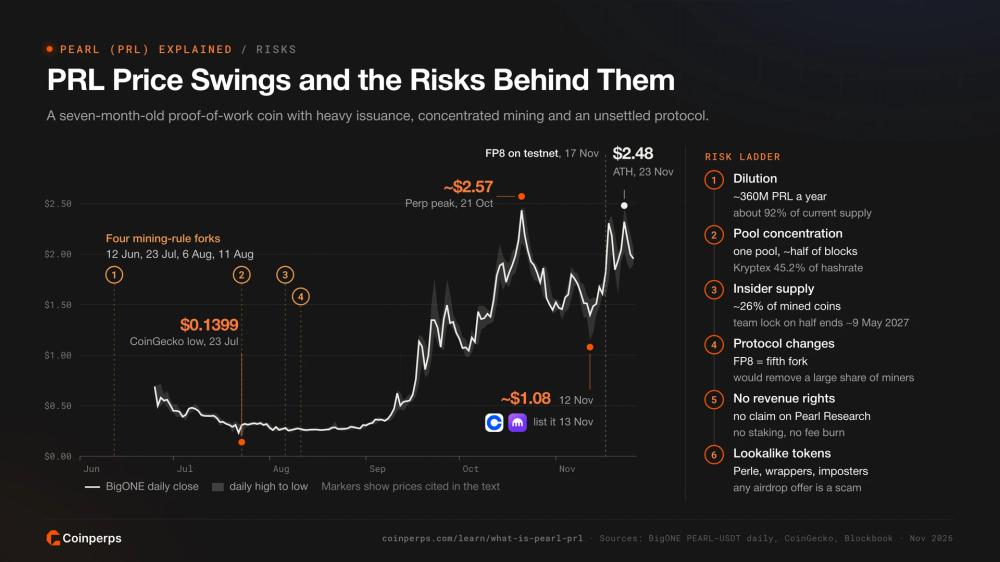
- Dilution: daily issuance of about 985,000 PRL annualises to roughly 360 million coins, close to 92% of current supply by our estimate.
- Pool concentration: one pool finds close to half of all blocks, which gives its operator a large say over the chain until miners move.
- Insider supply: team and shareholders held about a quarter of mined coins in early November, and the voluntary lock on half of the team's share ends around 9 May 2027.
- Protocol changes: mainnet went through four mining-rule forks between June and August, and FP8 would be a fifth that removes a large share of miners.
- No revenue rights: PRL gives holders no stake in Pearl Research Labs, whose equity investors own the inference business.
- Lookalike tokens: Perle, unofficial wrappers and imposter contracts can all be bought by mistake. Pearl is only mined, so any airdrop or token sale offer is a scam.
US regulators treat mined coins more clearly than most tokens. In March 2026 the SEC issued an interpretation, with matching guidance from the CFTC, under which solo and pool mining of digital commodities on a proof-of-work network does not involve the offer and sale of a security. It does not name Pearl, and no regulator has ruled on PRL.
That interpretation is agency guidance, which a court or a later administration could revisit. The bill that would have written the digital commodity category into statute, the Clarity Act, stalled in the Senate in September 2026.
Worth watching from here are a mainnet height for FP8, the end of the team lock in May 2027, any change in Kryptex's share of blocks and a general launch of the Together AI endpoint.
Bottom Line
Pearl takes Bitcoin's proof-of-work model and swaps hashing for the matrix multiplication that AI models rely on. Its mined coin, PRL, is capped at 2.1 billion, launched with no premine and about 18.6% issued by late November 2026.
Published cryptography backs the design, and Coinbase and Kraken listed the coin within seven months. Evidence that miners serve real AI demand is still missing. Outside research found most mining used random inputs, and the FP8 upgrade meant to change that has no mainnet date.
Traders should confirm they are buying PEARL on spot venues or a verified Pearl perpetual, since PRL usually means Perle. Heavy issuance and one dominant pool add to the volatility of a coin with thin order books. Nothing here is investment advice.
FAQs
Can you mine Pearl on a gaming GPU?
Yes, for now. Third-party miners run on consumer NVIDIA cards, and an RTX 4090 earned about $6.25 a day before electricity and pool fees on 26 November 2026. Pearl's official miner supports only H100 and H200 data centre cards. The planned FP8 upgrade is written for NVIDIA's Hopper and Blackwell chips, so older gaming cards would stop qualifying if it reaches mainnet.
Is PRL the same as PEARL or Perle?
PRL and PEARL are two tickers for the same Pearl coin. Pearl's own software uses PRL, while Coinbase, Kraken, Gate and most other exchanges list it as PEARL. Perle is a different project, a Solana token that uses the PRL ticker on Binance, Bybit, Coinbase and other exchanges. It traded near $0.067 on 26 November 2026, when Pearl was near $1.96.
Did Pearl have a premine or an ICO?
No. The genesis block paid no coins and Pearl Research Labs has held no token sale, so every PRL in existence was mined. Early blocks came quickly, and about 121.7 million PRL were mined in the first six days. The company, its team and its shareholders disclosed holdings of about 98 million PRL on 9 November 2026, which they say were mined or bought at market prices.
Which wallet can hold PRL?
Native PRL lives on the Pearl chain, where addresses begin with prl1. Pearl publishes a desktop wallet for Windows, macOS and Linux, along with a wallet daemon called Oyster and its command-line client, oystercli. Ethereum and Solana wallets cannot hold the native coin, so any Pearl token shown in them is a wrapper such as WPRL or an unrelated lookalike.
Is Pearl (PRL) a security?
No regulator has ruled on PRL. An SEC interpretation from March 2026, issued with matching CFTC guidance, says solo and pool mining of digital commodities on a proof-of-work network does not involve the offer and sale of a security. It treats tokens that draw their value from a working network as digital commodities, but it does not name Pearl and could be changed later.


