Who Is Vladimir Novakovski? The Quant Who Built Lighter
Vladimir Novakovski went from physics olympiads and Citadel to founding Lighter, the zero-fee Ethereum perps exchange. See his career, how he built LIT and what his CFTC plan means.

Coinperps may earn a commission from partner links, at no cost to you; rankings follow our methodology. Not financial advice.
Key takeaways
- Quant turned founder: Vladimir Novakovski won silver medals at the 2001 physics and informatics olympiads, finished Harvard at 18 by his own account and worked at Citadel and Graham Capital before moving to Silicon Valley.
- Built from a pivot: Lighter grew out of Novakovski's AI networking startup Lunchclub in 2022, and 80% of its engineers stayed for the change.
- Design built on proofs: Lighter uses zero-knowledge circuits to prove matching and liquidations on Ethereum, charges retail traders nothing and earns from latency-sensitive firms.
- Two dates to watch: Novakovski plans to apply to the CFTC in November 2026, and team and investor LIT tokens start vesting on 27 December 2026.

- Founder
- Vladimir Novakovski, since 2022
- Type
- Perps exchange on an Ethereum zero-knowledge rollup
- Retail fees
- Zero on Standard accounts, 300 ms taker delay
- Token
- LIT, 1 billion maximum supply
On this page 9 sections
- Who Is Vladimir Novakovski?
- Vladimir Novakovski's Early Life and Education
- Novakovski's Career Before Crypto
- How Lunchclub Became Lighter
- How Novakovski Designed Lighter
- The Tests Novakovski Has Faced at Lighter
- How Novakovski Structured the LIT Token
- Novakovski's Robinhood Deal and CFTC Plan
- Bottom Line
Vladimir Novakovski is the founder and CEO of Lighter, the zero-knowledge perpetual futures exchange built on Ethereum. If you trade perps or hold LIT, his background explains why Lighter charges retail traders nothing and why it is now heading to US regulators.
He arrived in crypto late. A Russian immigrant who finished Harvard at 18, he spent about eight years in high-frequency trading, moved to Silicon Valley, led machine learning at Quora and ran the AI networking startup Lunchclub before pivoting that company into Lighter in 2022.
This profile follows that path through to the design choices behind Lighter, the crises he has handled and his plan to bring the exchange under the CFTC.
Who Is Vladimir Novakovski?
Vladimir "Vlad" Novakovski is a Russian-born US founder and former quantitative trader who runs Lighter, one of the largest decentralised perpetual exchanges. Since founding the company in 2022 he has raised close to $90 million, according to Fortune. Founders Fund, Ribbit Capital, Haun Ventures and Robinhood are among the backers.
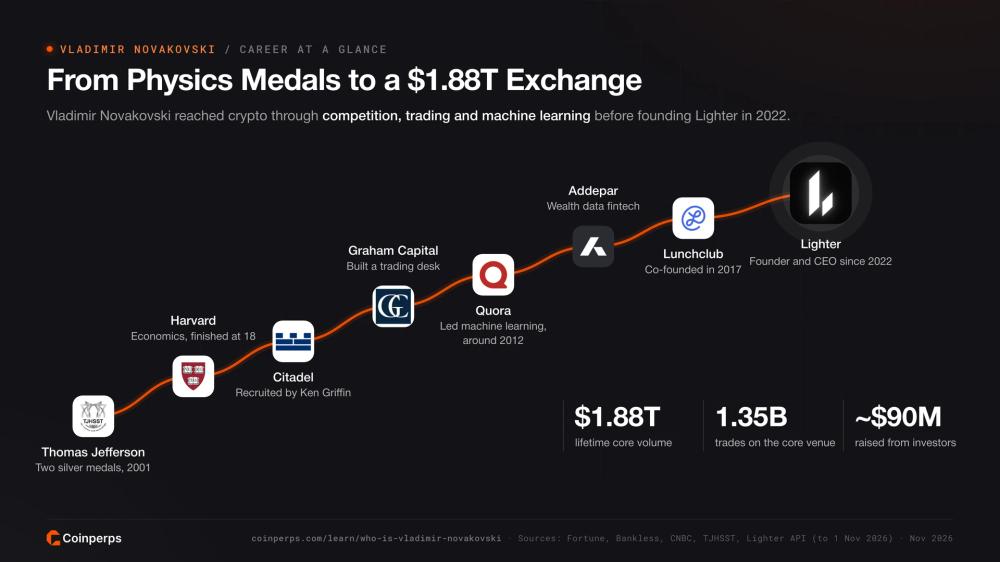
Up to 1 November 2026, Lighter's own exchange metrics API shows about $1.88 trillion of lifetime volume on its core venue, spread across 1.35 billion trades.
Vladimir novakovski | Details |
|---|---|
Known as | Vlad Novakovski |
Role | Founder and CEO of Lighter |
Age | 40 in November 2025, per Fortune |
Origin | Moved from Russia to the United States as a child |
School | Thomas Jefferson High School for Science and Technology, Virginia |
University | Harvard, economics |
Career | Citadel, Graham Capital, Quora, Addepar, Euclid Analytics, Lunchclub |
Company | Elliot Technologies, Inc., which operates Lighter |
Token | LIT |
Vladimir Novakovski's Early Life and Education
Novakovski's teenage record explains the engineering-heavy way he runs Lighter. Twice he reached the top level of competitions that reward solving hard problems against a clock.
Olympiads at Thomas Jefferson
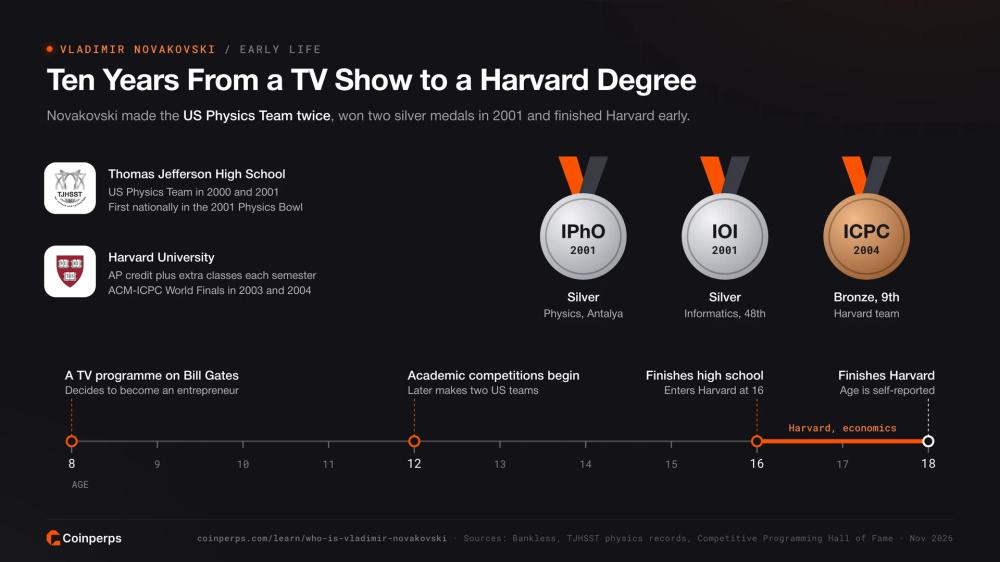
Fortune reports he came to the US as a child, and he calls himself a Russian immigrant. On Bankless he said a television programme about Bill Gates, watched with his father, convinced him at eight to become an entrepreneur. Academic competitions followed from around age 12.
School was Thomas Jefferson, the selective maths and science high school in Northern Virginia. Its physics team records put him on the US Physics Team in 2000 and 2001. In 2001 he placed first nationally in the Physics Bowl and won silver at the International Physics Olympiad in Antalya.
A second silver came the same year at the International Olympiad in Informatics, where the Competitive Programming Hall of Fame ranks him 48th.
Harvard at 16
High school ended at 16. Harvard ended at 18, by his own account on Bankless, thanks to AP credit and extra classes each semester. One wiki profile gives 2004 and age 19, so treat the exact age as self-reported.
He studied economics, he told Bankless in 2025, and the competing continued. Harvard teams he sat on reached the ACM-ICPC World Finals in 2003 and 2004, finishing ninth with a bronze medal in the second year. His dorm-room trading went badly. Ken Griffin, who had run a fund from Harvard years earlier, had already arbitraged away the strategies he kept finding.
Novakovski's Career Before Crypto
Nearly two decades of work taught Novakovski market structure and matching systems, the two subjects at the core of what Lighter does for traders today.
Citadel and Graham Capital
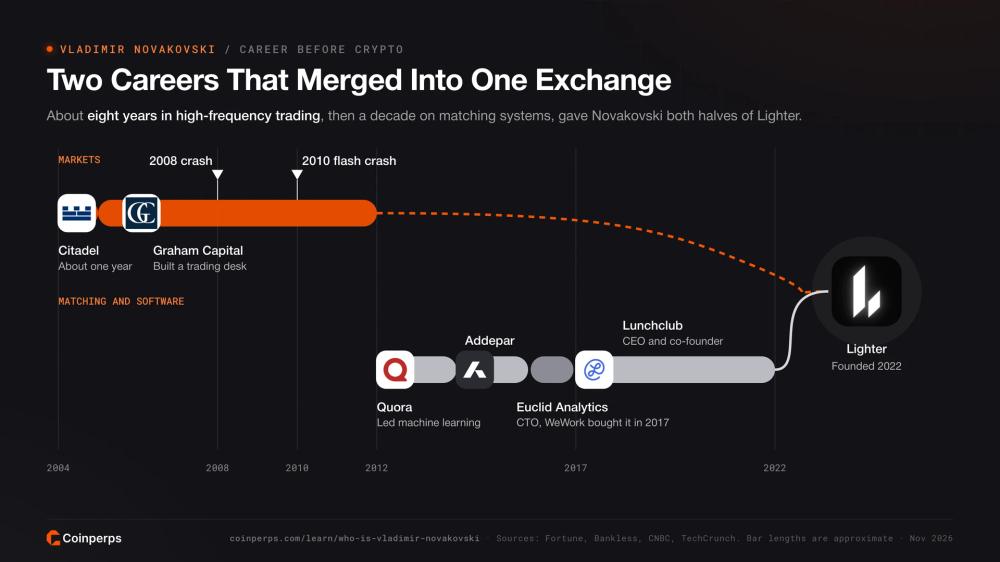
Griffin personally recruited him to Citadel at 18. After about a year he left for Graham Capital to build a trading desk, a job he has compared to running a startup inside a larger firm.
His high-frequency trading years came to about eight in total, long enough to include the 2008 crash and the 2010 flash crash.
Quora, Addepar and Euclid
Silicon Valley came next, around 2012. At Quora he led the machine learning team, and he has described that work as another matching problem, pairing people with questions and answers.
Addepar, the wealth data fintech co-founded by Joe Lonsdale, was his following stop. He pushed the company to recruit interns from maths and science competitions and worked there with Scott Wu, later his co-founder. He was also CTO of Euclid Analytics, which WeWork bought in 2017.
Crypto stayed in the background throughout. The Bitcoin white paper reached him in 2012, and zero-knowledge proofs deepened his interest around 2017 and 2018.
How Lunchclub Became Lighter
Lighter began as a rescue plan for a stalled startup, and the team and early investor relationships carried over.
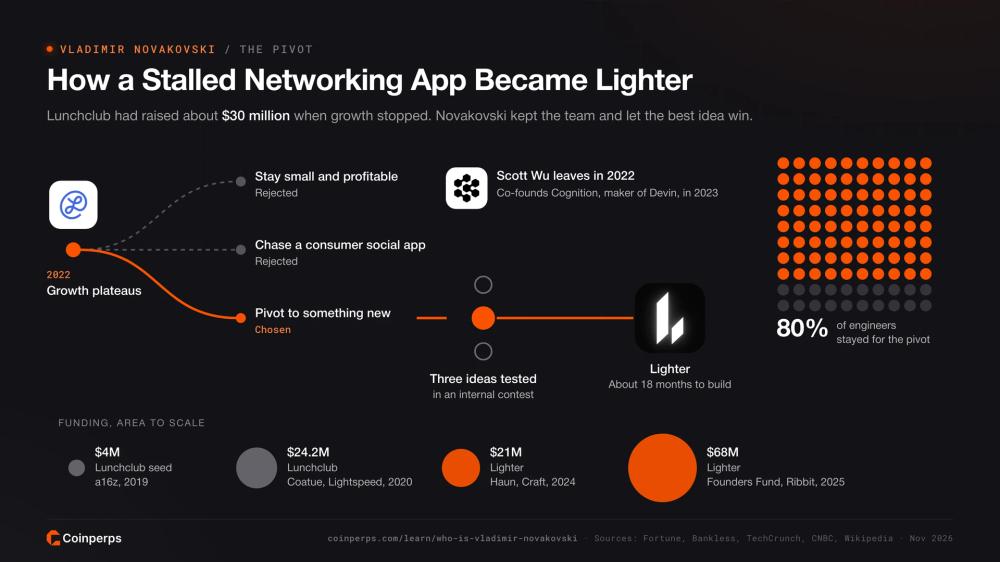
Novakovski co-founded Lunchclub in 2017 with Scott Wu and Hayley Leibson, using AI to match professionals for one-to-one meetings. a16z put in $4 million in 2019. A year later Coatue and Lightspeed led a $24.2 million round at a valuation above $100 million. Robinhood co-founder Vlad Tenev was among its listed investors.
By 2022 growth had plateaued. Novakovski told Fortune the options were a small profitable business, a consumer app he doubted could work, or a pivot. Wu left that year and co-founded Cognition, the maker of Devin, in 2023.
He took the pivot and kept 80% of the engineering team. Three ideas went through an internal contest, the strongest won, and the core technology took about 18 months to build. Lighter's terms name Elliot Technologies, Inc. as the operator, and Lunchclub's listed parent has the same name.
Private testing began in January 2025, and the public mainnet followed in October. Funding had started earlier. Haun Ventures and Craft Ventures led a $21 million round in 2024, then Founders Fund and Ribbit Capital led a $68 million round in November 2025. Fortune put that valuation at about $1.5 billion using anonymous sources, and Novakovski declined to comment.
How Novakovski Designed Lighter
Traders should be able to verify an exchange instead of trusting it. That is Novakovski's central design bet, and his argument on Bankless is that off-chain matching leaves users unable to prove order priority or liquidations were handled fairly.
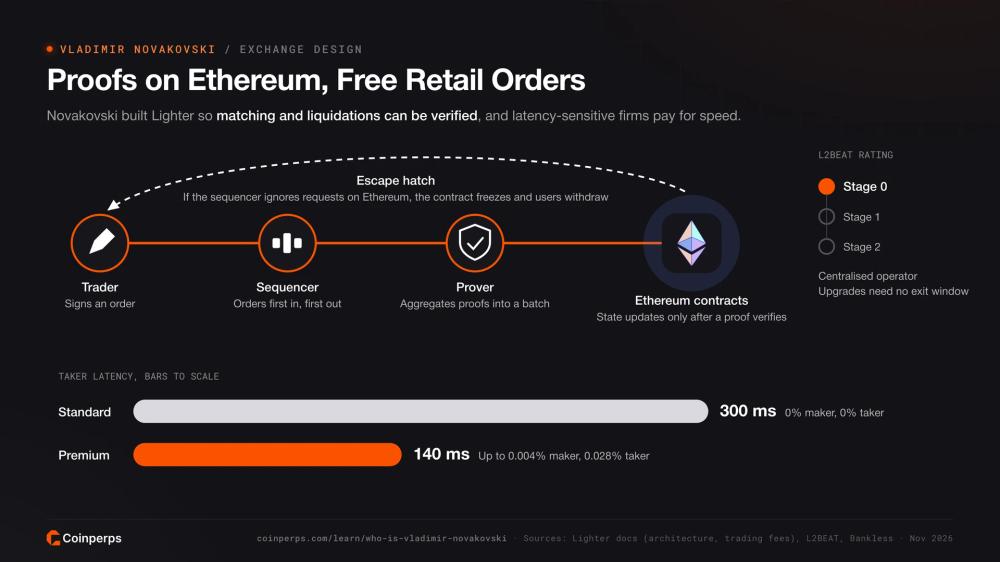
Zero-knowledge circuits are his answer, enforcing price-time priority and liquidation rules. The architecture docs describe a sequencer ordering transactions and a prover aggregating the proofs. Ethereum contracts hold deposits and update state only once a proof verifies.
An escape hatch sits behind all of this. Should the sequencer ignore requests posted on Ethereum, the contract freezes and users can withdraw using the posted data.
His trading background shows in the fees. Standard accounts pay nothing to make or take on regular orders but accept a 300 ms taker delay. Premium accounts buy 140 ms taker latency for up to 0.004% maker and 0.028% taker. Latency-sensitive firms therefore fund the venue, a split covered in our guide to maker and taker fees.
L2BEAT rates Lighter Stage 0, citing a centralised operator and contracts that can be upgraded without an exit window. His security pitch is strongest on proofs and exits, and weakest on upgrade control.
How Novakovski Differs From Jeff Yan
The obvious comparison is Jeff Yan, the former high-frequency trader who built Hyperliquid. Both are Harvard graduates and Olympiad medallists. On capital, architecture and visibility they went opposite ways.
Choice | Vladimir novakovski, Lighter | Jeff yan, Hyperliquid |
|---|---|---|
Outside capital | About $90 million from venture investors | None |
Base layer | Ethereum layer 2 with validity proofs | Its own layer 1 |
Retail fees | Zero on Standard accounts | Tiered maker and taker fees |
Insider token share | 50% to team and investors | No venture allocation |
Public profile | Regular podcasts and investor calls | Rare interviews |
Novakovski told Coinage he does not see decentralised exchanges as a winner-take-all contest. The larger opportunity, he argued, lies in taking share from centralised venues.
The Tests Novakovski Has Faced at Lighter
Lighter's growth has come with public failures, and how a founder handles them tells traders more than a pitch deck.
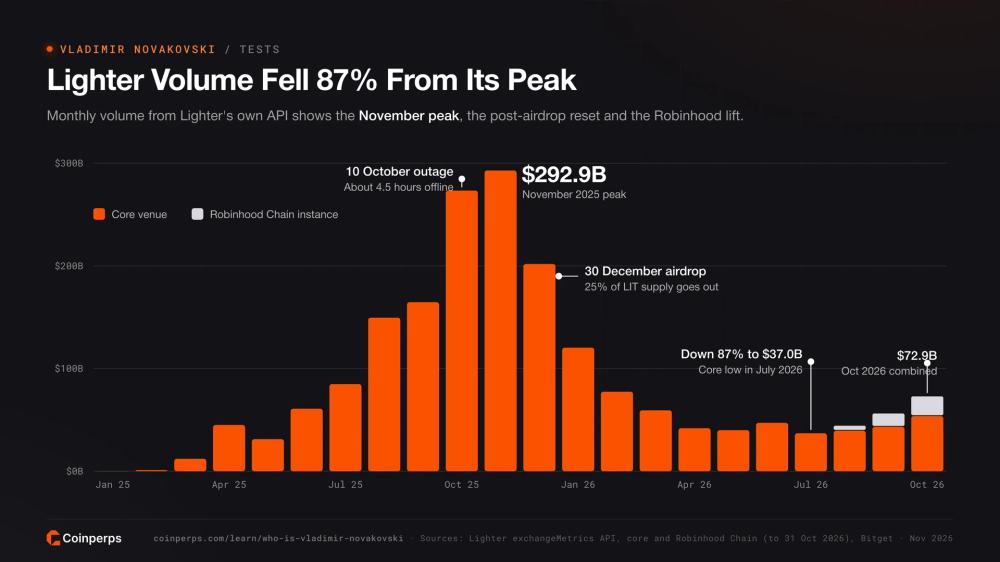
The 10 October Outage
The biggest test arrived during the record liquidation event of 10 and 11 October 2025. A reported database failure took the exchange offline for about 4.5 hours, and Lighter also acknowledged performance problems before the crash. Novakovski said a database upgrade had been planned for that same weekend.
Compensation came to 250,000 points plus refunded liquidation fees, against an estimated $32 million of trader losses. Holders of the LLP liquidity pool, down about 5%, were the least satisfied group after receiving 25,000 of those points.
LLP collateral now sits in isolated strategies, which caps losses within each bucket. Readers exposed to that kind of pool should also understand auto-deleveraging.
The Volume Reset After the Airdrop
Monthly volume on the core venue peaked at $292.9 billion in November 2025, when The Block ranked Lighter first among perps protocols. By July 2026 it had fallen 87% to $37.0 billion, once the points seasons that drove the airdrop had ended.
October 2026 brought $53.8 billion on the core venue and another $19.1 billion on the separate Robinhood Chain instance, based on Lighter's own API. Our Lighter statistics page tracks the wider numbers.
The Insider Allocation Debate
Half of the LIT supply went to the team and investors, a split critics called excessive for a DeFi project. Large transfers from a team address before launch added to the suspicion. Novakovski said in a Twitter Space they were for holding allocated funds and had nothing to do with the airdrop.
How Novakovski Structured the LIT Token
Novakovski treats the token as the company's main economic asset. For LIT holders, the case rests on his execution and on how insiders behave after their lockup ends.
"The token is where the value will accrue," he said before the launch, adding that investors backed the company knowing this. LIT is issued from Lighter's US C-Corp, which says it will run the protocol at cost. Only about 1% of the cap table opted out of that structure, he said later.
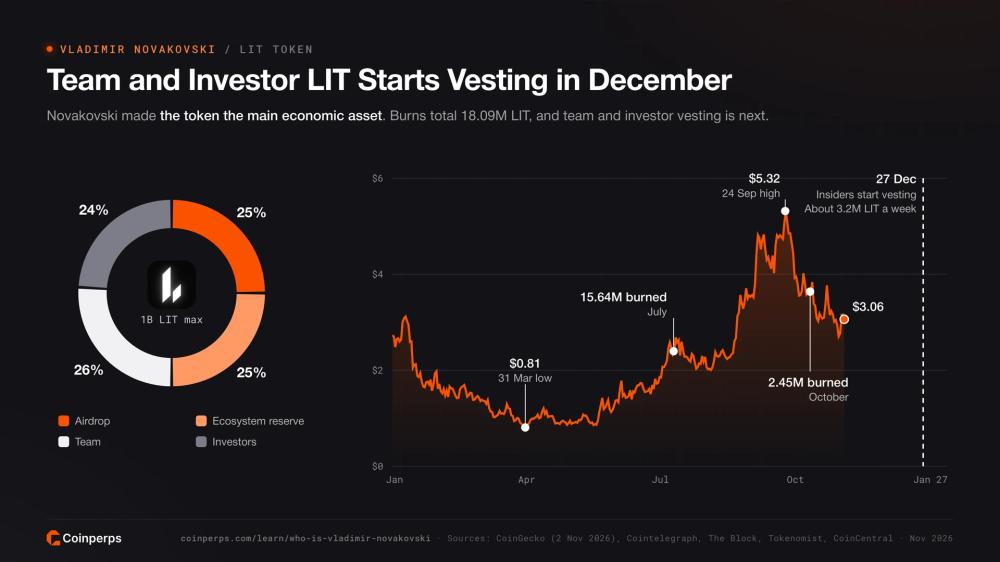
Maximum supply is 1 billion LIT. The ecosystem received 50%, including the 25% airdrop on 30 December 2025. Of the remainder, the team took 26% and investors 24%, both on a one-year lock followed by three years of linear vesting.
Revenue funds daily buybacks, and purchased tokens have been burned since the end of June 2026. CoinGecko's total supply of 981.9 million implies 18.09 million LIT gone so far, which matches the July burn of 15.64 million plus the October burn of 2.45 million.
Team and investor tokens start vesting on 27 December 2026, at about 3.2 million LIT a week on Tokenomist's estimate. That rate would outpace the current burn. LIT has swung from about $0.81 in March 2026 to about $5.32 in September, and it traded near $3.06 on 2 November.
What Is Vladimir Novakovski's Net Worth?
No verified figure exists for Novakovski's net worth, and his personal LIT allocation has not been disclosed. At the 2 November price the whole team allocation of 260 million LIT was worth about $796 million, but staff share it, it stays locked until late December and it vests over three years. Online estimates we found cite no primary source.
Novakovski's Robinhood Deal and CFTC Plan
Novakovski's next phase depends on the US. Robinhood supplied distribution outside America, and a CFTC licence is the missing piece inside it.
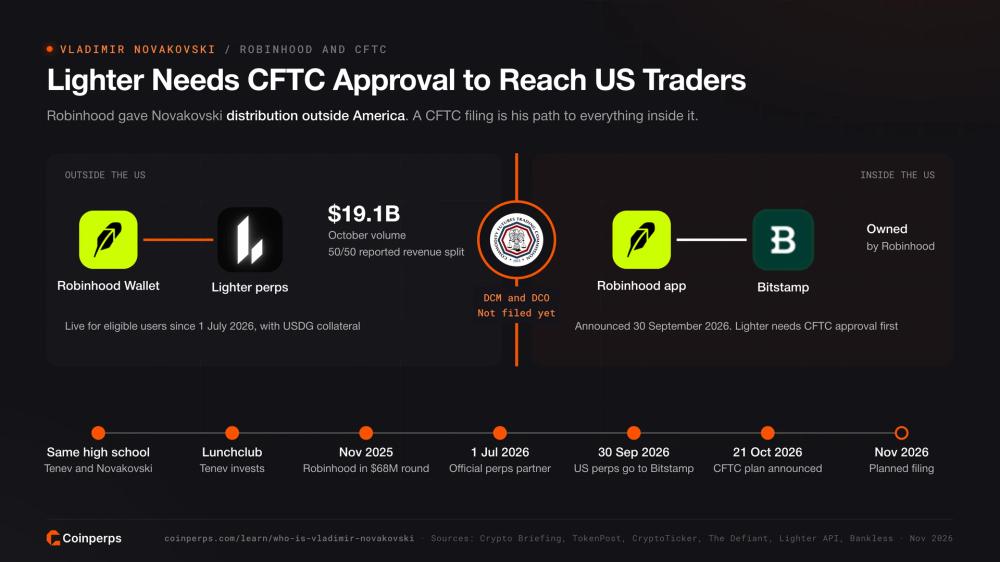
Tenev attended the same high school and backed Lunchclub, and Robinhood later joined Lighter's $68 million round. When Robinhood Chain went live on 1 July 2026, Lighter became its official perps partner, a deal Novakovski traced back 12 years. Reported terms include a 50/50 revenue split, USDG collateral and LIT incentives for Robinhood users.
Americans are left out for now. Robinhood Wallet offers Lighter's perps to eligible users outside the US, and on 30 September Robinhood said its US customers would get perps through Bitstamp, the exchange it already owns. LIT fell sharply on the news.
His response came on the 21 October investor call. Lighter will apply in November for two CFTC registrations covering perps and options, he said, a designated contract market for trading and a derivatives clearing organisation for clearing.
Nothing had been filed as of 2 November, and approval is uncertain. Any Robinhood US integration would depend on licensing and product, he added, and he reportedly said the team has spent about a year talking to regulators.
His stated goal is to be the first on-chain perps DEX with CFTC approval, a step that would change how US perps regulation applies to Lighter. He has also told Coinage he wants markets on compute, energy and rent, and said Lighter uses only about 1% of Ethereum blob space today. In his January Fortune interview he named US regulatory clarity as the main driver for perps.
Bottom Line
Vladimir Novakovski is a former Citadel quant and Olympiad medallist who turned a failing AI startup into one of the largest on-chain derivatives venues. His bet is that verifiable matching, free retail trading and Ethereum settlement can beat faster-moving rivals.
So far the record is strong on engineering and mixed on stress events and token distribution. His next tests have dates attached, with the CFTC filing due in November and insider vesting starting on 27 December.


