WhiteBIT Restricted Countries List 2026: Bans, Licenses & Alternatives
WhiteBIT built local platforms for the United States, the United Kingdom and the European Economic Area in the past twelve months, yet all three remain blocked on the global site. None of them carries perpetual futures.

Coinperps may earn a commission from partner links, at no cost to you; rankings follow our methodology. Not financial advice.
Key takeaways
- Thirty countries and territories are blocked from whitebit.com, including the United States, United Kingdom, Canada, Russia and Belarus, per the forbidden-jurisdictions list in WhiteBIT's identity verification documentation.
- Three regional platforms launched in eight months, none of them offering perpetuals. WhiteBIT US arrived in December 2025, whitebit.uk in May 2026, and whitebit.eu after the Austrian MiCA authorization of 19 June 2026.
- Derivatives now sit in a separately licensed company, WhiteBIT Broker, authorized by the National Bank of Georgia in April 2026 to run perpetual futures under a domestic regulator rather than offshore.

- Blocked countries
- 30, incl. US, UK, Canada
- Countries served
- More than 150 countries
- US access
- WhiteBIT US, spot only
- Perps leverage
- Up to 100x on crypto pairs
How we rate WhiteBIT Partner link · How we rank
WhiteBIT, founded in 2018 and headquartered in Lithuania, is a global exchange with 35 million users, 330+ assets, and over $5 billion in daily trading volume.
Field average across 19 exchanges. Coinperps score 6.9/10, #11 of 19.
Coinperps may earn a commission if you sign up through this link, at no cost to you. Rankings follow our method, not partner deals.
On this page 10 sections
- Which Countries Does WhiteBIT Restrict?
- Countries Supported by WhiteBIT
- WhiteBIT Derivatives Trading Restrictions
- Does WhiteBIT Require Mandatory KYC Verification?
- Is WhiteBIT Banned in the US?
- Does WhiteBIT Restrict the UK and Europe?
- What Licenses Does WhiteBIT Have?
- Can You Access WhiteBIT with a VPN?
- Best Alternatives if WhiteBIT is Unavailable in Your Country
- Bottom Line
Which Countries Does WhiteBIT Restrict?
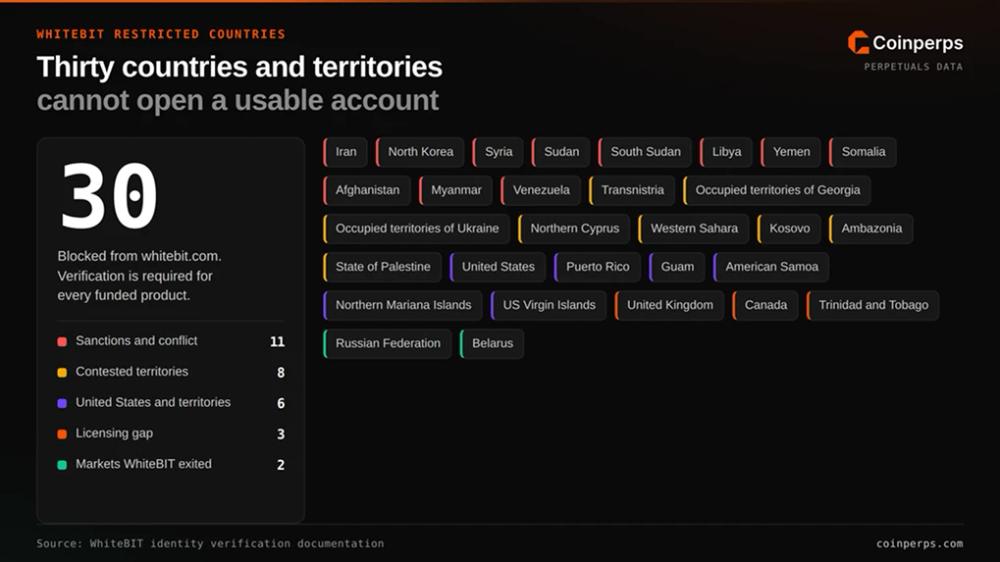
Thirty countries and territories cannot open a usable WhiteBIT account. The list sits in the identity verification documentation rather than in a numbered clause of the User Agreement, and it names the citizenships and residencies whose documents the exchange refuses. Deposits, withdrawals and every trading product need a verified account, so appearing on that list blocks you completely.
- Comprehensive sanctions and conflict zones: Iran, North Korea, Syria, Sudan, South Sudan, Libya, Yemen, Somalia, Afghanistan, Myanmar, Venezuela.
- Contested and unrecognized territories: Transnistria, the temporarily occupied territories of Georgia, the temporarily occupied territories of Ukraine, the Turkish Republic of Northern Cyprus, Western Sahara, Kosovo, the Federal Republic of Ambazonia, the State of Palestine.
- United States and its territories: the United States, Puerto Rico, Guam, American Samoa, the Northern Mariana Islands and the US Virgin Islands, each listed individually.
- Licensing-led blocks: the United Kingdom, Canada and Trinidad and Tobago.
- Withdrawn markets: the Russian Federation and Belarus.
Most of the first group tracks external designations rather than WhiteBIT policy. Iran, North Korea and Myanmar are the three jurisdictions named on the FATF list of high-risk countries subject to a call for action, and several others carry US Treasury sanctions programs.
Russia and Belarus reached the list differently. WhiteBIT withdrew from both markets voluntarily in 2022 after Russia's invasion of Ukraine, delisting ruble pairs and closing accounts, a decision the company says cost around 30% of its user base at the time. The hostility now runs both ways. In January 2026 Russia's Prosecutor General's Office designated WhiteBIT and parent company W Group as "undesirable organizations", a status that criminalizes cooperation with the firm inside Russia.
WhiteBIT's own documentation contradicts itself on one entry. The registration walkthrough omits the United Kingdom while the verification article includes it. Treat the verification article as authoritative for the global platform, and see the UK section below for what changed in May 2026.
Countries Supported by WhiteBIT
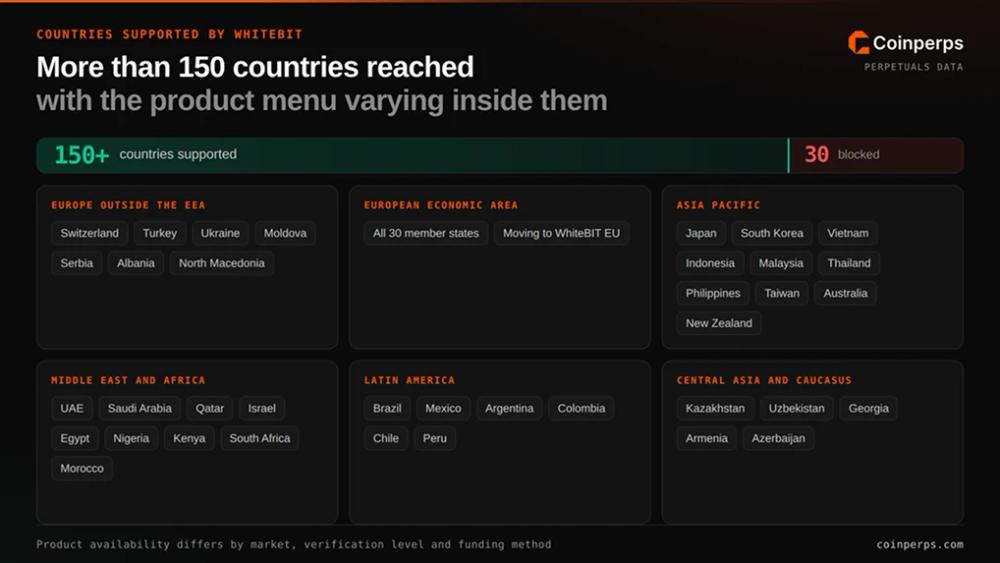
Outside those thirty entries, WhiteBIT reports reaching more than 150 countries. Central and Eastern Europe remains the densest concentration, since that is where the exchange built its original audience.
- Europe outside the EEA: Switzerland, Turkey, Ukraine, Moldova, Serbia, Albania, North Macedonia
- European Economic Area: all 30 member states, transitioning to WhiteBIT EU under the Austrian MiCA authorization
- Asia-Pacific: Japan, South Korea, Vietnam, Indonesia, Malaysia, Thailand, the Philippines, Taiwan, Australia, New Zealand
- Middle East and Africa: the UAE, Saudi Arabia, Qatar, Israel, Egypt, Nigeria, Kenya, South Africa, Morocco
- Latin America: Brazil, Mexico, Argentina, Colombia, Chile, Peru
- Central Asia and Caucasus: Kazakhstan, Uzbekistan, Georgia, Armenia, Azerbaijan
An account that opens fine may still see a reduced product menu. P2P Express is confined to Ukraine. Video-call verification is offered only to residents of Ukraine and Germany, per the verification documentation. Crypto Bundles target EU users while QuickSend is withheld from them. Funding methods vary too, so SEPA and card payments cover the Eurozone, GBP runs through the separate UK platform, and USD by SWIFT arrived in July 2026.
WhiteBIT Derivatives Trading Restrictions
WhiteBIT offers perpetual futures in fewer countries than it offers spot trading, and the gap is not advertised.
The global platform runs one perpetual futures book. Contracts are USDT-margined, support isolated and cross modes, and reach up to 100x on crypto pairs. TradeFi, launched in July 2026, wraps precious metals, energy commodities, large-cap US equities and index ETFs into the same perpetual structure using USDT as collateral. The wider field is ranked in our best TradFi perpetual exchanges guide.
None of the three new regional platforms carries either product.
- WhiteBIT US launched with spot trading, instant exchange and deposit or withdrawal services only. Derivatives require CFTC registration the company does not hold.
- whitebit.uk offers spot, analytics and instant conversion with GBP funding. Crypto derivatives remain off limits to UK retail clients under the FCA's standing ban.
- WhiteBIT EU holds a MiCA crypto-asset service provider authorization covering exchange, custody and transfer. Perpetual futures are financial instruments under MiFID II and fall outside that permission.
Georgia is the exception. In April 2026 the group obtained a brokerage license from the National Bank of Georgia for a new company, WhiteBIT Broker, dedicated to derivatives including perpetuals, while the existing VASP registration keeps handling spot. Most competitors have avoided that split and kept derivatives offshore under a group holding company.
Live pricing for every venue named here sits on our funding rates and open interest dashboards.
Does WhiteBIT Require Mandatory KYC Verification?
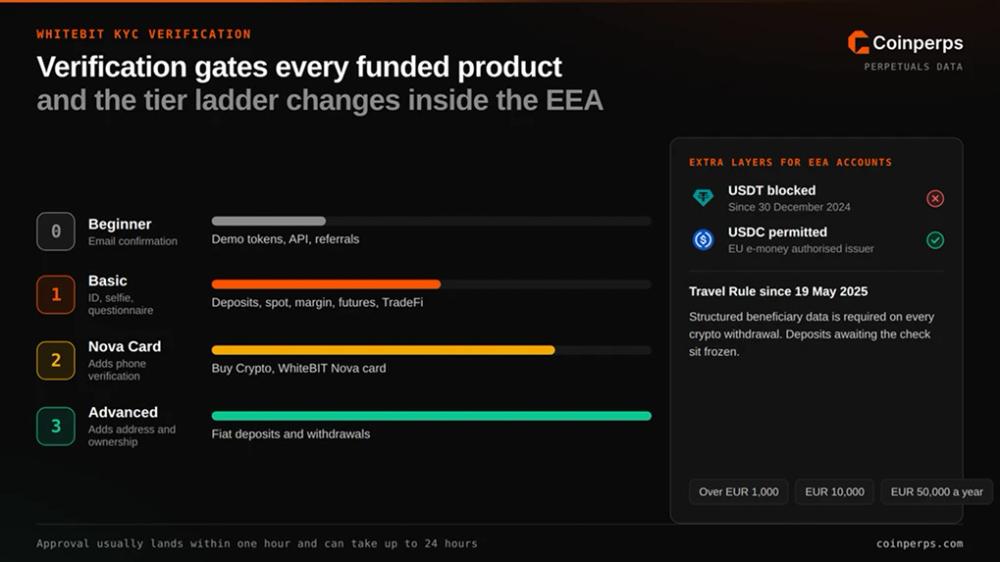
Yes, with no meaningful unverified tier. An email-only Level 0 account gets demo tokens, API access and the referral program. Everything with real money attached, including deposits, withdrawals, spot, margin and futures, requires identity verification.
The tier structure differs by region.
- Level 0 (Beginner): email confirmation. Demo trading only.
- Level 1 (Basic): government ID, selfie and questionnaire. Unlocks crypto deposits and withdrawals, spot, margin, futures and TradeFi. Not offered to EU residents.
- Level 2 (Nova Card), or Level 1 in the EU: adds phone verification. Unlocks fiat purchases and the WhiteBIT Nova card. EU users enter here rather than at Basic.
- Level 3 (Advanced), or Level 2 in the EU: adds proof of address, a risk-profiling questionnaire and a beneficial ownership declaration. Unlocks fiat deposits and withdrawals.
Approval usually lands within an hour and can stretch to 24 hours under load. From 15 June 2026 WhiteBIT applied a stricter verification path to users covered by Swiss anti-money-laundering rules, a list running to roughly 170 countries, adding NFC document scanning and a Form A beneficial owner declaration.
EEA accounts carry two further layers. USDT deposits and withdrawals have been rejected since 30 December 2024 because Tether lacks EU e-money authorization. Crypto withdrawals have required structured Travel Rule data since 19 May 2025, per WhiteBIT's regulatory compliance documentation, and deposits awaiting that check sit frozen rather than failing outright.
If verification-free trading is the requirement, WhiteBIT is the wrong venue. Our best no-KYC perpetual futures exchanges ranking covers the optional-KYC centralized field.
Is WhiteBIT Banned in the US?
The global platform blocks US users. WhiteBIT US, a separate company, serves them.
WhiteBIT.com refuses US citizens and residents, and lists Puerto Rico, Guam, American Samoa, the Northern Mariana Islands and the US Virgin Islands separately so the territories cannot be argued around. Offering leveraged crypto derivatives to Americans requires CFTC registration plus FinCEN money services business registration and state money transmitter licenses, none of which the Lithuanian entity holds.
WhiteBIT US went live on 1 December 2025 as an independently operated company headquartered in New York. Fully verified users get spot trading, instant exchange and deposit or withdrawal services, and the company has stated an ambition to reach all fifty states. Fiat integration, corporate onboarding and institutional custody were flagged as future additions. Perpetual futures were not.
American perpetuals traders are left where they started. The domestic options appear in our Coinbase Perpetuals restricted countries and Kraken restricted countries guides, both covering CFTC-regulated venues.
Does WhiteBIT Restrict the UK and Europe?
UK and EEA residents can now trade spot with a local WhiteBIT platform, but not perpetuals.
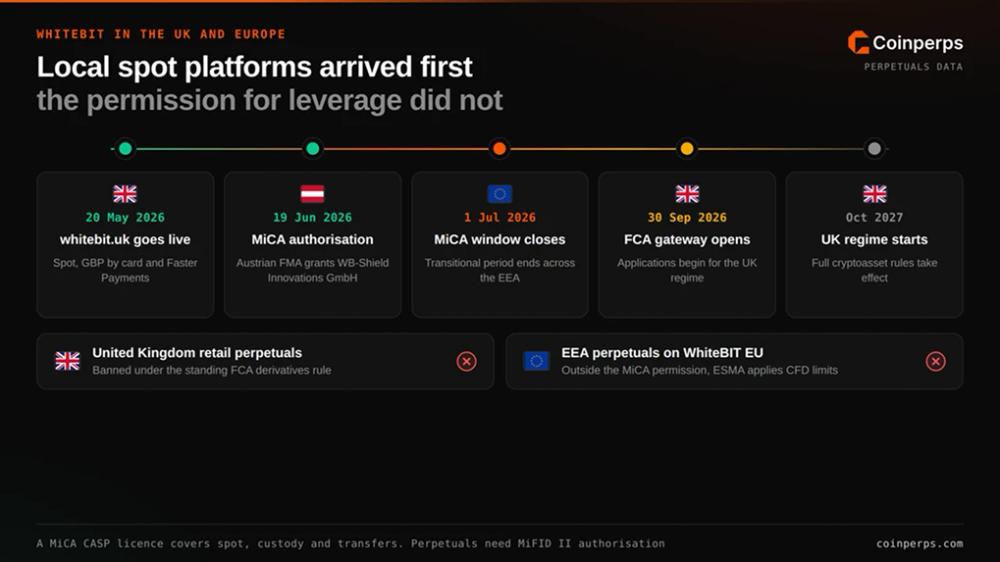
The United Kingdom appears on the global forbidden list, yet whitebit.uk went live on 20 May 2026 with spot trading, market analytics, instant conversion and GBP funding through payment cards and Faster Payments. The launch financial promotion was approved by an FCA-authorized firm rather than by WhiteBIT itself. Britain's full cryptoasset regime does not begin until October 2027 and the FCA authorizations gateway opens on 30 September 2026, so WhiteBIT UK trades ahead of the permissions rather than under them. Retail derivatives stay banned throughout.
Europe matters more. WB-Shield Innovations GmbH, trading as WhiteBIT EU, received MiCA authorization from Austria's Financial Market Authority on 19 June 2026, eleven days before the transitional window closed on 1 July. The Vienna entity passports across all 30 EEA states, and a dedicated whitebit.eu platform is rolling out to European users. Our MiCA licensed exchanges ranking places it against the rest of the authorized field.
For perpetuals traders the license is less useful than the headline suggests. A crypto-asset service provider permission covers spot, custody and transfers. Leveraged derivatives need a MiFID II investment firm authorization on top, and European regulators tightened that perimeter in February 2026 when ESMA confirmed that perpetual futures fall within the scope of the CFD product intervention measures whatever the product is called. Any firm selling them to EU retail clients now faces leverage caps and key information document duties.
European venues that already cleared both hurdles are compared in our best crypto perpetual futures exchanges in Europe guide, and the underlying classification questions are unpacked in crypto perpetual futures regulation explained.
What Licenses Does WhiteBIT Have?
Which WhiteBIT company serves you decides which products you see. The exchange reports more than ten VASP authorizations across its institutional materials, alongside $3.4 trillion in annual trading volume and 5,500 institutional clients.
Entity | Jurisdiction | License or role | Products |
|---|---|---|---|
UAB Clear White Technologies | Lithuania | VASP registration, supervised by the Financial Crime Investigation Service | Global platform including perpetuals |
WB-Shield Innovations GmbH (WhiteBIT EU) | Austria / EEA | MiCA CASP authorization granted 19 June 2026, passported to 30 EEA states | Spot, custody, transfers |
WhiteBIT Broker | Georgia | National Bank of Georgia brokerage license, April 2026 | Derivatives including perpetuals |
WhiteBIT Georgia | Georgia | VASP registration | Spot |
WhiteBIT US | United States | State-level operational licenses, New York headquarters | Spot, instant exchange, ramps |
WhiteBIT UK | United Kingdom | Operating ahead of the FCA cryptoasset gateway | Spot, GBP funding |
WhiteBIT Financial Company s.r.o. | Czech Republic | VASP registration | Regional operations |
WhiteBIT Tech Sp. z o.o. | Poland | VASP registration | Regional operations |
Certifications fill part of the gap that licensing leaves open. WhiteBIT was the first exchange to reach Cryptocurrency Security Standard Level 3, holds ISO/IEC 27001 and 27701 certifications plus PCI DSS Level 1, keeps 96% of assets in cold storage, uses Fireblocks for custody, and has been audited by Hacken with no reported breach since launch.
Holding a license somewhere and serving every product there are separate questions. Austria authorizes spot. Georgia authorizes derivatives. Lithuania hosts the global book where most perpetuals volume clears.
Can You Access WhiteBIT with a VPN?
No, because the block is document-based rather than network-based. WhiteBIT refuses identity documents issued to citizens or residents of the thirty listed jurisdictions, so a masked IP gets you a Level 0 account with demo tokens and nothing else. Verification checks your passport against that list before any deposit, withdrawal or trade.
Trying it anyway carries costs with no offsetting protection.
- Frozen funds with no recourse. An account later identified as belonging to a restricted-jurisdiction resident can be suspended, and a user who misrepresented residency has no consumer protection claim in any of the regimes WhiteBIT operates under.
- Travel Rule and residency cross-checks. EEA and Turkish withdrawals require beneficiary and originating-VASP data under FATF standards, which surfaces mismatches between declared and actual residence.
- Criminal exposure in one specific case. Russian residents face liability under the undesirable-organizations designation for using the platform at all, independent of anything WhiteBIT does.
- Tax obligations that do not disappear. Trading through an unauthorized venue does not remove local reporting duties on realized gains.
The permissionless alternative is on-chain, where geofencing replaces identity checks. Our best decentralized perpetual exchanges ranking and the Hyperliquid restricted countries breakdown cover that field.
Best Alternatives if WhiteBIT is Unavailable in Your Country
Your replacement depends on whether sanctions, a licensing gap or a missing product caused the block.
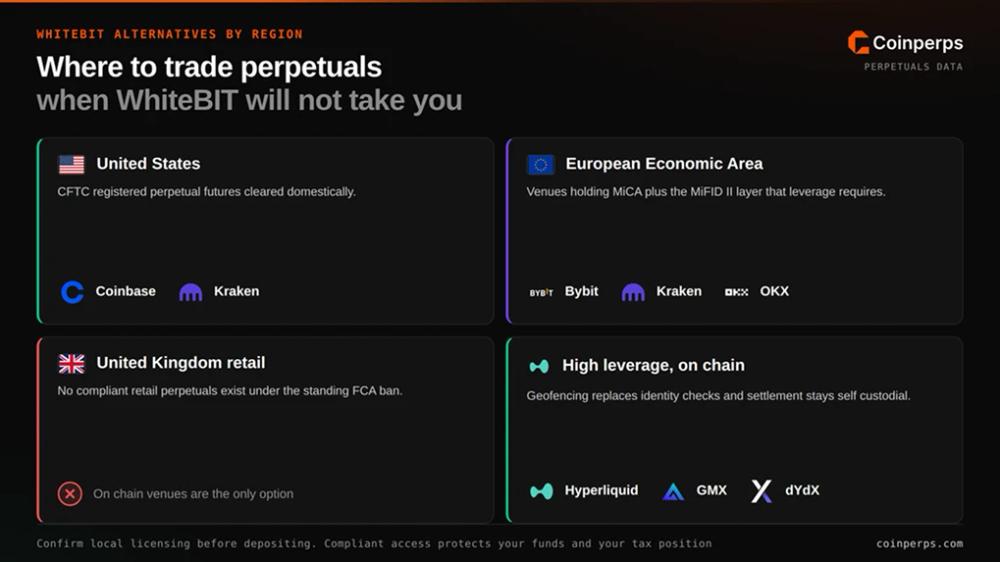
- United States: Coinbase and Kraken both run CFTC-registered perpetual-style futures domestically. WhiteBIT US covers spot only.
- United Kingdom: no compliant retail perpetuals exist under the FCA ban. Spot runs through whitebit.uk or an FCA-registered competitor, and leveraged exposure means on-chain venues.
- Canada: derivatives access is heavily constrained by Canadian Securities Administrators guidance. Our best crypto futures platforms in Canada guide covers the FINTRAC-registered field.
- European Economic Area: Bybit EU and Kraken hold both the MiCA permission and the MiFID layer that leverage requires. WhiteBIT EU does not. See the Bybit restricted countries guide for the entity map.
- Russia and Belarus: neither WhiteBIT nor most Western venues serve these markets. Regional options are covered separately.
- High leverage with light verification: BloFin leads the optional-KYC centralized field, with Hyperliquid, GMX and dYdX covering the non-custodial side.
- Cost-sensitive traders: WhiteBIT's 0.010% maker and 0.035% taker base rates are competitive, though the full field is ranked in our lowest fee crypto perpetual exchanges guide.
Confirm local licensing before depositing. Compliant access protects both your funds and your tax position.
Bottom Line
WhiteBIT's restricted list has barely moved in length, but its meaning has changed. Thirty entries still name the United States, the United Kingdom and Canada alongside the usual sanctions cases, yet two of those three now have a locally incorporated WhiteBIT platform serving spot customers. A block on whitebit.com increasingly means service from a different company under a different regulator, on a narrower menu.
Perpetuals traders feel that narrowing most. Every regional company launched since December 2025 stops at spot. The Austrian MiCA license does not reach leveraged products, and ESMA's February 2026 position on perpetual futures makes the MiFID path harder. Georgia is the only place where WhiteBIT has built a derivatives business inside a domestic regulatory perimeter, and whether that model scales beyond one market is the open question for 2027.
Traders in a supported country get a deep order book, 100x perpetuals, a strong security record and one of the widest TradFi perpetual menus outside the majors. Traders in a blocked jurisdiction get a local spot platform at best and nothing at worst. The perpetual exchanges directory, our decentralized perpetuals list, and live funding rates and open interest trackers cover the working alternatives in every major market.


