Best TradFi Perpetual Exchanges (2026)
Compare the top TradFi perpetual exchanges for 2026, including stock, ETF, commodity, index, and FX perps across leading centralized & DeFi platforms.

Disclosure: Coinperps may earn a commission from partner links, at no extra cost to you. Reviews are based on independent testing, see how we test.
- The best TradFi perpetual exchanges for 2026 are Bybit, Hyperliquid, Kraken, Binance, Coinbase, and OKX, based on product depth and structure.
- These platforms bring stocks, commodities, indices, ETFs, and FX into crypto-style derivatives, with stablecoin settlement, funding rates, and leveraged exposure.
- Traders should compare fees, market coverage, leverage, licensing, oracle design, and regional access before treating any TradFi perp as tradable.

Bybit
Bybit, founded in 2018 and headquartered in Dubai, is the world’s second-largest exchange by volume, serving 60 million users with 1,800+ assets and over $11 billion in daily trading.
Features
Fees
Regulation
Overall
TradFi perpetuals are the link between crypto derivatives and real-world market exposure, covering stocks, indices, commodities, and FX through perp-style contracts, stablecoin margin, funding, and extended trading sessions.
The strongest onchain signal comes from HIP-3: Hyperliquid reported early highs of $1 billion in open interest and $4.8 billion in 24-hour volume across builder-deployed markets.
Below, we compare the best TradFi perpetual exchanges by markets, fees, leverage, structure, and access. 🔽
The Best TradFi Perpetual Exchanges in 2026
We built the following table from official exchange pages and recent product announcements, checking each platform’s TradFi asset coverage, leverage, fees, licensing, and standout market structure.
1. Bybit
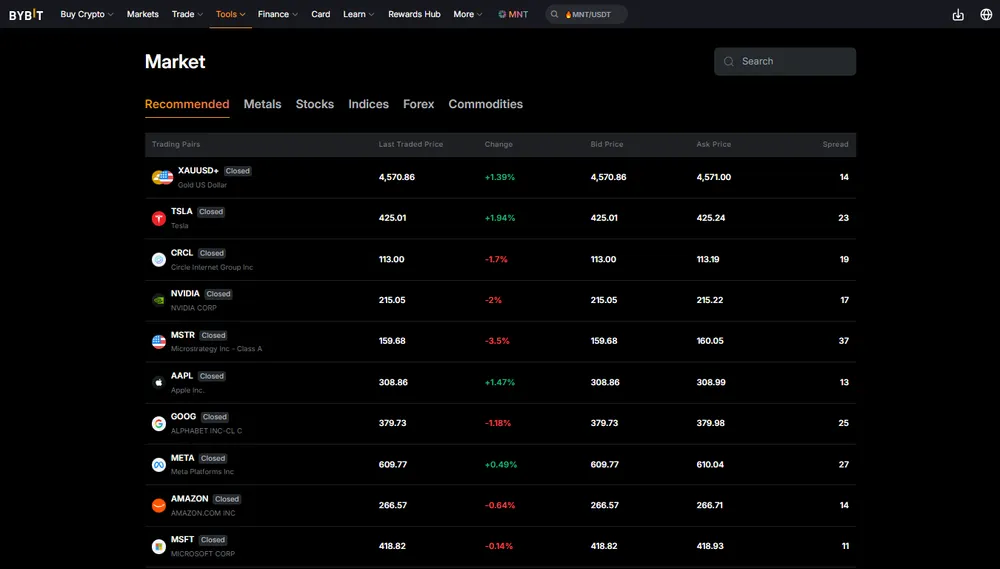
Bybit is our best pick for traders who want crypto-style perpetuals on traditional finance assets. Its TradFi Perpetual Contracts are USDT-margined, USDT-settled products tracking stocks, ETFs, and commodities, with 24/7 access through the regular Futures interface rather than MT5 alone.
Coverage is still developing, but the lineup already looks useful: Bybit reported 20 US stock perpetuals, three commodities, and three global ETF contracts in May 2026. Maximum leverage is up to 10x on these newer TradFi perps, which feels sensible for equity-linked volatility.
Fees follow Bybit’s standard USDT perpetual structure, so VIP 0 traders pay 0.0200% maker and 0.0550% taker, with discounts at higher tiers. We like the familiar margin, funding, and liquidation mechanics, though after-hours liquidity and gap risk need respect.
Pros
- 24/7 access to stock, ETF, and commodity exposure.
- Familiar USDT margin flow for existing derivatives traders.
- Weekly listings make the TradFi perp menu feel active.
Cons
- TradFi perp coverage remains smaller than crypto derivatives markets.
- Regional restrictions exclude some important user groups and jurisdictions.
- After-hours spreads can widen when underlying markets are closed.
2. Hyperliquid
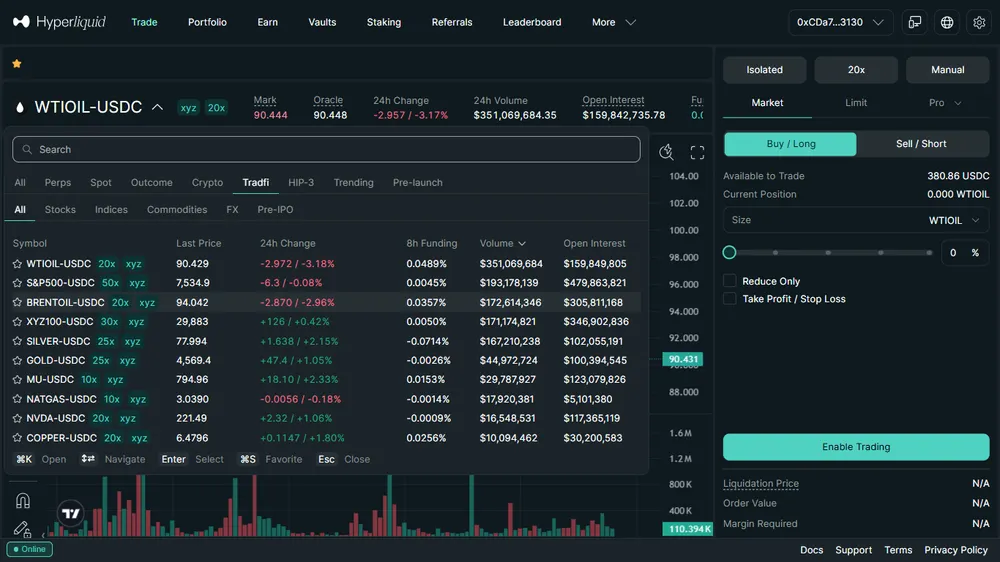
Next on our list, Hyperliquid is the strongest decentralized route for traditional finance perps, mainly through HIP-3 builder-deployed markets. HIP-3 lets independent deployers define perps, oracles, leverage limits, and settlement rules while keeping execution on HyperCore’s onchain order books for users.
Trade[XYZ] is the key protocol to watch here, because XYZ markets cover equities, equity indices, commodities, and FX. We like the reach: stocks price 24/5, commodities price 23/5, and FX includes weekend internal pricing when external quotes pause during live sessions.
Fees are higher than standard Hyperliquid crypto perps, with HIP-3 standard base rates at 0.030% maker and 0.090% taker before tier discounts. The tradeoff feels fair for licensed SP500 exposure, XYZ100, oil, metals, EUR/USD, and USD/JPY markets in one interface.
Pros
- Self-custody design removes exchange custody from the trading flow.
- HIP-3 creates faster listing paths for new TradFi markets.
- Trade[XYZ] documentation gives clear oracle and session details.
Cons
- Standard HIP-3 fees are pricier than native Hyperliquid perps.
- Builder concentration makes deployer risk harder to diversify.
- Some TradFi markets still rely on internal pricing windows.
3. Kraken
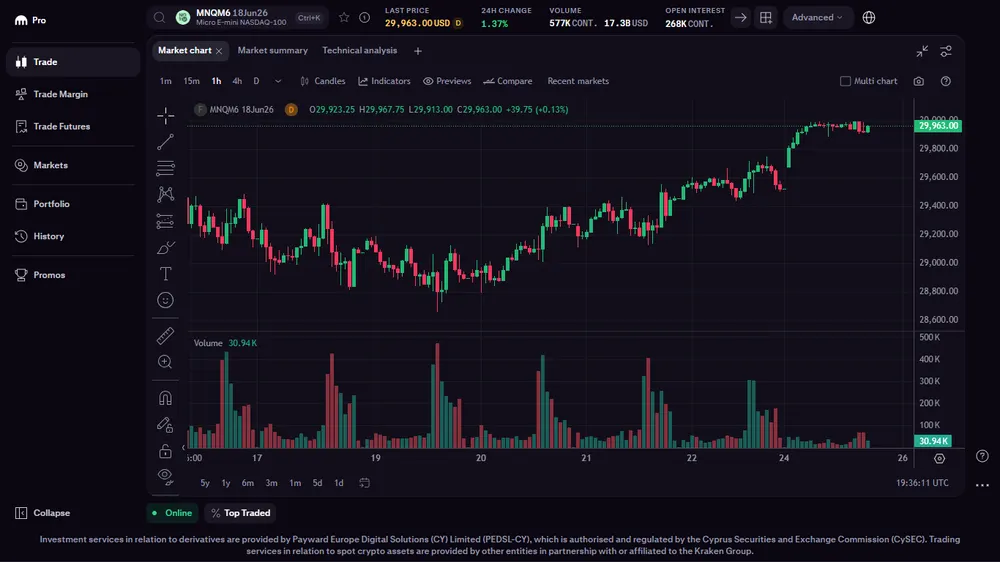
Coming in third on our list, Kraken fits traders who want regulated TradFi futures access inside a crypto-native workflow. Kraken Pro gives eligible EU clients 70 traditional finance futures markets, including oil, gold, S&P 500, Nasdaq 100, and FX.
The licensing angle is its main advantage. Kraken says the EU offering is CySEC-compliant, while PEDSL-CY holds CySEC licence 342/17; Kraken MTF also operates through Crypto Facilities Ltd, an FCA-authorized multilateral trading facility for regulated futures contracts for eligible institutions.
Platform coverage is also broader after NinjaTrader. Kraken says NinjaTrader’s FCM license supports US margin and futures under CFTC regulation, while Kraken Pro and futures.kraken.com support derivatives access in eligible regions. Fees start at 0.0200% maker and 0.0500% taker.
Pros
- Strongest regulatory profile among crypto-native TradFi futures platforms.
- Kraken Pro keeps crypto and macro futures in one interface.
- NinjaTrader adds a serious US futures trading footprint.
Cons
- TradFi products are fixed-term futures, not classic perpetual contracts.
- Eligibility rules make access more fragmented than crypto spot trading.
- US and EU product sets differ across regulated entities.
4. Binance
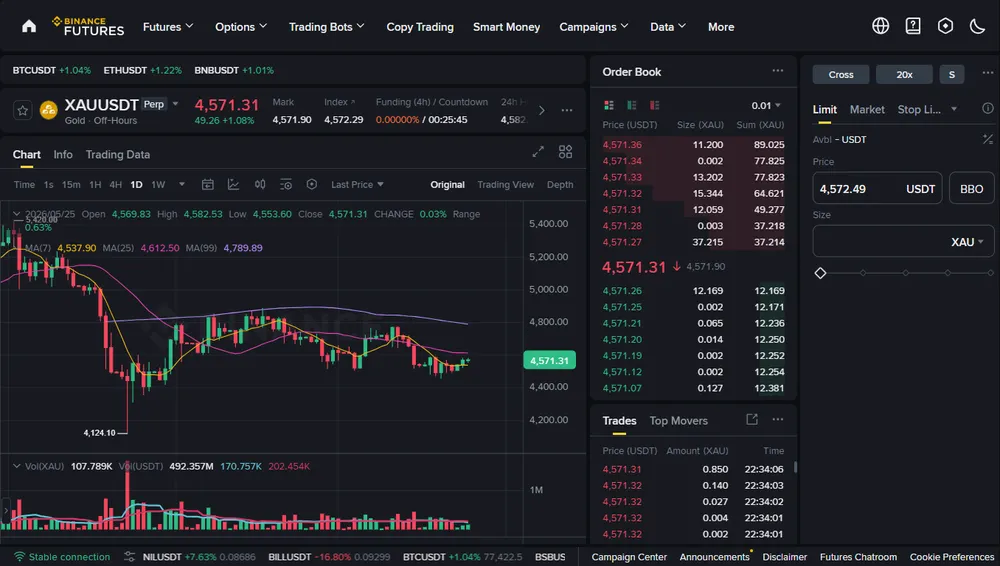
For traders who prefer the deepest centralized exchange flow, Binance gives TradFi perps the most familiar Futures layout. Its contracts launched in January 2026, trade 24/7, settle in USDT, and cover stocks, ETF indices, and commodities from one TradFi tab.
The asset list is already broad for a new category, with Binance Academy highlighting 29 TradFi assets across gold, crude oil, SPY, QQQ, NVIDIA, Apple, and Microsoft. Most contracts offer up to 10x leverage, while some newer ETF-linked listings reach 20x.
Costs are competitive during the current promotion: Binance lists 0.0000% maker fees and 0.0400% taker fees for regular users on TradFi Perps, with a BNB discount lowering taker fees to 0.0360%. We like the liquidity, though regional access remains uneven.
Pros
- Broadest centralized TradFi perp menu among crypto exchanges.
- 24/7 trading works across stocks, ETFs, and commodities.
- Multi-Assets Mode can use assets like BTC as margin.
Cons
- Product access varies heavily by country and account eligibility.
- Off-hours pricing can behave differently from live market sessions.
- Large platform scope can feel complex for newer derivatives users.
5. Coinbase
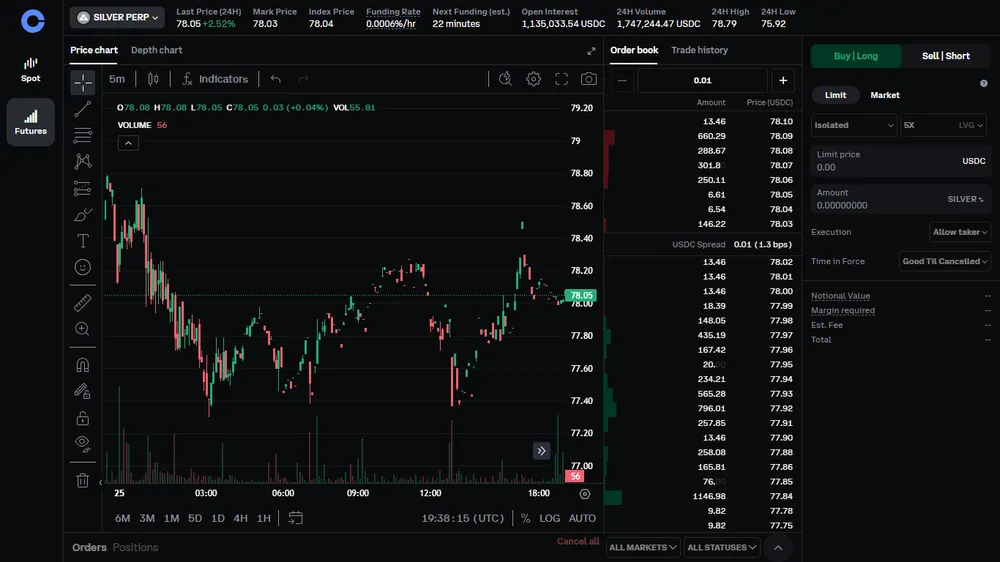
Coinbase is the cleaner pick for traders who want TradFi perps with a stronger compliance wrapper. Its stock perpetual futures launched for eligible non-US traders in March 2026, giving 24/7 leveraged synthetic exposure to US equities through Coinbase International Exchange.
The TradFi product mix now reaches stocks, gold, and silver perps with up to 25x leverage on Coinbase Advanced. Coinbase also lists 0% maker and 0.01% taker fees on that page, which gives it one of the sharper headline fee profiles.
Licensing is the main reason we trust the setup more than most newer TradFi-perp platforms. Stock and commodity perps are offered by Coinbase Bermuda Ltd., a Class F entity licensed by the Bermuda Monetary Authority, while Coinbase Derivatives covers CFTC-regulated US futures.
Pros
- Strong brand trust for traders entering synthetic stock exposure.
- Coinbase Advanced keeps spot, perps, and futures access connected.
- Bermuda and CFTC entities improve the regulatory credibility.
Cons
- Stock perpetuals are unavailable to US traders at launch.
- TradFi perp selection is narrower than Binance or Bybit.
- Coinbase fees can vary across regions, entities, and interfaces.
6. OKX
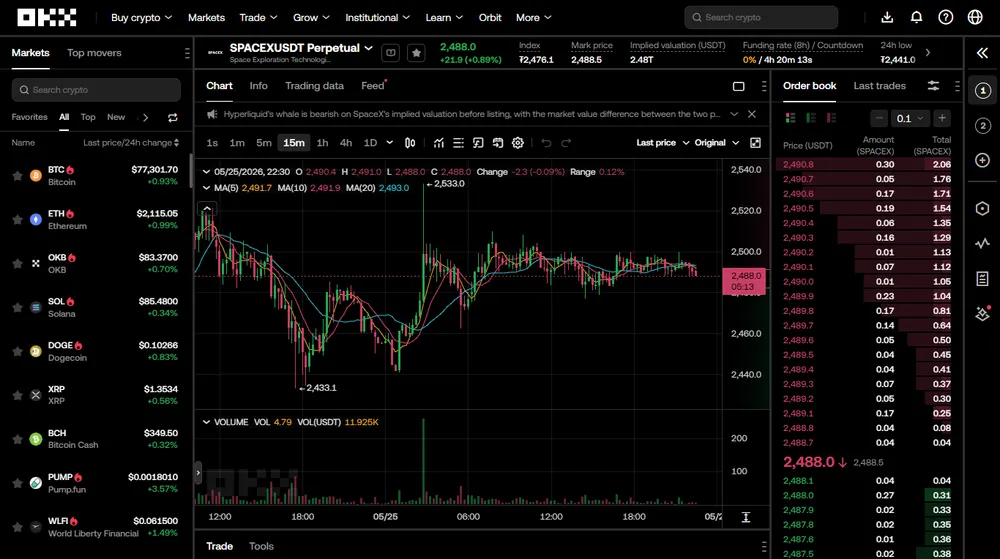
Last on our list, OKX closes the category as a fast-moving TradFi perp platform with strong institutional momentum. Its equity perpetual swaps cover 20+ stocks and indices, trade around the clock, use crypto-portfolio margin, and target eligible markets across Asia, LATAM, Türkiye, and CIS regions.
The core equity contracts are USDT-settled, available through web, app, and API, with leverage listed from 0.01x to 5x on selected names. Early markets included TSLA, MSTR, NVDA, GOOGL, MSFT, AAPL, META, QQQ, and SPY.
The recent ICE partnership gives OKX a stronger TradFi data angle. ICE, the NYSE parent, will provide benchmark pricing for new Brent and WTI oil perpetuals, following a strategic relationship announced in March 2026. We like that credibility boost for commodities exposure.
Pros
- ICE partnership adds serious benchmark credibility for oil perps.
- Equity perps cover mega-cap stocks and major ETF proxies.
- Web, app, and API access suit different trading workflows.
Cons
- Maximum equity leverage is lower than Binance or Coinbase.
- Eligibility remains limited across regions and account types.
- Commodity expansion is still early compared with crypto markets.
What is a TradFi Perpetual Crypto Exchange?
A TradFi perpetual crypto exchange brings traditional markets into crypto derivatives rails. Traders get synthetic exposure to stocks, ETFs, commodities, indices, or FX through contracts that track reference prices, settle in stablecoins, and usually trade beyond normal stock-market hours.
Robinhood helps explain the wider shift, even though it does not belong in the perp table. It was an early mainstream player in tokenized onchain stock access, issuing Stock Tokens first on Arbitrum, while stating users buy tokenized contracts, not actual shares.
Perpetual exchanges take that synthetic-access idea into a leveraged trading format. A perp has no expiry date, so traders can hold long or short exposure without rolling contracts. Funding rates, index prices, and oracle rules keep the market anchored to the underlying asset.
The category now splits across centralized exchanges, regulated derivatives platforms, and decentralized protocols. Bybit and Coinbase package stock or commodity perps inside exchange accounts, while Hyperliquid’s HIP-3 lets builders deploy markets with their own oracle, leverage, and settlement design.
How Do TradFi Perpetual Contracts Work?
TradFi perpetuals work by wrapping familiar markets inside crypto-style derivatives: index pricing, margin, leverage, funding payments, and long or short exposure without fixed contract expiry.
1. Equity Perpetuals
Equity perpetuals track individual company shares, usually large US names with strong trading demand. Bybit, Binance, Coinbase, OKX, Ostium, and newer launches around pre-IPO names all use synthetic exposure, so traders follow share-like prices without receiving shareholder rights.
These contracts usually rely on stock-market reference prices during regular sessions, then exchange or oracle models outside those hours. That creates 24/7 access, but after-hours pricing can move away from the next official open, especially around earnings or news events.
2. Index and ETF Perpetuals
Index and ETF perpetuals compress broader market exposure into one contract. Traders can access S&P 500, Nasdaq 100, SPY, QQQ, or synthetic baskets without opening a brokerage account, while platforms handle collateral, margin, liquidation, and settlement through crypto-native infrastructure.
This type suits macro views better than single-stock speculation. Hyperliquid’s HIP-3 model lets builders launch index-style markets, while Ostium supports indices and ETFs from a self-custody interface. Centralized exchanges package similar exposure inside familiar futures dashboards.
3. Commodity Perpetuals
Commodity perpetuals track markets like gold, silver, crude oil, platinum, and palladium. They bring futures-style macro trading into crypto accounts, often with stablecoin margin and continuous access. gTrade, Ostium, Hyperliquid, OKX, Binance, Coinbase, and Bybit all fit this broader theme.
The key difference is the underlying market schedule. Oil and metals have deep legacy futures markets, but crypto perps may keep trading when reference markets slow or close. Funding, spreads, oracle design, and benchmark quality matter more than the headline leverage.
Note: For a deeper oil-specific breakdown, read our guide on Oil Perpetual Contracts. It explores how crypto traders access crude markets through Hyperliquid’s 24/7 perp mechanics, funding, leverage, and benchmark-driven pricing.
4. FX Perpetuals
FX perpetuals track currency pairs such as EUR/USD, GBP/USD, USD/JPY, or crypto-adjacent dollar crosses. Decentralized platforms like Ostium and gTrade lean heavily into this category, while Kraken also supports FX derivatives through its regulated futures setup.
Forex perps can feel familiar to crypto traders because the market already trades nearly around the clock. Weekend handling becomes the important detail: some platforms pause external references, use internal pricing, widen risk controls, or adjust leverage until liquidity improves.
How Are TradFi Perps Regulated Around the World?
Regulation depends on whether TradFi perps are treated as derivatives, CFDs, securities-linked products, or virtual-asset contracts, with retail access often stricter than professional access.
The main jurisdictional patterns look roughly like this in 2026:
- United States: The CFTC oversees derivatives on commodities, so leveraged crypto or TradFi perps generally need registered futures or swaps infrastructure there.
- United Kingdom: The FCA bans retail crypto derivatives, so TradFi perps need careful classification, eligible-client controls, and proper permissions before distribution there.
- European Union: ESMA’s MiCA framework covers crypto-assets outside existing financial-services law, while derivatives still fall back into MiFID-style financial-instrument analysis across member states.
- Singapore: MAS treats payment-token derivatives as unsuitable for public promotion, pushing exchanges toward licensed, risk-disclosed, and eligibility-screened access for local customers.
- Hong Kong: The SFC is gradually opening virtual-asset derivatives under licensed-platform rules, with strong client onboarding, custody, and product-approval expectations for operators.
- Australia: ASIC treats many digital-asset derivatives as financial products, so providers need AFS licensing, disclosure, reporting, and retail-client protections in Australia.
- Japan: The FSA brought crypto-asset derivatives inside financial-instruments regulation, with margin, advertising, solicitation, and user-protection rules applying to providers serving Japan.
- Canada: The CSA restricts leverage for crypto trading platforms, allowing margin mainly for permitted clients under registered or pre-registered frameworks nationally.
- Switzerland: FINMA applies technology-neutral financial-market rules, so derivatives, trading systems, and intermediaries need authorization based on function and market role there.
- United Arab Emirates: Dubai’s VARA now has exchange-traded virtual-asset derivatives rules, while DIFC firms separately follow DFSA crypto-token permissions inside the financial centre.
Risks of TradFi Perpetual Exchanges
TradFi perps can make stocks, commodities, indices, and FX easier to trade from crypto accounts, but the same structure adds leverage, funding, oracle, liquidity, custody, and regulatory risks.
1. Market and Trading Risks
These risks come from the contract design itself: leverage, synthetic pricing, funding payments, liquidation engines, and trading sessions that may outlast the underlying market.
Key trading risks to check before opening positions:
- Leverage: Small price moves can trigger large losses, especially when 10x, 20x, or higher leverage is used on volatile assets.
- Liquidation: Positions can be liquidated automatically when margin falls below maintenance requirements, sometimes before traders can manually react.
- Funding: Perpetual contracts use funding payments to stay near index prices, so holding costs can rise during crowded long or short positioning.
- Mark price: Liquidations often use mark price, not last traded price, so index methodology can affect account equity and risk levels.
- Liquidity: Stock, FX, and commodity perps can become thinner outside underlying market hours, causing wider spreads and heavier slippage.
- Basis risk: TradFi perps may move away from spot or futures benchmarks when news breaks after market close or oracle updates lag.
2. Platform and Regulatory Risks
These risks come from where the contract trades: centralized custody, decentralized market builders, regional permissions, legal classification, and the quality of operational controls.
Platform-side risks deserve the same attention as price charts:
- Custody: Centralized platforms expose traders to solvency, security, and operational risks, especially when collateral stays inside exchange-controlled accounts.
- Oracle: Builder-deployed markets may rely on custom oracle rules, so bad data, delays, or discretion can distort contract pricing.
- Jurisdiction: Regulators like CFTC may treat TradFi perps as derivatives, swaps, CFDs, or securities-linked products, limiting retail access by country.
- Eligibility: Some products only serve non-US, professional, or region-approved users, which can change account access, leverage, and available markets.
- Counterparty: Synthetic exposure depends on the platform’s settlement, liquidation, and insurance systems, not ownership of stocks, barrels, or currencies.
- Product changes: Exchanges can adjust leverage, margin tiers, index rules, or delist markets when volatility, regulation, or liquidity conditions change.
Bottom Line
TradFi perpetual exchanges are moving from niche experiment to serious derivatives category, with Bybit, Binance, Coinbase, Hyperliquid, Kraken, and OKX all taking different routes into stocks, commodities, indices, and FX.
The best choice depends on access, regulation, product depth, and trading style. Centralized platforms offer familiar dashboards, while decentralized protocols add self-custody, builder-led markets, and custom oracle design.
We would treat TradFi perps as advanced trading products, not stock replacements. Leverage, funding, liquidity, and regional eligibility matter more than headline asset counts or promotional fees.