Best Crypto Exchanges in the USA Ranked (2026)
Compare the best crypto exchanges in the USA, from Kraken and Coinbase to Gemini and Robinhood, by licence, state access, dollar fees, depth and tax rules.

Coinperps may earn a commission from partner links, at no cost to you; rankings follow our methodology. Not financial advice.
Key takeaways
- Kraken is the best crypto exchange in the USA: it held $7.9 million of Bitcoin orders within 0.1% of the mid price, more than twice Coinbase's book, and it publishes proof of reserves. It is closed in New York and Maine.
- Coinbase works in every state: it holds a New York BitLicense and a final national trust charter and files audited accounts, though its entry fees of 0.50% and 0.90% are higher than Kraken's.
- No federal exchange licence exists: the CLARITY Act failed in the Senate on 15 September 2026, so exchanges remain state-licensed money businesses and coins carry no FDIC or SIPC cover.
- The buy button costs the most: a $1,000 limit order costs $4 on Kraken Pro and $5 on Coinbase Advanced, against 1% or more on most instant-buy screens.
- US oversight
- Wyoming bank charter, Fed master account, CFTC
- States not served
- New York, Maine
- Entry maker / taker
- 0.40% / 0.80%
- Bitcoin depth within 0.1%
- $7.9M
- US perps
- Yes, since June 2026
Why it ranks #1 Partner link · Kraken referral code · How we rank
Kraken is the best crypto exchange in the USA for spot trading.
- The deepest Bitcoin dollar book we measured.
- Proof of reserves above 100% and a bank charter.
- Free ACH, $4 wires and a $4.99 plan that waives fees.
Coinperps may earn a commission if you sign up through this link, at no cost to you. Rankings follow our method, not partner deals.
On this page 9 sections
The best crypto exchange in the USA is Kraken, followed by Coinbase. Both hold US banking or trust charters, publish clear fee schedules and held the deepest dollar order books we measured in November 2026.
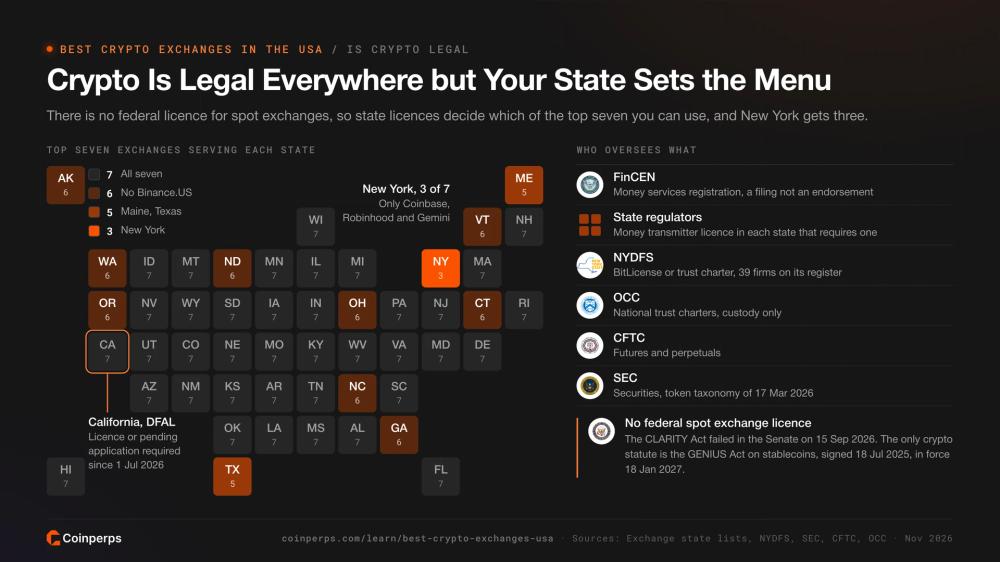
The United States still has no federal licence for spot crypto exchanges. A market structure bill failed in the Senate on 15 September 2026, so exchanges remain money services businesses that are licensed state by state.
We read each platform's US fee schedule, licence page and state list, then sampled live dollar order books three times on 15 November 2026. Those checks are weighed with our exchange rankings, which score liquidity, features, fees and regulation.
This guide to the best crypto exchanges in the USA puts spot trading first. Perpetual futures count as a bonus, and nothing here is legal, tax or investment advice.
Top 7 Crypto Exchanges in the USA
Exchange | US oversight | States not served | Entry maker / taker | Bitcoin depth within 0.1% | US perps | Key nuance |
|---|---|---|---|---|---|---|
Wyoming bank charter, Fed master account, CFTC | New York, Maine | 0.40% / 0.80% | $7.9M | Yes, since June 2026 | Deepest dollar book, proof of reserves | |
NY BitLicense, OCC trust charter, CFTC | None | 0.50% / 0.90% | $3.4M | Yes, since July 2025 | Every state, audited public company | |
State licences, CFTC, conditional OCC charter | New York | 0.25% / 0.50% | $1.1M | Yes, up to 5x | 400+ coins | |
NY BitLicense, CFTC | None | 0.50% / 0.95% | $2.7M on Bitstamp | Announced | About 0.95% inside the price by default | |
NY trust charter, CFTC | None | 0.60% / 1.20% | $0.8M | No | Highest entry fees | |
State licences | New York, Texas | 0.20% / 0.35% | Not measured | No | Parent pleaded guilty in 2025 | |
State licences | 12 states | 0.00% / 0.019% | $0.7M | No | Lowest fees, thin books |
1. Kraken
- US oversight
- Wyoming bank charter, Fed master account, CFTC
- States not served
- New York, Maine
- Entry maker / taker
- 0.40% / 0.80%
- Bitcoin depth within 0.1%
- $7.9M
- US perps
- Yes, since June 2026
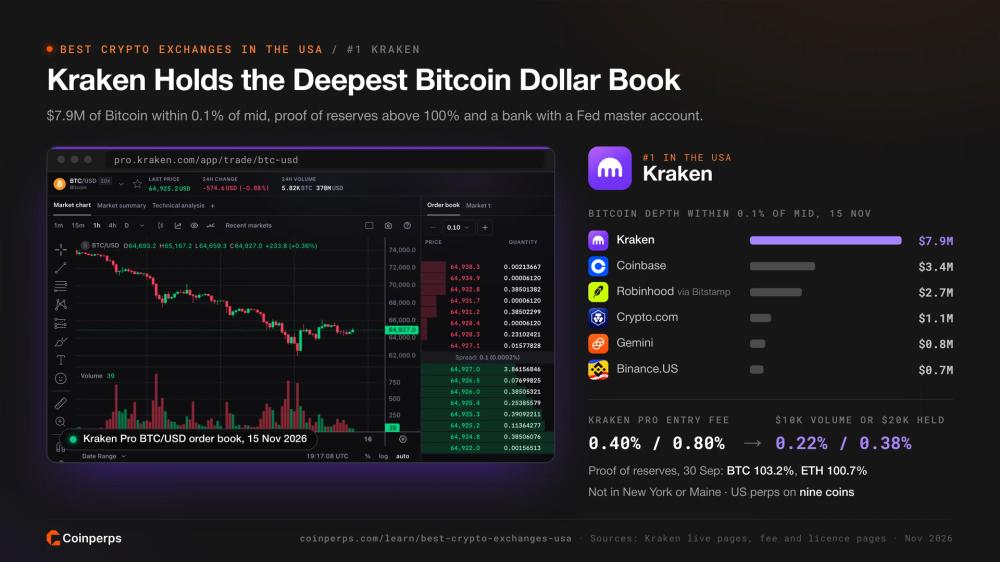
Kraken is the best crypto exchange in the USA for spot trading. It held the deepest Bitcoin dollar book in our sample, publishes proof of reserves and owns a Wyoming-chartered bank that has a Federal Reserve account.
US accounts sit with Payward Interactive, a money services business registered with the Financial Crimes Enforcement Network (FinCEN). Its banking arm, Kraken Financial, received a Federal Reserve master account on 4 March 2026, the first granted to a digital asset bank. Kraken does not serve New York or Maine.
Our order book samples on 15 November 2026 found about $7.9 million of Bitcoin bids and offers within 0.1% of the mid price, against $3.4 million on Coinbase. A $100,000 market buy moved the Kraken price by less than 0.01%.
Kraken Pro has charged 0.40% maker and 0.80% taker at its entry tier since 9 July 2026. Trading $10,000 in 30 days or holding $20,000 on the platform cuts that to 0.22% and 0.38%. The simple buy button costs a flat 1% plus a spread.
Kraken+ costs $4.99 a month and removes trading fees on up to $10,000 of app trades each month. ACH is free both ways, though deposits carry a seven-day withdrawal hold, and a wire withdrawal costs $4.
Kraken lists more than 600 assets worldwide, although some are closed to US clients. Staking is offered in 37 states plus Washington DC and Puerto Rico. Its broker-dealer also sells more than 11,000 US stocks and ETFs commission-free.
The proof of reserves for 30 September 2026 showed 103.2% backing for Bitcoin and 100.7% for Ether, checked by an outside accounting firm. The Securities and Exchange Commission (SEC) dropped its case against Kraken in March 2025. On 30 October 2026 the platform went offline for an hour during a market sell-off.
As a bonus, Kraken Pro lists perpetual futures for US clients on nine coins through Bitnomial, an exchange regulated by the Commodity Futures Trading Commission (CFTC). Eligible clients can also trade spot on margin up to 10x. Read our Kraken restricted countries guide, or sign up through Kraken.
Pros
- The deepest Bitcoin dollar book we measured.
- Proof of reserves above 100% and a bank charter.
- Free ACH, $4 wires and a $4.99 plan that waives fees.
Cons
- Closed to residents of New York and Maine.
- A 0.80% entry taker fee since July 2026.
- A one-hour outage on 30 October 2026.
2. Coinbase
- US oversight
- NY BitLicense, OCC trust charter, CFTC
- States not served
- None
- Entry maker / taker
- 0.50% / 0.90%
- Bitcoin depth within 0.1%
- $3.4M
- US perps
- Yes, since July 2025
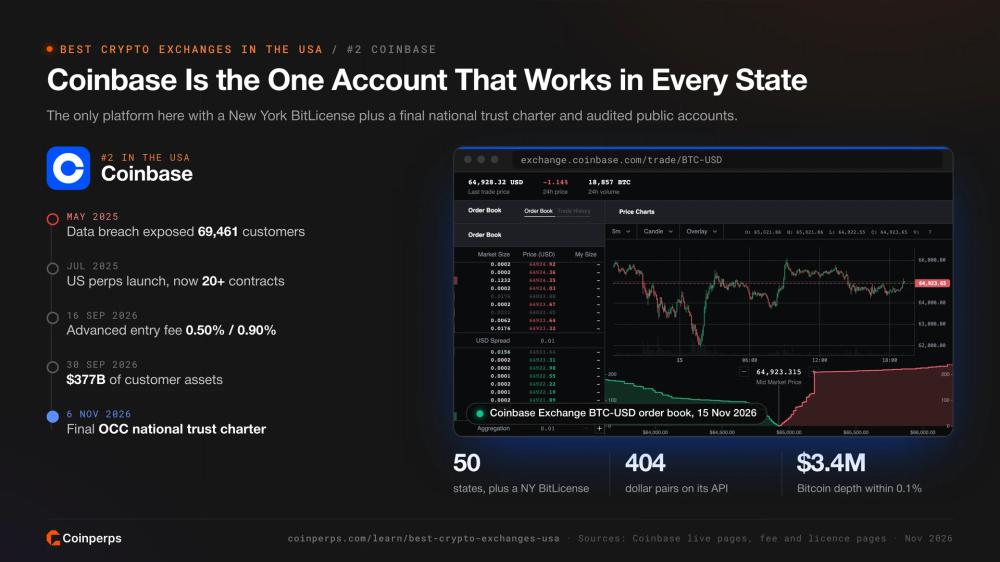
Coinbase is the best exchange for Americans who want one account that works in every state. It is the only platform here that pairs a New York BitLicense with a final national trust charter and audited public accounts.
Coinbase, Inc. holds money transmitter licences across the country, plus New York's BitLicense. The Office of the Comptroller of the Currency (OCC) gave final approval to Coinbase National Trust Company on 6 November 2026. That charter covers custody only, so it adds no deposit insurance.
Coinbase Advanced has charged 0.50% maker and 0.90% taker at the entry tier since 16 September 2026. The simple buy screen costs more, because it adds a variable fee and a spread that appear only at checkout. Coinbase's own California disclosure caps that fee at $10 on orders under $200 and at 6% above that.
Its exchange API listed 404 dollar pairs on 15 November 2026. The Bitcoin book held about $3.4 million within 0.1% of the mid price, second only to Kraken. Coinbase also sells US stocks in every state and offers prediction markets through Kalshi.
The US user agreement states that customer crypto remains the customer's property and is not subject to claims of Coinbase's creditors. Coinbase publishes no proof of reserves and relies on audited accounts. It reported $377 billion of customer assets on 30 September 2026.
In May 2025 bribed support contractors copied the personal data of 69,461 customers. Coinbase refused a $20 million ransom and reimbursed users who were tricked afterwards. Staking also remains restricted for residents of a few states, including California.
Coinbase has offered perpetual futures to US customers since July 2025 and now lists more than 20 contracts. Compare the leaders in our Kraken vs Coinbase guide, or open an account through Coinbase.
Pros
- Available in all 50 states, including New York.
- A final OCC trust charter and audited public accounts.
- 404 dollar pairs, stocks and regulated perps.
Cons
- Entry fees of 0.50% and 0.90% on Coinbase Advanced.
- Instant-buy fees shown only at checkout.
- A 2025 data breach affecting 69,461 customers.
3. Crypto.com
- US oversight
- State licences, CFTC, conditional OCC charter
- States not served
- New York
- Entry maker / taker
- 0.25% / 0.50%
- Bitcoin depth within 0.1%
- $1.1M
- US perps
- Yes, up to 5x
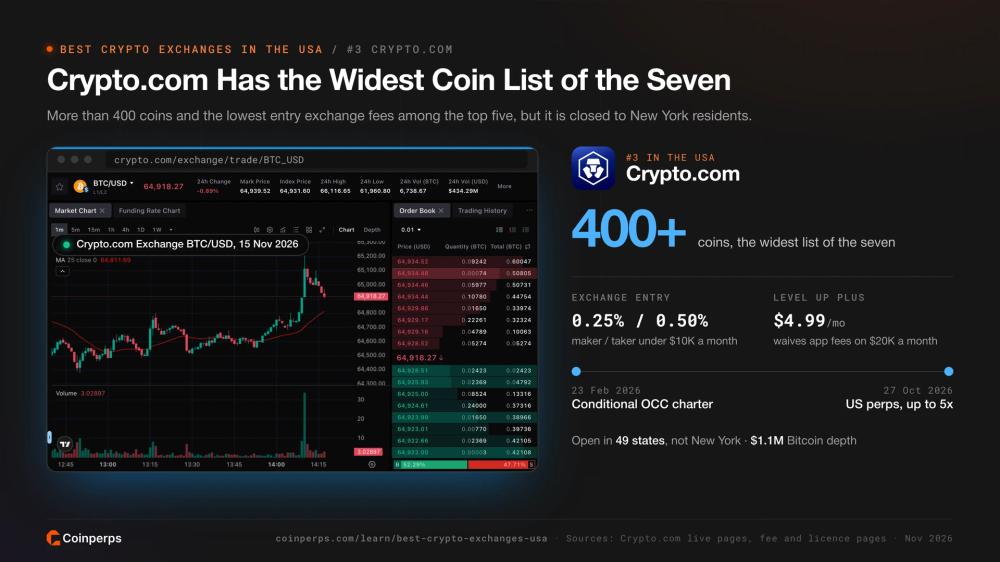
Crypto.com offers the widest coin list of the seven, at more than 400 coins. It is open in 49 states and closed to New York residents.
Its US arm, Foris DAX, is a money services business that holds state licences. The group also owns a CFTC-regulated futures exchange and clearing house. On 23 February 2026 the OCC conditionally approved a national trust bank for it.
The Crypto.com Exchange charges 0.25% maker and 0.50% taker below $10,000 of monthly volume, the lowest entry tier among the top five. The app shows no fee line and earns an undisclosed spread.
The Level Up Plus plan costs $4.99 a month and removes app trading fees on up to $20,000 of trades a month, although the spread still applies. ACH deposits are free from $1. Its Bitcoin dollar book held about $1.1 million within 0.1% of the mid price.
Perpetual futures went live for eligible US traders on 27 October 2026 at up to 5x leverage. The SEC closed its investigation of the company without charges, and we found no current proof of reserves. Read our Crypto.com restricted countries guide, or sign up through Crypto.com.
Pros
- More than 400 coins for US users.
- Exchange fees of 0.25% and 0.50% at the entry tier.
- Regulated perps and a conditional OCC charter.
Cons
- Not available in New York.
- An undisclosed spread in the app.
- No current proof of reserves that we could find.
4. Robinhood
 Best forAbout 0.95% inside the price by default
- US oversight
- NY BitLicense, CFTC
- States not served
- None
- Entry maker / taker
- 0.50% / 0.95%
- Bitcoin depth within 0.1%
- $2.7M on Bitstamp
- US perps
- Announced
Robinhood suits people who already invest there and want crypto beside their stocks. Robinhood Crypto holds a New York BitLicense, serves every state and belongs to a profitable listed company that bought the Bitstamp exchange in June 2025.
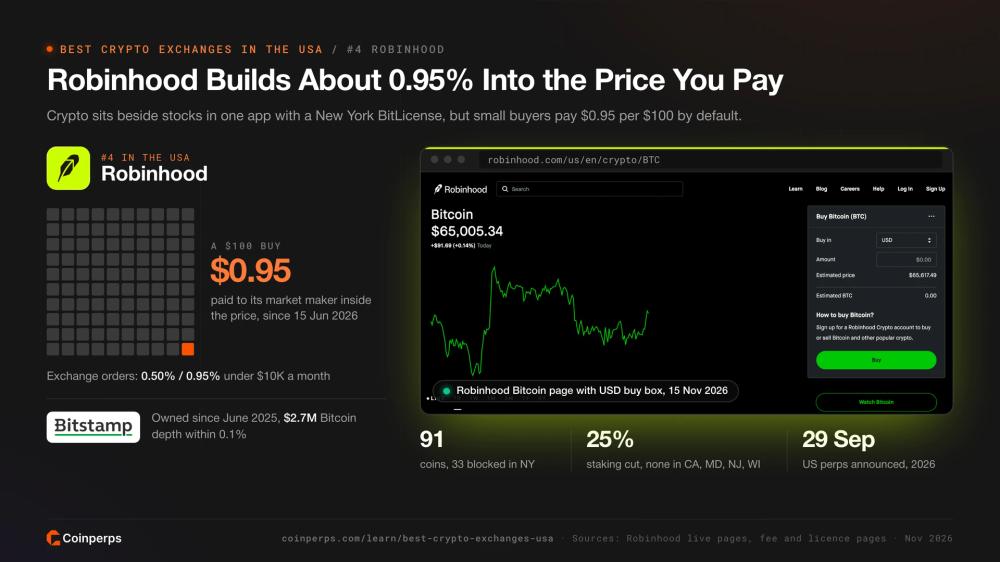
The app charges no commission, yet since 15 June 2026 Robinhood has received $0.95 per $100 from its market maker inside the price you pay. Orders sent to its partner exchanges cost 0.50% maker and 0.95% taker below $10,000 of monthly volume under its fee schedule.
The coin list is short at about 91 cryptocurrencies, and 33 of them cannot be traded in New York. Sending coins to your own wallet costs only the network fee. Bitstamp's Bitcoin dollar book, one of the venues behind those exchange orders, held about $2.7 million within 0.1% of the mid price.
Staking covers Solana, Ether and Cardano for a 25% cut of rewards and is unavailable in California, Maryland, New Jersey and Wisconsin. New York's regulator fined Robinhood Crypto $30 million in 2022 over anti-money-laundering and cybersecurity controls.
Robinhood announced US perpetual futures on 29 September 2026, capped at 10x on Bitcoin and Ether. We could not confirm that they are live.
Pros
- A New York BitLicense and all 50 states.
- Crypto, stocks and cash in one app.
- Withdrawals to your own wallet at network cost.
Cons
- About 0.95% a trade for small buyers.
- Only about 91 coins, fewer in New York.
- No staking in four states.
5. Gemini
 Best forHighest entry fees
- US oversight
- NY trust charter, CFTC
- States not served
- None
- Entry maker / taker
- 0.60% / 1.20%
- Bitcoin depth within 0.1%
- $0.8M
- US perps
- No
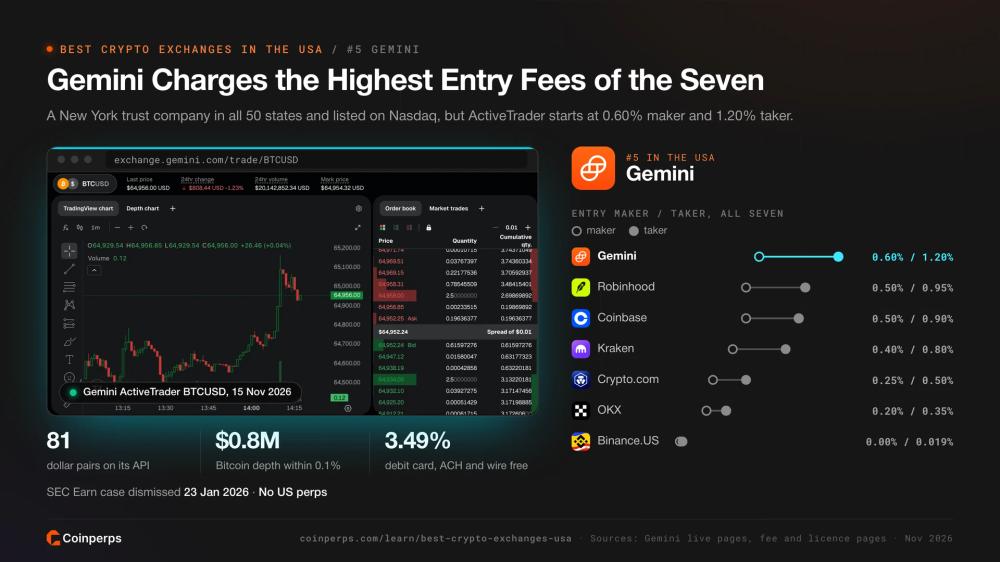
Gemini is the most conservative choice on licensing and the most expensive on fees. It is a New York trust company, is available in all 50 states and has been listed on Nasdaq since September 2025.
The New York State Department of Financial Services (NYDFS) supervises Gemini Trust Company directly. Its affiliate Gemini Titan became a CFTC-regulated exchange in December 2025 and runs prediction markets. The CFTC also registered a Gemini clearing house in 2026.
The ActiveTrader schedule dated 1 September 2026 charges 0.60% maker and 1.20% taker at the entry tier. Many reviews still quote 0.20% and 0.40%. The mobile schedule no longer publishes an instant-buy percentage, so check the quote on the review screen.
ACH and wire deposits are free, while a debit card costs 3.49%. Its API listed 81 dollar pairs. The Bitcoin book held about $0.8 million within 0.1% of the mid price, roughly a tenth of Kraken's.
The SEC dismissed its Gemini Earn case on 23 January 2026 after Earn customers recovered their assets in kind. Gemini then left the UK, EU and Australia and cut 25% of its staff. It offers no US perpetual futures.
Pros
- A New York trust charter and all 50 states.
- A CFTC-regulated exchange and clearing house.
- Free ACH and wire deposits.
Cons
- Entry fees of 0.60% and 1.20%, the highest here.
- An instant-buy spread that is no longer published.
- A thin Bitcoin book and a shrinking business.
6. OKX
- US oversight
- State licences
- States not served
- New York, Texas
- Entry maker / taker
- 0.20% / 0.35%
- Bitcoin depth within 0.1%
- Not measured
- US perps
- No
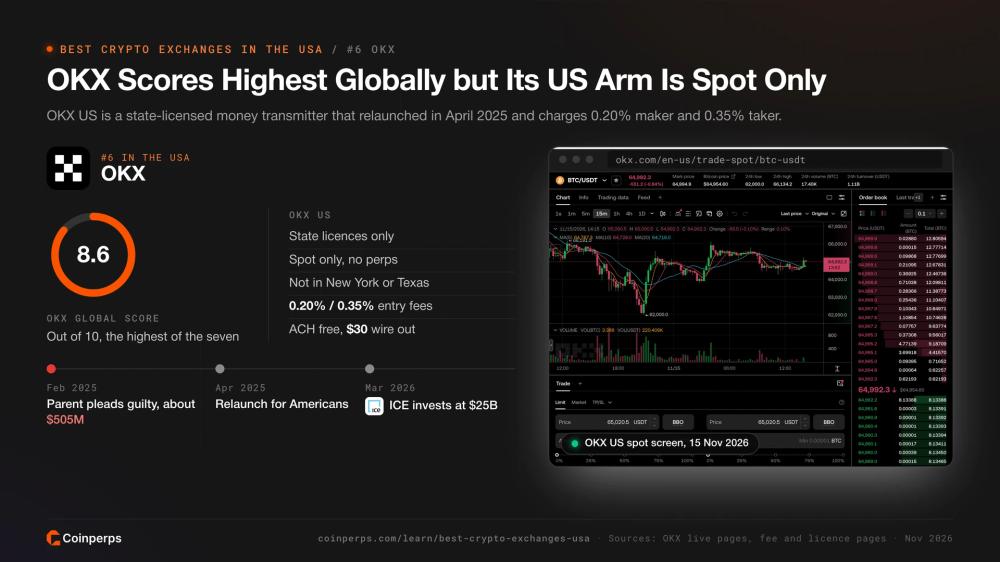
OKX scores 8.6 in our global rankings, the highest of any exchange on this list. Its US arm ranks sixth because it is a newer and smaller business that holds state licences only and offers spot trading alone.
OKX Inc. is a federally registered money services business and state-licensed money transmitter. It relaunched for Americans in April 2025 and does not serve New York or Texas. Intercontinental Exchange, owner of the New York Stock Exchange, invested in OKX in March 2026 at a $25 billion valuation.
The US fee table charges regular users 0.20% maker and 0.35% taker, the lowest entry tier here after Binance.US. The 0.08% and 0.10% often quoted belong to its international schedule. ACH deposits are free and a domestic wire withdrawal costs $30.
In February 2025 the group's operator pleaded guilty in New York to running an unlicensed money transmitting business and agreed to pay about $505 million. OKX publishes proof of reserves for its global platform, and we found no separate US report. Read our OKX restricted countries guide, or sign up through OKX.
Pros
- Entry fees of 0.20% and 0.35%.
- The highest global score on this list.
- Backed by the owner of the New York Stock Exchange.
Cons
- Not available in New York or Texas.
- A 2025 US guilty plea by its parent.
- Spot only, and no US reserve report.
7. Binance.US
- US oversight
- State licences
- States not served
- 12 states
- Entry maker / taker
- 0.00% / 0.019%
- Bitcoin depth within 0.1%
- $0.7M
- US perps
- No
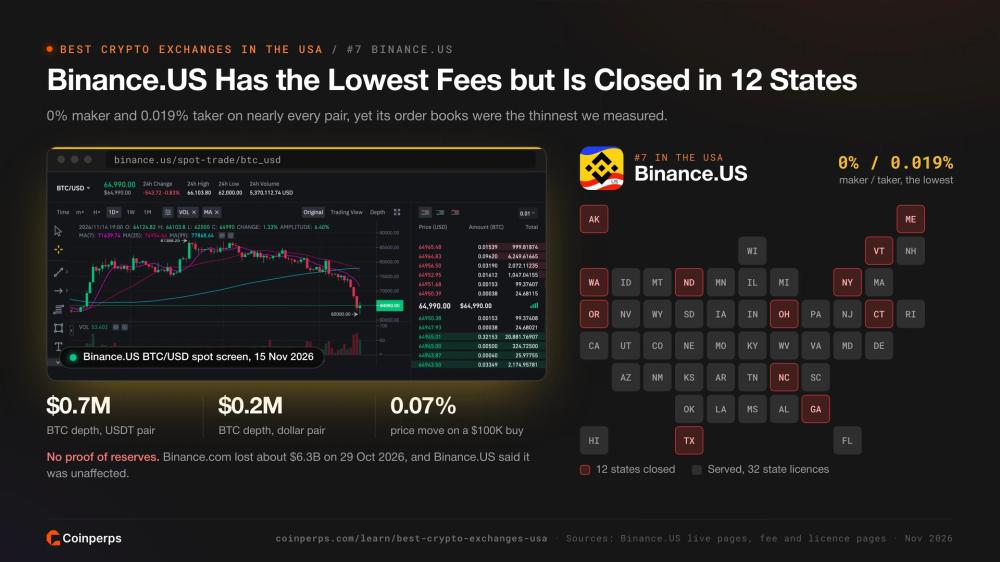
Binance.US has the lowest published spot fees in the country and the weakest reach. It is closed in 12 states, including New York and Texas, and its order books were the thinnest we measured.
The fee page lists 0% maker and 0.019% taker at the entry tier on nearly every pair, after an April 2026 price cut. ACH transfers are free and a wire withdrawal costs $25. Its API listed 204 coins on 15 November 2026.
The Bitcoin book against USDT held about $0.7 million within 0.1% of the mid price, and the dollar pair held $0.2 million. A $100,000 market buy on that dollar pair moved the price by about 0.07%, more than three times the taker fee.
BAM Trading runs Binance.US under 32 state licences and says it is separate from Binance.com. Hackers took about $6.3 billion from Binance.com on 29 October 2026. Binance.US said it was unaffected, and we found no independent confirmation.
It publishes no proof of reserves and offers no derivatives. Our guide to Binance futures in the USA explains which Binance products Americans cannot use.
Pros
- Fees of 0% maker and 0.019% taker.
- Free ACH transfers.
- 204 coins.
Cons
- Closed in 12 states, including New York and Texas.
- The thinnest order books we measured.
- No proof of reserves, and a parent brand hacked in October.
How We Ranked These Exchanges
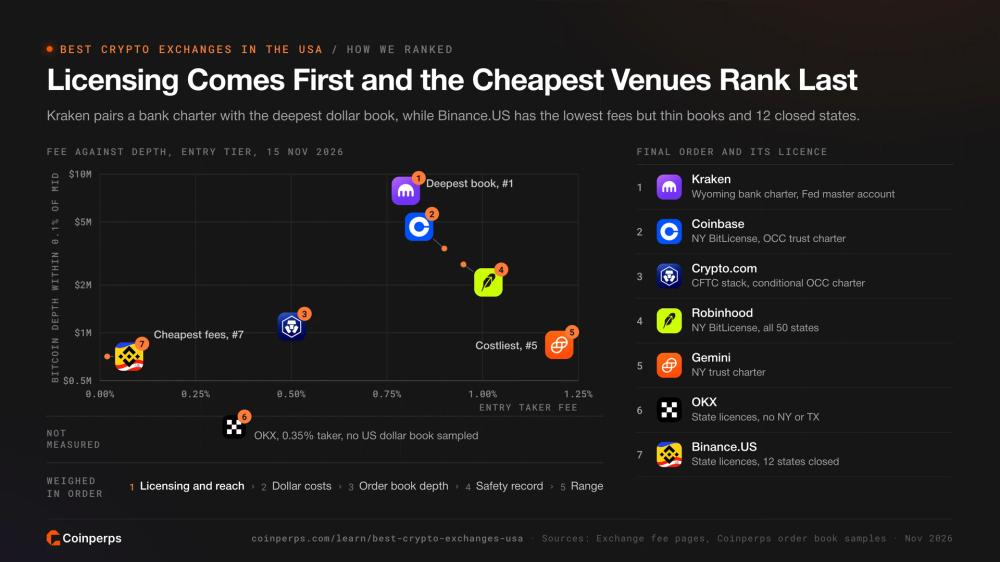
Our order puts US licensing first, then the cost and depth of buying crypto with dollars. The global score behind our exchange rankings carries the rest. That score weighs liquidity and features at 30% each, and fees and regulation at 20% each.
The order weighs the factors below.
- Licensing and reach: federal charters, a New York licence and the number of states served.
- Dollar costs: entry maker and taker fees, the instant-buy fee, and ACH and wire charges.
- Order book depth: Bitcoin, Ether and Solana dollar books sampled three times on 15 November 2026.
- Safety record: proof of reserves, audited accounts, hacks, outages and enforcement history.
- Range: coins, staking, stocks and regulated derivatives open to US users.
Kraken leads because it pairs the deepest dollar books with proof of reserves and low transfer costs. Coinbase is second on reach and disclosure, since it serves every state and files audited accounts. A New Yorker should treat Coinbase as the first choice, because Kraken is closed there.
Kraken scores 8.0 in our global rankings, ahead of Coinbase and Crypto.com at 6.8 each. Bybit, Binance and Gate.io score higher worldwide, but their international platforms do not accept US residents. OKX's 8.6 reflects its global exchange, so its smaller US arm sits lower here.
Gate US holds 35 state licences but is closed in New York, Texas and four other states, and its dollar books could not fill a $100,000 order. eToro reached New York in April 2026 and offers a short coin list. Uphold paid the New York Attorney General more than $5 million in April 2026 over a yield product.
Strike, River and Swan sell Bitcoin only. Bybit, Bitget, MEXC, HTX and KuCoin bar US residents, as our guides to Bitget and MEXC in the USA explain.
Is Crypto Legal in the USA?
Buying, holding and selling crypto is legal in all 50 states. What the country lacks is a single federal licence for spot exchanges, so the protection you get depends on the exchange's charters and on your state.
What Federal Law Covers
The only crypto statute Congress has passed is the GENIUS Act, signed on 18 July 2025, which regulates dollar stablecoins. The OCC finalised its rule on 21 October 2026, and both take effect on 18 January 2027.
The CLARITY Act would have handed spot trading in most tokens to the CFTC. It passed the House in July 2025 and then failed a Senate vote on 15 September 2026. Democrats won both chambers on 3 November, and analysts quoted by CNBC called the bill dead for this Congress.
What Regulators Changed
Agencies filled part of the gap, and on 17 March 2026 the SEC and CFTC published a token taxonomy that treats digital commodities, collectibles and tools as non-securities. It also says protocol staking is not a securities offering, so US exchanges list more coins and offer staking again.
The SEC proposed Regulation Crypto Assets in August. In October CFTC chair Michael Selig floated an optional federal licence for leveraged retail trading and noted that his agency cannot require spot crypto to trade on registered venues without Congress. All of this rests on agency action that a later administration could reverse.
State Licences
Until Congress acts, an exchange registers with FinCEN and obtains a money transmitter licence in each state that requires one. New York's official register lists 39 firms, 26 holding a BitLicense and 13 a trust charter. Coinbase, Gemini, Robinhood Crypto and Bitstamp are on it, while Kraken, Crypto.com, OKX and Binance.US are not.
California's Digital Financial Assets Law has required a state licence or a pending application since 1 July 2026.
How to Check an Exchange
You can verify an exchange's claims yourself.
- NMLS Consumer Access: state licences by company name or NMLS number.
- NYDFS register: every firm allowed to serve New Yorkers.
- FinCEN MSB search: federal registration, which is a filing and not an endorsement.
- NFA BASIC: futures firms that offer perps.
How to Buy Crypto With US Dollars
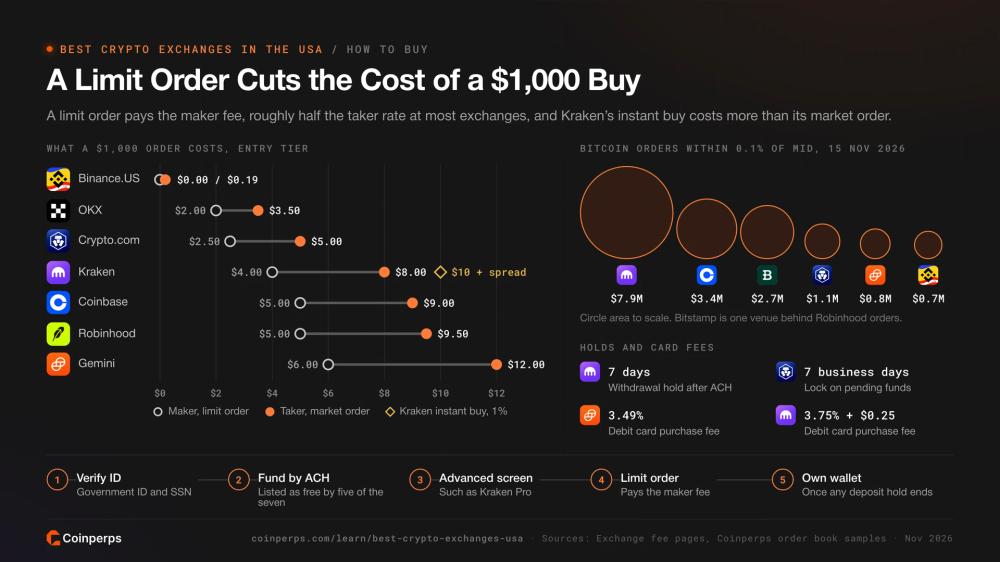
You fund the account by bank transfer, then place an order on the exchange's trading screen. The method you choose changes the cost more than the exchange does, because instant-buy buttons charge several times the fee of a limit order.
- Open an account and verify your identity with a government ID and Social Security number.
- Link a bank account and deposit dollars by ACH, which Kraken, Gemini, Crypto.com, OKX and Binance.US list as free.
- Switch to the advanced screen, such as Kraken Pro or Coinbase Advanced.
- Place a limit order to pay the maker fee, or a market order to pay the taker fee.
- Move long-term holdings to a wallet you control once any deposit hold ends.
What a $1,000 Order Costs
Exchange | Maker order | Taker order | Instant buy |
|---|---|---|---|
 Kraken | $4.00 | $8.00 | $10.00 plus spread |
 Coinbase | $5.00 | $9.00 | Variable fee plus spread |
 Crypto.com | $2.50 | $5.00 | Undisclosed spread |
| Robinhood | $5.00 | $9.50 | About $9.50 inside the price |
| Gemini | $6.00 | $12.00 | Undisclosed spread |
 OKX | $2.00 | $3.50 | Not published |
 Binance.US | $0.00 | $0.19 | Undisclosed spread |
The table uses each platform's entry tier on 15 November 2026. A $1,000 Bitcoin market buy moved the price by less than 0.01% on Kraken, Coinbase, Gemini and Crypto.com, and by about 0.01% on Binance.US.
Entry tiers are expensive in 2026, with starting taker fees of 0.80% on Kraken, 0.90% on Coinbase and 1.20% on Gemini. Monthly plans moved the other way. Kraken+ and Crypto.com's Level Up Plus both cost $4.99 and waive fees on $10,000 and $20,000 of monthly app trades. Our maker vs taker guide shows how limit orders cut costs further.
Deposit Holds and Card Fees
ACH deposits usually credit at once for trading, but the coins cannot leave straight away. Kraken holds withdrawals for seven days after an ACH deposit, and Crypto.com locks crypto bought with pending funds for seven business days. A wire clears the same day and carries no hold on Kraken.
Debit cards cost far more, at 3.49% on Gemini and 3.75% plus $0.25 on Kraken.
Order Book Depth
Depth decides what larger orders cost. Kraken held about $7.9 million of Bitcoin orders within 0.1% of the mid price, Coinbase $3.4 million, Bitstamp $2.7 million, Crypto.com $1.1 million and Gemini $0.8 million. On Solana, Kraken held about $1.0 million and Gemini less than $0.1 million.
Crypto Exchanges vs Banks, Brokers and ETFs
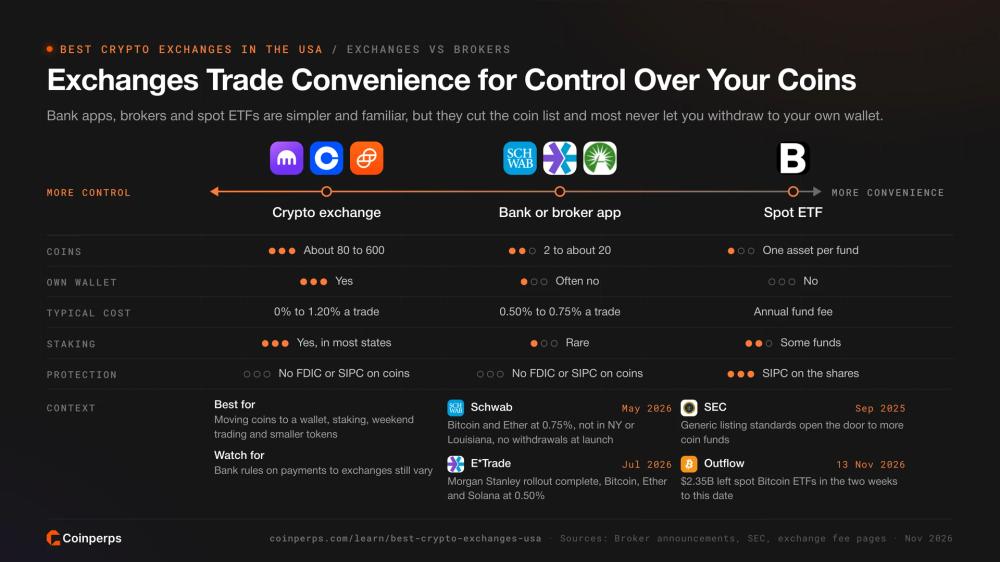
Americans can now buy Bitcoin through a bank app, a stockbroker or an exchange-traded fund as well as an exchange. Those wrappers trade coin choice and self-custody for familiar protections.
Feature | Crypto exchange | Bank or broker app | Spot ETF |
|---|---|---|---|
Coins | About 80 to 600 | 2 to about 20 | One asset per fund |
Withdraw to Your Own Wallet | Yes | Often no | No |
Typical Cost | 0% to 1.20% a trade | 0.50% to 0.75% a trade | Annual fund fee |
Staking | Yes, in most states | Rare | Some funds |
Protection | No FDIC or SIPC cover on coins | No FDIC or SIPC cover on coins | SIPC cover on the shares |
Charles Schwab began selling Bitcoin and Ether to retail clients in May 2026 at 0.75% a trade, outside New York and Louisiana and without crypto withdrawals at launch. Morgan Stanley's E*Trade completed its rollout in July, selling Bitcoin, Ether and Solana at 0.50%. Fidelity Crypto runs through a national trust bank and offers a short coin list.
Spot ETFs are the simplest way to hold crypto in a retirement account. The SEC approved generic listing standards in September 2025, which let funds for Solana, XRP and other coins list without a product-specific order. Our Bitcoin ETF and Ethereum ETF pages track daily holdings.
Investors pulled $2.35 billion from spot Bitcoin ETFs in the two weeks to 13 November 2026.
An exchange is the better tool if you want to move coins to a wallet, stake them, trade at weekends or buy smaller tokens. Bank rules on payments to exchanges still vary, as our Bank of America crypto policy guide explains.
Perpetual Futures and Leverage for US Traders
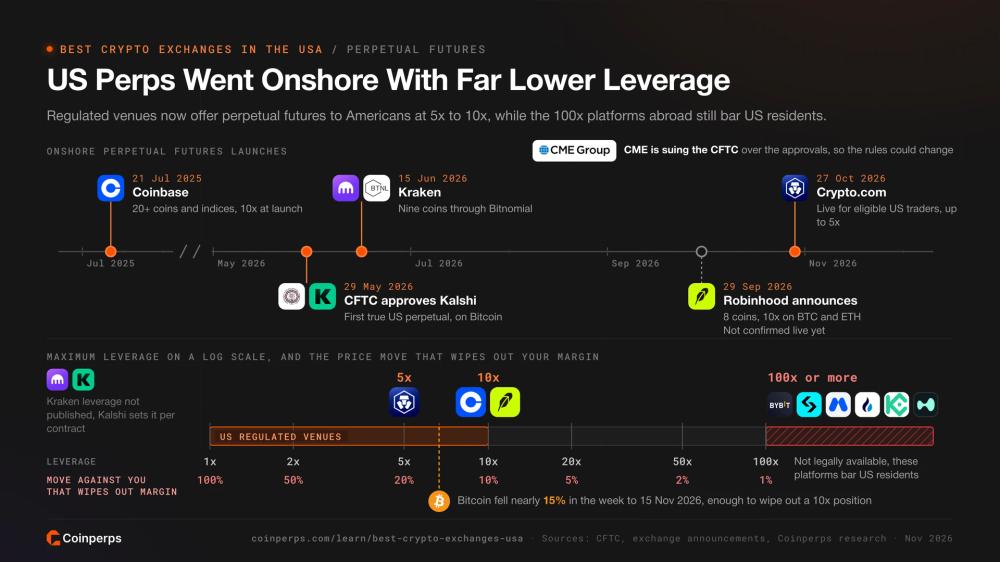
Perpetual futures became available onshore in 2026, so US traders no longer need an offshore account to trade them. They remain a high-risk extra, and the leverage on offer is far lower than abroad.
The CFTC approved the first true US perpetual, Kalshi's Bitcoin contract, on 29 May 2026. Staff then allowed Coinbase and Bitnomial to remove expiry dates from their perpetual-style futures. Our perpetual futures regulation guide follows each step.
Venue | US launch | Contracts | Maximum leverage |
|---|---|---|---|
| Coinbase | 21 July 2025 | 20+ coins and indices | 10x at launch |
 Kalshi | June 2026 | Bitcoin and altcoins | Set per contract |
| Kraken | 15 June 2026 | 9 coins | Not published |
| Crypto.com | 27 October 2026 | Not published | 5x |
| Robinhood | Announced 29 September 2026 | 8 coins | 10x on Bitcoin and Ether |
Offshore leverage of 100x or more is not legally available. Bybit, Bitget, MEXC and HTX bar US residents, and a March 2026 CFTC consent order permanently barred KuCoin from serving them. Hyperliquid's terms exclude US persons too, as our guide to Hyperliquid in the USA explains.
At 10x a 10% move against you wipes out your margin, and Bitcoin fell nearly 15% in the week to 15 November 2026. Exchange group CME is suing the CFTC over the approvals, so the rules could change. Read our guides to perps versus spot trading, funding rates and Kalshi perpetuals before using leverage.
Crypto Tax in the USA
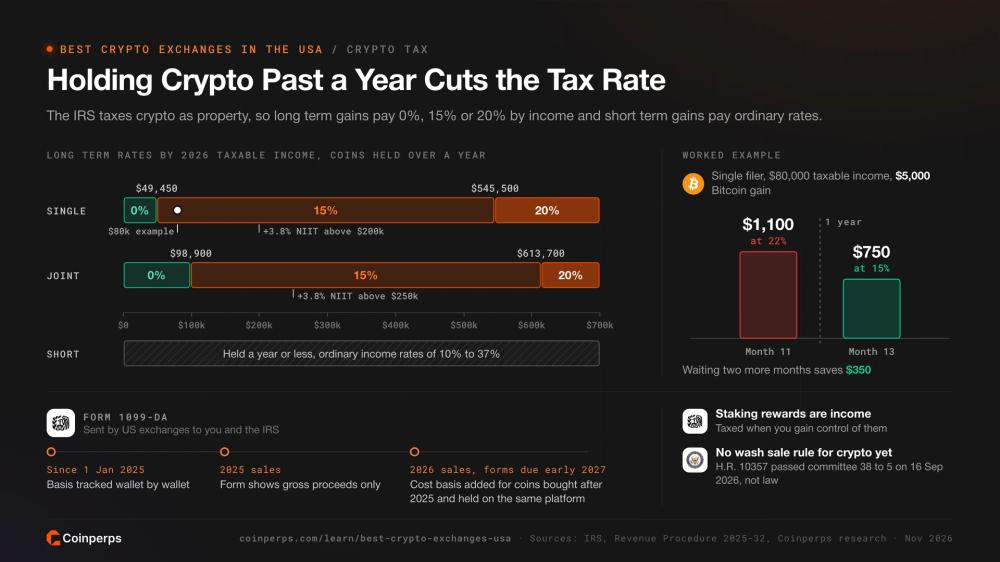
The Internal Revenue Service (IRS) treats crypto as property, so selling, swapping or spending it triggers capital gains tax. Buying and holding does not.
Gains on coins held for a year or less are taxed at ordinary income rates of 10% to 37%. Coins held longer qualify for long-term rates under Revenue Procedure 2025-32. For 2026 the 0% rate applies up to $49,450 of taxable income for single filers and $98,900 for joint filers. The 15% rate applies up to $545,500 and $613,700, and 20% applies above that.
High earners also pay the 3.8% net investment income tax above $200,000 of income for single filers and $250,000 for joint filers. Staking rewards count as income when you gain control of them, under Revenue Ruling 2023-14.
A single filer with $80,000 of taxable income who sells Bitcoin for a $5,000 gain after 11 months owes $1,100 at the 22% rate. Waiting until month 13 cuts that to $750 at 15%. Most states add their own income tax.
What Exchanges Report
US exchanges send Form 1099-DA to you and the IRS. Forms for 2025 sales showed gross proceeds only. Forms for 2026 sales, due in early 2027, add cost basis for coins bought after 2025 and held on the same platform.
Basis has been tracked wallet by wallet since 1 January 2025 under Revenue Procedure 2024-28, so keep your own records when you move coins between platforms.
Wash Sales and Pending Changes
The wash-sale rule still covers only stock and securities, so you can sell crypto at a loss and buy it back at once. The House Ways and Means Committee approved H.R. 10357 by 38 votes to 5 on 16 September 2026, and the bill would extend the rule to digital assets. It is not law, and no exemption for small purchases exists either.
Risks, Scams and Customer Protection
No government scheme protects coins held on an exchange, even a licensed one. Fraud is the larger danger for most Americans, and it usually starts outside the exchange.
What Is Not Insured
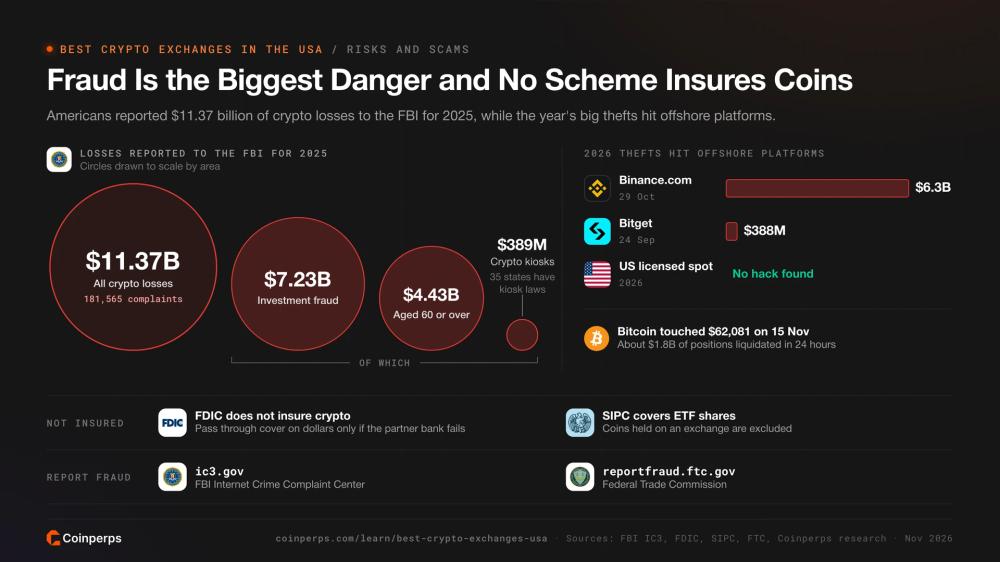
The Federal Deposit Insurance Corporation (FDIC) lists crypto among the products it does not insure. Dollars an exchange keeps at a partner bank may get pass-through cover if that bank fails, which does not help if the exchange itself fails. The Securities Investor Protection Corporation (SIPC) protects securities, so it covers ETF shares and excludes coins.
Hacks and Outages
The big thefts of 2026 hit offshore platforms. Hackers took about $388 million from Bitget on 24 September and about $6.3 billion from Binance.com on 29 October, the largest crypto theft on record. We found no hack of a US-licensed spot exchange this year. Kraken's one-hour outage and Coinbase's 2025 data breach show that access and personal data can still fail.
Keep only trading balances on an exchange, turn on a passkey or authenticator app, and withdraw long-term holdings to your own wallet.
Scams
Americans reported $11.37 billion of crypto-related losses to the FBI for 2025 across 181,565 complaints. Investment fraud made up $7.23 billion, and people aged 60 or over lost $4.43 billion. Crypto kiosks accounted for $389 million, and 35 states have now passed kiosk laws.
No exchange employee will call to move your funds to a safe wallet. The IRS also says letters with a QR code asking you to register your crypto are fake. Report fraud to the FBI at ic3.gov and to the Federal Trade Commission at reportfraud.ftc.gov, and ignore any recovery service that wants a fee upfront.
Market Risk
Bitcoin touched $62,081 on 15 November 2026, a four-month low, while our fear and greed index read extreme fear. Our liquidations page showed about $1.8 billion of forced closures in 24 hours. Size positions so that a 50% fall would not force a sale.
Bottom Line
Kraken is the best crypto exchange in the USA, thanks to the deepest dollar books we measured, proof of reserves, a bank on Federal Reserve rails and cheap transfers. Coinbase is the best choice in New York and Maine, and for anyone who wants every product in one regulated account.
Crypto.com offers the widest coin list and low exchange fees, Robinhood suits existing customers, and Gemini trades high fees for a New York trust charter. OKX and Binance.US are cheaper but narrower in reach and track record.
Federal rules remain unfinished after the CLARITY Act's failure. Check an exchange's licences for your state, use limit orders, keep records for Form 1099-DA and move savings to a wallet you control.


