Best DEXs on Solana Ranked by Real Swap Costs
Jupiter and Raydium lead our ranking of Solana DEXs on price, security record and fees. See what a SOL swap costs on each exchange from $1,000 to $1 million, where perps trade after the Drift theft and how to avoid sandwich attacks.

Coinperps may earn a commission from partner links, at no cost to you; rankings follow our methodology. Not financial advice.
Key takeaways
- Jupiter is the best DEX on Solana for most traders: it compares more than 100 liquidity sources, and our 21 November 2026 quotes put a $100,000 SOL to USDC swap at about 0.01% through Jupiter against 0.14% on the best single exchange.
- Raydium is the strongest single exchange: its pools are open source, the website adds no fee and about half of Solana's tokenised stock volume trades there. Raydium paid or pledged compensation after both exploits on its record.
- The cheapest liquidity has no website: proprietary market makers took 40% of Solana spot volume in the third quarter of 2026 and only accept orders through aggregators.
- Most 2026 losses came from stolen keys: Drift lost $295.4 million on 1 April 2026 to deceived signers, and memecoin swaps with wide slippage were sandwiched about 18 times as often as tight ones.

- Type
- DEX aggregator with perps
- Swap fee
- 0% to 0.5%; 0.02% on SOL to stablecoin
- Perps leverage
- Up to 250x on SOL, ETH and BTC
- $100,000 SOL swap
- About 0.01% price cost in our test
On this page 9 sections
The best DEXs on Solana today are Jupiter and Raydium. Jupiter compares prices across more than 100 liquidity sources, so it gives most traders the best rate on a swap. Raydium is the strongest single exchange, with open-source pools and the deepest market for tokenised stocks.
Orca, Meteora, Phoenix, Pacifica and PumpSwap complete the list. A DEX (decentralised exchange) lets you trade from your own wallet with no account, so you keep custody of your coins until the trade settles.
On 21 November 2026 we priced the same SOL to USDC swap on each exchange at four sizes. This guide is general information and not personalised financial advice.
Best DEXs on Solana Compared
DEX | Type | Best for | Trading fee | Key nuance |
|---|---|---|---|---|
Aggregator with perps and lending | Best price on almost any swap | 0% to 0.5%; 0.02% on SOL to stablecoin | Mobile terms exclude US residents | |
AMM and launchpad | Tokenised stocks and new tokens | Pool tiers from 0.01% to 4%; 0.25% default | $1.34 million exploit of a retired contract in June 2026 | |
Concentrated liquidity AMM | SOL and major pairs traded direct | Pool tiers from 0.01% to 2% | Merging with Loopscale into Formation | |
Dynamic fee AMM | Liquidity providers and new launches | Base fee plus a volatility fee | Launch pools can charge very high early fees | |
On-chain order book for perps | Perpetual futures settled fully on Solana | 0.005% maker; 0.035% taker | Reported to restrict the US, Canada and UK | |
Hybrid perps exchange | Deepest perp markets tied to Solana | 0.015% maker; 0.040% taker | Orders match off-chain; still labelled closed beta | |
Memecoin AMM | Newly launched memecoins | 0.30% to 1.25% by market cap | No published audit or bug bounty |
Fees come from each project's own documentation, checked on 21 and 22 November 2026. Volume figures quoted below come from Blockworks Research, CoinGecko, the exchanges' public APIs and the news reports linked.
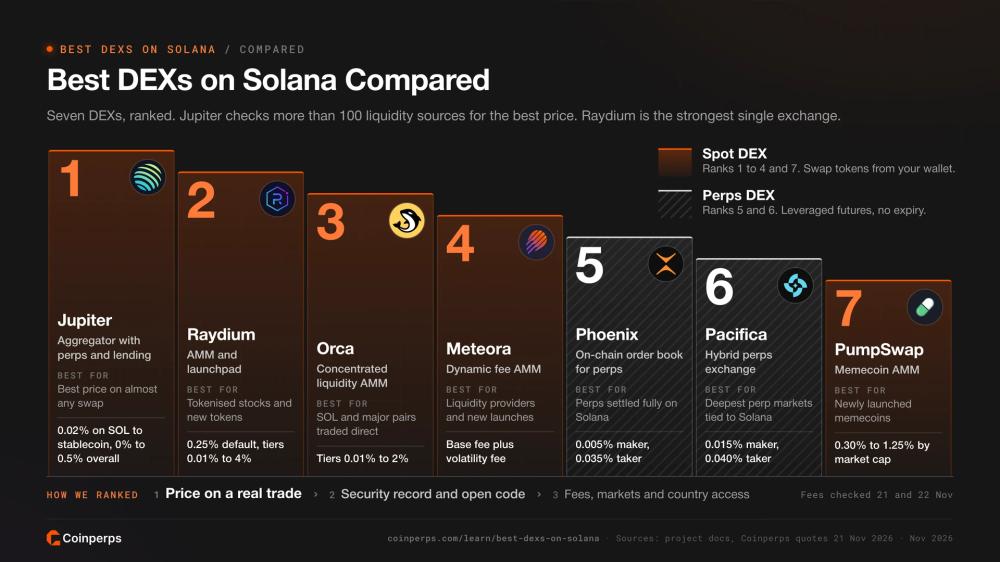
Price on a real trade carried the most weight in our ranking, measured with our own quotes. Security record and how much of the code is public came second. Fees, range of markets and country access followed.
1. Jupiter
Best forBest price on almost any swap- Type
- Aggregator with perps and lending
- Trading fee
- 0% to 0.5%; 0.02% on SOL to stablecoin
- Key nuance
- Mobile terms exclude US residents
Jupiter is the best DEX on Solana for most traders because it searches the others for you. As an aggregator, it checks every pool and market maker for the best price and can split one order across several. Our quotes on 21 November 2026 put a $100,000 SOL to USDC swap through Jupiter at about 0.01% in price cost, against 0.14% on the best single exchange.
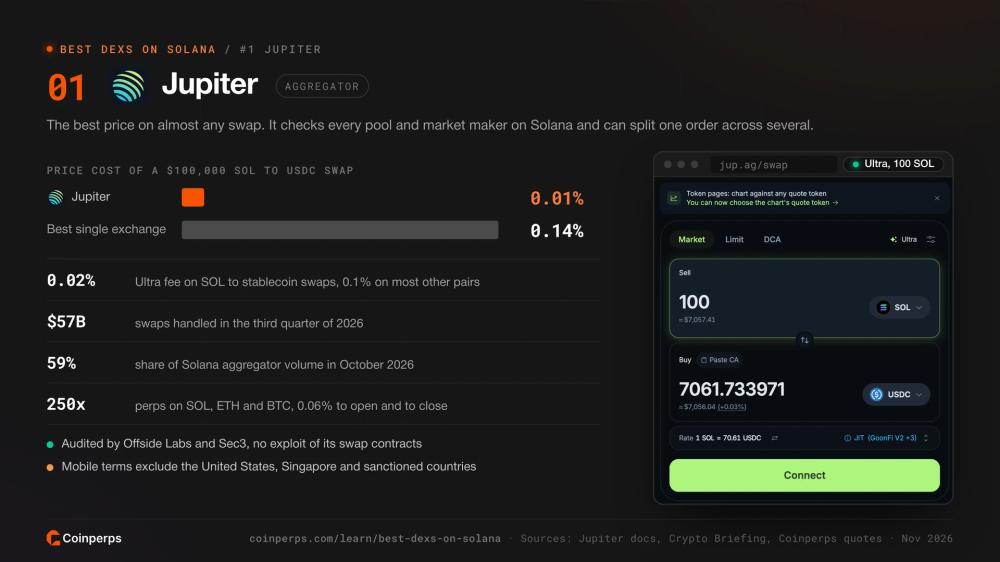
Part of that edge comes from proprietary market makers that only take orders from aggregators. Jupiter handled about $57 billion of swaps in the third quarter of 2026, according to Crypto Briefing's review of the quarter. Its share of aggregator volume slipped to 59% in October as rivals DFlow and OKX grew.
The default Ultra mode charges 0.02% on SOL to stablecoin swaps and 0.1% on most other pairs. Tokens under 24 hours old cost 0.5%, and stablecoin to stablecoin swaps are free. Manual mode has no Jupiter fee but drops the sandwich protection and support that Ultra includes.
Jupiter also runs perpetual futures, where SOL, ETH and BTC trade against its JLP liquidity pool at up to 250x with a 0.06% fee to open and to close. An order book for newer markets such as HYPE and tokenised SpaceX followed on 22 September 2026. Lending and the JupUSD stablecoin sit in the same app.
On security, Jupiter's own page lists audits by Offside Labs and Sec3 and records no exploit of its swap contracts. The mobile app is the weaker option. It charges 0.1% on SOL to stablecoin swaps, more than the website, and its terms say Jupiter does not serve wallets in the United States, Singapore and a list of sanctioned countries.
Pros
- Best measured price: our $1,000 to $1 million test swaps cost less on Jupiter than on any single exchange.
- Reaches private market makers: BisonFi, ZeroFi and similar venues only accept orders through aggregators.
- One app for spot and perps: swaps, limit orders, 250x perps and lending share one wallet connection.
Cons
- Fee on top of the pool: Ultra adds 0.02% to 0.5% that a direct pool swap does not.
- US wallets excluded: the mobile terms list the United States as a restricted location.
- Losing aggregator share: Jupiter's slice of Solana aggregator volume fell from 71% to 59% between July and October 2026.
2. Raydium
 Best forTokenised stocks and new tokens
- Type
- AMM and launchpad
- Trading fee
- Pool tiers from 0.01% to 4%; 0.25% default
- Key nuance
- $1.34 million exploit of a retired contract in June 2026
For a single exchange with no aggregator in front, Raydium is the strongest on Solana. It has run since February 2021 and publishes the code for all three of its pool types. Blockworks Research ranked it third among Solana venues in the third quarter with about 10% of spot volume.
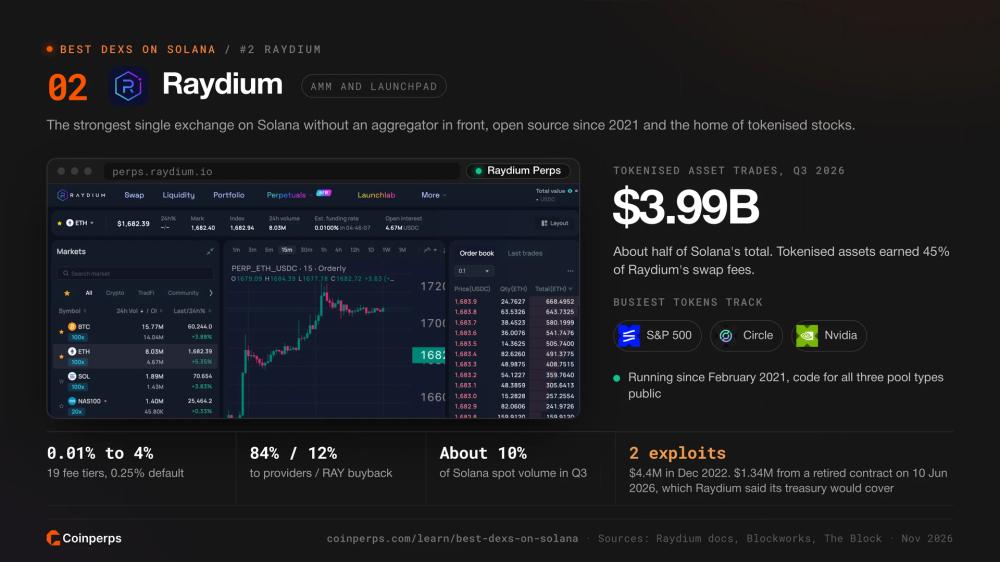
Raydium handled $3.99 billion of tokenised asset trades in the third quarter, about half of Solana's total, according to Blockworks figures. Tokens tracking the S&P 500, Circle and Nvidia were the busiest, and tokenised assets earned 45% of the exchange's swap fees.
The Raydium fee reference lists 19 tiers from 0.01% to 4% for concentrated pools, with 0.25% as the default. We found no separate website fee. Liquidity providers receive 84% of each fee and 12% buys back the RAY token, a scheme that had reached $204.3 million by the end of September 2026.
Its LaunchLab launchpad charges 1% while a new token is on its starting price curve and 0.25% once it moves to a normal pool. Launches rose from 24,504 in the second quarter to 162,861 in the third. Most of that came from one partner, StonkFun, a concentration risk for Raydium's revenue.
Raydium has been exploited twice. The first time, in December 2022, a stolen admin key cost about $4.4 million. Then on 10 June 2026 an attacker drained roughly $1.34 million from a retired contract that the website no longer used. Raydium said its treasury would cover the loss in full, and the pools in use today were not affected.
Pros
- Open source and audited: all three pool contracts are public, with audits from OtterSec, Halborn and Sec3.
- Deepest tokenised stock market: about half of Solana's tokenised asset volume trades here.
- No separate website fee: you pay the pool tier and the network fee only.
Cons
- Two exploits on record: December 2022 and June 2026, with compensation paid or pledged each time.
- Single-venue pricing: a direct swap misses the private market makers that often quote tighter.
- Launch revenue is concentrated: StonkFun produced about 86% of LaunchLab's attributable fees.
3. Orca
 Best forSOL and major pairs traded direct
- Type
- Concentrated liquidity AMM
- Trading fee
- Pool tiers from 0.01% to 2%
- Key nuance
- Merging with Loopscale into Formation
Swapping SOL and other large tokens without an aggregator is where Orca does best. It gave the lowest direct price in our test from $10,000 upwards, with a $100,000 SOL to USDC swap costing 0.14%. No source we checked records an exploit of its Whirlpools contracts, which have been audited six times since 2022.
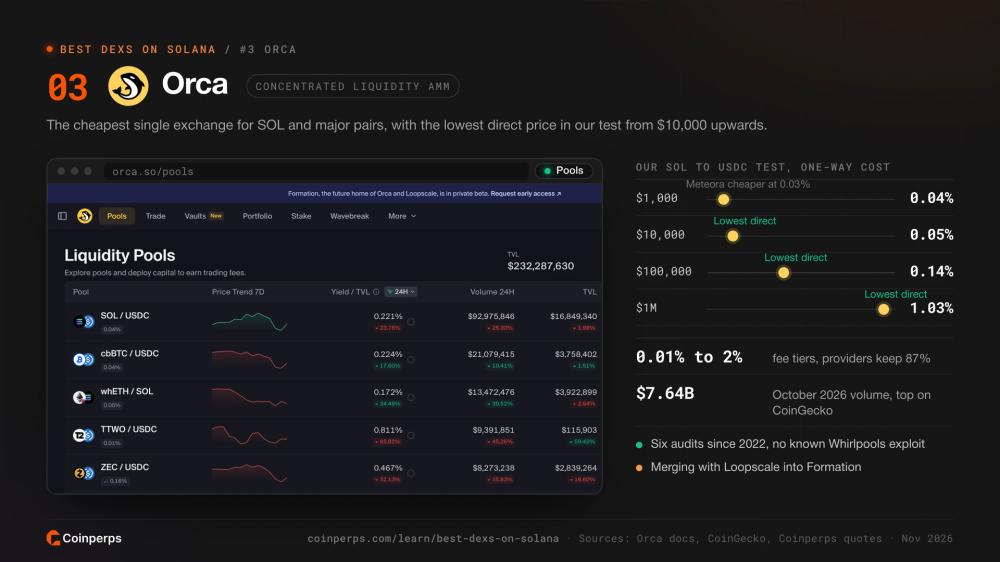
Whirlpools are concentrated liquidity pools, where providers place funds in a chosen price range to earn more fees from less capital. Fee tiers run from 0.01% to 2%, and liquidity providers keep 87% of each fee. CoinGecko tracked $7.64 billion of Orca volume in October 2026, the most of any Solana exchange it covers.
Blockworks Research estimated in January 2026 that at least 85% of Orca's SOL to stablecoin volume came from arbitrage and market-making bots. That keeps the pools tightly priced, though the headline volume overstates ordinary use.
Orca and the lender Loopscale announced a merger into a new company called Formation on 7 October 2026, with ORCA as the group's token. A holder vote the same month proposed cutting the share of fees paid to stakers from 40% to 10%, and reports conflict on whether it passed. Orca's documentation still showed 40% when we checked.
Orca blocked US users from its website in March 2023, but its current list of blocked regions names only sanctioned and high-risk countries. Loopscale paused its own lending protocol on 5 November 2026 after an attack, which did not touch Orca's pools.
Pros
- Best direct pricing: the cheapest single exchange in our SOL to USDC test at $10,000 and above.
- Clean security record: six audits and no known exploit.
- Wider access: neither the US nor the UK appears on the current blocked list.
Cons
- Governance in flux: the Formation merger and the fee vote change who controls the token.
- Bot-heavy volume: most SOL to stablecoin trading is professional arbitrage.
- Thin on small tokens: new memecoins mostly trade elsewhere.
4. Meteora
 Best forLiquidity providers and new launches
- Type
- Dynamic fee AMM
- Trading fee
- Base fee plus a volatility fee
- Key nuance
- Launch pools can charge very high early fees
Meteora suits liquidity providers and traders of newly launched tokens. Its main pool design, DLMM, sorts liquidity into narrow price bins and raises the fee automatically when the price is moving fast. Meteora's pools paid providers $140 million in fees on $32 billion of volume in the first half of 2026.
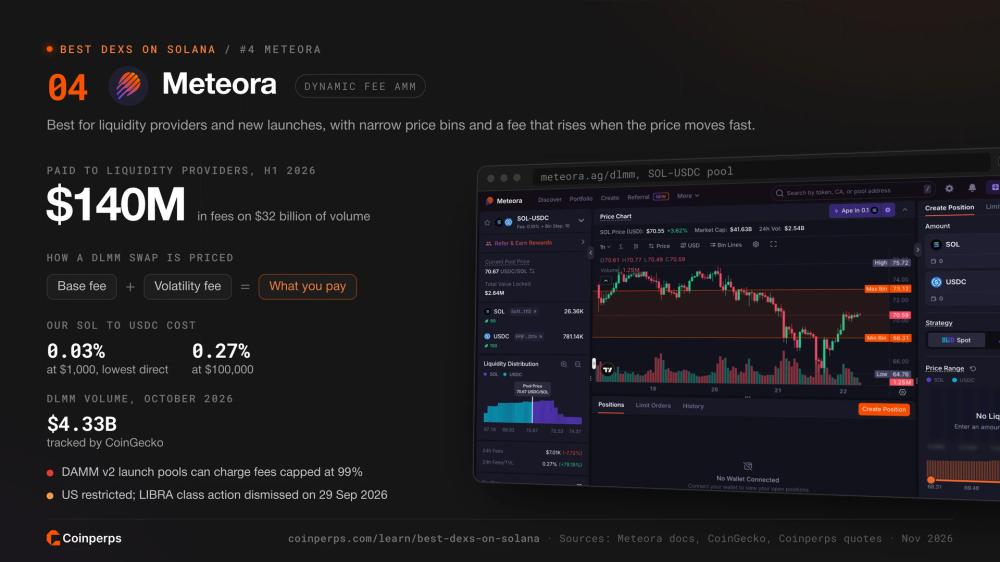
Each DLMM swap pays a base fee set by the pool plus a variable fee tied to volatility. A second pool type, DAMM v2, lets a token's creator schedule fees that start high and decay. The DAMM v2 fee documentation caps the total at 99%, so check the quoted fee before buying a token in its first minutes.
On our test Meteora priced a $1,000 SOL to USDC swap at 0.03%, slightly better than Orca or Raydium. Costs rose faster with size, reaching 0.27% at $100,000. CoinGecko tracked $4.33 billion of DLMM volume in October 2026.
Meteora carries a reputational mark from the LIBRA token, which launched on it in February 2025 promoted by Argentina's president, and then collapsed. A US class action over that launch was dismissed with prejudice on 29 September 2026. The team separately lost $1.5 million to a fraudulent counterparty in the first quarter of 2026 while buying back its MET token.
The terms list the United States, China and Russia among restricted territories and ban the use of a VPN to get around the block. No contract exploit of Meteora's pools appears in the sources we reviewed.
Pros
- Strong fee income for providers: $140 million paid to liquidity providers in six months.
- Good small-trade pricing: the lowest direct cost at $1,000 in our test.
- Launch tooling: many third-party launchpads list their tokens in Meteora pools.
Cons
- High fees on fresh launches: scheduled fees can take a large slice in the opening minutes.
- US restricted: the terms name the United States as a restricted territory.
- Legal history: the US LIBRA case was dismissed, but the launch still marks its reputation.
5. Phoenix
 Best forPerpetual futures settled fully on Solana
- Type
- On-chain order book for perps
- Trading fee
- 0.005% maker; 0.035% taker
- Key nuance
- Reported to restrict the US, Canada and UK
Phoenix is the best fully on-chain exchange for perpetual futures on Solana. Every order sits in a public order book that settles on Solana itself and uses no private matching server. Its own API showed 110 markets on 21 November 2026, including 48 stock perps, and $1.19 billion of volume in the previous 30 days.
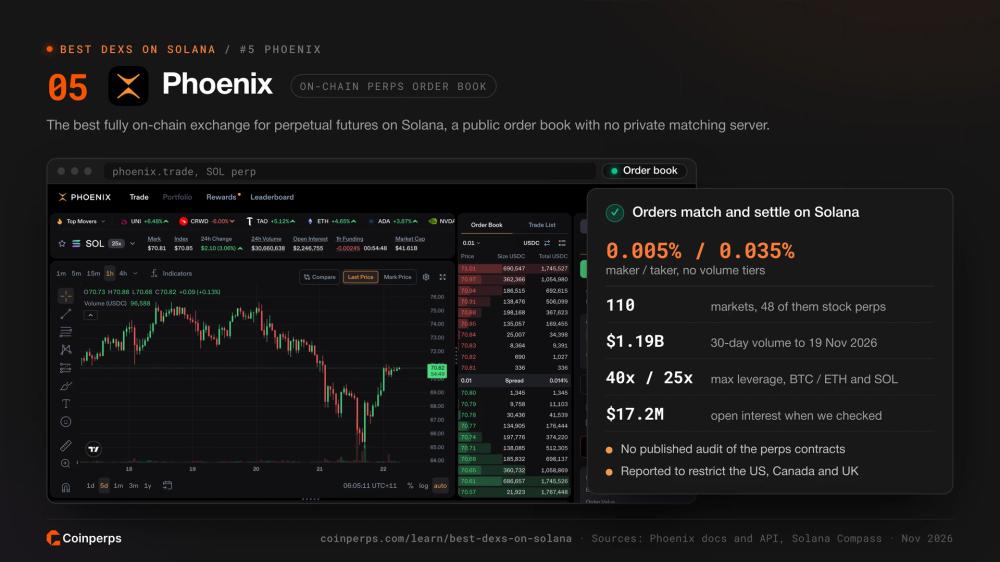
Takers pay 0.035% and makers 0.005% under the Phoenix fee page, which has no volume tiers. Maximum leverage is 40x on BTC and 25x on ETH and SOL. You can post USDC as collateral, or SOL at 80% of its value. cbBTC was added on 12 November 2026.
Phoenix began as a spot order book in 2023 and switched its focus to perps with a private beta in December 2025. The older spot exchange still runs under the Phoenix Legacy name. Its builder, Ellipsis Labs, also operates SolFi, one of the private market makers that aggregators send orders to.
Galaxy Research cited about 1,300 traders in July 2026, and open interest was $17.2 million when we checked. We found no published audit of the perps contracts and no token. Solana Compass reports that the United States, Canada and the United Kingdom are restricted.
Pros
- Fully on-chain: orders, matching and settlement all happen on Solana.
- Low flat fees: 0.035% taker and 0.005% maker for every account.
- Wide market list: 110 perps across crypto, stocks and commodities.
Cons
- Shallow markets: $17.2 million of open interest limits large positions.
- No perps audit found: the 2023 audit covered the spot exchange.
- Restricted regions: the US, Canada and UK are reported as blocked.
6. Pacifica
 Best forDeepest perp markets tied to Solana
- Type
- Hybrid perps exchange
- Trading fee
- 0.015% maker; 0.040% taker
- Key nuance
- Orders match off-chain; still labelled closed beta
Pacifica has the most perp volume of any exchange built around Solana. Its API reported $727 million traded in the 24 hours to 21 November 2026, about three times Jupiter's perps. It ranks below Phoenix here because its orders are matched on Pacifica's own servers, with Solana used for deposits, withdrawals and custody.
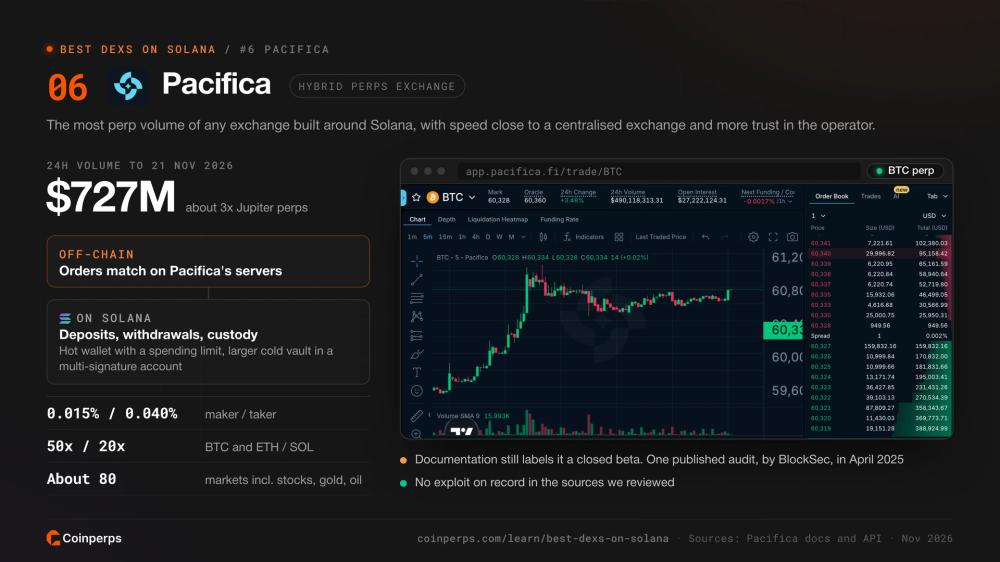
Pacifica's fund security page describes a hot wallet controlled by the matching engine with a spending limit, and a larger cold vault held in a multi-signature account on Solana. You get speed close to a centralised exchange and trust the operator more than you would on Phoenix.
The fee schedule starts at 0.015% for makers and 0.040% for takers, falling with 30-day volume. Leverage reaches 50x on BTC and ETH and 20x on SOL. The exchange lists about 80 markets, including stocks, gold, oil and two currency pairs.
Pacifica launched in June 2025 and says it is self-funded. Cryptopolitan reported that it was launched by Constance Wang, formerly chief operating officer of FTX, though the documentation names no founders. It has no token and runs a weekly points programme. BlockSec audited the contracts in April 2025, the only audit published, and the documentation still labels the product a closed beta.
Pros
- Highest volume: $727 million in 24 hours, the most among Solana-linked perp venues.
- Broad markets: crypto, stocks, commodities and currencies on one margin account.
- No exploit on record: none found in the sources we reviewed.
Cons
- Off-chain matching: trades are not settled order by order on Solana.
- Light disclosure: one audit, no published country list and unnamed founders in the documentation.
- Low SOL liquidity: SOL perps were only about 5% of its volume.
7. PumpSwap
 Best forNewly launched memecoins
- Type
- Memecoin AMM
- Trading fee
- 0.30% to 1.25% by market cap
- Key nuance
- No published audit or bug bounty
Memecoins that have just launched trade on PumpSwap. It belongs to pump.fun, and every coin that completes pump.fun's starting price curve moves into a PumpSwap pool. That pipeline made it the largest single venue on Solana in the third quarter of 2026, with about 21% of spot volume.
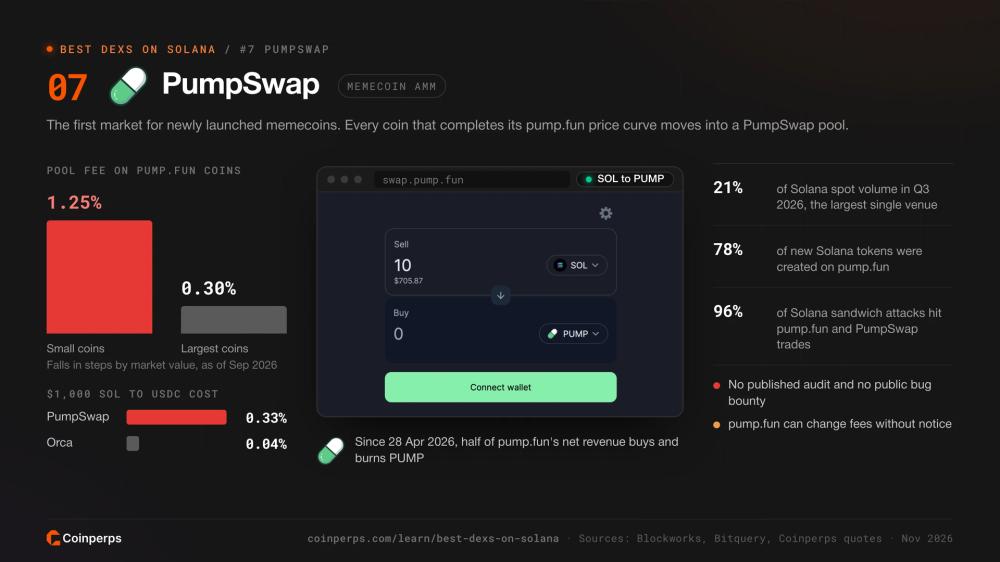
Fees are the highest on this list. As of September 2026, pools for pump.fun coins charged 1.25% while a coin's market value was small, falling in steps to 0.30% for the largest coins. Part of each fee goes to the coin's creator. Since 28 April 2026, half of pump.fun's net revenue has bought and burned its PUMP token.
A $1,000 SOL to USDC swap cost 0.33% on PumpSwap in our test, about eight times Orca's price, because its pools are simple and built for small tokens. Bitquery found that 96% of sandwich attacks on Solana over 11 months hit pump.fun and PumpSwap trades.
Disclosure is the weakest of the major venues. The Blockworks transparency filing for PUMP states there is no published audit of PumpSwap and no public bug bounty. It adds that pump.fun can change fees without notice. A US class action against its operator, Baton Corporation, is continuing on racketeering claims.
Pros
- First market for new memecoins: pump.fun created 78% of new Solana tokens over the past year.
- Deep in its niche: the largest Solana venue by total volume in the third quarter.
- Creator rewards: part of every trading fee is paid to the coin's creator.
Cons
- High fees: up to 1.25% per trade on small coins.
- No audit published: and no public bug bounty.
- Most tokens fail: between about 0.3% and 2% of pump.fun coins reached a PumpSwap pool in 2026.
How Solana DEXs Work
Most Solana swaps now pass through two layers that you never see. An aggregator takes your order, and a professional market maker often fills it. Knowing the four venue types explains why the cheapest price is rarely on the website with the best-known name.
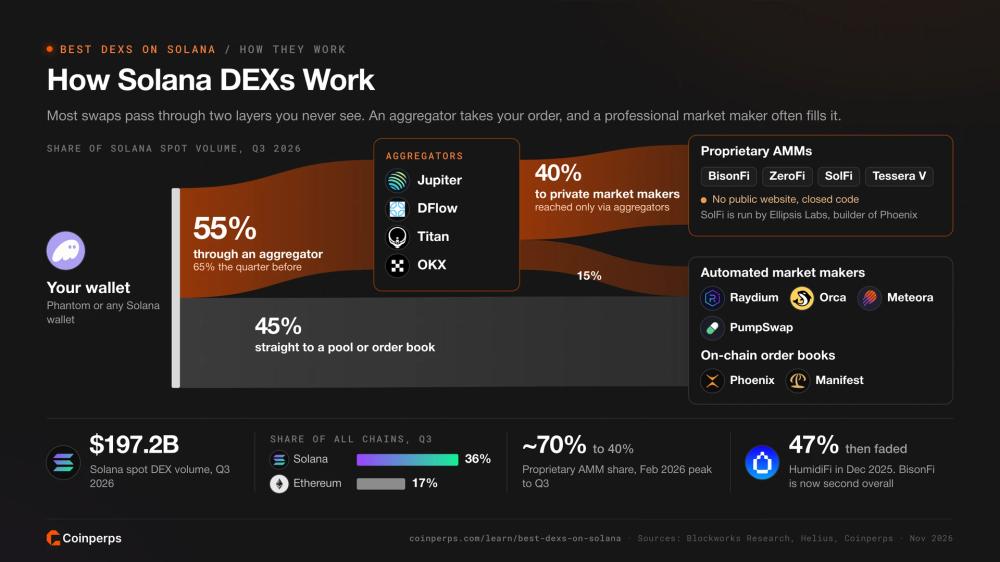
- Automated market makers: pools of two tokens funded by the public, priced by a formula. Raydium, Orca, Meteora and PumpSwap work this way.
- Order books: buyers and sellers post prices, as on a centralised exchange. Phoenix and Manifest keep their books on-chain.
- Proprietary AMMs: a single trading firm quotes from its own funds and updates prices many times a second. BisonFi, ZeroFi, SolFi and Tessera V have no public website.
- Aggregators: Jupiter, DFlow, Titan and OKX compare all of the above and send each order where it is cheapest.
Solana handled $197.2 billion of spot DEX volume in the third quarter of 2026, or 36% of the total across all blockchains, according to the Blockworks Research token holder report. Ethereum had 17%. Our Uniswap statistics cover how that rival market is split.
Proprietary AMMs took 40% of Solana's spot volume in that quarter, more than any other venue type. Their share peaked near 70% in February 2026 and fell as memecoin trading returned. Helius, a Solana infrastructure firm, explains how these market makers quote. Their code is closed and they usually have no outside liquidity providers.
Aggregators carried 55% of spot volume in the third quarter, down from 65% the quarter before. The leaderboard beneath them moves quickly. HumidiFi held 47% of all Solana spot volume in December 2025 and has since faded to a minor venue, while BisonFi rose to second place overall.
A pool website shows you one venue, and an aggregator shows you the best of more than 100, so compare quotes. Our guide to perp DEX aggregators covers the same idea for futures.
What a Swap Costs on Each Solana DEX
The gap between the best and worst Solana DEX grows quickly with trade size. On 21 November 2026 we requested SOL to USDC quotes from Jupiter's public API, limited to one exchange at a time, and then with every venue allowed. We bought and immediately sold at each size and halved the round-trip loss.
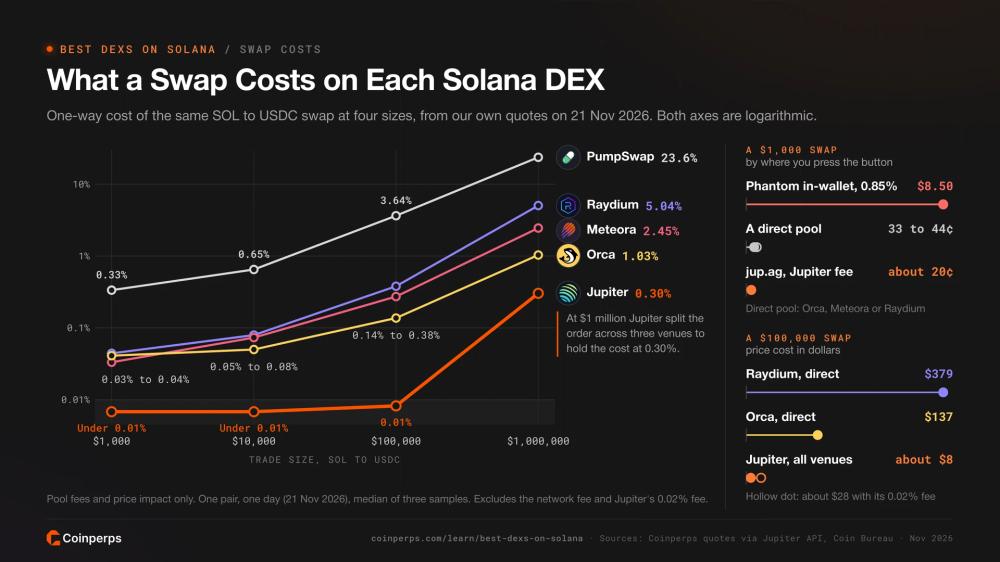
Trade size | Jupiter, all venues | Orca | Meteora | Raydium | PumpSwap |
|---|---|---|---|---|---|
$1,000 | Under 0.01% | 0.04% | 0.03% | 0.04% | 0.33% |
$10,000 | Under 0.01% | 0.05% | 0.07% | 0.08% | 0.65% |
$100,000 | 0.01% | 0.14% | 0.27% | 0.38% | 3.64% |
$1,000,000 | 0.30% | 1.03% | 2.45% | 5.04% | 23.6% |
Each figure is the median of three samples and covers pool fees and price impact. It excludes Jupiter's own Ultra fee of 0.02% on this pair and the network fee. The results describe one pair on one day, and smaller tokens will behave differently.
Among the three main AMMs the choice barely matters at $1,000, since each costs 33 to 44 cents. Size changes that. A direct Orca swap of $100,000 cost about $137 and a Raydium swap about $379, while Jupiter's combined price cost about $8, or roughly $28 once its 0.02% fee is added.
Private market makers explain the difference. ZeroFi alone quoted a $10,000 swap at under 0.01% and BisonFi at about 0.01%, both well inside any public pool. At $1 million Jupiter split the order across three venues to hold the cost at 0.30%.
Where you press the swap button matters as much. Phantom's built-in swap charges 0.85% on select swaps, according to Coin Bureau's review, which is $8.50 on a $1,000 trade. The same swap on jup.ag costs about 20 cents in Jupiter fees. Our maker and taker fee guide explains how such charges add up.
Network costs are small. Solana's base fee is 5,000 lamports per signature, a fraction of a cent, and most users add a small priority fee. Slippage tolerance has more effect on your result, as the safety section below shows.
Perpetual Futures on Solana DEXs
Perpetual futures, or perps, are leveraged contracts with no expiry date. Solana is a small market for them, and 2026 made it smaller. The four venues below that report volume traded about $1.1 billion between them around 21 November 2026, against $13.3 billion on Hyperliquid alone.
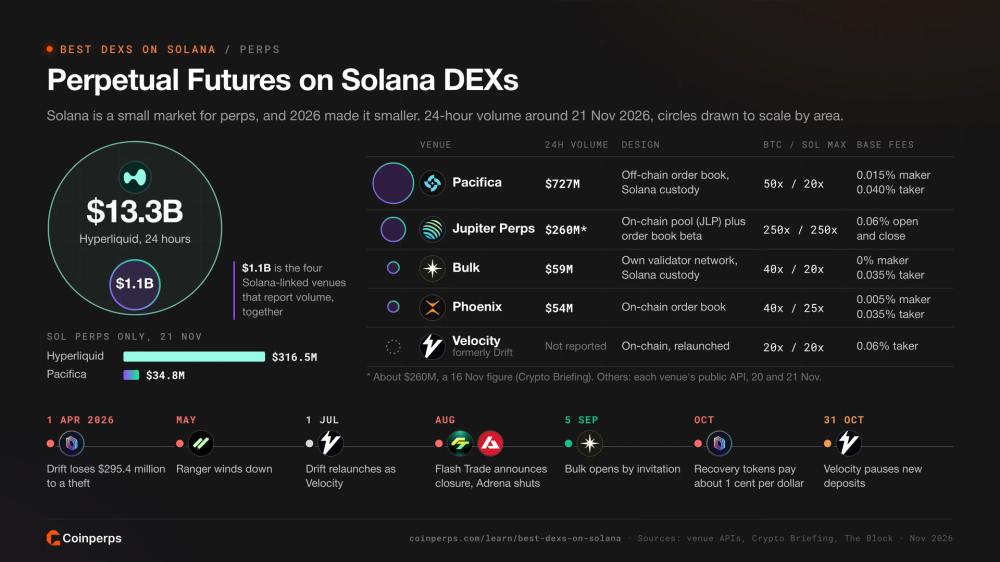
Venue | Design | BTC / SOL max leverage | Base fees | 24-hour volume |
|---|---|---|---|---|
Pacifica | Off-chain order book, Solana custody | 50x / 20x | 0.015% maker; 0.040% taker | $727 million |
Jupiter Perps | On-chain pool (JLP) plus order book beta | 250x / 250x | 0.06% open and close | About $260 million |
Phoenix | On-chain order book | 40x / 25x | 0.005% maker; 0.035% taker | $54 million |
Bulk | Own validator network, Solana custody | 40x / 20x | 0% maker; 0.035% taker | $59 million |
Velocity (formerly Drift) | On-chain, relaunched | 20x / 20x | 0.06% taker | Not reported |
Volumes come from each venue's public API on 20 and 21 November 2026, except Jupiter, which is a 16 November figure reported by Crypto Briefing. Bulk opened on 5 September 2026 by invitation.
The largest name is missing because of a theft. Drift, one of Solana's oldest perp DEXs, lost $295.4 million on 1 April 2026. Its recovery plan attributes the theft to attackers linked to North Korea. They tricked its signers into approving transactions in advance, and no flaw in the trading code was involved, The Block reported.
Users have not been repaid. Drift issued recovery tokens that began redeeming at about one cent per dollar lost in October 2026. The exchange relaunched as Velocity with new code and a 20x leverage cap. Solana Compass reported that it paused new deposits on 31 October, and we could not confirm they had reopened.
Ranger wound down in May 2026, Flash Trade announced its closure in August unless a buyer appeared, and Adrena shut the same month. For SOL itself, liquidity sits elsewhere. Hyperliquid traded $316.5 million of SOL perps on 21 November against $34.8 million on Pacifica.
Jupiter's pool model differs from an order book in one costly way. You pay an hourly borrow fee on the full position instead of funding, on top of a price impact fee on large orders. Compare live SOL perpetual markets and funding rates before choosing, and see our ranking of the top decentralised perpetual exchanges across all chains.
Memecoins and Tokenised Stocks on Solana DEXs
What you trade on Solana decides which DEX you should open. SOL and stablecoin pairs dominate volume and are cheapest through an aggregator. Memecoins and tokenised stocks each have a home venue and their own risks.
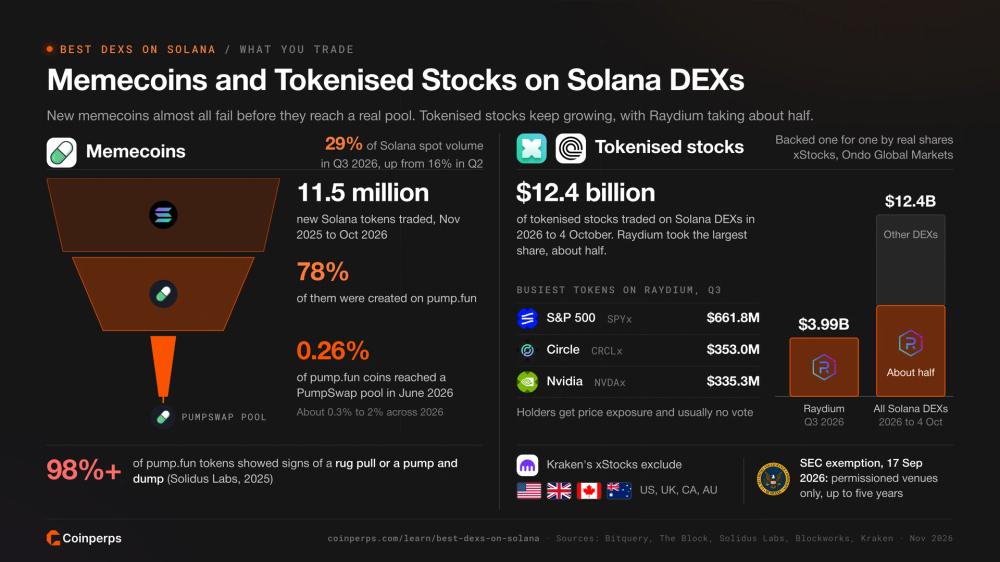
Memecoins were 29% of Solana spot volume in the third quarter of 2026, up from 16% in the second, on Blockworks Research figures. Nearly all of them start on pump.fun. Bitquery counted 11.5 million new Solana tokens that traded between November 2025 and October 2026, and pump.fun created 78% of them.
Few survive. Of all pump.fun coins, the share that completed the starting curve and reached a PumpSwap pool fell to 0.26% in June 2026, on The Block's data. A 2025 study by Solidus Labs found signs of a rug pull or a pump and dump in more than 98% of pump.fun tokens.
Tokenised stocks are tokens backed one for one by real shares held with a custodian, sold under names such as xStocks and Ondo Global Markets. Solana DEXs traded $12.4 billion of them in 2026 up to 4 October, Crypto Briefing reported, and Raydium took the largest share, about half.
Kraken's xStocks availability page excludes the United States, United Kingdom, Canada and Australia. Holders get price exposure and usually no vote. The European regulator ESMA has warned of a legal title gap between owning the token and owning the share.
On 17 September 2026 the Securities and Exchange Commission issued an innovation exemption letting qualifying venues trade tokenised US stocks through liquidity pools for up to five years. It covers permissioned venues and tokens with full shareholder rights, so today's offshore products do not qualify. Traders who want leverage on shares can compare stock perps instead.
How Safe Are Solana DEXs
The biggest losses on Solana in 2026 came from stolen keys and deceived staff, while trading code held up well. An audit of the pool matters less if one compromised laptop can move the treasury.
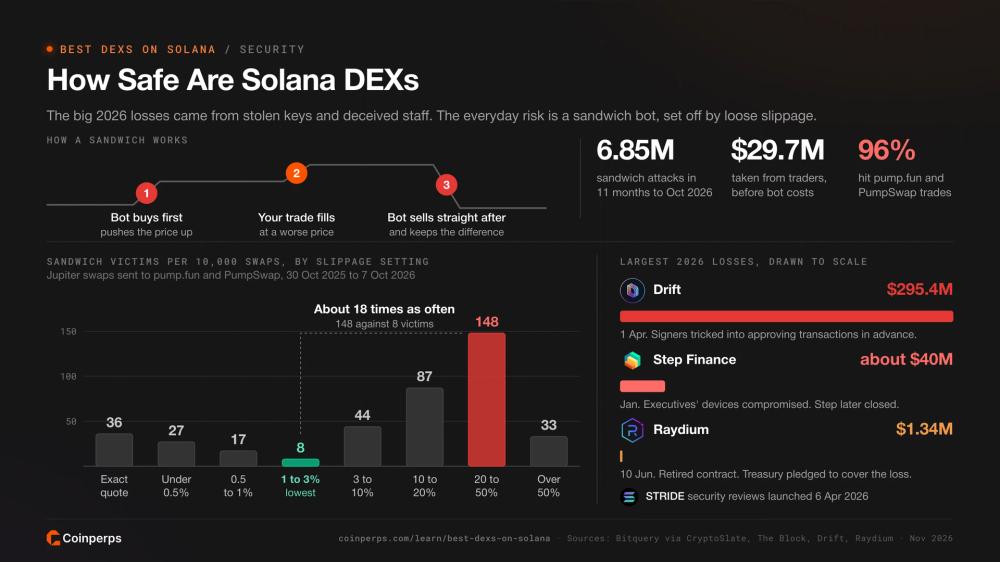
Drift's $295.4 million was the largest loss by far. Step Finance lost roughly $40 million in January when executives' devices were compromised, and it later closed. Among the spot exchanges in this guide, only Raydium's retired contract was exploited.
Sandwich attacks are the everyday risk. A bot sees your pending trade, buys first to push the price up, then sells straight after you. Bitquery data published by CryptoSlate counted 6.85 million such attacks between October 2025 and October 2026, taking about $29.7 million before costs.
Your slippage setting drives the risk. Slippage tolerance is the worst price you agree to accept. In the same study, Jupiter swaps into pump.fun pools set to 20% to 50% slippage were hit about 18 times as often as those set to 1% to 3%. Memecoin traders who raise slippage to get an order through are the main victims.
Jupiter's Ultra mode sends trades through its own delivery system and sets slippage automatically, and proprietary AMMs have no public pool for a bot to trade against. The Solana Foundation launched a security review programme called STRIDE on 6 April 2026, five days after the Drift theft.
A short checklist covers most of the danger.
- Check the address: bookmark each DEX and confirm the token's contract address before you buy.
- Keep slippage low: 1% to 3% is enough for liquid pairs.
- Read what you sign: a transaction that asks for unlimited access to a token deserves a second look.
- Limit exposure: keep long-term holdings in a separate wallet from the one you trade with.
Our guide to the best USDT wallets compares hardware and software options that also hold Solana tokens.
How Alpenglow and Faster Blocks Change Trading
Solana rebuilt its core in 2026, and trades now confirm faster as a result. Alpenglow, a new system for agreeing on blocks, went live on 21 October 2026. It targets final confirmation in about 150 milliseconds, down from roughly 12.8 seconds before.
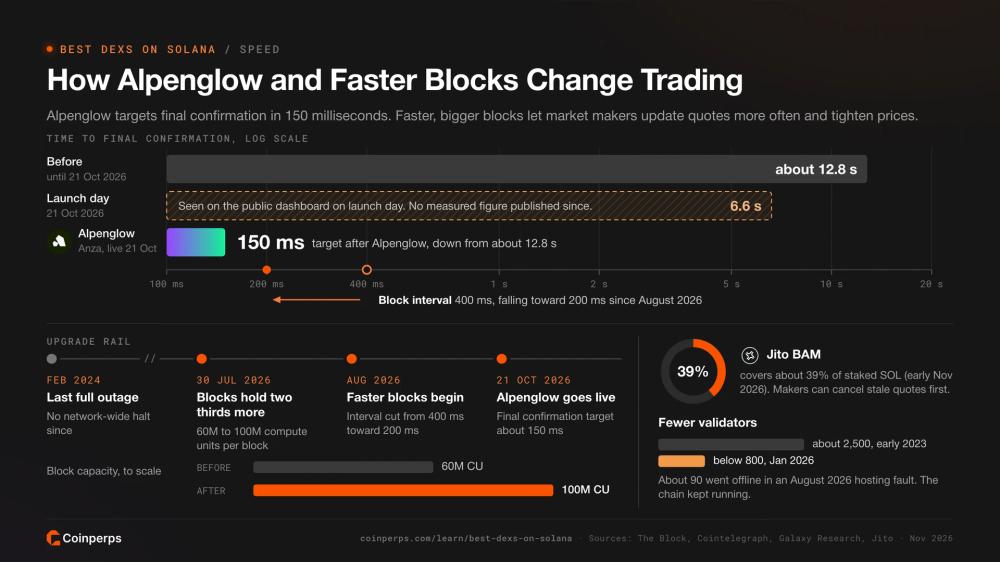
For now that number is a goal. On launch day the public dashboard still showed 6.6 seconds, as Cointelegraph noted, and we found no measured figure published since. Wallets and websites will also add a short delay of their own.
Capacity per block rose by two thirds on 30 July 2026, and the time between blocks began falling from 400 milliseconds toward 200 in August, as Galaxy Research had previewed. The network's last full outage was in February 2024.
For traders the gain is tighter prices. Market makers can update quotes more often when blocks arrive faster, which narrows the spread they need to charge. Jito's block-building system, BAM, lets an exchange order its own transactions so that makers can cancel stale quotes first. It covered about 39% of staked SOL in early November.
Concentration is the caveat. The number of validators fell below 800 in January 2026, down more than 65% from early 2023, The Block reported. In August a fault at one hosting company took about 90 of them offline, though the chain kept running.
Institutional interest has continued through the price fall. US spot Solana funds launched in October 2025, and our Solana ETF tracker follows their holdings. To see where leveraged SOL positions cluster, use the Solana liquidation heatmap.
Who Can Use Solana DEXs and How Swaps Are Taxed
A DEX has no sign-up form, yet where you live still limits which websites you can use and how each trade is taxed. Restrictions apply to the website that a company runs. The smart contracts underneath stay open to any wallet.
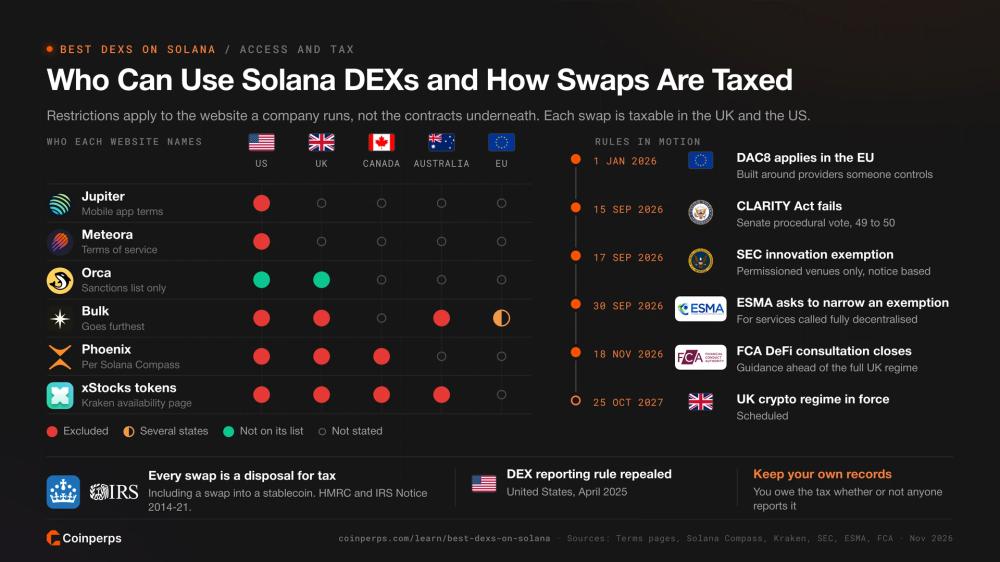
Jupiter's mobile terms and Meteora's terms of service both name the United States, whereas Orca's current list covers only sanctioned and high-risk countries. Bulk goes furthest and excludes the US, the UK, Australia and several European Union states. Using a VPN to get around a block breaches these terms.
Rules written for DEXs are still missing in the largest markets. In the United States the CLARITY Act, which would have set market rules, failed a Senate procedural vote 49 to 50 on 15 September 2026. The derivatives regulator, the CFTC, has since extended no-action relief to software developers that connect users to registered venues.
Europe exempts services that are fully decentralised, without defining the term. ESMA asked on 30 September 2026 for that exemption to be narrowed, citing projects that claim decentralisation while a company stays in control. In the UK the Financial Conduct Authority consulted on guidance for decentralised finance until 18 November 2026, ahead of a full regime on 25 October 2027.
HM Revenue and Customs treats swapping one token for another as a disposal for Capital Gains Tax. The US Internal Revenue Service takes the same view under Notice 2014-21. Each swap is a taxable event, including one into a stablecoin.
Reporting is patchier than liability. In April 2025 the United States repealed the rule that would have made DEX websites report customer trades. The European Union's DAC8 directive has applied since 1 January 2026, though it is built around providers that a person or company controls. You owe the tax either way, so keep your own records.
Leveraged products carry tighter limits than swaps. Our guides to perp DEXs against centralised exchanges and to no-KYC perpetual exchanges explain what changes when you trade futures.
Bottom Line
Jupiter is the best DEX on Solana for most people because it found the lowest price at every size we tested. Use Raydium for tokenised stocks and for a direct, open-source exchange. Orca is the pick for large SOL swaps made without an aggregator, and Meteora suits those who want to provide liquidity.
For perpetual futures, Phoenix keeps everything on-chain and Pacifica offers more volume with more trust in its operator. PumpSwap is where new memecoins trade, at high fees and with the weakest disclosure on this list.
Whichever you choose, compare a quote on an aggregator before swapping on a single exchange. Keep slippage low, and record every swap as a taxable trade.


