HIP-3 Statistics on Hyperliquid and What the First Year Shows
HIP-3 has traded about $665 billion since launch. See its volume, open interest, top markets, deployers, fees and risks, built from Hyperliquid's own API data.

Not financial advice.
Key takeaways
- HIP-3 is now a quarter of Hyperliquid: builder-deployed markets traded $64.7 billion in the last 30 days, 26.7% of Hyperliquid volume, and about $665 billion since launch on 13 October 2025.
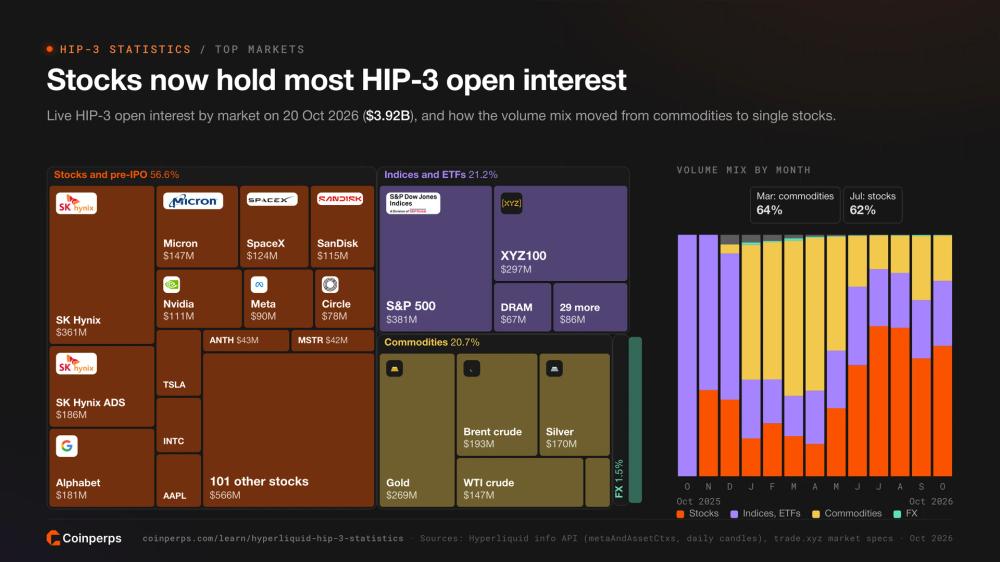
- Stocks replaced commodities: commodities were 64% of HIP-3 volume in March 2026, but single stocks and pre-IPO contracts made up 62% in July and now hold 56.6% of open interest.
- One deployer runs the market: trade.xyz carries about 97% of HIP-3 volume and open interest, and six of the ten registered deployer DEXs have delisted every market.
- Cheap to trade, thin at weekends: growth mode cuts fees by at least 90% on 151 of 162 live markets, yet weekends carry only 5.3% of HIP-3 stock volume.
On this page 9 sections
HIP-3 is the Hyperliquid upgrade that lets outside teams list their own perpetual futures markets on Hyperliquid's order book. A year after launch, those builder-deployed markets handle about a quarter of all Hyperliquid volume. On some days in July 2026 they handled two thirds of it.
This page covers HIP-3 alone, from volume and open interest to deployers, fees, rival venues and incidents. Most of the figures come from our own pull of Hyperliquid's public API on 20 October 2026.
Exchange-wide numbers such as total Hyperliquid volume, HYPE buybacks and staking sit on our Hyperliquid statistics page. If you want to know how the markets work and how to trade them, read Hyperliquid HIP-3 perpetuals explained.
HIP-3 Statistics at a Glance
These figures size the HIP-3 market as of 20 October 2026. Rows marked Coinperps data come from Hyperliquid's public info API, and other sources are linked further down.
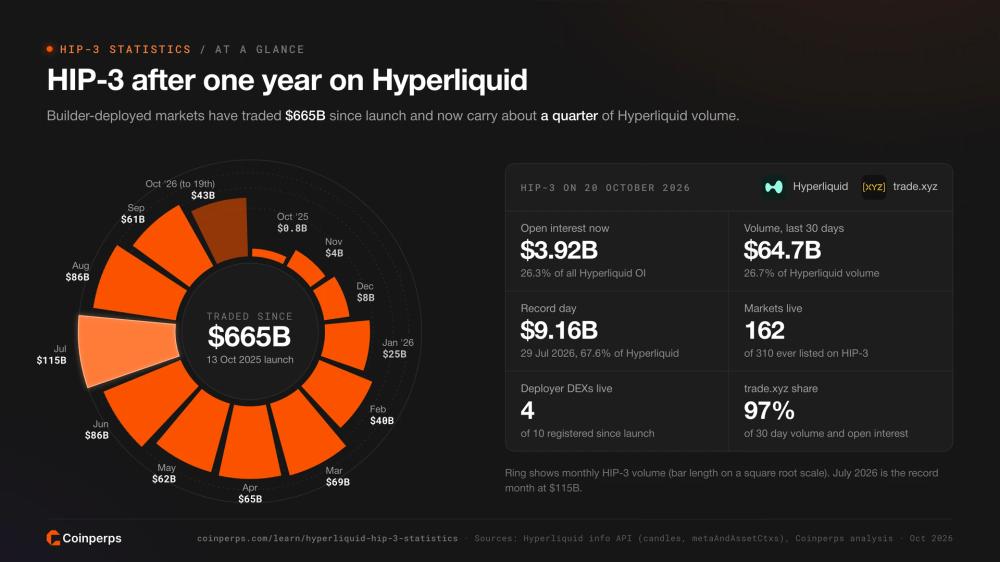
Metric | Value | Source |
|---|---|---|
Mainnet launch | 13 October 2025 | Hyperliquid |
Cumulative HIP-3 volume | About $665 billion | Coinperps data |
Volume, last 30 days | $64.7 billion (26.7% of Hyperliquid) | Coinperps data |
Record day | $9.16 billion on 29 July 2026 (67.6% of Hyperliquid) | Coinperps data |
Open interest now | $3.92 billion (26.3% of Hyperliquid) | Coinperps data |
Record open interest | Above $4.44 billion (August 2026) | The Block |
Deployer DEXs registered | 10, of which 4 are live | Coinperps data |
Markets ever listed | 310, of which 162 are live | Coinperps data |
trade.xyz share | 97.2% of 30-day volume, 97.1% of open interest | Coinperps data |
Markets in growth mode | 151 of 162 live markets | Coinperps data |
Deployer stake | 500,000 HYPE per DEX | Hyperliquid docs |
We built the volume figures from daily candles for every HIP-3 market, delisted ones included. Each day's base volume is multiplied by the average of its open, high, low and close, which makes the totals close estimates. Checked against reported monthly figures, they land within about 1%.
HIP-3 Trading Volume
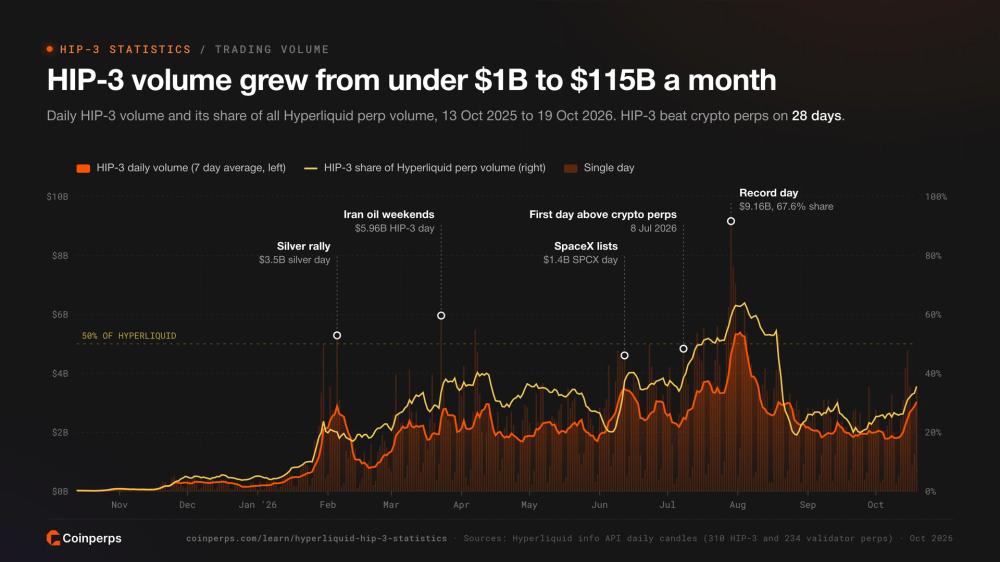
HIP-3 volume grew from under $1 billion in its first month to $115.1 billion in July 2026, the record so far. Trading has cooled since, though HIP-3 still holds a far larger share of Hyperliquid than it did a year ago.
Month | HIP-3 volume | Share of hyperliquid volume |
|---|---|---|
October 2025 | $0.76B | 0.2% |
November 2025 | $4.21B | 1.7% |
December 2025 | $8.13B | 4.7% |
January 2026 | $24.98B | 11.7% |
February 2026 | $40.44B | 19.6% |
March 2026 | $68.66B | 32.0% |
April 2026 | $65.14B | 34.8% |
May 2026 | $62.49B | 31.4% |
June 2026 | $85.60B | 32.1% |
July 2026 | $115.09B | 51.3% |
August 2026 | $85.96B | 35.4% |
September 2026 | $60.91B | 24.5% |
October 2026 (to 19th) | $42.54B | 29.8% |
The first surge arrived in January 2026. Gold and silver rallied, and HIP-3 open interest set new records each week, as The Block noted at the time. In March the Iran conflict pushed oil traders onto venues that stay open at weekends.
June and July added another leg, led by the SpaceX listing and a rally in memory chip stocks that put single-stock perps in front.
On 8 July 2026, HIP-3 volume beat Hyperliquid's native crypto perps for the first time, a crossover The Defiant also covered. It has happened on 28 days in total. The biggest of those days was 29 July, when HIP-3 markets traded $9.16 billion. SK Hynix, Micron and SanDisk perps drew heavy trading, and the total came to 67.6% of all Hyperliquid perp volume.
Trade counts climbed just as quickly, from 0.64 million in October 2025 to 63.5 million in March 2026 and 65.9 million in July. The average HIP-3 trade, at roughly $1,100 to $1,750, has been smaller than the typical trade on Hyperliquid's crypto perps in every month of 2026.
HIP-3 Open Interest
HIP-3 open interest, meaning the value of positions still open, stands at $3.92 billion. That equals about 26% of Hyperliquid's total and sits around 12% below the August record.
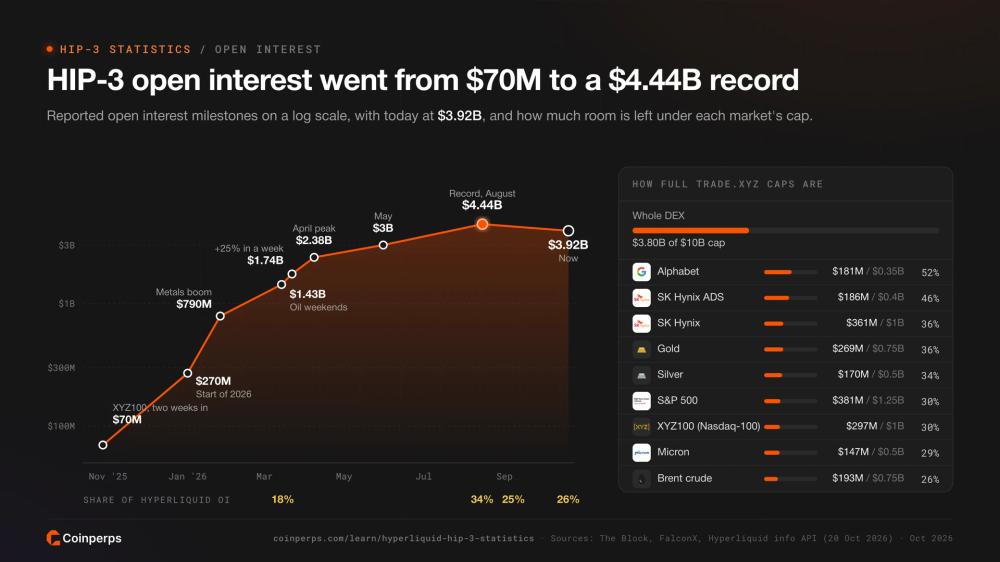
Its growth shows up clearly in reported milestones.
- October 2025: XYZ100, the first HIP-3 market, held about $70 million of open interest two weeks after launch, according to FalconX.
- January 2026: open interest passed $790 million during the metals boom.
- March 2026: it reached $1.43 billion on 14 March and $1.74 billion on 22 March, a 25% weekly jump reported by The Block.
- April 2026: it peaked at $2.38 billion early in the month and still stood near $2.1 billion on 15 April, a gain of roughly 580% for the year by The Block's count.
- August 2026: it set a record above $4.44 billion, and HIP-3's share of Hyperliquid open interest rose from 18% in March to over 34%.
- September 2026: by 8 September the share had slipped back to 25%, The Block noted, as crypto open interest grew and HIP-3 open interest dipped.
Each market also has an open interest cap set by its deployer. On trade.xyz the largest are $1.25 billion on SP500 and $1 billion apiece on XYZ100, SK Hynix and WTI crude. Once a cap fills, new positions are blocked, and that bites hardest during big news events. To compare with crypto perps, use our live open interest dashboard.
The Most Traded HIP-3 Markets
HIP-3 began as a stock index product and became a commodities venue in early 2026. Since June it has mostly traded single stocks, and stocks and pre-IPO contracts now hold 56.6% of HIP-3 open interest.
Asset class | Share of HIP-3 open interest (20 oct 2026) | Share of volume, march 2026 | Share of volume, july 2026 |
|---|---|---|---|
Stocks and pre-IPO | 56.6% | 16.6% | 62.1% |
Indices and ETFs | 21.2% | 16.7% | 23.7% |
Commodities | 20.7% | 64.2% | 14.0% |
FX | 1.5% | 1.1% | 0.2% |
Crypto (HyENA, now closed) | 0% | 1.4% | 0.1% |
Ten markets account for 59.5% of HIP-3 open interest, led by the licensed S&P 500 contract.
- SP500, $381 million, the S&P 500 contract licensed by S&P Dow Jones Indices in March 2026
- SK Hynix (SKHX), $361 million
- XYZ100, which tracks the Nasdaq-100, $297 million
- Gold, $269 million
- Brent crude, $193 million
- SK Hynix US depositary shares (SKHY), $186 million
- Alphabet (GOOGL), $181 million
- Silver, $170 million
- WTI crude (CL), $147 million
- Micron (MU), $147 million
Lifetime volume tells a different story. WTI crude has traded about $85 billion, XYZ100 about $83 billion and silver about $65 billion. Silver's busiest day was 5 February 2026, at $3.5 billion, while crude peaked at $2.2 billion on 7 April, the day the US announced a ceasefire with Iran. Our guide to oil perpetual contracts on Hyperliquid goes deeper on those markets.
Pre-IPO perps let traders price a private company before it lists. After the listing each contract converts into a normal stock perp, the trade.xyz documentation explains. SpaceX's contract traded $1.4 billion on its 12 June listing day, or 30% of all HIP-3 volume, according to The Block. Oura is the live pre-IPO market today.
HIP-3 Deployers and Market Share
HIP-3 is permissionless in design but concentrated in practice. Over the last 30 days trade.xyz, which Hyperliquid's tokenisation team Hyperunit built, carried 97.2% of HIP-3 volume. It also holds 97.1% of open interest.
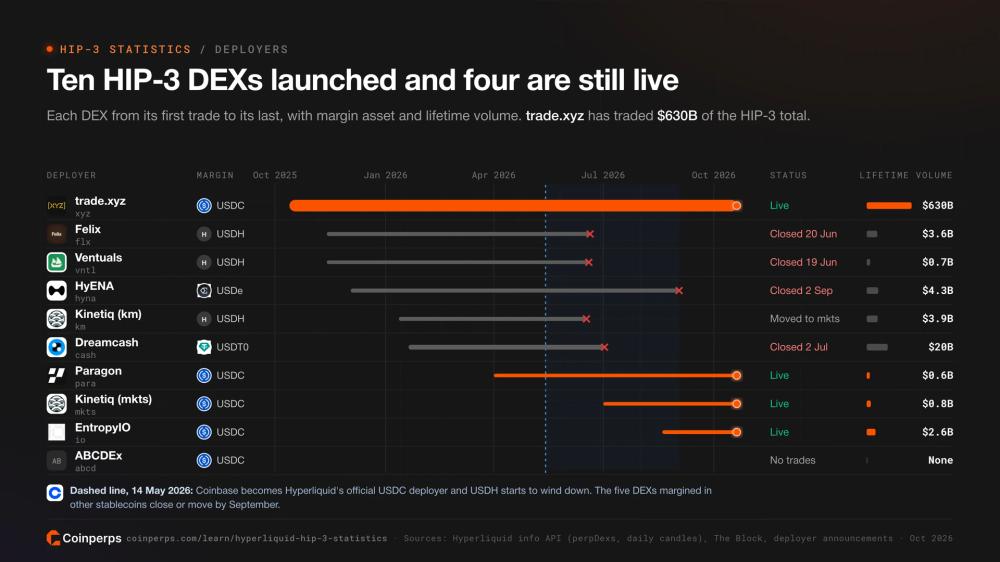
Since launch ten deployer DEXs have registered. Six of them no longer list a single market.
Deployer | DEX code | Collateral | Lifetime volume | Status |
|---|---|---|---|---|
trade.xyz | xyz | USDC | $629B | Live |
Dreamcash | cash | USDT0 | $19.5B | Closed July 2026 |
HyENA | hyna | USDe | $4.3B | Closed September 2026 |
Markets by Kinetiq | km | USDH | $3.9B | Moved to mkts in June 2026 |
Felix | flx | USDH | $3.6B | Closed June 2026 |
EntropyIO | io | USDC | $2.6B | Live since August 2026 |
Markets by Kinetiq | mkts | USDC | $0.8B | Live |
Ventuals | vntl | USDH | $0.7B | Closed June 2026 |
Paragon | para | USDC | $0.6B | Live since April 2026 |
ABCDEx | abcd | USDC | Under $0.1B | Delisted |
Stablecoins explain most of the exits. Coinbase became Hyperliquid's official USDC deployer on 14 May 2026, and the USDH stablecoin began to wind down, The Block reported. Felix, Ventuals and Kinetiq's first DEX all used USDH. Dreamcash ran on Tether's USDT0 and HyENA on Ethena's USDe, so both lost ground once trading consolidated around USDC.
The newer entrants are smaller and more specialised. Paragon offers crypto index perps such as Bitcoin dominance at up to 50x leverage. EntropyIO lists pre-IPO contracts, Anthropic among them. Combined, the three live DEXs outside trade.xyz hold about $114 million of open interest.
Under the HIP-3 specification, each live DEX must keep 500,000 HYPE staked for at least 183 days. Validators can slash that stake for faulty oracle or market operation. With four DEXs live, at least 2 million HYPE is locked, worth about $157 million at the 20 October price of $78.72. No slashing event has been reported.
HIP-3 Fees, Funding and Leverage
Trading HIP-3 markets usually costs less than trading Hyperliquid's crypto perps, and baseline funding is lower. Leverage on most single stocks is lower as well.
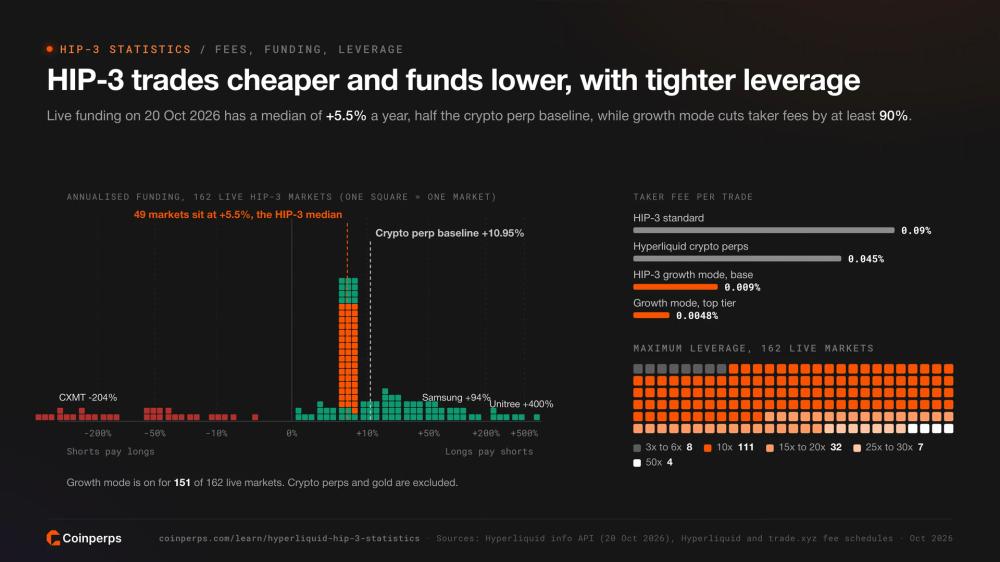
Standard HIP-3 fees are twice the rate on validator-run perps, split evenly between Hyperliquid and the deployer. Growth mode arrived in November 2025 and cuts all-in fees by at least 90%. Base taker fees then fall to between 0.0045% and 0.009%, against 0.045% on core perps, according to the Hyperliquid fee schedule.
Of the 162 live HIP-3 markets, 151 run in growth mode. Crypto perps and gold cannot use it. The full tier table is in our Hyperliquid fees explained guide.
The cheap pricing means HIP-3 earns less per dollar traded. In the first half of 2026 it generated 11.2% of Hyperliquid's gross fees, 21Shares found, while carrying about 27% of the exchange's volume by our count. CoinShares puts the realised protocol take on HIP-3 at about 0.55 basis points, compared with about 3 basis points at standard pricing.
Funding is lower too. At 0.000625% an hour, or about 5.5% a year, the median live HIP-3 market charges half the 10.95% baseline on Hyperliquid's crypto perps. Hot or thinly traded names can swing far from that. On 20 October Unitree longs were paying close to 400% annualised, and CXMT shorts over 200%.
For cross-exchange comparisons, see our funding rates page.
Leverage caps are tighter than many traders expect.
- 10x: 111 of 162 live HIP-3 markets, mostly single stocks.
- 20x to 30x: megacap stocks, oil, gold, silver and XYZ100.
- 50x: four markets, the S&P 500 contract plus the euro, yen and pound.
HIP-3 Against Centralised Exchanges and CME
Centralised exchanges still trade more real-world asset perps than HIP-3 does, even though HIP-3 is the largest onchain venue for them. Binance leads clearly on volume. HIP-3 leads in index contracts.
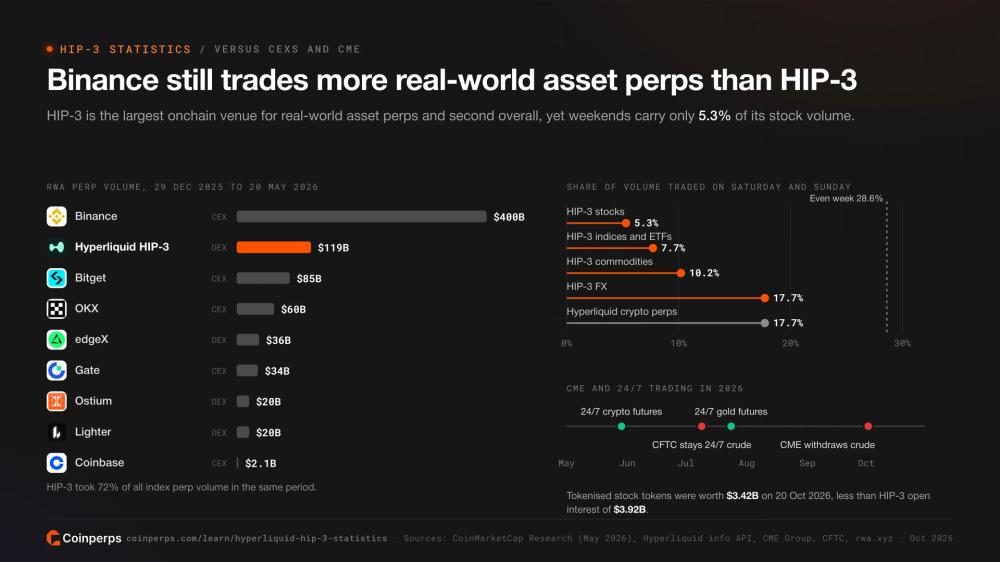
CoinMarketCap Research tracked real-world asset perp volume across 17 venues between 29 December 2025 and 20 May 2026.
Venue | RWA perp volume | Share |
|---|---|---|
Binance | $400B | About 49% |
Hyperliquid HIP-3 | $119B | 14.5% |
Bitget | $85B | About 10% |
OKX | $60B | About 7% |
edgeX | $36B | About 4% |
Gate | $34B | About 4% |
Ostium | $20B | About 2% |
Lighter | $20B | About 2% |
Coinbase | $2.1B | Under 1% |
That report also gave HIP-3 72% of all index perp volume. Centralised exchanges moved quickly once HIP-3 had launched. Binance listed gold and silver perps in January 2026, Kraken added tokenised equity perps in February, and in March Coinbase launched stock perps for non-US users. Our list of the best TradFi perpetual exchanges compares them.
Weekend trading is HIP-3's clearest edge over traditional futures, yet weekends carry a small share of its volume. Between April and mid-October 2026, Saturdays and Sundays accounted for 5.3% of HIP-3 stock volume, 7.7% of index and ETF volume and 10.2% of commodity volume. Hyperliquid's crypto perps did 17.7% of their volume at weekends. An even spread across the week would be 28.6%.
Demand jumps when news breaks while traditional markets are shut. During the Iran conflict Hyperliquid's WTI perp reached about $1.7 billion in daily volume, and JPMorgan analysts noted non-crypto traders using it while CME was closed.
In July 2026 CME launched round-the-clock gold futures. The CFTC stayed its 24/7 crude contract on 9 July, though, and CME withdrew that filing in October. That leaves weekend oil trading with crypto venues.
Perps also dwarf tokenised stock tokens. rwa.xyz valued distributed tokenised stocks at about $3.42 billion on 20 October 2026, less than HIP-3's open interest alone.
HIP-3 Risks Visible in the Data
Beyond the usual perp risks, HIP-3 has some of its own. Deployer-run oracles, thin weekend books and concentration in one venue have all cost traders money in its first year.
Date | Market | What happened | Liquidations |
|---|---|---|---|
Mid-December 2025 | XYZ100 | A $10M Sunday short pushed the price down about 3.5% while Nasdaq futures were closed (The Defiant) | About $13M |
29 January 2026 | Gold and silver | Silver fell about 12% in a day (Decrypt) | About $71M across 3,200 users |
7 April 2026 | WTI and Brent | Oil dropped after the US announced a two-week ceasefire with Iran (Decrypt) | About $79.7M |
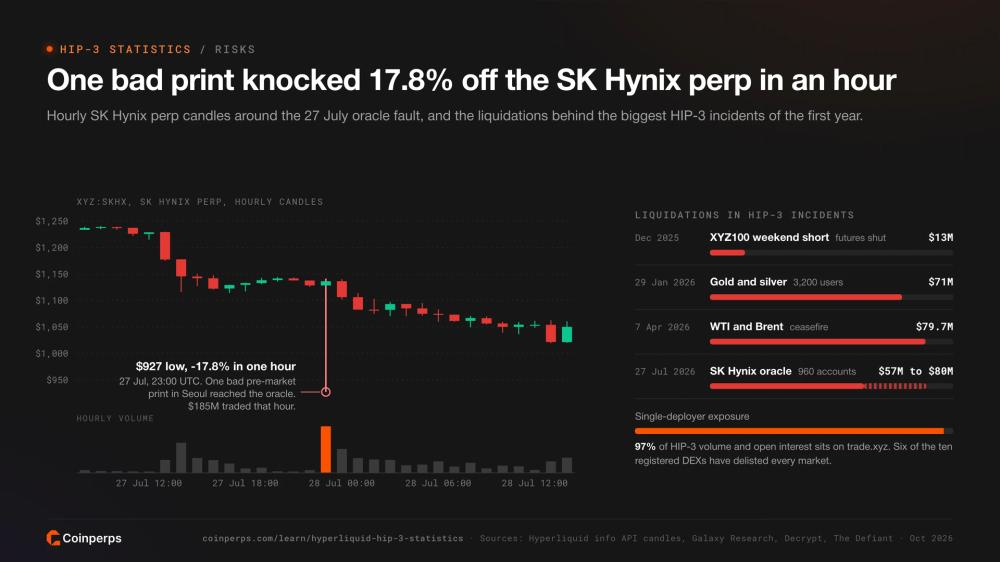
27 July 2026 | SK Hynix | One bad pre-market print in Seoul cut the mark price 18.7% | $57M to $80M across 960 accounts |
The SK Hynix event is the clearest test of HIP-3 oracle design so far. Every input to the oracle read the same Korean order book, Galaxy Research found, so the median and averaging rules absorbed only part of the move. Profitable shorts were auto-deleveraged, and trade.xyz later reimbursed traders as a one-time decision. Our guide on how to avoid auto-deleveraging explains the mechanism.
Weekend pricing brings a separate risk. While stock exchanges are shut, trade.xyz prices equity perps from its own order book, inside bounds tied to each market's maximum leverage. Prices can gap when the reference market reopens, its risk disclosures warn.
Then there is concentration. One deployer holds about 97% of activity, so an outage, oracle fault or legal problem at trade.xyz would hit almost the whole HIP-3 market. Six DEXs have already delisted every market, and their traders had to close or settle positions on each deployer's timetable.
Access is restricted as well. US persons are barred from trade.xyz, and the S&P 500 contract is licensed for eligible non-US users only. The UK FCA added Hyperliquid to its warning list in May 2026, and European regulators have said perps sold to retail clients will likely fall under CFD rules.
Before you trade, check our Hyperliquid restricted countries list and our guide to crypto perpetual futures regulation.
Bottom Line
In a year, HIP-3 went from a single Nasdaq-100 contract to a market that has traded about $665 billion and holds $3.92 billion of open interest. Stocks, indices and commodities now make up a quarter to a half of daily Hyperliquid volume.
The same data shows a market that leans on one deployer and trades thinly at weekends unless news breaks. It has already been through oracle and liquidation incidents. Treat HIP-3 markets as leveraged derivatives with their own rules, and check each market's leverage, funding and caps first. Live platform data is on our Hyperliquid exchange page.


