Best Crypto Exchanges in China for 2026
Compare the best crypto exchanges for Chinese users, from mainland access and CNY P2P depth to KYC rules, Notice 42, tax and bank card freeze risks.

Disclosure: Coinperps may earn a commission from partner links, at no extra cost to you. Reviews are based on independent testing — see how we test.
- No exchange is legal in mainland China: Notice 42, issued by eight agencies on 6 February 2026, bans every crypto business and bars overseas platforms from serving mainland users, so Chinese users have no local investor protection on any exchange.
- Kraken is the safest overall pick: its prohibited list does not name mainland China, it holds MiCA, CySEC and UK FCA licences, works in Chinese and accepts USDT on TRON, although you must buy USDT elsewhere first.
- OKX and Binance lead on yuan access: OKX's terms do not name the mainland and it runs a live CNY P2P market, while Binance has the deepest market, with 3,540 adverts, but calls mainland accounts withdrawal-only.
- Bybit, Gate, KuCoin, MEXC and HTX exclude mainland China in their terms: Bybit still accepts Chinese nationals who live abroad, while HTX now faces UK sanctions and an EU transaction ban.
- The biggest practical risk sits outside the exchange: buying USDT on P2P can expose your bank card to a police freeze if the counterparty's money came from fraud, and courts treat crypto contracts as void.

Kraken
Kraken is the most trusted and well regulated perpetuals exchange across the US, Europe, Canada, and other key markets, offering 170+ contracts with deep liquidity and low fees.
Features
Fees
Regulation
Overall Rating
No crypto exchange can legally serve mainland China. On 6 February 2026 the People's Bank of China (PBoC) and seven other agencies issued Notice 42, which bans every crypto business and bars overseas platforms from serving mainland users "in any form".
Chinese users still trade, mostly through a VPN and offshore apps. Chainalysis puts China's crypto economy at $176.3 billion or more in the year to June 2026, and 59.1% of that activity moved peer to peer (P2P).
We read the terms of 13 exchanges on 15 October 2026, pulled live Chinese yuan (CNY) P2P order books and compared spot fees, licences and security records.
This guide to the best crypto exchanges in China weighs our exchange rankings against how each platform treats mainland users and the licences its group holds abroad. Those foreign licences are the only regulatory backstop a Chinese user has.
Top 6 Crypto Exchanges for Chinese Users
Exchange | Mainland China in Terms | CNY On-Ramp | Spot Maker Fee | Spot Taker Fee | Key Licence | Key Nuance |
|---|---|---|---|---|---|---|
Not listed | None, deposit USDT on TRON | 0.38% | 0.80% | MiCA (Ireland), CySEC, UK FCA | Widest licensing, Chinese-language app, no Chinese corporate ties | |
Not listed | P2P with Alipay, WeChat Pay and bank | 0.08% | 0.10% | MiCA (Malta), Dubai VARA | Founded in Beijing, never announced a mainland user exit | |
Not listed, illegal-use clause applies | Deepest P2P, 3,540 live ads | 0.10% | 0.10% | ADGM (Abu Dhabi) | Mainland accounts officially withdrawal-only since 2021 | |
Not listed, illegal-use clause applies | Thin P2P with freeze compensation | 0.10% | 0.10% | EU national registrations | About $388 million hack in September 2026, users covered | |
Not listed | None, deposit USDC | 0.04% | 0.07% | None (decentralised) | No KYC, you hold your own keys | |
Excluded | None | 0.10% | 0.10% | MiCA (Austria) | Only for Chinese nationals living abroad |
1. Kraken
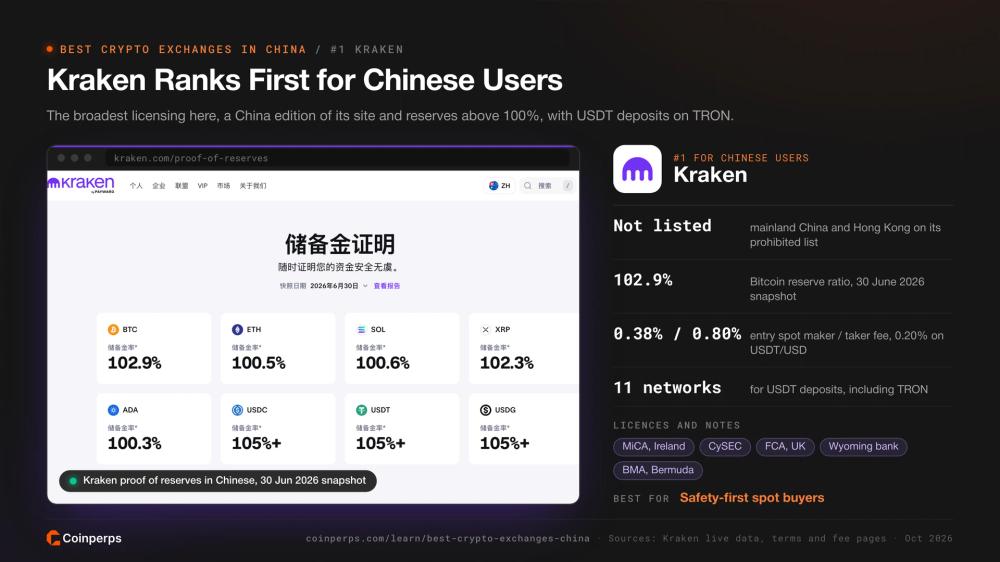
Kraken ranks first for Chinese users who put the safety of their funds ahead of convenience. No exchange holds a licence that covers the mainland, so the strongest protection on offer is a heavily regulated custodian with verified reserves and no Chinese corporate ties.
Its prohibited regions list, updated on 30 September 2026, names neither mainland China nor Hong Kong. The list covers sanctioned states plus Japan and Russia.
Kraken holds the longest licence list in this guide. Two Irish entities hold MiCA licences, a Cyprus entity is a CySEC investment firm and its UK arm is registered with the Financial Conduct Authority. It also runs a Wyoming bank charter, an SEC-registered broker-dealer and a Class F digital asset licence in Bermuda.
Kraken was founded in San Francisco in 2011 and has no Chinese founders, offices or parent company. That matters because Notice 42 makes mainland staff and partners of offshore platforms liable, and Huobi, Binance and MEXC all cleared mainland users after the 2021 crackdown.
The platform works in Chinese. Kraken runs a China edition of its website, its apps offer Simplified and Traditional Chinese, and its document requirements accept a passport or national identity card. Chinese-language proof of address clears faster with a notarised translation.
Mainland access looks open in practice, although Kraken has not said so publicly. In February 2025 lawyer Xiao Sa's team reported that Kraken's site loaded from mainland IP addresses without a VPN and that accounts passed verification with Chinese phone numbers, ID cards and China as the country of residence.
The same team warned that serving mainland residents breaches Chinese rules, so this access could close without notice. Their test accounts could withdraw up to $100,000 a day, and they moved USD out to Hong Kong and US bank accounts.
Kraken has no yuan on-ramp. The usual path is to buy USDT through P2P on another exchange and send it to Kraken, which accepts USDT deposits on TRON, Ethereum, Solana and eight other networks.
Spot crypto fees are the highest on this list. The Kraken fee schedule charges 0.38% maker and 0.80% taker at the first Kraken Pro tier, while stablecoin and FX pairs such as USDT/USD cost 0.20%. Futures cost 0.02% maker and 0.05% taker.
Kraken's proof of reserves snapshot of 30 June 2026 showed Bitcoin reserves at 102.9% of client balances and USDT above 105%, reviewed by an independent accounting firm. Kraken says no customer funds have been lost to a platform breach since 2011.
Its incidents have not touched client money. Security researchers took about $3 million from Kraken's treasury in 2024 and returned it, and rogue support staff exposed data on about 2,000 accounts in 2025 and 2026. Our Kraken restricted countries guide covers access, and you can sign up through Kraken.
Pros
- Neither mainland China nor Hong Kong is on its prohibited list.
- The broadest licensing of any exchange here, including MiCA, CySEC and the UK FCA.
- A Chinese-language website and app, plus USDT deposits on TRON.
- Reserves above 100% in its June 2026 snapshot and no customer funds lost to a hack.
Cons
- No CNY on-ramp, so you still need a P2P market elsewhere.
- The highest spot crypto fees in this guide.
- Mainland access rests on practice, not a published Kraken policy, and could close.
2. OKX
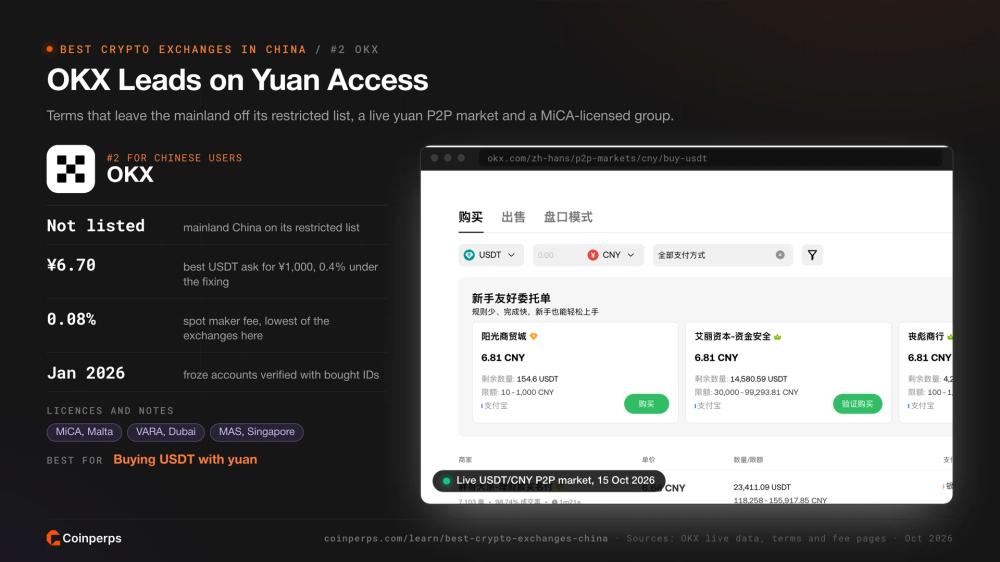
OKX is the best exchange for Chinese users who need a yuan on-ramp, because its terms do not list mainland China as restricted, it runs an active CNY P2P market and its group holds a MiCA licence (the EU's crypto rulebook) through Malta. The Risk and Compliance Disclosure, updated on 8 July 2026, names Hong Kong as restricted but not the mainland.
Our 15 October check found about 200 adverts on each side of the USDT/CNY market, the most the API returns. For a ¥1,000 order the best price to buy USDT was ¥6.70 via Alipay and the best price to sell was ¥6.66. Merchants accept bank transfer, Alipay and WeChat Pay.
Spot trading costs 0.08% for makers and 0.10% for takers at the base tier, according to the OKX fee framework. Perpetual futures cost 0.02% maker and 0.05% taker. OKX lists about 1,176 spot pairs and publishes monthly proof of reserves reports.
OKX began as OKCoin in Beijing in 2013, founded by Star Xu. After China's 2021 ban it said it had left the mainland, with no local office and no app in Chinese stores, but it never announced a clear-out of mainland accounts. It does treat mainland users as a separate group and closes its Jumpstart token sales to them.
In January 2026 OKX froze about $40,000 in stablecoins held in accounts that had been verified with purchased identities. OKX also pleaded guilty in the US in February 2025 and paid $504 million over unlicensed money transmission. Our OKX restricted countries guide covers regional access, and you can open an account through OKX.
Pros
- Terms that do not name mainland China, unlike Bybit, Gate, KuCoin, MEXC and HTX.
- A live CNY P2P market with Alipay, WeChat Pay and bank transfer.
- The lowest base spot maker fee of the centralised exchanges here.
- MiCA, Dubai VARA and Singapore licences across the group.
Cons
- No licence covers mainland users, and Notice 42 makes its service to them illegal under Chinese law.
- Some products, such as Jumpstart, are closed to mainland accounts.
- Accounts verified with borrowed or bought identities get frozen.
3. Binance
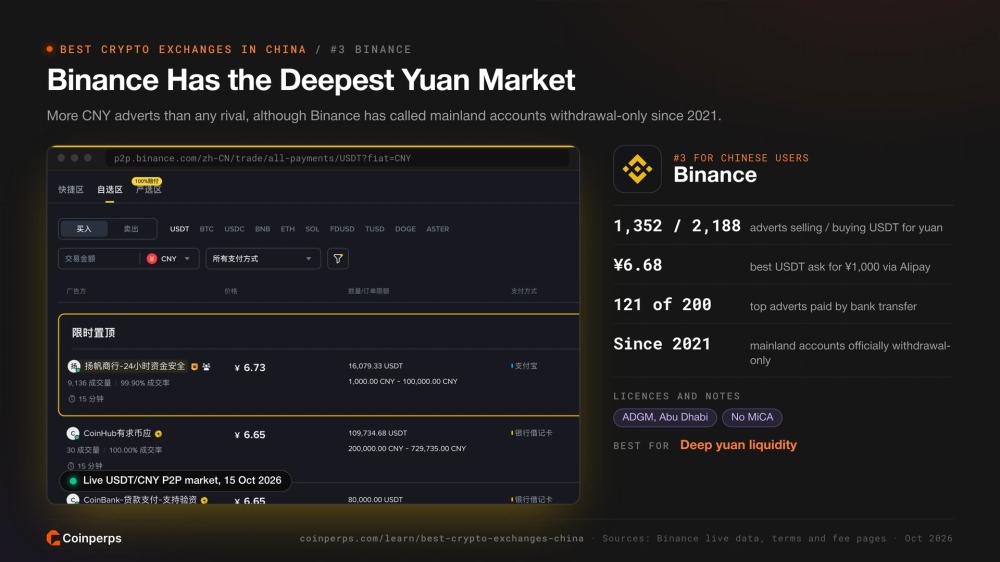
Binance runs the deepest yuan P2P market of any exchange. Our 15 October check found 1,352 adverts selling USDT for yuan and 2,188 buying it, 3,540 in total. For a ¥1,000 order the best buy price was ¥6.68 via Alipay and the best sell price was ¥6.66.
Among the top 200 adverts, 121 accepted bank transfer, 65 Alipay, 20 QQ Wallet and 8 WeChat Pay, and some block-size merchants quote ¥6.65 for orders starting at ¥200,000.
Officially, Binance delisted CNY from its P2P market at the end of 2021 and says mainland accounts have been withdrawal-only since then. Its List of Prohibited Countries, updated on 5 January 2026, does not name China, but its terms bar use wherever it would be illegal under local law and ban VPNs used to get around restrictions.
We could not confirm which accounts can trade the CNY adverts that still appear. Enforcement looked loose in 2023, when the Wall Street Journal found about 900,000 active Binance users in China in May, roughly 20% of the exchange's volume at the time.
Spot trading costs 0.10%, or 0.075% when fees are paid in BNB, according to the Binance fee schedule. USDⓈ-M futures cost 0.02% maker and 0.05% taker, and Binance leads the Coinperps open interest rankings on most major contracts.
Binance holds a global licence from the Financial Services Regulatory Authority of Abu Dhabi Global Market (ADGM), live since January 2026 according to its licences page. It has no MiCA licence after it withdrew its EU application in June 2026.
Changpeng Zhao and Yi He founded Binance in Shanghai in July 2017 and moved it offshore after China's ICO ban that September. Yi He became co-CEO in December 2025. Our Binance restricted countries guide covers access by region, and you can sign up through Binance.
Pros
- The deepest CNY P2P market, with 3,540 live adverts on our check.
- About 1,380 spot markets and the largest futures open interest of any exchange.
- An ADGM licence and regular proof-of-reserves reports.
- Full Simplified Chinese support and a large Chinese-speaking community.
Cons
- Mainland accounts are officially withdrawal-only, so access can be cut without notice.
- No MiCA licence after its EU exit in 2026.
- A $4.3 billion US settlement in 2023 still shapes how regulators view it.
4. Bitget
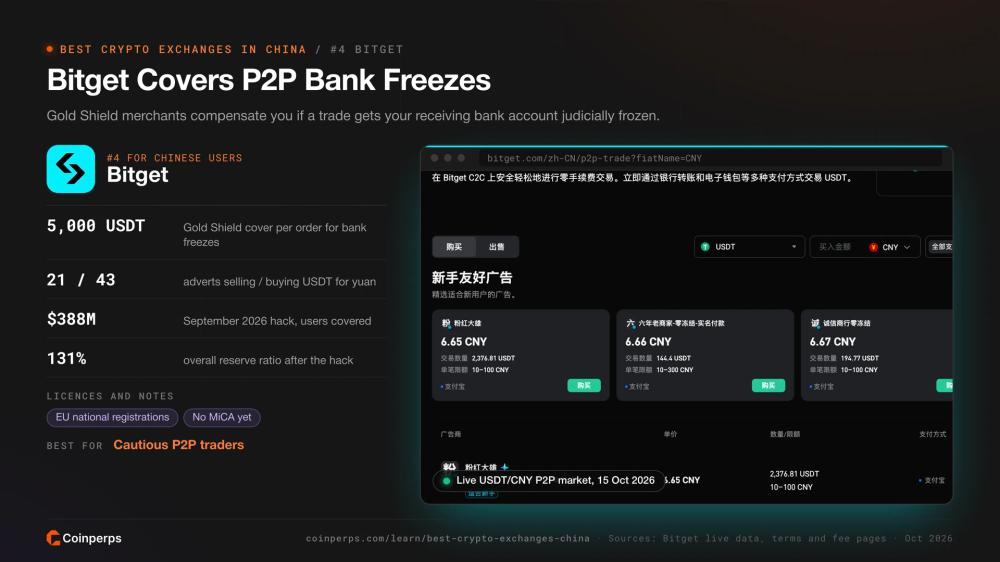
Bitget is the only exchange we found that compensates P2P users for bank freezes. Its "Gold Shield" merchants pay up to 5,000 USDT per order if your receiving account is judicially frozen because of their payment.
Its yuan market is small. Our check found 21 adverts selling USDT and 43 buying it, with a best price of ¥6.65 on both sides and Alipay, WeChat Pay and bank transfer accepted. The Terms of Use, updated on 15 September 2026, list Hong Kong as prohibited but not the mainland, although they bar use anywhere the service is "not permitted, restricted or illegal".
Spot trading costs 0.10% for makers and takers, with 20% off when you pay in BGB. Futures cost 0.02% maker and 0.06% taker, and Bitget also offers copy trading, which mirrors other traders' positions.
Bitget lost about $388 million in a hack on 24 September 2026, when attackers drained 12 hot and warm wallets. Its Protection Fund covered users, all withdrawals resumed by 2 October, and its proof of reserves showed a 131% overall ratio afterwards.
Bitget has no MiCA licence yet and applied to Austria's Financial Market Authority in June 2026. It holds pre-MiCA registrations in Lithuania, Poland, Italy, Czechia and Bulgaria. Our Bitget restricted countries guide lists where it operates, and you can join through Bitget.
Pros
- Gold Shield merchants compensate judicial bank freezes up to 5,000 USDT.
- CNY P2P with Alipay, WeChat Pay and bank transfer.
- Thousands of spot pairs plus copy trading.
- Reserves above 100% after the September 2026 hack.
Cons
- A thin yuan market, so prices move on larger orders.
- A fresh hack, even though users were covered.
- No MiCA licence yet.
5. Hyperliquid
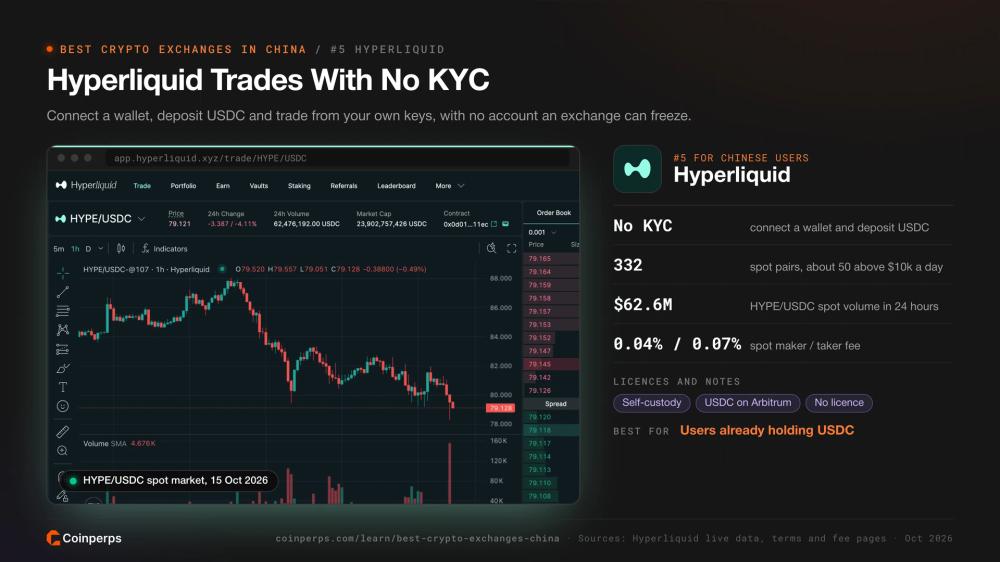
Hyperliquid is the leading decentralised exchange (DEX) and the only platform here with no identity checks. You connect a wallet, deposit USDC and trade from your own keys, and Coinperps rates it the top DEX in our rankings.
Its Terms of Use, updated on 15 June 2026, restrict the United States, Ontario and sanctioned territories. China is not named, but the terms ban VPNs used to hide your location.
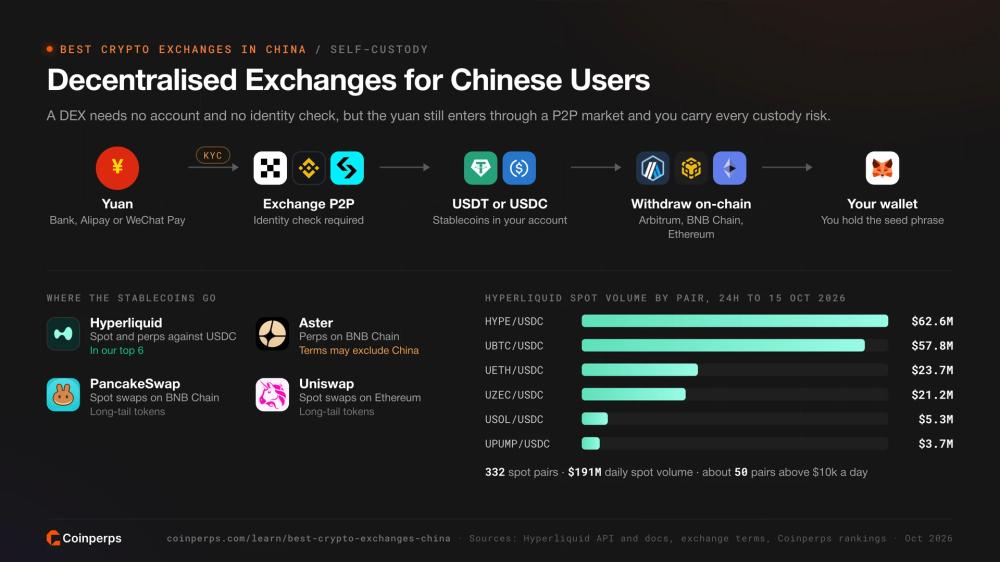
Spot trading is smaller than its futures business. On 15 October Hyperliquid listed 332 spot pairs with about $191 million in daily volume, led by HYPE/USDC at $62.6 million and UBTC/USDC, a bridged form of Bitcoin, at $57.8 million. Only about 50 pairs traded more than $10,000 that day.
Spot fees are 0.04% maker and 0.07% taker at the base tier, and perpetual futures cost 0.015% and 0.045%, according to the Hyperliquid fee docs. You fund it with USDC on Arbitrum, as our guide to depositing USDC on Hyperliquid explains.
Governance is more centralised than the name suggests. In March 2025 validators delisted the JELLY token and force-settled positions within minutes to protect a community vault. The official app has no Chinese language option. Read our Hyperliquid fees explained guide before trading, and start through Hyperliquid.
Pros
- No KYC and no account an exchange can freeze.
- Low spot and futures fees.
- Mainland China is not named in its restricted list.
Cons
- No yuan on-ramp, so you still need a P2P market to get USDC.
- A lost seed phrase means lost funds, with no support desk to recover them.
- Thin liquidity outside the top few spot pairs.
6. Bybit
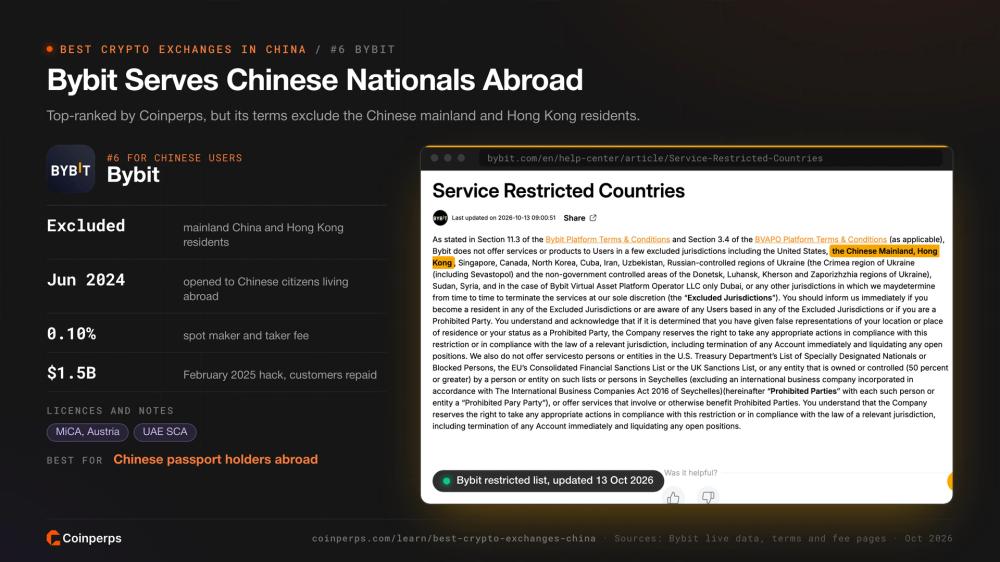
Bybit shares the top score in our exchange rankings, but its restricted countries list, updated on 13 October 2026, excludes "the Chinese Mainland" and Hong Kong. It belongs in this guide for Chinese nationals who live outside the mainland.
Bybit opened verification to Chinese citizens abroad in June 2024. If you live in a supported country, a Chinese passport plus local proof of address gives you full access. If you misstate your location, Bybit's terms let it close the account and liquidate your positions.
Bybit has no CNY P2P market. Spot trading costs 0.10% for makers and takers, and perpetual futures cost 0.02% maker and 0.055% taker. Bybit EU holds a MiCA licence from Austria's Financial Market Authority.
In February 2025 Bybit lost about $1.5 billion in a hack that the FBI attributed to North Korea, and customers were made whole. Our Bybit restricted countries guide lists supported regions, and eligible users can sign up through Bybit.
Pros
- Accepts Chinese nationals who live in supported countries.
- Deep spot and futures liquidity with a MiCA-licensed EU arm.
- Full Chinese-language support.
Cons
- Mainland China and Hong Kong residents are excluded.
- No yuan P2P market.
- The largest exchange hack on record, even though customers were repaid.
How We Ranked These Exchanges
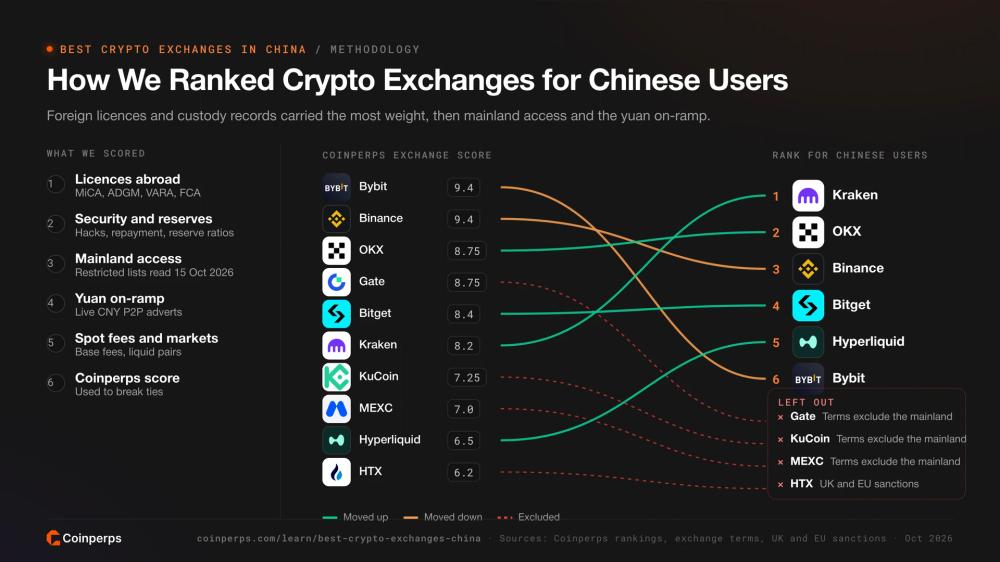
Our ranking rewards exchanges that let Chinese users trade spot crypto with the least legal and custody risk. No exchange can hold a licence for the mainland, so we weighted foreign licences and custody records most heavily, followed by mainland access and the yuan on-ramp.
- Licences abroad: a MiCA, ADGM, VARA or FCA licence means a regulator audits custody and conduct, even if it cannot protect you in China.
- Security and reserves: hacks, how customers were treated afterwards and the latest proof-of-reserves ratios.
- Mainland access in the terms: we read each platform's restricted list on 15 October 2026 and ranked exchanges that name mainland China below those that do not.
- Yuan on-ramp: we counted live CNY P2P adverts and checked which payment methods merchants accept.
- Spot fees and markets: base-tier maker and taker fees and the number of liquid spot pairs.
- Coinperps score: our exchange rankings cover liquidity, product range and reliability, and they break ties.
Several high-scoring exchanges were dropped because their terms exclude the mainland. Gate scores 8.75 in our rankings, but its user agreement names mainland China, as do the terms of KuCoin and MEXC.
HTX, the former Huobi, also excludes the mainland and still lists a deep yuan market under the label "CNH". We left it out because the UK sanctioned its operator on 26 May 2026 and the EU banned transactions with it from 23 August 2026.
Is Crypto Legal in China?
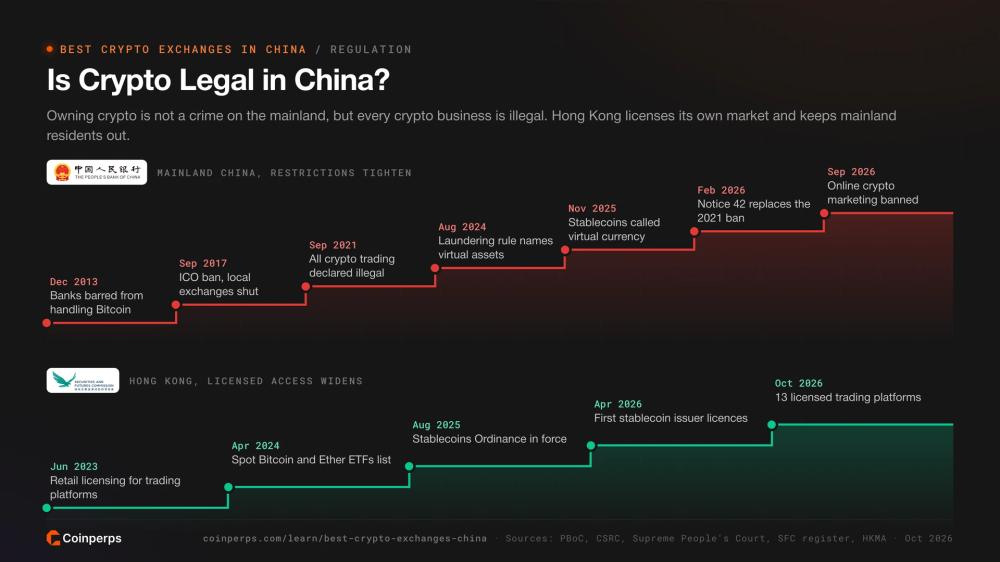
Owning crypto is not a crime in mainland China, but every business that lets you buy, sell or trade it is illegal. Your trades also have no legal protection, because Chinese courts treat crypto investment contracts as void.
Notice 42 Replaced the Earlier Ban
Notice 42 repealed the September 2021 ten-agency notice that first declared all crypto trading illegal, and it names Bitcoin, Ether and Tether as virtual currencies with no legal tender status.
The notice bans fiat-to-crypto exchange, crypto-to-crypto trading, matching and pricing services, token sales and crypto derivatives. It bars overseas entities and individuals from serving mainland users "in any form" and bans yuan-pegged stablecoins issued offshore without approval. Article 19 states that losses from investing in virtual currencies fall on the investor.
The direction was set months earlier. A PBoC meeting with 13 agencies on 28 November 2025 said speculation had resurged and called stablecoins a form of virtual currency that cannot meet anti-money laundering rules.
Holding Crypto Is Not a Crime
Shanghai courts have described Bitcoin as property, and a Shanghai High Court commentary in 2024 said that simply holding crypto is not illegal, while businesses may not invest in it or issue tokens.
Criminal law protects your coins from theft. In June 2026 prosecutors publicised a Qingdao case in which a man received 10 years and 9 months for stealing 107 BTC after memorising the victim's seed phrase.
Civil courts are less helpful when a trade goes wrong. In Guiding Case No. 199, the Supreme People's Court upheld the cancellation of an arbitration award that ordered a party to pay the dollar value of Bitcoin, because enforcing it would support crypto-to-fiat exchange.
Payments and Promotion Are Cut Off
Banks and payment apps may not serve crypto businesses. In June 2021 the PBoC summoned five major banks and Alipay and ordered them to find and cut off accounts linked to exchanges and over-the-counter (OTC) dealers.
New rules on online marketing of financial products took effect on 30 September 2026 and forbid any firm or person from marketing "virtual currency issuance and trading" or offshore financial services to mainland residents.
VPN Rules
Using an unapproved VPN breaks China's internet rules, although enforcement against individuals is rare. A 2017 Ministry of Industry and Information Technology (MIIT) notice bans unauthorised cross-border VPN services.
The penalties can be heavy when police do act. In 2023 police in Chengde confiscated RMB 1.058 million that a programmer had earned working remotely through a VPN. Every exchange in this guide also bans VPN use in its own terms.
Hong Kong Runs a Separate Licensed Market
The Securities and Futures Commission (SFC) has licensed trading platforms since June 2023, and its register listed 13 platforms on 12 October 2026, including OSL, HashKey Exchange and Bullish.
Those platforms are closed to mainland residents. HashKey says it does not serve users in mainland China, and Hong Kong's spot Bitcoin and Ether ETFs are not open to mainland investors through the Southbound Stock Connect. Hong Kong residents should use an SFC-licensed platform.
Which Exchanges Accept Users From Mainland China?
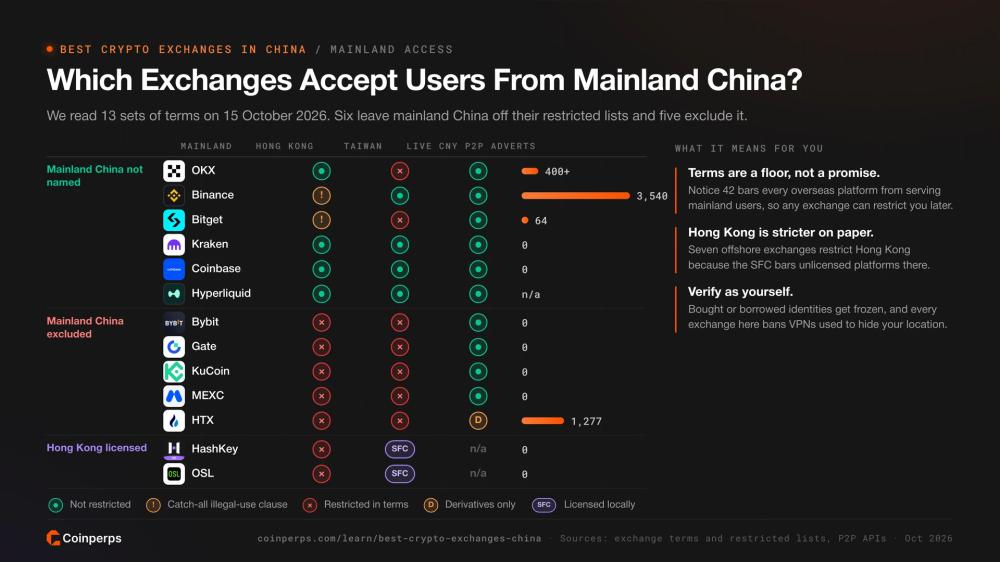
If you live on the mainland, only a few exchanges leave you off their restricted lists, and none can promise to keep serving you.
- Mainland China not named: OKX, Binance, Bitget, Kraken, Coinbase and Hyperliquid. Binance and Bitget still bar use wherever it would be illegal, which Notice 42 arguably covers.
- Mainland China named as restricted: Bybit, Gate, KuCoin, MEXC and HTX.
- Hong Kong licensed, mainland excluded: HashKey Exchange and OSL, which require Hong Kong residence.
Hong Kong is treated more harshly than the mainland on paper. OKX, Bitget, Bybit, Gate, KuCoin, MEXC and HTX all restrict Hong Kong, because the SFC forbids unlicensed platforms from serving its residents. No exchange we checked restricts Macau, and only HTX restricts Taiwan, for derivatives alone.
Identity checks depend on your documents and your address. Chinese passport holders who live abroad can verify on most exchanges with local proof of address, and Bybit opened to them explicitly in 2024.
Mainland residents with a resident ID card face more uncertainty. In July 2026 several outlets reported that Coinbase had quietly begun accepting Chinese ID cards with mainland addresses for crypto-only accounts. Coinbase made no announcement, and its ID document table had no China entry on 15 October.
Verify with your own identity and your real address. Exchanges freeze accounts opened with bought or borrowed documents, as OKX did in January 2026, and misstating your location gives every exchange here the right to close your account.
How to Buy USDT With Chinese Yuan
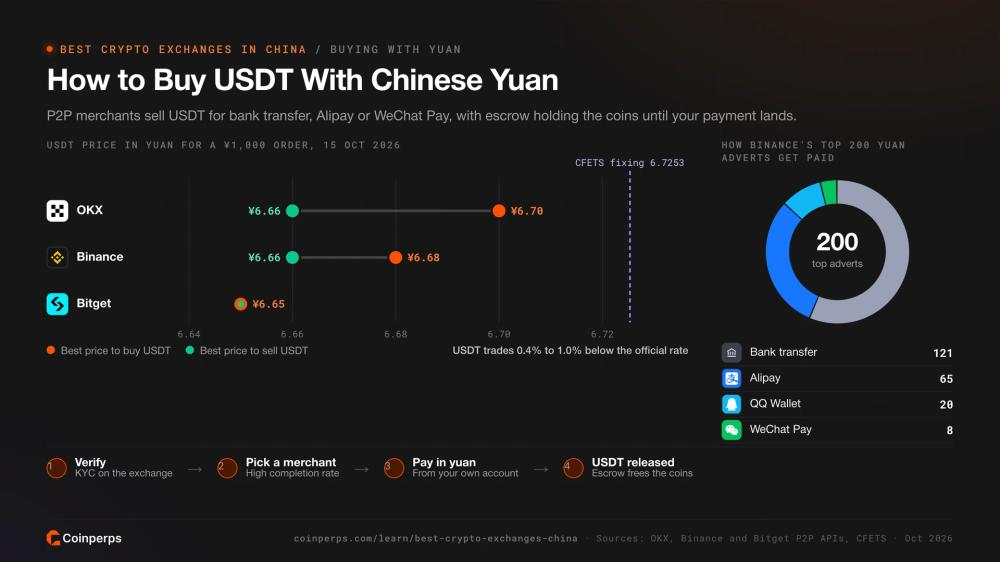
Most Chinese users buy USDT, a dollar-pegged stablecoin, through a P2P market inside an exchange app. You pay a seller in yuan by bank transfer, Alipay or WeChat Pay, and the exchange holds the seller's USDT in escrow until you confirm payment.
- Verify your account: complete identity checks first, because P2P markets need at least basic verification.
- Pick a merchant: filter by payment method and choose a verified merchant with a high completion rate and hundreds of past orders.
- Pay from your own account: transfer the exact amount from a bank card or wallet in your own name and keep the receipt.
- Release and withdraw: the seller releases the USDT once your payment arrives, and you can then trade spot or withdraw it to a wallet.
Prices sat just below the official exchange rate on our check. The China Foreign Exchange Trade System (CFETS) set the USD/CNY central parity at 6.7253 on 15 October, while the best P2P prices for a ¥1,000 order were ¥6.68 to ¥6.70 to buy and ¥6.66 to sell.
That puts USDT about 0.4% to 1.0% below the official rate. WeChat Pay adverts tend to cost more than bank transfer adverts, so paying by bank card usually gets a better price.
The market keeps growing despite the ban. Chainalysis found that Chinese wallets sending stablecoins peer to peer grew 43-fold between early 2024 and mid 2026, and that Chinese users turn over their stablecoins 33.2 times a year against a 9.3 times world average.
The yuan gained about 4.5% against the dollar on the CFETS fixing since the end of 2025, so USDT has lost value in yuan terms.
Your bank and foreign exchange limits still apply. The State Administration of Foreign Exchange (SAFE) caps personal purchases at $50,000 a year and bars using that quota for overseas investment, and a December 2024 SAFE rule requires banks to report "illegal cross-border virtual currency" activity.
Decentralised Exchanges and Self-Custody
A decentralised exchange lets you trade from your own wallet with no account to freeze and no identity checks. You still need stablecoins to fund it, and you carry every custody risk yourself.
Hyperliquid is the largest option. Its spot market trades HYPE and bridged versions of Bitcoin, Ether and Solana against USDC, and its futures market is far deeper, as our perp DEX vs CEX comparison shows.
Aster is popular with Chinese-speaking traders. It runs on BNB Chain, and YZi Labs, the family office linked to Binance co-founder Changpeng Zhao, holds a minority stake. Our guide to trading on Aster covers the basics, but third-party reviews say its terms exclude China, so check before you connect.
PancakeSwap on BNB Chain and Uniswap on Ethereum are the main spot swap markets for tokens that centralised exchanges do not list. Both need a self-custody wallet funded with USDT or USDC.
Skipping identity checks still leaves a trail. Every transfer is public on the blockchain, and Chinese police routinely trace USDT through underground banking cases. Back up your seed phrase offline, because the Qingdao theft case shows how one exposed phrase can empty a wallet.
Crypto Taxes in China
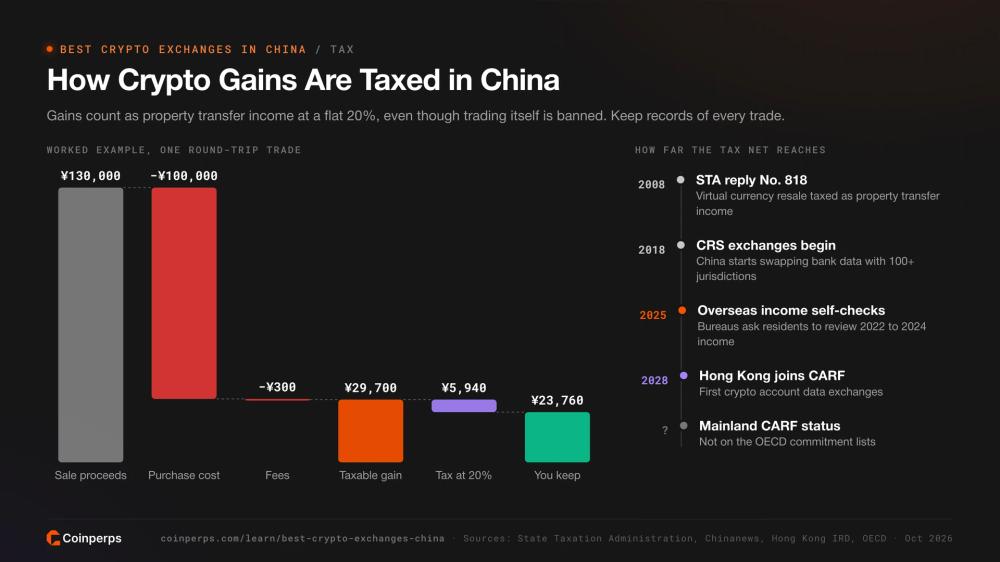
Crypto gains are taxable in China even though trading is banned. Gains from buying and reselling virtual currency count as property transfer income, taxed at a flat 20% under a 2008 State Taxation Administration reply that a Shanghai tax bureau still applied in 2024.
The taxable gain is your sale price minus your purchase price and reasonable fees. If you buy USDT worth ¥100,000, sell crypto for ¥130,000 and pay ¥300 in fees, your gain is ¥29,700 and the tax is ¥5,940.
Chinese tax residents owe tax on worldwide income, and enforcement on overseas income is rising. Since 2025 tax bureaus have asked residents to self-check foreign income for 2022 to 2024, using data shared under the Common Reporting Standard (CRS), which China joined in 2018.
None of those official notices names crypto, and most offshore exchanges sit outside CRS reporting today. Hong Kong has committed to the OECD's Crypto-Asset Reporting Framework (CARF) with first exchanges by 2028, while the mainland's position is unclear. Keep records of every trade and speak to a qualified tax adviser.
Risks of Using Crypto Exchanges From China
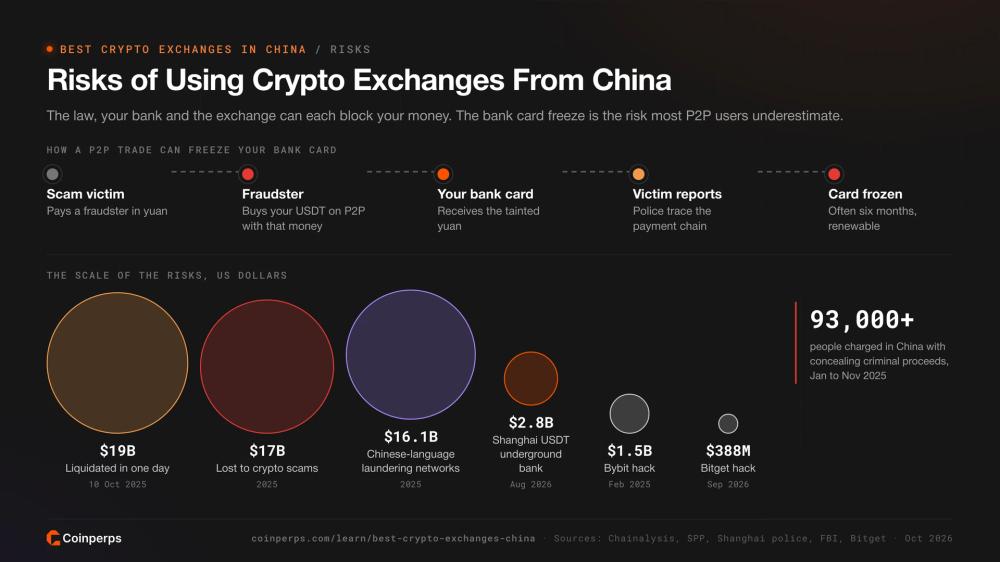
The risks for Chinese users go beyond price swings, because the law, your bank and the exchange can each block your money.
- No legal protection: courts treat crypto investment contracts as void, so you cannot recover losses through a Chinese court.
- Account restrictions: exchanges can switch a mainland account to withdrawal-only or close it, as Binance did in 2021.
- Bank card freezes: if a P2P buyer pays you with scam money, police can freeze your card during the fraud investigation, often for six months at a time.
- Criminal exposure: a 2024 judicial interpretation lists virtual asset trading as a money laundering method, and prosecutors charged more than 93,000 people with concealing criminal proceeds in the first 11 months of 2025.
- Platform failure: Bybit and Bitget both suffered major hacks within the past two years, and an exchange that serves you illegally owes you no local remedy.
- Scams: Chainalysis estimates about $17 billion was lost to crypto scams in 2025, and Chinese-language Telegram marketplaces supply much of the tooling behind them.
- Leverage: about $19 billion in positions were liquidated in a single day on 10 October 2025, which is why we treat spot trading as the safer starting point.
Underground banking cases show how P2P money gets caught up in crime. In August 2026 Shanghai police broke up a ¥20 billion network that bought USDT from coin merchants to move money abroad. Chainalysis says Chinese-language laundering networks handled $16.1 billion in 2025 and sold illicit USDT 10% to 20% below market.
A price far below the market rate is the clearest warning sign. Trade only with verified merchants, pay from your own account, keep chat records and receipts, and reject any request to move the deal off the platform.
Bottom Line
Kraken is the strongest choice for Chinese users who put safety first, combining terms that do not name the mainland, the broadest licensing here, a Chinese-language app and reserves above 100%. OKX is the best exchange with a yuan on-ramp, and many users buy USDT on its P2P market before moving it to Kraken.
Binance offers the deepest yuan liquidity but treats mainland accounts as withdrawal-only on paper, and Bitget's freeze compensation suits cautious P2P buyers.
Hyperliquid suits users who already hold USDC, and Bybit is the pick for Chinese nationals living abroad. Whichever platform you choose, Notice 42 leaves you without local protection, so keep your positions small, use spot before leverage and protect your bank card at every P2P trade.
