Best Crypto Exchanges in Ukraine (2026)
Compare the best crypto exchanges in Ukraine for 2026, from UAH P2P rails and trading fees to Bill 10225-d, martial law limits and the incoming tax rules.

Disclosure: Coinperps may earn a commission from partner links, at no extra cost to you. Reviews are based on independent testing, see how we test.
- The hryvnia gateway era just ended: Binance closed UAH deposits and withdrawals through Fiat Trade and delisted USDT/UAH on 28 September 2026, leaving P2P as its only tenge-free hryvnia route. Bybit’s zero-fee UAH P2P and WhiteBIT’s card rails now handle most exchange funding.
- Regulation is one vote away: Bill 10225-d passed its first reading in September 2025 with 246 votes and is being finalised for the second. Until it becomes law, no exchange holds a Ukrainian licence, while crypto sale proceeds face 18% income tax plus a 5% military levy.
- The NBU still blocks card purchases: Martial law rules classify crypto buys as quasi-cash, blocking them from hryvnia accounts and capping foreign-currency card purchases at 100,000 UAH monthly. Domestic P2P transfers remain the practical on-ramp for most traders.

Bybit
Bybit, founded in 2018 and headquartered in Dubai, is the world’s second-largest exchange by volume, serving 60 million users with 1,800+ assets and over $11 billion in daily trading.
Features
Fees
Regulation
Overall
Ukraine trades more crypto per person than almost anywhere on Earth, yet no exchange serving the country holds a Ukrainian licence because none exists. Chainalysis ranked Ukraine seventh in its 2026 Global Crypto Adoption Index and first worldwide by population a year earlier, driven by wartime savings behaviour and heavy stablecoin use.
The market is shifting quickly. The Verkhovna Rada passed bill 10225-d at first reading in September 2025 and is finalising it for a second. The bill would introduce licences, MiCA-style rules and a defined tax regime. Binance also shut its hryvnia fiat gateway on 28 September 2026, while Kuna closed after a court-ordered block in 2025.
We funded accounts through PrivatBank and Monobank cards, ran UAH P2P orders on every platform below and tested spot and perpetuals execution on each. The comparison assumes you want spot and futures in one place with a hryvnia rail unlikely to trigger bank monitoring.
Top 6 Crypto Platforms in Ukraine
How We Ranked These Exchanges
Over several months, we tested more than a dozen exchanges using live accounts funded through PrivatBank, Monobank and PUMB cards. Each platform was scored under the Coinperps platform ranking methodology, using five weighted categories:
- UAH on-ramp reliability: 25%
- Legal and regulatory standing: 25%
- Spot + perps liquidity: 20%
- Fees & execution: 20%
- Ukrainian language support: 10%
On-ramp reliability carries the same weight as legal standing. Ukraine has no licensing regime yet, so a major difference between platforms is simply whether hryvnia can move without a failed checkout or frozen card. Coinperps earns referral commissions from some exchanges covered here, but those arrangements never influence rankings. Full details are available on the Coinperps affiliate disclosure page.
1. Bybit
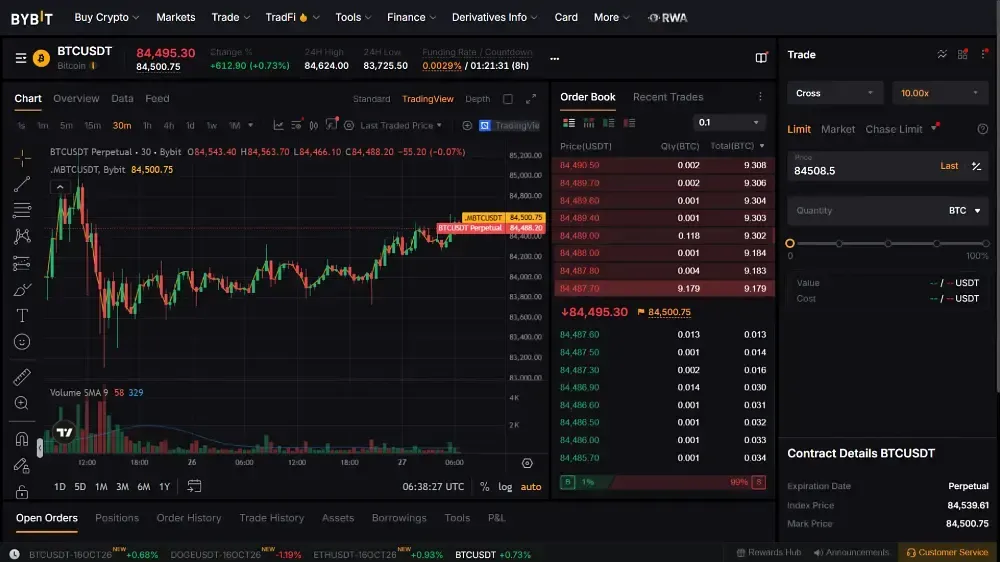
Bybit takes the top position by combining the strongest UAH P2P market of any global exchange with a fully localised Ukrainian interface. Sellers on its hryvnia board accept transfers through PrivatBank, Monobank, A-Bank and PUMB, and neither side pays a P2P commission. During our testing, competitive offers stayed within half a percent of the cash dollar rate.
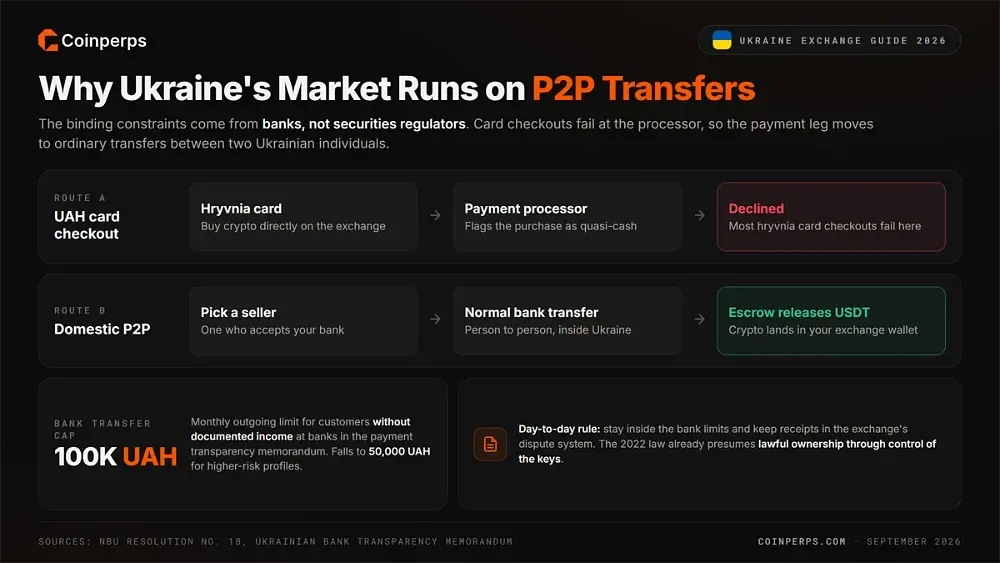
Direct card checkouts fail much more often than they clear because the National Bank prohibits quasi-cash payments from hryvnia accounts. Bybit’s escrow-based P2P avoids that restriction because the payment leg is an ordinary domestic transfer between two individuals. In every order we tested, USDT reached the funding wallet within minutes, including evening trades during air-raid alerts.
Spot trading costs 0.10%, while USDT perpetuals are priced at 0.02% maker and 0.055% taker. Leverage reaches 100x on major contracts. BTC and ETH funding remains among the tightest tracked on Coinperps, which matters more than headline fees once positions stay open overnight.
The group also holds a MiCAR licence from Austria’s FMA, giving Ukrainians who relocate into the EU a regulated route, as covered in our Bybit restricted countries guide.
Pros
- Zero-commission UAH P2P with deep seller coverage across PrivatBank, Monobank, A-Bank and PUMB, priced close to the cash dollar rate.
- Full Ukrainian localisation across the app, web platform and support articles, which no other global exchange on this list matches.
- Deep spot and perpetuals liquidity with a MiCA-licensed EU entity backing the group’s regulatory standing.
- Monthly Merkle-tree proof-of-reserves that users can verify against their own balances.
Cons
- No direct UAH deposit gateway, so every fiat entry and exit runs through P2P counterparties.
- The 0.10% spot fee is higher than MEXC’s maker pricing for cost-sensitive traders.
- No Ukrainian licence exists for it to hold, leaving disputes governed by foreign terms of service.
2. WhiteBIT
WhiteBIT is the closest thing Ukraine has to a home exchange. Founded in Kharkiv in 2018 and now registered in Lithuania with a MiCA licence, it reports more than 8 million users and ranks as Europe’s largest exchange by traffic. It sponsors the Ukrainian national football team and has funded drones and humanitarian programmes since 2022.
Its hryvnia infrastructure is the deepest in this comparison. A Card Transfer deposit route runs through a P2P partner using invoice-matched card numbers. P2P Express converts UAH to USDT in one step, while WhiteBIT maintains a genuine USDT/UAH spot order book instead of routing everything through merchants. Withdrawals land directly on a named Ukrainian card.
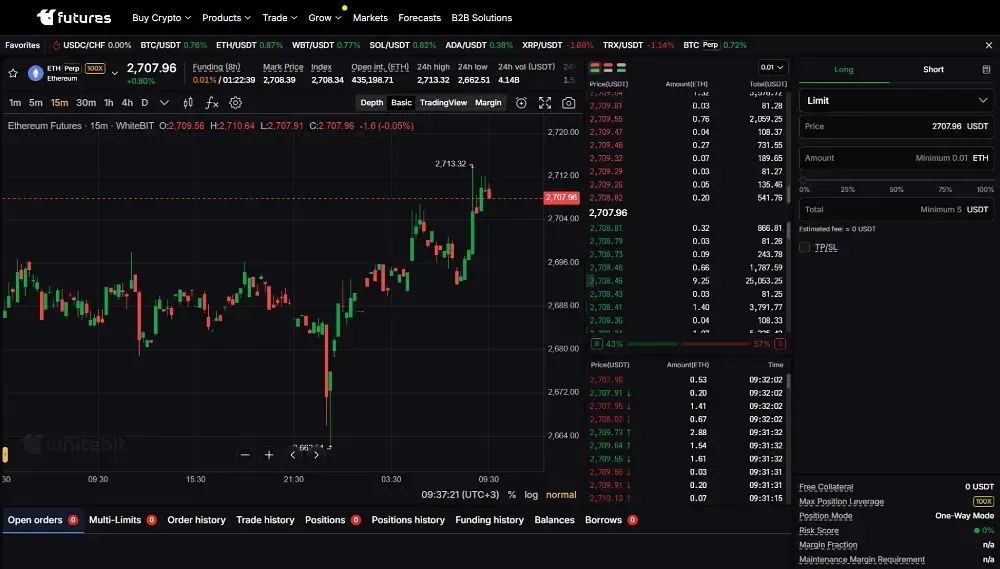
Derivatives pricing undercuts most rivals at 0.01% maker and 0.035% taker across more than 270 perpetuals. BTC and ETH contracts carry a 0.055% taker fee, with leverage up to 100x. Liquidity on long-tail perps thins out compared with Binance, while card deposits cost around 3% to 4%.
In our testing, P2P Express was the more practical funding route, with Card Transfer serving as a backup. Regional coverage is detailed in our WhiteBIT restricted countries guide.
Pros
- The only platform reviewed with a native USDT/UAH order book plus direct card deposit and withdrawal rails.
- Ukrainian founding team, full localisation and a visible commitment to the country’s defence and humanitarian causes.
- Futures taker fees of 0.035% on most pairs undercut the 0.05% to 0.06% charged by larger rivals.
- MiCA licence and CCSS Level 3 security certification support its regulatory and custody standing.
Cons
- Card Transfer deposit fees of roughly 3% to 4% make the direct rail expensive for larger amounts.
- Perpetuals depth beyond the top pairs trails Binance, Bybit and OKX during volatile sessions.
- No copy trading or built-in bots, which pushes strategy automation onto third-party tools.
3. Binance
Binance remains the liquidity benchmark for Ukrainian traders, but its fiat relationship with the hryvnia has ended. The exchange closed UAH deposits and withdrawals through Fiat Trade on 28 September 2026, delisted USDT/UAH and converted leftover balances at a fixed 46.5 UAH per USDT. Card withdrawals had already stopped in December 2025.
The P2P market survives. Binance has confirmed that it continues unchanged, and it remains the country’s largest hryvnia merchant pool. Offers cover PrivatBank, Monobank and PUMB, with tight spreads during business hours. For traders holding hryvnia, Binance now works best as a crypto-in, crypto-out venue with P2P acting as the bridge.
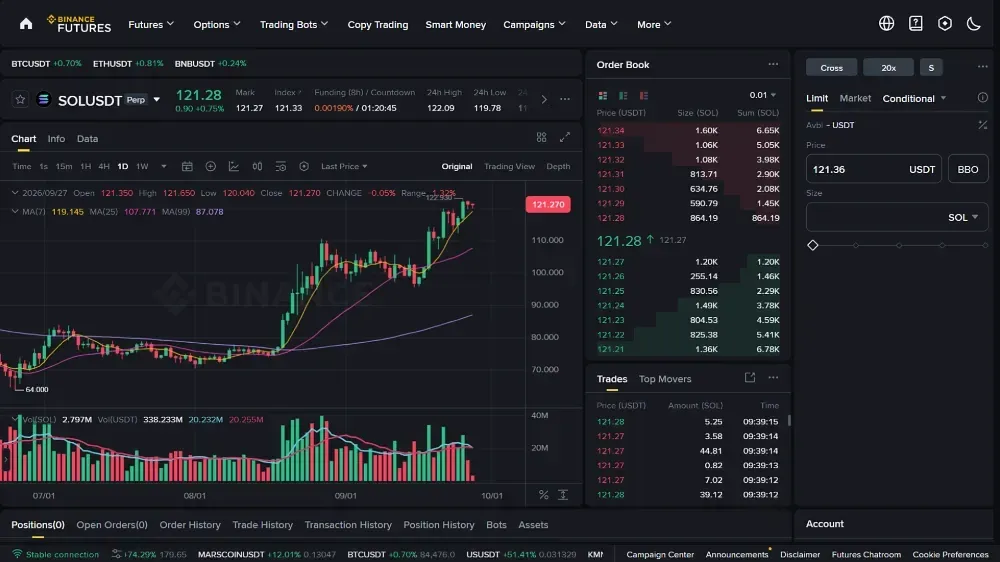
On the trading side, Binance leads the Coinperps open interest rankings across most major perpetuals. Spot trading costs 0.10%, while USDⓈ-M futures are 0.02% maker and 0.05% taker. Leverage reaches 125x. Our Bybit vs Binance futures fees comparison breaks down where each platform wins on real trading costs.
Pros
- The deepest spot and perpetuals books available from Ukraine, absorbing size that moves prices elsewhere.
- The largest UAH P2P merchant pool, which Binance has confirmed will keep operating after the gateway closure.
- Broad product range spanning options, copy trading, earn products and a full Ukrainian-language interface.
Cons
- The September 2026 fiat wind-down removed direct UAH deposits, withdrawals and the USDT/UAH pair entirely.
- Successive service cuts for Ukrainian users create real uncertainty about long-term commitment to the market.
- The product sprawl makes the interface heavier than Bybit or WhiteBIT for newcomers.
4. OKX
OKX offers the best derivatives execution accessible from Ukraine. Mainland Ukraine does not appear in its restricted countries disclosure, which blocks only the occupied regions of Crimea, Donetsk and Luhansk in line with sanctions. Registration works with a Ukrainian passport or Diia-issued documents, and the exchange consolidated its EU operations under a Malta MiCA licence in 2025.
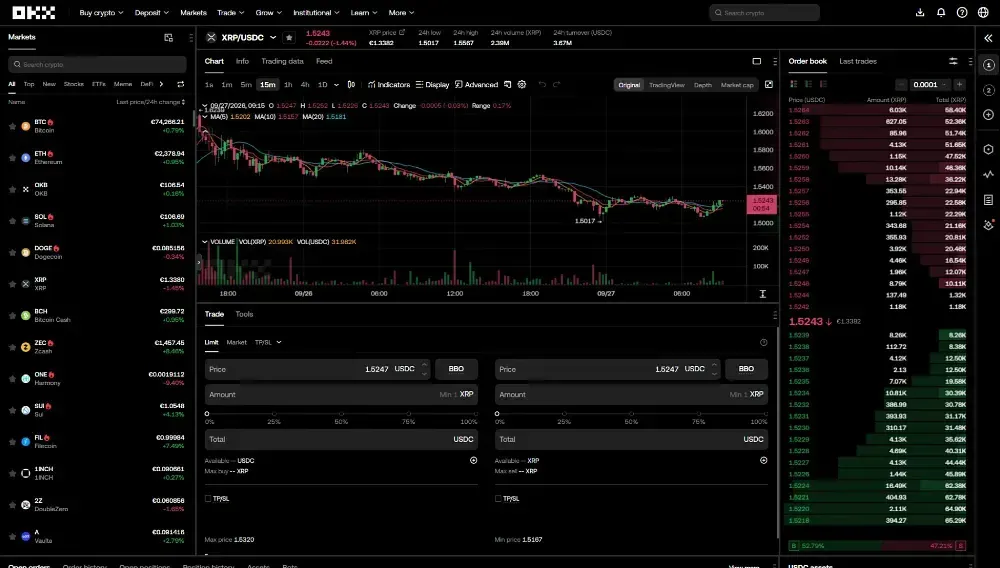
The matching engine is the main attraction. OKX stays stable during liquidation cascades that produce wicks on smaller venues, and its options market is the deepest available to Ukrainian traders. Spot costs 0.08% maker and 0.10% taker. Perpetuals run at 0.02% maker and 0.05% taker, while leverage reaches 100x on majors. Its Web3 wallet remains the strongest bundled self-custody product of any exchange here.
Hryvnia access comes through a functional but smaller P2P market covering Monobank and PrivatBank. Spreads widen noticeably outside peak hours. During our testing, we bought USDT through Bybit or WhiteBIT and transferred it to OKX over TRC20 or Arbitrum instead.
That two-exchange route added one network fee while keeping card activity concentrated among merchants on a single platform.
Pros
- Execution and engine stability during volatile sessions that rival or beat every platform on this list.
- The deepest options order book plus an industry-leading Web3 wallet for on-chain access.
- A Malta MiCA licence anchors the EU entity, useful for Ukrainians who relocate within Europe.
Cons
- The UAH P2P market is thinner than Bybit’s or Binance’s, with wider spreads after hours.
- Ukrainian localisation trails Bybit and WhiteBIT, with parts of the platform defaulting to English or Russian.
- No direct hryvnia deposit rail of any kind.
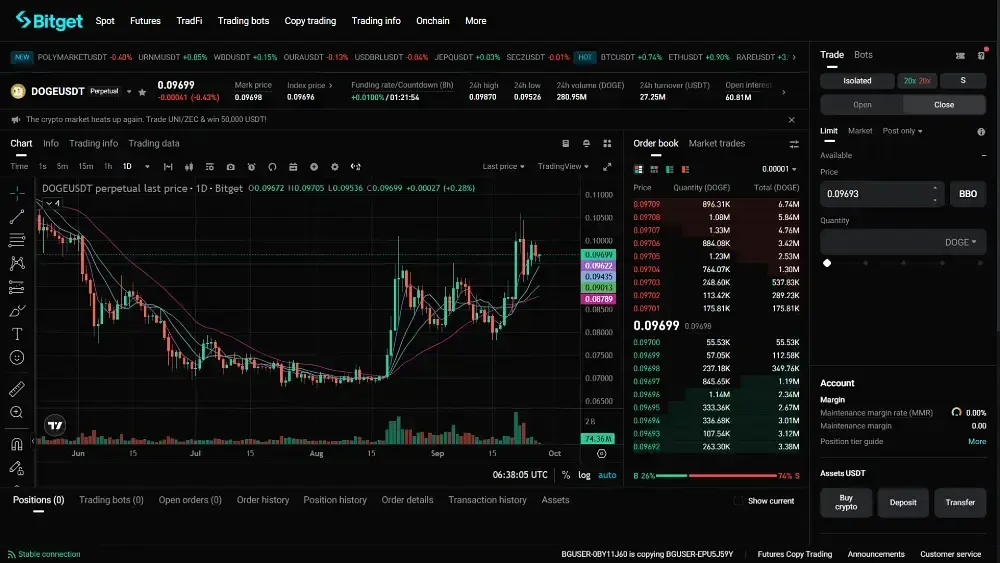
5. Bitget
Bitget has built much of its Ukrainian audience around copy trading, offering the largest curated pool of strategy providers available to local users. Mainland Ukraine is absent from its restricted countries list, while the occupied territories are excluded. Its futures engine supports 125x leverage under tiered risk limits, which behaved sensibly during the liquidation cascades we tested.
Reserve disclosures are a genuine strength. Bitget publishes monthly proof-of-reserves with ratios well above 100% and maintains a protection fund worth hundreds of millions of dollars. Spot fees are 0.10%. Futures cost 0.02% maker and 0.06% taker, with discounts for BGB holders. For active traders, that taker rate sits slightly above Binance and OKX.
UAH funding works through P2P merchants and third-party card gateways. Card purchases carry spreads of roughly 2% to 3% over the interbank rate and count toward the NBU’s foreign-currency quasi-cash cap, making P2P the more sensible default. The interface is busy, Ukrainian localisation is partial, and support is handled mostly in English or Russian.
Pros
- The most developed copy trading ecosystem accessible from Ukraine, with transparent trader statistics.
- Monthly reserve reporting backed by a sizeable protection fund covering user losses from platform failures.
- Wide altcoin perpetuals coverage with a stable engine at up to 125x leverage.
Cons
- Futures taker fees of 0.06% run above Binance, OKX and WhiteBIT for high-volume traders.
- Card gateway spreads of 2% to 3% make direct purchases expensive compared with P2P.
- No Ukrainian-language support channel, and only partial interface localisation.
6. MEXC
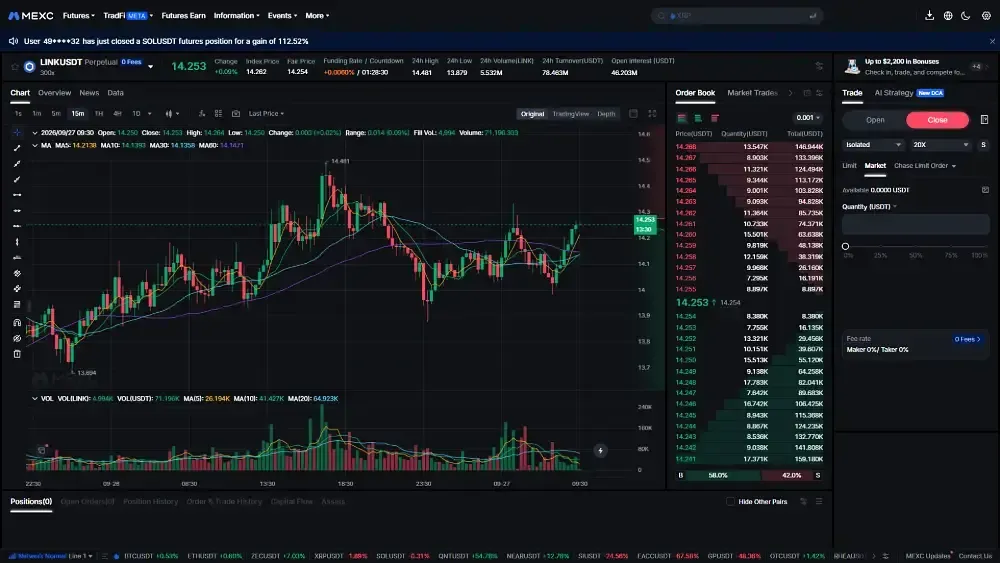
MEXC is the fee leader in this comparison. It charges 0% maker and 0.05% taker on spot, while futures cost 0% maker and 0.02% taker, with recurring zero-fee campaigns on top. Its catalogue contains more than 2,900 assets, so new tokens frequently list here first. Mainland Ukraine remains fully served, with only the six occupied regions named in its prohibited jurisdictions list.
The trade-off is regulatory standing. MEXC operates from the Seychelles without a tier-one licence anywhere, and several European regulators have issued warnings about it. That is why it scores 1/10 for regulation on our exchange profile.
Basic trading works without KYC, although unverified withdrawals are now capped near 1,000 USDT per day, as explained in our guide to the best no-KYC perpetual futures exchanges.
Leverage reaches 500x on flagship contracts, the highest figure in this guide and one to treat with genuine caution. UAH access comes through a P2P market that accepts Ukrainian bank cards, though merchant depth trails Bybit and Binance considerably. In our testing, we funded MEXC by transferring USDT from another exchange and kept only active working capital on the platform.
Pros
- The lowest base fee schedule of any major exchange, with 0% maker pricing on spot and futures.
- The widest altcoin selection in this comparison, often listing new tokens before larger venues.
- Functional no-KYC access for small balances, within the reduced withdrawal ceiling.
Cons
- No tier-one licence anywhere and multiple regulator warnings, the weakest legal standing on this list.
- The UAH P2P market is shallow, with fewer merchants and wider spreads than rivals.
- 500x leverage invites account-destroying liquidations from a single adverse candle.
What Makes a Good Crypto Exchange for Ukrainian Traders?
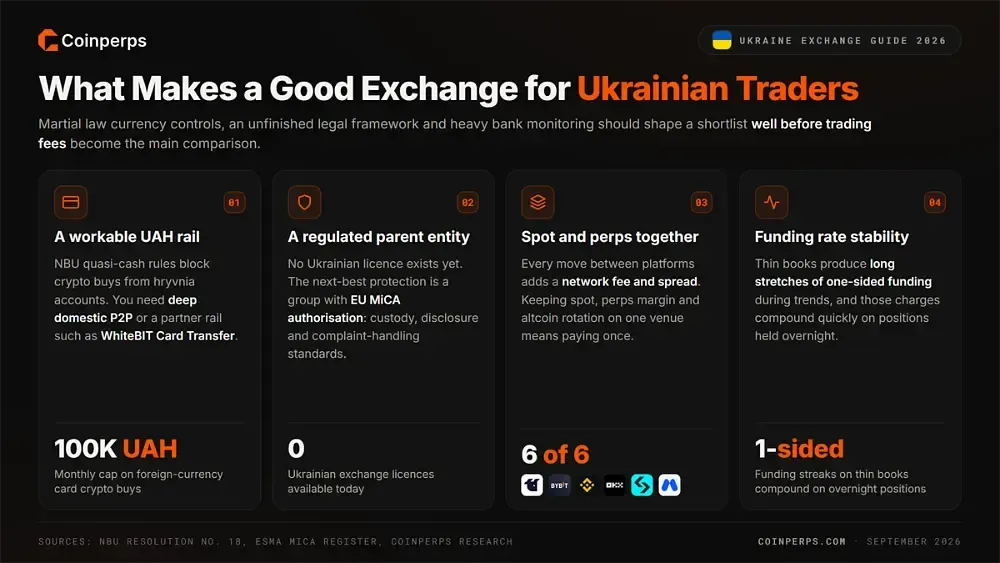
Ukraine combines martial law currency controls with an unfinished legal framework and heavy bank monitoring. Those conditions create three practical constraints that should shape a shortlist well before trading fees become the main comparison.
- A workable UAH rail: The NBU’s quasi-cash rules block crypto purchases from hryvnia accounts and cap foreign-currency card buys at 100,000 UAH monthly. An exchange therefore needs deep domestic P2P coverage or a dedicated partner rail such as WhiteBIT’s Card Transfer.
- A regulated parent entity: No Ukrainian licence is available yet. The next-best protection is a group holding EU MiCA authorisation, since that imposes custody, disclosure and complaint-handling standards a purely offshore operator does not face. Our MiCA licensed exchanges guide lists the platforms that qualify.
- Spot and perps together: Every move between platforms adds a network fee and spread. Keeping spot purchases, perpetuals margin and altcoin rotation on one venue means paying those costs once. All six exchanges here offer both markets, though liquidity differs sharply.
Funding rate stability also belongs on the checklist. Thin books can produce long stretches of one-sided funding during trends, and those charges compound quickly on positions held overnight. Our explainer on positive vs negative funding fees covers how to interpret those rates before sizing a position.
How Is Crypto Regulated in Ukraine?
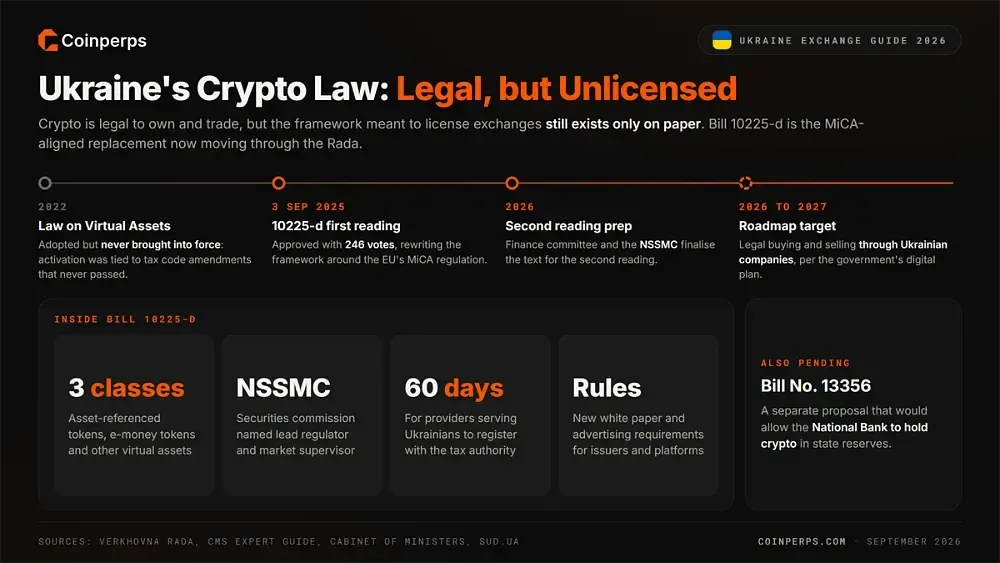
Ukraine is in a deliberate transition. Crypto is legal to own and trade, but the framework intended to license exchanges still exists only on paper.
Legal Framework and Bill 10225-d
The Law on Virtual Assets was adopted in 2022 but never brought into force because its activation was tied to tax code amendments that were never passed. It named the National Securities and Stock Market Commission as the lead regulator and allowed foreign providers to serve Ukrainians. Without the tax component, however, licences could not be issued.
Bill 10225-d is the replacement now moving through parliament. The Rada approved it at first reading on 3 September 2025 with 246 votes, rewriting the framework around the EU’s MiCA regulation. It divides assets into asset-referenced tokens, e-money tokens and other virtual assets. The bill also introduces white paper and advertising rules and requires providers serving Ukrainians to register with the tax authority within 60 days.
Throughout 2026, the finance committee has been preparing the bill for its second reading together with the NSSMC. The government’s digital roadmap separately targets legal buying and selling through Ukrainian companies by 2026 to 2027. A separate proposal, bill No. 13356, would allow the National Bank to hold crypto in state reserves.
Enforcement and NBU Currency Controls
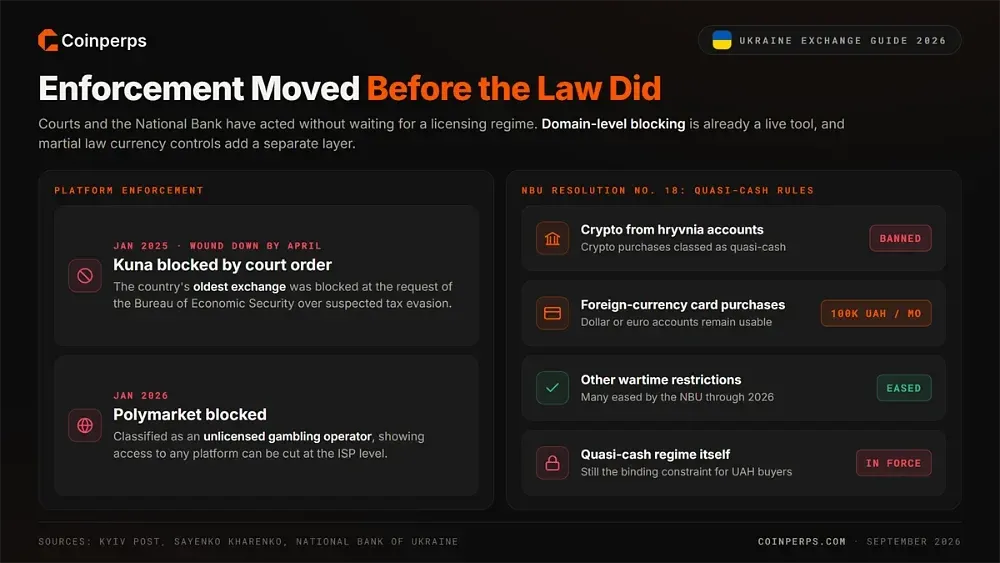
Enforcement has moved ahead without waiting for the new licensing framework. Kuna, the country’s oldest exchange, was blocked by court order at the request of the Bureau of Economic Security over suspected tax evasion in January 2025 and had wound down completely by April. Regulators also blocked Polymarket in January 2026 as an unlicensed gambling operation, showing that domain-level blocking is already an active enforcement tool.
National Bank martial law controls add a separate layer. Resolution No. 18 and its amendments classify crypto purchases as quasi-cash, banning them from hryvnia accounts outright and limiting foreign-currency card purchases to 100,000 UAH per month. The NBU eased many wartime restrictions through 2026, but the quasi-cash regime remains in force.
Spot Trading Rules
Individuals can legally own and trade crypto, and the 2022 law established a presumption of lawful ownership confirmed by control of the keys. What Ukraine still lacks is a licensing perimeter. Every exchange serving the country, including WhiteBIT, therefore operates under foreign registrations alongside ordinary civil and anti-money-laundering law.
In practice, the binding constraints come from banks rather than securities regulators. The quasi-cash prohibition causes most hryvnia card checkouts to fail at the payment processor. That is why the market has largely organised itself around domestic P2P transfers, where the payment leg is simply a normal transfer between two Ukrainian individuals.
Bank-side monitoring adds another layer. Institutions participating in the payment transparency memorandum cap outgoing transfers at around 100,000 UAH per month for customers without documented income, falling to 50,000 UAH for higher-risk profiles. Staying within those limits and keeping receipts inside the exchange’s dispute system matters more day to day than anything contained in the draft law.
Futures and Perpetuals Rules
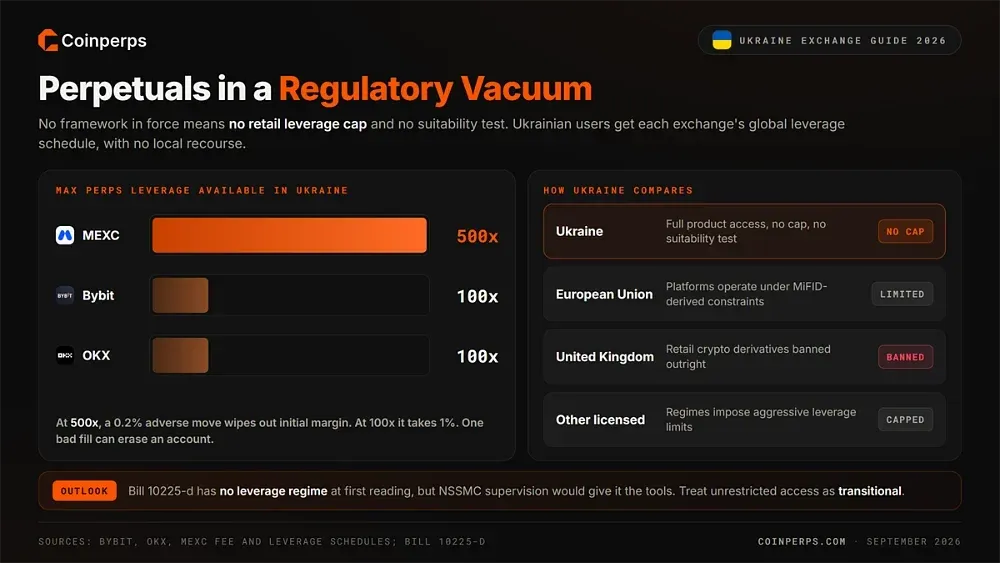
Ukraine imposes no leverage cap on retail crypto derivatives because there is no framework in force that could impose one. All six platforms in this guide therefore offer Ukrainian users their global leverage schedules, ranging from 100x on Bybit and OKX to MEXC’s 500x, without a suitability test.
That puts Ukraine in unusual company. EU platforms operate under MiFID-derived constraints, the UK bans retail crypto derivatives outright, and licensed regimes elsewhere impose aggressive leverage limits. Ukrainian traders currently access perpetuals in a genuine regulatory vacuum: full product availability with no local recourse. Our guide to crypto perpetual futures regulation maps how Ukraine compares with other markets.
The first-reading text of bill 10225-d does not contain a derivatives-specific leverage regime. Its MiCA alignment and NSSMC supervision would, however, give the regulator tools to introduce one. Traders building strategies around very high leverage should treat today’s unrestricted access as a transitional artefact rather than a permanent feature.
Crypto Taxes in Ukraine
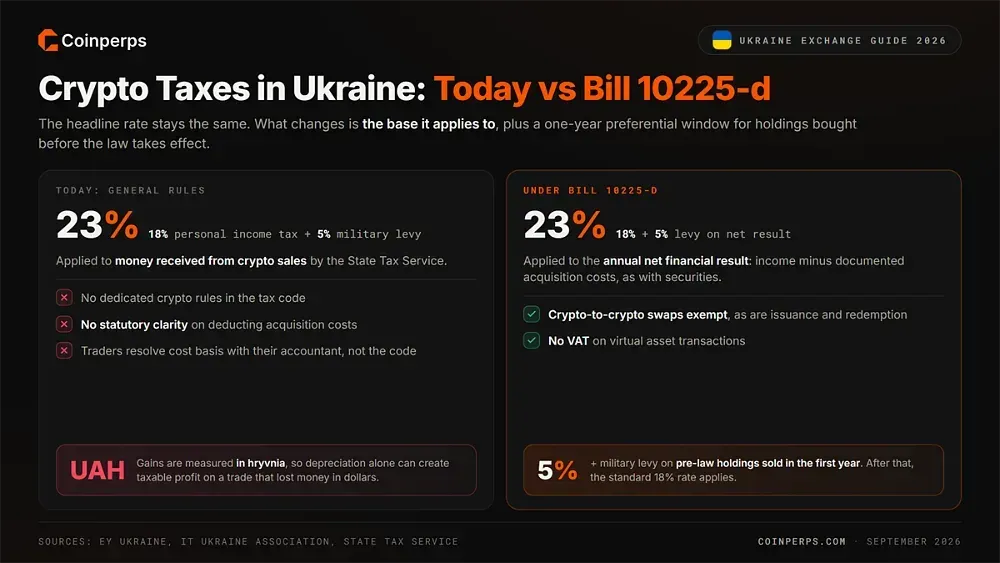
The current tax position remains uncomfortable. There are no dedicated crypto rules, so the State Tax Service applies the general rates of 18% personal income tax plus the 5% military levy to money received from crypto sales. There is no statutory clarity on deducting acquisition costs, leaving many traders to resolve that question with their accountant rather than the code.
Bill 10225-d would define the mechanics. It taxes the annual net financial result, calculated as income minus documented acquisition costs, at 18% plus the 5% levy. The approach follows the same logic already applied to securities. Crypto-to-crypto swaps are exempt, as are issuance and redemption events, while VAT does not apply to virtual asset transactions.
The transition provision matters most for long-term holders. Assets acquired before the law takes effect can be sold during the first year at a preferential 5% rate plus the military levy. After that, the standard 18% rate applies. One quirk deserves attention: gains are calculated in hryvnia, so currency depreciation can create taxable profit even when a position lost value in dollar terms.
Risks of Using Crypto Exchanges From Ukraine
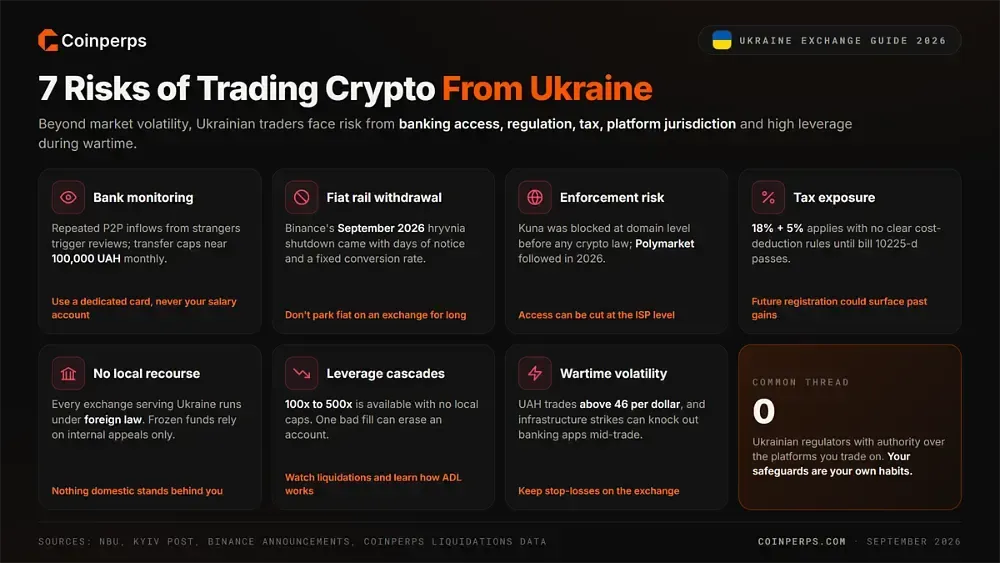
Using crypto exchanges from Ukraine adds risks beyond normal market volatility, especially around banking access, regulatory uncertainty, taxation, platform jurisdiction and high-leverage trading during wartime.
The main risks Ukrainian traders should account for are:
- Bank monitoring: Repeated P2P inflows from unrelated individuals trigger financial monitoring reviews, while clients without documented income face transfer caps near 100,000 UAH monthly. Use a dedicated card and never your salary account.
- Fiat rail withdrawal: Binance’s September 2026 hryvnia shutdown shows that gateways can disappear with only days of notice and balances may be converted at a fixed rate. Avoid parking fiat on an exchange for long.
- Enforcement risk: Kuna was blocked at the domain level by court order before a crypto law existed, and Polymarket followed in 2026. Access to any platform can therefore be cut at the ISP level.
- Tax exposure: Until bill 10225-d passes, the 18% plus 5% rates apply without clear cost-deduction rules. Unreported gains can accumulate liability that a future registration regime could surface retroactively.
- No local recourse: Every exchange serving Ukraine operates under foreign law. A frozen account or failed withdrawal leaves users with the platform’s internal appeals process and nothing domestic behind it.
- Leverage cascades: With 100x to 500x available and no local caps, one bad fill can erase an account. Watch the Coinperps liquidations dashboard and read our guide on how to avoid auto-deleveraging first.
- Wartime volatility: The hryvnia trades above 46 to the dollar, while infrastructure strikes can interrupt banking apps in the middle of a trade. Keep stop-losses on the exchange rather than relying on manual exits.
Best UAH Deposit Methods for Crypto
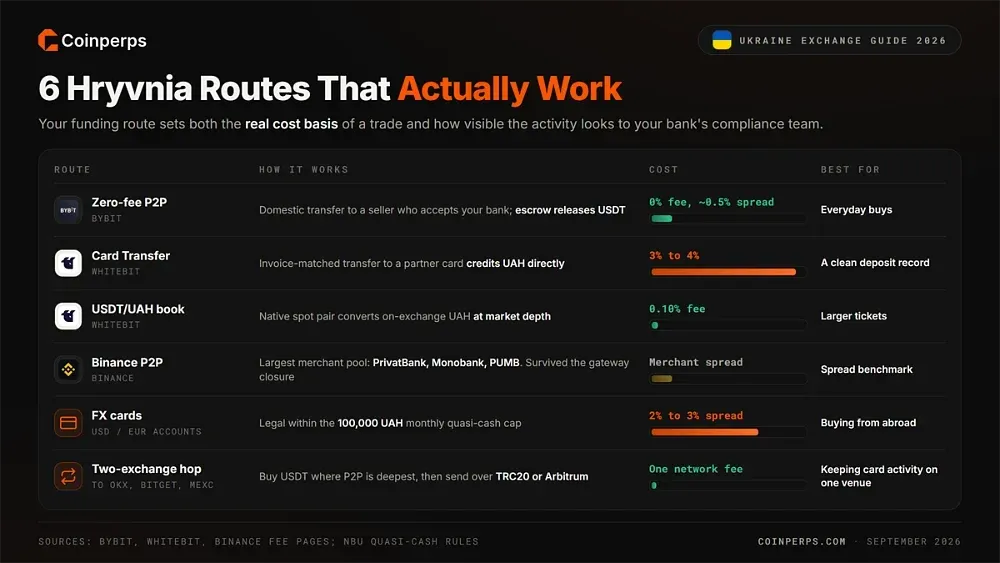
Your funding route determines both the real cost basis of a trade and how visible the activity appears to your bank’s compliance team. It deserves as much attention as the exchange itself.
Here are the hryvnia routes that actually work in practice:
- Zero-fee P2P (Bybit): Choose a seller that accepts your bank and send an ordinary domestic transfer. Escrow then releases USDT, with no platform commission and pricing typically within 0.5% of the cash dollar rate.
- Card Transfer (WhiteBIT): An invoice-matched transfer to a partner card credits UAH directly to your exchange balance. It costs roughly 3% to 4% but creates a clean deposit rather than a merchant trade.
- USDT/UAH order book (WhiteBIT): Once hryvnia is on the exchange, the native spot pair converts it at market depth for a 0.10% fee, avoiding merchant spreads entirely on larger tickets.
- Binance P2P: The country’s largest merchant pool survives the fiat gateway closure, covering PrivatBank, Monobank and PUMB. It remains the benchmark for comparing spreads before a sizeable purchase.
- Foreign-currency cards: Purchases from dollar or euro accounts remain legal within the 100,000 UAH monthly quasi-cash cap. They can be useful abroad but typically carry gateway spreads of 2% to 3%.
- Two-exchange transfer: Buy USDT where P2P liquidity is deepest, then move it to OKX, Bitget or MEXC over TRC20 or Arbitrum. One network fee keeps card activity concentrated on a single platform.
What Changes When Bill 10225-d Becomes Law?
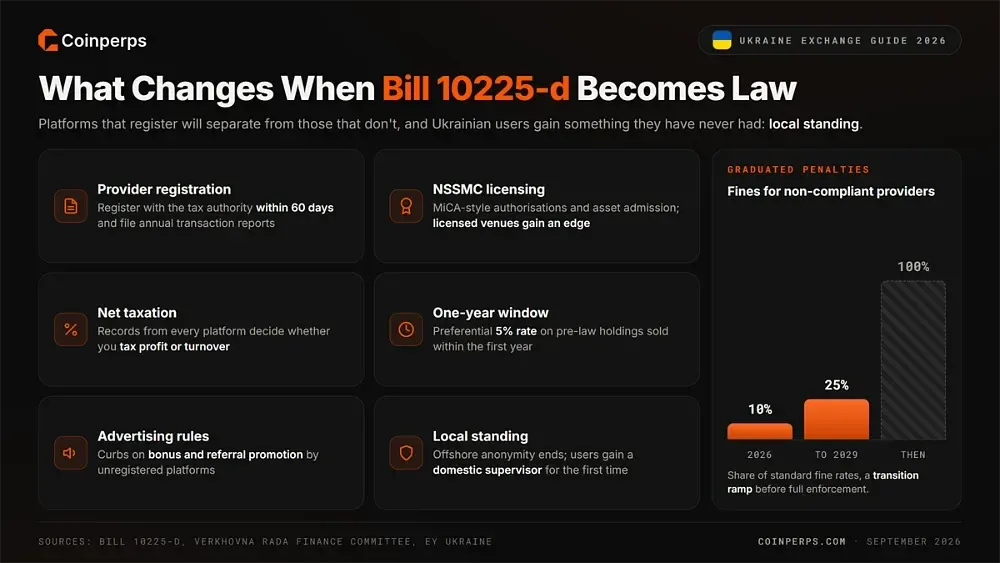
The second reading will reshape this ranking. Platforms that register and comply will separate more clearly from those that do not, while Ukrainian users will finally gain something they have never had: local standing.
The most consequential changes for everyday traders are:
- Provider registration: Exchanges serving Ukrainians must register with the tax authority within 60 days and file annual transaction reports, ending the anonymity of the current offshore arrangement.
- NSSMC licensing: The securities regulator becomes the market supervisor, issuing authorisations and admitting assets under MiCA-style rules. Licensed venues gain an advantage that foreign platforms must earn.
- Net taxation: The annual net-result method replaces today’s gross ambiguity. Keeping purchase records from every platform becomes the difference between taxing profit and taxing turnover.
- One-year window: The preferential 5% rate on pre-law holdings sold within the first year creates a genuine planning opportunity for anyone holding long-term positions.
- Advertising rules: New restrictions in the advertising law will curb bonus and referral promotion by unregistered platforms, likely reducing the marketing reach of purely offshore venues.
- Graduated penalties: Non-compliant providers face fines at 10% of standard rates in 2026 and 25% through 2029, creating a transition ramp before full enforcement.
Bottom Line
Bybit is the default choice for Ukrainian traders who want spot and perpetuals on one platform. Its zero-fee UAH P2P market is the most reliable hryvnia rail left after Binance’s gateway closure. The interface is fully localised, while its MiCA-licensed EU entity gives the group more regulatory substance than any offshore rival.
WhiteBIT is the natural second account because of its direct card rails, USDT/UAH order book and Ukrainian roots. Binance still earns its place for liquidity and the country’s largest P2P pool, provided you now treat it strictly as a crypto-in, crypto-out venue.
OKX wins on execution for traders comfortable funding through a second exchange. Bitget leads for copy trading, while MEXC offers the lowest fees and the longest altcoin list, balanced against the weakest regulatory standing in this comparison.
The second reading of bill 10225-d is the event to watch. Once licensing goes live, expect WhiteBIT and the MiCA-licensed globals to register early, the preferential 5% window to trigger a wave of realised gains, and the gap between compliant and offshore platforms to widen quickly. Position your accounts now so the transition works for you rather than around you.