Best P2P Crypto Exchanges
Compare the best P2P crypto exchanges, from Binance, Bybit and OKX to non-custodial Hodl Hodl and Bisq, with fees, escrow rules, local USDT premiums and scams to avoid.

Coinperps may earn a commission from partner links, at no cost to you; rankings follow our methodology. Not financial advice.
Key takeaways
- Binance P2P is the best P2P crypto exchange for most people: it had live USDT ads in 101 currencies in our scan, runs P2P through an Abu Dhabi-authorised firm and partly compensates bank freezes through Shield Merchants.
- Bybit and OKX fill the gaps: Bybit tops our global rankings and leads in naira and roubles, while OKX charges no P2P fees and requires a 10,000 USDT merchant deposit.
- The local premium costs more than the fee: USDT sold 13.4% above the official rate in Venezuela and 7.2% in Argentina on 23 October 2026, while platform prices sat within about half a point of each other.
- Escrow protects the coins but not your bank account: pay and accept money only in your own name, never release on a screenshot and avoid third-party transfers that can get an account frozen.

- Model
- Custodial escrow
- P2P fees
- 0% taker, 0% to 0.35% maker by currency
- Fiat currencies
- 101 with live ads
- Escrow and disputes
- Escrow, appeals, Shield Merchants
Why it ranks #1 Partner link · How we rank
Binance runs the deepest P2P marketplace in the world, with live USDT ads in 101 fiat currencies in our scan and more than 700 payment methods.
- The most fiat currencies and payment methods of any P2P platform.
- A P2P provider authorised in Abu Dhabi and a published fee schedule.
- Partial compensation for bank freezes through Shield Merchants.
Coinperps may earn a commission if you sign up through this link, at no cost to you. Rankings follow our method, not partner deals.
On this page 9 sections
P2P crypto exchanges let you buy and sell crypto directly with other people, paying by bank transfer, mobile money or cash while the platform holds the coins in escrow until the seller confirms payment.
Where capital controls, falling currencies or bank blocks keep people off exchanges, P2P is often the main way to buy USDT or Bitcoin. Value sent between personal wallets inside countries rose from $56.8 billion to $228.7 billion in the year to June 2026, Chainalysis found, and 96% was stablecoins.
The best P2P platforms combine deep local liquidity, low fees, strict merchant checks and a dispute team that can freeze a trade.
We scanned live USDT ads across Binance, Bybit and OKX on 23 October 2026, read each platform's P2P terms and fee schedule, and weighed the results against our exchange rankings. It covers spot buying first, treats futures as a bonus and is not financial or legal advice.
Top 8 P2P Crypto Exchanges
Exchange | Model | P2P fees | Fiat currencies | Escrow and disputes | Key nuance |
|---|---|---|---|---|---|
Custodial escrow | 0% taker, 0% to 0.35% maker by currency | 101 with live ads | Escrow, appeals, Shield Merchants | Deepest liquidity, no naira since 2024 | |
Custodial escrow | 0% in most currencies, up to 0.3% maker in five | 73 with live ads | Escrow, 15-minute Fast Track appeals | Top Coinperps score, strong in NGN and RUB | |
Custodial escrow | 0% for takers and merchants | 94 with live ads | Escrow, disputes within 72 hours | 10,000 USDT merchant deposit | |
Custodial escrow | 0%, except 0.2% on NGN buy ads | 74 listed | Escrow, appeals in about 36 hours | 690 payment methods, 135% reserves | |
Custodial escrow | 0% (temporarily waived) | 71 listed | Escrow, Gate has the final say | MiCA licence, long restricted list | |
Custodial escrow | 0% for traders and merchants | 67 listed | Escrow, appeals 10 minutes after payment | No protection scheme found | |
Non-custodial multisig | 0.75% per party (0.5% with a referral) | 100+ | 2-of-3 multisig, human dispute desk | No KYC, excludes US and Russia | |
Decentralised desktop app | Trade fee set by contributor vote | About 50 payment methods | 2-of-2 multisig, mediation, arbitration | No company, no account, 0.25 BTC cap |
 Bybit P2P
 OKX P2P
 Bitget P2P
 Gate.io P2P
 KuCoin P2P
1. Binance P2P
- Model
- Custodial escrow
- P2P fees
- 0% taker, 0% to 0.35% maker by currency
- Fiat currencies
- 101 with live ads
- Escrow and disputes
- Escrow, appeals, Shield Merchants
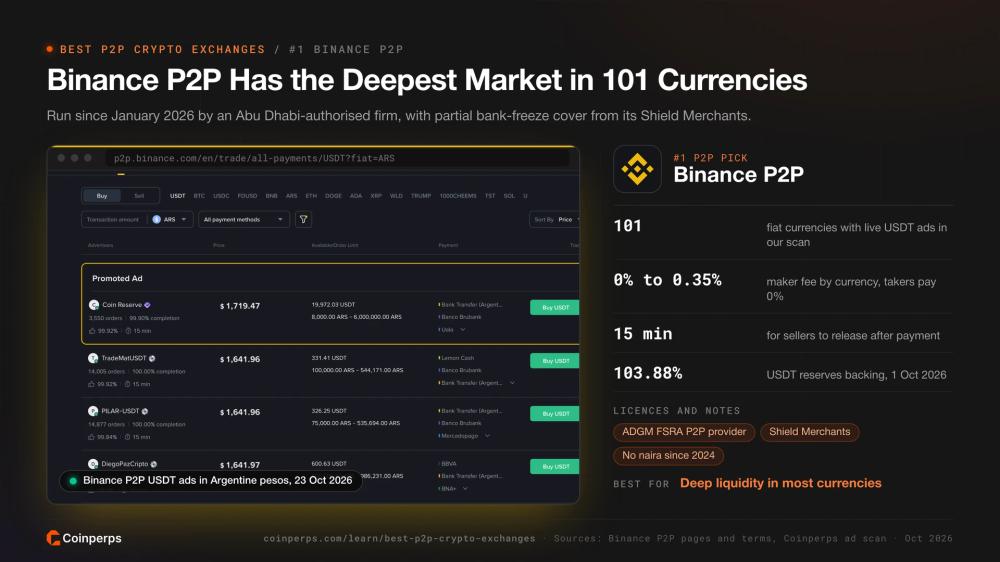
Binance runs the deepest P2P marketplace in the world, with live USDT ads in 101 fiat currencies in our scan and more than 700 payment methods.
Since 5 January 2026, Binance P2P has been run by Nest Trading Limited, authorised by the Abu Dhabi Global Market's Financial Services Regulatory Authority under the new P2P terms. The ADGM licence announced in December 2025 also covers Binance's exchange and custody arms.
Takers pay no percentage fee, but the P2P fee schedule adds a flat 0.05 to 0.08 USDT per USDT order in 87 currencies. Maker fees run from 0% in 48 currencies, including GBP, ZAR and KES, to 0.35% in USD and NZD, with 20% to 50% off for verified merchants.
Sellers must release coins within 15 minutes of receiving payment under Binance's transaction policy, and payment accounts must match the name on your identity check (KYC). Its Shield Merchant programme pays part of an order back if your bank account is frozen after trading with one of its vetted merchants.
Binance delisted all naira pairs on 28 February 2024, and our scan found no naira, rouble, real or cedi ads. Since 21 September 2026, only licensed corporate merchants may sell AED to UAE users.
Binance's proof of reserves for 1 October 2026 shows 103.88% USDT backing. It pleaded guilty in the US in 2023 and paid $4.3 billion. See our Binance restricted countries guide or open an account through Binance.
Pros
- The most fiat currencies and payment methods of any P2P platform.
- A P2P provider authorised in Abu Dhabi and a published fee schedule.
- Partial compensation for bank freezes through Shield Merchants.
Cons
- No naira, rouble, real or cedi ads at the time of our scan.
- Maker fees up to 0.35% and a flat taker charge per order.
- Not available to residents of the US, Canada or the Netherlands.
2. Bybit P2P
- Model
- Custodial escrow
- P2P fees
- 0% in most currencies, up to 0.3% maker in five
- Fiat currencies
- 73 with live ads
- Escrow and disputes
- Escrow, 15-minute Fast Track appeals
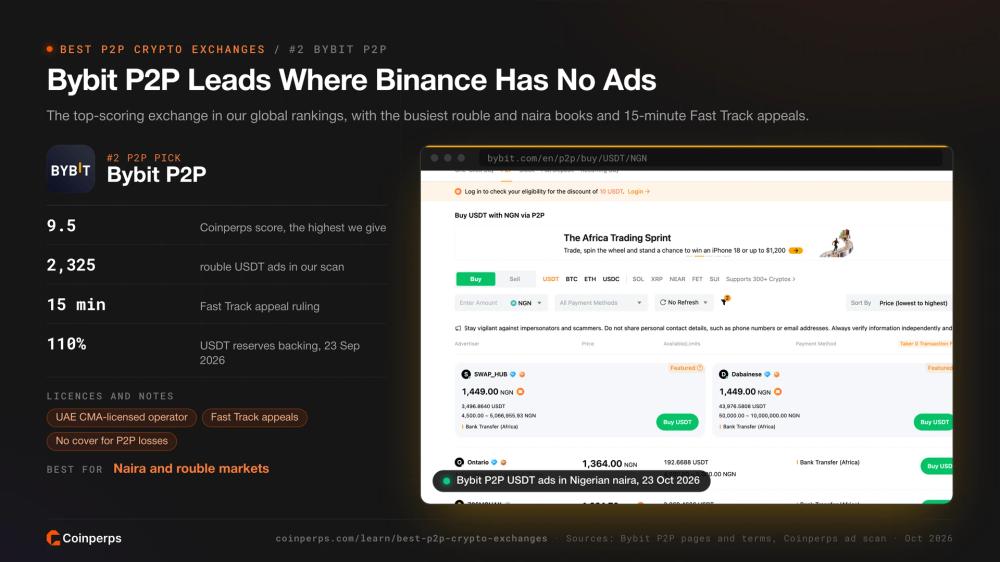
Bybit has the highest score in our global exchange rankings, and its P2P desk fills the markets Binance has left, with Nigeria and Russia its busiest.
Our scan found live USDT ads in 73 fiat currencies. RUB carried 2,325 buy and sell ads, NGN 1,385 and USD 1,341, and Bybit supports more than 600 payment methods.
Most currencies trade free, but the fee page updated on 28 July 2026 charges makers 0.05% to 0.3% in Nigerian naira, Russian roubles, Ghanaian cedis, Tajik somoni and Azerbaijani manat. Manat takers also pay 0.25%, although Bybit's site footer still advertises zero-fee P2P.
Disputes over "paid but not released" orders go to a Fast Track appeal with a ruling within 15 minutes, and appeals must be filed within five days. Bybit's January 2026 P2P terms lock the seller's coins in escrow but state that P2P losses and bank freezes will not be reimbursed.
The platform operator holds a UAE virtual asset platform licence granted in October 2025. North Korean hackers stole about $1.5 billion from Bybit in February 2025, and its proof of reserves for 23 September 2026 shows 110% USDT backing.
Bybit P2P excludes the US, UK, Canada, France, Singapore and Dubai. Compare it in our Binance vs Bybit guide, or sign up through Bybit.
Pros
- The highest Coinperps score of any exchange we rank.
- Deep naira and rouble markets where Binance has no ads.
- Fast Track appeals decided within 15 minutes.
Cons
- Maker fees of up to 0.3% in five currencies.
- Its terms rule out compensation for P2P losses or bank freezes.
- Not available in the US, UK, Canada or France.
3. OKX P2P
- Model
- Custodial escrow
- P2P fees
- 0% for takers and merchants
- Fiat currencies
- 94 with live ads
- Escrow and disputes
- Escrow, disputes within 72 hours
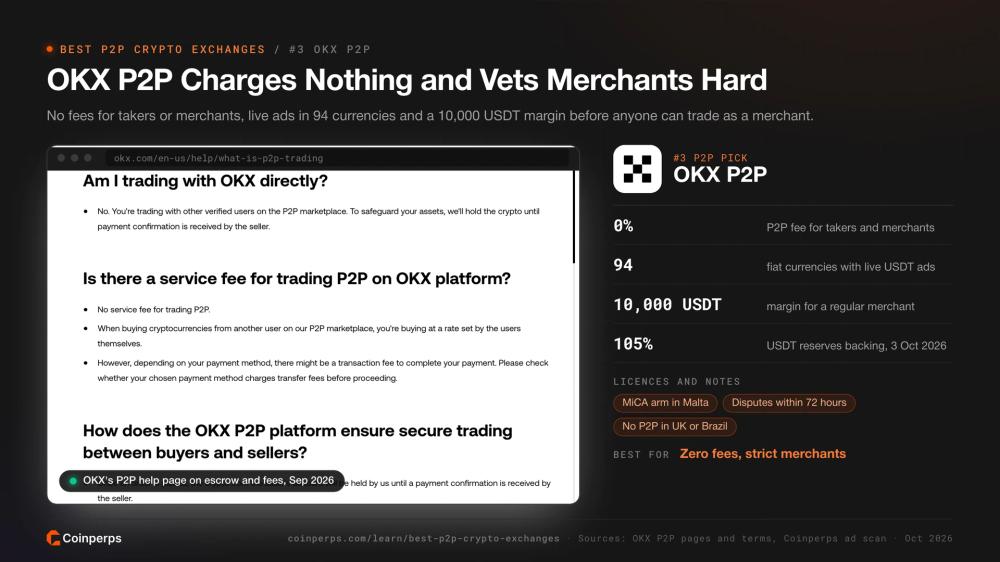
OKX charges no P2P fees at all and sets the strictest merchant entry bar of the big three marketplaces.
Its help centre confirms there is no service fee on P2P trades, and merchants post ads free under its merchant programme. Our scan found live USDT ads in 94 fiat currencies, including NGN, BRL and EUR.
Regular merchants must lock a 10,000 USDT margin, pass video verification and keep a 90% completion rate, while Diamond merchants lock 100,000 USDT. That margin can be confiscated if a merchant's conduct causes losses.
Disputes are raised in the app within 72 hours of the order, and OKX aims to respond within 24 hours. It cannot unfreeze a bank account but helps with the order dispute behind it.
OKX lists Nigeria, India and Canada among its restricted locations and blocks P2P in the UK, Brazil and South Korea. Its parent pleaded guilty in the US in February 2025 and agreed to pay more than $504 million, and its proof of reserves for 3 October 2026 shows 105% USDT backing.
See our OKX restricted countries guide, or open an account through OKX.
Pros
- Zero P2P fees for buyers, sellers and merchants.
- A 10,000 USDT margin keeps casual merchants out.
- Live ads in 94 fiat currencies in our scan.
Cons
- P2P blocked in the UK, Brazil and South Korea.
- No bank-freeze compensation scheme.
- A US guilty plea in 2025 over anti-money laundering failures.
4. Bitget P2P
- Model
- Custodial escrow
- P2P fees
- 0%, except 0.2% on NGN buy ads
- Fiat currencies
- 74 listed
- Escrow and disputes
- Escrow, appeals in about 36 hours
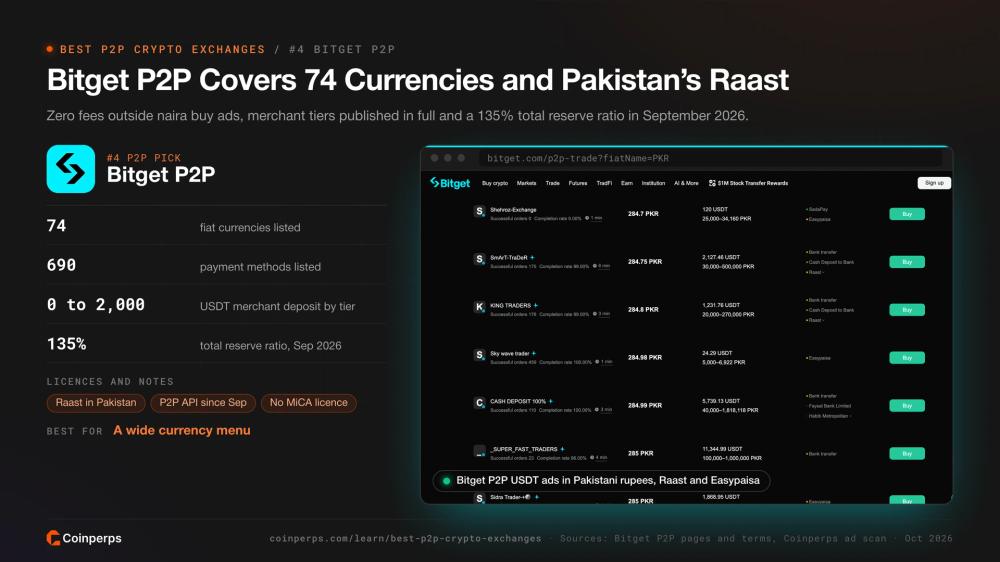
Bitget offers one of the widest P2P menus, with 74 fiat currencies and 690 payment methods listed, and charges nothing outside one market.
Its zero-fee policy for buyers and sellers has one exception in Nigeria, where a February 2026 update charges makers 0.2% on naira buy ads.
Its merchant tiers are published in full. Starter merchants post no deposit, Advanced merchants lock 200 USDT and Master merchants 2,000 USDT, with completion rates of 80% to 95%. Appeals are usually resolved within 36 hours.
Bitget P2P supports Pakistani rupees through Raast, Pakistan's instant payment system, and verified merchants have had a P2P API since September 2026.
The group's September 2026 proof of reserves reports a 135% total reserve ratio across 19 assets. Bitget has no MiCA licence and has withdrawn from France and Germany. Read our Bitget restricted countries guide, or sign up through Bitget.
Pros
- Zero fees in every market except naira buy ads.
- Clear merchant tiers with deposits from 0 to 2,000 USDT.
- A 135% total reserve ratio in September 2026.
Cons
- Appeals can take up to 36 hours.
- No MiCA licence and no service in France or Germany.
- No P2P-specific protection for bank freezes.
5. Gate.io P2P
- Model
- Custodial escrow
- P2P fees
- 0% (temporarily waived)
- Fiat currencies
- 71 listed
- Escrow and disputes
- Escrow, Gate has the final say
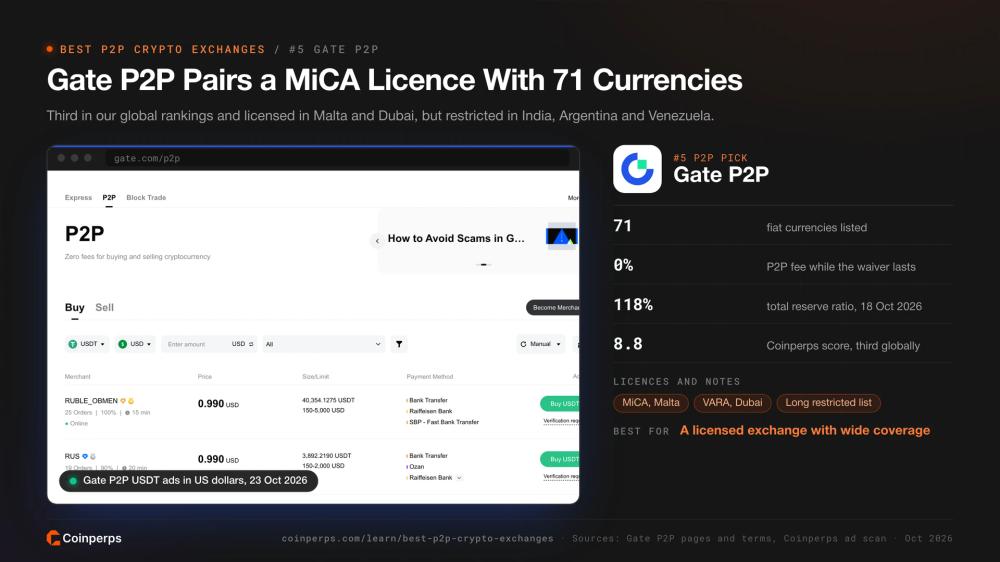
Gate ranks third in our global exchange rankings and lists 71 fiat currencies on P2P, but its long list of restricted countries limits who can use it.
The P2P fee is "temporarily waived for all users", so it could return. Gate's trading rules make KYC mandatory, require payment accounts to match the KYC name and give Gate the final say in disputes.
Gate's licences page lists a MiCA licence from Malta for Gate Technology Ltd, a Dubai VARA licence and a Japanese registration. Its proof of reserves dated 18 October 2026 shows a 118% total reserve ratio.
Its restricted locations include the US, UK, India, Indonesia, Argentina, Venezuela, Thailand and the UAE. The same list names Bolivia and mainland China, yet Gate added boliviano P2P in May 2026, so check your own eligibility before you deposit.
Read our Gate restricted countries guide, or sign up through Gate.
Pros
- A MiCA licence and a 118% reserve ratio in October 2026.
- 71 fiat currencies and about 700 payment methods listed.
- No P2P fees while the waiver lasts.
Cons
- Restricted in large P2P markets such as India, Argentina and Venezuela.
- A restricted list that contradicts some of its own markets.
- Merchant deposit amounts are not published.
6. KuCoin P2P
- Model
- Custodial escrow
- P2P fees
- 0% for traders and merchants
- Fiat currencies
- 67 listed
- Escrow and disputes
- Escrow, appeals 10 minutes after payment
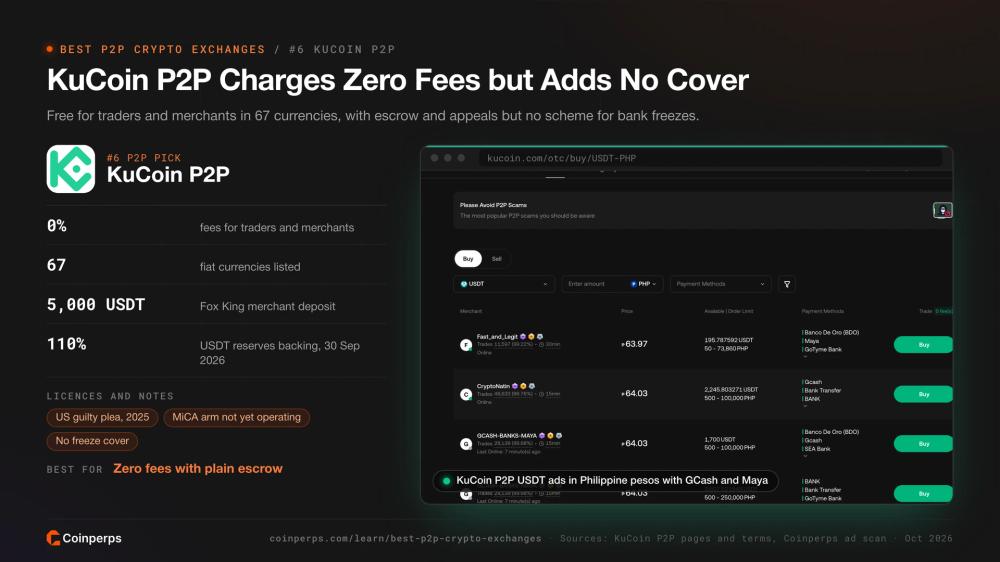
KuCoin charges nothing on P2P for traders or merchants and lists 67 fiat currencies, but it offers no protection scheme beyond escrow.
Its P2P page confirms the zero fees and says the seller's coins sit in escrow once a buy order is placed. Buyers can appeal 10 minutes after marking an order paid, and unpaid orders cancel after 30 minutes.
Its merchant programme has Verified, Gold and Fox King levels, with a 5,000 USDT deposit for Fox King.
KuCoin pleaded guilty in the US in January 2025, agreed to about $297 million in penalties and left the US market. Austria's FMA authorised its EU arm under MiCA in November 2025 but still bars it from starting operations.
Its proof of reserves for 30 September 2026 shows 110% USDT backing. Read our KuCoin restricted countries guide, or sign up through KuCoin.
Pros
- Zero P2P fees for traders and merchants.
- 67 fiat currencies and nearly 500 payment types listed.
- Monthly proof of reserves with 110% USDT backing.
Cons
- No compensation scheme for bank freezes or fraud.
- A US guilty plea and permanent US ban.
- Its MiCA arm is barred from starting operations.
7. Hodl Hodl
 Best forNo KYC, excludes US and Russia
- Model
- Non-custodial multisig
- P2P fees
- 0.75% per party (0.5% with a referral)
- Fiat currencies
- 100+
- Escrow and disputes
- 2-of-3 multisig, human dispute desk
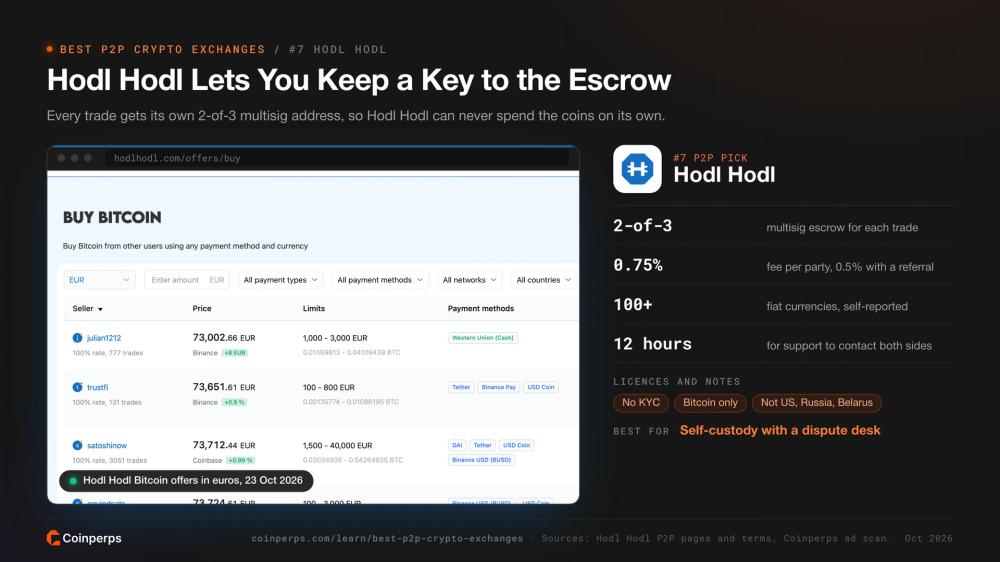
Hodl Hodl is the strongest non-custodial P2P platform for most people, because it never holds your Bitcoin and still offers a web interface and a human dispute desk.
Each trade gets its own 2-of-3 multisig escrow address, with one key each for the buyer, the seller and Hodl Hodl. Fees are 0.75% per party, or 0.5% for users who joined with a referral code, and are charged only on completed trades.
No identity verification is required, and the platform claims 300,000 users and more than 100 fiat currencies. A support manager contacts both parties within 12 hours of a dispute while the Bitcoin stays locked.
The terms of service effective 4 June 2026 exclude the US, Russia and Belarus, and the operator, Hodlex Ltd, is registered in the Marshall Islands. It trades Bitcoin only, so it cannot help if you want USDT.
Pros
- You keep a key to the escrow, so the platform cannot spend your coins.
- No KYC and more than 100 fiat currencies.
- A dispute team that answers within 12 hours.
Cons
- 0.75% per side is dearer than zero-fee exchanges.
- Bitcoin only, with no USDT.
- Not available in the US, Russia or Belarus.
8. Bisq
 Best forNo company, no account, 0.25 BTC cap
- Model
- Decentralised desktop app
- P2P fees
- Trade fee set by contributor vote
- Fiat currencies
- About 50 payment methods
- Escrow and disputes
- 2-of-2 multisig, mediation, arbitration
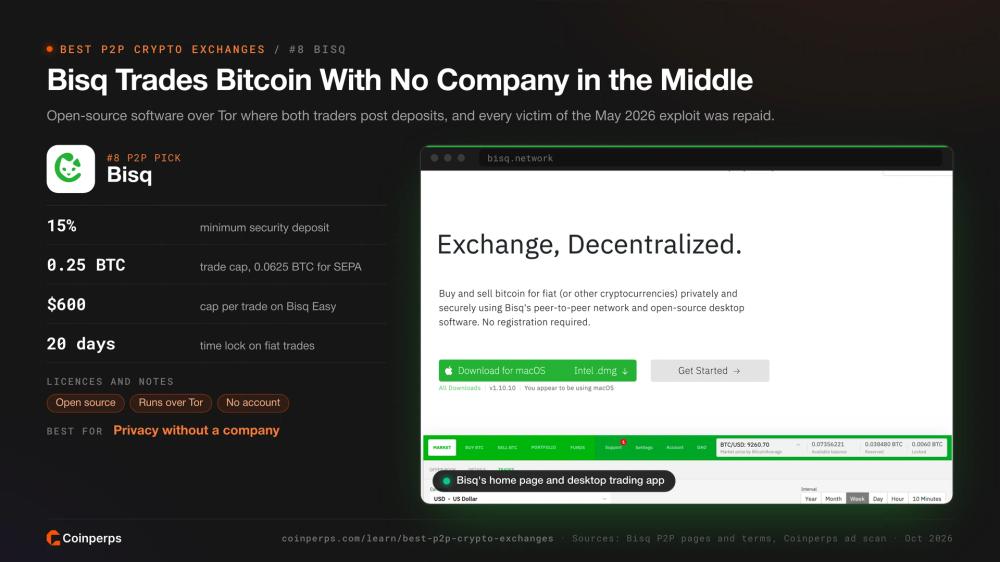
Bisq is open-source desktop software that matches buyers and sellers over Tor, with no company, no account and no registration.
In Bisq 1, both traders lock a security deposit of at least 15% in a 2-of-2 multisig, and disputes move from mediation to arbitration. A 20-day time lock on fiat trades lets an arbitrator step in if both sides stop cooperating.
After an exploit on 1 May 2026 drained 11.59 BTC from 10 users' altcoin trades, Bisq reimbursed every victim by 5 June. Its security releases cap trades at 0.25 BTC, and at 0.0625 BTC for high-risk methods such as SEPA and Zelle.
Beginners can start with Bisq Easy in Bisq 2, which charges no trade fees and relies on seller reputation, with a $600 cap per trade.
Pros
- No company, account or KYC, and the software runs over Tor.
- Both traders post deposits, so cheating costs money.
- All victims of the 2026 exploit were repaid.
Cons
- A desktop app with a steeper learning curve.
- Trades capped at 0.25 BTC, or $600 on Bisq Easy.
- Thinner liquidity than exchange P2P markets.
How We Ranked P2P Exchanges
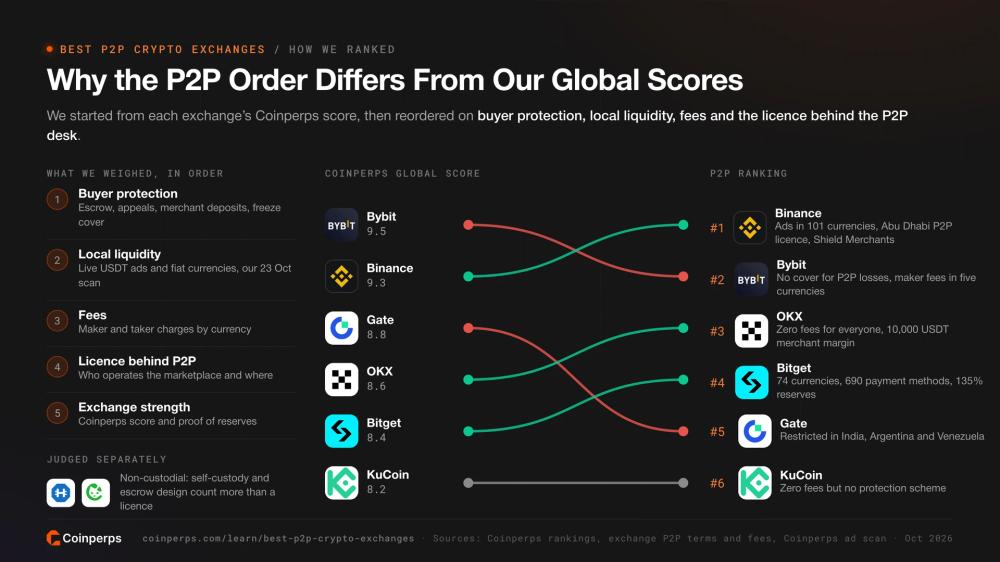
We ranked each platform on the protection a buyer gets if a trade goes wrong, then on local liquidity, fees, the licensing behind the P2P service and the parent exchange's strength, following our ranking methodology.
Protection covered escrow, the dispute process, merchant deposits and any bank-freeze compensation, taken from each platform's P2P terms. Liquidity came from our own scan of public USDT ads on 23 October 2026, plus each exchange's published list of fiat currencies and payment methods.
For custodial marketplaces, our exchange rankings of liquidity, features, fees and regulation set the starting order. Bybit scores highest overall, but Binance takes first place for P2P on its depth, its Abu Dhabi-authorised P2P provider and its Shield Merchant cover.
Hodl Hodl and Bisq were judged separately as non-custodial platforms, where self-custody and the escrow design matter more than a licence. Futures counted only as a tiebreaker, so a deep spot P2P market outweighed extra leverage.
Platforms We Left Out
MEXC runs zero-fee P2P in 59 currencies, but the Seychelles regulator took enforcement action against the company operating mexc.com in May 2026, and the Dutch AFM warned against it in 2025.
HTX offers freeze compensation in its Premium zone, but the UK sanctioned its operator, Huobi Global, in May 2026. Paxful closed in November 2025 and was sentenced in the US in February 2026, and LocalBitcoins shut in 2023.
How P2P Crypto Trading Works
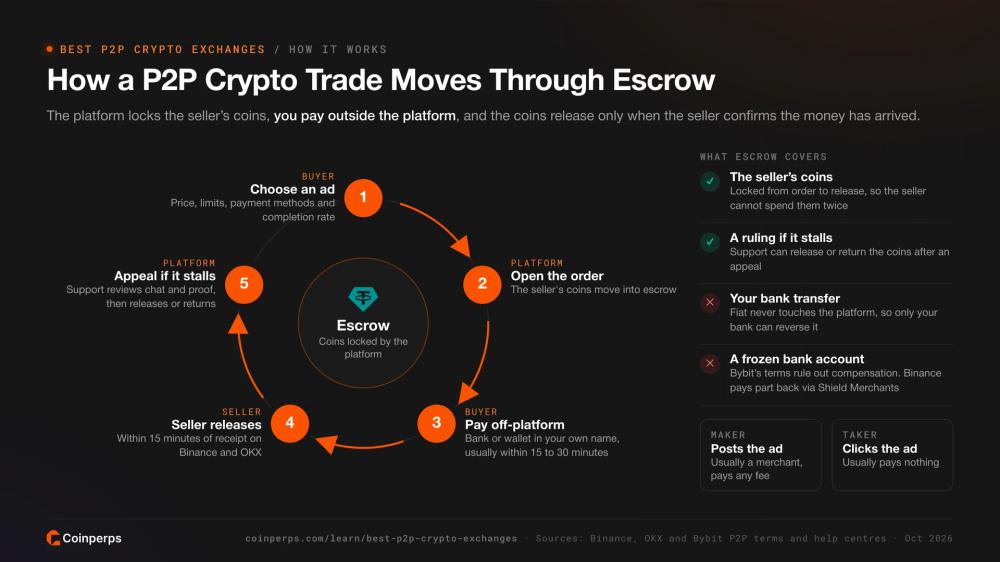
On a P2P exchange you trade with another user at a price they set, and the platform's job is to lock the seller's coins until the buyer's payment arrives.
- Choose an ad. Each ad shows the merchant's price, order limits, accepted payment methods, completed orders and completion rate.
- Open the order. The seller's crypto moves into escrow on the platform, and a payment timer starts, usually 15 to 30 minutes.
- Pay outside the platform. You send money from a bank or wallet in your own name to the account shown in the order, then mark the order paid.
- Wait for release. The seller checks the money has landed and releases the coins, which Binance and OKX require within 15 minutes of receipt.
- Appeal if it stalls. Support reviews chat logs and payment proof, and can release or return the escrowed coins.
The maker posts an ad, usually a merchant who trades all day, and the taker clicks it. Most platforms charge takers nothing and collect any fee from makers.
FATF's guidance on virtual assets treats a P2P platform by what it does, so a marketplace that holds escrow counts as a regulated service provider. That is why every custodial platform here requires KYC and names that match your bank account.
Escrow protects the coins, but the money never touches the platform, so once you send a bank transfer only your bank can reverse it.
What P2P Trading Costs
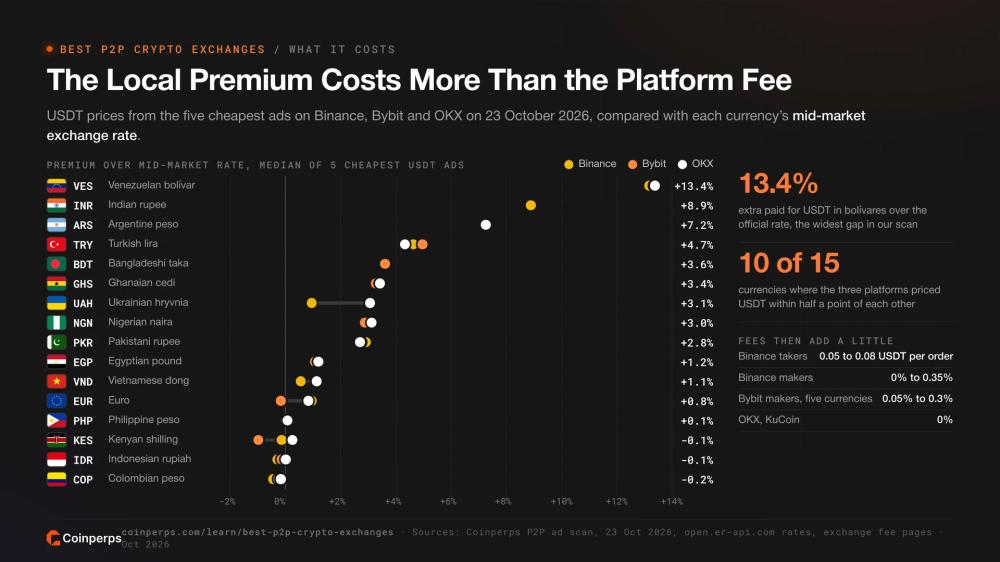
The platform fee is the smallest part of a P2P trade, because the local price of USDT often sits several percent above the official exchange rate.
We compared the median of the five cheapest USDT sell ads on Binance, Bybit and OKX with the mid-market rate for 18 currencies on 23 October 2026. Buyers paid 13.4% over the official rate in Venezuelan bolívares, 7.2% in Argentine pesos, 8.9% in Indian rupees on Binance and 4.7% in Turkish lira.
The premium was close to zero in Philippine pesos, Indonesian rupiah, Kenyan shillings and Colombian pesos. Prices on the three platforms sat within about half a point of each other in most currencies, so the local market sets the price and the platform choice matters more for safety than cost.
Binance charges takers a flat 0.05 to 0.08 USDT per order in most currencies, and Bybit and Bitget charge makers in Nigeria. Bank or mobile-money charges and the network fee to withdraw USDT come on top.
Spreads also widen in a crisis. After the capture of Nicolás Maduro in January 2026, the P2P price of USDT in Venezuela reached about 140% above the official rate, and Binance imposed temporary price limits. Our maker vs taker fees guide explains how order-book fees compare.
Where P2P Trading Matters Most
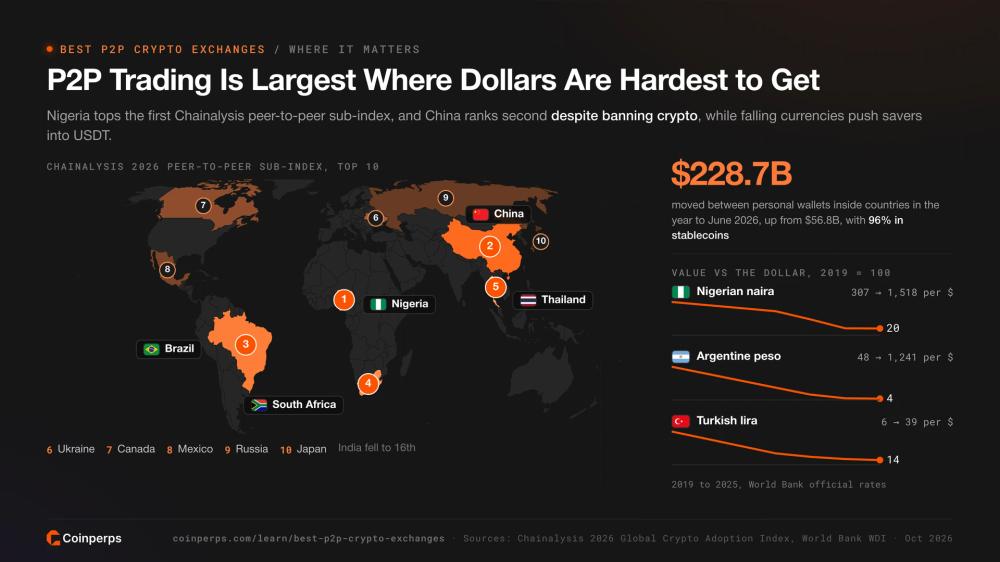
P2P trading is largest where people need dollars and banks make it hard to get them, which is why Africa, Latin America and Asia lead the rankings.
The Chainalysis 2026 Global Crypto Adoption Index added a peer-to-peer sub-index for the first time, based on transfers between personal wallets inside each country. Nigeria ranked first, followed by China, Brazil, South Africa and Thailand, while India fell to 16th.
China ranks second although the People's Bank of China repeated in November 2025 that crypto activity is illegal there, a sign that bans push demand into P2P channels.
Currency collapses drive the rest. World Bank data shows the official naira rate went from 307 per dollar in 2019 to 1,518 in 2025, the Argentine peso from 48 to 1,241 and the Turkish lira from 5.7 to 39.5.
In Venezuela, the analyst firm Ecoanalítica estimated that USDT 1.389 billion changed hands on Binance P2P in one month to mid-July 2026, close to the central bank's own dollar sales. Our country guides for Egypt, Venezuela and Bangladesh cover local P2P markets in detail.
Is P2P Crypto Trading Legal?
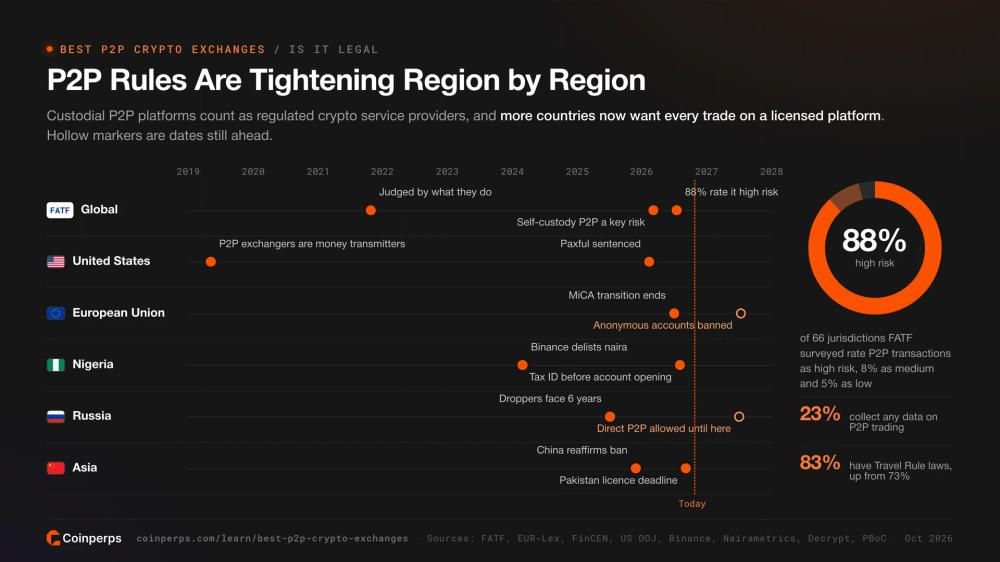
P2P trading is legal in most countries, but custodial P2P platforms are regulated as crypto service providers, and a growing number of governments now want every trade on a licensed platform.
Global Rules
FATF's July 2026 update found that 88% of surveyed jurisdictions rate P2P transactions as high risk, while only 23% collect any data on them. Its March 2026 report called P2P transfers through self-custody wallets "a key vulnerability" for stablecoins.
In the EU, MiCA exempts only services that run "in a fully decentralised manner without any intermediary", and ESMA confirmed that unlicensed providers must stop serving EU clients from 1 July 2026. The AML Regulation bans anonymous crypto accounts from 10 July 2027.
In the US, FinCEN's 2019 guidance treats anyone in the business of buying and selling crypto for others as a money transmitter. Paxful's guilty plea included conspiring to run an unlicensed money transmitting business.
Country Crackdowns
Nigeria's tax authority now requires P2P operators to collect a tax identification number before activating an account, with a ₦10 million penalty for the first month of default. In Russia, a new law makes direct P2P crypto trades between individuals legal only until 1 July 2027.
Vietnam's crypto pilot will penalise residents who trade outside licensed providers six months after the first licence is granted. Pakistan's PVARA required existing operators to apply for a no-objection certificate by 5 September 2026.
Tax on P2P Trades
Selling crypto through P2P is a taxable disposal in most countries, even when no exchange reports it. India taxes gains at a flat 30% and applies a 1% tax deducted at source above set thresholds.
Keep the order history, payment receipts and merchant names for every trade, because a bank may ask for them as well as the tax office.
Custodial vs Non-Custodial P2P Platforms
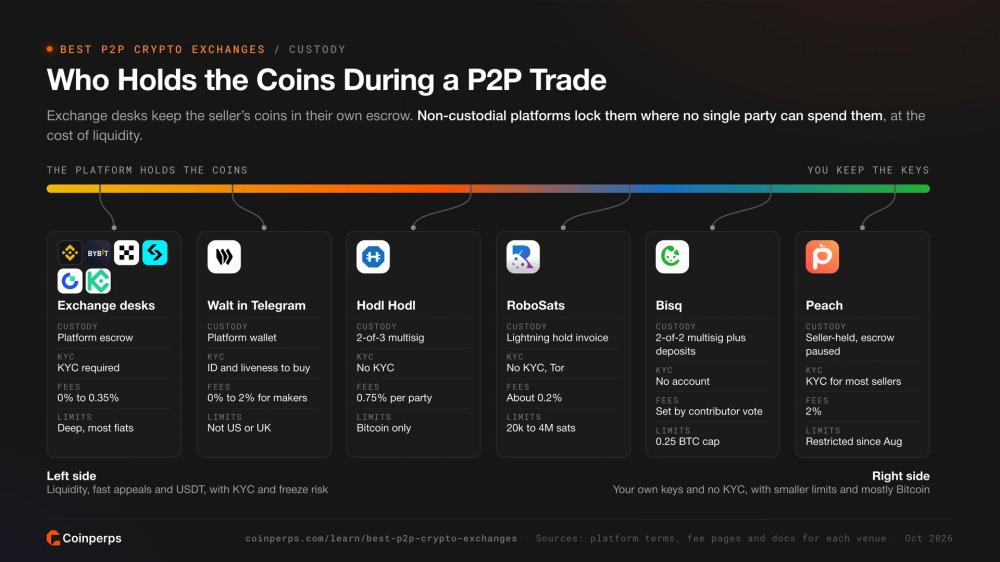
A custodial P2P platform holds the seller's coins in its own escrow, while a non-custodial one locks them in a multisig wallet or Lightning hold invoice that it cannot spend alone.
Custodial exchanges offer the most liquidity, the fastest trades and a support team with the power to move escrowed coins. In return they require KYC, can freeze your account and depend on the exchange staying solvent.
Non-custodial platforms keep your keys in your hands and usually skip KYC, but they have fewer users, smaller limits and slower dispute processes. They also trade mainly Bitcoin, so they suit savers more than people buying USDT for payments.
Platform | Custody | KYC | Fees | Limits |
|---|---|---|---|---|
2-of-3 multisig | None | 0.75% per party | Set by each offer | |
2-of-2 multisig, security deposits | None | Set by contributor vote | 0.25 BTC per trade | |
Lightning hold invoice | None | About 0.2% in total | 20,000 to 4,000,000 sats | |
Seller-held while escrow is paused | Required for most sellers | 2% | Restricted since August 2026 | |
Walt (Telegram) | Custodial | ID and liveness to buy | 0% to 2% for makers | Not in the US or UK |
RoboSats now runs as a federation of independent coordinators and is still labelled alpha. Peach paused its multisig escrow on 31 August 2026 during a dispute with a Swiss regulator, so sellers now hold the coins themselves.
Telegram's custodial wallet rebranded as Walt in September 2026 and charges makers 0.9% to 1.2% in most of its fee-paying currencies. Our guide to no-KYC perpetual futures exchanges covers self-custody options for derivatives traders.
P2P Scams and Frozen Bank Accounts
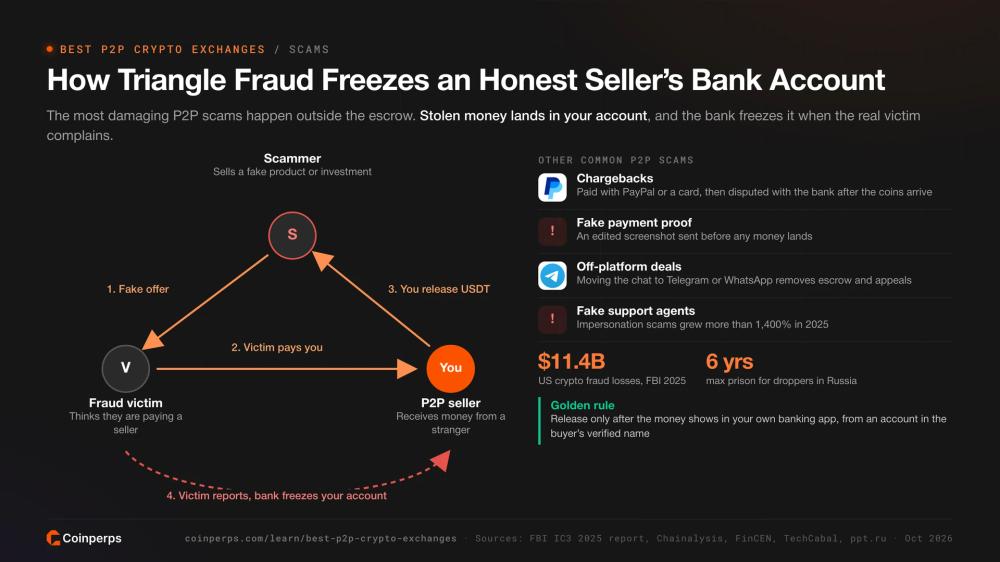
The biggest P2P risk is fraud that never touches the platform, such as stolen money landing in your bank account or a fake payment screenshot.
Common P2P Scams
- Triangle fraud: a scammer has a fraud victim pay you, so you release crypto and your account is frozen once the victim reports it.
- Chargebacks: a buyer pays with a reversible method such as PayPal or a card, receives the coins and then disputes the payment with their bank.
- Fake payment proof: the buyer marks the order paid and sends an edited screenshot before any money arrives.
- Off-platform requests: a trader asks to finish the deal on Telegram or WhatsApp, where no escrow or appeal exists.
- Fake support agents: impersonation scams grew more than 1,400% in 2025, according to Chainalysis, and real support never asks you to move coins.
The FBI's 2025 Internet Crime Report recorded $11.4 billion in crypto losses from 181,565 complaints. A September 2026 FinCEN alert said scam proceeds are often laundered through networks of money mules and P2P exchangers.
Why Bank Accounts Get Frozen
When a fraud victim reports a payment, banks freeze the receiving account and sometimes every account that money passed through. In Nigeria, P2P merchants refuse third-party payments and cap trade sizes to avoid this.
Russia has made the problem criminal. Since July 2025, people who hand over bank cards or move money for fraudsters, known as droppers, face up to six years in prison.
How to Trade Safely
- Trade only with verified merchants who have hundreds of orders and a completion rate above 95%.
- Release crypto only after the money shows in your own banking app, never on a screenshot.
- Accept payment only from an account in the buyer's verified name, and reject third-party transfers.
- Avoid reversible payment methods when you sell, and keep every trade inside the platform chat.
- Start small with a new counterparty and keep records of each order and payment.
Bottom Line
Binance P2P is the best P2P crypto exchange for most people, with ads in 101 currencies, a P2P provider authorised in Abu Dhabi and partial cover for bank freezes. Bybit scores highest in our global rankings and leads in naira and roubles, while OKX charges no fees at all and sets the strictest bar for merchants.
Bitget and Gate add wide currency menus and high reserve ratios, and KuCoin suits buyers who want zero fees and accept no extra protection. Hodl Hodl and Bisq are the strongest choices for Bitcoin buyers who want to keep their own keys.
On any platform, the escrow only protects the coins. Pay and accept money only in your own name, never release on a screenshot and check your country's rules before you trade. Our perps vs spot guide explains the next step once you hold USDT.


