Best Crypto Exchanges in Venezuela
Compare the best crypto exchanges in Venezuela, from bolívar P2P depth and fees to SUNACRIP licences, US sanctions relief and the USDT dollar rate.

Disclosure: Coinperps may earn a commission from partner links, at no extra cost to you. Reviews are based on independent testing — see how we test.
- Most global exchanges serve Venezuela: Bybit, Binance, OKX, Bitget and MEXC accept Venezuelan residents under their current terms, while Gate, HTX, WhiteBIT and Crypto.com list the country as restricted.
- Only two local licences are public: SUNACRIP, under restructuring since March 2023, has confirmed licences for Crixto to 31 December 2026 and Kontigo to 8 January 2027.
- USDT is the everyday dollar: The P2P USDT rate passed 1,000 bolívars on 8 October 2026, about 15% above the official BCV rate.

Bybit
Bybit, founded in 2018 and headquartered in Dubai, is the world’s second-largest exchange by volume, serving 60 million users with 1,800+ assets and over $11 billion in daily trading.
Features
Fees
Regulation
Overall Rating
Venezuelans can legally use most global crypto exchanges, yet none of them holds a licence from SUNACRIP, the country's crypto regulator. Chainalysis data shows Venezuela received $39.1 billion in crypto value between July 2025 and June 2026.
That was up 107.2% year on year and fourth in Latin America behind Brazil, Argentina and Mexico. USDT now serves as the everyday dollar for salaries, rent, supermarket bills and savings while the bolívar keeps losing value.
On 8 October 2026 the peer-to-peer (P2P) USDT rate crossed 1,000 bolívars for the first time, Bloomberg Línea reported. The official Banco Central de Venezuela (BCV) rate stood at about 877.
We checked every major exchange's terms for Venezuelan restrictions, pulled live bolívar P2P order books and compared spot fees, cards and security records in October 2026. This list of the best crypto exchanges in Venezuela weighs our exchange rankings against local licensure where it exists.
Top 6 Crypto Exchanges in Venezuela
Exchange | Bolívar On-Ramp | Maker Fee | Taker Fee | Venezuela Card | Key Nuance |
|---|---|---|---|---|---|
Zero-fee P2P | 0.10% | 0.10% | Virtual Mastercard | Best all-rounder with a MiCA-licensed group | |
P2P with 20+ banks | 0.10% | 0.10% | Binance Card | Deepest bolívar liquidity | |
Zero-fee P2P | 0.08% | 0.10% | Virtual Visa | Lowest maker fee of the majors | |
Direct bank payout | Spread | Spread | None | SUNACRIP licence to 31 Dec 2026 | |
Zero-fee P2P | 0.10% | 0.10% | None | Copy trading, recovering from September hack | |
Thin P2P | 0% | 0.05% | None | Lowest spot fees |
How We Ranked These Exchanges
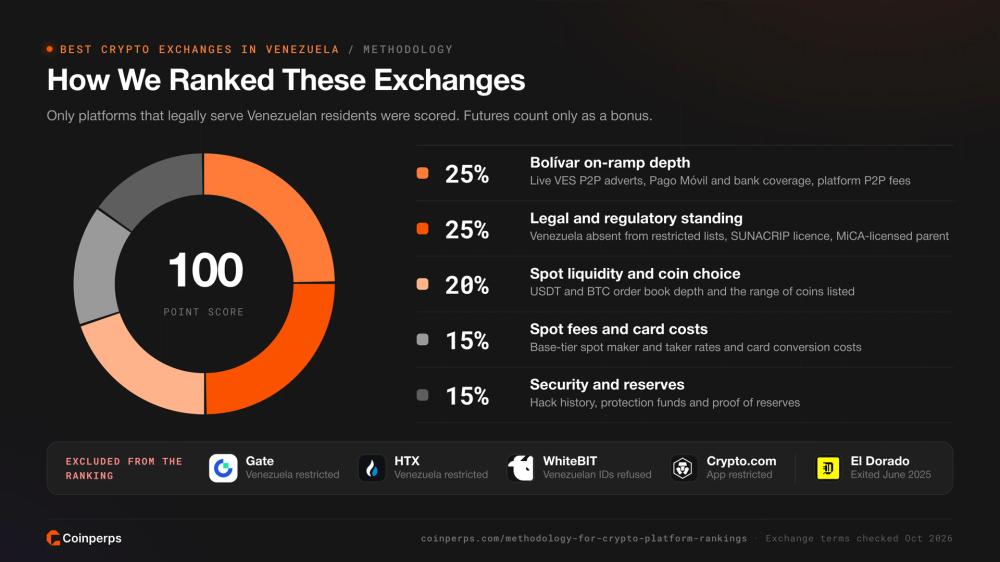
Every exchange on this list legally serves Venezuelan residents under its own terms as of October 2026. We reviewed more than a dozen platforms Venezuelans commonly use and scored the eligible ones with the weights from our methodology for crypto platform rankings.
- Bolívar on-ramp depth: 25%
- Legal and regulatory standing: 25%
- Spot liquidity and coin choice: 20%
- Spot fees and card costs: 15%
- Security and reserves: 15%
Legal standing carries the same weight as the bolívar on-ramp because access varies so widely. Perpetual futures count only as a bonus. Gate, HTX, WhiteBIT and Crypto.com name Venezuela as a restricted location in their current terms, so they are excluded however strong their products are.
Our Gate restricted countries guide and Crypto.com restricted countries guide cover the details. El Dorado, once a popular P2P app, stopped serving Venezuelan residents in June 2025.
1. Bybit
Bybit ranks first because it pairs a deep, commission-free bolívar P2P market with deep spot order books, a local card and a regulated parent. Venezuela is absent from its service restricted countries list, last updated on 13 October 2026, which excludes jurisdictions such as the United States, Cuba, Iran and North Korea.
Its bolívar (VES) P2P market supports Pago Móvil, Banesco, Provincial, Mercantil, Bancamiga, BNC and several smaller banks, plus dollar wallets such as Zinli, Zelle and AirTM. Escrow holds the seller's USDT until your bolívar transfer is confirmed, and Bybit charges no platform fee on P2P orders.
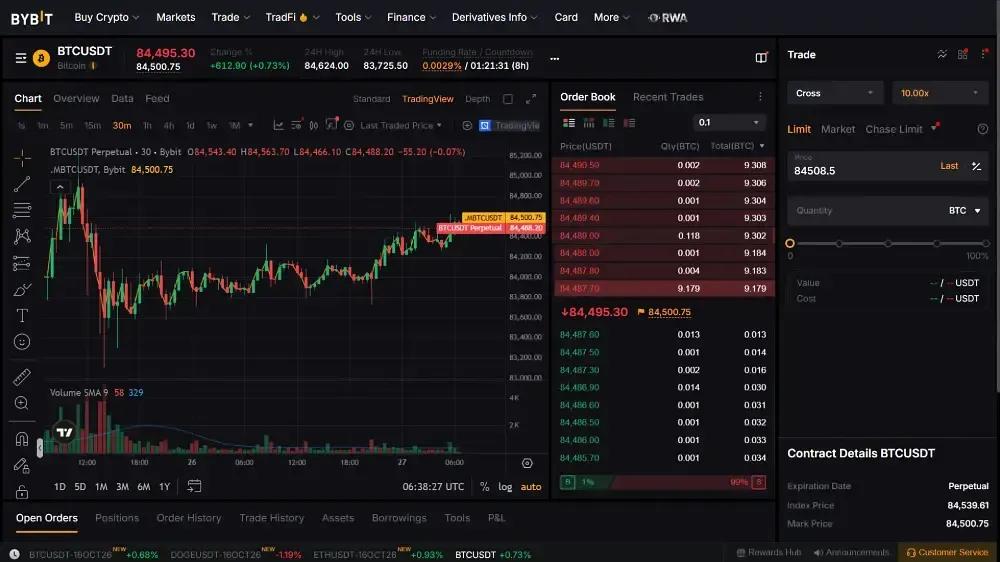
Spot trading costs 0.10% for both makers and takers. On 17 August 2026 Bybit opened its virtual Mastercard to Venezuelan users. It works online and with Apple Pay, though some in-store payments in Venezuela were declined at launch.
The group holds a licence under MiCA, the EU's crypto rulebook, through Bybit EU in Austria, a stronger regulatory anchor than most offshore rivals have. Perpetual futures are available as a bonus, at 0.02% maker and 0.055% taker. Our Bybit restricted countries guide breaks down regional coverage, and you can open an account through Bybit.
Pros
- Zero-fee VES P2P across Pago Móvil and the major Venezuelan banks.
- Deep spot order books, with perpetual futures as an extra.
- A virtual Mastercard available to Venezuelan-verified accounts since August 2026.
- A MiCA-licensed EU entity.
Cons
- No SUNACRIP licence, so disputes are governed by foreign terms of service.
- The 0.10% spot fee is higher than MEXC's maker pricing.
- A February 2025 hack of about $1.5 billion shows custody risk, although customers were made whole.
2. Binance
Binance runs the deepest bolívar P2P market in the country. Our check on 14 October 2026 found roughly 3,300 live VES/USDT advertisements. TRM Labs counted 2,565 active VES listings in April 2026, 90.2% of them for USDT.
Its coverage of more than 20 Venezuelan payment methods, from Pago Móvil to Banesco, Mercantil, Provincial, BNC and Bancamiga, is the widest on this list. On 15 April 2026, the day after the US Treasury's OFAC issued General License 57, Binance added Banco de Venezuela, Banco del Tesoro and Banco Digital de los Trabajadores back to P2P. Banco de Venezuela had been removed in 2023.
Binance launched its card in Venezuela in August 2026, and the first 3,000 places filled within minutes. Local purchases settle in bolívars at the official BCV rate, around 15% below the P2P rate, so spending USDT through the card costs more than selling it on P2P first.
Spot trading costs 0.10%, or 0.075% when fees are paid in BNB, and its spot order books are the deepest on this list. Futures traders also get 0.02% maker and 0.05% taker pricing, and Binance leads the Coinperps open interest rankings on most major contracts.
Its weakness is political exposure. The government DNS-blocked Binance in August 2024 after the disputed presidential election, cutting access at the internet-provider level. Access returned within days, but the episode showed how fast the country's main crypto on-ramp can vanish. You can sign up through Binance.
Pros
- By far the largest bolívar P2P merchant pool in Venezuela.
- Coverage of more than 20 Venezuelan payment methods, including the state banks restored in April 2026.
- The deepest spot order books on this list.
Cons
- Its prominence makes it the first target when the government restricts internet access.
- Source-of-funds requests to P2P merchants in July 2026 added friction for active sellers.
- Card purchases settle at the BCV rate, roughly 15% worse than P2P.

3. OKX
OKX gives Venezuelan traders low spot fees, strong execution and a growing set of local products. Venezuela is not among the restricted locations in its risk and compliance disclosure, as our OKX restricted countries guide explains.
Its zero-fee VES P2P market showed about 165 live advertisements during our check, covering Pago Móvil, Banco de Venezuela, Banesco, Mercantil, Provincial, BNC and Bancamiga. That pool is smaller than Bybit's or Binance's, so spreads can widen outside peak hours.
In July 2026 OKX launched a virtual Visa card for Venezuelan users. It requires verification with a Venezuelan national ID card (cédula) and charges no issuance fee.
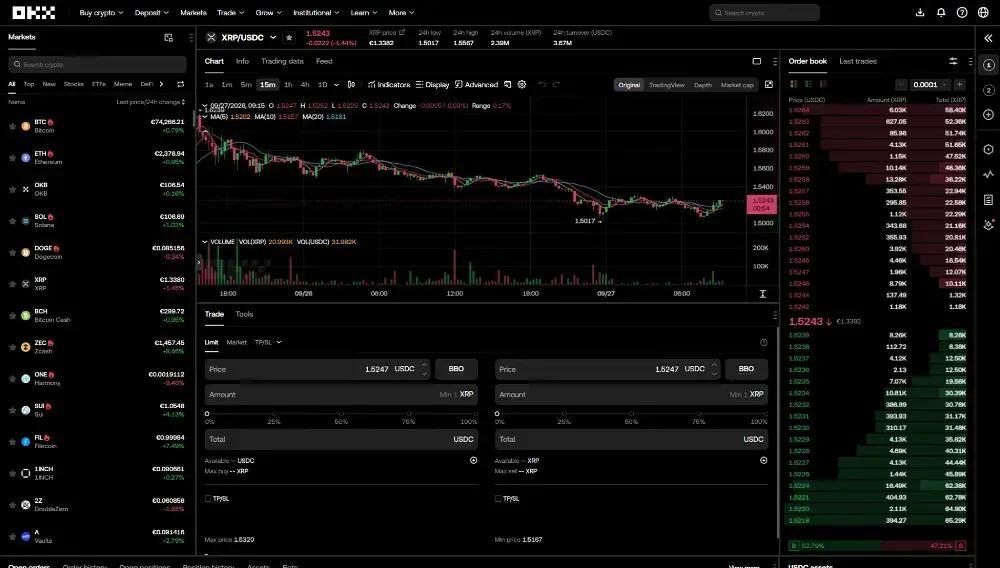
Spot fees are 0.08% maker and 0.10% taker. Perpetual futures are available too, at 0.02% maker and 0.05% taker. The group holds a MiCA licence through its Malta entity and runs an industry-leading Web3 wallet for self-custody. Accounts open through OKX.
Pros
- A 0.08% spot maker fee, below Bybit, Binance and Bitget.
- A virtual Visa card available to Venezuelan users since July 2026.
- A MiCA-licensed EU entity and an industry-leading Web3 wallet.
Cons
- The VES P2P market is much thinner than Binance's or Bybit's.
- The Venezuelan card only launched in July 2026, so its track record is short.
- No SUNACRIP licence and no direct bolívar deposit gateway.
4. Crixto
Crixto suits Venezuelans who want to deal with a locally licensed company. SUNACRIP renewed its licence, number CI-SUNA-2026-001, on 2 January 2026, valid until 31 December 2026, CriptoNoticias reported. It covers fiat to crypto exchange in both directions, P2P, custody, over-the-counter (OTC) trades and payment gateway services.
Crixto acts as the counterparty, paying bolívars directly into your Venezuelan bank account when you send it USDT. It is also the local partner behind Binance Pay at physical shops, where customers pay in USDT and merchants receive bolívars.
That convenience costs more. A demonstration transaction analysed by CriptoNoticias found that using Crixto cost 6.98% more than selling the same USDT on Binance P2P that day. Crixto has no order book, perpetuals or altcoin market, so active traders pair it with a global exchange.
Pros
- One of only two platforms with a publicly confirmed SUNACRIP licence in 2026.
- Pays bolívars directly to a local bank account without a P2P counterparty.
- Powers Binance Pay acceptance at Venezuelan retailers.
Cons
- Conversion rates were about 7% worse than Binance P2P in a published test.
- No order book or altcoin access.
- The licence expires on 31 December 2026 and must be renewed.
5. Bitget
Bitget offers a working bolívar P2P market and popular copy trading, but a recent security incident drops it to fifth. Venezuela is not a prohibited country under its terms of use, updated on 15 September 2026, and our Bitget restricted countries guide covers the full list.
On 24 September 2026, attackers stole about $387.5 million through a zero-day flaw in third-party security products. Bitget says its cold wallets and private keys were not compromised and its user protection fund is covering losses. Services restarted in phases from 28 September, and fiat and P2P returned on 2 October.
Its VES P2P market supports Pago Móvil, Mercantil, Banesco, Bancamiga, BNC, Provincial and Zinli with no platform fee. Spot trading costs 0.10%, and its copy trading marketplace is one of the largest open to Venezuelans. Futures are available at 0.02% maker and 0.06% taker. Open an account through Bitget.
Pros
- Zero-fee VES P2P with good coverage of Venezuelan banks and Zinli.
- The most developed copy trading ecosystem on this list.
- A wide altcoin list alongside futures for experienced users.
Cons
- The September 2026 hack is recent and the protection fund must be rebuilt.
- The 0.10% spot fee is double MEXC's taker rate.
- No MiCA licence for the group.
6. MEXC
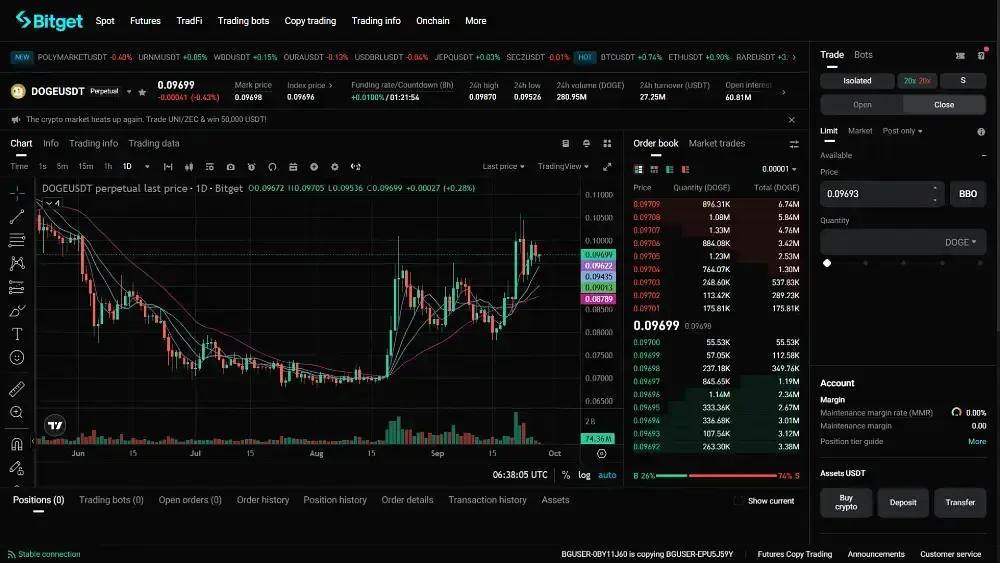
MEXC charges the lowest spot fees in this comparison, at 0% maker and 0.05% taker. It often lists new tokens before larger rivals, and its futures are cheap too, as our guide to the lowest-fee crypto perpetual exchanges shows.
Older versions of MEXC's terms named Venezuela as a restricted country, but the current user agreement, updated on 13 October 2026, no longer does. Because the wording has changed before, check the terms again before depositing. Our MEXC restricted countries guide tracks the list.
The bolívar P2P market is the thinnest of the six, so many users buy USDT on Binance or Bybit and transfer it over. Its futures offer up to 500x leverage, enough to wipe out an account on a single candle. MEXC holds no major licence anywhere. Accounts open through MEXC.
Pros
- The lowest spot fees on this list, with 0% maker pricing.
- The widest altcoin selection on this list, often with early listings.
- Venezuela removed from the restricted list in the current terms.
Cons
- The thinnest bolívar P2P market of the platforms reviewed.
- No tier-one licence and the weakest regulatory standing on this list.

What Makes a Good Crypto Exchange for Venezuelan Traders?
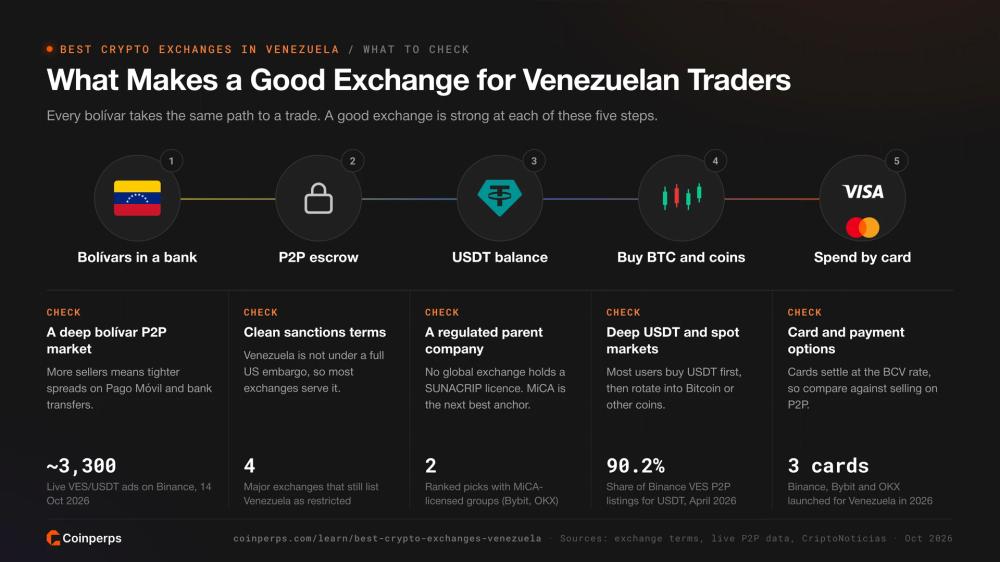
Venezuelan traders need more from an exchange than low fees, because high inflation, a dual exchange rate, foreign sanctions and a regulator under restructuring since 2023 shape every deposit and withdrawal. These features matter most.
- A deep bolívar P2P market: Most Venezuelans fund accounts by sending a Pago Móvil or bank transfer to a P2P seller. The more merchants a platform has, the tighter the spread and the faster an order completes.
- Clean sanctions terms: Venezuela is not under a comprehensive US embargo, so most exchanges serve its residents. Platforms that list it as restricted can freeze an account after one compliance review.
- A regulated parent company: No global exchange holds a SUNACRIP licence. The next best protection is a group with EU MiCA authorisation, which imposes custody and disclosure rules, as explained in our guide to MiCA-licensed exchanges.
- Deep USDT and spot markets: Most Venezuelans buy USDT first and then rotate into Bitcoin or other coins. Deep spot books keep that second step cheap, while every transfer between platforms adds a network fee and spread.
- Card and payment options: Binance, Bybit and OKX all launched cards for Venezuelan users in 2026, so stablecoin balances can be spent directly.
Perpetual futures count as a bonus in this ranking. Every exchange here except Crixto offers them, yet most Venezuelans use exchanges to save in dollars and buy spot crypto.
How Is Crypto Regulated in Venezuela?
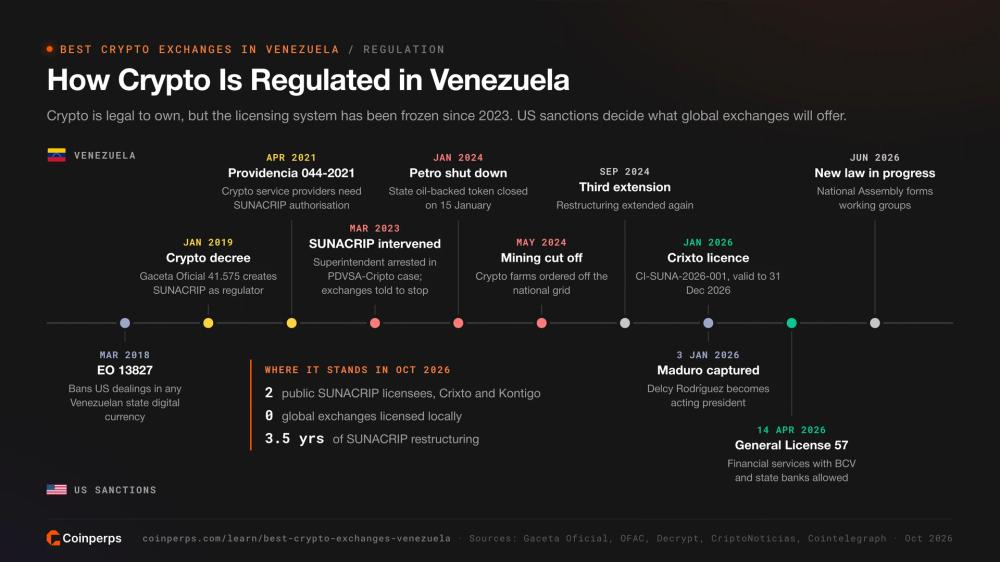
Venezuelans can legally own and use crypto, but the system meant to license exchanges has been largely frozen since 2023. Global platforms operate without local authorisation, and only a few domestic companies hold licences.
SUNACRIP and the Licensing Regime
The legal framework is the Decreto Constituyente sobre el Sistema Integral de Criptoactivos, published in Gaceta Oficial 41.575 in January 2019. It made the Superintendencia Nacional de Criptoactivos y Actividades Conexas (SUNACRIP) the regulator for exchanges, mining and other crypto services.
A 2021 rule, Providencia 044-2021, requires crypto service providers operating in or from Venezuela to hold SUNACRIP authorisation.
In March 2023 the system collapsed into a corruption scandal. Superintendent Joselit Ramírez was arrested and the government ordered SUNACRIP restructured after prosecutors alleged oil sale proceeds had been diverted through the agency, in what became known as the PDVSA-Cripto case.
The restructuring board then ordered licensed exchanges to suspend operations. The intervention was extended three times through September 2024.
SUNACRIP still issues licences under an acting superintendent. The only publicly confirmed licensees in 2026 are Crixto, valid to 31 December 2026, and the USDC app Kontigo, which was authorised until 8 January 2027. Kontigo faces US scrutiny after JPMorgan froze accounts linked to it over sanctions concerns.
In June 2026 the National Assembly set up technical working groups toward a new crypto law. No bill has been published yet.
Two state crypto projects have also ended. The Petro, the government's oil-backed token, was shut down on 15 January 2024, and in May 2024 the government ordered crypto mining farms disconnected from the national grid.
US Sanctions After Maduro's Capture
US sanctions shape what exchanges offer Venezuelans as much as local law does. On 3 January 2026, US forces captured Nicolás Maduro and Vice President Delcy Rodríguez became acting president. Since then, the US Treasury's Office of Foreign Assets Control (OFAC) has eased sanctions through general licences.
General License 57, issued on 14 April 2026, matters most for everyday finance. It authorises financial services involving the Banco Central de Venezuela, Banco de Venezuela, Banco del Tesoro and Banco Digital de los Trabajadores. Binance restored those state banks to its P2P market the following day. The broader Venezuela sanctions programme remains in force.
Ordinary residents were never the target. OFAC's FAQ 680 confirms US persons may deal with the people of Venezuela as long as blocked persons such as the government are not involved. Executive Order 13827 still bars US persons from dealing in any digital currency issued by the Venezuelan government, which covered the Petro (OFAC FAQ 564).
Spot Trading Rules
The 2019 decree expects platforms serving Venezuela to hold SUNACRIP authorisation, but there are no known enforcement cases against people using Binance, Bybit or OKX.
Currency rules impose the real limits. In June 2026 banks began capping individual dollar purchases at $1,000 a month and $12,000 a year.
In August 2026 police in Maracaibo arrested three people accused of buying dollars at the BCV rate and reselling USDT on Binance P2P at the higher parallel rate. Ordinary P2P trading remains legal, while systematic arbitrage between the official and parallel rates carries criminal risk.
Futures and Perpetuals Rules
Venezuelan traders face no local leverage cap because the country has no framework for crypto derivatives. Each platform in this guide sets its own limits, from 100x on OKX to 500x on MEXC.
EU platforms work under limits drawn from MiFID investment rules, and the UK bans retail crypto derivatives altogether, as our explainer on crypto perpetual futures regulation covers. In Venezuela the only protection is the risk discipline you bring to each trade.
Why USDT Became Venezuela's Everyday Dollar
For most Venezuelans an exchange account is a way to hold dollars, receive payments and protect savings from inflation.
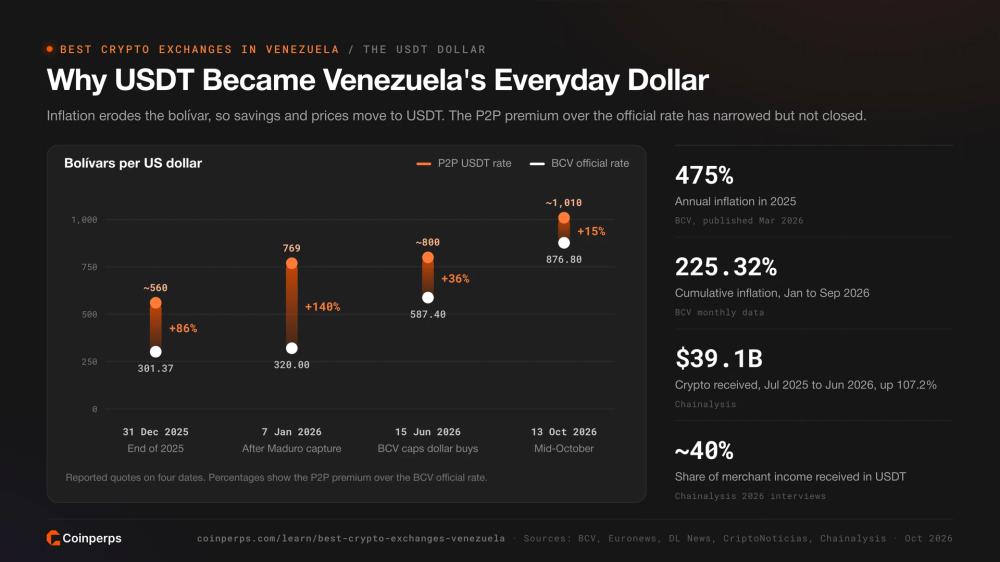
The BCV reported annual inflation of 475% for 2025. Monthly inflation in 2026 has ranged from 32.57% in January to 8.4% in September, a cumulative 225.32% rise between January and September.
After Maduro's capture, Binance P2P quotes briefly reached about 140% above the official rate. By mid-October 2026 the gap had narrowed to roughly 15%, as the BCV quoted about 877 bolívars per dollar against P2P quotes around 1,000.
Merchants interviewed for the Chainalysis 2026 study receive close to 40% of their income in USDT. In the quarter after the January transition, 891.7% more crypto left the country than in the previous period.
Remittances add demand from almost 7 million Venezuelan refugees and migrants living elsewhere in Latin America and the Caribbean, according to R4V.
Venezuela ranked 18th in the 2025 Chainalysis Global Crypto Adoption Index. The 2026 index uses a new methodology that places Venezuela outside its top 20, and Chainalysis says the two years are not comparable.
Best Bolívar Deposit Methods for Crypto
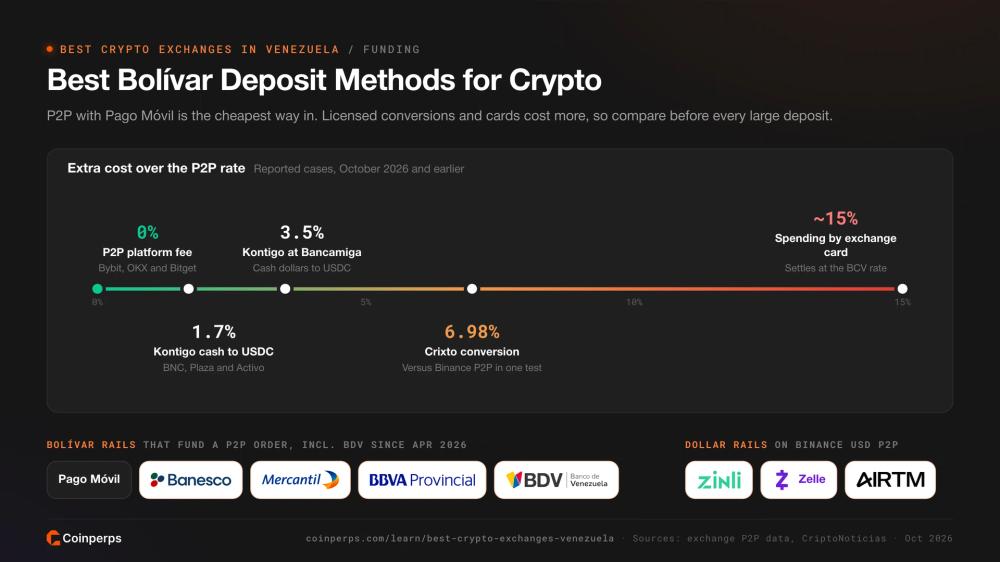
How you fund an account sets both the real cost of a trade and how visible the activity is to your bank. Compare the options below before every large deposit, since spreads move daily.
- Pago Móvil P2P: The most common method. Choose a seller on Bybit, Binance, OKX or Bitget, send an instant Pago Móvil transfer and escrow releases the USDT once the seller confirms. Bybit, OKX and Bitget charge no platform fee.
- Bank transfer P2P: Sellers accept transfers from Banesco, Mercantil, Provincial, BNC, Bancamiga and, since April 2026, Banco de Venezuela on Binance. Same-bank transfers usually clear fastest.
- Dollar wallets: Binance's USD P2P market accepts Zinli, Wally, Zelle and AirTM. Zinli users reported preventive account blocks in March 2026 after topping up with Banco de Venezuela cards, so keep records of your funding.
- Licensed conversion: Crixto pays bolívars directly into a local bank account. It avoids P2P counterparties but has cost about 7% more than Binance P2P in a published comparison.
- Cash dollars to USDC: Kontigo converts cash dollars to USDC at BNC, Plaza and Activo for a 1.7% fee, or 3.5% at Bancamiga, according to CriptoNoticias. Weigh that against the US scrutiny the company faces.
- Two-exchange transfer: Buy USDT where the P2P market is deepest, then send it to OKX, Bitget or MEXC over the TRON or Arbitrum network. One network fee keeps your bank activity concentrated on a single platform.
Crypto Taxes in Venezuela
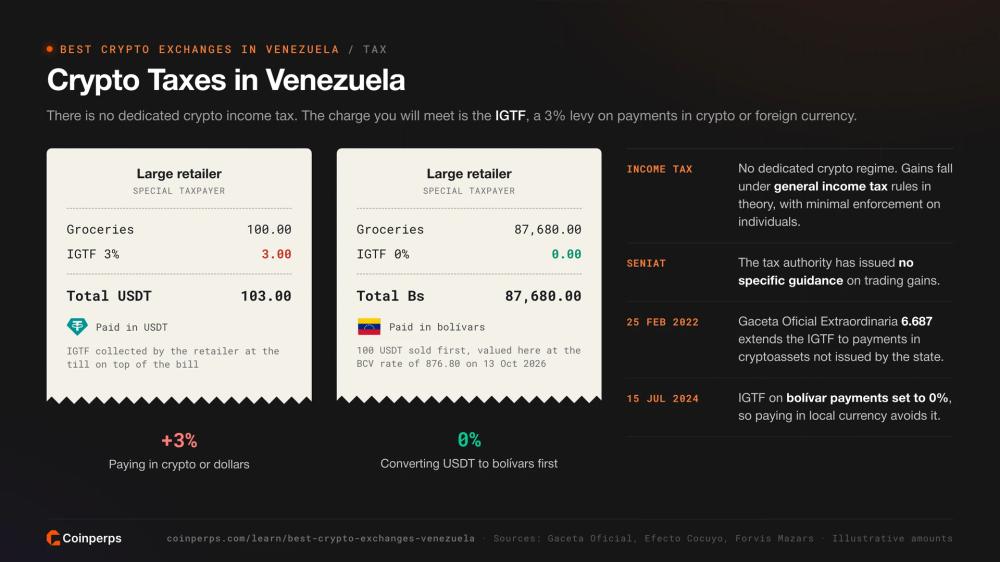
Venezuelan traders face no dedicated crypto income tax, and the tax authority SENIAT has published no specific guidance on trading gains. Gains fall under general income tax rules in theory, though enforcement on individuals is minimal.
The tax you will meet day to day is the IGTF (Impuesto a las Grandes Transacciones Financieras). A 2022 reform in Gaceta Oficial Extraordinaria 6.687 extended it to payments made in foreign currency or in cryptoassets other than those issued by the state, at 3%.
Businesses designated as special taxpayers collect it, so it usually appears at the till when you pay a large retailer in USDT.
Payments in bolívars have been taxed at 0% since 15 July 2024, so converting USDT to bolívars before paying avoids the 3% charge. Keep a record of every purchase and sale, since a new crypto law could bring clearer reporting rules.
Risks of Using Crypto Exchanges From Venezuela
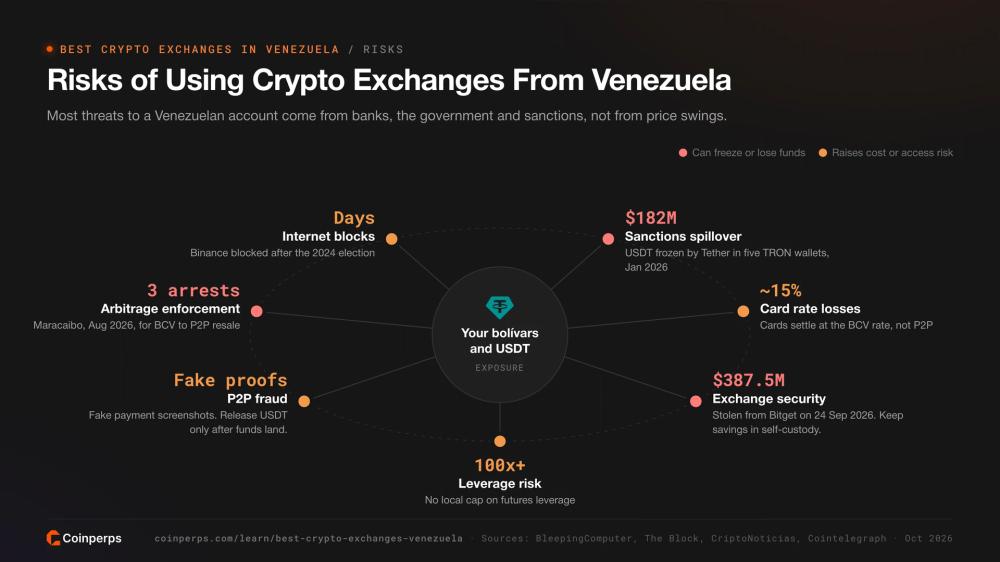
Venezuelan traders carry risks well beyond price volatility, and most of them come from banks, the government and sanctions.
- P2P fraud: Fake payment screenshots and reversed transfers are the most common scams. Never release USDT until the money is visible in your own bank app, and only trade with verified merchants.
- Arbitrage enforcement: The August 2026 arrests in Maracaibo show that buying at the BCV rate and reselling on P2P can be treated as a crime. Banks may also freeze accounts with unusual deposits.
- Internet blocks: Binance was blocked at the internet-provider level in August 2024 after the election. Access can disappear with no warning, so keep funds you need on more than one platform.
- Exchange security: Bitget's $387.5 million hack in September 2026 shows that even large platforms can halt withdrawals for days. Move long-term savings to a wallet you control.
- Sanctions spillover: Tether froze about $182 million in USDT across five TRON wallets in January 2026 at the request of law enforcement. Avoid counterparties and apps with links to sanctioned entities.
- Card rate losses: Exchange cards settle local purchases at the BCV rate, so selling USDT on P2P before spending is often cheaper.
- Leverage risk: Futures with 100x to 500x leverage and no local caps can erase an account in one move. If you trade them, watch the Coinperps liquidations dashboard and read our guide on how to avoid auto-deleveraging.
Bottom Line
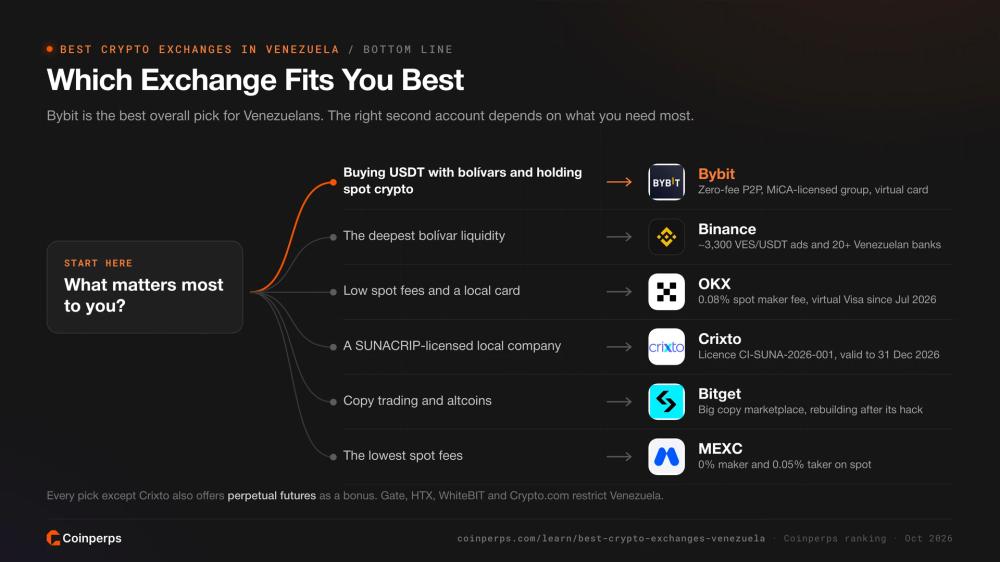
Bybit is the best overall crypto exchange in Venezuela for buying USDT with bolívars and trading spot crypto. Its zero-fee bolívar P2P market, MiCA-licensed parent and Venezuelan card make it the most complete package, and perpetual futures come as a bonus. Open an account through Bybit.
Binance remains essential for the deepest bolívar liquidity, and OKX offers low spot fees and its new Venezuelan card. Crixto is the pick if a SUNACRIP licence matters to you. Bitget suits copy traders once it rebuilds confidence after its hack, and MEXC offers the lowest spot fees.
Watch the National Assembly's work on a new crypto law and any further OFAC licences. Either could change which platforms can legally serve Venezuela, and we will update this ranking as the rules develop.