Best Crypto Exchanges in Egypt in 2026
Compare the best crypto exchanges in Egypt, from EGP P2P depth and spot fees to the CBE ban, recent arrests and the shrinking USDT premium.

Disclosure: Coinperps may earn a commission from partner links, at no extra cost to you. Reviews are based on independent testing — see how we test.
- No exchange is licensed in Egypt: Article 206 of Banking Law No. 194 of 2020 bans unlicensed crypto trading, and the CBE has never issued a licence.
- Global exchanges still accept Egyptians: Bybit, Binance, OKX, Bitget, MEXC and KuCoin serve Egyptian residents through EGP P2P markets with InstaPay and mobile wallets.
- The USDT premium has almost vanished: USDT cost about 1% above the official rate in October 2026, while the black-market dollar traded at more than double the official rate in early 2024.

Bybit
Bybit, founded in 2018 and headquartered in Dubai, is the world’s second-largest exchange by volume, serving 60 million users with 1,800+ assets and over $11 billion in daily trading.
Features
Fees
Regulation
Overall Rating
No crypto exchange is licensed in Egypt, because the Central Bank of Egypt (CBE) has never issued a licence under Article 206 of Banking Law No. 194 of 2020. Many Egyptians still buy USDT and Bitcoin through global platforms that accept Egyptian residents.
Egypt ranked 26th in the 2025 Chainalysis Global Crypto Adoption Index and 20th in TRM Labs' 2025 adoption ranking, the highest of the four North African countries TRM ranked, all of which restrict crypto.
In August 2026 the Interior Ministry arrested individual traders in Beni Suef and Minya for trading crypto on exchange platforms. Choosing an exchange in Egypt is also a choice about legal exposure.
We checked every major exchange's terms, pulled live Egyptian pound (EGP) peer-to-peer (P2P) order books on 14 October 2026 and compared spot fees, licences and security records.
This guide to the best crypto exchanges in Egypt weighs our exchange rankings against the licences each group holds abroad.
Top 6 Crypto Exchanges in Egypt
Exchange | EGP On-Ramp | Maker Fee | Taker Fee | Live USDT/EGP Ads | Key Nuance |
|---|---|---|---|---|---|
Zero-fee P2P | 0.10% | 0.10% | About 250 | Best all-rounder with a MiCA-licensed group | |
P2P with InstaPay and wallets | 0.10% | 0.10% | About 440 | Deepest EGP liquidity, ADGM-licensed | |
Zero-fee P2P | 0.08% | 0.10% | About 230 | Dubai VARA and EU MiCA licences | |
P2P with mobile wallets | 0.10% | 0.10% | 40+ | Copy trading, recovering from September hack | |
P2P | 0% | 0.05% | About 70 | Lowest spot fees, fined by Dubai's VARA | |
P2P | 0.10% | 0.10% | Under 30 | Wide altcoin list, thinnest EGP market |
1. Bybit
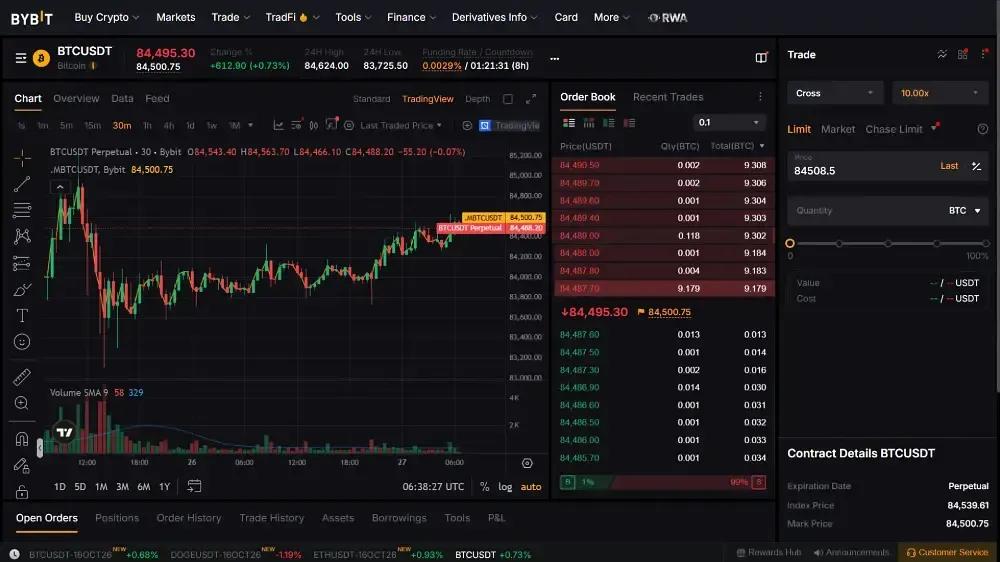
Bybit ranks first because it combines a commission-free EGP P2P market, deep spot order books and a group licence under MiCA, the EU's crypto rulebook. Egypt is absent from its service restricted countries list, updated on 13 October 2026.
Its EGP P2P market showed about 96 adverts to buy USDT and 150 to sell on 14 October 2026. Sellers accept InstaPay, bank transfers from CIB, Banque Misr, National Bank of Egypt (NBE) and Alex Bank, and mobile wallets such as Vodafone Cash, Orange Cash and e& money.
Bybit charges no fee on EGP P2P trades, because its P2P fee schedule exempts currencies missing from its fee table. Escrow holds the seller's USDT until your transfer is confirmed.
Spot trading costs 0.10% for makers and takers, and perpetual futures cost 0.02% maker and 0.055% taker. The MiCA licence sits with Bybit EU in Austria. Our Bybit restricted countries guide covers regional access, and you can open an account through Bybit.
Pros
- Zero-fee EGP P2P with InstaPay, the main Egyptian banks and mobile wallets.
- Deep spot order books, with perpetual futures as an extra.
- A MiCA-licensed EU entity.
Cons
- No CBE licence, like every exchange in Egypt.
- No Bybit card is available to Egyptian residents.
- A February 2025 hack of about $1.5 billion, attributed by the FBI to North Korea, shows custody risk, although customers were made whole.
2. Binance
Binance runs the deepest Egyptian pound P2P market. Our check on 14 October 2026 found about 141 adverts to buy USDT and 299 to sell, and 115 of the buy adverts accepted InstaPay.
Sellers accept the widest range of payments on this list, including InstaPay, Vodafone Cash, Etisalat Cash, Orange Cash, WE Pay, myFawry and telda, plus transfers from CIB, NBE, Banque Misr, Alex Bank, Banque du Caire, QNB, AAIB and HSBC Egypt. Egypt is not on its list of prohibited countries, updated on 5 January 2026.
Spot trading costs 0.10%, or 0.075% when fees are paid in BNB. Binance lists a P2P fee of 0.10% to 0.15% on EGP express trades, a small cost that Bybit and OKX do not charge.
In December 2025 Binance secured a global licence from the Financial Services Regulatory Authority of Abu Dhabi Global Market (ADGM). That gives Binance.com an Arab regulator but no standing under Egyptian law.
Futures traders get 0.02% maker and 0.05% taker pricing, and Binance leads the Coinperps open interest rankings on most major contracts. Our Bybit vs Binance fee comparison shows how the two leaders differ. You can sign up through Binance.
Pros
- By far the largest EGP P2P merchant pool, with InstaPay on most adverts.
- Coverage of more than 15 Egyptian banks and wallets.
- An ADGM licence for Binance.com and the deepest spot order books on this list.
Cons
- A P2P fee on EGP express trades, unlike Bybit and OKX.
- No Binance card for Egyptian residents.
- Its size makes it the most visible platform to Egyptian authorities and banks.

3. OKX
OKX gives Egyptian traders low spot fees, strong execution and the most relevant regional licence on this list. Egypt is not among the restricted locations in its risk and compliance disclosure, last updated on 8 July 2026, as our OKX restricted countries guide explains.
Our check counted about 67 USDT buy adverts and 165 sell adverts in its EGP market. Sellers accept InstaPay, Vodafone Cash, Fawry, Orange, Qahera Cash and transfers from Bank of Alexandria, CIB, Banque Misr, NBE and QNB, and OKX charges no P2P service fee.
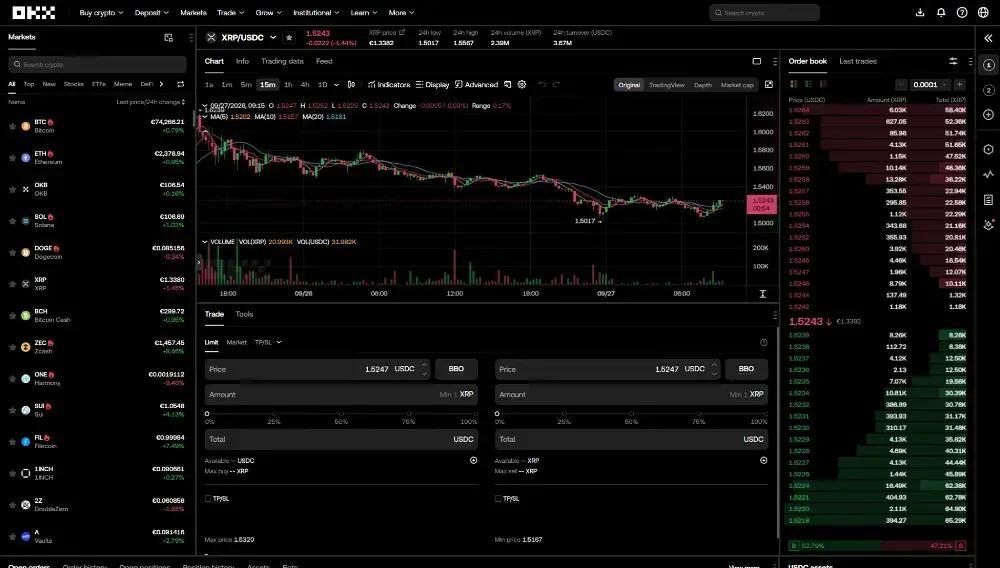
Spot fees are 0.08% maker and 0.10% taker, the lowest maker rate among the big three. Perpetual futures are available too, at 0.02% maker and 0.05% taker, with up to 100x leverage on Bitcoin.
OKX Middle East holds a licence from Dubai's Virtual Assets Regulatory Authority (VARA), and the group holds a MiCA licence through Malta. Its Web3 wallet is also a strong self-custody option. Accounts open through OKX.
Pros
- A 0.08% spot maker fee, below Bybit, Binance and Bitget.
- Zero-fee EGP P2P with InstaPay and Fawry.
- Licences from Dubai's VARA and under MiCA.
Cons
- The EGP P2P market is much thinner than Binance's.
- The OKX card is available only in the European Economic Area.
- No CBE licence and no direct EGP deposit gateway.
4. Bitget
Bitget offers a working EGP P2P market and popular copy trading, but a recent security incident holds it at fourth. Egypt is not a prohibited country under its terms of use, updated on 15 September 2026, and our Bitget restricted countries guide covers the full list.
On 24 September 2026, attackers stole about $352 million from Bitget's hot and warm wallets through a third-party zero-day flaw, a figure Bitget later revised to $387.5 million. The exchange says its user protection fund covers the loss.
Only about 18 merchants were selling USDT for pounds on Bitget during our check. Sellers accept InstaPay, Vodafone Cash, Etisalat Cash, Orange Money, WE Pay, e& money and bank transfers from CIB, NBE and Alex Bank.
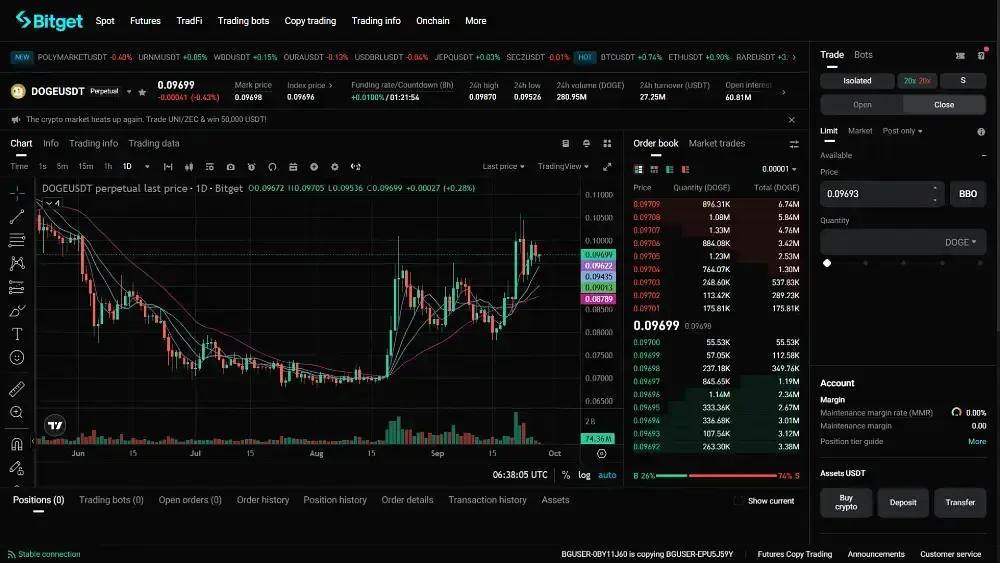
Spot trading costs 0.10%, or 0.08% when fees are paid in BGB, and its copy trading marketplace is one of the largest open to Egyptians. Futures are available at 0.02% maker and 0.06% taker. Open an account through Bitget.
Pros
- EGP P2P with good coverage of Egyptian mobile wallets.
- The most developed copy trading ecosystem on this list.
- A wide altcoin list alongside futures for experienced users.
Cons
- The September 2026 hack is recent and the protection fund must be rebuilt.
- A thin EGP P2P market compared with the top three.
- No MiCA or VARA licence for the group.
5. MEXC
MEXC charges the lowest spot fees in this comparison, at 0% maker and 0.05% taker. It often lists new tokens early, and its futures are cheap too, as our guide to the lowest-fee crypto perpetual exchanges shows.
Its current user agreement, updated on 13 October 2026, places no restriction on Egyptian residents, and our MEXC restricted countries guide tracks the list. About 52 merchants were selling USDT for pounds and 21 were buying during our check.
Regulatory standing is the weakness. On 22 June 2026 Dubai's VARA fined MEXC's operator MX Global for serving Dubai residents without a licence. Its futures offer up to 500x leverage, enough to wipe out an account on a single candle. Accounts open through MEXC.
Pros
- The lowest spot fees on this list, with 0% maker pricing.
- A wide altcoin selection, often with early listings.
- An active EGP P2P market for a smaller exchange.
Cons
- No major licence and a 2026 VARA fine.
- Extreme leverage on futures.

6. KuCoin
KuCoin suits Egyptians who want a broad altcoin list on a large global exchange. Egyptian residents can register under its terms of use, last updated on 29 September 2026, as our KuCoin restricted countries guide explains.
KuCoin has the thinnest EGP P2P market on this list, at fewer than 30 live adverts. Sellers accept InstaPay, Etisalat Cash, Orange Cash, WE Pay, telda and transfers from Alex Bank, Banque Misr, CIB and NBE.
Spot trading costs 0.10% for both makers and takers at the base level, and futures cost 0.02% maker and 0.06% taker. On 24 June 2026 Dubai's VARA fined KuCoin's operator Peken Global for serving Dubai customers without a licence. You can use our KuCoin referral code or open an account through KuCoin.
Pros
- One of the widest altcoin selections among large exchanges.
- InstaPay and mobile wallet support on EGP P2P.
- Futures available as a bonus.
Cons
- The thinnest EGP P2P market on this list.
- A 2026 VARA fine for unlicensed activity in Dubai.
How We Ranked These Exchanges
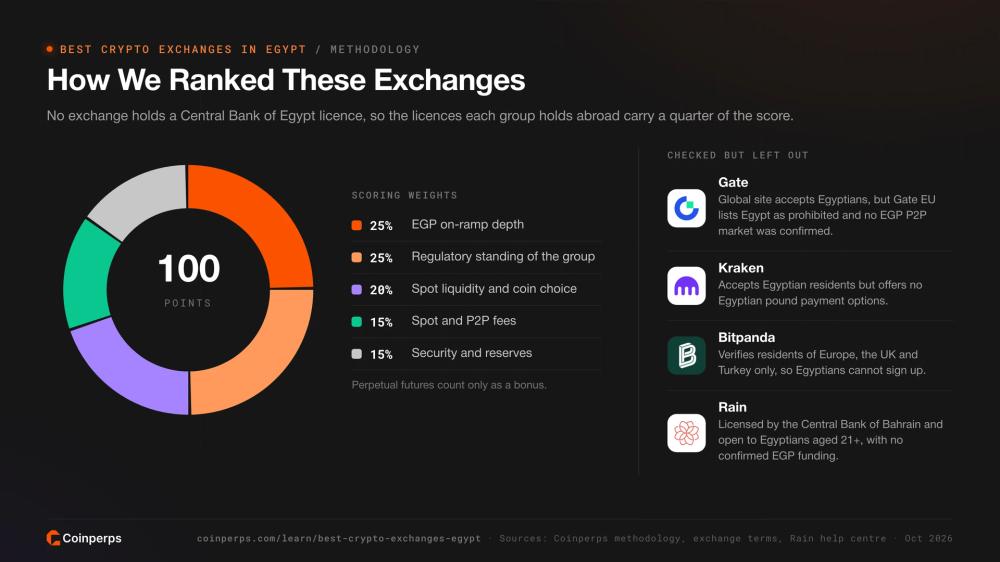
Every exchange on this list accepts Egyptian residents under its own terms. With no CBE-licensed option available, we weighted the licences each group holds abroad and scored platforms with our methodology for crypto platform rankings.
- EGP on-ramp depth: 25%
- Regulatory standing of the group: 25%
- Spot liquidity and coin choice: 20%
- Spot and P2P fees: 15%
- Security and reserves: 15%
Perpetual futures count only as a bonus. EGP depth reflects live USDT/EGP adverts on 14 October 2026 and the banks and wallets sellers accept.
Gate's global site accepts Egyptians, but its EU entity lists Egypt as prohibited and we could not confirm an EGP P2P market, as our Gate restricted countries guide notes. Kraken offers no EGP payment options, and Bitpanda does not verify Egyptian residents.
Gulf exchanges offer the nearest regional licence. Rain, licensed by the Central Bank of Bahrain, accepts Egyptian residents aged 21 or over, but we found no confirmed EGP funding method, so it does not make the top six.
Is Crypto Trading Legal in Egypt?
Trading crypto in Egypt without a CBE licence is illegal, no licence has ever been issued, and prosecutions of individual traders do happen.
Banking Law 194 and the CBE Ban
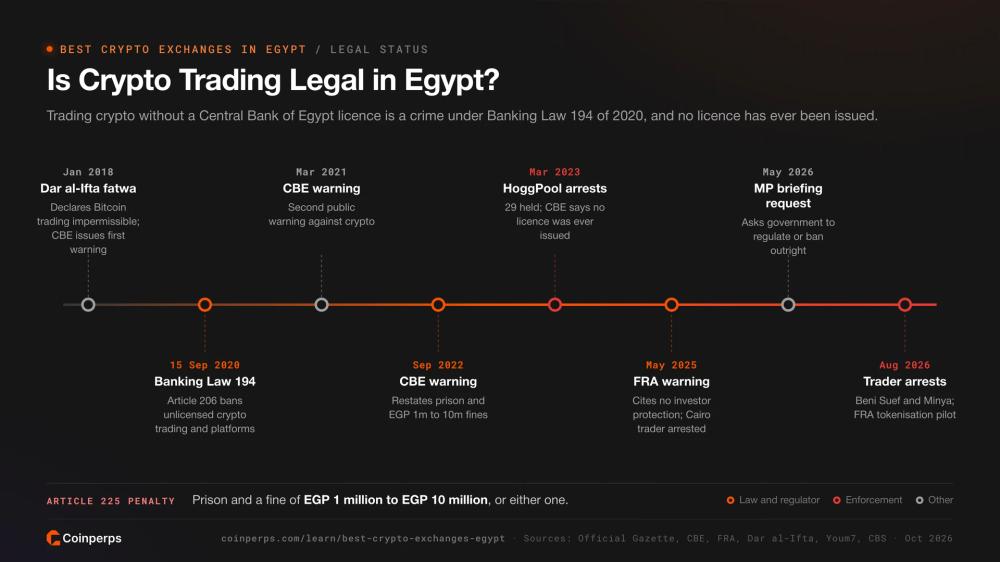
Article 206 of Banking Law No. 194 of 2020, published in the Official Gazette on 15 September 2020, prohibits issuing, trading or promoting cryptocurrencies, and creating or operating platforms to trade them, without a licence from the CBE board.
Article 225 sets the penalty at imprisonment and a fine of EGP 1 million to EGP 10 million, or either one. Repeat offenders face both prison and the fine.
The CBE has warned the public four times, in January 2018, March 2021, September 2022 and March 2023. The March 2023 statement followed the HoggPool scam and confirmed that no licence has ever been granted to trade crypto in the Egyptian market.
Enforcement Against Individual Traders
Egyptian police arrest ordinary traders as well as scam operators. In 2026 the Interior Ministry's public funds unit arrested a programmer in Beni Suef on 11 August and traders in Minya on 24 August and 27 August for trading crypto through accounts on online platforms.
In May 2025 police in Cairo arrested a man for trading crypto and selling mining rigs, and in March 2023 they arrested 29 people behind the HoggPool scheme. Several cases also involved unlicensed currency dealing or fraud.
FRA, Parliament and the Digital Pound
The Financial Regulatory Authority (FRA), which oversees non-bank finance, renewed its warning against dealing in crypto in May 2025, citing the absence of any body to protect investors.
The FRA is testing tokenisation of regulated products only. In August 2026 Granite and Tarmiiz joined its sandbox to tokenise money market fund units, a pilot that excludes Bitcoin and stablecoins.
On 3 May 2026 an MP filed an urgent briefing request asking the government to choose between a strict regulatory framework and deterrent bans, and no draft law has followed. The CBE is working on a digital pound, with rollout broadly targeted for 2030.
Religious guidance matters to many Egyptians too. Dar al-Ifta, the official fatwa authority, declared Bitcoin trading impermissible in a fatwa published in January 2018. The opinion is non-binding and has not been revised.
Futures and Perpetuals Rules
Egypt has no framework for crypto derivatives, so the ban in Article 206 applies to futures as much as spot. Each platform sets its own leverage limits, from 100x on OKX to 500x on MEXC.
EU platforms work under limits drawn from MiFID investment rules, and the UK bans retail crypto derivatives altogether, as our explainer on crypto perpetual futures regulation covers. In Egypt the size of each position is your only safeguard.
What Makes a Good Crypto Exchange for Egyptian Traders?
Egyptian traders need more from an exchange than low fees, because a criminal ban, bank card limits and a volatile pound shape every deposit and withdrawal.
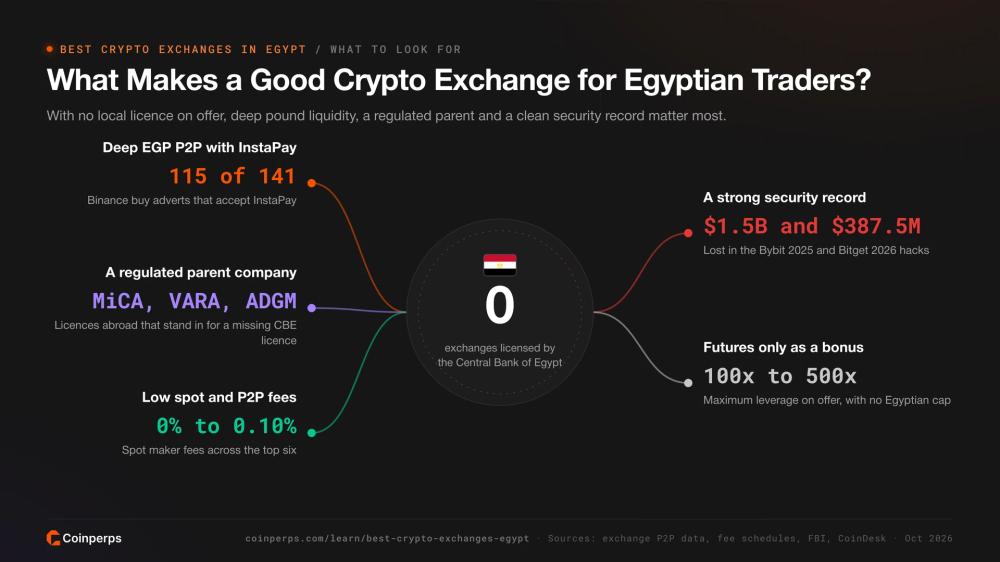
- A deep EGP P2P market with InstaPay: Most Egyptians fund accounts by sending an InstaPay or mobile wallet transfer to a P2P seller, and more merchants mean tighter spreads.
- A regulated parent company: No exchange holds a CBE licence. The next best protection is a group licensed under EU MiCA, Dubai's VARA or Abu Dhabi's ADGM, as explained in our guide to MiCA-licensed exchanges.
- Deep USDT and spot markets: Many traders buy USDT first and then move into Bitcoin or other coins, so deep spot books keep the second step cheap.
- Low spot and P2P fees: Spot fees range from 0% to 0.10% for makers on this list. Our explainer on maker vs taker fees shows how the two rates affect each trade.
- A strong security record: Proof of reserves and a funded protection pool matter more when no local regulator can step in, as the Bybit and Bitget hacks showed.
Every exchange here offers perpetual futures, which this ranking treats as a bonus to spot trading. Our guide to crypto perps vs spot trading explains the difference.
Why Egyptians Turn to USDT
For many Egyptians a crypto account is a way to hold dollars, receive freelance pay and protect savings from a currency that has lost more than 40% of its value since early 2024.
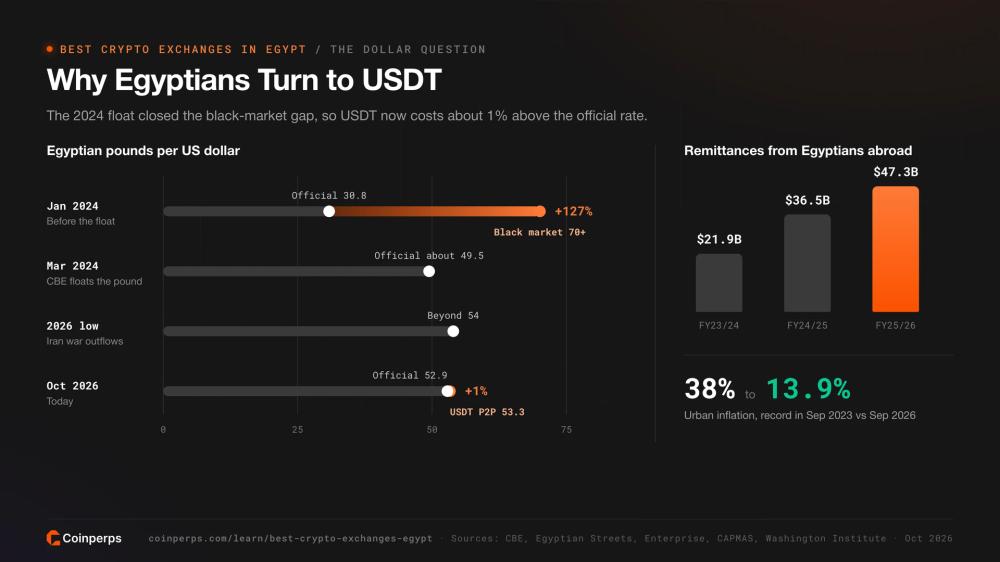
The pound traded near 30.9 per dollar before the CBE let it float on 6 March 2024, and it settled around 49.5 within days. In January 2024 the black-market dollar had topped EGP 70, more than double the official rate, and USDT on P2P markets tracked that parallel price.
The float closed most of that gap. On 13 October 2026 the CBE's official rate was about 52.9 per dollar, while the cheapest USDT on Binance P2P cost about 53.3 EGP, a premium near 1%.
The pound remains exposed to shocks. After the Iran war began in February 2026, the pound fell beyond 54 per dollar as foreign investors pulled money out.
Inflation has eased from its record of 38% in September 2023 to 13.9% in September 2026, and bank certificates now pay more than inflation. That weakens the case for holding USDT as an inflation hedge.
Remittances matter too. Egyptians abroad sent a record $47.3 billion in the 2025/26 fiscal year, up 29.6%. USDT gives freelancers paid from abroad another way to receive dollars.
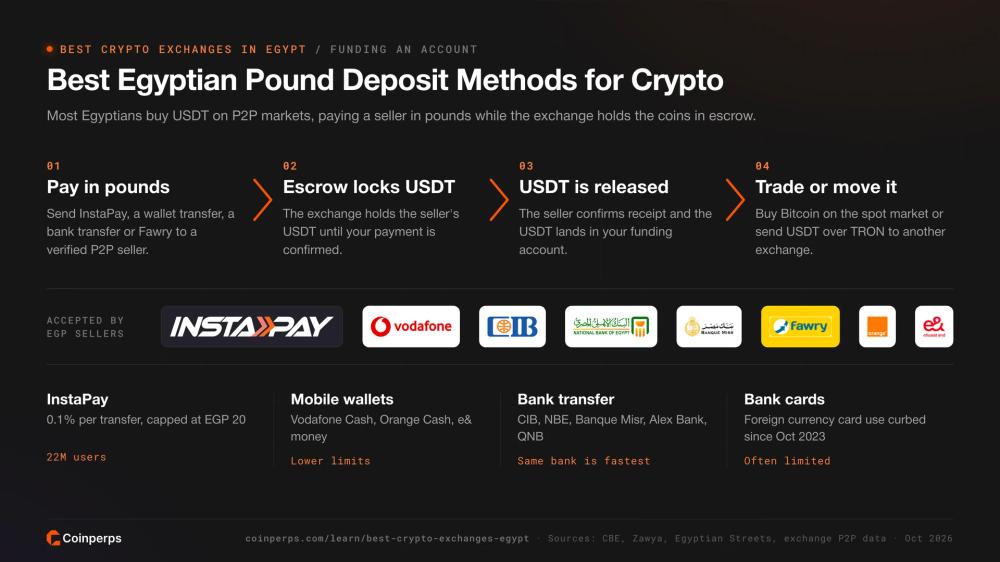
Best Egyptian Pound Deposit Methods for Crypto
Your funding method decides what a trade really costs and how visible it is to your bank. Spreads move daily, so compare these options before any large deposit.
- InstaPay P2P: The most common option, accepted on most EGP adverts on Binance, Bybit and OKX. InstaPay had nearly 22 million registered customers by mid-2026, and transfers cost 0.1%, capped at EGP 20.
- Mobile wallets: Vodafone Cash, Orange Cash, e& money and WE Pay work on most P2P markets. Their lower limits suit smaller purchases.
- Bank transfer P2P: Sellers accept transfers from CIB, NBE, Banque Misr, Alex Bank and QNB. Same-bank transfers usually clear fastest.
- Fawry: OKX, Binance and Bitget sellers accept myFawry or Fawry payments, useful for Egyptians without a bank app.
- Bank cards: Egyptian banks suspended foreign currency use of debit cards abroad in October 2023 and cap foreign currency spending on credit cards, which limits direct card purchases on exchanges.
- Two-exchange transfer: Buy USDT where the P2P market is deepest, then send it to OKX, MEXC or KuCoin over the TRON or Arbitrum network. One network fee keeps your bank activity on a single platform.
Large or frequent P2P transfers can draw questions from your bank, so trade only with verified merchants and keep a record of every order.
Crypto Taxes in Egypt
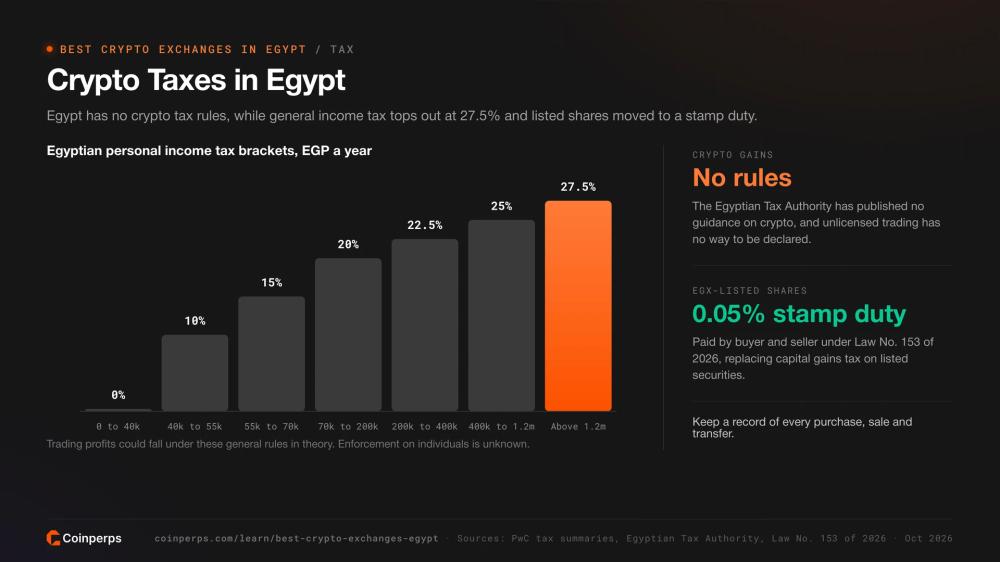
Egypt has no crypto tax rules, and the Egyptian Tax Authority has published no guidance on trading gains or how to declare them.
Personal income tax in Egypt runs from 0% to 27.5% above EGP 1.2 million a year. In theory, regular trading profits could fall under general income tax rules, though enforcement on individuals is unknown.
Stock market gains follow different rules. Law No. 153 of 2026 replaced capital gains tax on securities listed on the Egyptian Exchange with a stamp duty from July 2026. Crypto is not a listed security, so that regime does not apply.
Keep a record of every purchase, sale and transfer. If Egypt introduces crypto licensing, clear records will make any new reporting rules easier to meet.
Risks of Using Crypto Exchanges From Egypt
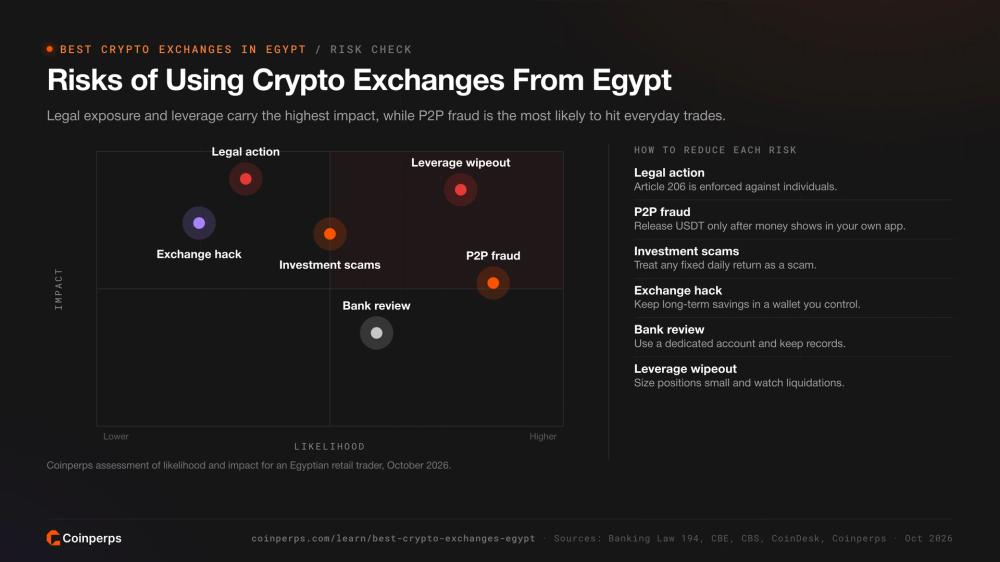
Egyptian traders face legal, banking and scam risks on top of price swings.
- Legal risk: Article 206 makes unlicensed crypto trading a crime punishable by prison and fines of up to EGP 10 million. Arrests in 2026 show the law is enforced against individuals.
- P2P fraud: Fake payment screenshots and reversed InstaPay transfers are the most common scams. Never release USDT until the money is visible in your own bank or wallet app.
- Investment scams: HoggPool collected money from Egyptian savers before police shut it down in 2023. Treat any platform promising fixed daily returns as a scam.
- Exchange security: Bitget's hack of about $352 million in September 2026 shows that even large platforms can halt withdrawals. Move long-term savings to a wallet you control.
- Bank account scrutiny: Repeated P2P transfers from many strangers can trigger a bank review, so keep records and use a dedicated account.
- Leverage risk: Futures with up to 500x leverage and no local caps can erase an account in one move. If you trade them, watch the Coinperps liquidations dashboard and read our guide on how to avoid auto-deleveraging.
Bottom Line
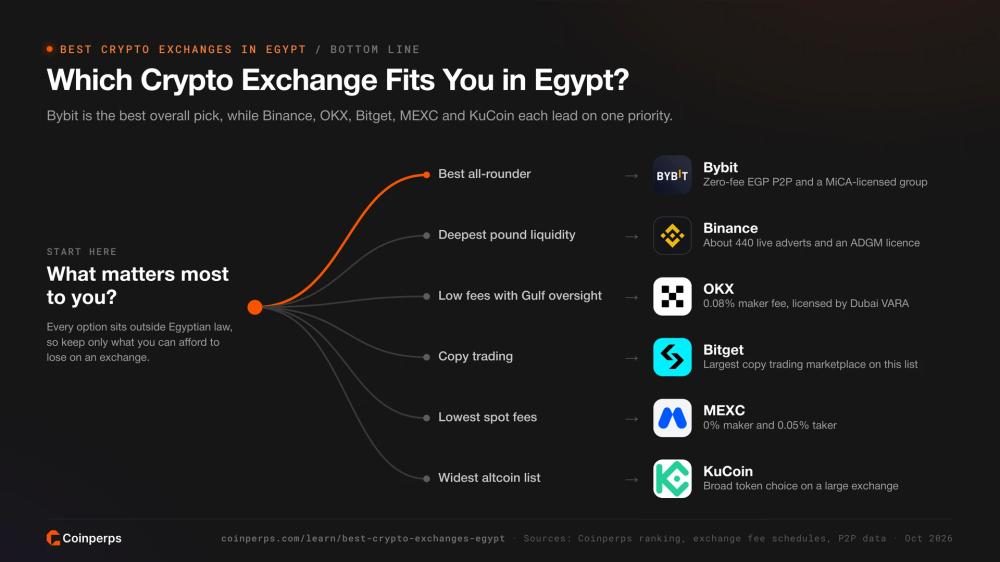
Bybit is the best overall crypto exchange in Egypt for buying USDT with Egyptian pounds and trading spot crypto. Its zero-fee EGP P2P market, MiCA-licensed parent and deep spot books make it the most complete package. Open an account through Bybit.
Binance remains essential for the deepest EGP liquidity and holds an ADGM licence, and OKX offers low spot fees with Dubai and EU licences. Bitget suits copy traders once it rebuilds confidence after its hack, MEXC offers the lowest spot fees and KuCoin the widest altcoin list.
No exchange is legal under Egyptian law today. Watch the CBE, the FRA and Parliament for any licensing framework, and we will update this ranking as the rules develop.