Best Crypto Exchanges in Germany (2026)
Compare the best crypto exchanges in Germany, from MiCA licences and euro spot fees to bank crypto offers, regulated futures, the one-year tax rule and scams.

Coinperps may earn a commission from partner links, at no cost to you; rankings follow our methodology. Not financial advice.
Key takeaways
- Kraken is the best crypto exchange in Germany: it pairs a MiCA licence from the Central Bank of Ireland with a CySEC licence for regulated futures, and SEPA Instant deposits to its German IBAN are free.
- Every exchange serving Germans now needs a MiCA licence: Germany ended its transition period on 31 December 2025, so Binance has stopped onboarding EU users and Bitget has closed sign-ups for German residents.
- Banks charge more than exchanges: a €1,000 Bitcoin purchase costs €2.50 in fees on Bitvavo but €15 plus a spread at a Volksbank charging 1.5%.
- Crypto held for over a year is still tax-free: gains below €1,000 a year are exempt, but a finance ministry draft would end the one-year rule for coins bought from 2027.

- EU licence
- MiCA (Central Bank of Ireland), MiFID (CySEC)
- EUR deposits
- SEPA, SEPA Instant
- Spot maker / taker
- 0.40% / 0.80%
- Regulated futures
- Yes
Why it ranks #1 Partner link · How we rank
Kraken is the best crypto exchange in Germany because it pairs a MiCA licence for spot trading with an EU futures licence, in one account with free euro deposits.
- MiCA and CySEC licences, so spot and regulated futures share one account.
- Free SEPA Instant deposits to a German IBAN.
- More than 600 crypto pairs plus tokenised stocks.
Coinperps may earn a commission if you sign up through this link, at no cost to you. Rankings follow our method, not partner deals.
On this page 9 sections
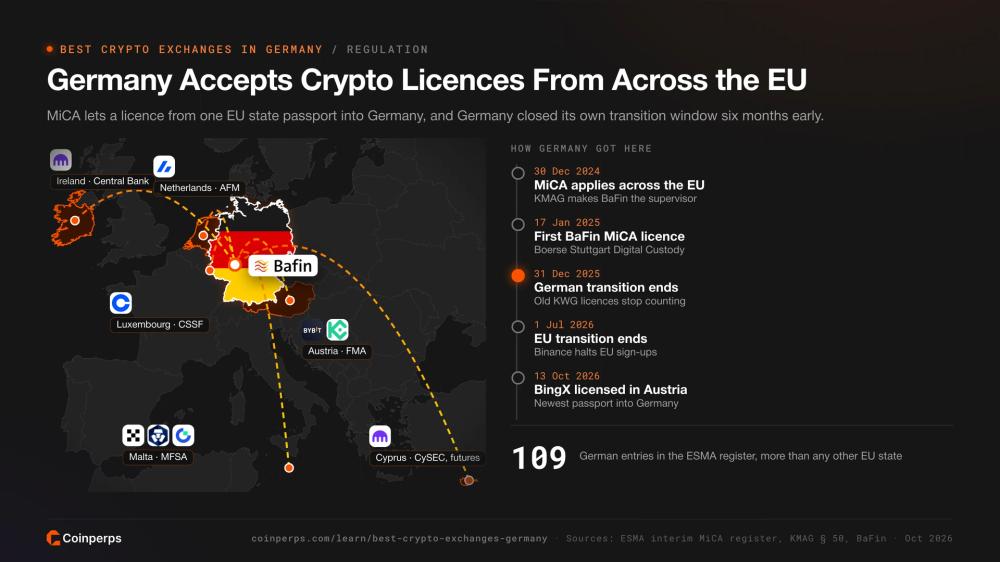
Since 1 January 2026, every crypto exchange serving German residents has needed a licence under the EU's Markets in Crypto-Assets Regulation (MiCA). Germany ended its own transition period six months before the rest of the EU.
Kraken, Bitpanda, OKX, Bybit EU, Coinbase, Bitvavo and BISON hold MiCA licences that cover Germany. Binance has stopped onboarding EU users, and Bitget has closed sign-ups for German residents.
German banks sell crypto too. Trade Republic, N26 and the first Volksbanken already offer it, and the Sparkassen began a staged rollout in October 2026.
We checked every licence against the ESMA register of crypto-asset service providers, compared euro deposits and spot fees, and weighed the results against our exchange rankings.
This guide to the best crypto exchanges in Germany puts spot trading first and treats regulated futures as a bonus. It is not tax or legal advice.
Top 7 Crypto Exchanges in Germany
Exchange | EU licence | EUR deposits | Spot maker / taker | Regulated futures | Key nuance |
|---|---|---|---|---|---|
MiCA (Central Bank of Ireland), MiFID (CySEC) | SEPA, SEPA Instant | 0.40% / 0.80% | Yes | German IBAN, spot and futures in one account | |
MiCA (BaFin and Austria's FMA) | SEPA, SEPA Instant, PayPal, card | 0.25% / 0.25% (Fusion) | No | BaFin-licensed German entity, savings plans from €10 | |
MiCA (Malta's MFSA), MiFID | SEPA, SEPA Instant, PayPal, card | 0.08% / 0.10% | Yes (X-Perps) | Lowest base spot fees on this list | |
MiCA (Austria's FMA) | SEPA, PayPal, card, Apple Pay | 0.25% / 0.25% | No, MiFID licence pending | Top Coinperps score, Blockpit tax partner | |
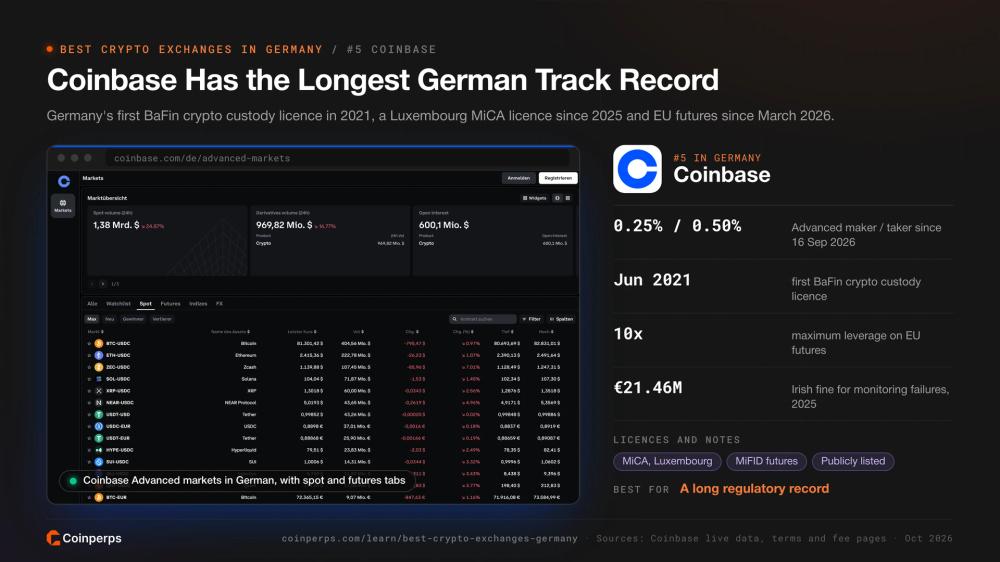
MiCA (Luxembourg's CSSF), MiFID | SEPA, card, PayPal | 0.25% / 0.50% | Yes | Held Germany's first BaFin crypto custody licence | |
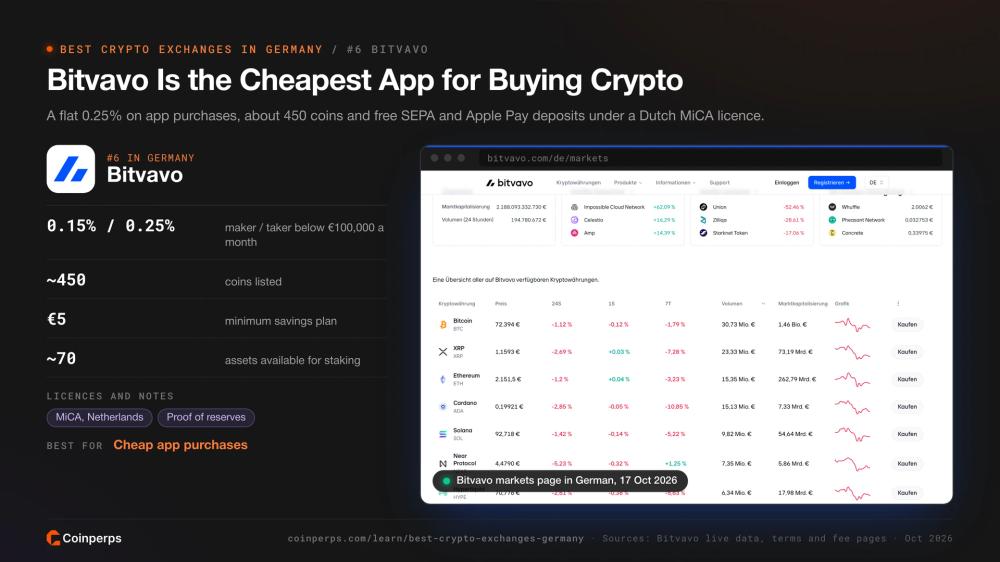
MiCA (Netherlands' AFM) | SEPA, Apple Pay, card, PayPal | 0.15% / 0.25% | No | About 450 coins, cheapest app purchases | |
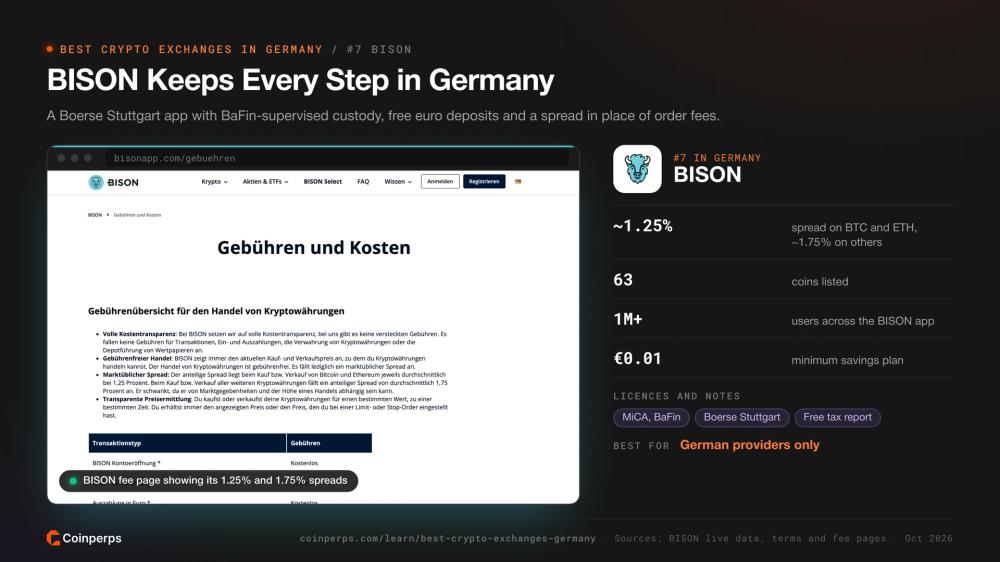
MiCA (BaFin) | SEPA, SEPA Instant | About 1.25% spread, no order fee | No | Run by Boerse Stuttgart, 63 coins |
 OKX
OKX Bybit EU
 Coinbase
1. Kraken
- EU licence
- MiCA (Central Bank of Ireland), MiFID (CySEC)
- EUR deposits
- SEPA, SEPA Instant
- Spot maker / taker
- 0.40% / 0.80%
- Regulated futures
- Yes
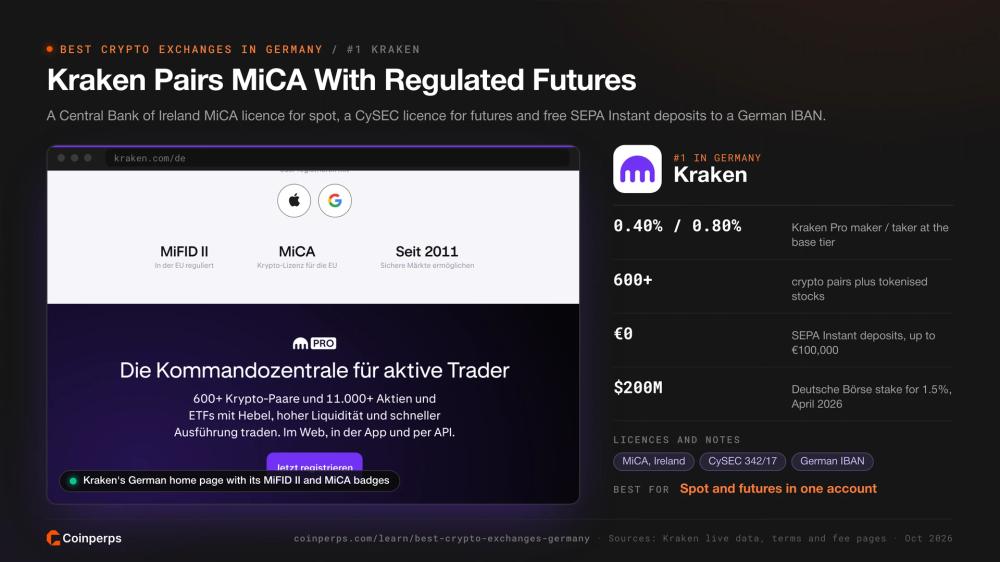
Kraken is the best crypto exchange in Germany because it pairs a MiCA licence for spot trading with an EU futures licence, in one account with free euro deposits.
Its crypto services in Europe run through Payward Europe Solutions Limited, which the Central Bank of Ireland regulates as a crypto-asset service provider (CASP). German clients moved onto that licence on 1 August 2025, after a year served through the BaFin-licensed DLT Finance.
Derivatives come from a second company, Payward Europe Digital Solutions (CY) Limited, which holds licence number 342/17 from the Cyprus Securities and Exchange Commission (CySEC). German residents therefore get regulated futures, which a MiCA licence alone cannot provide.
SEPA and SEPA Instant deposits are free from Kraken's side, with a €1 minimum and a €100,000 cap per instant transfer. EUR accounts sit with the German branch of Banking Circle, so customers receive a German IBAN.
Kraken Pro charges makers 0.40% and takers 0.80% at the lowest volume tier, under the fee schedule Kraken restructured in July 2026. Instant buys in the Kraken app cost 1% plus a spread, so frequent buyers pay less on the Pro order book. Kraken lists more than 600 crypto pairs alongside tokenised stocks and ETFs.
Deutsche Börse, Germany's main exchange operator, agreed to buy a 1.5% stake in Kraken's parent, Payward, for $200 million in April 2026.
Kraken switched USDT to sell-only for EEA users in March 2025 to comply with MiCA's stablecoin rules, so euro and USDC pairs carry most German trading. Our Kraken restricted countries guide covers regional access, or open an account through Kraken.
Pros
- MiCA and CySEC licences, so spot and regulated futures share one account.
- Free SEPA Instant deposits to a German IBAN.
- More than 600 crypto pairs plus tokenised stocks.
Cons
- Base Kraken Pro fees rose to 0.40% / 0.80% in July.
- Instant buys cost 1% plus a spread.
- USDT can only be sold, not bought, in the EEA.
2. Bitpanda
 Best forBaFin-licensed German entity, savings plans from €10
- EU licence
- MiCA (BaFin and Austria's FMA)
- EUR deposits
- SEPA, SEPA Instant, PayPal, card
- Spot maker / taker
- 0.25% / 0.25% (Fusion)
- Regulated futures
- No
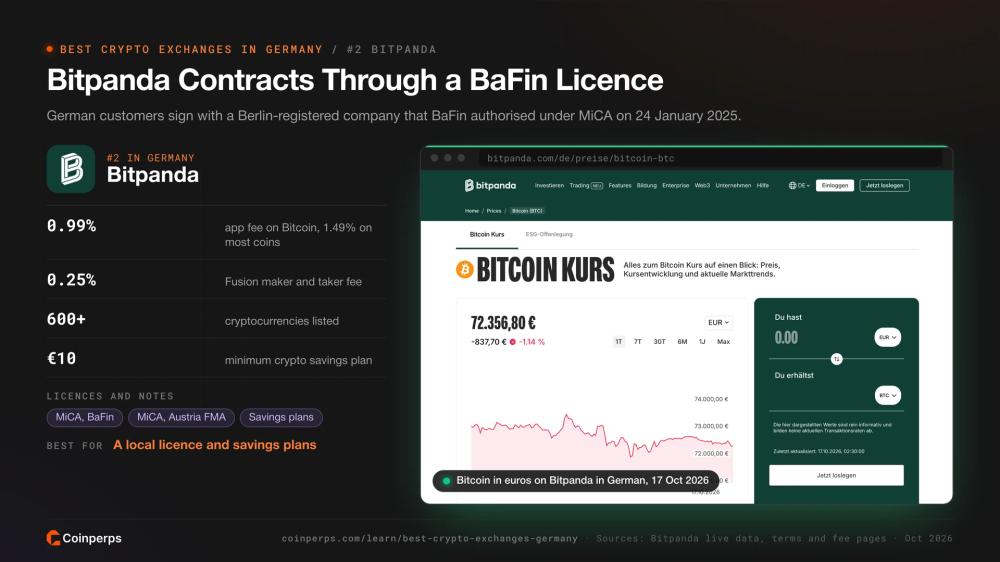
Bitpanda is the strongest local choice, because German customers contract with a Berlin-registered company licensed by BaFin, Germany's financial regulator.
Accounts opened since November 2022 sit with Bitpanda Asset Management GmbH, which received MiCA authorisation from BaFin on 24 January 2025. Its Austrian parent, Bitpanda GmbH, holds a separate MiCA licence from Austria's FMA.
The Bitpanda app builds its fee into the price. Its cost disclosure, dated 8 July 2026, sets 0.99% for Bitcoin and stablecoins, 1.49% for most other coins and 2.49% for small caps. Bitpanda Fusion, its order-book platform, charges makers and takers 0.25% below €100,000 of monthly volume.
Bitpanda lists more than 600 cryptocurrencies, runs crypto savings plans from €10 and offers staking on over 40 coins, keeping 20% of rewards. Stocks, ETFs and precious metals sit in the same app.
Bitpanda has no perpetual futures, though spot margin of up to 10x on crypto arrived in July 2025. For the Anlage SO tax form, it points German users to its paid partner Blockpit.
Pros
- A BaFin-licensed German contracting entity.
- More than 600 coins and savings plans from €10.
- Crypto, stocks, ETFs and metals in one app.
Cons
- App purchases cost 0.99% to 2.49% per trade.
- No perpetual futures for German retail.
- No free German tax report.
3. OKX
- EU licence
- MiCA (Malta's MFSA), MiFID
- EUR deposits
- SEPA, SEPA Instant, PayPal, card
- Spot maker / taker
- 0.08% / 0.10%
- Regulated futures
- Yes (X-Perps)
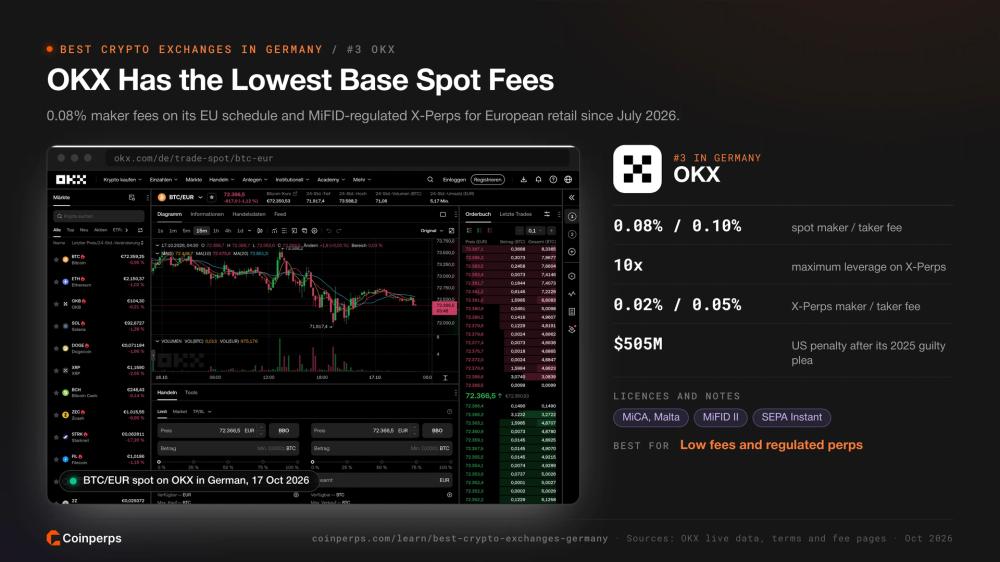
OKX has the lowest base spot fees on this list and is one of three here selling regulated perpetual-style futures to German residents.
OKX Europe Limited holds a MiCA licence from the Malta Financial Services Authority (MFSA), granted on 27 January 2025 and passported to Germany. The EU fee schedule lists 0.08% maker and 0.10% taker fees for regular users.
Euro deposits by SEPA and SEPA Instant are free from OKX, with SEPA Instant capped at €100,000. PayPal works for deposits only, and cards, Apple Pay and Google Pay buy crypto directly.
X-Perps, launched for European retail on 28 July 2026, are five-year futures with a funding rate, so they trade like perpetuals. A separate company, OKX Europe Markets Limited, issues them under MiFID II at up to 10x leverage, with fees of 0.02% maker and 0.05% taker.
OKX publishes a proof of reserves page and offers ETH and SOL staking in the EU. In February 2025 its parent pleaded guilty in the US to unlicensed money transmission and agreed to pay about $505 million. Compare it with Kraken in our OKX vs Kraken guide.
Pros
- 0.08% / 0.10% spot fees, the lowest base rate here.
- Regulated X-Perps at up to 10x leverage.
- Free SEPA Instant deposits.
Cons
- A US guilty plea in 2025 over anti-money laundering failures.
- Germany is not named explicitly on the X-Perps country list.
- Less German-language support than local rivals.
4. Bybit EU
- EU licence
- MiCA (Austria's FMA)
- EUR deposits
- SEPA, PayPal, card, Apple Pay
- Spot maker / taker
- 0.25% / 0.25%
- Regulated futures
- No, MiFID licence pending
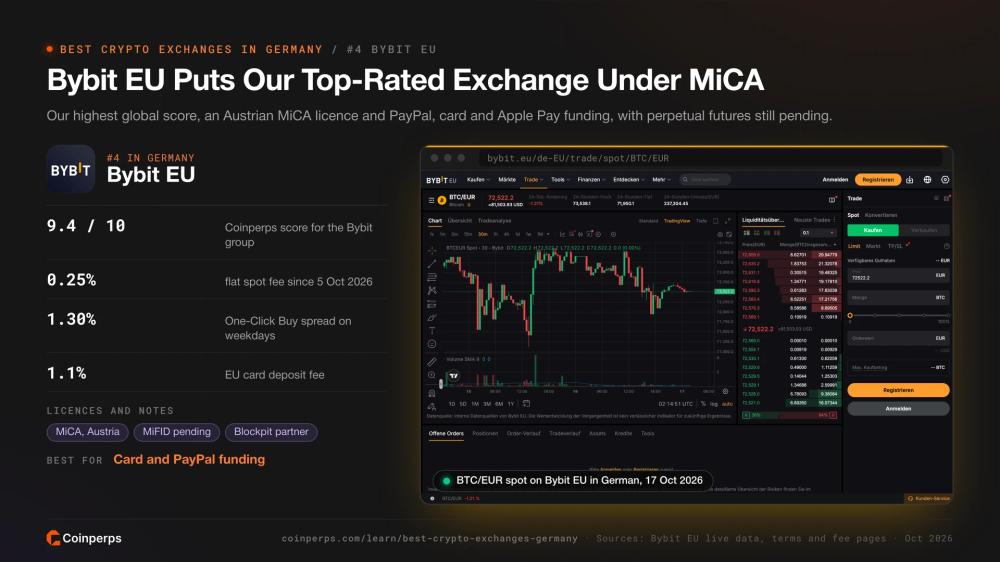
Bybit tops our global exchange rankings with a score of 9.4 out of 10, and its Vienna-based arm, Bybit EU GmbH, offers German residents a MiCA-licensed version.
Austria's FMA authorised Bybit EU on 28 May 2025 for custody, exchange and transfer services, passported across the EEA except Malta. Euro deposits are free, and the card fee is 1.1% for EU Visa and Mastercard, or 1.8% plus €0.24 for Apple Pay and Google Pay.
Since 5 October 2026, spot trading uses one flat rate of 0.25% for makers and takers below €100,000 of monthly volume. One-Click Buy carries a spread of 1.30% on weekdays and 1.80% at night and weekends, so the order book is cheaper.
German residents get spot, spot margin up to 10x and recurring buys, but no perpetual futures until a MiFID II licence, applied for in September 2025, comes through. Blockpit is its official tax partner, with 50% off the first report.
Bybit lost about $1.5 billion in ETH to a North Korean hack in February 2025 and covered client losses in full. Sign up through Bybit.
Pros
- The highest-rated exchange group in our rankings, with a MiCA licence.
- PayPal, cards and Apple Pay alongside SEPA.
- Official Blockpit tax partnership.
Cons
- No perpetual futures for German residents yet.
- Spot fees rose to a flat 0.25% in October.
- German help articles are machine-translated.
5. Coinbase
- EU licence
- MiCA (Luxembourg's CSSF), MiFID
- EUR deposits
- SEPA, card, PayPal
- Spot maker / taker
- 0.25% / 0.50%
- Regulated futures
- Yes
Coinbase has the longest regulatory record in Germany, where its subsidiary received the country's first crypto custody licence from BaFin in June 2021.
Coinbase moved its EU business onto a single MiCA licence from Luxembourg's CSSF in June 2025, replacing its national registrations in Germany, France and four other countries. It is the only publicly listed exchange here.
Coinbase cut its Advanced fees on 16 September 2026, setting the EU entry tier at 0.25% maker and 0.50% taker. The simple app charges more through a spread and a Coinbase fee, both shown in the order preview.
On 9 March 2026 Coinbase launched regulated futures for 26 European countries, Germany included, through a MiFID entity. They include perpetual-style contracts with a five-year term and hourly funding, at up to 10x on Bitcoin and Ether.
A May 2025 data breach exposed about 70,000 customers' personal details after support contractors were bribed, and Coinbase reimbursed users tricked into sending funds. In November 2025 the Central Bank of Ireland fined Coinbase Europe €21.46 million for transaction monitoring failures. Open an account through Coinbase.
Pros
- A regulatory track record in Germany since 2021.
- Regulated futures for German residents since March 2026.
- 0.25% / 0.50% Advanced fees since September.
Cons
- The simple app adds a spread and a fee.
- A €21.46 million Irish fine for monitoring failures in 2025.
- The 2025 support data breach.
6. Bitvavo
 Best forAbout 450 coins, cheapest app purchases
- EU licence
- MiCA (Netherlands' AFM)
- EUR deposits
- SEPA, Apple Pay, card, PayPal
- Spot maker / taker
- 0.15% / 0.25%
- Regulated futures
- No
Bitvavo is the cheapest app for buying crypto in Germany, at 0.25% per purchase, with about 450 coins.
The Amsterdam exchange holds a MiCA licence from the Dutch AFM, dated 26 June 2025, and took German customers back from its partner Hyphe on 1 September 2025.
Its fee table charges makers 0.15% and takers 0.25% below €100,000 of monthly volume, and app purchases cost the same 0.25%. SEPA and Apple Pay deposits are free, cards cost 1% and PayPal 2%.
Bitvavo stakes about 70 assets, runs savings plans from €5 and exports a tax report for Blockpit and CoinTracking, its partners. It publishes a quarterly proof of reserves attested by The Network Firm. There are no futures, margin or options.
Pros
- 0.25% app purchases and 0.15% maker fees.
- About 450 coins and savings plans from €5.
- Quarterly proof of reserves.
Cons
- No futures or margin trading.
- Card and PayPal deposits cost 1% to 2%.
- Its chief executive resigned in July 2025 after press reports on personal money laundering issues.
7. BISON
 Best forRun by Boerse Stuttgart, 63 coins
- EU licence
- MiCA (BaFin)
- EUR deposits
- SEPA, SEPA Instant
- Spot maker / taker
- About 1.25% spread, no order fee
- Regulated futures
- No
BISON is the most German option here, an app from the Boerse Stuttgart Group with more than one million users.
Custody sits with Boerse Stuttgart Digital Custody GmbH, which received the first MiCA licence BaFin granted, on 17 January 2025. EUWAX AG executes trades after notifying BaFin under MiCA's procedure for banks in April 2025. Euro balances are held at Solaris and Deutsche Bank under the €100,000 deposit guarantee.
BISON charges no order fee, and its fee page puts the spread at about 1.25% for Bitcoin and Ether and about 1.75% for other coins, charged on each buy and each sell. SEPA and SEPA Instant deposits are free, while cards and Apple Pay cost 2.49%.
The app lists 63 coins, offers savings plans from €0.01 and stakes ETH and SOL, keeping 27% of rewards. It provides a free tax information report and 15% off Blockpit.
Pros
- German companies at every step, supervised by BaFin.
- Free SEPA Instant deposits and free custody.
- A free tax information report.
Cons
- A 1.25% to 1.75% spread on each trade.
- Only 63 coins.
- No order book or futures.
How We Ranked These Exchanges
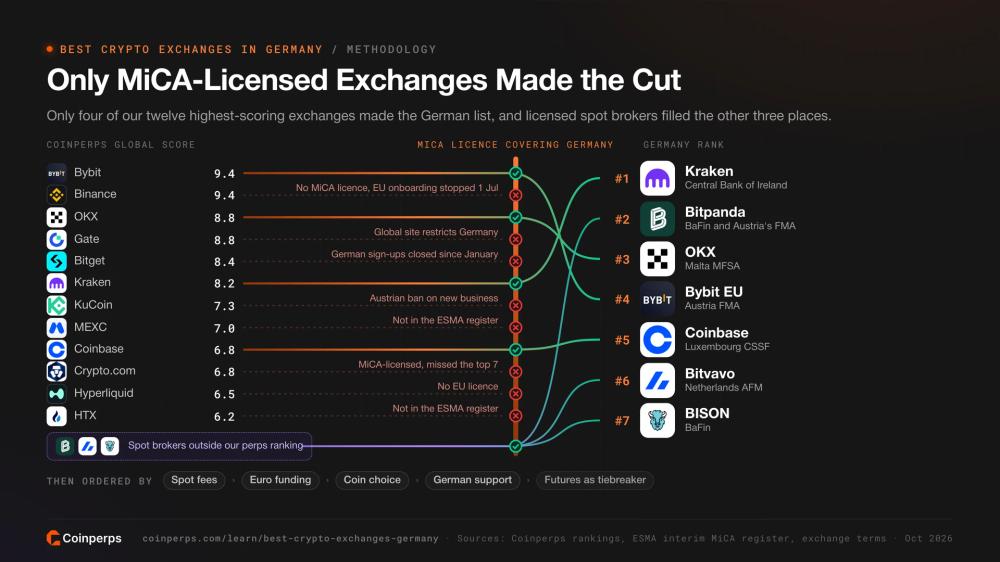
We ranked exchanges first on whether they hold a MiCA licence covering Germany, then on spot fees, euro funding, coin choice and German-language support, using our ranking methodology.
Licence status came from the ESMA interim MiCA register, downloaded on 17 October 2026. Fees came from each exchange's published schedule, checked the same week. An exchange closed to new German users could not make the list, whatever its global score.
Our exchange rankings score platforms on liquidity, fees, regulation and features, and set the order among licensed venues. Bybit and OKX rank highest globally. Kraken takes first place for Germany because it pairs MiCA authorisation with regulated futures and a German IBAN.
Futures counted only as a tiebreaker, so cheap spot trading and good euro funding beat extra leverage.
Is Crypto Legal in Germany?
Buying, holding and selling crypto is legal in Germany, as long as you use an exchange licensed by BaFin or by another EU regulator that has passported the licence into Germany.
MiCA and the KMAG
MiCA has applied across the EU since 30 December 2024. Germany implemented it through the Financial Market Digitalisation Act (FinmadiG), whose first article created the Crypto Markets Supervision Act (KMAG), which names BaFin as supervisor.
Germany shortened MiCA's transition period, so firms with existing German licences could operate only until the end of 31 December 2025 under § 50 KMAG, against an EU deadline of 1 July 2026. BaFin confirmed on 25 August 2026 that the EU window closed with no extension or grace period.
According to its 2025 annual report, BaFin moved eight existing crypto custodians onto MiCA licences and oversaw the orderly wind-down of four others.
Passported Licences and Banks
A crypto firm licensed in one EU country can serve Germany after notifying its home regulator, under Article 65 of the MiCA regulation. That is how Kraken (Ireland), OKX (Malta) and Bybit EU (Austria) serve German residents legally.
Banks and investment firms take a shorter path. Under Article 60 they notify their regulator 40 working days before launching crypto services. Trade Republic, N26, DekaBank for the Sparkassen and DZ Bank for the Volksbanken all used it. Germany has 109 entries in the ESMA register, more than any other member state.
How to Check an Exchange's Licence
Search the BaFin company database or the ESMA register by the exchange's legal entity name, because brand names rarely appear. Kraken is listed as Payward Europe Solutions Limited and Crypto.com as Foris DAX MT Limited.
In an August 2026 interview, BaFin said German investors pay too little attention to where a provider is supervised, and some platforms aimed at Germans are supervised outside the EU or not at all.
The Travel Rule and Private Wallets
The EU's Transfer of Funds Regulation requires exchanges to send sender and recipient details with every crypto transfer, whatever the amount. Above €1,000 to or from a private wallet, the exchange must check that the wallet belongs to you, often through a signed message or a small test payment.
Exchanges Without a MiCA Licence
Binance has no MiCA licence anywhere in the EU. It withdrew its Greek application on 24 June 2026, and since 1 July EU users cannot sign up, buy, deposit or stake there, although withdrawals still work.
Bitget closed sign-ups for German residents on 16 January 2026 and is still awaiting an Austrian licence. MEXC, HTX and Hyperliquid do not appear in the ESMA register, and the Dutch AFM flagged MEXC as non-compliant in September 2025.
Gate's global site names Germany as a restricted location, so German users are sent to Gate Europe, which holds a Maltese MiCA licence. BingX received an Austrian MiCA licence on 13 October, too recently to judge its German service. Our guides on Binance, Bitget and MEXC restricted countries track the details.
Can You Buy Crypto Through a German Bank or Broker?
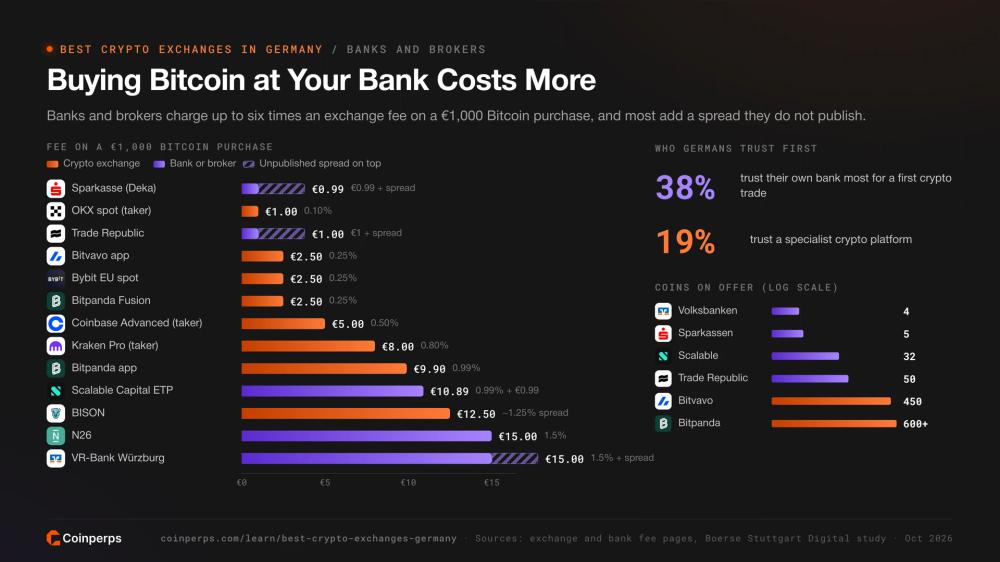
German banks and brokers now sell crypto directly, which suits savers who want it beside their current account, though most charge more and offer far fewer coins than an exchange.
Trade Republic charges a €1 flat fee per trade plus an unpublished spread, offers about 50 coins and has allowed transfers to external wallets since November 2025. Savings plans start at €1 with no execution fee.
N26 runs crypto through Bitpanda and charges 1.5% for Bitcoin and 2.5% for most other coins, with no transfers to outside wallets. Scalable Capital sells 32 crypto exchange-traded products (ETPs), securities that track a coin, for a 0.99% spread surcharge plus a €0.99 order fee on its free plan.
The Sparkassen began rolling out "Krypto powered by Deka" in waves from mid-October, with five coins (BTC, ETH, XRP, SOL and POL) for a €0.99 order fee plus a spread, and coins can move only to other licensed providers, never to your own wallet.
The Volksbanken offer meinKrypto in the VR Banking App, with four coins held by Boerse Stuttgart Digital. VR-Bank Würzburg went live first in May 2026, and each bank sets its own fees. ING and DKB sell only crypto exchange-traded notes in the securities account.
A Boerse Stuttgart Digital study found 38% of Germans trust their own bank most for a first crypto trade, against 19% for specialist platforms. That trust costs money, as a €1,000 Bitcoin purchase at VR-Bank Würzburg, which charges 1.5%, costs €15 before the spread, against €2.50 on Bitvavo.
How to Buy Crypto With Euros in Germany
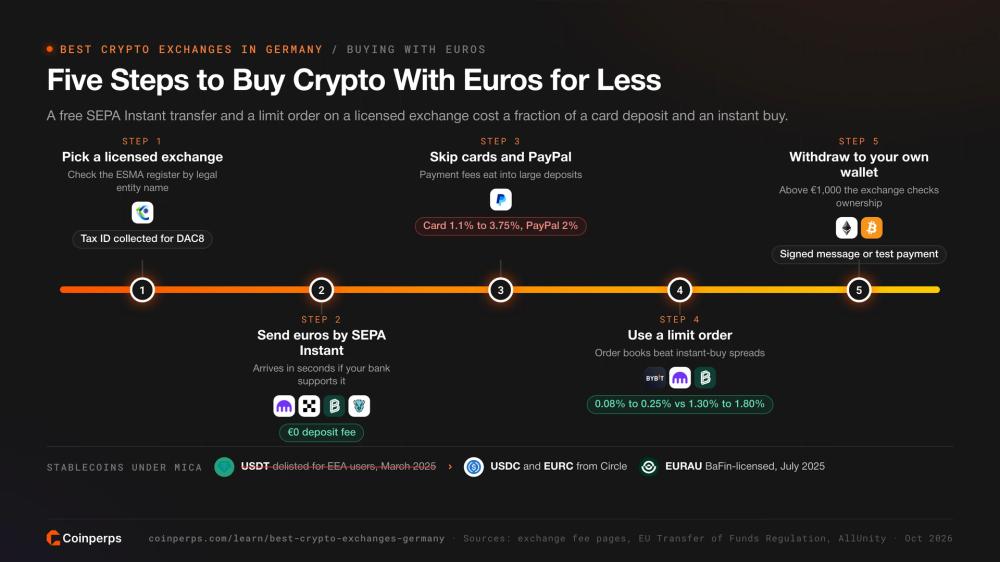
The cheapest way to buy crypto in Germany is a free SEPA transfer to a licensed exchange, then a limit order on its order book.
- Pick an exchange from the ESMA register and verify your identity with an ID card or passport. Exchanges must also collect your tax ID under the EU's DAC8 reporting rules.
- Send euros by SEPA or SEPA Instant. Kraken, OKX, Bitpanda and BISON charge nothing for instant transfers, which arrive within seconds if your bank supports them.
- Avoid card and PayPal deposits for large sums. Bitvavo charges 2% for PayPal, and BISON charges 2.49% for cards.
- Buy on the order book. A limit order on Kraken Pro, Bitpanda Fusion or Bybit EU costs a fraction of an instant buy, whose spread reaches 1.80% on Bybit EU at weekends.
- Withdraw to your own wallet if you trade rarely, and keep records. Transfers above €1,000 to a private wallet trigger an ownership check.
MiCA also changed which stablecoins you can buy. Licensed exchanges may list only stablecoins from authorised e-money issuers, so Binance and Kraken removed USDT from EEA trading in March 2025. USDC and Circle's euro coin, EURC, replaced it.
Germany has its own euro stablecoin as well. AllUnity, a joint venture of Deutsche Bank's DWS, Galaxy and Flow Traders, received a BaFin e-money licence and launched EURAU on 31 July 2025.
Crypto Futures and Leverage Rules in Germany
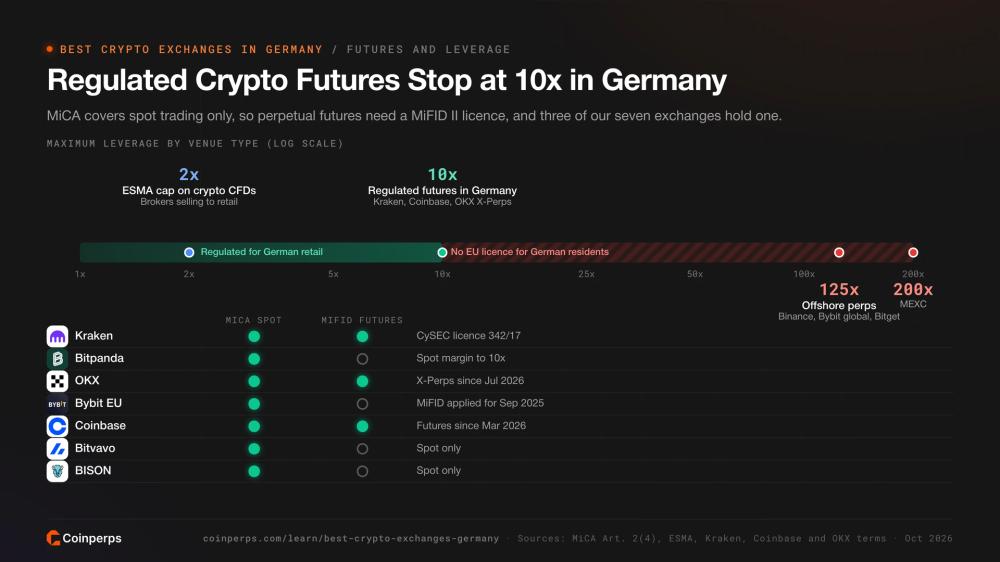
German residents can trade crypto futures legally only on exchanges with an EU investment licence under MiFID II, because MiCA does not cover derivatives.
Article 2(4) of MiCA excludes crypto-assets that count as financial instruments, so perpetual futures fall under MiFID II. A MiCA licence alone, such as Bybit EU's or Bitvavo's, cannot cover a crypto perpetual.
Three exchanges on our list sell regulated futures to German residents. Kraken uses its CySEC-licensed Cyprus entity, Coinbase its MiFID entity since March, and OKX its X-Perps since July. Leverage is capped at 10x on each.
Crypto CFDs from brokers face a tighter cap of 2:1, set by ESMA's product intervention measures. Offshore exchanges offering 100x or more to Germans operate without an EU licence. Our guide to perpetual futures regulation and European futures platform ranking go deeper.
The tax position on futures improved in December 2024, when the Annual Tax Act 2024 abolished the €20,000 cap on offsetting losses from derivatives for all open cases. Futures profits are usually capital income taxed at the flat 25% rate, with no one-year exemption, so speak to a tax adviser.
Crypto Taxes in Germany
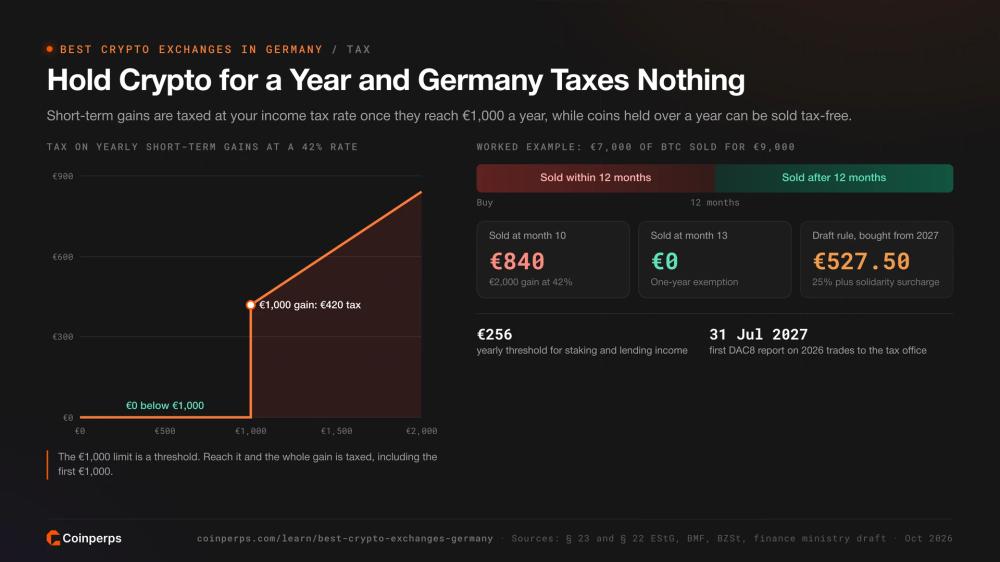
Crypto held for more than one year can be sold tax-free in Germany, so the holding period decides most of your tax bill.
Under § 23 of the Income Tax Act (EStG), gains on crypto sold within a year are taxed at your personal income tax rate, which reaches 42% from €69,879 of taxable income in 2026. Total private sale gains below €1,000 a year stay tax-free, but at €1,000 or more the whole gain is taxable.
Staking and lending rewards are income under § 22 No. 3 EStG, tax-free only below €256 a year. The Federal Ministry of Finance (BMF) letter of 6 March 2025 sets detailed record-keeping duties, allows first-in, first-out (FIFO) per wallet and adds extra duties for users of foreign exchanges.
Exchanges also report to the tax office. Under the Crypto Tax Transparency Act (KStTG), Germany's version of DAC8, platforms collect your tax ID and send transaction totals for 2026 to the Federal Central Tax Office (BZSt) by 31 July 2027.
The one-year exemption may end for new purchases. A finance ministry draft reported on 30 September would tax crypto bought from 1 January 2027 at the 25% flat rate plus solidarity surcharge. Existing holdings would keep the old rule. The cabinet did not adopt it on 14 October, and the Bundestag heard a petition with 44,439 signatures to keep the exemption.
Risks and Scams to Watch
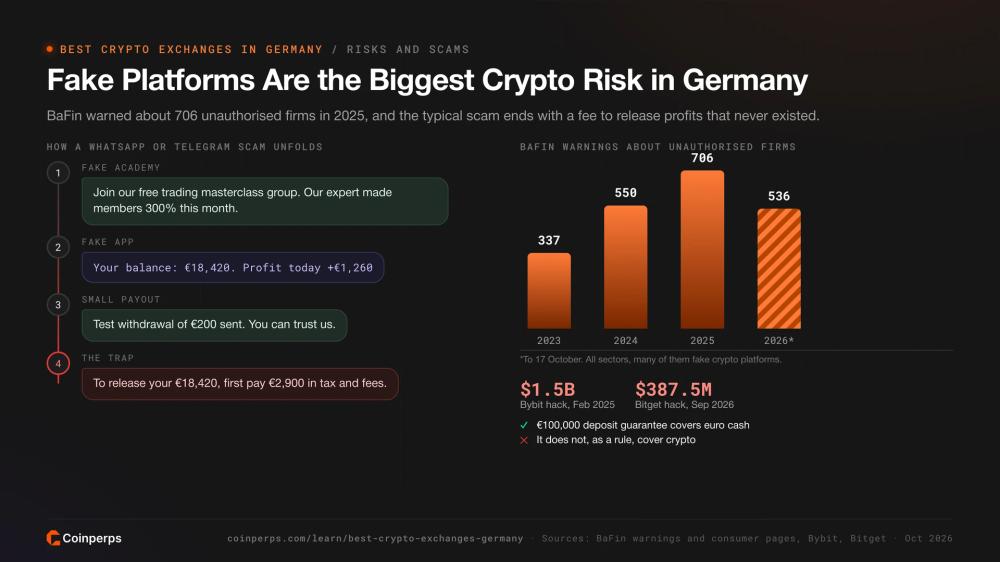
The biggest risk for German crypto users is fraud by fake platforms copying the names of licensed firms, and crypto has no deposit protection.
The €100,000 deposit guarantee and €20,000 investor compensation do not as a rule cover crypto, according to BaFin. Only the euro balance at a bank, such as BISON's accounts at Solaris and Deutsche Bank, falls under the guarantee.
BaFin published 706 warnings about unauthorised business in 2025 and 536 by mid-October 2026, many of them fake crypto trading platforms. In September 2026 it warned that callers were spoofing BaFin's own phone number to demand transfers.
Investment scams on WhatsApp and Telegram follow a pattern BaFin describes. A fake "academy" chat leads to a trading app that shows invented profits, pays out small test sums and then demands taxes or fees before any withdrawal. BaFin never charges such fees and never recovers lost money.
Exchanges get hacked too. Bybit lost $1.5 billion in February 2025, and Bitget lost about $387.5 million in September 2026. A BaFin survey found 27% of German crypto holders keep more than a fifth of their wealth in digital assets, so spreading holdings and using self-custody limits the damage.
Bottom Line
Kraken is the best crypto exchange in Germany, pairing a MiCA licence with regulated futures and free SEPA Instant deposits to a German IBAN. Bitpanda is the best local alternative, contracting through a BaFin-licensed German company.
OKX has the lowest spot fees and regulated perpetual-style futures, Bybit EU carries our highest global score, and Bitvavo is cheapest for app purchases. Coinbase and BISON suit buyers who value a long German regulatory record.
Check every platform in the ESMA register before depositing, keep records for the one-year tax rule and treat unlicensed exchanges offering high leverage as a risk to your money. Our MiCA licensed exchanges guide compares the full EU field.


