Best Crypto Exchanges in Sri Lanka
Compare the best crypto exchanges in Sri Lanka, from LKR P2P depth and spot fees to the CBSL card ban, the coming SEC licensing law and tax.

Disclosure: Coinperps may earn a commission from partner links, at no extra cost to you. Reviews are based on independent testing — see how we test.
- No exchange is licensed in Sri Lanka: the CBSL has never authorised a crypto exchange, and the government calls crypto trading "not recognised" without calling it illegal, so no local investor protection applies.
- Bybit is the best all-rounder: it offers zero-fee LKR P2P, a MiCA-licensed group and Bybit Pay, which launched with Sri Lankan merchants in November 2025.
- Binance has the deepest rupee market: our check found 56 adverts selling USDT and 190 buying it, more than every other exchange combined, with prices about 2% above the official rate.
- P2P is the only practical LKR on-ramp: CBSL Directions No. 03 of 2021 bar Sri Lankan cards from crypto payments, and no exchange accepts direct rupee bank deposits.
- Regulation is coming: VASPs became reporting entities under Act No. 17 of 2026, and an SEC-led licensing law approved by the Cabinet in July 2026 is now being drafted.

Bybit
Bybit, founded in 2018 and headquartered in Dubai, is the world’s second-largest exchange by volume, serving 60 million users with 1,800+ assets and over $11 billion in daily trading.
Features
Fees
Regulation
Overall Rating
No crypto exchange is licensed in Sri Lanka. The Central Bank of Sri Lanka (CBSL) has never authorised a crypto exchange, and Sri Lankans who buy Bitcoin or USDT do so on global platforms that accept residents.
That gap is closing. In July 2026 the Cabinet approved a licensing regime for virtual asset service providers (VASPs), with the Securities and Exchange Commission of Sri Lanka (SEC) as the future regulator.
We checked every major exchange's terms, pulled live Sri Lankan rupee (LKR) peer-to-peer (P2P) order books on 15 October 2026 and compared spot fees, licences and security records.
This guide to the best crypto exchanges in Sri Lanka weighs our exchange rankings against the licences each group holds abroad, the only regulatory backstop Sri Lankan users have today.
Top 6 Crypto Exchanges in Sri Lanka
Exchange | LKR On-Ramp | Spot Maker Fee | Spot Taker Fee | Live USDT/LKR Ads (Sell / Buy) | Key Nuance |
|---|---|---|---|---|---|
Zero-fee P2P | 0.10% | 0.10% | 12 / 29 | Bybit Pay live in Sri Lanka, MiCA-licensed group | |
P2P with bank transfer and eZ Cash | 0.10% | 0.10% | 56 / 190 | Deepest LKR liquidity, ADGM-licensed | |
Zero-fee P2P with eZ Cash | 0.08% | 0.10% | 10 / 49 | MiCA and Dubai VARA licences | |
None, deposit USDT | 0.40% | 0.80% | No P2P | Widest licensing, open to Sri Lankans | |
No working LKR market | 0.10% | 0.10% | 1 / 0 | MiCA and VARA licences, proof of reserves | |
P2P, sell side only | 0.10% | 0.10% | 0 / 13 | Copy trading, recovering from September hack |
1. Bybit
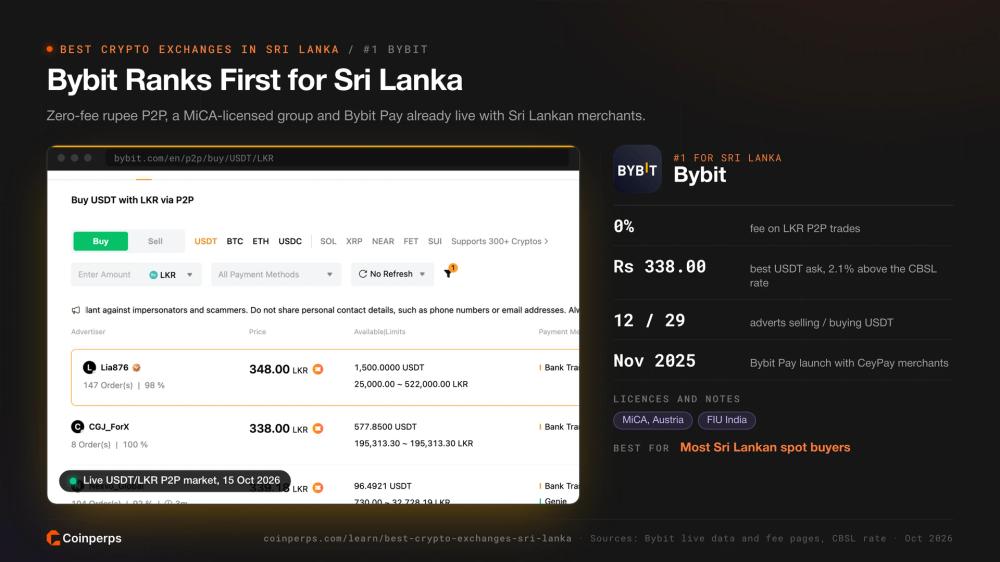
Bybit ranks first for Sri Lanka because it pairs a commission-free LKR P2P market with deep spot order books, a group licence under MiCA (the EU's crypto rulebook) and the most visible local presence of any global exchange. Sri Lanka is absent from its service restricted countries list, updated on 13 October 2026, so residents can open full accounts, including derivatives.
Our check found 12 adverts selling USDT for rupees and 29 merchants buying it, with the best ask at LKR 338.00 per USDT. That is about 2.1% above the CBSL indicative rate of LKR 331.05 on 14 October. Sellers accept bank transfers marked "Bank Transfer (Sri Lanka)", Dialog's Genie wallet, cash deposits and mobile top-ups, and escrow holds the seller's USDT until your payment is confirmed.
LKR P2P trades on Bybit are free, because its P2P fee schedule only charges currencies listed in its fee table and the rupee is not one of them. Spot trading costs 0.10% for makers and takers at the base tier, while perpetual futures cost 0.02% maker and 0.055% taker with up to 150x leverage on Bitcoin.
Bybit is the only major exchange with a payment product live in the country. Bybit Pay launched in Sri Lanka on 5 November 2025 through Ceylon Cash's CeyPay, starting with 50 point-of-sale merchants and 50 online merchants, after a year of free Web3 seminars in Colombo, Galle, Kandy and Ella.
Bybit EU holds a MiCA licence from Austria's Financial Market Authority, and the group is registered with India's Financial Intelligence Unit (FIU). Our Bybit restricted countries guide covers regional access, and you can open an account through Bybit.
Pros
- Zero-fee LKR P2P with escrow, bank transfer and Genie wallet payments.
- The strongest Sri Lankan footprint of any exchange, including Bybit Pay merchants.
- Deep spot order books, with perpetual futures as an extra.
- A MiCA-licensed EU entity and India FIU registration.
Cons
- No Sri Lankan licence, like every exchange on this list.
- Its LKR P2P market is about a fifth the size of Binance's.
- A February 2025 hack of about $1.5 billion, attributed by the FBI to North Korea, shows custody risk, although customers were made whole.
2. Binance
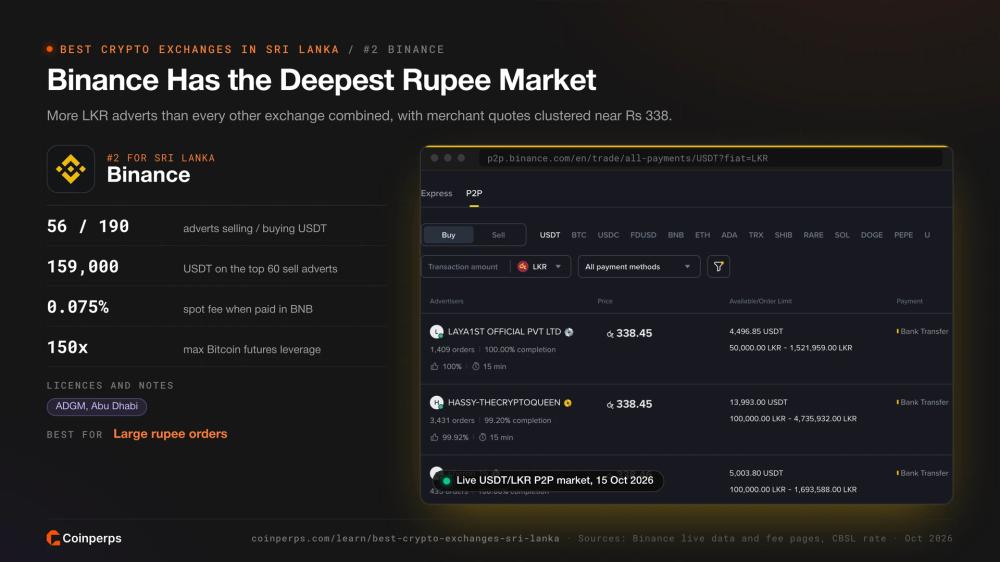
Binance runs the deepest Sri Lankan rupee P2P market. Our check found 56 adverts selling USDT and 190 buying it, more than every other exchange combined, with the best ask at LKR 338.00 and merchant quotes clustered between LKR 338.00 and LKR 338.46.
That depth lets larger orders fill at one price. The top 60 sell adverts held about 159,000 USDT, and 39 of the 56 sellers were verified merchants. Payment options include bank transfers, Trans Bank, cash deposits, eZ Cash and mobile top-ups, and takers pay no P2P fee.
Spot trading costs 0.10%, or 0.075% when fees are paid in BNB, according to the Binance fee schedule. USDⓈ-M futures cost 0.02% maker and 0.05% taker with up to 150x leverage, and Binance leads the Coinperps open interest rankings on most major contracts.
Binance holds a global licence from the Financial Services Regulatory Authority of Abu Dhabi Global Market (ADGM), live since January 2026 according to its licences page. It has no MiCA licence, after it withdrew its EU application in June 2026.
Binance is the exchange most often named in Sri Lankan courts. In March 2026 a Colombo magistrate warned that money was leaving the country through crypto, in a Rs 290 million fraud case allegedly moved through Binance accounts. Binance said it cooperated fully. Our Bybit vs Binance fee comparison shows how the two leaders differ, and you can sign up through Binance.
Pros
- By far the largest LKR P2P merchant pool, with tight pricing near the official rate.
- Room for large orders, with about 159,000 USDT on the top sell adverts.
- An ADGM licence for Binance.com and the deepest spot order books on this list.
- Community events in Colombo and a $200,000 donation to the Sri Lanka Red Cross after Cyclone Ditwah.
Cons
- No MiCA licence after the June 2026 withdrawal.
- A $4.3 billion US settlement in 2023 for anti-money laundering failures.
- The platform Sri Lankan banks and courts scrutinise most.
3. OKX
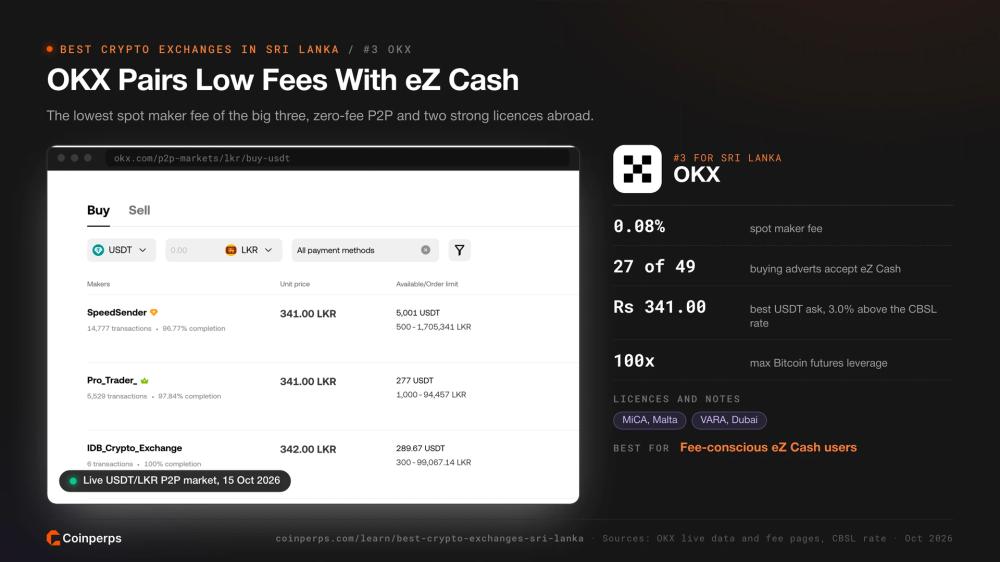
OKX gives Sri Lankan traders the lowest spot maker fee among the big three and two strong licences abroad. Sri Lanka is not among the restricted locations in its risk and compliance disclosure, last updated on 14 September 2026, while neighbouring India and Nepal are, as our OKX restricted countries guide explains.
Its LKR P2P market showed at least 10 adverts selling USDT and 49 buying it, with the best ask at LKR 341.00. That is about 3% above the official rate, so buying on OKX costs slightly more than on Binance or Bybit. eZ Cash is the standout payment option, appearing on 27 of the 49 adverts buying USDT, alongside bank transfers and Trans Bank, and OKX charges no P2P fee.
Spot fees are 0.08% maker and 0.10% taker, and perpetual futures cost 0.02% maker and 0.05% taker with up to 100x leverage on Bitcoin.
OKX holds a MiCA licence through Malta and a licence from Dubai's Virtual Assets Regulatory Authority (VARA). Its Web3 wallet suits users who want USDT in self-custody. Accounts open through OKX.
Pros
- A 0.08% spot maker fee, below Bybit, Binance and Bitget.
- Zero-fee LKR P2P with wide eZ Cash support.
- Licences under MiCA and from Dubai's VARA.
- A built-in Web3 wallet for self-custody.
Cons
- A thinner LKR market than Binance, priced further from the official rate.
- A $504 million US guilty plea in February 2025 for operating without a money transmitting licence.
- The OKX card is available only in Europe.
4. Kraken
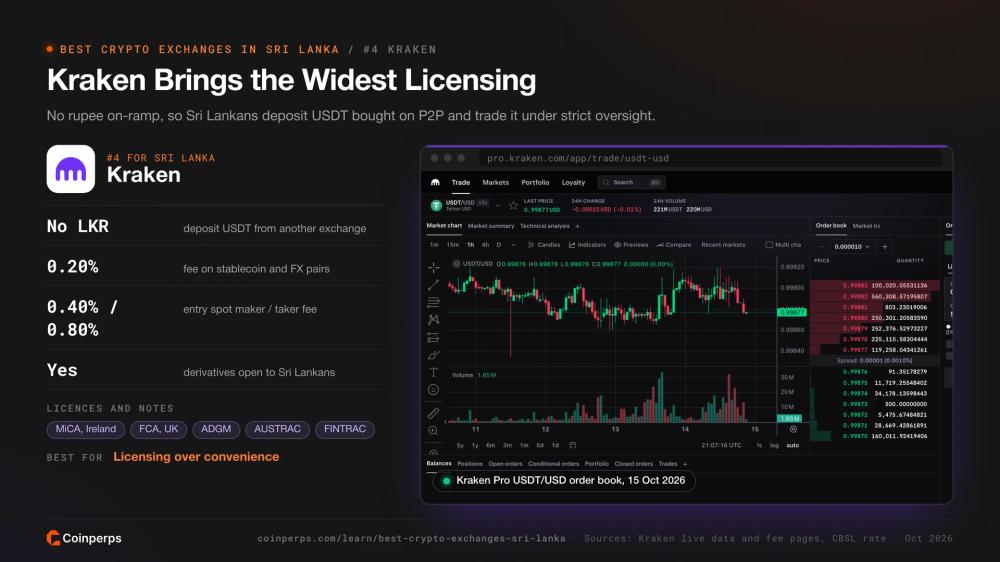
Kraken is the most heavily regulated exchange that accepts Sri Lankans, and it suits users who already hold USDT and want a conservative place to keep it. Sri Lanka appears nowhere on its geographic restrictions page, updated on 30 September 2026, and residents can also trade Kraken's derivatives.
Kraken has no P2P market or rupee support, so you buy USDT through P2P elsewhere and deposit it, paying a network fee for the transfer.
Small traders pay high fees. The Kraken fee schedule starts at 0.40% maker and 0.80% taker on spot, falling with 30-day volume, although stablecoin and FX pairs cost 0.20%. Futures cost 0.02% maker and 0.05% taker.
Kraken's regulatory footprint includes a MiCA licence from the Central Bank of Ireland, UK FCA registration, licences in Australia, Canada and Abu Dhabi, and a Wyoming bank charter in the US. Our Kraken restricted countries guide covers access, and accounts open through Kraken.
Pros
- The widest set of licences on this list.
- Full access for Sri Lankan residents, including derivatives.
- A long record of proof-of-reserves audits and no major customer fund loss.
Cons
- No LKR on-ramp, so you must buy USDT elsewhere first.
- Entry-tier spot fees of 0.40% and 0.80%, the highest here.
- A smaller altcoin list than Bybit, Binance or Gate.
5. Gate
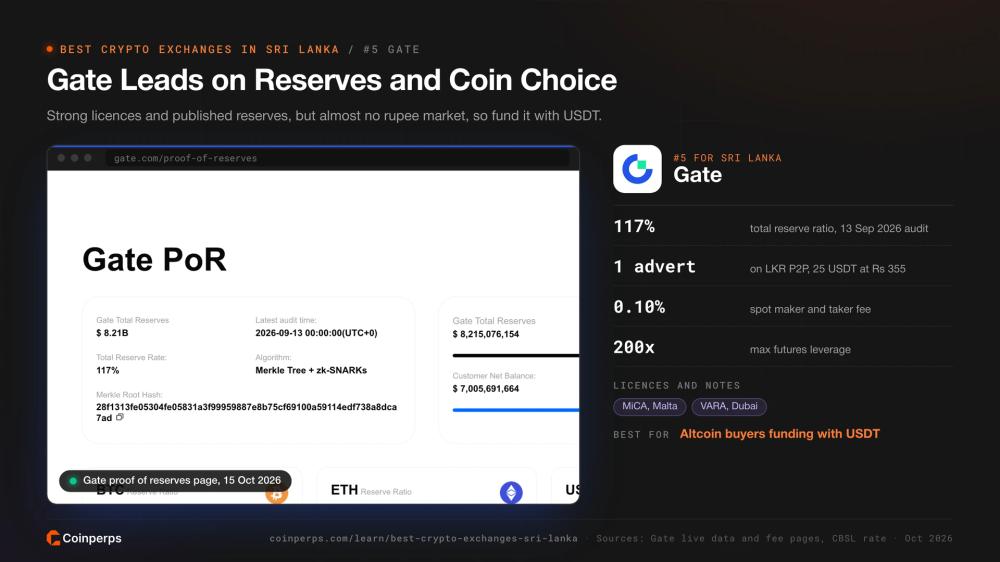
Gate earns its place on licensing and coin choice, while its rupee access is weak. Sri Lanka is not named in its user agreement, and the exchange holds a MiCA licence through Malta and a Dubai VARA licence, according to its licensing overview.
Its LKR market barely exists. Our check found a single advert selling 25 USDT at LKR 355.00, a 7.2% premium, from a user with no completed orders. Sri Lankans fund Gate by buying USDT on Binance, Bybit or OKX and transferring it in.
Gate offers one of the widest altcoin lists among large exchanges, spot fees of 0.10% for makers and takers, and futures at 0.02% maker and 0.05% taker with up to 200x leverage. It publishes regular proof of reserves reports. You can save on fees with our Gate referral code.
Pros
- MiCA and Dubai VARA licences.
- A very wide altcoin selection, often with early listings.
- Published proof of reserves.
Cons
- No working LKR P2P market, so funding takes an extra transfer.
- Futures leverage up to 200x, which can wipe out an account in one move.
6. Bitget
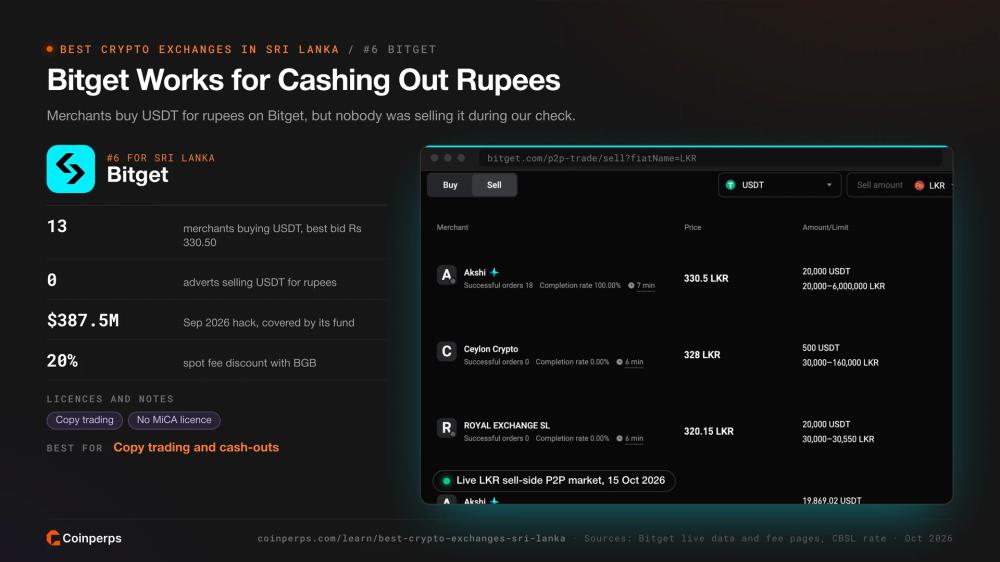
Bitget brings the most developed copy trading marketplace on this list, but a recent hack and a one-sided LKR market hold it at sixth. Sri Lanka is not a prohibited country under its terms of use, updated on 15 September 2026, and our Bitget restricted countries guide covers the full list.
On 24 September 2026, attackers stole about $352 million from Bitget's hot and warm wallets through a third-party zero-day flaw, a figure Bitget later revised to $387.5 million. Its incident report says the protection fund covered the loss and withdrawals were fully restored by 2 October.
You can sell USDT for rupees on Bitget, but you cannot buy it there. Our check found 13 merchants buying USDT, with the best bid at LKR 330.50, and no adverts selling it. That makes Bitget useful for cashing out to eZ Cash, Genie or a bank account, and of little use for a first purchase.
Spot trading costs 0.10%, with a 20% discount when fees are paid in BGB, and futures cost 0.02% maker and 0.06% taker. Bitget held its first Colombo community meetup in August 2024. Open an account through Bitget.
Pros
- The largest copy trading ecosystem open to Sri Lankans.
- An LKR cash-out market with eZ Cash and Genie support.
- A wide altcoin list alongside futures.
Cons
- The September 2026 hack is recent, and the protection fund had to be refilled.
- No adverts selling USDT for rupees during our check.
- No MiCA licence for the group.
How We Ranked These Exchanges
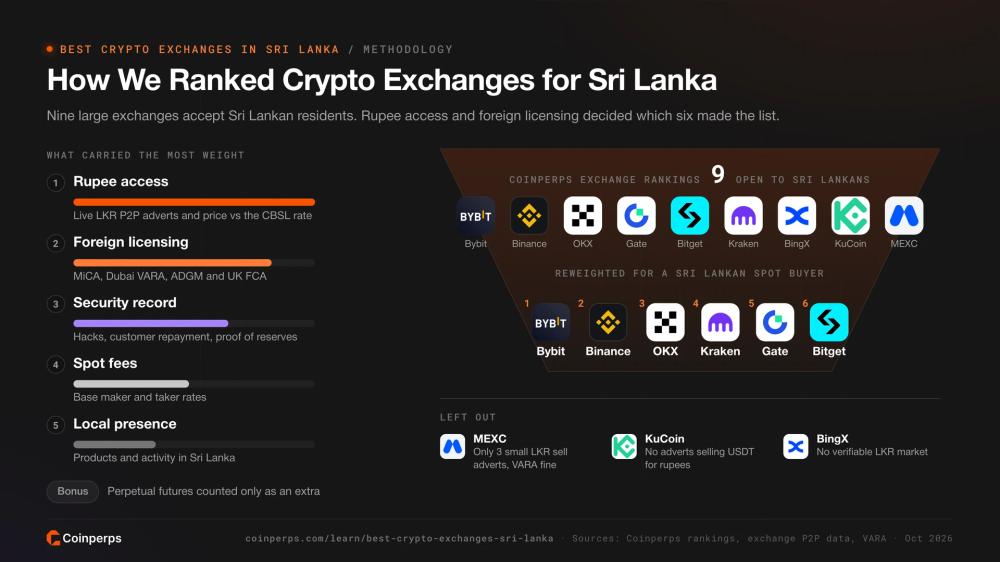
This ranking favours exchanges where Sri Lankans can buy USDT in rupees and keep it with a well-licensed group. It starts from the Coinperps exchange rankings, built on liquidity, fees, security and product depth under our ranking methodology, reweighted for a Sri Lankan spot buyer.
Rupee access carried the most weight. With card payments for crypto banned, an exchange without a live LKR P2P market forces you through another platform first, so we counted live adverts and compared each best price with the CBSL indicative rate.
Licensing came next. With no Sri Lankan licence available, we gave credit for strong foreign licences such as MiCA, Dubai VARA, ADGM and the UK FCA, which impose capital, custody and audit rules on the group.
Security, spot fees and local presence completed the scoring. Futures counted only as a bonus, as our guide to perps vs spot trading explains.
MEXC, KuCoin and BingX missed the list. MEXC has the lowest spot fees, at 0% maker and 0.05% taker, and sponsored concerts in Colombo in August 2026, but its LKR market had only three small sell adverts and Dubai's VARA fined its operator in June 2026. KuCoin had no adverts selling USDT for rupees, and we could not verify a working LKR market on BingX.
What Sri Lankan Traders Should Look For in a Crypto Exchange
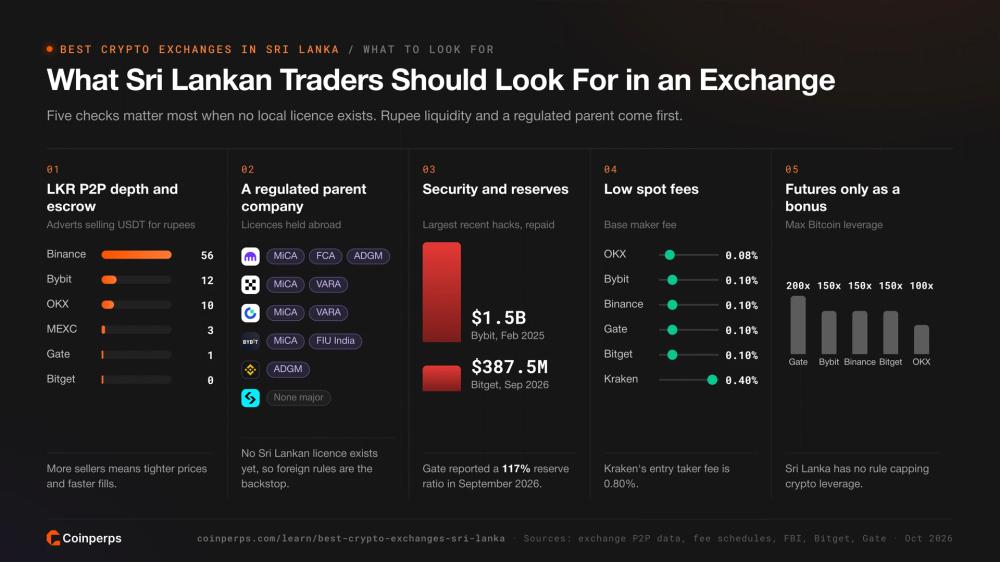
A good exchange for Sri Lanka lets you buy USDT in rupees safely, keeps your funds with a regulated group and charges low spot fees.
LKR P2P depth and escrow come first, because more adverts mean tighter prices and escrow protects you if a counterparty disappears. Binance sets the benchmark with 56 adverts selling USDT and 190 buying it.
A regulated parent company stands in for the missing local licence. MiCA, VARA, ADGM and FCA rules require segregated client assets, capital buffers and audits that a Sri Lankan user cannot otherwise rely on.
A clean security record and proof of reserves matter because there is no deposit insurance for crypto. Check how an exchange handled its last incident and whether it publishes verifiable reserves.
Low spot fees add up for regular buyers. Base rates sit between 0.08% and 0.10% at the big exchanges and rise to 0.80% at Kraken's entry tier, which our maker vs taker fees guide explains.
Futures should stay a bonus for spot buyers. Every exchange here offers perpetual futures with 100x leverage or more, and Sri Lanka has no rule capping it. Our crypto perpetual futures regulation guide covers how other countries limit leverage.
Is Crypto Legal in Sri Lanka?
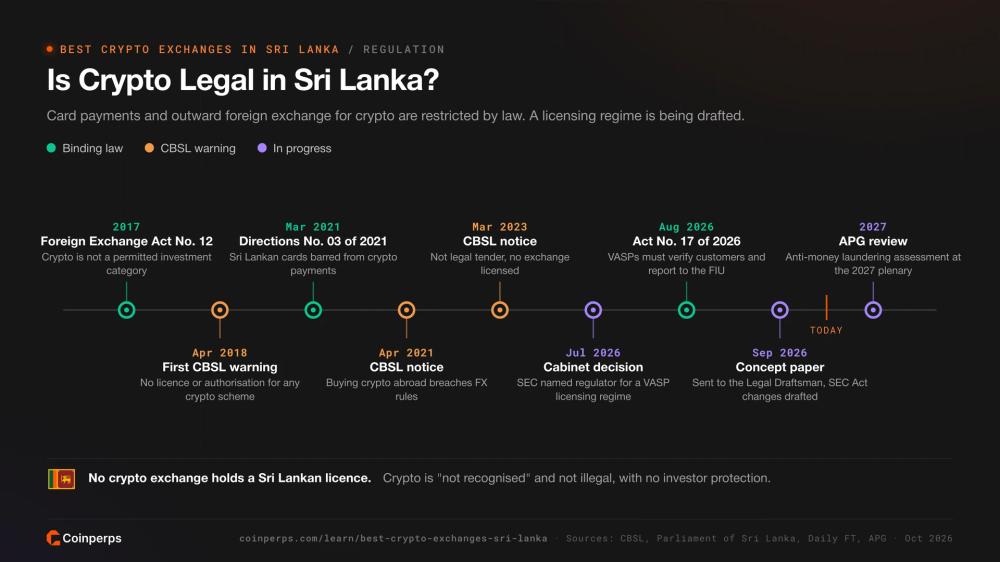
You can own and trade crypto in Sri Lanka, but the state does not recognise or protect it. In July 2026 the Deputy Minister of Finance told Parliament that crypto trading is "not recognised" and stopped short of calling it illegal, while the rupee remains the only legal tender.
What the Central Bank Has Said
The CBSL has issued public warnings on virtual currencies since 2018. Its 29 March 2023 notice states that crypto is not legal tender and that the bank has not licensed any business for crypto exchange, mining, custody or initial coin offerings. These notices carry no legal force on their own.
The Card Ban and Foreign Exchange Rules
The binding rules come from the Foreign Exchange Act No. 12 of 2017. Directions No. 03 of 2021, in force since March 2021, bar Sri Lankan debit and credit cards from paying for virtual currency transactions. The CBSL's April 2021 notice adds that sending foreign currency abroad to buy crypto breaches foreign exchange rules, because crypto is not a permitted investment category.
New Anti-Money Laundering Rules for Crypto Firms
The Financial Transactions Reporting (Amendment) Act No. 17 of 2026, certified on 4 August 2026, brings VASPs under Sri Lanka's anti-money laundering law. They must now verify customers, keep records and report suspicious transactions to the Financial Intelligence Unit. The Act creates reporting duties and grants no licences.
The SEC Licensing Regime on the Way
The Cabinet approved an SEC-led regime on 27 July 2026, with the CBSL, the Financial Intelligence Unit and the Inland Revenue Department coordinating. By 12 October 2026 the concept paper had reached the Legal Draftsman, and the first phase covers licensed exchanges and custodians only. No bill had been tabled when we checked.
The timing links to Sri Lanka's next anti-money laundering assessment by the Asia/Pacific Group on Money Laundering, due at its 2027 plenary. Once the law passes, global exchanges serving Sri Lanka are likely to face registration, local reporting and possibly tax collection.
Futures and Leverage Rules
Sri Lanka has no specific rule on crypto futures or leverage. Offshore derivatives therefore carry no local investor protection, and funding them with a card or outward foreign currency hits the same restrictions as spot buying.
Why Sri Lankans Buy USDT
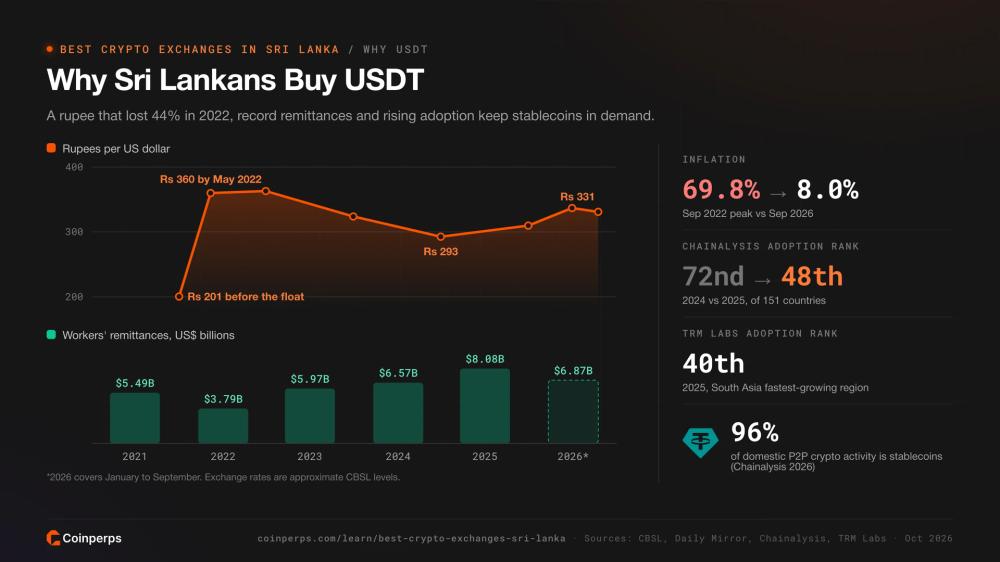
For many Sri Lankans, USDT is a way to hold dollars without a dollar bank account, a habit that took hold in the 2022 crisis, when Sri Lanka defaulted on its foreign debt and the rupee fell 44% against the US dollar in just over two months.
Inflation peaked at 69.8% in September 2022. The CBSL reported inflation of 8.0% in September 2026, but the rupee has weakened again this year, from about LKR 310 per dollar at the end of 2025 to LKR 331 in mid-October.
Remittances add to demand. Sri Lankan workers abroad sent a record $8.08 billion in 2025, and $6.87 billion arrived in the first nine months of 2026.
Sri Lanka ranked 48th of 151 countries in the 2025 Chainalysis Global Crypto Adoption Index, up from 72nd a year earlier, and 40th in TRM Labs' 2025 adoption ranking, which named South Asia the fastest-growing region.
Chainalysis also found that stablecoins now make up 96% of domestic P2P crypto activity, and the LKR markets we checked traded USDT almost exclusively.
How to Buy Crypto With Sri Lankan Rupees
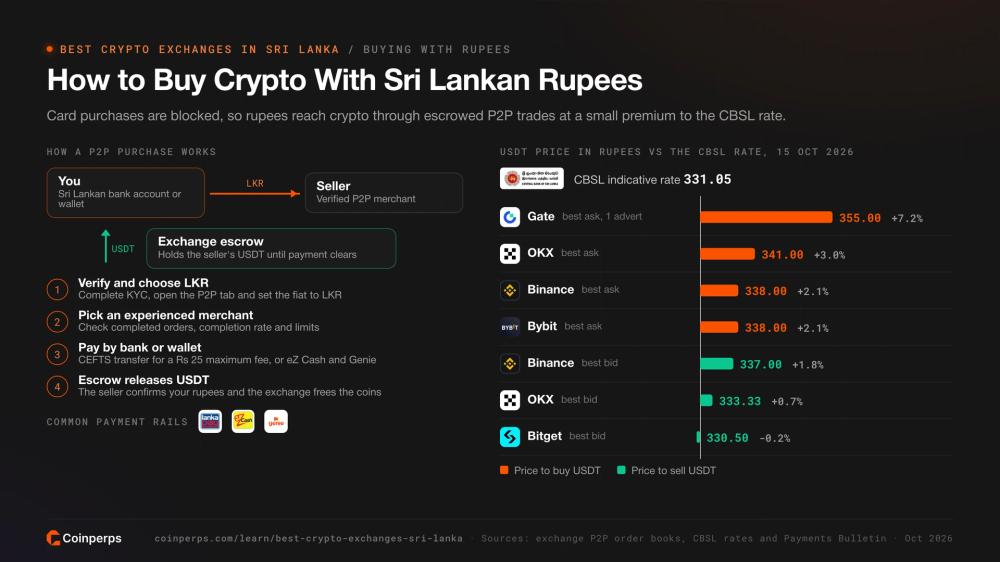
In Sri Lanka you turn rupees into crypto through P2P trading. The CBSL card ban blocks card purchases and no exchange accepts direct LKR bank deposits, so you buy USDT from another user who receives your rupee transfer.
On Binance, Bybit or OKX, complete identity checks, open the P2P tab and choose LKR, pick an advert from an experienced merchant, then pay by bank transfer or wallet and wait for the seller to release USDT from escrow.
Most adverts accept "Bank Transfer (Sri Lanka)", which settles through CEFTS, the CBSL's instant payment system, for a maximum fee of Rs 25. eZ Cash is common on OKX and Binance, while Genie appears on Bybit and Bitget.
P2P buyers pay a small premium. On 15 October the best USDT asks were LKR 338.00 on Binance and Bybit and LKR 341.00 on OKX, 2.1% to 3% above the CBSL indicative rate. Selling USDT back returns a little less, with best bids between LKR 330.50 and LKR 337.00.
To stay safe, trade only inside the exchange chat, send money from an account in your own name, never release crypto before the rupees reach your account, and avoid adverts that ask for WhatsApp contact or very large minimums.
Card-based services such as MoonPay list LKR, but Sri Lankan banks must block those payments. You can then move USDT to Kraken, Gate or a self-custody wallet for a network fee of about 0.5 to 1.5 USDT on TRON.
Crypto Taxes in Sri Lanka
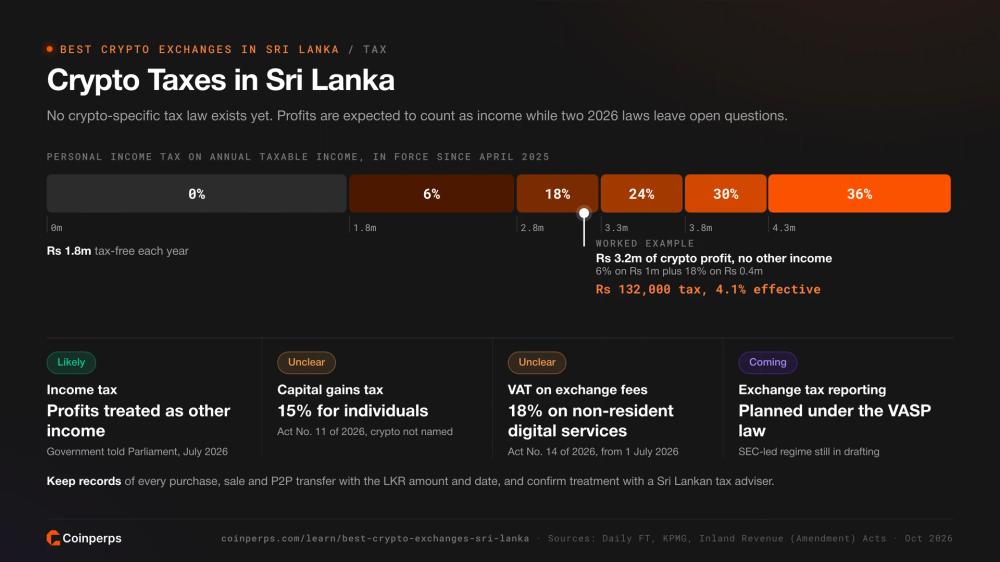
Sri Lanka has no crypto-specific tax law, so gains fall under the general Inland Revenue Act No. 24 of 2017. In July 2026 the government told Parliament that crypto profits would generally be treated as other income, with detailed Inland Revenue Department guidance still unpublished.
Income treatment means personal income tax applies. The first LKR 1.8 million of annual income is tax-free, and the rates then rise from 6% to 36% across bands, under the current rate schedule in force since April 2025.
Two 2026 laws could also apply. The Inland Revenue (Amendment) Act No. 11 of 2026 raised capital gains tax to 15% for individuals, and VAT at 18% has applied to non-resident digital service providers since 1 July 2026. Neither law names crypto, so whether they reach crypto gains or exchange fees is still unclear.
Keep records of every purchase, sale and P2P transfer, with the LKR amount and date. The coming VASP law is expected to add tax reporting by exchanges, and a Sri Lankan tax adviser can confirm how your gains should be declared.
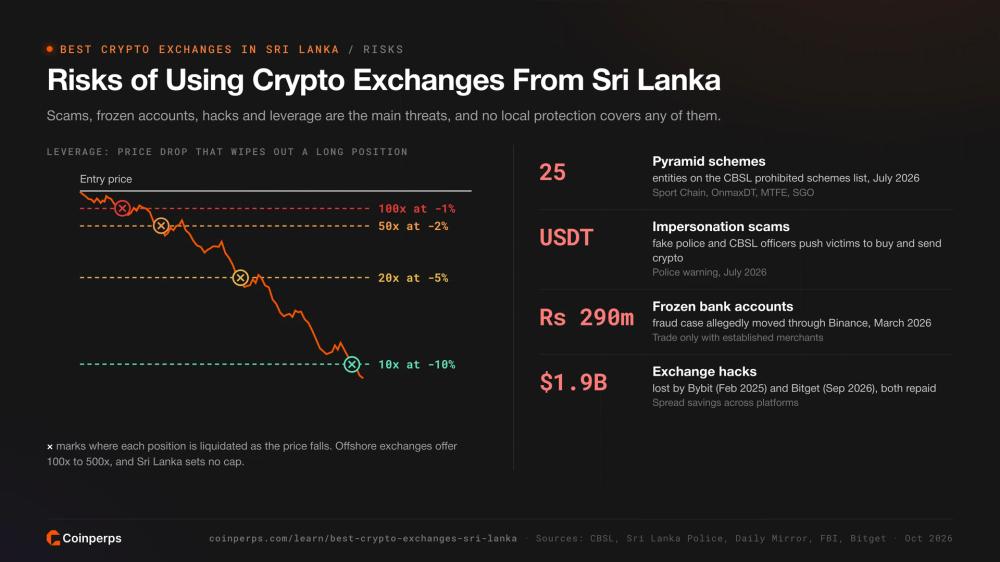
Risks of Using Crypto Exchanges From Sri Lanka
Sri Lankan users face scams, frozen bank accounts and exchange failures, with no local protection against any of them.
Pyramid schemes dressed as crypto investments have cost Sri Lankans billions of rupees. The CBSL's July 2026 list of prohibited schemes names 25 entities, including Sport Chain, OnmaxDT, MTFE and the SGO mining platform. If a scheme pays you for recruiting others, walk away.
Impersonation scams now push victims into USDT. In July 2026 Sri Lanka Police warned that fraudsters posing as police, CID and CBSL officers were telling victims to buy crypto and send it to them.
Frozen accounts on P2P happen when a buyer pays you with stolen money. Police can freeze your bank account while they investigate, even if you sold USDT in good faith, so trade with established merchants and keep proof of every payment.
Exchange hacks still happen. Bybit lost about $1.5 billion in February 2025 and Bitget about $387.5 million in September 2026, and both covered customers from their own funds. A smaller exchange might not, so spread long-term savings across platforms or a self-custody wallet.
Leverage is the fastest way to lose money. Offshore exchanges offer 100x to 500x on futures, and a 1% move against a 100x position can wipe it out. Our guide to avoiding auto-deleveraging explains how leveraged positions fail.
Bottom Line
Bybit is the best all-round crypto exchange for most Sri Lankans, with zero-fee LKR P2P, a MiCA-licensed group and Bybit Pay already live in the country. Binance is the pick for large rupee orders, thanks to an LKR market several times deeper than any rival.
OKX suits fee-conscious eZ Cash users, and Kraken suits users who value licensing over convenience. Gate and Bitget work best as second accounts funded with USDT bought elsewhere.
No Sri Lankan licence or investor protection applies yet, whichever exchange you choose. Buy through escrowed P2P trades, keep records for tax, and watch for the SEC's new VASP law, which could change which exchanges can serve Sri Lanka.
