
What Is the KuCoin Referral Code?
KuCoin referral code cpdiscount gives new accounts a 15% discount on trading fees across spot, margin and futures through the Coinperps partner link. The discount is attached to the account rather than a temporary campaign. There is no minimum activity requirement, and it remains in place as trading volume increases.
Its duration depends on the KuCoin scheme supporting the code. Under the standard referral programme, the inviter stops earning commission 365 days after the invitee registers. Any cashback shared with the invitee ends at the same time. Coinperps uses KuCoin's affiliate programme, which KuCoin describes as a permanent relationship. As a result, cpdiscount has no one-year cutoff.
The discount comes from the commission KuCoin pays its partner. If no commission is generated, there is nothing to share. Zero-fee trades therefore receive no discount, while accounts that reach VIP level 4 or above stop generating commission altogether.
New users can also complete tasks through KuCoin's Rewards Hub, which is explained below. Identity verification is required before trading. Account availability depends on location, with the US market closed by court order and the EU entity paused by its regulator. Our KuCoin restricted countries list tracks current access, while the KuCoin exchange review covers the platform itself.

How to Use the KuCoin Referral Code (Step-by-Step)
KuCoin does not allow users to add a referral code after registration, so it must be applied when the account is created.
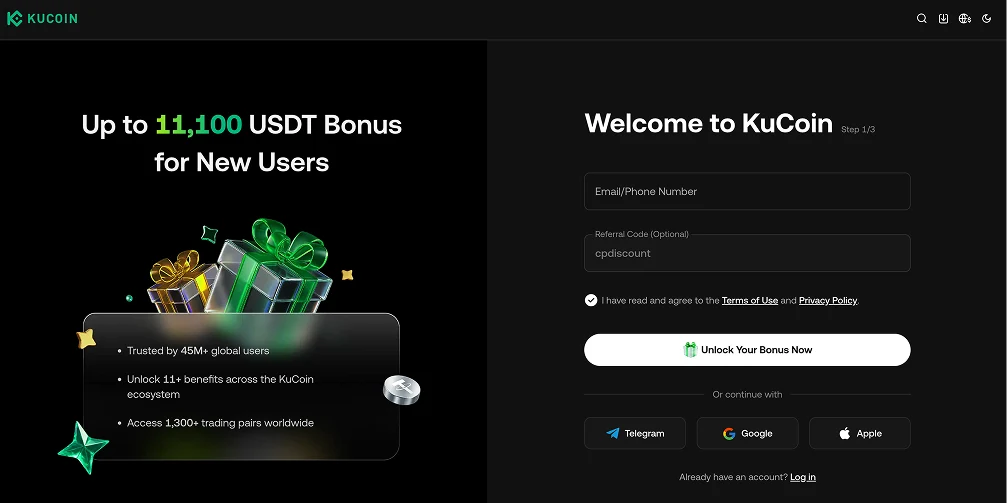
- Open the partner link: Use the button at the top of this page to pre-fill cpdiscount in the referral field. Check that the code appears before submitting the form.
- Register with email or phone: Create a strong password and enable two-factor authentication. Choose a standard main account, as sub-accounts, institutional accounts and API-only traders cannot participate in Rewards Hub promotions.
- Complete identity verification: Submit a government-issued ID and complete the liveness check. KuCoin requires verification before trading, and successful completion provides a small USDT reward through the Rewards Hub.
- Deposit or buy crypto: Fund the account with an on-chain transfer, fiat deposit, P2P transaction or third-party provider. Red packets and trial funds do not qualify as a first deposit.
- Place your first trade: Complete any spot or futures order to release the first-trade reward. The 15% fee discount applies from this order onwards.
- Work through the Rewards Hub: Open the Rewards Hub on the web or in the app to view your assigned deposit and trading tasks. New-user tasks expire 30 days after registration.
- Claim and withdraw: Rewards are credited to the Rewards Hub balance and become withdrawable after reaching the stated threshold. Coupons appear under My Coupons, with a separate expiry date for each one.
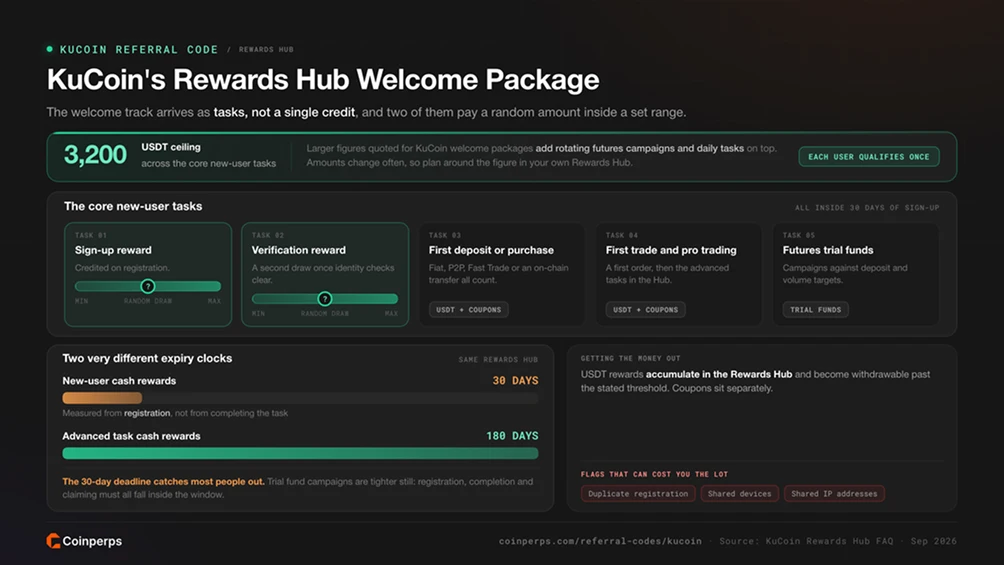
KuCoin's Rewards Hub Welcome Package
The welcome offer is delivered through individual tasks rather than one account credit. Users have 30 days from registration to complete them. KuCoin's Rewards Hub FAQ values the core new-user tasks at up to 3,200 USDT in cash rewards and coupons. Each person can qualify only once.
- Sign-up reward: Registration triggers a random USDT reward within a specified range.
- Verification reward: Another random USDT draw becomes available once identity verification is approved.
- First deposit or purchase: Users receive USDT and coupons after an eligible first deposit or purchase through fiat, P2P, Fast Trade, a third-party provider or an on-chain transfer.
- First trade and pro trading: A first spot or futures order unlocks additional USDT and coupons. More rewards are available through the advanced trading tasks displayed in the Hub.
- Futures trial funds: Some time-limited campaigns give newly registered accounts trial funds for meeting net deposit and volume targets. Registration, task completion and reward claiming must occur within the campaign period.
- Withdrawal rule: USDT rewards build up in the Rewards Hub and can be withdrawn once the required threshold is reached. KuCoin may remove rewards from accounts linked to duplicate registrations, shared devices or shared IP addresses.
Higher welcome-package figures, including the maximum shown at the top of this page, combine the core new-user offer with rotating futures campaigns and daily tasks. These amounts change frequently and depend on deposit size and trading volume. Use the figure displayed in your own Rewards Hub when planning which tasks to complete.
Cash earned from advanced tasks remains valid for 180 days. New-user cash rewards expire 30 days after registration, which is the deadline most easily missed.
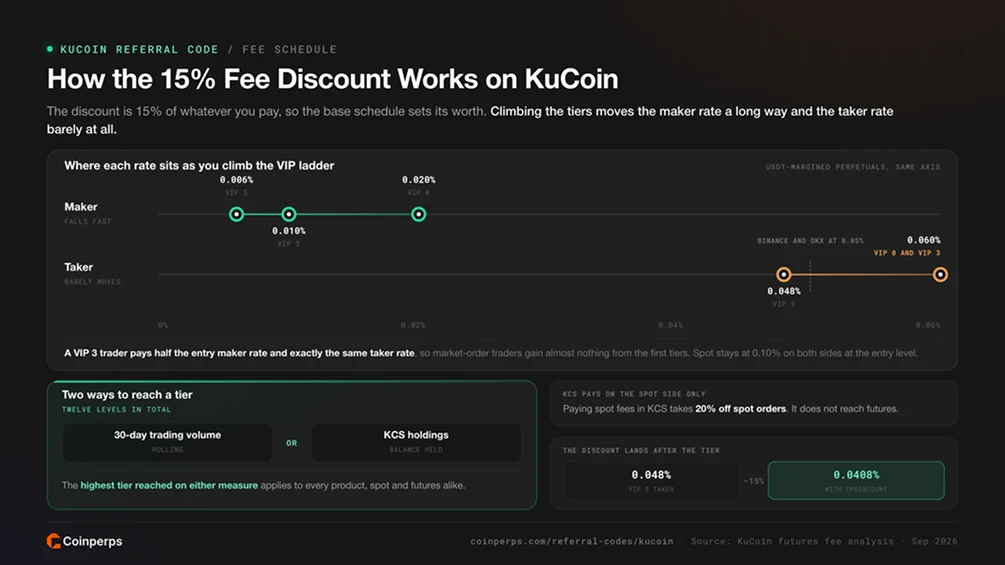
How the 15% Fee Discount Works on KuCoin
The discount returns 15% of the fee charged, so its value depends on KuCoin's underlying rates. At the entry tier, spot orders cost 0.10% for both makers and takers. USDT-margined perpetuals charge 0.02% maker and 0.06% taker, according to KuCoin's futures fee analysis. The taker fee is one basis point higher than the rates at Binance and OKX.
KuCoin allows cpdiscount to stack with other fee reductions. Paying spot fees with KCS, its exchange token, cuts spot trading costs by 20%. There are also twelve VIP levels that reduce spot and futures rates based on either 30-day trading volume or KCS holdings. Whichever measure produces the higher tier applies across every product.
Maker fees decline quickly, but taker rates remain unchanged through the earlier tiers. At VIP 3, the maker fee is half the entry-level rate while the taker fee stays at 0.06%. Traders who rely on market orders therefore receive little benefit from those first upgrades. Because the referral saving is calculated after the tier reduction, cpdiscount lowers a VIP 5 taker's 0.048% fee to 0.0408%.
How Much Can You Save With the KuCoin Referral Code?
Leveraged traders stand to save the most because perpetual fees apply to the full value of every fill, not just the margin committed. Major pairs support up to 100x leverage, allowing a relatively small balance to produce enough turnover for a 15% discount to become material.
- Position size: $2,000 of margin at 25x controls $50,000 of exposure.
- Round trip: Opening and closing the position generates $100,000 of fee-bearing volume because both fills are charged.
- Monthly volume: Thirty round trips create $3 million in trading volume.
- Taker cost: At the entry-level rate of 0.06%, fees total $1,800 per month.
- Discount: The 15% reduction saves $270 monthly, or about $3,200 a year at the same pace.
Using resting limit orders has a larger effect than the referral discount. At the 0.02% maker rate, the same $3 million in monthly volume costs $600. The discount falls to $90, but the total fee bill is two thirds lower. Savings are much smaller for spot buyers. Converting $20,000 per month through market orders at 0.10% costs $20, of which $3 is returned.
After the 15% discount, KuCoin's 0.06% taker fee becomes an effective 0.051%. This is lower than Bybit's 0.055%, as the Bybit referral code does not include a rebate. It remains above Bitget's effective 0.048% through the Bitget referral code and OKX's 0.0425% through the OKX referral code. KuCoin's main advantage is the depth of its altcoin listings.
Funding payments are not covered by the discount. They move directly between long and short traders, with KuCoin taking no share.

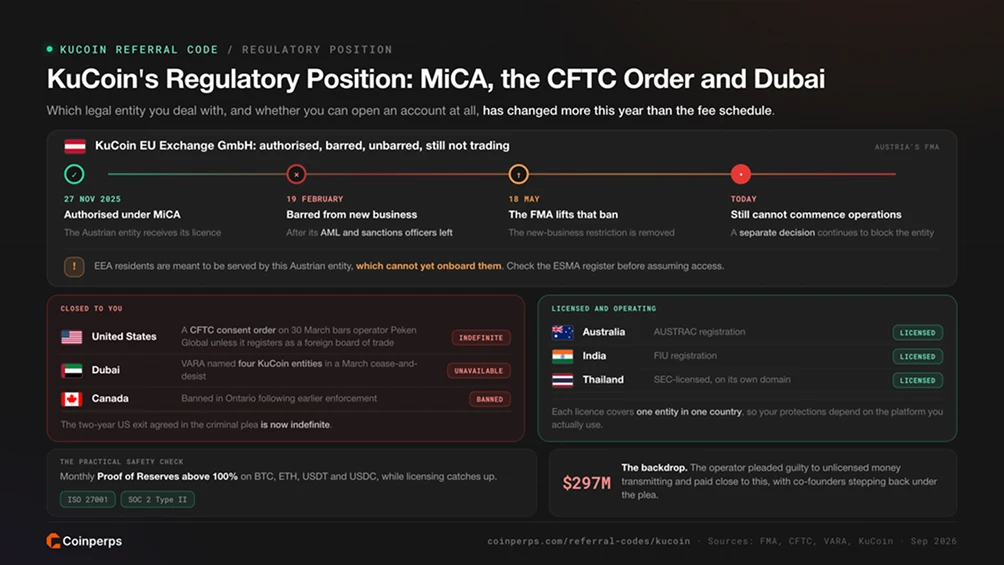
KuCoin's Regulatory Position: MiCA, the CFTC Order and Dubai
Access to KuCoin, along with the legal entity serving each user, has changed more this year than its fee schedule. The table below summarises the developments relevant to new accounts.
This regulatory position follows KuCoin's criminal case. Its operator pleaded guilty to running an unlicensed money transmitting business and paid nearly $297 million in penalties. The co-founders also withdrew from management under the plea agreement. March's consent order closed the case and ruled out a US return unless KuCoin obtains CFTC registration.
European readers can use the MiCA licensed exchanges list to find competitors that are both authorised and operating. While KuCoin EU remains paused, the best crypto futures platforms in Europe ranking covers available alternatives. Our perpetual futures regulation explainer examines the wider effect of enforcement on offshore venues.
KuCoin Referral Programme vs Affiliate Programme
The scheme supporting a KuCoin code determines whether the invitee's discount continues for one year or indefinitely.
Any verified KuCoin user can participate in the standard referral programme. During the month in which verification is completed, the referrer begins with a 25% commission on the invitee's trading fees. That rate is reassessed monthly and can rise to 35%. Referrers may pass some of the commission back to invitees as cashback, but the arrangement ends 365 days after registration.
- Eligible trades: Spot, margin, trading bots, ETFs and futures. API trading is excluded.
- VIP cutoff: Commission stops once the invitee reaches VIP level 3.
- Regional exclusions: The programme is unavailable to residents of Belgium, France, the Netherlands and other restricted regions.
- Payout: Commission is settled daily and paid the following day in the currency used for the fee.
This page uses the affiliate programme instead. Approved partners receive between 40% and 60% of invitee fees, based on quarterly volume and new-user targets, and may choose how much cashback to share. KuCoin explains these terms in its affiliate guide. Because the company describes affiliate relationships as permanent, cpdiscount is not subject to the 365-day limit.
According to the same guide, an invitee's cashback rate remains protected while the affiliate holds a commission tier of at least 40%. A downgrade below that level also reduces the invitee's rate. Coinperps cannot control KuCoin's quarterly assessment. The 15% discount is attached to this link today, with its future treatment governed by KuCoin's rules.
For a comparison of referral and tier-based savings, see our best crypto exchange VIP programs roundup. It compares KuCoin's structure with the programmes offered by OKX, Bitget and Bybit.
Bottom Line
KuCoin referral code cpdiscount reduces spot, margin and futures trading fees by 15%. It has no expiry or minimum activity requirement because it operates through KuCoin's affiliate programme, not the standard 365-day referral scheme. The code lowers the 0.06% futures taker rate to an effective 0.051%. That beats Bybit's undiscounted rate but remains higher than the effective fees available through Bitget and OKX referral codes.
KuCoin's Rewards Hub provides USDT and coupons, although all new-user tasks must be completed within 30 days and campaign values change frequently. The exchange's main attraction remains its listing breadth. With more than 1,000 assets and early access to smaller tokens, KuCoin ranks ninth in our coverage. It would place higher without the permanent US restriction, paused EU entity and Dubai order.
For side-by-side data covering every venue, visit our perpetual exchanges ranking and comparison hub. All available codes are listed in the referral codes hub.