Can You Use Binance Futures in the USA?
Kalshi is the only CFTC-regulated venue offering both event contracts and crypto perps, and its access map is unusual. The Member Agreement restricts 54 jurisdictions, perps are US-only, and several governments block the platform outright.

Disclosure: Coinperps may earn a commission from partner links, at no extra cost to you. Reviews are based on independent testing, see how we test.
- Binance Futures stays off-limits to US residents in 2026. The global platform geo-blocks American IPs and requires non-US residency at sign-up, while Binance.US runs spot trading only, with no perpetuals, margin, or options.
- The legal history is the cause, not a glitch. Binance's November 2023 settlement with US authorities installed a compliance monitor, and offering unregistered leveraged derivatives to Americans is the conduct that triggered it.
- The 2026 thaw helped everyone but Binance so far. The CFTC cleared the first regulated US perpetuals in late May, but the approved venues are Kalshi, Coinbase, and Kraken, not Binance, and a Binance.US revival is still a comment, not a filing.
- Kraken is the best alternative for US traders. It switched on CFTC-regulated perpetual futures for eligible US clients on June 15, 2026, giving Americans a regulated, domestic home for the product Binance keeps closed.

Kraken
Kraken is the most trusted and well regulated perpetuals exchange across the US, Europe, Canada, and other key markets, offering 170+ contracts with deep liquidity and low fees.
Features
Fees
Regulation
Overall
For most of a decade, the answer to whether Americans can trade Binance Futures has been a flat no, and traders stopped asking.
2026 earns a second look. Nearly every variable around that no moved at once: the criminal case against the founder is closed, a pardon is signed, and US regulators spent the spring inviting perpetual futures back onshore.
None of it changed the account-level reality, which is where this guide focuses. We separate what is settled (you cannot use Binance Futures from the US today) from what is in flux (whether Binance returns), flag the VPN risks that trip traders up, and point to the regulated perps desks that opened to Americans this year. Where a claim touches your money or legal standing, we link the primary source.
Is Binance Futures Available in the USA?
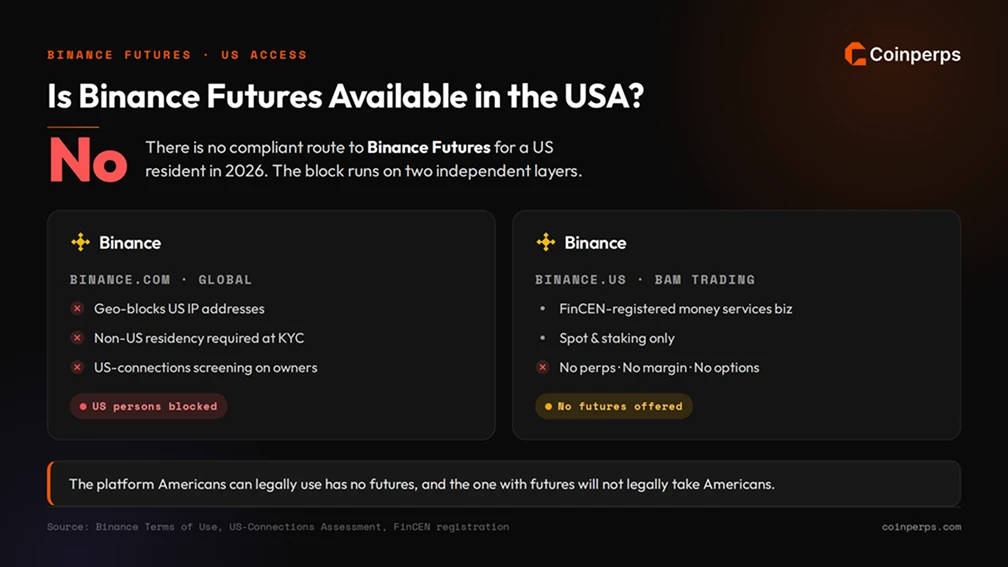
No. There is no compliant route to Binance Futures for a US resident in 2026. The block runs on two layers that operate independently:
- The global platform: Binance.com screens out US IP addresses and requires non-US residency at verification, and entities or funds with American ownership get routed through a separate US-connections assessment. Perpetual futures are squarely off the menu, since they are regulated derivatives the global entity is not licensed to sell stateside.
- The US carve-out: Since 2019, Binance has served Americans through BAM Trading Services, operating as Binance.US and registered with FinCEN as a money services business. It runs spot and staking only, with no perpetuals, margin, or options.
So the platform Americans can legally touch has no futures, and the one with futures will not legally take Americans. For the country-by-country view, our Binance Futures restricted countries guide maps where the product is open, gated, or closed.
Why Binance Futures Is Blocked for US Traders
The block is not caution. It is the direct legacy of one of crypto's largest enforcement actions and the supervision it left behind.
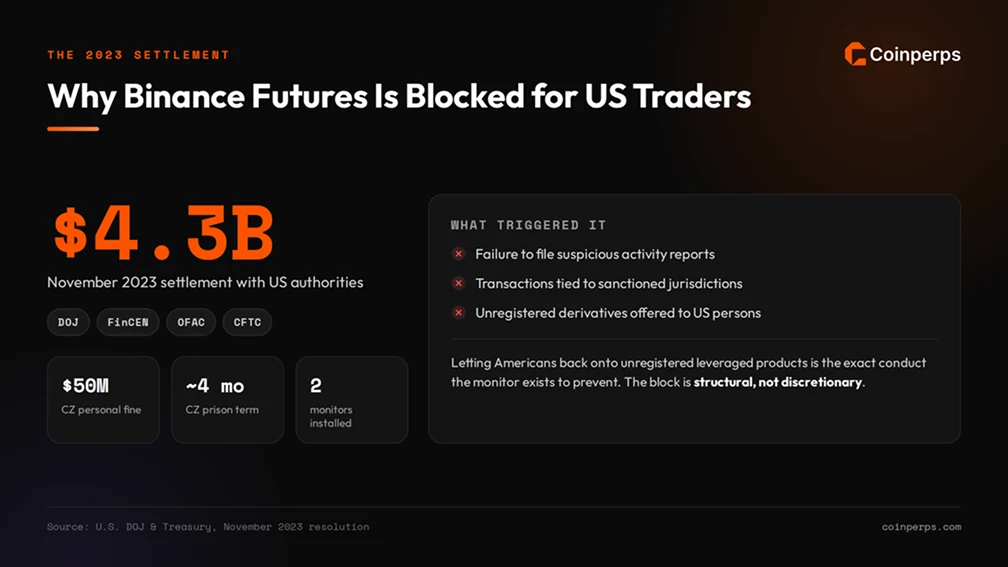
In November 2023, Binance resolved a multi-year US investigation with a roughly $4.3 billion settlement spanning the DOJ, FinCEN, OFAC, and the CFTC. The conduct was specific: failing to file suspicious activity reports, processing transactions tied to sanctioned jurisdictions, and running an unregistered derivatives venue for US persons. The deal also forced Binance to retain an independent compliance monitor with deep access to its books, oversight that still shapes how cautiously it treats US access, though the company has since pushed to wind that monitorship down.
That backdrop explains the geo-block. Letting Americans back onto unregistered leveraged products is the exact behavior the monitor exists to prevent, so the posture is structural, not discretionary. The founder served his penalty separately: Changpeng "CZ" Zhao paid a $50 million fine, pleaded guilty to a single Bank Secrecy Act violation, and left prison in September 2024. The corporate restriction outlived the personal one, which is why a free founder and an open US futures market are not the same thing.
The 2026 Thaw: What Has Actually Changed
Three separate doors swung open in barely a year, and none of them leads to Binance Futures yet:
- The SEC case vanished: The regulator voluntarily dropped its civil suit against Binance in May 2025, with prejudice, clearing one of the two federal clouds over the company.
- CZ was pardoned: On October 23, 2025, President Trump pardoned Zhao, a move the White House framed as undoing a prosecution it called part of a war on crypto. Zhao says he holds no operational role but remains a major shareholder.
- The CFTC reopened perps: Under Chairman Mike Selig, confirmed in December 2025, the agency approved the first regulated US perpetual contract on May 29, 2026, cleared Kalshi's BTCPERP, and let a Coinbase affiliate route customers to global perps, with a formal policy statement following in early June.
A licensed domestic perps market now exists for the first time, but Kalshi, Kraken, and Coinbase built it, not Binance. CZ noticed the gap: at Consensus Miami in May 2026, he floated a Binance.US revival as one route back to deeper liquidity. For now that is a conference remark, not a license application, so read it as direction, not timeline.
Can You Use a VPN to Trade Binance Futures in the US?
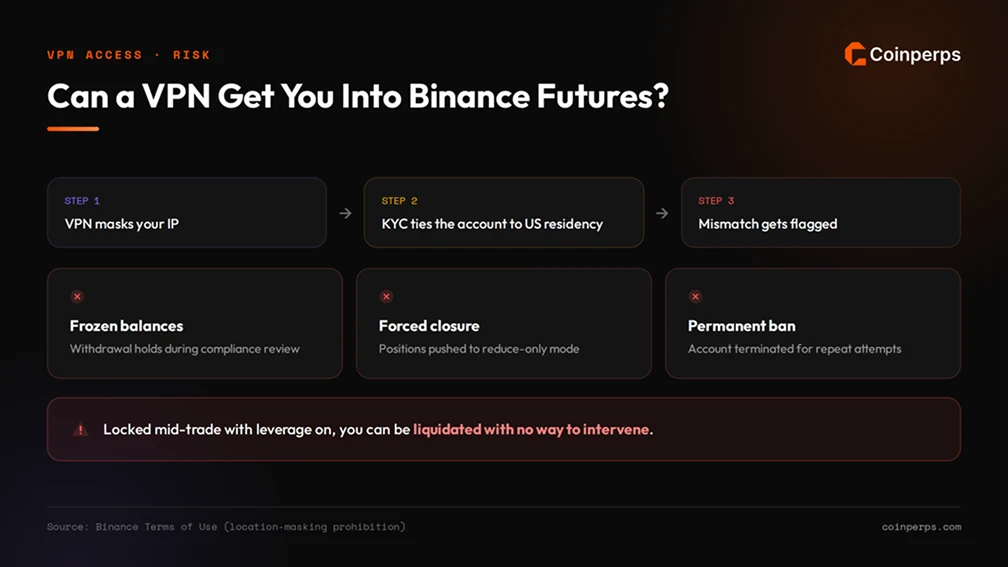
You can mask an IP. You cannot get a usable, safe Binance Futures account out of it, because the residency tied to your verified identity is what counts, not your apparent location. Binance enforces full KYC, including government ID and a liveness check, and once your documents read United States, no server overrides them. Its terms also ban location-masking outright, so a flagged account can face:
- Frozen balances and withdrawal holds while a compliance review runs, usually at the worst possible moment.
- Forced closure or reduce-only mode, stripping your ability to add margin, hedge, or exit a position.
- Permanent termination for repeated attempts to bypass the regional block.
Leverage is what turns this from inconvenient to dangerous. If a review locks your account while perpetual positions are open, you can be liquidated with no way to act, and a compliance monitor is still watching this exact category of US access. A locally regulated venue is the rational path, and in 2026 most US traders finally have one. If you are weighing optional-KYC offshore venues anyway, our best no-KYC perpetual futures exchanges ranking covers the tradeoffs.
Will Binance Return to the US Futures Market?
The path exists, the obstacles are real, and the honest answer sits between them.
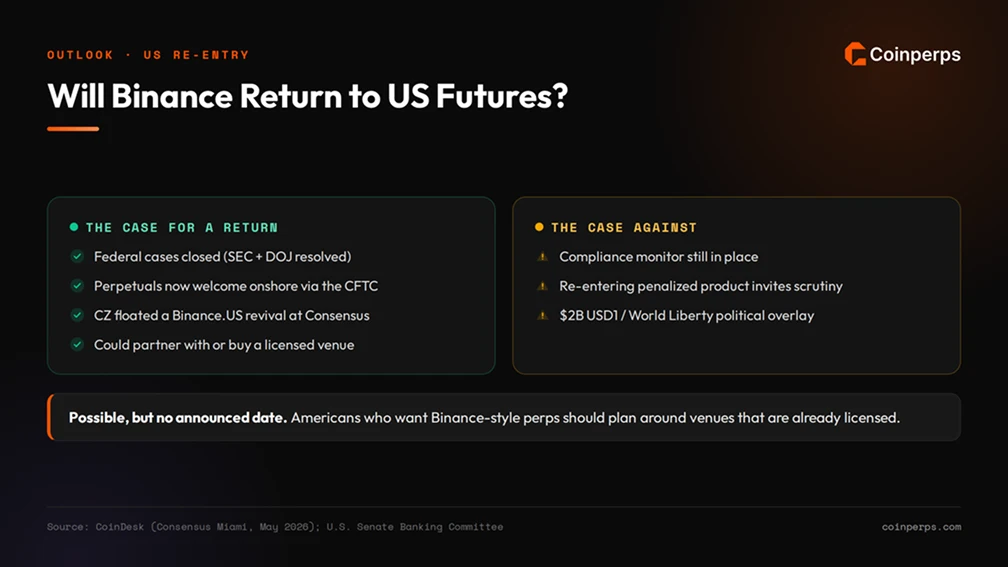
- The case for a return: The federal cases are closed, perps are explicitly welcome onshore, and CZ has publicly mused about reviving Binance.US. A US arm that pursued a CFTC-registered perps product, most plausibly by partnering with or acquiring a licensed venue the way Kraken did, is no longer far-fetched on the rules alone.
- The case against: Re-entering the exact product line that drew the original penalty invites scrutiny rather than avoiding it. There is also a political overlay: reporting ties a roughly $2 billion stablecoin-denominated investment into Binance to USD1, a token issued by World Liberty Financial, a venture connected to the president's family, which has drawn lawmaker questions about the pardon's timing. None of that is illegal on its face, but it raises the attention any Binance US move would face.
For now, Americans who want Binance-style perps should plan around venues that are already licensed, not a return with no announced date.
Best Binance Futures Alternatives for US Traders
The useful shift in 2026 is that trading perps legally in the US stopped being a contradiction. Three options cover most needs, each inside the CFTC perimeter rather than around it.
Kraken
Kraken became the clearest direct substitute on June 15, 2026, when it switched on CFTC-regulated perpetual futures for eligible US clients on Kraken Pro. It got there by acquisition: parent company Payward bought Bitnomial, a Chicago firm holding the full stack of CFTC licenses (exchange, clearinghouse, brokerage), for up to $550 million, skipping a multi-year registration. The practical win is that perps share a wallet with Kraken's CME-listed contracts, so collateral is not stranded across venues. Confirm coverage by state in our Kraken restricted countries guide.
Coinbase
Coinbase suits traders who want a regulated, US-headquartered venue with a familiar onramp. Alongside the nano BTC and ETH futures it launched in 2025, Coinbase won no-action guidance letting an affiliate connect eligible US customers to perpetual products at the global level. Availability is gated by product and jurisdiction, so check the specifics in our Coinbase perpetuals restricted countries breakdown first.
Kalshi
Kalshi inverted the usual map. Where offshore platforms serve the world and block America, Kalshi built CFTC-approved perpetuals that serve the US first, branded "American Perpetuals," starting with Bitcoin and Ethereum across a multi-asset lineup. Margin sits in regulated futures accounts and leverage is conservative by offshore standards, the tradeoff for trading inside the perimeter. Mechanics, funding, and risks are in our Kalshi Perpetuals review, with the access map in the Kalshi restricted countries guide.
Traders outside the US comparing these against Binance on cost can use our live funding rates and open interest trackers and the full perpetual exchanges directory. Bybit holds the deepest non-US book for size, and on-chain traders can read our how to use Hyperliquid in the USA guide, noting that Hyperliquid excludes US persons in its terms.
Bottom Line
You cannot use Binance Futures in the USA in 2026. The global platform blocks US persons by design, Binance.US is spot only, and the 2023 settlement gives the company every reason to hold that line. A founder's pardon and a friendlier CFTC did not move the account-level reality, and a VPN only converts a closed door into a liquidation risk.
What changed is the alternative. For the first time, Americans have a domestic, CFTC-regulated perpetuals market, with Kraken live as of mid-June, Coinbase routing into global perps, and Kalshi running its own approved contracts. If Binance does mount a comeback, it will most likely arrive through that licensed framework, not a reopened global login, so learn the regulated venues now and watch whether Binance joins them.
If you open a Binance account outside the US, our Binance referral code guide covers current fee rebates.
Frequently Asked Questions
Can a US resident open a Binance.com Futures account?
No. Binance.com requires non-US residency at verification and screens for US connections, so a US resident cannot legally open or fund a futures account there. Binance.US is the only compliant entry point for Americans, and it offers no perpetual futures at all.
Does Binance.US offer any leveraged or futures products?
No. Binance.US runs as a spot-and-staking platform under BAM Trading Services, with no perpetuals, margin, or options. Traders who want regulated leverage in the US currently look to Kraken, Coinbase, or Kalshi instead.
Is it illegal to use a VPN for Binance Futures from the US?
Using a VPN to bypass Binance's regional limits breaches the platform's own terms, which can trigger account freezes, forced closures, or permanent bans. Beyond the contract issue, masking US residency to trade unregistered leveraged products is the activity that drew Binance's US enforcement action, so the practical and financial risk is high.
Will the CZ pardon let Binance Futures back into the US?
Not on its own. The October 2025 pardon resolved the founder's personal case but left the corporate structure, the spot-only US entity, and the compliance monitorship untouched. A US futures return would require Binance to stand up a CFTC-registered product, which has not been announced.
Where can US traders legally trade crypto perpetuals in 2026?
Inside the CFTC framework that opened in late May 2026. Kraken launched regulated perpetuals for eligible US clients on June 15 via its Bitnomial acquisition, Coinbase secured a path to route US customers into global perps, and Kalshi offers its CFTC-approved "American Perpetuals" on Bitcoin, Ethereum, and other assets.