2026年最佳无KYC永续合约加密交易所
BloFin, Hyperliquid and Lighter lead our ranking of no KYC perpetual futures exchanges. See withdrawal limits, fees, leverage, order book depth, country restrictions and how private each one really is.

Coinperps 可能通过合作伙伴链接获得佣金,您无需额外支付;排名遵循我们的评测方法。 不构成财务建议。
关键要点
- BloFin is the best no KYC perpetual futures exchange: an email address is enough to trade 528 perpetuals at up to 150x and withdraw 20,000 USDT a day, and no other large centralised exchange still documents that.
- Onchain venues fill the rest of the list: Hyperliquid, Lighter, Aster, Extended and Jupiter Perps need only a wallet, and Hyperliquid alone traded about $13.4 billion in 24 hours on 14 November 2026.
- Centralised no KYC trading is disappearing: MEXC, BingX, Bitunix and Phemex now require ID, BitMEX and CoinEx have closed, and the US Treasury cut MEXC off from American banks on 6 November 2026.
- No KYC does not mean anonymous: exchanges still log your email and device, onchain positions are public, stablecoin issuers can freeze a wallet, and tax still applies.

- No KYC withdrawals
- 20,000 USDT a day
- 永续合约市场
- 528
- 最高杠杆
- BTC和ETH150x杠杆
- 入场费
- 0.02% Maker 手续费,0.06% Taker 手续费
本页内容 9 个章节
- Best No KYC Perpetual Futures Exchanges
- What a No KYC Perpetual Futures Exchange Is
- How No KYC Exchanges Compare on Cost, Depth and Leverage
- Why Most Centralised Exchanges Now Require KYC
- How Private No KYC Perp Trading Really Is
- How to Fund a No KYC Futures Account
- Where No KYC Exchanges Are Restricted
- Risks of Trading Perps Without KYC
- 总结
BloFin, Hyperliquid and Lighter are the best no KYC perpetual futures exchanges today. BloFin takes first place because it is the only large centralised exchange that still documents futures trading with just an email address.
Aster, Extended and Jupiter Perps complete the list. Those five run onchain, which means you connect a wallet and never open an account. Many centralised exchanges that once appeared on lists like this now ask for ID, and two have closed.
Each venue's own help pages, terms and public market data were checked on 14 November 2026. This guide is general information and is not investment, tax or legal advice.
Best No KYC Perpetual Futures Exchanges
交易所 | Sign-up | No KYC withdrawals | Perp markets | Max BTC leverage | Maker / Taker | 关键细节 |
|---|---|---|---|---|---|---|
邮箱 | 20,000 USDT a day | 528 | 150x | 0.02% / 0.06% | Only large centralised exchange left | |
Wallet or email | No venue limit | 350 | 40x | 0.015% / 0.045% | Deepest onchain order books | |
Wallet | No venue limit | 209 | 50x | 0% / 0% | Zero fees with a 300 ms taker delay | |
Wallet or email | No venue limit | 594 | 1001x | 0% / 0.04% | Terms reserve the right to ID checks | |
Wallet | No venue limit | 413 | 50x | 0% / 0.025% | 179 stock and commodity markets | |
Solana wallet | No venue limit | 11 | 250x | 统一 0.06% | You trade against a liquidity pool |
 BloFin
 Jupiter Perps
Market counts and leverage were read from each venue's public API, and fees are the entry tier for a new account. Hyperliquid's count combines its own 179 markets with 171 listed by third-party deployers.
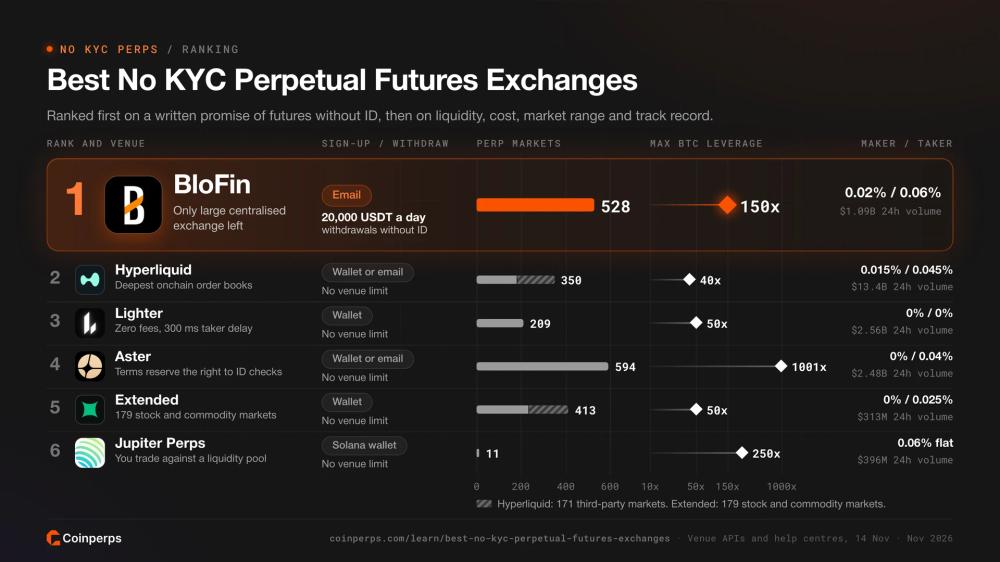
The first test in our ranking was whether a venue states in writing that perpetuals can be traded without ID, since many exchanges still advertised as no KYC have stopped. After that we weighed liquidity and cost, then market range, track record and country restrictions. Our ranking methodology sets out the wider scoring.
12. BloFin
Best forOnly large centralised exchange left- Sign-up
- 邮箱
- No KYC withdrawals
- 20,000 USDT a day
- 永续合约市场
- 528
- 比特币最大杠杆
- 150x
- Maker / Taker 手续费
- 0.02% / 0.06%
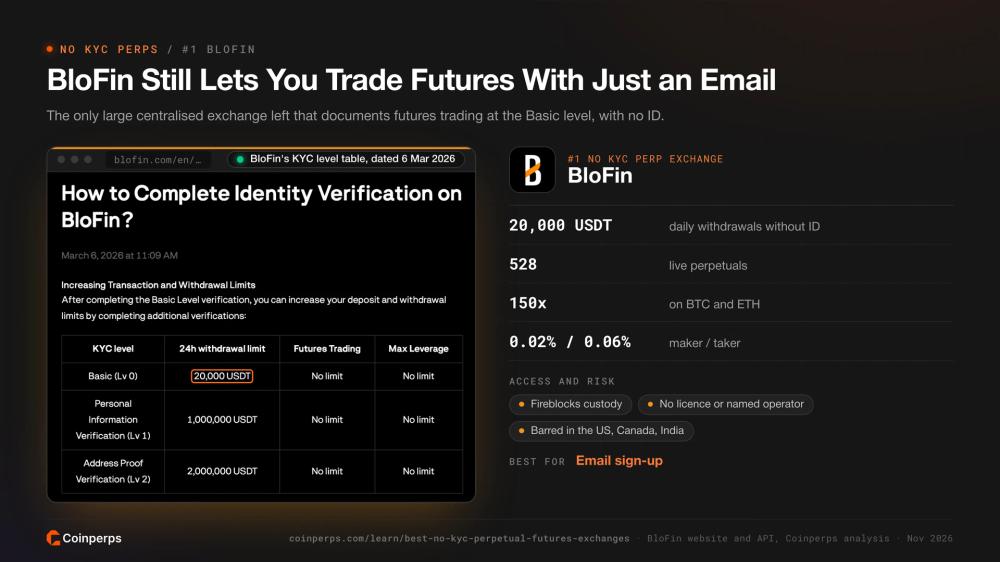
For most traders, BloFin is the best no KYC perpetual futures exchange. Every new account starts at the Basic level on its identity verification page, dated 6 March 2026. That level has no limit on futures trading or leverage, and it allows 20,000 USDT of withdrawals every 24 hours.
No other large centralised exchange still puts that in writing. Registration takes an email address. You deposit crypto and trade, with no wallet or bridge to manage. Uploading an ID raises the withdrawal limit to 1,000,000 USDT a day, and proof of address lifts it to 2,000,000 USDT.
On 14 November 2026 the public API listed 528 live perpetuals. Of those, 398 were crypto contracts settled in USDT or USDC, while 110 tracked stocks and six followed commodities or an index. Only BTC-USDT and ETH-USDT reach 150x. SOL and XRP stop at 125x, while most altcoins sit at 50x or 75x. Entry fees are 0.02% maker and 0.06% taker.
Across three order book samples, a $1 million market buy of BTC-USDT moved the price 0.68 basis points. The same order on Binance, measured at the same moment, moved it 1.04 basis points. BloFin's 24-hour perpetual volume was about $1.09 billion.
Fireblocks holds the exchange's wallets. In November 2026 the proof of reserves page showed ratios of 106.52% for USDT, 146.97% for BTC and 162.75% for ETH, though no outside auditor is named. Card and SEPA purchases ask for ID, so the no KYC path is crypto in and crypto out.
BloFin holds no licence from a major regulator. Its terms of use name no operating company, and they let it request documents or freeze an account for "unusual activities". Residents of the US, Canada, China, India, Russia, Singapore and the UAE are barred. The full list is in our BloFin restricted countries guide.
优点
- Documented no KYC futures: an email unlocks every perpetual at full leverage, with 20,000 USDT of withdrawals a day.
- Familiar exchange experience: no wallet, bridge or gas token is needed, and copy trading and bots show no ID step in BloFin's guides.
- Wide market list: 528 perpetuals including 110 stock contracts, with 150x on BTC and ETH.
缺点
- No licence or named operator: nothing stands behind deposits except BloFin's own controls and a self-published reserves page.
- ID can be demanded later: the terms allow document requests and freezes at BloFin's discretion.
- Regulator notices: India's financial intelligence unit named BloFin in a non-compliance round on 9 September 2026.
2. Hyperliquid
- Sign-up
- Wallet or email
- No KYC withdrawals
- No venue limit
- 永续合约市场
- 350
- 比特币最大杠杆
- 40x
- Maker / Taker 手续费
- 0.015% / 0.045%
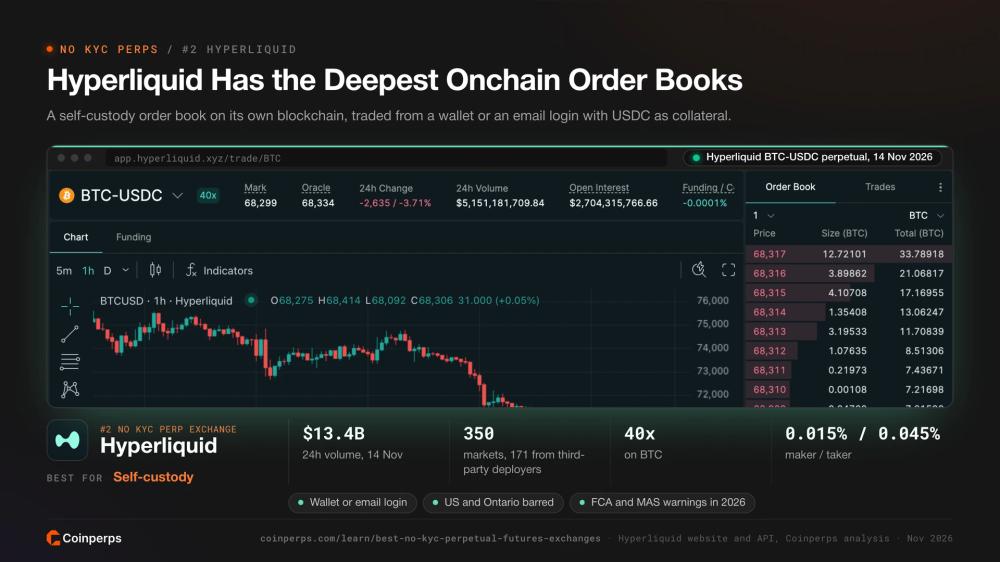
Traders who want self-custody and the deepest onchain liquidity should look at Hyperliquid first. Its order book runs on a purpose-built blockchain. You trade from a wallet or an email login, and USDC is the collateral.
In our snapshot Hyperliquid traded about $13.4 billion in 24 hours, more than the next five venues on this list combined. Its own 179 crypto perpetuals accounted for around $8.9 billion. A further $4.5 billion came from 171 stock, commodity and pre-IPO markets, which third-party deployers such as trade.xyz list on its infrastructure.
Leverage is conservative. BTC goes to 40x, ETH to 25x, and SOL and XRP to 20x. Most smaller coins are capped between 3x and 10x. Entry fees are 0.015% maker and 0.045% taker, which staking HYPE can cut by up to 40%. Our Hyperliquid fees guide works through the tiers.
At large size the book was the strongest we measured. A $5 million BTC market buy moved the price 2.1 basis points, less than on Binance or any other venue here. Funding is paid hourly, and every fill, position and liquidation can be seen onchain.
The terms, last updated on 15 June 2026, bar anyone in the United States or Ontario. They also prohibit VPN use to hide a location. In May 2026 the UK's Financial Conduct Authority issued a warning about Hyperliquid, and Singapore's central bank added it to its investor alert list in June.
Hyperliquid has intervened in its own markets too. Its validators delisted the JELLY contract in March 2025 and settled positions at a fixed price. On 10 October 2025 the exchange closed profitable positions through auto-deleveraging. See our Hyperliquid review and restricted countries guide for more.
优点
- Deepest onchain liquidity: about $13.4 billion in 24-hour volume and the smallest price impact on a $5 million BTC order.
- Self-custody with no account: a wallet or email login is enough, and there is no withdrawal cap.
- Stocks and commodities: third-party deployers list 171 non-crypto and pre-IPO markets alongside the core crypto perps.
缺点
- Regulator warnings: the FCA and Singapore's MAS both flagged Hyperliquid in 2026, and US and Ontario residents are barred.
- Everything is public: positions and liquidation prices can be tracked by anyone.
- Lower leverage: 40x on BTC and 3x to 10x on most altcoins.
3. Lighter
 Best forZero fees with a 300 ms taker delay
- Sign-up
- Wallet
- No KYC withdrawals
- No venue limit
- 永续合约市场
- 209
- 比特币最大杠杆
- 50x
- Maker / Taker 手续费
- 0% / 0%
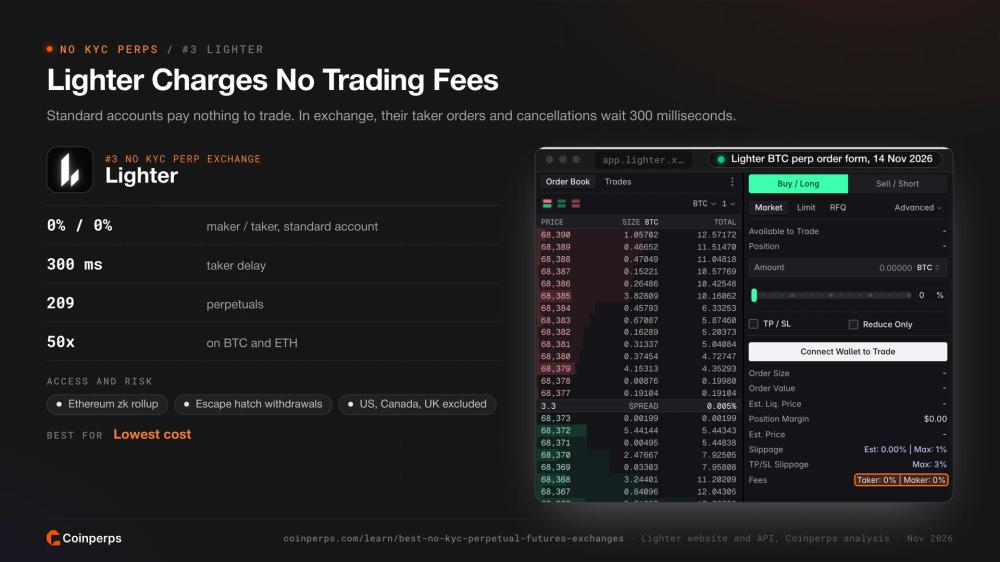
Nowhere is it cheaper to trade perpetuals without KYC than on Lighter, whose default account pays no trading fees at all. The order book settles to Ethereum. All you need is a wallet and some USDC.
Standard accounts pay 0% maker and 0% taker. In exchange, their taker orders and cancellations wait 300 milliseconds. A paid Premium tier starts at 0.004% maker and 0.028% taker and shortens the taker delay to 140 milliseconds. Most manual traders will not notice the delay. Fast automated strategies will.
Lighter had 209 active perpetuals in our snapshot and about $2.56 billion of 24-hour volume. BTC and ETH go to 50x and SOL to 25x. Beyond crypto, the list covers roughly 50 stocks, eight currency pairs, eight commodities and several pre-IPO names. A $1 million BTC market buy moved the price 1.13 basis points, close to Binance.
Because Lighter is a zero-knowledge rollup, funds sit in Ethereum contracts. Its documentation describes an escape hatch for withdrawing on Ethereum if the operator stops processing requests. The interface collects no personal data beyond what a wallet reveals.
Access is narrower than Hyperliquid's. The terms exclude the United States, Canada, the United Kingdom, China, Russia, Ukraine and Venezuela, among others. During the October 2025 crash Lighter went offline for about four and a half hours. Users also reported slow withdrawals when its LIT token launched that December.
Its founder said in October 2026 that the company plans to apply for registration with the US derivatives regulator. No filing had been confirmed when we checked. Volume is tracked on our Lighter statistics page, and the Vladimir Novakovski profile covers the team.
优点
- Zero trading fees: the default account pays nothing to open or close a position.
- Ethereum-secured custody: funds sit in Ethereum contracts with a documented escape hatch.
- Broad market list: 209 perpetuals across crypto, stocks, currencies and commodities at up to 50x.
缺点
- Order delay: free accounts wait 300 milliseconds on taker orders and cancellations.
- Long restricted list: the US, Canada, UK, China, Russia and Ukraine are all excluded.
- Past outages: the platform was down for hours on 10 October 2025.
4. Aster
 Best forTerms reserve the right to ID checks
- Sign-up
- Wallet or email
- No KYC withdrawals
- No venue limit
- 永续合约市场
- 594
- 比特币最大杠杆
- 1001x
- Maker / Taker 手续费
- 0% / 0.04%
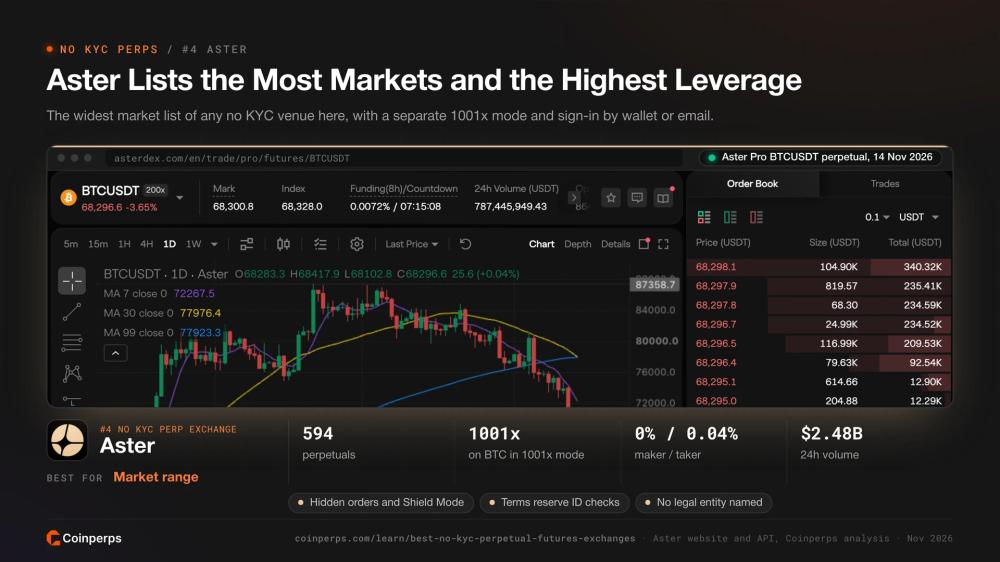
Aster has the widest market list and the highest leverage of any no KYC venue here. Sign-in works with a wallet or with an email and password, and collateral is posted in USDT.
Its API listed 594 perpetuals on 14 November 2026. They cover crypto plus US, Hong Kong and Korean stocks, along with currencies and commodities. Maker orders are free, and the base taker fee is 0.04%. On stock and commodity contracts takers pay 0.0125%, a cut that took effect on 7 September 2026. Volume was about $2.48 billion in 24 hours.
A separate 1001x mode allows up to 1001x on BTC and 250x on ETH. A move of just 0.1% against you wipes out the margin at 1001x, so the feature suits very short trades and little else. Each mode is covered in our Aster trading guide.
Hidden orders conceal price and size from other traders, and Shield Mode keeps positions off the public book. Aster has run on its own blockchain since March 2026, and that chain encrypts orders. None of this hides deposits and withdrawals from chain analysis.
The chain's core code is not open source, and the terms name no legal entity. Section 2.3 reserves the right to "implement limited identity verification procedures". Today's no KYC access is therefore a policy that can change.
Those terms exclude the United States, Canada, the United Kingdom, China, Russia, Ukraine and Venezuela. A pricing error on the XPL contract forced liquidations in September 2025. Aster refunded affected traders within hours.
优点
- Largest market list: 594 perpetuals across crypto, global stocks, currencies and commodities.
- Order privacy: hidden orders and Shield Mode keep positions out of public view.
- Low costs: free maker orders, 0.04% taker and 0.0125% on stock and commodity contracts.
缺点
- ID checks reserved: the terms allow identity verification to be introduced.
- Opaque operator: no legal entity is named and the chain's core code is closed.
- Extreme leverage: 1001x positions are liquidated by a 0.1% move.
5. Extended
 Best for179 stock and commodity markets
- Sign-up
- Wallet
- No KYC withdrawals
- No venue limit
- 永续合约市场
- 413
- 比特币最大杠杆
- 50x
- Maker / Taker 手续费
- 0% / 0.025%
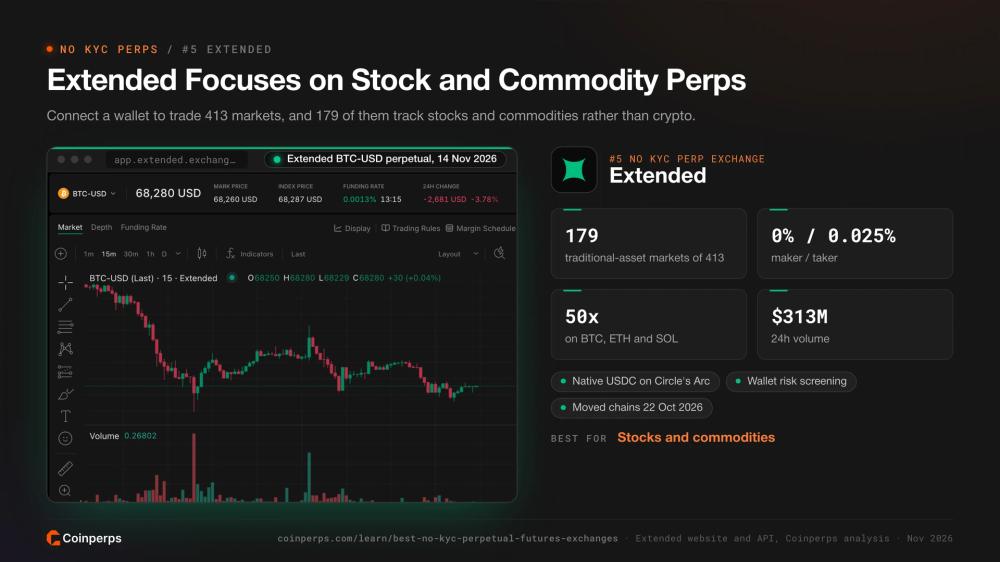
Outside Hyperliquid, Extended is the strongest no KYC choice for stock and commodity perps. It had 413 active markets when we checked, 179 of which track traditional assets. Every one is margined in USDC.
Maker orders are free. Takers pay 0.025% on crypto and 0.010% on traditional-asset markets, and BTC, ETH, SOL and other large coins go to 50x. A $1 million BTC market buy moved the price about 0.7 basis points in our order book sample. Even so, 24-hour volume of $313 million is small next to the venues above.
On 22 October 2026 Extended moved from Starknet to Arc, the blockchain built by USDC issuer Circle. USDT and wrapped Bitcoin were dropped as collateral in the process. Any EVM wallet works, and creating an account takes two signatures.
Compliance is more visible here than on other onchain venues. The terms, rewritten on 30 October 2026, say access can be refused if a wallet fails a Know Your Transaction risk check. They also exclude the United States, United Kingdom, Canada, Hong Kong and Russia. No identity document is requested, but your wallet's history is screened.
优点
- Traditional markets: 179 stock, index, currency and commodity perps beside 234 crypto contracts.
- Low fees: 0% maker with 0.025% taker on crypto and 0.010% on traditional assets.
- Native USDC: margin sits in Circle-issued USDC on Circle's own chain.
缺点
- Wallet screening: the terms allow access to be refused after a transaction risk check.
- Smaller volume: about $313 million a day, a fraction of Hyperliquid or Lighter.
- Recent migration: the move to Arc is weeks old and has little track record.
6. Jupiter 永续合约
 Best forYou trade against a liquidity pool
- Sign-up
- Solana wallet
- No KYC withdrawals
- No venue limit
- 永续合约市场
- 11
- 比特币最大杠杆
- 250x
- Maker / Taker 手续费
- 统一 0.06%
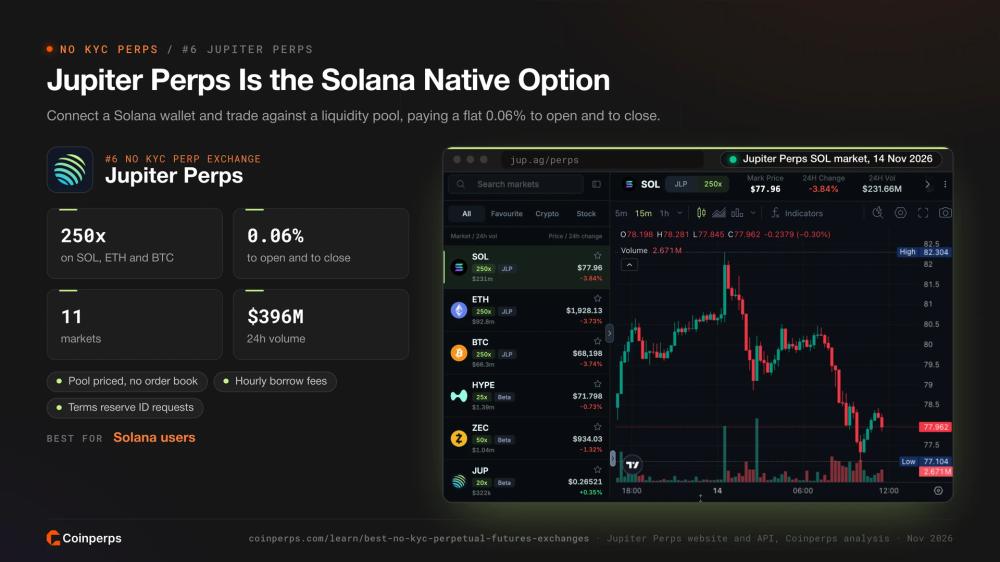
If your assets already sit on Solana, Jupiter Perps is the best no KYC perpetual venue for you. A Solana wallet is all it takes to trade SOL, ETH or BTC against a shared liquidity pool at up to 250x.
There is no order book on the main markets. Trades execute at an oracle price against the pool, which keeps entry simple and removes the risk of a thin book. Those three markets traded about $396 million in 24 hours when we checked, and SOL led with $234 million. Eight newer order book markets add coins such as ZEC, BNB and HYPE at 20x to 50x.
Costs are higher than on the venues above. The fee schedule charges 0.06% to open and again to close. Larger trades pay a price impact fee on top, and an hourly borrow fee applies to the full position. Borrow fees keep accruing for as long as a position stays open.
Jupiter also runs a separate product with 500x to 1000x leverage, where profit is capped at 25 times collateral. Fiat purchases go through third-party processors that handle their own ID checks. The terms we could read are dated September 2024. They reserve the right to request identity documents and exclude the United States and Singapore among others.
优点
- Solana native: trade from a Solana wallet with no bridge.
- Simple execution: oracle pricing against a pool, with 250x on SOL, ETH and BTC.
- Built-in on-ramp: third-party card and bank purchases sit inside the same app.
缺点
- Higher costs: 0.06% each way plus price impact and hourly borrow fees.
- Few markets: 11 in total, against hundreds elsewhere.
- ID rights reserved: the terms allow Jupiter to request identity documents.
What a No KYC Perpetual Futures Exchange Is
A no KYC perpetual futures exchange lets you trade leveraged contracts without uploading a passport, a selfie or proof of address. KYC stands for know your customer. It refers to the identity checks that global anti-money laundering standards require financial firms to run.
Perpetual futures track an asset's price and never expire. They stay close to the spot price because long and short traders exchange a funding payment, which our funding rates page shows live. Our comparison of perps and spot trading explains the product.
Tiered Centralised Accounts
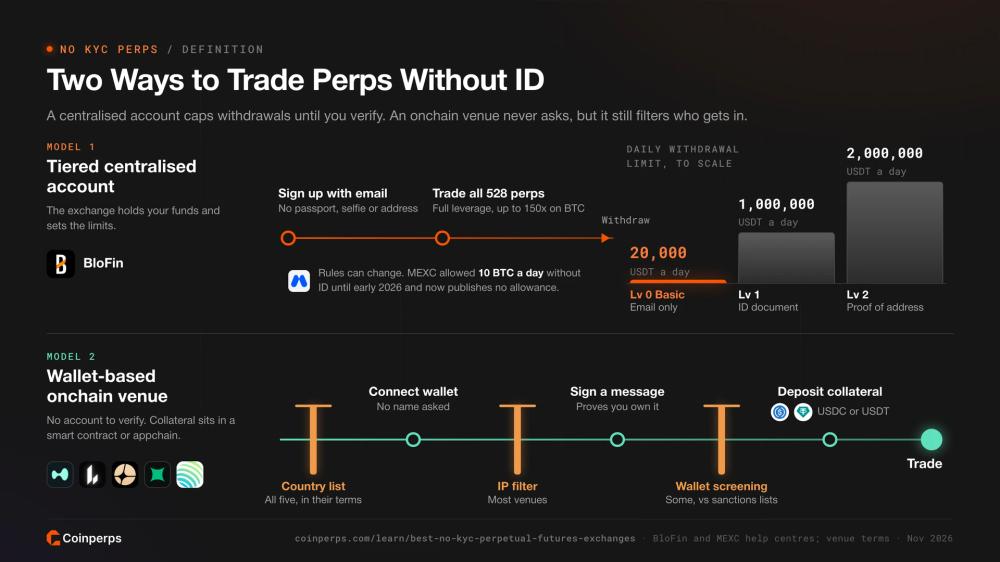
A centralised exchange holds your funds and keeps an account for you. In the no KYC version, that account can trade after an email sign-up, but withdrawals are limited until ID is supplied. BloFin works this way, with a 20,000 USDT daily allowance at the unverified level.
What an unverified account can do remains the exchange's decision, and the answer can change. Until early 2026 MEXC allowed 10 BTC of daily withdrawals without ID. It no longer publishes any unverified allowance.
Wallet-Based Onchain Venues
An onchain venue has no account to verify. You connect a wallet, sign a message and deposit collateral into a smart contract or a purpose-built blockchain. Hyperliquid, Lighter, Aster, Extended and Jupiter Perps all work this way, and none asks for a name.
Each one still blocks certain countries in its terms. Most filter by IP address, and some screen wallets against sanctions lists. How the two models differ on custody and execution is covered in our perp DEX and CEX comparison.
How No KYC Exchanges Compare on Cost, Depth and Leverage
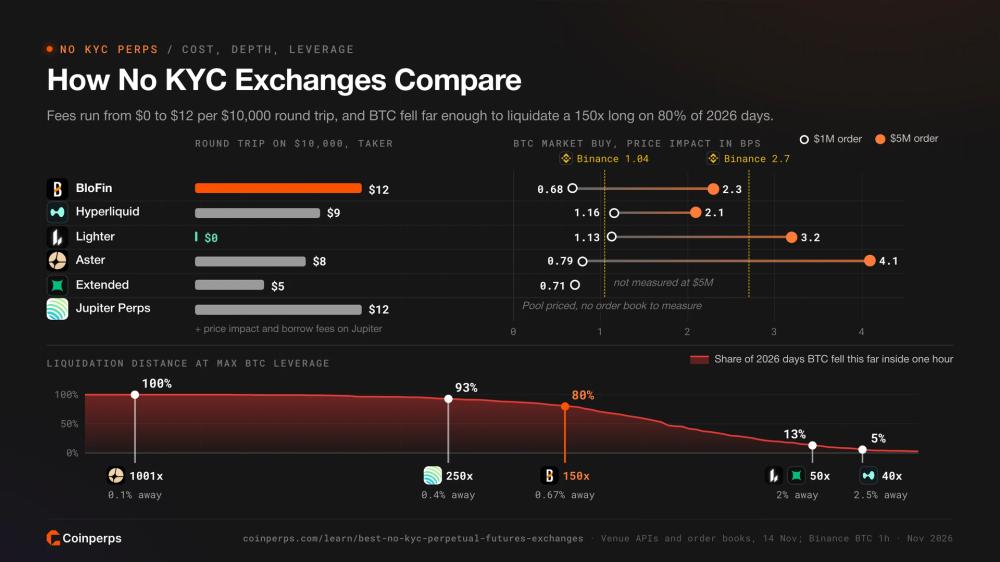
Once you know a platform accepts you, cost and liquidity should drive your choice, because the six venues differ far more there than on access. We measured all three on 14 November 2026.
Trading Costs
At entry level, fees range from nothing to 0.12% per round trip. The table shows what the two taker fees add up to on a $10,000 position opened and closed with market orders.
交易所 | Round-trip taker cost on $10,000 | 备注 |
|---|---|---|
 更轻 | 0美元 | Standard account; 300 ms taker delay |
| Extended | 5美元 | 0.025% each way |
 Aster | 8美元 | 0.04% each way; $2.50 on stock and commodity perps |
 Hyperliquid | 9美元 | 0.045% each way before HYPE staking discounts |
| BloFin | 12美元 | 0.06% each way; 0.05% from VIP 1 |
| Jupiter Perps | 12美元 | 0.06% each way; price impact and borrow fees extra |
Every venue adds funding payments and spreads on top. Limit orders are cheaper, and four of the six charge makers nothing. For a wider view, see our list of the lowest fee perpetual exchanges.
Order Book Depth
Depth decides what a market order costs. We sampled each BTC perpetual book three times on 14 November 2026 and measured how far a market buy moved the price from the midpoint.
A $1 million order moved the price 0.68 basis points on BloFin, 0.71 on Extended, 0.79 on Aster, 1.13 on Lighter and 1.16 on Hyperliquid. Binance came in at 1.04 at the same moment. One basis point is 0.01%. In money terms, every venue filled $1 million of BTC for a price impact of roughly $70 to $120.
Larger orders change the ranking. At $5 million Hyperliquid had the smallest impact at 2.1 basis points, ahead of BloFin at 2.3, Binance at 2.7, Lighter at 3.2 and Aster at 4.1. These snapshots cover BTC only, and altcoin books are far thinner on every platform.
Leverage and Liquidation Distance
Maximum leverage tells you how small a move wipes out your margin. At 40x, Hyperliquid's BTC limit, the price must move about 2.5% against you. The distance shrinks to 0.67% at BloFin's 150x and to 0.4% at Jupiter's 250x. At Aster's 1001x it is 0.1%.
We ran Binance's hourly BTC futures candles for 2026 against those distances. The price fell at least 0.67% inside a single hour on 255 of 317 days, or 80% of them. A fall of 2.5%, the distance at 40x, happened on 17 days. To see where leveraged positions are clustered, use the liquidations page and the Bitcoin liquidation heatmap.
Why Most Centralised Exchanges Now Require KYC
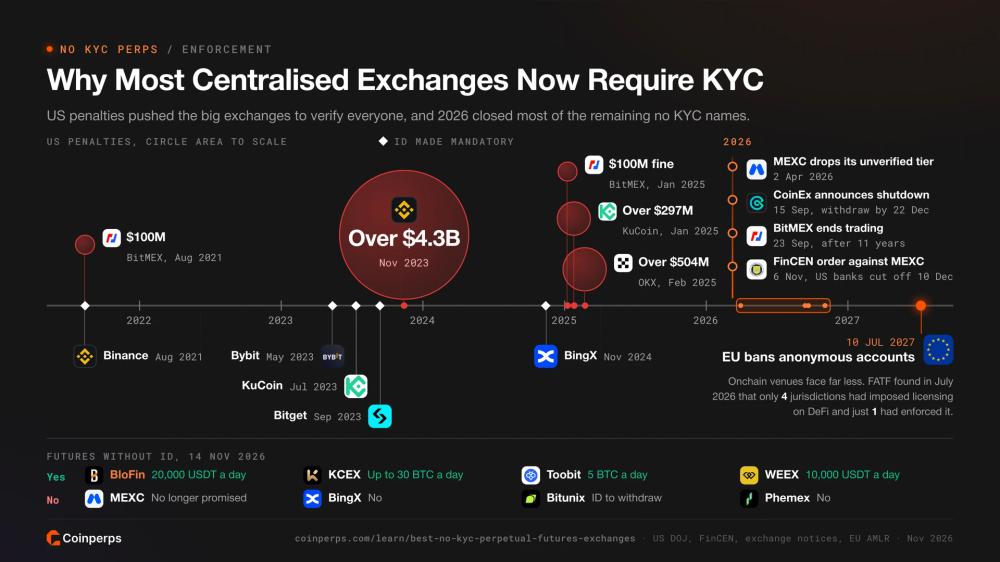
If you used a no KYC futures exchange a few years ago, it has probably asked for your ID since. Regulators prosecuted the largest ones for skipping identity checks, which is why BloFin is now an exception.
The Enforcement Record
US authorities charged four of the biggest email-only derivatives venues with the same offence. BitMEX paid $100 million in 2021, then a further $100 million fine in January 2025. Binance pleaded guilty in November 2023, and its penalties came to more than $4.3 billion.
KuCoin pleaded guilty in January 2025 and agreed to pay more than $297 million. According to prosecutors, until at least July 2023 it "did not require customers to provide any identifying information". In February 2025, OKX agreed to more than $504 million in penalties.
Each exchange switched to mandatory verification before or as part of its settlement. Binance did so in August 2021, Bybit in May 2023, KuCoin in July 2023 and Bitget in September 2023.
Where the Remaining Names Stand
A second wave in the past two years removed most of the exchanges older guides still recommend. We checked each one's own help centre on 14 November 2026.
交易所 | Futures without ID? | Unverified withdrawals | 状态 |
|---|---|---|---|
| BloFin | 是 | 20,000 USDT a day | Table dated 6 March 2026 |
 KCEX | 是 | Up to 30 BTC a day | Per its own blog; operator not disclosed |
 Toobit | 是 | 5 BTC a day | Page dated 1 August 2025 |
 WEEX | Yes, as reported | 10,000 USDT a day | Cut from 500,000 USDT in April 2025 |
 MEXC | No longer promised | None published | Unverified tier removed 2 April 2026 |
 BingX | 无 | 20,000 USDT a day | Unverified accounts cannot deposit or trade |
 Bitunix | 无 | 无 | ID needed to withdraw |
 Phemex | 无 | 0 USDT | ID needed to trade and withdraw |
KCEX, Toobit and WEEX still allow futures without ID, but they do not document operator, reserves and limits as clearly as BloFin, so we left them out of the ranking. India's financial intelligence unit named Toobit, WEEX and Bitunix alongside BloFin in its September 2026 notice.
MEXC is the biggest change. Its own guide now says it requires KYC, and access for unverified accounts depends on region. On 6 November 2026 the US Treasury's FinCEN named MEXC a primary money laundering concern, an order that bars US financial institutions from sending or receiving funds involving it from 10 December 2026.
Two long-running exchanges have closed. BitMEX ended trading on 23 September 2026 after 11 years and said the decision was not linked to legal or regulatory issues. CoinEx announced its shutdown on 15 September 2026. Its users must withdraw by 22 December 2026.
接下来会发生什么
From 10 July 2027 the EU's anti-money laundering regulation bans crypto providers from keeping anonymous accounts. Providers of self-hosted wallets are exempt where they have no control over the wallet.
Onchain venues face far less today. The Financial Action Task Force's July 2026 update found that only four jurisdictions had imposed licensing on decentralised finance arrangements. Just one had ever enforced. The report called this "an increasingly significant gap".
Meanwhile the US is bringing perpetuals onshore with ID checks attached. Its derivatives regulator approved the first US Bitcoin perpetual in May 2026 and cleared single-stock perpetuals in November. Our perpetual futures regulation guide follows each country.
How Private No KYC Perp Trading Really Is
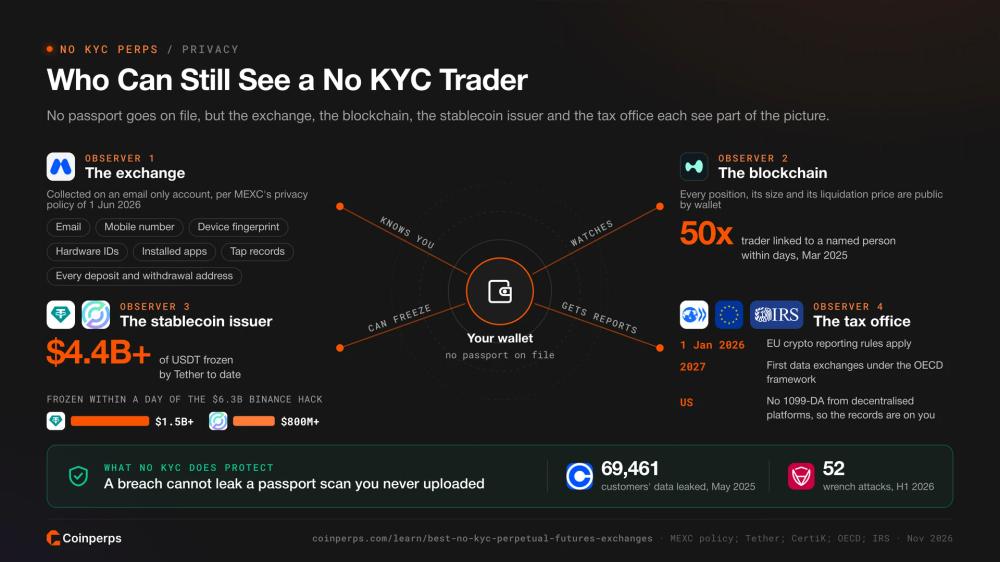
Trading without KYC keeps your passport out of an exchange's database, but it does not make you anonymous. Part of the picture is still visible to the exchange, and other parts to the blockchain, the stablecoin issuer and the tax office.
What the Exchange Still Knows
An email-only account still generates data. MEXC's privacy policy, updated on 1 June 2026, lists what the exchange collects. The list includes email address, mobile number, device fingerprint, hardware identifiers, installed apps and tap records. Every deposit and withdrawal address is logged too.
A court order can force that record to be handed over, and the exchange can ask for ID later. The privacy gain is narrower. A breach cannot leak a passport scan you never uploaded.
Coinbase disclosed in May 2025 that bribed support agents had leaked the personal data of 69,461 customers. In the first half of 2026, security firm CertiK counted 52 violent "wrench attacks" on crypto holders. It says attackers build target lists from leaked databases and exchange records.
Public Onchain Positions
Onchain venues ask for no name and publish everything else. Look up a wallet address on Hyperliquid and you can see each position, its size and its liquidation price. In March 2025 a trader made millions on 50x positions there. Within days an investigator had linked the wallet to a named person.
One identified transaction is usually enough to label a wallet. It might be a withdrawal from a verified exchange, a card purchase or a payment to someone who knows you. CertiK lists onchain activity among the sources attackers use, so a large visible position carries its own risk.
Wallet Screening and Stablecoin Freezes
Margin on almost every venue is USDT or USDC, and both issuers can freeze tokens in any wallet. Tether says it has frozen more than $4.4 billion in USDT while working with law enforcement in 65 countries.
Hackers took about $6.3 billion from Binance on 29 October 2026. Within about a day, Tether had frozen more than $1.5 billion and Circle more than $800 million. The GENIUS Act now requires licensed US stablecoin issuers to keep that ability.
Venues screen wallets too. Extended's terms allow it to refuse a wallet that fails a transaction risk check, and in June 2026 users reported Hyperliquid's interface restricting wallets with indirect links to a sanctioned exchange. Coins received from a flagged source can lock you out without anyone asking your name.
Tax and Reporting
Skipping KYC does not change what you owe. In the US, decentralised and non-custodial platforms are not required to issue the 1099-DA tax form, so the record-keeping falls to you.
For centralised firms, automatic reporting is widening. The OECD's crypto reporting framework has its first exchanges of data in 2027. The EU's equivalent rules have applied since 1 January 2026.
How to Fund a No KYC Futures Account
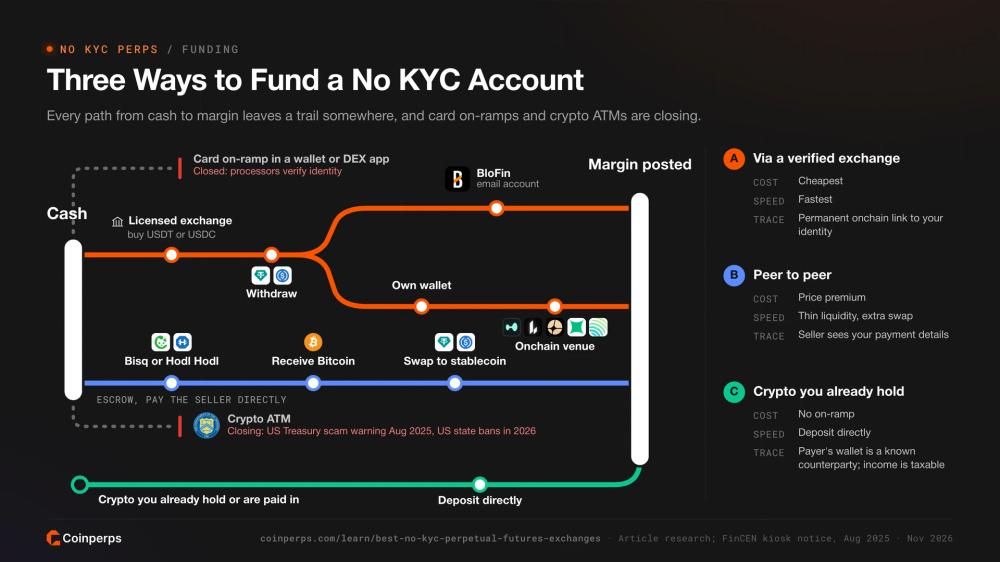
Funding is where most traders lose the privacy they were looking for, because turning money into crypto almost always involves a verified service.
From a Verified Exchange
Most people buy USDT or USDC on a licensed exchange and withdraw it. From there the coins go to BloFin, or to your own wallet and on to an onchain venue. It is the cheapest and fastest path, and our Hyperliquid deposit guide shows the steps.
Because the withdrawal is recorded onchain, the link between your identity and your trading wallet is permanent. That is usually acceptable for traders whose aim is to keep documents off a derivatives platform.
Peer-to-Peer
Buying from another person avoids an exchange account. Bisq, Hodl Hodl and similar services hold the crypto in escrow while you pay the seller directly. Most of what they sell is Bitcoin, which you would still need to swap into a stablecoin before posting margin.
Prices carry a premium and liquidity is thin. The seller also sees your payment details. Our guide to the best P2P crypto exchanges compares the larger platforms, most of which require ID.
Crypto You Already Hold
If you are paid in stablecoins or already hold crypto in your own wallet, you can deposit directly. No on-ramp is involved. The payer's wallet is still a known counterparty, though, and the income is taxable.
Other options are closing. Card purchases inside wallets and DEX apps go through processors that verify identity. Crypto ATMs are being restricted. The US Treasury issued a warning about scam payments through kiosks in August 2025, and several US states banned them in 2026.
Where No KYC Exchanges Are Restricted
Every venue on this list blocks some countries, so no KYC never means open to everyone. The block is written into the terms you accept and is usually enforced by IP address.
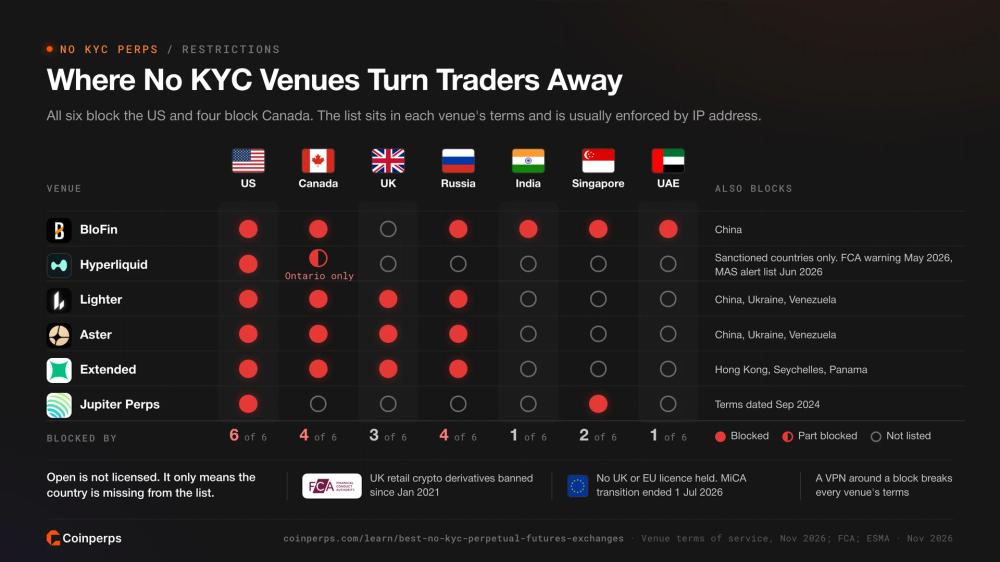
交易所 | 美国 | 加拿大 | United Kingdom | Other notable blocks |
|---|---|---|---|---|
| BloFin | 受限 | 受限 | 开盘 | China, India, Russia, Singapore, UAE |
| Hyperliquid | 受限 | Ontario only | 开盘 | Sanctioned countries |
| 更轻 | 受限 | 受限 | 受限 | China, Russia, Ukraine, Venezuela |
| Aster | 受限 | 受限 | 受限 | China, Russia, Ukraine, Venezuela |
| Extended | 受限 | 受限 | 受限 | Hong Kong, Russia, Seychelles, Panama |
| Jupiter Perps | 受限 | 开盘 | 开盘 | 新加坡 |
"Open" only means the country is absent from the venue's restricted list. No exchange in the table holds a licence in the UK or the EU.
United States and Canada
All six venues exclude US residents. Americans now have regulated perpetuals with full ID checks, and our guide to using Hyperliquid in the USA explains the position. Four of the six block Canada. What remains there is covered in the Canadian futures guide.
United Kingdom and European Union
UK rules have banned the sale of crypto derivatives to retail customers since January 2021, whatever a venue's terms say. EU residents lost access to unlicensed firms when the MiCA transition ended on 1 July 2026. The securities regulator ESMA had already said in February 2026 that perpetuals are likely to count as contracts for difference.
None of the venues here appears on our MiCA licensed exchanges list. The regulated alternatives are ranked in the European perpetuals guide.
VPNs and Your Own Liability
Using a VPN to get around a block breaks the terms of every venue here. Hyperliquid, Aster and Extended prohibit it in writing, and an exchange that detects it can freeze the account. The Financial Action Task Force lists offshore platforms that coach users to use VPNs among the abuses regulators should act on.
In most countries, trading without KYC is not an offence in itself, and enforcement so far has targeted operators. Tax, sanctions rules and the terms you accepted all remain your responsibility.
Risks of Trading Perps Without KYC
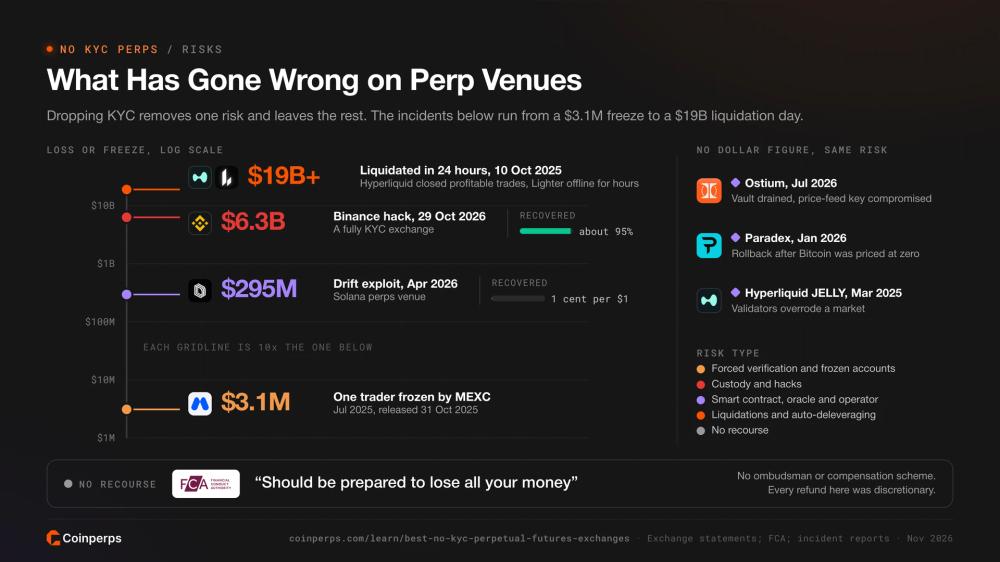
No KYC venues remove one risk, the exposure of your identity documents, and add several others.
Forced Verification and Frozen Accounts
An exchange that lets you in without ID can still demand it on the way out. In July 2025 MEXC froze about $3.1 million belonging to one trader under its risk control rules. The funds were released on 31 October after a public campaign. A senior executive apologised and promised a faster dispute process.
BloFin's terms give it similar powers, including freezes for "unusual activities" and requests to prove the source of funds. We found no documented case of BloFin doing this at scale. Keeping balances modest and withdrawing regularly within the daily limit is the practical defence.
Custody and Hacks
Funds on a centralised exchange belong to the exchange until you withdraw them, and KYC does not reduce that risk. The largest theft in crypto history, about $6.3 billion on 29 October 2026, hit Binance, an exchange that verifies every customer.
Binance covered about 95% of that loss from its own reserves, which a smaller unlicensed exchange may be unable to do. A published proof of reserves and an outside custodian matter for that reason.
Smart Contract, Oracle and Operator Risk
Onchain venues swap custody risk for technical risk. Drift, a Solana perpetuals exchange, lost about $295 million in April 2026, and its recovery token redeems for about one cent per dollar lost. Ostium's liquidity vault was drained in July 2026 through a compromised price-feed key.
Operators can also step in. After an error priced Bitcoin at zero and liquidated traders in January 2026, Paradex rolled back its blockchain. Hyperliquid's validators overrode a market in the JELLY episode.
Liquidations and Auto-Deleveraging
On 10 October 2025 more than $19 billion of positions were liquidated across the market in 24 hours. Hyperliquid closed profitable trades through auto-deleveraging that day, and Lighter was offline for hours.
How exchanges choose which positions to close is explained in our guide on how to avoid auto-deleveraging.
无追索权
No ombudsman, compensation scheme or regulator stands behind any venue on this list. Every refund described above was paid at the platform's discretion.
The UK's FCA tells consumers that anyone buying crypto "should be prepared to lose all your money". Of the exchanges it named in September 2026, India's finance ministry said there may be no regulatory recourse for any loss.
总结
BloFin is the best no KYC perpetual futures exchange for most traders. No other large centralised venue still documents email-only futures trading, and it comes with 528 markets, 150x on BTC and ETH and 20,000 USDT of daily withdrawals.
For traders who prefer to hold their own funds, Hyperliquid has the deepest onchain books and Lighter charges no fees. Aster offers the longest market list. Extended focuses on stock and commodity contracts, while Jupiter Perps serves Solana users.
Whichever you choose, confirm that your country is permitted and keep leverage well below the maximum. Treat no KYC as a policy that can change. Live volume, fees and open interest can be compared on our perpetual exchanges hub and the decentralised perpetual exchange rankings.


