HTX Restricted Countries List 2026: Bans, Licenses & Alternatives
HTX widened its blocked map days before the MiCA deadline, adding all 27 EU states to its full-service ban instead of licensing like its rivals. Here is the 2026 list, why it changed, and where to trade if you are locked out.

Disclosure: Coinperps may earn a commission from partner links, at no extra cost to you. Reviews are based on independent testing, see how we test.
- HTX now blocks the entire European Union from every service, a change that landed alongside the July 1, 2026 MiCA cutoff. Added to long-standing bans on the US, mainland China, Hong Kong, the UK, Singapore and several sanctioned states, the full-service list nears 40 jurisdictions once the EU bloc is counted.
- A separate, shorter list blocks only derivatives. Traders in Taiwan, Israel, New Zealand and a few other markets keep spot access, but perpetuals and futures are switched off.
- KYC is mandatory and the licence stack is thin. Identity checks gate funding and withdrawals, while HTX holds a VARA registration in Dubai plus a handful of smaller approvals, but no MiCA CASP licence and no US entity, leaving it behind OKX, Bybit, Kraken and Coinbase.

HTX
HTX, founded in 2013 and rebranded from Huobi, is a global exchange backed by Justin Sun, offering 700+ assets, 200x futures leverage, and $680M in daily volume.
Features
Fees
Regulation
Overall
Where you can trade HTX changed more in June 2026 than at any point since the Huobi rebrand. HTX rewrote the restricted clause in its user terms to wall off the whole European Union, joining MEXC and other unlicensed venues that judged a MiCA licence more expensive than the EU market itself.
This guide separates HTX's sanctions blocks from the licensing-driven ones, covers the fresh EU exit and the still-closed US market, and points you to a venue that fits your jurisdiction. Where a restriction touches your money or legal standing, we link the primary source.
List of HTX Restricted Countries
HTX names the jurisdictions it will not serve in clause 1.2 of the HTX Platform User Agreement, titled "Restricted Jurisdictions." The clause splits into two tiers: places barred from everything, and places barred only from derivatives. HTX can revise it without notice, so the live terms override any third-party list, including this one.
Prohibited from all HTX services:
- North America and sanctioned states: The United States, Cuba, Iran, North Korea, Sudan, Syria and Venezuela, where exclusion follows OFAC and UN sanctions rather than any HTX business decision.
- Greater China: Mainland China and Hong Kong, reflecting the mainland's 2021 exchange ban and Hong Kong's separate licensing regime, which HTX abandoned after pulling its application in 2024.
- Other named markets: The United Kingdom, Italy, Singapore and Myanmar.
- The European Union: All 27 member states, listed individually from Austria and Belgium to Spain and Sweden, plus any future EU entrant.
Prohibited from derivatives only:
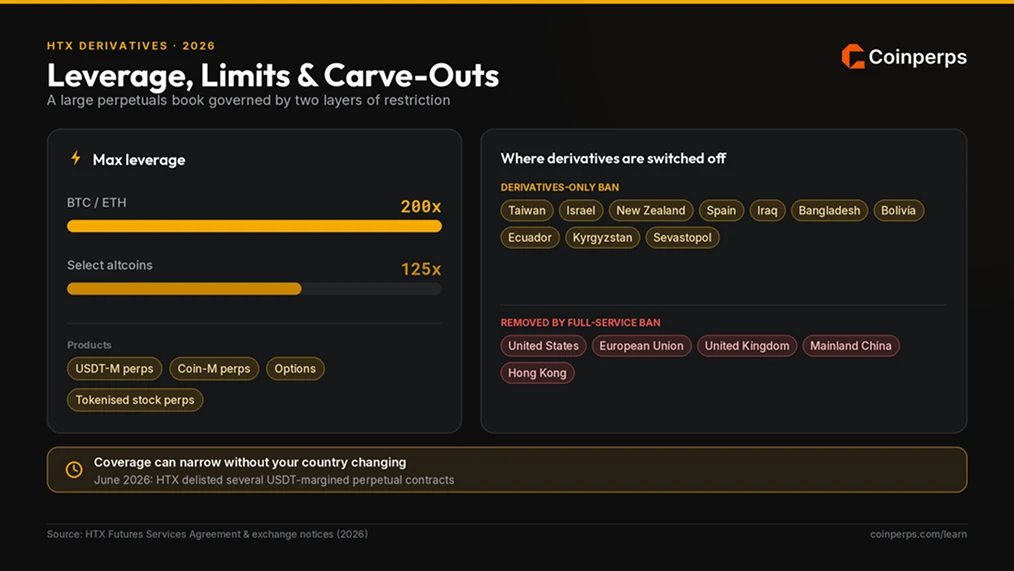
- Taiwan, Israel, Iraq, Bangladesh, Bolivia, Ecuador, Kyrgyzstan, Sevastopol, Spain and New Zealand keep spot access, but perpetual and futures products are blocked.
Counted together, the full-service bans approach 40 jurisdictions once the EU bloc joins the named list, a figure that has climbed steeply this year. The sanctions entries rarely move. The ones that shifted in 2026 came from financial regulators, and the EU is the clearest case.

How the MiCA Deadline Forced HTX Out of the European Union
A fully verified HTX user in Germany, France or the Netherlands now finds every service switched off. Without a MiCA licence, HTX can no longer legally serve EU clients, and the cutoff reaches tens of millions of users at once.
The Markets in Crypto-Assets regulation requires any platform serving EU clients to hold a CASP licence from at least one member state by July 1, 2026, with that single authorisation then passporting across the bloc. The European Securities and Markets Authority confirmed in April 2026 that the deadline is firm, with no extension and orderly wind-down expected from unlicensed firms.
HTX did not apply. It folded the entire EU into the all-services ban in its user terms, landing in the same camp as MEXC and other derivatives-heavy venues that chose exit over compliance. The exchanges that stayed went the other way. Bybit secured a MiCA authorisation (FN 636180i), while Kraken, OKX, Coinbase and Crypto.com hold passportable licences that keep European clients trading.
Leveraged products carry the heaviest compliance load, so regulators carve them out first, and when a venue writes off a whole region, spot disappears alongside derivatives. European HTX users now need a licensed home, and our guide to the best crypto perpetual futures exchanges in Europe maps the venues that stayed.

Countries Supported by HTX
Outside the restricted tiers, HTX runs as a single global platform across most of Asia, the Middle East, Latin America, Africa and parts of Oceania, with the full spot, margin, options and perpetuals stack open to verified users. It reports tens of millions of registered accounts and lists more than 700 assets, with fiat handled through cards, peer-to-peer trading and third-party gateways.
Representative supported markets include:
- Latin America: Brazil, Mexico, Argentina, Colombia and Chile, several covered by HTX's regional payment and remittance approvals.
- Middle East: The United Arab Emirates, home to HTX's strongest licence, plus Saudi Arabia and neighbouring Gulf markets.
- Asia: Japan, Vietnam, Indonesia, the Philippines, Thailand and Malaysia.
- Africa: Nigeria, South Africa and Kenya via local payment channels.
- Oceania: Australia, where HTX has pursued regulatory cooperation, while New Zealand keeps derivatives off the table.
Fiat coverage does not guarantee perpetuals access, since HTX tailors products market by market and the derivatives carve-outs apply on top. Check your jurisdiction against the live agreement before funding an account.
HTX Derivatives Trading Restrictions
HTX runs a large derivatives book of USDT-margined and coin-margined perpetuals, options, and the tokenised stock contracts that appeared in mid-2026 promotions. Leverage reaches up to 200x on Bitcoin and Ethereum and 125x on selected altcoins, governed by the HTX Futures Services Agreement inside the main terms.
Two layers apply. The derivatives-only ban strips futures from residents of Taiwan, Israel, New Zealand and the markets listed above, even where spot stays open. The full-service bans then remove derivatives entirely for the US, the EU, the UK, mainland China, Hong Kong and the sanctioned states, with the UK case driven by the FCA's ban on selling crypto derivatives to retail consumers that predates HTX's wider exclusion.
Availability also moves on HTX's own initiative. It delisted several USDT-margined perpetuals in June 2026, a reminder that contract coverage in a supported country can narrow without your jurisdiction changing. Traders comparing venues can sort the field through the perpetual exchanges directory, live funding rates and the perp DEX versus CEX breakdown.
Is HTX Banned in the US?
Yes. The United States sits on the all-services list, so residents cannot register, deposit, trade spot or futures, or use fiat rails on HTX. The block is structural. Serving US derivatives traders legally takes CFTC registration plus FinCEN money services registration and state money transmitter licences, none of which HTX holds.
The backdrop is shifting even if the ban is not. In March 2026 the SEC settled its long-running case against Justin Sun and the Tron entities, with a Sun-affiliated company paying a $10 million penalty and all claims against Sun himself dismissed with prejudice and no admission of wrongdoing. That lifted a legal cloud over HTX's most visible backer since 2023, and Sun has since voiced interest in building in the US.
A cleared founder is not a US licence. HTX has floated re-entry before without a concrete regulated pathway, so American traders should treat it as closed and look to domestic venues. The risks of chasing offshore access sit in our how to use MEXC in the USA guide, while the Coinbase Perpetuals and Kraken restricted countries breakdowns cover the CFTC-registered options that serve US clients.
Does HTX Require Mandatory KYC Verification?
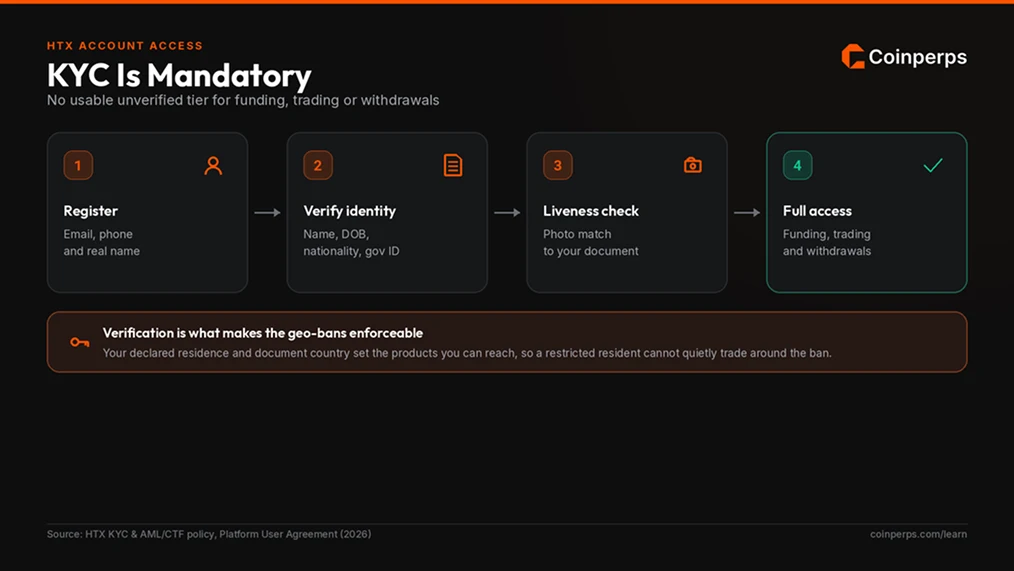
Yes. HTX gates full access behind Know Your Customer checks, collecting your name, date of birth, nationality, a government ID and a photo verification before unlocking funding, trading and withdrawals at normal limits. The terms tie these checks to AML and counter-terrorism-financing rules and let HTX request notarised document translations where needed.
Verification is what makes the geographic bans enforceable. Your declared residence and document country set the products you reach, so a user in a restricted region cannot quietly pass identity checks with local papers and trade as if the ban were not there. Skipping verification caps activity and, for restricted residents, closes the door. Anyone weighing HTX against optional-verification venues should read the best no-KYC perpetual futures exchanges ranking, since the two models sit at opposite ends of the spectrum.
What Licenses Does HTX Have?
HTX has built a regulatory footprint over the past two years, though it is uneven and skips the authorisations that define the current frontier in Europe and the US. The Dubai registration is the strongest, covering a major market under a purpose-built virtual asset regulator.
The gaps matter more than the entries. With no MiCA CASP licence, HTX cannot legally serve the EU after July 1, 2026, the direct reason the bloc joined its banned list, and with no US entity the American market stays shut. UK users also get no Financial Services Compensation Scheme cover, since the FCA does not register HTX.
On transparency, HTX publishes a monthly Merkle Tree Proof of Reserves and reports reserve ratios at or above 100% across major assets, though that disclosure does not replace the missing licences.

Can You Access HTX With a VPN?
Not in any way that holds up. A VPN can change the IP you connect from, but not the country tied to your verified identity, and that mismatch is what compliance systems flag. Because KYC binds your account to a government document and a declared residence, a restricted-region user who passes verification with local papers still cannot reliably move funds in or out without tripping a review.
The downside is concrete. HTX can suspend an account it later flags as a restricted resident, freeze the balance, and move it into a wind-down window under the terms you accepted at signup. A trader who dodges the geoblock has no consumer-protection recourse if something goes wrong, and an unauthorised venue does not erase local tax reporting.
The genuinely permissionless path is on-chain, covered in the decentralized perpetual exchanges directory and the Hyperliquid restricted countries guide.
Best Alternatives if HTX Is Unavailable in Your Country
The right substitute depends on whether you want a licensed local venue, an offshore high-leverage product, or non-custodial perpetuals. The table below ranks the venues that cover the regions HTX cannot.
European Union and the United Kingdom
This is where the gap bites hardest. Bybit (MiCA FN 636180i), Kraken and OKX hold passportable MiCA licences and keep European users in regulated perpetuals, with regional detail in the best crypto perpetual futures exchanges in Europe guide. UK retail traders stay blocked from leveraged crypto by the FCA, so on-chain venues are the usual workaround.
United States
Kraken and Coinbase offer CFTC-regulated perpetuals to eligible US clients through licensed entities HTX cannot match. The Coinbase Perpetuals restricted countries guide covers eligibility by state and product.
Asia, the Middle East and Latin America
Bybit and OKX run the deepest order books outside the largest venue, both carrying VARA registrations in Dubai and serving most markets where HTX operates. For lighter verification offshore, BloFin leads the optional-KYC category, detailed in the BloFin restricted countries guide.
Non-custodial and cost-optimized
To step outside geofencing, Hyperliquid settles perpetuals through its own on-chain order book and leads decentralized volume, though it still excludes US residents. The lowest fee crypto perpetual exchanges ranking sorts the field by maker and taker rates.
Confirm local licensing before depositing anywhere. Compliant access protects both your balance and your tax position.
Bottom Line
HTX's restricted list reads like an offshore exchange that outgrew its licence stack, with the bill now coming due region by region. The sanctions blocks on the US, Iran, North Korea and others are permanent and tied to international law. The newer limits are regulatory, and the European Union is the headline, with HTX banning all 27 states rather than meeting MiCA's licensing bar.
That choice separates HTX from the exchanges pulling ahead. Bybit, Kraken, OKX and Coinbase invested in MiCA and US authorisations and kept those markets open, while HTX and MEXC judged them too costly to license. The Sun settlement lifted a legal weight off the brand and the Proof of Reserves reporting is real, but neither changes the fact that two of the world's largest trading blocs are now shut to HTX users.
For traders in a supported country, HTX stays a deep derivatives venue with mandatory KYC as the entry cost. For anyone in the EU, the US, the UK or another restricted region, the alternatives above are the cleaner path, and the perpetual exchanges directory plus live open interest and funding rates trackers map the venues that serve your market.
Frequently Asked Questions
Is HTX banned in the entire European Union?
Yes, under its 2026 terms. HTX added all 27 EU member states to the list of jurisdictions barred from every service, a move tied to the July 1, 2026 MiCA licensing deadline. Because it holds no MiCA CASP authorisation, HTX cannot legally serve EU clients, so spot, derivatives and fiat are all closed to European residents, not just leveraged products.
What happens to my HTX account if my country becomes restricted?
HTX's terms let it suspend or close accounts from restricted jurisdictions, usually with a notice period and a wind-down window to cancel orders, close positions and withdraw your balance. Timelines sit at HTX's discretion, so once your region is added, the safer move is to withdraw to self-custody or a supported venue promptly.
Can I use HTX derivatives in countries like Taiwan or New Zealand?
No. Taiwan, Israel, New Zealand and several other markets sit on HTX's derivatives-only restricted list, which blocks perpetual and futures trading while usually leaving spot open. The leveraged products are off regardless of account status, so traders there need a different venue for perpetuals.
Does HTX still operate in the US or plan to return?
HTX does not serve US residents and has no US-licensed entity. Regulated derivatives there would need CFTC registration plus FinCEN and state-level licensing, none of which HTX holds. The early-2026 settlement of the SEC case against Justin Sun removed a legal obstacle and Sun has voiced US ambitions, but no concrete pathway exists, so treat the market as closed.
Is HTX safe to use where it is available?
HTX publishes a monthly Merkle Tree Proof of Reserves showing reserve ratios at or above 100% on major assets, and it operates under a VARA registration in Dubai among other approvals. It is not licensed by the FCA, FinCEN or under MiCA, so users in many regions lack the protections those frameworks bring. As with any custodial exchange, weigh the reserve transparency against the thin licensing before committing real capital.